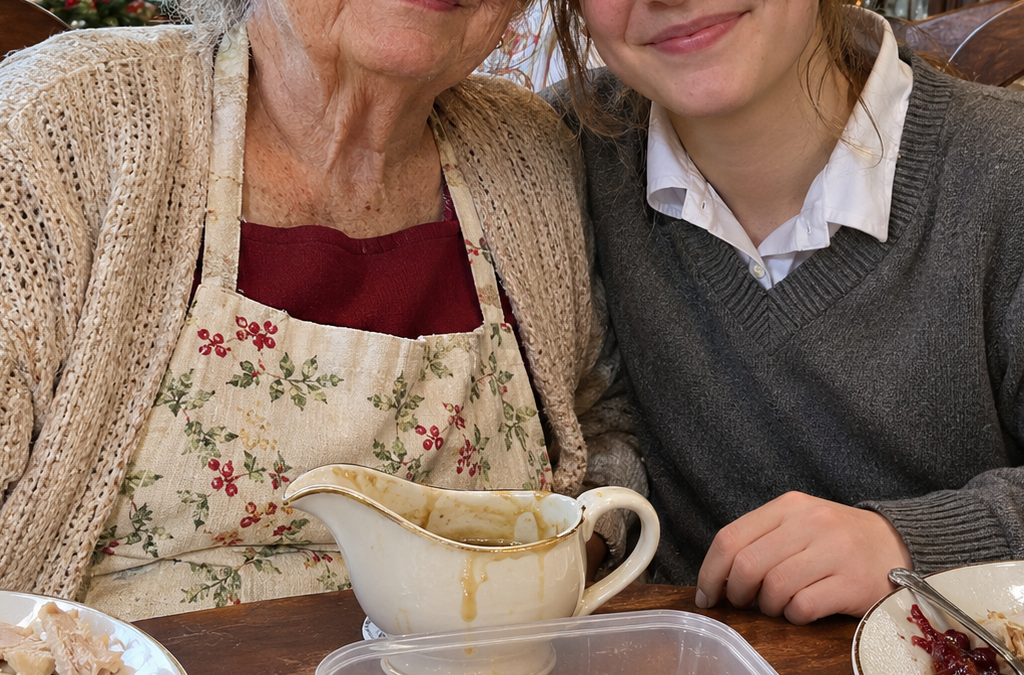
At Christmas dinner, my husband dropped my hearing aids into the gravy boat and said, “You hear plenty when money’s mentioned.”
Chapter 1 of 7
“Will you take them out, please?”
Mark exaggerated his mouth movements, the way he did when mocking me. Without the devices, ordinary table conversation reached me in scraps.
“You heard me well enough, Nora.”
One had squealed. I’d set both on a napkin and asked him to face me.
Gloria patted his wrist. “He’s trying to have a pleasant dinner.”
“Gloria, are you really defending this?”
“Don’t spoil Christmas over a little joke.”
Lily looked down beside her. My granddaughter was fifteen; Gloria was eighty-nine. Neither reached for them.
Paul shifted beside me, but I held up a hand. A blue folder lay open near Mark’s plate, a house photograph sticking out.
My name is Nora Ellis. I was sixty-nine, married to Mark Dalton for thirty-four years. Before retiring, I’d supervised a public-school cafeteria here in Dayton, Ohio. Feeding people had occupied most of my working life and nearly all my married one.
The home my grandson and his wife expected to occupy was my brother’s house.
Paul was seventy-two. He’d spent forty-one years building and repairing homes. His worn property file rested under his chair, brought because Mark wanted to discuss the cottage after dinner.
The rolls cooling on the table were my grandson’s favorites. Lily’s damp school scarf hung by the vent. Gloria’s turkey was already cut into pieces she could manage.
And my hearing aids were sinking into gravy.
My face burned. I had made excuses for him until everyone expected them. Paul’s phone lay beside his plate, briefly showing a list of saved messages before its screen dimmed.
Mark noticed me looking at the photograph. He drew the folder closer.
The porch in his blue folder belonged to my brother.
“Stop disrupting dinner and sit down properly,” Mark said.
He faced me squarely for that. I could follow his broad mouth movements and the familiar rhythm of an order.
“Take them out first,” I said.
Instead, he reached across the folder toward Paul. His mouth turned away. A few words reached me, something about finishing the house discussion.
Gloria leaned forward until I could see her face.
“Let him speak, Nora. We’ve all waited long enough.”
There was a bank contact card clipped inside the folder. Ruth Carter’s name was printed across it. Ruth worked at the branch where I did my banking.
I pointed toward the gravy boat. Mark shoved his chair back.
“STOP MAKING EVERYTHING ABOUT YOU!”
That reached me clearly. Lily flinched. The heat in my face spread down my neck.
“You did that so I couldn’t follow you?”
Mark looked straight at me again.
“I wanted you to stop interrupting dinner.”
His answer hurt more than the joke. He’d made sure I understood the insult, then turned away when the conversation mattered.
So I stopped serving. The potatoes remained beside my plate, with half the table still waiting.
“Then serve yourselves.”
I stepped into the adjoining hall. From there, I could still see Paul and the corner of Mark’s folder. Nobody followed immediately.
For years, I’d gone back into rooms like that carrying an apology. Usually it wasn’t mine to make.
This time I opened my phone’s live call captions. Reading helped when voices weren’t clear, especially over the phone. Then I dialed Ruth’s number from the card I could still see beside Mark’s plate.
We were eating early on Christmas Eve because Lily would spend Christmas Day with her parents. The bank was still open.
“Ruth, it’s Nora Ellis. I’m here with Paul.”
Her greeting appeared on my screen. Then another sentence followed, and I read it twice.
“I’ve been trying to reach him about the Maple Avenue property.”
“What do you need from him?”
“Direct confirmation about using his house as security for Mark’s business borrowing.”
My knees went weak against the hall wall. I hadn’t known the house had been discussed with the bank at all.
“Please speak to him yourself,” I said.
I returned to the dining room with the captions still running. Mark reached for the folder before I reached my chair. Paul looked from my screen to his face.
Paul stood. “That house isn’t yours to promise, Mark.”
He took my phone and switched it to speaker. I stayed beside him, where I could read the screen.
“This is Paul Ellis,” he said. “I own that property.”
Ruth checked his identity and the address with him. She kept her questions to the house. There was no discussion of Mark’s account balance or what his business owed.
Mark’s voice changed when he recognized hers. His shoulders dropped, and he leaned toward the phone.
“Ruth, glad we caught you. We’re discussing everything together.”
Then he turned to me, making each word visible.
“Stop interfering. You don’t know what we’ve arranged.”
But Paul hadn’t sat down.
“Nothing’s been arranged with my house,” he said. “Ask me directly, Ruth.”
Beside Gloria, Lily finally moved. She carried the gravy boat into the kitchen. When she returned, the devices were in a dry food container. She hadn’t rinsed them or tried to turn them on.
“Keep them safe for me, please,” I told her.
She nodded without looking at Mark. I wanted to touch her shoulder, but she went back to her seat.
Ruth’s next words appeared a little behind the sound. I watched them fill the screen while Mark began talking over her.
Paul asked him to let her finish.
“Mark told us you’d already said yes, Paul.”
Mark leaned closer to the phone.
“She means we’d talked about it. Paul knows.”
Paul answered Ruth, not him. “I haven’t given permission to use my house.”
Gloria pushed her plate away. She watched me as though I’d brought the bank into our dining room for entertainment.
“Tell her this got out of hand, Nora.”
I knew the words she wanted. Mark was tired. His work was difficult. We’d misunderstood each other. I’d supplied those explanations at birthdays, in driveways, and once outside Lily’s school.
“I’m not calling this a misunderstanding,” I said.
Mark stared at me. I was humiliated, standing beside a dinner I’d cooked while he waited for me to explain away what he’d done.
Ruth said she would speak directly with Paul after the holiday and check the property information. Paul gave her his number. The call ended without Mark getting the reassurance he kept requesting.
“You can stay with me,” Paul said.
He faced me when he spoke. There was room in his guest bedroom, he added. No rush about tonight.
“Thank you. I need a minute.”
I wasn’t ready to decide where I would sleep. Lily was watching, and the rolls were still warm. Those small things made leaving harder than I wanted to admit.
Mark had already moved on to the cottage.
“They’re expecting to move,” he said. “I got those repairs organized. Now you’re going to pull this?”
Paul remained beside his chair.
“They need to talk to me about the house.”
Gloria told him to think about the young couple. Mark picked up his phone and began typing. Mine buzzed before he’d finished.
He’d opened a family message thread. A sentence appeared beneath my name, blaming me for stopping the move. He wanted my grandson to read it while the Christmas food was still on the table.
Mark pushed his phone toward me. “Tell your grandson why his wife won’t have a home.”
Chapter 2 of 7
“Mark called it our wedding gift,” Evan told me over the phone. “He said we could move when the repairs were done.”
I’d called my grandson from the hall instead of answering through Mark’s screen. Claire, his wife, was beside him. Her words appeared in my call captions.
“We’ve already ordered packing boxes,” she said. “Did Paul not know?”
“He knew you needed somewhere to live. That’s different from giving you his house.”
Evan didn’t answer. At twenty-five, he’d believed a man who had been in our family his whole life.
“I won’t answer for Paul.”
But I offered to meet them with him after the holiday.
By Monday, we were standing inside the cottage on Maple Avenue. A bundle of flattened moving boxes lay across their back seat.
Claire had brought them because she’d expected to pack things Paul had stored in the kitchen. She’d even brought a marker to label what belonged to him.
Seeing that hurt. They’d come prepared to be helpful, certain the difficult decisions were already behind them.
Paul showed them the three bedrooms and the bathroom where the work had been finished. Evan paused over a furnace vent. Working in HVAC, he noticed airflow before fresh paint.
Claire lingered at the smallest bedroom.
“My desk would fit in here,” she said.
At twenty-four, she worked as a dental assistant and brought home study materials for additional training. In their apartment, she spread them across the kitchen table.
Paul waited until we returned to the living room.
“I’d considered renting it to you,” he said. “We never worked out terms. I didn’t offer to give it away.”
“Mark said it was settled,” Evan said.
“It wasn’t settled with me.”
Claire looked back down the hallway. I wanted to comfort her, but I couldn’t offer somebody else’s house to do it.
Mark arrived before we’d finished talking. He knew about the meeting and had insisted he belonged there.
“So you started without me.”
I wore a temporary clinic loaner. It helped me hear him without watching his face every second.
“Nora’s turning Paul against you,” he told Evan. “You know what this place needed before I got involved.”
Paul began to answer. Mark spoke over him.
“I organized the repairs. Everybody knew this house was for you.”
Evan glanced at the patched wall behind him, then at me.
“She’s making this harder than it needs to be,” Mark said.
I felt ashamed that my grandson had to stand there weighing my honesty against a place to live. Mark knew how badly they wanted it.
“The owner has to make his own offer,” I said.
There was nothing else I could promise them.
Paul’s phone rang while Mark was still arguing about the repairs. Ruth was returning his call from Buckeye Community Bank, open again after the holiday.
Paul asked whether he could put her on speaker. She agreed to discuss the ownership check with us.
“That requires the owner’s participation. I still need his direct answer about permission.”
“The records show you as the sole owner,” Ruth told him. “There’s no recorded mortgage against the cottage.”
Mark stepped closer.
“Which is what I’ve been saying. Nothing’s happened to his house.”
“Your statement alone can’t create a mortgage,” Ruth said. “That requires the owner’s participation. I still need his direct answer about permission.”
“I haven’t given permission,” Paul said.
She confirmed she would note that answer. The borrowing arrangement and Mark’s statement still needed review. She didn’t discuss his balances with us.
Relief left me tired enough to sit down. The house was still Paul’s, but that hadn’t stopped Mark from speaking for him.
Paul kept his property file beside him after the call. There were purchase records and repair receipts, the ordinary things he’d saved throughout forty-one years of building work.
He’d kept complete messages, too. Arguments over what a customer remembered had cost him money early on.
“One fellow remembered a whole extra bathroom,” he told Evan. “Same price, naturally.”
Evan gave a short laugh. It was the first easy sound he’d made all morning.
When Paul checked his phone afterward, I saw that Mark’s earlier contact was still there. He didn’t play it. I didn’t ask him to explain it in front of the others.
Before coming to the cottage, I’d arranged professional service for my own devices. The clinic would clean and inspect them and replace affected external parts as needed.
Nobody had promised they were unharmed. I’d almost said they were probably fine when making the appointment, then stopped myself.
Lily had wanted to stay with me after her Christmas visit with her parents. My daughter, Dana, had agreed, as long as she knew where we’d be.
“Is everything okay now?” Lily had asked me.
“Not yet, honey.”
Her disappointment hurt. For years, I’d used “fine” to end conversations she could tell weren’t finished.
At the cottage, Claire finally faced Mark.
“Can we see the paper saying Paul gave us the house?”
“You’ve seen the work I put into it.”
“I mean something from Paul. With his name on it.”
Evan stood beside her. Mark looked between them, waiting.
“You’re worrying about paper while I’ve got bills coming due,” he said. “This affects more than your move.”
Claire didn’t apologize. When they left, the boxes stayed in their car.
Paul remained to check a sticking window. I went back to the house I shared with Mark, dreading the sound of his truck in the driveway.
Before I got out of my car, my phone buzzed.
He’d sent a photograph of a business supplier invoice. The $24,300 balance was circled heavily, as though I’d somehow overlooked a bill that had never been mine.
Mark’s message beneath the invoice read, “You can explain this bill when the work stops.”
Chapter 3 of 7
“The supplier needs paying,” Mark said the next morning. “Use your savings.”
He was waiting in the kitchen when I came downstairs. The invoice lay beside the toaster, where he knew I would see it.
“My savings won’t cover that.”
“Then tell me what you’ve got.”
It embarrassed me to answer, although the money was mine. Years of setting aside small amounts had left me with a reserve for emergencies.
“$9,200. That’s all.”
“After everything I’ve paid for, you’re this ungrateful?”
He hadn’t asked what I might need it for. At sixty-nine, I had started worrying about expenses I couldn’t work extra shifts to cover.
“Ask Paul for the rest,” he said. “He’s the one holding everything up.”
“I’m not giving you my reserve. I’m not asking him, either.”
Mark looked at me as though I’d refused to help him up from the floor.
“You’re willing to watch my business go under?”
“I’m saying I won’t pay this bill.”
He began explaining the borrowing, talking faster whenever I tried to interrupt. The next $62,000 draw would cover the $24,300 supplier balance and $37,700 in ordinary project expenses. Materials, labor, work already promised.
“Borrowing keeps the jobs moving,” he said. “Selling things costs me work. You understand that much.”
I did understand. He had customers waiting and bills coming due. That frightened me, too.
But every explanation ended with something belonging to me or Paul.
“Then talk to the bank about your business.”
“I was doing that before you started making calls.”
The kettle clicked off behind him. Neither of us moved toward it.
For years, Mark had put cold toast back in the toaster until it came out like roofing shingles. I used to tease him about needing a permit for breakfast. That morning, he ate it standing up while watching me.
I missed being able to make that small joke. Missing it made me angry with myself.
Later, the clinic called about the service charge. Professional cleaning, inspection, and replacement of the affected external parts came to $240.
I paid with my own card. The temporary loaner let me hear the call, though I still asked the woman to repeat one sentence.
When she said the amount, my first thought had been to check what else Mark needed that week.
That habit frightened me more than the charge. Even this expense had nearly gone behind his in line.
Mark heard enough of my side to know who had called.
“You’re spending money on that while I’m trying to keep people working.”
“They needed professional service.”
“You always find money for yourself.”
I had never felt so small in my own kitchen. I kept the receipt in my email instead of explaining why I needed to hear.
He followed me into the hall when I called Paul.
“Stop discussing my business while you’re living under my roof.”
“Our home, Mark.”
“Then act like you belong here.”
I ended the call before Paul answered. My hands were shaking, and I didn’t want another conversation Mark could stand beside and correct.
Upstairs, I packed an overnight bag with clothes, my prescriptions, and a paperback I’d been reading for weeks. Leaving for a few nights didn’t mean I agreed the house was his alone. I wasn’t ready to settle anything beyond where I would sleep.
Paul answered my second call.
“Is the guest room still available?”
“Bed’s made. Come when you’re ready.”
Mark watched from the doorway as I carried the bag downstairs.
“Running to your brother won’t fix this.”
“I need somewhere I can finish a sentence.”
He didn’t offer to carry anything.
Paul’s guest room had a narrow bed and an empty closet. He showed me where the towels were, then left me alone. His ordinary kindness nearly made me cry.
Before I had unpacked, the family thread lit up.
“Did Paul ever actually agree to the bank using the house?”
Mark had written that plans for the cottage had been moving forward until I became upset at dinner. Now Paul was reconsidering, and the business and the young couple were paying for a private disagreement.
It sounded almost reasonable if you hadn’t been there.
Gloria replied that family matters should stay within the family. I felt humiliated all over again, reading her approval beneath his account.
Claire asked, “Did Paul ever actually agree to the bank using the house?”
Mark didn’t answer her question.
Paul knocked on the open door. Ruth had returned his call, and he asked whether I wanted to join them.
In his kitchen, Ruth explained that the bank held a declaration Mark had submitted about owner permission. It was separate from anything Paul might eventually sign.
“So telling you I object doesn’t take that back?” I asked.
“No. You can’t withdraw his statement for him.”
Paul would need to give his own account directly. Ruth needed to review what Mark had told the bank, not what I thought he ought to have said.
I was tired enough to resent another step. Saying no had felt difficult enough; now it seemed to have changed almost nothing.
Afterward, Paul said there might need to be a meeting.
“You can come if you want,” he said. “You don’t have to sit through it for me.”
“I don’t want you speaking for me.”
“All right.”
He let me sit with that answer. Then my phone buzzed again.
Mark posted, “Paul gave his word. Ask him what he said before dinner.”
Chapter 4 of 7
“I approved repairs,” Paul said. “I didn’t agree to give the house away or put it behind his borrowing.”
We were still in his kitchen, reading Mark’s message. I’d spent the night in the guest room and woken feeling like a visitor who’d stayed too long.
“Then he needs to hear that from you,” I said.
“He has.”
“I know. But I’m done carrying his questions back to you.”
That morning, I called Ruth and asked her to put the disputed claim directly to Mark. She said she could arrange a discussion at the branch if he agreed to attend.
He agreed quickly. That made me nervous. He still expected a conversation with me in it to end with someone helping him.
At the bank, Mark took the chair nearest Ruth’s desk. Paul sat beside me.
“Let’s get this cleared up,” Mark said. “I’ve got work waiting.”
Ruth had his blue folder on her desk beside the bank’s copy of his statement.
“This matches what we received from you,” she told him. She read the words “owner had agreed” and asked whether he stood by them.
The paper showed what Mark had told the bank. It didn’t show that Paul had actually given permission.
“Yes, with the understanding we’d finish talking as a family.”
“That isn’t what I asked,” Ruth said.
Mark leaned forward.
“I understood that he was helping us.”
I felt embarrassed for him, then resented how quickly that feeling came. He hadn’t shown any embarrassment when he asked for my savings.
Ruth gave him copies of Paul’s written confirmation and the bank’s ownership result. Paul remained the sole owner. There was no signed transfer, no promised gift, and no permission to use the cottage for Mark’s loan.
Mark read both pages.
“I know whose name is on it,” he said. “I’ve always known that.”
“Then why tell Evan it was his?” I asked.
“Because that was where this was heading.”
Paul spoke slowly. “I was considering renting it to them. I hadn’t decided the terms.”
“You let me arrange the repairs.”
“Yes. Repairs.”
Mark looked at me, waiting for help. I knew that look. Usually I supplied a gentler version of whatever he’d said.
This time I let his words stand.
“You’re making the work sound like nothing,” he told Paul.
“You knew we’d need to get the final permission afterward. Nobody was hiding that.”
“The work matters. It doesn’t make the house yours.”
It hurt to watch thirty-four years of familiar gestures become part of an argument I could no longer soften. Mark had barely looked at me except when he wanted support.
He turned back to Ruth.
“You knew we’d need to get the final permission afterward. Nobody was hiding that.”
“You told us the owner had already agreed.”
“Verbally. Before all this trouble at Christmas.”
Paul started to answer, but Ruth addressed Mark.
“Your signed lending agreement requires truthful property information. During this review, we also need confirmation directly from the owner.”
“So now you’ve got it,” Mark said. “He’s changed his mind.”
Ruth didn’t accept that description. She asked whether he wanted a further review with Paul present, or preferred to continue separately.
Mark answered before Paul could speak.
“Together. And the family should hear it.”
“Which family members?”
“The ones being told I made this whole thing up.”
I was tired of being described without being addressed. My loaner let me follow him clearly, which left him fewer excuses for what I’d heard.
“If we meet again, I’m speaking for myself,” I said.
“Nobody’s stopping you, Nora.”
He said it in front of Ruth as though he’d never done anything else.
Ruth explained that she needed written permission before discussing this limited borrowing and property issue with relatives. It wouldn’t cover unrelated accounts or private information.
“Fine,” Mark said. “I want them hearing the same facts.”
He signed the permission naming Paul, me, Gloria, Evan, Claire, and Lily.
Ruth agreed to attend the borrower-requested review, provided everyone understood its purpose. She wasn’t coming to settle who deserved a house.
“Hold it at the cottage,” I said.
Mark glanced over. “Why there?”
“Because that’s the house everyone’s talking about. And the people who heard your promise should be there.”
He considered that, then nodded.
“Good. Let Paul look Evan in the eye in those rooms.”
He still believed the finished work would do some of his arguing. I knew how hard those empty bedrooms would be on Claire.
We settled on Thursday at eleven at the Maple Avenue cottage. Ruth confirmed she would join all seven of us there.
Back at Paul’s, he heated leftover vegetable soup. He still broke spaghetti into it, the way our mother had when a pot needed stretching.
“Too much?” he asked.
“The spoon’s standing up.”
He laughed, and I did too. It surprised me how much I needed that ordinary sound.
Later, I spoke with Lily. Dana had approved her coming with me, but I wanted her to know what the meeting was.
“You don’t have to answer questions for anybody,” I told her.
“Will you be there the whole time?”
“Yes.”
She said she wanted to come.
I felt sad that my presence was something she needed confirmed. I’d stayed at so many tables without making anyone feel safer.
Paul was checking that the cottage had enough chairs when his phone sounded. Mark had sent him a fresh demand.
“Bring the deed, or tell Evan you stole his wedding gift.”
Chapter 5 of 7
Paul carried his ownership file up the cottage steps but stopped beside me.
“I brought the papers,” he said. “I’m not signing away the house or putting it behind his loan.”
“I’m coming in to speak for myself.”
“I know.”
He waited while I opened the door. That small courtesy mattered. I’d spent the drive worrying that I would let Mark do all the talking again.
Evan’s car stood at the curb with packed boxes behind the seats. Claire had carried one inside. It sat open on the kitchen counter, towels tucked around a stack of plates.
She saw me looking.
“We had to clear the table at our apartment,” she said. “I thought we could leave a few things.”
I wanted to tell her to unpack. It hurt that kindness still tempted me to make promises that weren’t mine.
“Paul needs to work that out with you,” I said.
Mark came through the back hallway carrying a chair. He had already arranged most of the seating.
“Nora, there’s room for you by the window.”
That chair stood behind the others, outside the rough circle. Gloria sat near its center, with Lily beside her.
“I’ll sit here.”
I moved my chair into the gap across from him. One leg squeaked across the floor.
“Lift it,” Paul said. “That one complains more than my knees.”
Lily almost smiled. I was grateful for a moment when nobody needed defending.
Ruth arrived while Mark was looking at the space I’d made.
“Ruth, thank you for coming out,” he said. “Take the good chair. We appreciate your time.”
He hadn’t greeted me.
Ruth sat where she could see everyone. Paul kept his file on his lap, and Evan stayed near Claire in the kitchen doorway.
“Mark, does your written permission still stand for me to discuss this borrowing and the cottage with everyone here?”
“Yes. That’s why I wanted them here.”
“Only that issue,” she said. “We’re not discussing unrelated accounts.”
Mark nodded, impatient now that the courtesy had served its purpose.
“Good. Then let’s find a way forward.”
He turned toward Paul, leaving me at the edge of his attention even though I was directly across from him.
“I’m not asking you to give anybody anything today.”
Paul waited.
“Temporary security. That’s all I need. Let the house support the borrowing until these jobs pay.”
The proposal frightened me because it sounded smaller than what we’d been arguing about. Mark knew how to make the next concession seem reasonable after a larger one had been refused.
“You keep the house,” he continued. “The kids don’t have to change plans. My supplier gets paid, and everybody can settle down.”
“No,” Paul said. “I’m not offering it for your business.”
“You haven’t even heard the terms.”
“I heard what you’re asking.”
Gloria leaned toward Paul.
“At our age, surely we can stop making everything difficult.”
Mark seized on that.
“Put a limit on it, then. A short one. Ruth can tell you what’s possible.”
Ruth didn’t take up the invitation.
“Paul has given his answer,” she said.
“And asking him now doesn’t change what you told the bank before,” I added.
Mark finally looked straight at me.
“I’m trying to solve the problem. Let me finish.”
“You finished the request. He answered.”
My voice sounded steadier than I felt. I was still afraid of the argument waiting after everyone else left.
Evan stepped into the living room.
“Are we talking about renting this place, or getting the house? Because those aren’t the same thing.”
“We’ll handle the details after the business payment,” Mark said.
“That’s where we started,” Claire said from the kitchen.
She had been taking towels from around the plates. Now she stopped unpacking and came to sit beside Evan.
Mark watched her leave the box open.
“You’re making this harder than it has to be.”
“We need to know whose permission we’re waiting for,” she said.
“Mine,” Paul answered. “And we haven’t agreed on a rental.”
Evan stared down the hallway toward the bedrooms. I felt sad for him. He’d brought part of his home in a cardboard box, and now he had nowhere certain to put it.
Beside me, Paul’s phone sounded once. He checked it without interrupting.
“May I have your phone?” I asked.
He looked at me, then handed me his original phone. I held it against my knee. Mark noticed, but Ruth was asking him about the statement he’d submitted.
“I want to understand what permission you believed you had,” she said.
Mark leaned back.
“Paul was helping the family. We’d talked about the house, the repairs, all of it. I reasonably believed he was on board.”
“With using it for your borrowing?” Ruth asked.
“Then Christmas dinner went bad. Nora got upset, and suddenly Paul wouldn’t do anything.”
“With helping us get this done.”
“That’s different,” I said.
He ignored me.
“Then Christmas dinner went bad. Nora got upset, and suddenly Paul wouldn’t do anything.”
Lily looked at me. I was humiliated by how easily he reduced what he’d done to my being upset. But I didn’t explain the dinner again.
“So you’re saying the refusal came afterward?” Ruth asked.
“That’s what I’ve been trying to tell you.”
Paul sat still beside me. The phone felt heavy in my hand.
Ruth began, “Before you sent the bank your answer—”
Mark interrupted her.
“He never refused before I submitted it.”
Chapter 6 of 7
“Say it plainly,” I said. “You’re saying he hadn’t told you no?”
Mark looked toward Evan before answering me.
“I believed Paul had agreed. He refused after you got upset at dinner.”
His relatives were sitting where he’d arranged them, listening as he’d wanted. I was afraid of what he would call me when they left.
“But you left him a message saying he’d already refused.”
Paul’s phone rested in my lap, the message list open. I held it where Mark could see.
“You told the bank you had permission. Your own message says you didn’t.”
“A piece of a conversation,” Mark said. “We talked about giving them the house, too. That’s different from temporary security.”
He turned toward Ruth.
“Please don’t make a lending decision over a family argument.”
Ruth stayed with the question he hadn’t answered.
“What had the owner told you before you sent us that answer?”
Mark rubbed his jaw. I knew he was angry, but he kept his voice level for her.
“Let’s hear what she thinks she’s found.”
Paul leaned forward enough to see his screen.
“That’s the saved voicemail he left me. Original entry, on this phone.”
The entry showed December 10. I opened it and pressed play myself.
Mark’s voice came from the speaker, familiar and impatient.
“I heard you, Paul. You said no to putting the house behind my loan. Sleep on it before you shut this down. I’ve already got people counting on me.”
I let the message finish. Nobody had to guess which house or which loan he meant.
Ruth asked to see the original entry. I held the screen toward her while Paul confirmed it was the message he’d received.
She checked her copy of Mark’s declaration.
“We received your statement the following morning.”
Mark stared at the phone.
“Yes, that’s me. I expected him to reconsider.”
It hurt to hear how little distance there was between his explanation and another demand. Paul’s answer had been clear. Mark had simply allowed him no time in which it could remain no.
“You said he hadn’t refused,” I said.
“I thought we could fix it before any papers needed signing.”
Gloria shifted beside Lily. “People say things when they’re worked up.”
Mark kept his attention on Ruth.
“It was a family misunderstanding. Paul can still straighten it out.”
“Expecting him to change his mind wasn’t permission,” Ruth said.
“Under the agreement you signed, I’m suspending your remaining $118,600 borrowing access.”
She waited until he stopped trying to interrupt.
“You reported agreement after an express refusal. I have authority to stop further advances on this facility.”
Then she said it directly to him.
“Under the agreement you signed, I’m suspending your remaining $118,600 borrowing access.”
Mark’s chair scraped backward as he stood.
“The draw I requested pays for work already committed.”
“It won’t be disbursed,” Ruth said. “The $31,400 already borrowed remains owing. I’ll send written confirmation.”
For a moment, Mark looked toward the kitchen, where Claire’s unpacked plates still sat. Then he turned on me.
“Tell her this is a private quarrel, Nora.”
Everyone could hear the order. There was no need for me to describe how he spoke when Ruth wasn’t there.
“You don’t get to silence me and borrow my family’s trust.”
My voice shook on the last word. I was frightened, and tired of pretending that I wasn’t.
“Don’t start performing for them,” he said.
“I’m staying apart from you. Anything about business, send it in writing.”
He waited for me to soften it. I stayed seated beside Paul.
Gloria reached toward Lily’s arm.
“Stay here, sweetheart. Let the adults finish.”
Lily stood before Gloria could hold her. She crossed the space between our chairs without looking at Mark and sat beside me.
“I should’ve helped you at the table.”
Her voice was low, but the loaner let me hear it. I wanted to tell her she’d done enough, to spare her the shame I recognized. Instead, I let her finish.
She brought out the clinic case.
“Mom took me to collect these. They said the work was finished.”
Inside were my hearing aids, professionally cleaned, inspected, and serviced. Lily had carried them here while wondering whether she could leave the chair beside Gloria.
“Look at me while you’re speaking, honey.”
She raised her face.
“I was scared he’d yell at me.”
“I know. I was scared, too.”
Her eyes filled. Mine did as well. I wasn’t going to ask a fifteen-year-old to explain why she hadn’t stopped a grown man.
“You shouldn’t have had to fix that dinner,” I said.
Gloria made a small, impatient sound. Lily stayed beside me.
Evan turned his chair away from Mark, toward Claire.
“We’ll find our own home,” he said. “We’re not waiting for this anymore.”
Claire nodded. She looked disappointed rather than relieved. The smallest bedroom was still down the hall, and her plates still needed packing.
Mark appealed to Evan.
“I put all this together for you.”
“You told us it was ours.”
Evan didn’t add anything. Claire went to the kitchen and began wrapping the plates again.
I felt sad watching her. Correcting the promise hadn’t made their lost plans painless.
Paul asked if she needed another box. She said the one she’d brought would do.
Mark remained standing, his coat over the chair behind him. His phone lit up, and he read the screen twice.
He showed Ruth the supplier’s message. She read it but didn’t change her answer about the draw.
The supplier’s payment extension ended in fourteen days.
Chapter 7 of 7
Before the supplier’s deadline passed, Mark obtained a brief written extension and listed his work truck. When it didn’t sell immediately, he had to negotiate again. He sent me the listing without a greeting.
He wanted $29,000.
I didn’t offer my reserve, and I didn’t ask Paul to replace the borrowing Mark had lost. That was harder than ignoring the message. I knew how often he used that truck.
“It’s paid for,” he wrote later. “Selling it makes every job harder.”
I believed him. I also knew whose house he had wanted to risk instead.
“You’ll need to work that out with the supplier,” I answered.
For a while, he sent photographs of tools and materials he carried in it. Each picture made me feel guilty. I stopped answering pictures.
On February 12, Mark completed the truck sale for $26,300 and paid the supplier $24,300. He emailed copies of both receipts.
The truck had belonged outright to Dalton Home Repair and wasn’t among the equipment pledged to the bank. He could sell it, but afterward he had to arrange other transportation for tools and materials. The remaining $2,000 wasn’t enough to make his other expenses disappear.
His message beneath the receipts said, “There. You got what you wanted.”
I read it twice before closing it. I had wanted him to leave my hearing alone and tell the truth about Paul’s house. The sale wasn’t something I could feel pleased about.
That same day, Ruth put the previously borrowed principal on a written repayment schedule: $700 a month, plus interest. Mark remained responsible for the debt. Further borrowing stayed suspended.
He asked whether I would tell Ruth he was trying.
“The receipts show what you’ve done,” I wrote. “I’m not speaking for you.”
It hurt to answer that plainly. I still remembered years when we’d worried over bills together without his making the worry my fault.
Evan and Claire found an apartment for $1,150 a month. Claire sent me a photograph of their kitchen, with the plates from the cottage finally in a cupboard.
“It’s smaller,” she told me over the phone. “But we both signed for it.”
“Do you like it?”
“The kitchen drawer hits the oven handle. Evan says he can fix it.”
From somewhere behind her, Evan said, “I said I’d look at it.”
I laughed. Then Evan came on the phone.
“We told Paul we’re not waiting for the cottage. We should’ve asked him ourselves.”
“You believed what Mark told you.”
“Yeah. We still should’ve asked.”
Paul helped them carry their table upstairs. They didn’t have to avoid him because they hadn’t received a house. Claire invited him back for dinner once they could find the box with their pans.
Their disappointment didn’t vanish. It simply stopped being something Paul was expected to cure by giving up his property.
When I began looking for a place, Paul asked whether I wanted to consider the cottage.
“You can say no,” he added. “I know there’s been enough said about that house.”
I looked at other rentals first. I needed to know I’d chosen it, rather than landed there because everyone was tired.
Then I went back alone. The rooms were quiet, and I could manage the steps. There was space for Lily to stay without my sleeping on a couch.
“I’d like to rent it,” I told him.
We signed a written agreement for $950 a month. I read it all, including the parts we thought we’d never need.
Paul offered to help move the heavier furniture.
“After that, you can tell me where things belong,” he said.
“And knock before coming in.”
“I know how doors work, Nora.”
He sounded offended for half a second. Then he laughed.
Having my own place relieved me, but the first evening was lonely. I missed familiar sounds and resented missing them. I almost called Mark to tell him where I’d put the kitchen table.
Instead, I called a friend and asked about her week.
I collected my belongings from the house with Paul present. Mark stood in the doorway of our bedroom while I packed.
“Financial questions in writing. I’ll read them and answer what concerns me.”
“We could talk without your brother hovering.”
“I’m not meeting you alone for arguments.”
“So this is how it is now?”
“Financial questions in writing. I’ll read them and answer what concerns me.”
He wanted decisions about our marriage while I was carrying a box downstairs. I told him those decisions would take time. Leaving hadn’t settled every question about our shared home, and I hadn’t agreed to his version of what belonged to whom.
But I could decide where I slept.
Gloria sent one message asking me to come home and make peace.
“No, Gloria. I’m staying here.”
I didn’t explain the dinner again. She didn’t apologize, and I stopped waiting for an apology before making plans.
Lily continued visiting with Dana’s permission. Arrangements went directly between Dana and me. If Mark had something to say, he could contact me himself.
Once, Lily asked whether she was supposed to tell me anything about him.
“No, honey. You’re here to see me.”
The relief on her face made me sad. Then she asked whether she could use the second bedroom for homework, and I said yes.
Four months after the meeting, she stayed overnight and came into the kitchen while I was making breakfast.
I had the radio on, a gardening call-in program Mark used to switch off. A caller wanted to know why her tomato seedlings kept dying.
“Probably listening to this guy,” Lily said.
“He hasn’t answered yet.”
“He’s been saying ‘well’ for ten minutes.”
We ate toast with peanut butter and sliced bananas, which Lily called breakfast sushi when the slices slid off. I could hear her without leaning across the table.
She started to tell me something, then waited while I turned from the counter.
“What happened at school?”
“Our group presentation. Remember the girl who wouldn’t do any slides?”
I nodded. Lily checked that I was looking at her and began again. There was no hurry to get her words out before somebody interrupted.
Being family didn’t make cruelty something I had to accommodate.
I adjusted my hearing aids and asked her to go on.







