At Dad’s birthday brunch in the home I supported, he scraped my breakfast into the dog’s bowl: “You can eat after your brother.”
Chapter 1 of 7
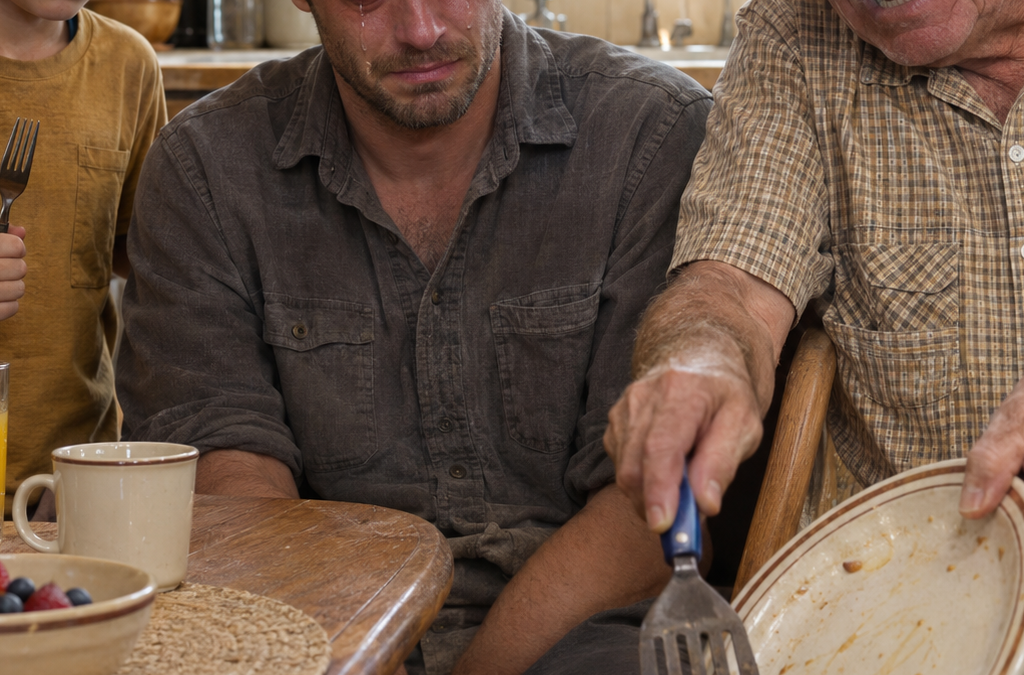
Eggs went first, then the pancakes. Dad used my blue-handled turner to push the last piece over the edge.
“You’re giving my breakfast to the dog?”
“Brian hasn’t eaten. You can wait your turn.”
Noah, eight, stood beside Rachel’s chair holding his fork. He stopped chewing.
“Rachel, are you going to let Noah learn this?”
She looked down at her plate. My brother leaned back beside her.
“Let Dad finish serving before you complain,” Brian said.
Nobody reached for the empty plate. Near the kitchen doorway sat a long delivery box marked for porch repairs.
“I made enough for everyone,” I said.
“You always make family meals about yourself,” Brian said.
The heat in my face spread down my neck. And Dad still held my plate over the bowl.
At thirty-three, I was Adam Bennett, the younger son who usually came through the back door with tools.
I owned the home-repair company that had funded my parents’ mortgage trust for six years.
Born Adam Mercer, I’d legally taken my late maternal grandfather’s surname at twenty-three. Dad still called it putting on airs. He thought I worked for somebody else, and I’d stopped correcting his guesses about my life.
The porch step outside was steady because I’d replaced its split support. The pancakes had grated apple in them, Dad’s favorite, even though grating apples for breakfast was a nuisance.
My blue-handled turner was in my hand now. Years earlier, Noah’s sticky little hand had covered that handle while I taught him to flip a pancake.
I kept fixing things before anyone had to ask.
Then Dad noticed where I was looking.
The porch-repair box carried my brother’s lake-house address.
Brian’s vacation rental was near Indian Lake, nowhere close to this kitchen in Dayton, Ohio. Dad shifted his chair toward the box, narrowing my view of the label.
The bowl beside his chair held the breakfast I’d cooked before anyone else arrived. Looking at it hurt more than I wanted to admit.
“Take that little piece left on the platter,” Dad said. “Leave the good ones for Brian.”
There was half a pancake near the rim, soaked through with syrup. But Brian still had two whole pancakes in front of him.
Dad was turning seventy-one. I’d come prepared to ignore a few remarks, eat breakfast, and stay for the funding discussion he’d arranged afterward.
Then he pointed at Brian’s plate.
“When he’s done, you can wash his dishes.”
“You want Noah watching me wait for Brian?”
“He’s older than you. Show him some respect.”
Rachel’s eyes stayed on her breakfast. Noah had lowered his fork, but he hadn’t sat down. I hated that he was waiting to see what I would do.
“Put the fork down, buddy,” I said. “Your food’s getting cold.”
Dad saw me reach for a clean plate.
“PUT THAT PLATE DOWN!”
The shout made Noah flinch. My fingers stopped against the cupboard shelf.
For a moment, the old habit almost won. Take the scrap, wash the dishes, spare everybody the uncomfortable meal. I’d done smaller versions of it for years.
Being useful had become my admission price.
“Fine,” I said. “I’m going outside.”
Dad started telling me not to sulk. But I walked past the box without answering, leaving the clean plate where it was. Through the screen door, I could still see Noah standing beside Rachel.
Outside, I called Dana Ellis at Cedar State Bank. She was already due at the house for the family funding discussion.
“Dana, it’s Adam. Are you still coming?”
“Yes. I’m bringing the repair records.”
“There’s a box here with Brian’s rental address.”
“The repair request includes that delivery address,” she said.
I looked through the screen again. Dad had turned toward Brian.
“For work on this house?” I asked.
“That’s the house your father named. We need to clarify the address.”
The money was supposed to help my parents stay in their home. And Dad knew that. His requests for repairs were supposed to be for this house, too.
Until that call, I’d thought the box might be something Brian had brought over. Now it was connected to a request Dad had sent the bank.
My knees felt weak against the porch rail.
“I’ll be here,” I told her.
By the time Dana arrived, Dad had opened the front door and put on his customer voice.
Dana stepped inside, and Dad stopped smiling at the bank’s name.
“Cedar State Bank,” she said, introducing herself where Brian and Rachel could hear. “I’m Dana Ellis, the bank officer Frank was expecting.”
Dad glanced past her toward me. His welcome had stalled when she mentioned the repair records instead of his birthday.
“Yes, of course. Come through,” he said. “We’re just finishing breakfast.”
The bowl was still beside his chair. My empty place needed no explanation, and Dana didn’t ask for one.
“I need the people permitted to discuss the housing fund,” she said. “We can use another room.”
“You can say it here,” Dad said.
So I agreed to stay. Brian remained beside Rachel, and Noah finally sat down. Nobody offered me another breakfast.
Dana opened her folder on the clear end of the table. She had a printed payment history, with one section marked along the side.
Dad leaned forward before she began.
“The address is nothing,” he said. “Materials get delivered wherever somebody can receive them.”
Dana looked at him, then at the page.
“I’m not deciding anything from a box label.”
That was the first thing she said that seemed to ease him. His shoulders settled, and he glanced at Brian as though the matter had already become silly.
I stood beside the chair I hadn’t been allowed to use. It embarrassed me to still be thinking about food, but I was hungry.
Then Dana showed me the first entry on the page. I couldn’t make out the smaller print from where I stood.
“Is this a request that hasn’t been paid?” I asked.
Dad interrupted before she could answer.
“Adam doesn’t need to pick through every little thing.”
Dana touched a second entry. “Your father already sent out $24,600.”
Brian stopped leaning back. Dad looked at the number, then at Dana.
“Don’t make it sound like I mailed cash somewhere,” he said.
“It was a repair payment,” she answered. “I need to match it to the completed work.”
The amount stayed in front of us. This wasn’t a delivery mix-up waiting to be corrected. Money had already left the housing fund.
Then Mom came through the kitchen doorway carrying Dad’s birthday cake. Linda Mercer was sixty-eight and had spent years feeding whole schools, but she looked annoyed to find breakfast unfinished.
“What’s going on now?”
“Adam’s making trouble over the repairs,” Dad said.
She set the cake on the counter. The icing said Happy Birthday, Frank, with a crooked blue border.
“Your father should be allowed to help Brian,” she told me. “It’s family.”
Dana kept her voice level.
“I’m checking what this payment bought.”
Dad pulled a folded copy of his repair request from beside his chair. He put it near Dana’s page, keeping his palm over most of it.
“The lake address was a delivery convenience,” he said. “That’s all you’re looking at.”
“I haven’t said otherwise,” Dana replied. “The bank needs to match the payment to the work.”
I was angry enough that I didn’t trust myself to answer Mom. She’d walked in after the shouting and already knew which son needed defending.
But Brian was no longer beside Rachel. The box wasn’t by the doorway, either.
My phone buzzed while Dad spoke to Dana. A voice message from him had just arrived, apparently sent before I came back inside.
I played it low beside my ear.
“Go out to the garage, Adam. Stop looking at that box.”
Through the kitchen doorway, I could see Brian carrying it toward the garage. The address label faced out against his shirt.
“Brian, leave it where everyone can see it.”
He kept moving toward the garage door.
Chapter 2 of 7
“It was a bulk delivery, Adam. Both houses needed materials.”
Brian turned sideways at the garage door. I stayed several feet away and photographed the address label against his shirt.
Only then did he put the box down.
“There. You got your picture,” he said. “Try asking before you make everybody look bad.”
The photograph showed where the box had been sent. It didn’t show who had used what was inside. I knew that, even while his explanation made me want to open it.
Instead, I went back to the kitchen.
Dana asked to speak with me on the front porch. Dad stayed near the table, telling Mom the bank had already made a simple repair job difficult.
Outside, Dana kept her voice low.
“The bank paid $24,600. I’ve confirmed the amount and the business that received it.”
“So what’s still missing?”
“Where the paid work happened. A payment record doesn’t establish that.”
I leaned against the porch rail. The paint beneath my elbow had worn thin, and I remembered sanding that spot before an old family cookout.
“The housing money could pay for their Dayton home, not Brian’s rental,” she said. “The signed arrangement let your father direct eligible repairs, but the bank could withdraw that permission for verified misuse.”
Two houses, Brian had said. Dad had said the other address was just convenient. Neither explanation told me what had actually been built.
It hurt to stand outside my parents’ house discussing whether Dad had lied about it. For years, I’d wanted the money to make their lives easier, not give us another reason to fight.
“What do you need from me?”
“Send me the photograph. Don’t turn a concern into a conclusion.”
Before I could answer, Dad opened the front door. Rachel stood behind him, her purse over her shoulder.
“If you’re going to drag outsiders into family money, the Saturday pickups stop,” he said.
I looked past him at Rachel.
“Noah and I have plans.”
“Rachel, tell Brian there’s no pickup this weekend,” Dad said. “We aren’t rewarding this.”
She looked toward the kitchen instead of answering. That hurt worse than Brian’s remarks. Noah and I usually spent Saturdays at the library, then argued over whether a hot dog counted as lunch.
“You don’t get to use Noah as a punishment.”
“Then stop making trouble for his father.”
Dana stood beside the rail without joining in. This wasn’t something a bank officer could settle.
Rachel said, “I’ll talk to Brian.”
She didn’t say she would bring Noah. Dad stepped back into the house as though he’d finished an errand.
I left without washing a single dish.
By the next morning, I was at a split-level across Dayton, checking the stairway we’d repaired. Sawdust still clung to the carpet protector, and the house smelled of fresh paint.
Caleb, my lead carpenter, was sitting on the bottom step with his work phone.
“Before you test it, I already bounced on it,” he said. “Professional bouncing. Very thorough.”
“I keep all the originals. Dates, too. Saves arguments about what was there before.”
He was twenty-nine and better at making customers comfortable than I’d ever been. Usually, I would’ve asked whether professional bouncing went on the invoice. That morning, I managed a small laugh.
He showed me the before-and-after pictures. The first showed the cracked support beneath the landing. Later pictures showed the opened wall, new blocking, and the finished stairway.
“Keep that middle one,” I said. “You can actually see the repair.”
“I keep all the originals. Dates, too. Saves arguments about what was there before.”
He moved through the pictures in order. It was ordinary work, documented while it happened. There was no speech about being careful, just a record of what he’d done.
I checked the landing myself. It held firm.
For a few minutes, that was enough: a problem we’d found, fixed, and could point to afterward. I was relieved to be somewhere my judgment counted.
While Caleb finished upstairs, I reread the porch description Dad had shown Dana. It described replacing boards and rebuilding the support beneath them.
That meant opening the porch up. There should have been a stage when the old boards came off, exposing the framing below.
Yesterday, I’d stood on the same weathered boards I remembered. I hadn’t noticed fresh cuts, new fasteners, or disturbed paint around the edges.
But I hadn’t inspected it, either. Familiarity wasn’t proof. I made a note to look properly instead of treating an angry memory as a measurement.
Dana called while I was outside by my truck.
“Does any of this change their mortgage payment?” I asked.
“No. The scheduled payments continue. Your parents keep their home.”
“And the money still in the fund?”
“It stays there for the housing arrangement.”
“I supplied it. That doesn’t let me take it back?”
“No. Funding it doesn’t let you reclaim the balance or direct my decision.”
Her answer stung, though I hadn’t expected anything different. I’d put money beyond my own reach so my parents could depend on it. Being angry with Dad didn’t undo that choice.
“All right,” I said. “Tell me what you can verify.”
“I will. Send observations separately from assumptions.”
After the call, I went inside and helped Caleb carry the last of the scrap out. The workday continued. Nobody needed me to defend my right to stand there.
Mom’s message arrived as we were leaving.
“Your father submitted another repair request for $18,400. He’s getting the remaining work finished without your permission.”
Chapter 3 of 7
“The new request hasn’t been paid,” Dana told me when I called. “We need to verify where the work would happen.”
“So Mom’s message doesn’t mean it’s going ahead?”
“No. Your father can still submit repair directions. This one needs answers.”
The mortgage payment would continue as scheduled. She made that clear before we hung up, and I was grateful she did. Dad would have an easier time blaming me if he could point to a missed payment.
I read Mom’s message again. She’d made it sound settled, as though the money was already on its way.
For the next two days, I went to work and checked my phone too often.
Then Brian called and told me to meet him at his rental near Indian Lake.
“You’re putting bookings at risk with all these questions.”
“I haven’t contacted any guests.”
“Come look before you wreck a source of family income.”
I agreed to meet him outside. Part of me hoped there would be an explanation I could believe. That embarrassed me, after everything, but I still wanted one.
Before leaving Dayton, I opened the rental listing. The pictures showed a refreshed porch, wide steps, and a diagonal stair rail that crossed beneath the top rail like a long slash. A small check-in plaque hung beside the entrance.
I sent Dana the listing link without adding a conclusion.
At the rental, Brian waited on the gravel beside Dad’s car. Dad stood near the steps, studying the porch as though he were considering buying it.
The new boards were pale against the older siding. The diagonal rail matched the listing. So did the check-in plaque, which had the Wi-Fi instructions printed below a welcome message.
Brian had once made me drive back here because a guest couldn’t work the television. The batteries had been backward. He’d still asked whether I could stay until the guest arrived.
Now he stood between me and the steps.
“See? Real work. Nobody invented a repair bill.”
“I didn’t say the work was imaginary.”
“Then stop acting like the money disappeared.”
We stayed in the gravel. I hadn’t asked to go inside, and Brian hadn’t offered. From there, I could see fresh fasteners and the clean ends of new boards.
It was good work. Saying otherwise would have been dishonest.
That was what made the conversation harder. The rental had clearly been improved, but I couldn’t tell by looking which payment had bought which board.
Dad came down one step.
“Brian loses income here, he can’t help us later.”
He said it patiently, as though this was the part I’d been too slow to understand.
“Your mother and I aren’t getting younger. You think everything stops at our front door?”
“The fund covered your house, Dad. Needing help doesn’t change the address.”
He looked toward the road instead of answering. I hated having to say it where anyone driving past could see us arguing.
Brian began explaining the purchases. Boards could be bought together, he said. Fasteners came in boxes larger than one job needed. A contractor could make one trip for supplies and use them at two places.
“Dad told you already, both houses needed work.”
“Then show Dana what went to each house.”
“You don’t get a receipt for every screw.”
That much was true. I bought supplies for several jobs at once myself. But our bills still described the work we’d completed.
I told him that, without mentioning my company.
Dad made a disgusted noise.
“That ungrateful contractor won’t even fix the description.”
“What’s wrong with the description?”
“It makes everything sound like it happened here.”
He glanced at Brian, who started talking about delivery costs. For a moment they spoke over each other, then Dad stopped.
According to him, he’d asked for clearer wording after the job was finished. The contractor had refused to rewrite it.
I didn’t know what had been written or what Dad wanted changed. His complaint wasn’t proof. Still, I was upset enough that I had to wait before answering.
“Let Dana see the original bill.”
“She has enough paper,” Dad said. “What she needs is some common sense.”
Brian folded his arms.
“I’m not losing summer money because you want attention.”
There it was again: my questions treated as a personal defect, while their answers kept changing.
I left without going up the steps.
At a gas station on the way home, I called Rachel about Saturday. Noah and I had planned to return his library books and find the next book in a series he liked.
“Brian won’t allow the pickup,” she said.
“Are you telling me it’s canceled?”
“He wanted to know if grown-ups could make you eat after everybody else.”
“Yes. I’m sorry.”
I stayed parked beside the air pump. The cancellation hurt more than the argument at the rental. Noah had left one of his books in my truck so we wouldn’t forget it.
Rachel said he’d asked a question after brunch.
“He wanted to know if grown-ups could make you eat after everybody else.”
“What did you tell him?”
“That he hadn’t done anything wrong.”
I was glad she’d said that. I wished she’d answered his question, too.
“Please tell him I didn’t forget our plans.”
She said she would.
That evening, Dad posted in the family group. He said I was interfering with the house fund and upsetting a repair arrangement that helped keep the family secure.
Under his message, he attached his signed repair summary.
The paid work, it said, included my parents’ front porch.
Chapter 4 of 7
The filled screw hole was still there, just left of my parents’ front door. I’d packed it years ago after removing a loose bracket. The filler had dried lighter than the wood.
Dad’s summary on my phone said those boards had been replaced.
That didn’t tell me where the money had gone. It did give me a specific question instead of another argument about what I remembered.
Dana stood beside me on the porch.
“I need to establish who directed the payment and where the work happened,” she said. “Keep those separate.”
Through the screen, Dad called us inside.
He and Mom had taken their usual places at the dining table. Mom’s grocery crossword lay beside her chair. She always filled in the food clues first and left Dad the car brands.
I’d grown up doing homework at that table. Being invited to sit there as a problem to be handled hurt more than I expected.
Dad nodded toward my phone.
“You saw what I sent. Maybe now we can stop this.”
“The boards by the door still have the old filler.”
“Then you can ask about the boards,” Dana said. “First, we need to clear up the funding.”
She’d called me before the meeting to request permission to verify the company records. I’d agreed. Now she had the ownership records and contribution history in front of her.
Mom looked at me.
“What does your job have to do with this?”
“Dana can explain it,” I said. “You have my permission.”
Dana spoke without changing her tone.
“Adam is the sole owner of Bennett Home Repair LLC. We verified the company’s ownership records with his permission.”
Dad pushed back his chair. His eyes went to the company name stitched above my shirt pocket, then back to my face.
“All of it?”
“Yes,” I said.
“The housing arrangement received $238,400 over six years,” Dana continued. “Adam supplied every contribution.”
Mom stared at the pages. Dad stayed half turned away from the table, his chair angled toward the kitchen.
“You knew what I meant. Why didn’t you tell me?”
For years, he’d spoken about the person helping them as though kindness required wealth from somewhere outside our family. Hearing the truth hadn’t made him look pleased. I hadn’t expected gratitude, but his expression still embarrassed me.
“You let me accept outside help,” he said.
“It wasn’t outside help.”
“You knew what I meant. Why didn’t you tell me?”
“I didn’t want another argument about who deserved credit.”
He looked toward Mom, waiting for her to answer that.
I remembered the first arrangement, how relieved I’d been when the payments started without another family discussion. Dad had decided an old customer must have remembered him. I’d never confirmed it.
At the time, anonymity had seemed easier than defending what I could afford or explaining how I’d earned it. Sitting there, I could admit that easier hadn’t meant better.
“You could’ve told us,” Mom said.
“I could have.”
“So you saved it for this,” Dad said. “Waited until you could embarrass us.”
Dana started to speak, but he kept going.
“You wanted us owing you without knowing it.”
His anger was easier to recognize than the shock had been. He could argue with my motives. He couldn’t argue with six years of payments already received.
“I wanted you to stay in your home,” I said.
Mom’s face hardened.
“If you’re doing that well, helping your parents shouldn’t come with questions.”
“The questions are about the repairs.”
“You know what your brother’s trying to build,” she said. “You could be happy for him.”
I was tired of being asked to prove love by agreeing to something else. My work shirt was damp beneath the arms, and I wanted to leave. Instead, I stayed in the chair they’d finally offered me.
Dana waited until Mom finished.
“We aren’t deciding whether Adam is a good son,” she said. “We’re reviewing a repair direction Frank signed.”
Dad leaned forward.
“And I’ve told you it covered both places.”
“Then we need to establish what was completed at each.”
She didn’t argue about my reasons for paying. She returned to his request, the payment, and the work. Dad kept trying to pull her back toward me.
“Does he get to sit there judging us?”
“He can attend the review,” Dana said. “He doesn’t make my decision.”
That answer seemed to disappoint him. He wanted someone he could accuse of taking sides.
We agreed to meet again at the dining table. Brian and Rachel would attend with the four of us. Dana would bring the bank’s records and ask about the completed work.
“Sunday, eleven, here.”
Dad said it as though he were calling a meeting himself.
Then he said he wanted relatives there. He’d already told them I was interfering, and now he wanted them to hear his explanation.
Dana asked each adult participant whether that was acceptable. Mom agreed immediately. I agreed, though the thought of another audience made me miserable. She would confirm with Brian and Rachel, too.
Rachel could keep Noah with her if she needed to bring him.
On the way out, Dad followed me as far as the hall.
“Don’t expect applause for paying a bill.”
“I didn’t ask for any.”
By evening, his invitation appeared in the family group. He promised to prove I was “turning two ordinary repair jobs into a scandal.”
I was at home, eating a sandwich over the kitchen sink, when Rachel’s private reply came through.
“He told Noah you bought the right to be obeyed.”
Chapter 5 of 7
“Noah doesn’t owe me a loyalty test,” I told Rachel. “He can ask me questions himself.”
She’d called while I was still looking at her message about Dad.
“He thinks you’re mad at him for eating.”
That hurt. I pictured him standing beside her chair, waiting for permission to finish his breakfast.
“Tell him I’m not. And don’t ask him to pick anybody.”
“I’m bringing him tomorrow,” she said. “I’ve decided that much.”
I was glad, but I didn’t ask whether Brian agreed. Rachel had enough to answer for without reporting their whole marriage to me.
“I won’t pay for time with him,” I said. “Or stop asking questions to get Saturdays back.”
“I didn’t ask you to.”
“I know. I just need that clear.”
By Saturday afternoon, Mom had gathered relatives at the house. She called it getting everyone comfortable before the bank discussion. Dad called it giving people the whole story.
I brought the copy of his repair request and my phone. The delivery-label photograph was still saved where I could find it. There wasn’t anything new in my folder.
Mom met me near the dining table.
“We can still have a decent weekend,” she said. “Apologize first. Then Dana can talk numbers with your father privately.”
“For what, Mom?”
“For the way you’ve made him look.”
Beyond her, the relatives had settled between the dining room and living room. Dad had left his signed summary where people could read it.
I felt embarrassed before I’d even sat down. Mom had made the apology sound like something overdue, like I’d forgotten to bring back a borrowed dish.
“I’m not apologizing for asking where it went.”
“Your father and I shouldn’t have to beg our own son for kindness.”
“You could say you’re sorry he’s upset.”
“He’s upset because I asked.”
She looked toward the others.
“Your father and I shouldn’t have to beg our own son for kindness.”
On the counter sat her usual bowl of party pretzels, mixed with the broken crackers she refused to throw away. As kids, Brian and I had called it cupboard gravel. I almost reached for some before remembering how easily ordinary things pulled me back into acting fine.
Brian came in from the kitchen.
“Can we talk without you performing for everybody?”
He led me only as far as the far end of the table. We were still in view. Rachel stayed near Noah in the living room.
“I’ll cover the eighteen-four myself,” Brian said. “The pending work. Dad won’t need the fund for it.”
“That’s your choice.”
“Then we call the first payment settled. No more digging.”
His offer came quickly, as though he’d already given away more than he could stand. I understood that he wanted summer bookings protected. I didn’t understand why that required me to agree about work nobody had accounted for.
“Paying a future bill doesn’t tell Dana where the finished work happened.”
“You’re getting what you want.”
“I asked where the money went.”
“You know what? You’ve got plenty. Let one thing go.”
I was angry, and tired of hearing my business described as spare money. There were wages to meet and jobs that needed doing. But explaining that would only move us away from Dad’s request again.
So I didn’t.
Mom called Dana from the table and put her on speaker. She wanted confirmation that tomorrow wouldn’t become what she called a family trial.
“It’s an administrative review under the signed arrangement,” Dana said. “Not a trial.”
“Then Adam doesn’t need to make accusations,” Dad said.
“I’ll ask about the payment and the completed work.”
Mom interrupted to ask whether the relatives could stay. Dana checked with each adult participant again. We all agreed.
“And who decides what happens?” Brian asked.
“I do,” Dana said. “The bank delegated that decision to me. Adam doesn’t decide whether Frank can continue directing repair spending.”
Dad looked across at me. I couldn’t tell whether that answer relieved him or spoiled an argument he’d wanted to make.
Dana ended the call after confirming everyone would return in the morning. Nobody had lost their house. Nobody had been told to stop speaking. Yet Mom looked at me as though I’d arranged something cruel.
My phone buzzed with Caleb’s reply to the attendance message.
“I can be there. I’ll bring my work phone.”
I sent back a thank-you. Then I put the phone away.
Dad stood near the head of the table, where he could address both rooms.
“The $24,600 included work right here on our porch,” he said. “Not just Brian’s place. I’ve said that from the beginning.”
His voice had settled into the patient tone he used when he wanted witnesses.
I stayed where I was. Hearing him say it again made me sad in a way the shouting hadn’t. He’d had time to check, time to explain differently. This was the account he wanted everyone to carry home.
“The contractor’s angry about something else,” Dad continued. “An unrelated disagreement. Now he’s making a simple job difficult.”
Brian watched the doorway. Mom said we should leave the rest for morning, and the gathering began to break up.
Rachel caught me outside before I reached my truck. Noah was still inside getting his things.
“There’s something you should know,” she said. “He asked the contractor not to bring photographs.”
“Brian?”
She nodded.
“He refused. He’s bringing them.”
Chapter 6 of 7
I had breakfast beside the evidence at the Mercer dining table: a fresh covered plate, my blue-handled turner, and Dad’s repair request.
Caleb came in with Dana before anyone sat down.
“Caleb, thanks for coming,” I said to my lead carpenter.
“Brian asked me to leave the pictures home. I told him no.” He faced the table. “I’m the carpenter who did the paid work at the rental.”
Dad looked from Caleb to me. Brian stayed beside Rachel, with Noah between her chair and the wall. The relatives Dad had invited filled the adjoining room.
Dana began at eleven.
Dad spoke before she finished explaining which payment we were reviewing.
“The $24,600 covered both houses, including this front porch. That’s what I signed for.”
Caleb had his phone ready. Dana had the bank’s payment record, Dad’s signed request, and the full invoice from Caleb’s separate business.
Seeing those ordinary pages together made me sad. Dad could still correct himself. Instead, he looked toward the relatives, checking that they’d heard him.
Caleb showed the job photographs in order. The first showed old boards coming off Brian’s porch. Others showed exposed framing, new supports, then the rebuilt steps.
The diagonal rail appeared near the end. Beside the entrance hung the check-in plaque I’d seen at Indian Lake.
I leaned forward.
“That’s one porch, opened up and rebuilt straight through. Where does our porch come into this?”
Dad barely glanced at the screen.
“Those are the lake pictures. Nobody said he photographed everything.”
It was a fair question underneath the sneer. A set of pictures could leave out another job. I wanted the answer established, not guessed because I was angry.
Dana asked Caleb, “What work at this house did that payment buy?”
“None.”
He said it without looking at me.
“These are the originals on my work phone. I took them as I went, before anybody argued about the bill.”
He showed Dana the image details, then the next photograph. The framing matched from one stage to another. So did the doorway and the old siding above it.
His invoice covered that whole sequence, from removal through the finished rail. The payment reference on Dana’s record matched the reference on his full bill.
“No labor here,” he said. “No materials here. Everything on that bill went into the Indian Lake job.”
My face felt hot, though I’d asked for the answer. Dad’s front porch was only a few feet away. We could all see it through the screen.
Dad reached toward the phone.
Caleb kept it and turned the next original image toward Dana.
“You’re leaving things out because I questioned your bill,” Dad said.
“You asked me to change the job description afterward. I wouldn’t.”
Brian watched the tabletop.
Dad turned to me.
“And how exactly do you know this man?”
“He’s my lead carpenter.”
“At my day job. These pictures were already on my phone before this dispute.”
That landed differently from Caleb’s name at the door. Dad looked at the phone again, then at the company name on my shirt.
Caleb explained that this had been an independent side job, done off-hours through his own business. I permitted that work. It wasn’t a Bennett Home Repair contract.
“But he pays your wages,” Dad said.
“At my day job. These pictures were already on my phone before this dispute.”
Dana compared the invoice with the payment again. Caleb explained the quantities and the work each charge covered. He hadn’t divided a delivery between houses or billed for work elsewhere.
I was relieved he stayed specific. Dad could resent my business, my name, or my reasons for helping. None of those arguments explained a second porch.
Dana addressed Dad.
“This payment bought one job, and it wasn’t at this house.”
Mom’s hand rested on his arm. She hadn’t spoken since Caleb arrived.
Dana continued, “Under the signed delegation, the bank is revoking your spending authority over $91,850, effective immediately. I have the bank’s authority to make that decision.”
Dad stared at her.
“Future eligible housing expenses will be handled directly by the bank,” she said. “Your housing benefit and scheduled mortgage payments continue.”
He stood, forcing Mom’s hand aside.
“We’re finished with him. He can leave now.”
Dana was already speaking to Caleb.
“Please send the originals and the complete invoice copy to me.”
Caleb agreed. Dad remained standing while they confirmed what she needed. Mom drew her hand back into her lap.
I had never seen Dad try to dismiss someone in his own dining room and fail. It frightened me a little, even then. My breakfast was still covered, and I hadn’t touched it.
Rachel rose from Brian’s side.
She carried my plate to the empty chair beside hers. Noah watched her uncover the eggs and toast I’d made that morning.
“Your uncle doesn’t have to wait for anyone,” she told him.
Brian looked up at her. She stayed by the chair until I came over.
Dad was still watching me, waiting for an argument he could answer.
“I’ll help with housing, but I won’t help you teach him that.”
Then I sat down.
Noah asked whether I’d made the eggs myself. I told him yes, though they were probably getting rubbery.
“Mine do that,” he said.
I laughed once. It came out unevenly, but he smiled.
The toast had softened beneath the cover. I ate it anyway. Nobody asked me to clear Brian’s plate, and I didn’t offer.
Dana closed her folder, leaving one page out.
“This asks you to restore the payment,” she told Dad. “You’ll have an opportunity to respond.”
She placed the $24,600 reimbursement demand in front of him.
“Please respond in writing.”
Chapter 7 of 7
Sixteen days after the review, Dad signed an agreement to restore $24,600 to the housing fund. I sat across from him at Cedar State Bank while Dana explained the payment deadline.
His house still belonged to him and Mom. Dana hadn’t called him a criminal or taken money from his personal account. He’d chosen to sign rather than challenge the payment record and Caleb’s account of the work.
Dad read the last page twice.
“And once it’s paid, this part is finished?”
“The reimbursement dispute, yes,” Dana said. “It doesn’t restore your permission to direct repair spending.”
He looked at me then. I kept my eyes on him, though I wanted to look away.
“That’s what I needed clarified,” he told Dana.
He sounded like a customer checking a warranty. It hurt to hear that careful voice after weeks of being told I was destroying the family.
His certificate of deposit held $31,000. He’d decided to cash part of it to meet the deadline, using retirement savings he’d wanted left alone.
“I didn’t work all those years to spend it twice,” he said.
Dana waited. I didn’t answer for Brian or offer to cover the difference.
Dad signed. There was no handshake between us afterward.
In the parking lot, I sat in my truck without starting it. I’d wanted him to stop treating my help as something he could spend however he pleased. Getting there had left me exhausted.
For once, I let myself go home instead of finding another job to finish.
Mom corrected the story in our eighteen-person family group the following week.
“Adam paid for our housing support. The repair payment we discussed went to Brian’s rental, not our porch. Frank has agreed to repay it.”
Then she added, “We would appreciate some privacy now.”
I read it several times. She hadn’t said she was sorry. She had, however, told the same people who’d heard Dad’s version what had actually happened.
That mattered to me more than I expected.
I replied, “Thank you for correcting it.”
I didn’t add a heart or offer to come over. We weren’t ready for that, and I was tired of pretending a small opening meant everything had been repaired.
A few days later, Dad sent me a photograph of their sticking back door.
“Come fix this today. You’ve wasted enough of my time.”
I was eating lunch between jobs when it arrived. My first thought was whether I had the right plane in the truck.
Then I read his words again.
“No. Send housing repair requests to Dana.”
That was my whole reply.
I felt guilty through most of lunch. The guilt was familiar enough that I almost mistook it for an obligation. But I finished eating and went back to the customer who had actually hired us.
Mom contacted Dana about the door. The bank arranged an eligible repair directly. Nobody needed me to leave work, and the door got fixed.
“I don’t want him ready at the window and then disappointed,”
The unpaid request for Brian’s remaining rental work was closed without a payment from the fund. Whatever he chose to do there next was his expense.
Noah’s visits took longer to settle.
Rachel asked whether I could take him to the library again. This time, I asked her to confirm the arrangement with Brian before telling Noah.
“I don’t want him ready at the window and then disappointed,” I said.
“I’ll put us all on the message.”
Brian’s reply came later.
“That works. Bring him back after lunch.”
There was no apology attached. I didn’t ask for one as the price of seeing Noah. But I didn’t promise a repair, forgive a debt, or agree to stop talking about the fund, either.
When I picked Noah up, he climbed into the truck carrying two library books.
“Mom said you didn’t forget.”
“I didn’t.”
He asked whether we could get lunch somewhere with curly fries. I said yes, and he spent the drive explaining why ordinary fries were a waste of potatoes.
I was relieved enough to laugh at all of it.
On August 31, Dana confirmed that Dad’s $24,600 payment had cleared.
The housing reserve stood at $116,450 before any later eligible spending. Dad’s permission to direct repairs stayed revoked, and the scheduled mortgage payments continued separately.
I saved Dana’s confirmation and closed the message.
That evening, I ate dinner without checking the family group. Dad had met the agreement he’d signed. I didn’t need to turn that into forgiveness or find a reason to thank him for returning money he shouldn’t have used.
Three months after the review, Rachel and Noah came to my house in Dayton for breakfast.
We’d arranged it with Brian beforehand. He knew where they were, and Rachel wasn’t sneaking out or asking me to keep anything from him.
She stood in my kitchen while Noah studied the pancake batter.
“He’s been talking about this since yesterday,” she said.
“About seeing me?”
“Mostly the pancakes.”
“That sounds right.”
My kitchen was small. With three people in it, somebody always had to move to open the refrigerator. But nobody was telling me where I belonged.
Rachel had brought strawberries. Noah insisted on washing them, then announced that one had a suspicious soft spot and should be eaten immediately.
He ate it before either of us could inspect the evidence.
I laughed, and this time it came easily.
While the pan heated, Rachel said, “I should’ve spoken up at that birthday breakfast.”
“Yes,” I said.
She nodded. I appreciated that she didn’t ask me to make the answer gentler.
Noah came back to the stove before either of us said more. He watched a ring of bubbles form in the batter, his chin barely above the counter.
The old blue-handled turner rested beside the pan. I picked it up and checked the underside of the pancake.
“Can I have the first one?” he asked.
“I’m serving myself first. Yours is next.”
“Can mine be bigger?”
“I’ll see what the pan can manage.”
He accepted that and went to choose his strawberries. Rachel sat down, leaving my chair empty for me.
Helping my family didn’t require accepting a smaller place in it.
I slid the first pancake onto my own plate.







