At my flower shop’s hotel signing, my husband pledged our daughter’s $28,000 tuition money; he didn’t know what I had stopped doing.
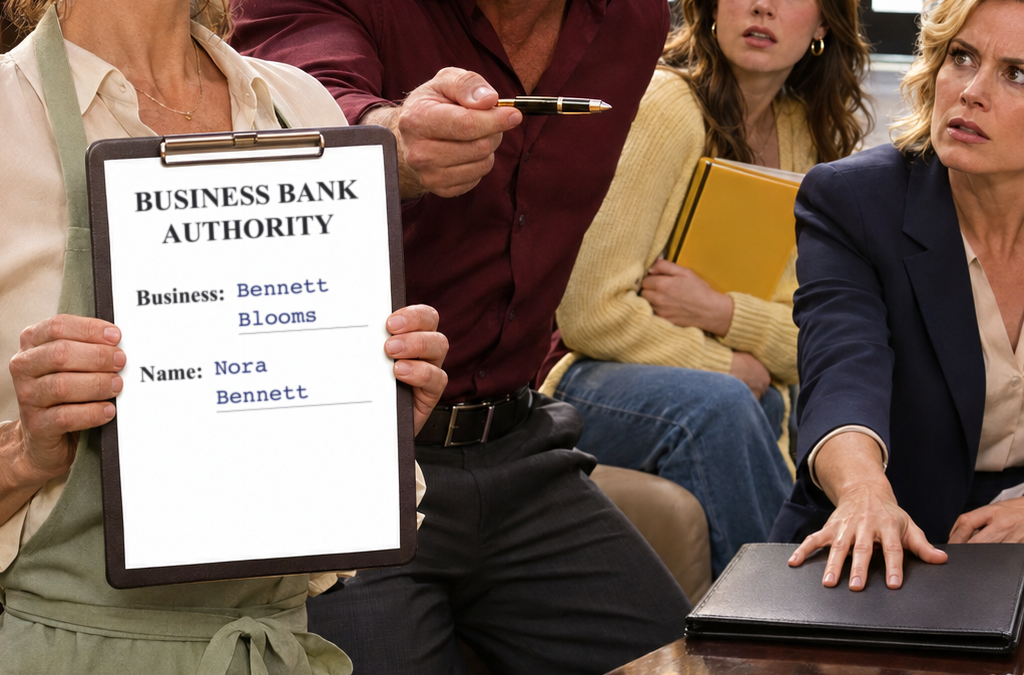
Chapter 1 of 7
“This is Nora, my delivery girl,” Mark told the buyers. “She arranges stems; I built everything that matters.”
It was Monday, June 22, ten in the morning. Through Linden House Hotel’s glass doors, Richmond, Texas, shimmered in the heat.
Mark rested one hand on our daughter’s chair.
“And we’re putting twenty-eight thousand into a second location. Money we’d set aside for Emily’s college. We’re making it work harder.”
Beth Brooks—no, Beth Parker. I knew her name. I had written it on six sample tags that morning, but for a second I couldn’t retrieve it.
Beth’s pen hovered above her notes. Emily stared at the yellow college binder on her lap.
Neither spoke.
I straightened the handouts beside Mark’s elbow. Their corners had caught on a water glass.
His name appeared under “Business Development.” Mine appeared nowhere.
A damp circle spread across the top sheet. I lifted it before the water reached the printed flowers.
“Nora, leave those,” Mark said. “They’ve got copies.”
I put the sheet down.
Beside the signing table, my white roses leaned toward the air-conditioning vent. I turned the vase a quarter turn, then caught myself doing that, too.
Beth watched my hand.
“Will those hold through an evening event?” she asked.
“Yes. These were conditioned overnight. For your lobby, I’d use a lower arrangement.”
“Nora’s very particular,” Mark said, smiling. “You should see our kitchen.”
Emily usually would have mentioned the measuring cup labeled FLOWERS, DO NOT MAKE PANCAKES. That morning, she pressed both thumbs against her binder’s metal rings.
I slid my worn snips, blue tape around one handle, deeper into my apron pocket.
Ten years of carrying those things, and I had forgotten to take them off before a hotel reception.
“The agreement is seventy-two thousand over twelve months,” Beth said. “Six thousand monthly, beginning August first.”
“Yes,” Mark said. “Which gives us the base for expansion.”
“For the hotel service,” I said.
“Of course, honey. That’s what we’re here for.”
He touched my shoulder as if I had missed a step.
I had founded Bennett Blooms ten years earlier. At forty-nine, I still got up before dawn for market runs. Mark had helped with purchasing and sales after leaving his building-supply job. Somewhere along the way, his introductions had changed.
I had corrected invoices afterward, in the shop. I had signed routine approvals rather than have difficult conversations.
“Mom,” Emily said quietly.
I bent toward her.
“Please don’t do this here.”
“Do what?”
She glanced at Beth, then down. “The hotel. We need this.”
Emily was eighteen. She had worked enough Saturdays to know what a regular hotel order could change. She had also heard her father call this our one real chance.
“I know we do,” I said.
Mark held out a pen.
“Let’s get the pictures first, then finish up. Nora?”
I reached for it out of habit. His thumb had worn a shiny spot near the clip. I had given him that pen on our twentieth anniversary, three years earlier.
My fingers stopped short.
“Beth, please leave the company signature blank.”
Mark kept the pen extended.
“We’ve been over the service schedule.”
“I’m asking her to leave it blank.”
Beth set her own pen beside the contract.
“Is there a service issue I need to address?”
“The flowers are ready. I haven’t agreed to a second shop.”
“That’s separate,” Mark said.
“You announced it with this agreement.”
His pen lowered.
Two weeks earlier, I had changed one thing at the bank.
My blue business-bank authority folder sat beneath my bag. Mark glanced at it when I pulled it free.
“Nora, we don’t need all your office things.”
Beth shifted the contract closer to herself.
“Let her get what she needs.”
I caught the folder’s bent corner against the tablecloth. Mark reached to help, and I held it still until his hand dropped.
I opened the blue folder toward Beth.
The card-user sheet lay on top. Under Mark’s name were the words “spending authority only.”
“That’s the purchasing card I authorized for him,” I said.
Beth looked at the page, then at me.
“Who signs for Bennett Blooms?”
“I do. I’m its sole member.”
Mark pulled out a chair.
“I’ve never said she doesn’t sign. I handle the purchasing, the supplier calls, all the things that keep her free to do the flowers.”
I moved the card sheet aside. A ribbon receipt curled over the yellow June 9 page, beside its unfilled “Owner release” line. Emily’s childhood sunflower drawing had caught in the back pocket.
I tucked its orange crayon petals inside before they tore.
“I need the company information to match,” Beth said. “That’s all.”
“It will,” Mark said. “We’ve been married twenty-three years. We can sort out a description.”
Emily rubbed a thumbnail along her binder’s spine.
“Dad, maybe just—”
“We’re fine, Em.”
She stopped.
A hotel employee offered coffee. Beth declined. Mark asked for another cup, and I moved my folder away from the waiting saucer.
“The college money,” I said. “You didn’t ask me.”
“It’s company savings, Nora. We haven’t paid tuition with it.”
“I set that profit aside for her.”
“And I want enough coming in to keep paying for her.”
Emily’s phone lit against her binder. She covered it with her palm.
“What is that?” I asked.
“Nothing. A picture.”
Mark looked toward her before I could ask again.
“Em, leave it.”
She lifted the phone, looked at him, then at me.
Emily turned her phone toward me: COLLINS FLORAL GROUP—PROOF READY.
The picture showed white letters mounted above a storefront window. Smaller lettering underneath read “Flowers for Every Occasion.”
“Are you expecting a different company?” I asked Beth.
“Our draft names Bennett Blooms LLC.”
“That’s a concept,” Mark said. “I forwarded it to Emily because she has a better eye for signs.”
“When were you going to show me?”
“When there was something worth showing you. It’s a proof, sweetheart.”
“My name came off.”
“The business could outgrow one person’s name. That isn’t an insult.”
I looked at the white letters until Emily lowered the phone.
Mark leaned forward, his coffee untouched.
“We can leave everything exactly where it is. Same rent, same workload, you driving before daylight. Or we can build enough business that Emily doesn’t have to worry every semester.”
“You’ve spent the money in front of her.”
“I’ve proposed using it. There’s a difference.”
“Then call it a proposal.”
“All right. A proposal.”
He turned toward Beth.
“I’m sorry. We didn’t intend to make you sit through a family discussion.”
Beth closed the contract cover without gathering it up.
“I’m not deciding the expansion question. I do need the business ready to make this commitment.”
“It is,” Mark said.
“The floral service is,” I said. “I won’t endorse an expansion announcement I haven’t reviewed.”
Beth asked about staffing, delivery windows, and who would answer a missed delivery call. I answered each question while Mark sat beside the pen.
We worked through the remaining service pages. A hotel employee quietly cleared the untouched pastry tray.
Eventually Beth said, “Let’s postpone the signing. We can resume when the company details are settled.”
Mark nodded.
“That’s reasonable.”
I was still beside the signing table when my phone vibrated.
At 11:06 a.m., Brazos Community Bank’s acknowledgment filled the screen: Mark Collins had submitted a $28,000 transfer request.
The named recipient was Summit Leasing LLC.
Chapter 2 of 7
At 8:15 a.m. Tuesday, June 23, I called Summit Leasing’s publicly listed office number. I read the acknowledgment from my phone, including Mark’s name and the $28,000 request.
“That would be the second storefront,” the woman said. “Are you calling for Mr. Collins?”
“For Bennett Blooms. Is this connected to Linden House Hotel?”
“No, ma’am. This is retail space.”
The bank screen still showed the request as pending. No money had moved.
“Please email me the address,” I said.
“I can send the listing. Anything else would need to come from Mr. Collins.”
I gave her my shop email.
Beside the register, yesterday’s delivery slips waited under a chipped frog paperweight. I moved them onto the keyboard so I wouldn’t forget them.
Then I left for Emily’s college appointment.
Mark was already at the enrollment counter when I arrived. He held Emily’s yellow binder while she searched her bag for identification.
“You made it,” he said.
“I said I would.”
“I wasn’t sure, with the shop.”
Emily pulled out her license. A peppermint fell from her bag and rolled under the counter.
“Leave it,” she told me when I bent down. “Mom. It’s covered in purse lint.”
I picked it up anyway. There wasn’t a trash can nearby, so I held it.
The clerk checked Emily’s information, then directed us to the chairs. Someone would call her when an enrollment adviser was available.
Mark chose three seats together. He put the binder between himself and Emily.
“While we’re waiting, Em, show your mother what we worked on.”
Emily looked toward the counter.
“Here?”
“It might clear things up.”
“What did you work on?” I asked.
“Just numbers,” she said.
She opened the binder halfway. Mark reached across and turned a page.
“We looked at what a second shop could bring in,” he said. “Conservatively.”
“Dad helped me make a worksheet.”
“Did you ask him to?”
Her fingers stopped on a plastic divider.
“I wanted to know if college was going to be a problem.”
“No,” I said. “College isn’t a problem.”
Mark leaned forward, elbows on his knees.
“The cost is real, Nora. We can spend down savings, or build something that pays again next year.”
“You submitted a transfer before we agreed.”
“A request. We still have to finish the details.”
“I called Summit.”
He nodded once.
“Good. You should see the space.”
“I asked whether this was a hotel requirement. It isn’t.”
“I never said the hotel required it. The hotel gives us reliable income. That makes another location less of a gamble.”
Emily pulled the binder closer.
“He said if both shops were earning, we wouldn’t have to keep having this conversation.”
I unwound the peppermint wrapper around the hard little lump.
“Emily, you don’t have to tell me what a second shop might earn.”
“I’m not trying to tell you.”
“I know.”
“You sound like I did something.”
Mark lowered his voice.
“She was helping. She wanted to understand the family business.”
I never asked her to carry the business.
Across the aisle, a boy was filling out a form against his knee. His mother kept offering him a clipboard. I watched him refuse it twice before I could speak.
“What college charges are due right now?” I asked Emily.
“She’s still getting registered,” Mark said.
“I’m asking her.”
Emily shut the binder.
“I don’t have the final bill yet.”
“Okay. Then we’ll get the bill.”
“That doesn’t make the rest disappear,” Mark said.
“No. But I need to know what we’re paying.”
He sat back, rubbing one thumb over his wedding band.
“I’ve spent years getting prices down for that shop. I don’t draw a paycheck. I’m trying to make the work add up to something.”
“I haven’t said you don’t help.”
“Yesterday sounded different.”
Emily looked between us. I put the peppermint in my bag.
My blue folder rested against my ankle. I had brought the company records because the enrollment office needed information about my self-employment.
The signed operating agreement and membership ledger were behind the bank papers. Both listed me as the only member of Bennett Blooms.
I showed Mark those two pages.
“The company records haven’t changed.”
“I’m your husband, Nora.”
“Yes. These don’t settle everything between us.”
They also couldn’t stop a pending bank request from inside my folder. I put them away.
Mark unzipped his document case and took out an older vendor-purchase authorization. My signature sat below the familiar list of purchasing responsibilities.
“This is how we’ve worked,” he said. “You wanted me handling suppliers.”
“I still need supplier orders handled.”
“Then please don’t act like I wandered in yesterday.”
Emily pressed her knees together, trapping the binder upright.
“Can you both stop? They’re going to call my name.”
I moved one chair away to give her room.
While we waited, I sent Dana Brooks a message asking for confirmation that the $28,000 request remained pending. I asked her to call me about its status.
I left Mark’s purchasing card active. The shop still had legitimate orders scheduled, including supplies we needed that week.
Emily stood when the adviser appeared. Her binder slipped off her knees and struck the carpet open.
I picked it up by the cover.
A worksheet faced me. Near the bottom, beneath rows of figures, Mark had typed “student financing gap.”
The amount was $7,000.
“Is this from the college?”
Emily reached for the binder, then let her hand drop.
“That’s the number Dad showed me. Why he said we needed the other shop.”
“Seven thousand?”
“It came from Dad’s worksheet, Mom. Not a college bill.”
Chapter 3 of 7
At 6:40 a.m. Wednesday, June 24, Emily sent me a picture of the worksheet.
“Books, driving, and the scholarship I haven’t gotten,” she wrote. “That’s how Dad got seven thousand.”
I stood beside the shop cooler, enlarging the rows with two fingers. Estimated expenses sat beside money nobody had awarded her.
“That’s an estimate, honey. Nothing there says seven thousand is due today.”
Before she answered, Mark posted in our family message thread.
“I can’t continue unpaid purchasing and deliveries while my role is being disputed. You’ll need to handle this morning’s hotel run.”
Three sample arrangements waited on the workbench. He had put the van keys beside them the night before.
I called him.
“You’re telling me now?”
“I’ve been trying to talk to you since Monday.”
“The samples are ready.”
“Then they should travel fine.”
“That isn’t what I asked.”
He paused. I could hear our kitchen faucet running.
“Nora, this account needs somebody coordinating purchases and sales. You can’t take away my place and keep assigning me the work.”
“I haven’t assigned you anything new.”
“No. Just the same things you’ve counted on for years.”
I pressed the phone between my ear and shoulder. One arrangement needed a shorter branch. I cut it, then couldn’t find where I had set the snips.
“Are you bringing the van back?”
“It’s already outside. I’m not stranding you.”
He hung up before I found the snips under my elbow.
At opening, a woman came in wanting flowers for a lunch that day. She pointed to the larger arrangement in my display book.
“Three of those. Whatever you have in peach.”
I had enough roses. Three pieces at my regular price would have made a good morning.
“I can have them ready this afternoon.”
“The lunch starts at eleven.”
I looked at the hotel samples, then at the clock.
“I’m sorry. I can’t promise that.”
“Could someone else do them?”
“Not this morning.”
She took a picture of the page and left to try another shop.
I wrote her request on a scrap of wrapping paper. Then I crossed it out.
The van smelled like wet cardboard and the cinnamon gum Mark kept in the console. I moved his folded road atlas off the passenger seat.
Our foam delivery blocks fit the wide vases, but one sample used narrow glass jars. I wedged those into a shallow crate with towels, testing each one before closing the doors.
Emily called while I was fastening the last strap.
“I can cover the counter.”
“You have orientation forms.”
“They’re online. I can do them there.”
“Thank you. The cooler order is taped beside the register.”
“I know where you put it.”
I waited, holding the strap against the buckle.
“Could you answer your dad in the thread? Just say you’re helping.”
“He’ll think I’m taking your side.”
“You are helping me.”
“At the shop. Mom, please. I don’t want to write anything.”
A delivery truck rattled past, swallowing whatever she said next.
“Come when you can,” I told her. “Don’t promise same-day work before you check the calendar.”
“I know.”
She sounded eighteen on that second “I know.” I let it go.
At Linden House Hotel’s loading dock, I lifted the crate onto a cart. One jar clicked against its neighbor.
A thin line ran from the rim toward the base. Water seeped into the towel.
I stopped the cart.
The dock attendant found me an empty bucket. I moved the flowers into it, then lifted the damaged jar out with a folded towel.
The other jars were intact. I had packed spare stems, but the broken jar had been part of the low grouping Beth wanted to compare.
“Need somebody upstairs?” the attendant asked.
“Could you tell purchasing I need a little more time?”
He nodded and went inside.
I stood at a stainless-steel utility counter, trimming stems into the bucket. Without the third jar, the grouping looked lopsided. I divided the flowers between the remaining two and lowered the taller stems.
The counter was too high. By the time I finished, my shoulders ached.
Beth came down while I was wiping water off the jars.
“Trouble on the road?”
“One cracked unloading. I’ve adjusted this pair, but I’ll replace the third for the full set.”
She looked them over.
“The lower height works better. Can you bring the complete version tomorrow?”
“Yes.”
“Loading entrance, one-thirty. I’ll meet you here.”
I wrote it on the back of my delivery slip. My phone showed the time I should have been finishing those peach arrangements.
Back at the shop, Emily had rung up two bouquets and eaten the emergency crackers I kept behind the receipt printer. She had left the empty sleeve standing upright, as if it still contained something.
“Excellent inventory system,” I said.
“I left you the salt.”
I shook the crumbs into my palm and ate them.
Then I called Mark from the workroom.
“After the hotel contract is settled, we can discuss a paid purchasing role. Hours, duties, an actual amount.”
“That would have been useful before all this.”
“I’m offering to discuss it now.”
“And the expansion?”
“I won’t approve money to get you back on deliveries.”
“That’s not what I said.”
“The offer about paid work stands.”
He said he needed to think. I set my phone beside the bucket and finished cleaning the stems.
At 2:18 p.m., Beth’s email arrived.
“Who can approve changes?”
Below her question was a message Mark had sent her. He suggested that I concentrate on “creative work” while someone else handled the hotel’s day-to-day account.
He had named Emily Bennett. My name was beside the flowers. Hers was beside “Account contact.”
Chapter 4 of 7
Thursday, June 25, I found Emily beside the shop register, reading Beth’s forwarded message.
“Did you agree to be the hotel contact?” I asked.
“Dad said it was a summer job. Answering emails.”
“Did he show you what he sent?”
“No. I thought you knew.”
I set my bag beneath the counter and answered Beth.
“Emily hasn’t been appointed to that role. Please send service questions and change requests directly to me.”
Emily watched me press Send.
“I could answer emails, though.”
“You could. After we agree on what you’re answering.”
“Okay.”
She picked at the label on her water bottle.
“Am I still working Saturday?”
“If you want the hours.”
“Yeah. I do.”
I handed her the order pad. A customer needed a birthday bouquet, and we still had flowers to sell.
At 1:30 p.m., I parked beside Linden House Hotel’s loading entrance. Beth came out carrying yesterday’s sample notes.
“You brought the whole set.”
“And an extra jar.”
I opened the crate. Each jar sat in its own cardboard sleeve this time.
Beth held the service-elevator door while I pushed the cart inside. We stopped beside a folding table, away from the delivery traffic.
“The lower grouping,” she said. “Can we do that in the dining room, too?”
“Yes, but I’d change these.”
I pulled out two tall stems and laid them on a towel.
“People will reach across this table. Those will end up in somebody’s sleeve.”
She measured the arrangement with her hand.
“What happens to the price?”
“If we keep the same number of tables, nothing. I can use fewer tall stems and more of the smaller flowers.”
“And if our events staff adds tables?”
“Send me the count first. I’ll price the additions before I make them.”
Beth marked her sheet.
“Mark said he’d handle adjustments.”
“I’ll handle them.”
She looked up.
“I need an authorized company signature and one accountable contact. I can’t send a change to three people and hope they agree.”
“Use me for both.”
I took the authority page from my blue folder and placed it beside her notes. It identified me as Bennett Blooms’ member and manager.
“This is the page for your vendor file.”
Beth read it, then tucked it into her clipboard.
“Thank you.”
She turned one jar until the flowers faced the hallway.
“Mark called this morning.”
I folded the towel over the loose stems.
“He said you’ve been exhausted. That he was simplifying communications so you could concentrate on the flowers.”
“He didn’t mention that to me.”
“He asked me to keep the service questions moving through him.”
A cart rattled past with stacked boxes of coffee cups. Beth moved her clipboard out of its path.
“I’m asking you directly,” she said. “Can you manage this account?”
“Yes. I’ll need your event counts on schedule. If something changes late, call me.”
“That I can do.”
I lifted the empty crate from beneath the table. Beth held the elevator again.
At the shop, Emily had left my lunch in the cooler. She’d written MOM on the foil, then added several warning arrows. Mark had eaten my lunch twice that spring while insisting he thought it was leftovers.
I ate half the sandwich standing at the workbench.
Mark arrived before I finished the second half. He stayed beside the receiving door, his brass key and card hanging from their black clip.
“Did Beth like the samples?”
“She accepted the changes.”
“Good. I told her you’d get them right.”
I wrapped the remaining sandwich.
“Why did you tell her I was exhausted?”
“You are exhausted.”
“You asked her to send questions through you.”
“Because every conversation is taking three conversations now.”
At 4:10 p.m., my phone rang on the workbench.
“Dana Brooks, Brazos Community Bank,” the caller said when I answered.
Mark’s hand stopped against the doorframe.
“Yes, Dana. Thanks for calling back.”
I carried the phone into the front office and closed the door.
“Is this still a good time?” she asked.
“Yes.”
“The request is pending. We’ll review it against the actual account records before any decision.”
“I want to participate in any discussion about releasing that money.”
“I’ll note that. We’ll confirm arrangements with you directly.”
“Please use this number.”
“I will.”
When I came out, Mark was looking at a delivery schedule pinned beside the door.
“You called the bank?”
“Yes.”
“About my request.”
“About the company account.”
“I could have explained it.”
“I wanted to ask them myself.”
He pulled the corner of the schedule flat.
“You could’ve told me.”
“I’m telling you now.”
He stayed another few minutes, asking about the hotel’s delivery window. I answered without handing him the schedule.
Later, Beth offered a new signing appointment: Tuesday, June 30, at 10:20 a.m., in Linden House’s private dining room. She listed herself, Mark, Emily, and me.
I forwarded the time to Emily. Mark replied to everyone.
“Works for me. I’ll arrange a 10:30 bank callback so we can confirm the financing is ready while we’re together.”
I read it twice, then returned to the arrangement on my bench. A bent stem needed replacing before morning.
At 7:12 p.m., another email arrived from Mark, addressed to Beth and copied to me. He had attached a completed hotel vendor sheet.
Beside “owner,” he had typed his own name.
Chapter 5 of 7
At 5:30 p.m. Friday, June 26, I replied to Mark’s vendor-sheet email.
“I haven’t approved this sheet. Please don’t use it for Bennett Blooms.”
Beth answered while I was putting the sample jars into their crate.
“Marked unaccepted. Nora, please bring the correct signature page Tuesday.”
I printed the page she attached and laid it beside my blue folder.
Emily stood across the workbench, pulling dried leaves from a bucket.
“Dad thought you’d be upset about that.”
“Did he tell you before he sent it?”
“No.”
She dropped a leaf, missed the trash, and left it on the floor.
“But I told him you were bringing the company papers.”
My hand stayed on the printer tray.
“What else?”
“Just what you said. About the hotel. The money.”
“How often?”
“I don’t know, Mom. When he asked.”
I lifted the printed page. Another sheet clung to it, blank from the printer.
“Did you tell him about my conversation with Beth?”
“Some of it.”
“That was my conversation with you.”
“He said you were worrying because you didn’t have all the numbers.”
I separated the sheets and set the blank one aside.
“He promised college wouldn’t be at risk,” she said. “He said he wouldn’t do this if it could hurt me.”
“And you believed him.”
“He’s my dad.”
“I know who he is.”
She bent to pick up the leaf.
“I wasn’t trying to help him beat you.”
I pushed the crate away from the edge. Emily reached for the other end, then withdrew her hand.
“Tuesday,” I said, “I want you to come as yourself.”
“What does that mean?”
“You don’t have to explain him to me. Or explain me to him.”
“I can’t sit there and fight with Dad.”
“I’m asking you to sit there.”
She folded the leaf until it broke.
“I’ll come.”
Her yellow college binder lay beside her bag. She slid it inside without saying anything else.
After she left, I cut cardboard dividers for the samples. Our packing-tape dispenser screeched with every pull. Mark used to call it the shop rooster, especially when I started packing before sunrise.
That evening, nobody complained about the noise.
Mark came through the receiving door while I was testing the crate handles.
“I saw your email,” he said.
“Beth needs the right information.”
“Then we’ll give it to her.”
He set a revised handout on the bench. My name appeared above his.
“I can put founder credit on everything. Yours first. The website, hotel materials, whatever you want.”
I looked at the page without picking it up.
“You can have every hotel call directly,” he continued. “I’ll stay with suppliers. We don’t need to keep stepping on each other.”
“And what do you need from me?”
“Approval of the expansion budget.”
A strip of tape stuck to my thumb. I pulled it free.
“You’re offering my name back for twenty-eight thousand dollars.”
“No, Nora. I’m trying to give you what you said was missing.”
“I haven’t authorized that spending.”
“I’m asking now.”
“With the sign already designed.”
“A sign proof isn’t a lease.”
He moved the handout away from a wet spot.
“We finally have steady work coming. That’s when you grow. Not after we’ve spent the reserve and we’re hoping another account turns up.”
“The hotel hasn’t signed.”
“And Tuesday could settle that.”
“Credit doesn’t buy my approval, Mark.”
He rubbed his forehead, then lowered his hand.
“All right. Look at the budget again before Tuesday. That’s all I’m asking tonight.”
He left the handout. I put it on the office desk, away from the flowers.
On Monday, June 29, at 3:05 p.m., Mark sent the callback confirmation. Brazos Community Bank would call him at 10:30 Tuesday morning.
I called Dana separately using the bank number I already had.
She completed the identity checks before discussing the appointment.
“Mark, Emily, and Beth Parker will be there,” I said. “I’m comfortable discussing the pending request with them present.”
“Only that request?”
“Yes. Nothing unrelated.”
“We’ll keep it limited.”
I wrote the time on my delivery calendar, between a birthday order and a cooler-cleaning reminder.
Tuesday, June 30, at 10:20 a.m., Beth seated us in Linden House’s private dining room.
Emily arrived with her yellow binder hugged against her shirt. She chose the chair nearest the door.
I placed two sample jars on the table. My blue folder fit beside them.
Beth laid out the corrected company contract.
“The signature page now matches Nora’s company information,” she said. “Before we finish, is anything changing about the service?”
“No,” I said.
“No change,” Mark agreed. “The expansion is separate.”
Emily watched him place his phone on the table.
“The purchasing authority is already in place,” he told Beth. “Nora’s approved my buying decisions for years. We’re confirming the next step.”
Beth uncapped her pen.
“I’ll need Nora’s answer on anything affecting our agreement.”
“Of course. And the transfer is routine. That’s why I arranged the call.”
I turned one sample so its trailing greenery wouldn’t catch Beth’s sleeve.
“Let’s hear from the bank,” I said.
Mark checked his watch. Then he opened his document case.
“There’s one timing issue.”
“What timing issue?” I asked.
At 10:29, he took out a receipt I had never seen.
“I paid to hold the second storefront. June nineteenth. I didn’t want us losing it while we worked this out.”
Emily leaned forward. I kept my hands beside the samples.
“How much?”
Mark placed his $2,800 personal option receipt beside the phone.
“The option expires at eleven this morning. If we don’t proceed, I lose my money.”
Chapter 6 of 7
“Put it on speaker,” I said.
At 10:30 a.m., Mark dialed the bank’s known number and asked for Dana Brooks.
“The option is mine,” he said while we waited. “My signature, my twenty-eight hundred. I didn’t obligate the company.”
“Then why is it beside our contract?”
“Because I’m putting something into this, too. This is a family investment.”
Emily pulled her binder closer. Beth left her pen beside the signature page.
Dana came on the line. After completing her checks with Mark, she addressed me.
“Nora, are you present and still comfortable discussing this with the group?”
“Yes.”
“We’re limiting this call to the pending request and related account access.”
Mark flattened his older vendor-purchase authorization beside the phone.
“I have Nora’s signed purchasing authorization. We’ve worked this way for years. This is a routine release for the next location.”
“What authority are you relying on for the savings source?” Dana asked.
“This authorization. Nora signs, I handle buying and suppliers. She hasn’t needed to approve every individual payment.”
Beth looked at his paper, then at me.
“That lets him purchase through the operating account,” I said. “It doesn’t let him release this reserve.”
I opened my blue folder. The ribbon receipt caught beneath the yellow page, and I slid it free.
I placed the June 9 instruction beside his authorization.
Mark leaned forward to read it.
“Nora, I’m not disputing that you went to the bank. But we have a standing arrangement. You signed that purchasing permission because you wanted me handling this side.”
“Purchasing,” I said.
“A storefront needs fixtures, refrigeration, supplies. This money stays in the business.”
His finger rested on my older signature.
“And I’ve already put my own money down. I wouldn’t do that if I thought we were risking Emily’s college.”
Dana asked, “Nora, is there a standing instruction covering withdrawals from this savings reserve?”
Beth drew her contract back an inch, leaving space between the bank pages.
I turned the yellow sheet toward myself.
“The June ninth instruction requires my signature for each release.”
I put my finger beside the blank line.
“Owner release. I haven’t signed for this one. The older purchasing permission doesn’t extend to this reserve.”
“Let me pull our copy,” Dana said.
Mark took his hand off the older authorization.
“We’ve made decisions together for years,” he said. “You approved orders bigger than some months’ rent. I’ve negotiated prices, dealt with shortages. That arrangement worked.”
I kept my finger on the yellow page.
“The hotel gives us twelve months of work,” he continued. “Waiting could cost us the space. Then we’re trying to pay for college out of the same little shop, with you already stretched.”
Beth’s pen stayed on the table.
“We still need to account for delivering our service,” she said.
“Of course. That’s why the second location matters.”
Dana returned.
“I have the June ninth instruction. Nora, do you approve the twenty-eight-thousand-dollar release to Summit Leasing?”
“No.”
Mark moved his receipt closer to the phone.
“Could you review the older authorization against it? That’s what I’ve been working under.”
“I have both,” Dana said. “That instruction covers purchasing, not this savings release. This reserve requires Nora’s signature for each release.”
I held the folder flat with my palm.
“I’m also revoking Mark’s company purchasing-card access. Please disable it now.”
Mark looked at me.
“We still have orders.”
“I’ll handle the orders.”
“There are things already scheduled.”
“We can go over those separately.”
Dana asked me to confirm the revocation. I did.
“I’m recording the twenty-eight-thousand-dollar transfer as declined,” she said.
We waited while she worked. In the hallway, someone rolled a cart over the tile joints. Mark turned his black clip between two fingers.
“The transfer is declined,” Dana said. “I’m completing the card change now.”
Mark stopped turning the clip.
“Your $5,000 spending authority is disabled, effective now.”
He looked toward Beth before looking at me.
“Then a smaller amount,” he said. “Enough to keep the option open. Nora, ask them for that.”
“I’m not approving a smaller transfer.”
“Five thousand might give us time to negotiate.”
“No.”
Emily’s binder rings snapped shut.
“I’m not agreeing to use my tuition money.”
Mark turned toward her.
“Em, that was never supposed to leave you short.”
“I know what you said.”
She stood, holding the binder against her ribs. Then she set it beside my folder and lifted her chair. One leg bumped the table before she got it clear.
I moved my bag so she could sit beside me.
Mark watched her settle. His receipt had slipped halfway beneath the phone.
“You may help only when I ask; you may not decide for me.”
I held out my hand.
“The company card and shop key, please.”
He looked down at the black clip.
“I need to collect my things.”
“We can arrange a time.”
He worked the brass key around the ring without removing it.
Dana asked whether we needed anything further about the request.
“No,” I said. “Thank you.”
After the call ended, Mark slipped the card free. The key took longer. He pressed his thumbnail into the ring and turned it until the brass dropped onto the tablecloth.
Beth turned the unsigned hotel contract toward me.
“Any later service changes come directly to you,” she said.
“Yes.”
At 10:48, Mark’s phone lit with the bank’s card-disabled confirmation. His surrendered key and card lay beside my unsigned hotel contract.
Chapter 7 of 7
On Wednesday, July 1, the $28,000 was still in business savings. No transfer had occurred, and Mark’s disabled purchasing card stayed unusable.
Beth sent the corrected execution copy directly to me that morning.
I signed the $72,000 hotel agreement for Bennett Blooms LLC at my office desk. Beth returned her signed copy before lunch. Mark had no signature line, and I didn’t send him the pages to check.
I entered the August 1 start date on the shop calendar.
Then I went out front. A customer was waiting with a vase she wanted filled.
On Friday, July 3, Mark packed two suitcases and the small fan from his side of our bedroom.
“I found a short-term rental,” he said. “Furnished. It’ll do for now.”
I held the laundry basket against my hip.
“Do you need the other suitcase?”
“No. These are enough.”
His company card and shop key were in my office drawer. Leaving our house was his decision; I hadn’t asked for his house key or changed the residential locks.
At the door, he turned back.
“Twenty-three years, Nora. We should be able to talk.”
“We can. Call me first.”
He nodded, but stayed there until I put the basket down.
“Saturday dinner?” he asked.
“Not this Saturday.”
He carried the suitcases to his car separately.
On July 10, Summit Leasing sent written confirmation of what Mark’s option agreement said. The fee was nonrefundable. The option had expired at eleven on June 30.
His personal $2,800 was gone.
He called that evening.
“I think the shop should reimburse it.”
“No.”
“I paid it for the family. It wasn’t some weekend purchase.”
“I didn’t agree to it.”
“You could at least split it.”
I was sorting socks on the couch. One of Emily’s had turned everything around it faintly pink.
“I’m not reimbursing the option, Mark.”
He stayed on the line for several seconds.
“All right,” he said finally. “I heard you.”
That didn’t make the shop easier to run.
I put purchasing on a Tuesday schedule and paid for a few delivery hours each week. Emily’s counter shifts went on the calendar, with wages and a clear ending time. When she had class, I booked around it.
Some weeks, the cost came straight out of what I would have taken home.
One evening Mark called while I was eating over the sink.
“What are you having?”
“A baked potato.”
“Emily there?”
“Studying at a friend’s.”
“I could pick something up. We could have dinner.”
I looked at the potato skin folded against my plate.
“Are you asking to have dinner, or coming to talk about the shop?”
“I’m asking my wife to eat with me.”
“Then Sunday. Six. Somewhere out.”
“You have to schedule dinner now?”
“I have to know what I’m saying yes to.”
He suggested a place we used to take Emily after school concerts. We met there Sunday. We talked about her classes, his rental’s broken dishwasher, the heat.
When he asked about hotel staffing, I said, “That’s covered.”
He stirred his iced tea until the ice broke apart.
On Friday, July 17, my accountant finished reviewing the ledger and the tax reserve. Vendor bills were current. After that review, I documented a $7,000 owner distribution toward Emily’s first-term costs.
I transferred it to my personal account before paying anything for college.
The hotel service began Saturday, August 1. I delivered the first arrangements myself, with enough time to park properly and find the service elevator.
On August 7, I paid the college’s actual $6,750 tuition-and-fee charge. I kept the remaining $250 for books.
Emily read the receipt at our kitchen table.
“So that’s the bill?”
“That’s the bill.”
She traced the total with her finger.
“I kept thinking another number would show up.”
“We’ll look at the next one when it comes.”
She folded the receipt along its existing crease.
“I should’ve asked you.”
“Yes,” I said.
She stayed at the table while I washed the dishes.
On September 18, Beth approved our first seasonal service adjustment directly with me. We changed the lobby colors and added arrangements for two hotel events. She signed the price change after I sent it.
Mark had no company access or hotel contact role.
When he wanted dinner with Emily, he asked her himself. When he wanted to see me, he called me. Once, Emily began, “Dad wanted me to tell you—” and stopped.
“Give him my number,” I said.
She rolled her eyes.
“He has your number.”
“He certainly does.”
By December, she could answer that without lowering her voice.
On Saturday, December 19, at 8:10 a.m., we stood at the shop workbench in Richmond, Texas. Emily wore her coat over her apron because the front windows still felt cold.
A customer had ordered an inexpensive mixed bouquet for her sister.
“Cheerful, twenty-five dollars, no lilies,” Emily read from the slip.
I pulled a bucket closer.
“Those little purple ones?”
“Too short for this.”
“Everything I suggest is too short.”
“You suggested a pinecone yesterday.”
“It had height.”
I laughed and handed her a sheet of brown wrapping paper.
She went to the office for ribbon and came back holding my old blue folder.
“This was sticking out.”
Between her fingers was the sunflower drawing, its crayon petals rubbed thin at the fold.
“I gave it six leaves,” she said.
“You were generous.”
“Why was it still in here?”
I moved the flower bucket and cleared a dry patch beside the workbench.
“Bring that little frame from the shelf.”
She wiped its glass with her sleeve before I could offer a cloth. We fitted the paper inside, leaving the crooked stem visible.
I set it beside the bench, away from the splash of the buckets.
Emily smoothed the wrapping paper and checked the clock.
“I’ll get the lights.”
I chose cream carnations, purple statice, and one sunflower from the bucket. I picked up my worn snips, the blue tape soft against my fingers.
I clipped a sunflower beneath Emily’s drawing.







