Dad Threw Me Out at 17 and Came Back 24 Years Later With a Moving Truck—Then Grandma’s Old Lawyer Stood Up
Complete story · 7 chapters · about 31 minutes · ending included
Chapter 1: The Moving Truck at My Gate
“This is my mother’s farm. You’re just the stray she took in.”
That was what my father, Cliff Tatro, said after dropping his moving boxes on the grass outside my locked farmhouse yard gate.
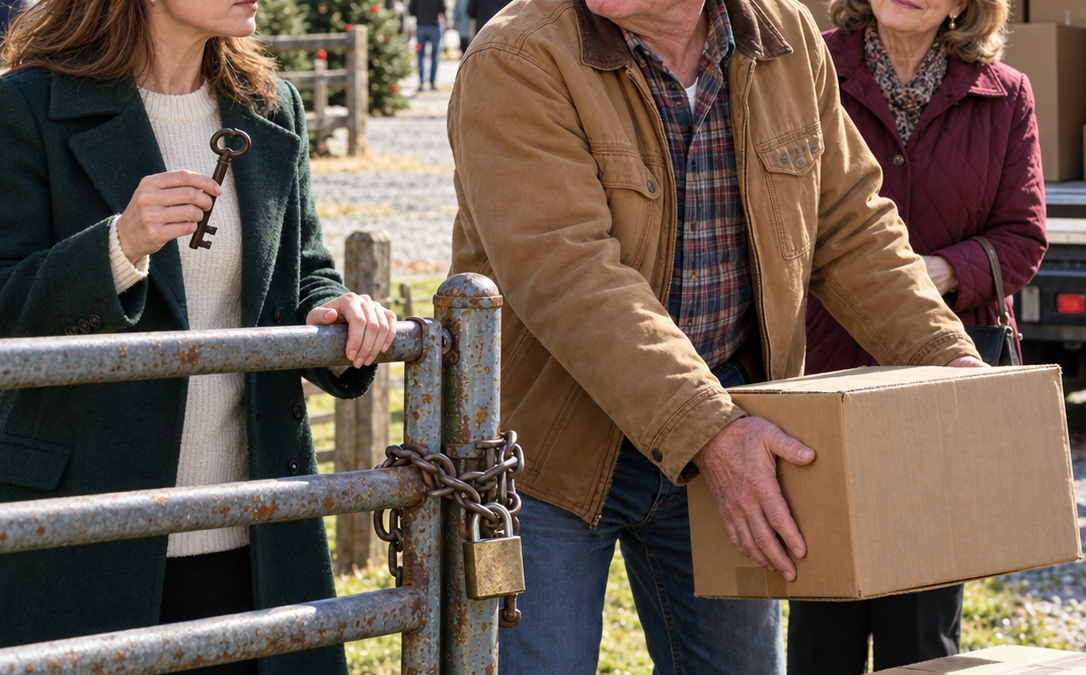
I held Ida’s iron key.
He waited.
It was eleven that Saturday morning, and about eighty customers stood in the lot at Tatro Tree Farm.
They had heard him.
A little boy stopped dragging his tree toward the wrapping stand, and his father caught the trunk before it tipped.
Nobody moved.
The truck had backed toward the gate until I raised my hand and stood against the latch.
Cliff had gotten out anyway.
He hadn’t brought a suitcase.
He had brought furniture.
Through the raised door, I could see a table wedged beside a mattress and a lamp wrapped in a towel.
No phone call. No asking. A whole moving truck.
Heat climbed up my neck.
I was forty-one years old, standing outside the house Grandma Ida had left me, and my father had called me a stray.
In front of my customers.
I looked toward my farmhand.
He had worked beside me for twelve years, through broken equipment, muddy planting days, and mornings when the trees wore solid ice.
He looked at his boots.
Nothing.
I was the girl who had stood outside my father’s place in Keene with a duffel bag at seventeen.
The girl who had gone to Ida after he put her out on October 13, 2001.
The girl who had kept working beside her grandmother until this farm became the place she knew how to belong.
Cliff turned toward the lot.
He raised his voice.
“My daughter invited us home for Christmas. She’ll sell you a tree and leave her father in the cold.”
A woman lowered her receipt.
I wanted to say Dad.
The word was still there after twenty-four years, ready to leave my mouth as if saying it correctly might make him act like one.
I swallowed it.
“That’s not how it went.”
“Come on, kiddo,” Cliff said.
“You need to load those.”
“We’ve been driving.”
“I didn’t ask you to.”
My fingers hurt around the key.
Darla climbed down from the passenger side and pulled her coat closed before looking at the farmhouse behind me.
Then Darla looked at the customers.
“We’re only asking for family,” Darla said.
“You brought a moving truck.”
“It’s Christmas,” Darla said.
“It’s November twenty-ninth.”
Darla’s smile stayed in place.
Cliff set another box beside the gate, directly against the bottom rail.
I stepped back.
“Don’t put that there.”
“Then open up.”
“No.”
The answer came out clearly.
My heart was pounding hard enough that I felt it beneath my coat collar, but I had already decided.
The gate stayed locked.
Cliff rested his palm on the top rail as if we were talking across a kitchen counter.
“Your grandma wouldn’t have left us standing out here.”
I felt sick.
Behind him, a customer shifted a bundled tree from one shoulder to the other.
I knew that look.
He wanted his tree loaded, his children in the car, and this family argument somewhere he didn’t have to hear it.
So did I.
But Cliff had chosen here.
I put the key in my coat pocket and took out my phone.
Cliff watched my hand.
“You calling somebody?”
“I’m reading what you sent.”
“We can settle this inside.”
“We can settle it here.”
My thumb missed the message thread.
I tried once more.
The screen opened beneath his name, with messages I had left unanswered and had hoped I wouldn’t need to look at again.
My fingers wouldn’t stay steady.
I raised the screen toward him.
“November second,” I said.
“Mandy.”
“‘Saw your farm on TV. Must be nice.'”
“That’s your father talking.”
“November sixteenth.”
Cliff took his hand off the rail.
I didn’t look up from the screen.
“‘We’re coming whether you answer or not.'”
A car door closed.
“I never answered,” I said. “Load your boxes and leave my land.”
Dead still.
Darla stopped smiling.
Cliff looked past my shoulder toward the farmhouse porch, where Ida’s old boot scraper still stood beside the door.
He pointed at the keyhole.
“You’re really going to keep that locked?”
“Yes.”
“With people watching?”
“Yes.”
His mouth tightened.
I hadn’t raised my voice, and I wasn’t going to give him an argument he could carry around town without the beginning attached.
I lowered the phone.
Not an invitation. Not a misunderstanding. His own words.
A woman near the wrapping stand touched the man beside her.
They spoke quietly.
Then he picked up their tree and carried it back toward the display row.
My stomach dropped.
“We’re going to leave it,” the woman said.
“Okay,” I said.
“We haven’t paid.”
“I know.”
I couldn’t manage anything else.
Another family followed, pulling their tree away from the checkout line and leaning it back where they had found it.
Two families.
I watched their children climb into their cars.
I wanted to run after them and explain that I had not invited this, that I had opened the farm that morning expecting customers and work.
I stayed at the gate.
Cliff watched the cars leave.
“See what you’re doing?”
My cheeks went hot again.
“I’m asking you to leave.”
“You could end this.”
“Load the truck.”
He stared at me.
The box against the gate had started to sag where the grass was wet.
Cliff bent for it.
His hands shook.
He missed the bottom edge, caught the cardboard against his knee, and stood there holding it while Darla reached for the other side.
“Let go,” Cliff said.
Darla stepped back.
I hated seeing his hands tremble.
I hated that he could still make me want to help him while I was standing where he had chosen to humiliate me.
I kept my hands down.
The truck ramp rattled.
Cliff carried the box up and shoved it beside the mattress.
I moved along the fence.
From there, I could see the wrapping stand without leaving the gate out of sight.
My farmhand lifted his head.
“Keep going,” I said.
He nodded once.
The wrapping machine started, and a customer pulled his tree forward.
The sound helped.
I needed something ordinary to happen while Cliff loaded the things he had expected to carry into my house.
Darla gathered a loose packing strap.
“Where are we supposed to go?” Darla said.
“I didn’t arrange your move.”
“He’s your father.”
“I heard him.”
Darla looked away.
Cliff came down the ramp for another box.
Beyond his shoulder, the tree-lighting poster was fastened to the farm stand wall.
December thirteenth.
Five o’clock.
Ida’s fortieth lighting.
Cliff stopped beside it.
My fingers went cold.
I had flipped that switch with Ida from 2001 through 2023, standing close enough that our coat sleeves touched.
Now Cliff was studying the poster.
He looked toward the farmhouse yard, then back at me.
“What?” I said.
He picked up the box.
No answer.
I watched him carry it into the truck, and I couldn’t stop looking between the poster and the gate.
Darla climbed into the cab.
Cliff pulled down the cargo door and secured it before walking around to the driver’s side.
He moved slowly now.
Nobody offered to help.
I returned to the latch and checked it with my palm.
Still locked.
The engine started, but the truck stayed where it was.
Then the driver’s window lowered.
Picking up where the Facebook post left off
I took Ida’s iron key out of my pocket and held it where Cliff could see it.
He looked past it toward the lighting poster.
“See you at Mom’s lighting, kiddo. This year I flip the switch.”
Chapter 2: The Post With My Photo in It
He wasn’t asking.
Darla’s post appeared on my phone with a picture of Cliff beside the boxes at my locked gate.
The words above it said:
Her own father, homeless at Christmas.
My stomach tightened.
The photograph showed the farmhouse behind me and the key in my hand.
It didn’t show his messages.
Or what he’d said.
Someone had shared the post in the town community group, where people asked about plowing and advertised church suppers.
Now my name was there.
I opened the comments.
Then I stopped.
I couldn’t answer strangers while customers waited for their trees, so I put the phone beneath the counter and finished the sale in front of me.
The next call canceled.
So did another.
By Tuesday, fourteen reservations were gone.
I kept a list.
Some people said their plans had changed, and some simply asked me to remove their names.
One woman said more.
“We buy our tree as a family,” the woman said. “That picture upset my husband.”
“I didn’t invite them.”
“We just don’t want any trouble.”
The line went dead.
I crossed out the reservation.
Not a late pickup. Not a different tree. A canceled sale.
I set the pen down.
Marian Gagne came into the farm stand while I was still looking at the list.
Marian carried her gloves.
I knew her coat from years of seeing it beside Ida’s at the tree lighting.
I wanted help.
Instead, Marian looked at my phone.
“I saw the post,” Marian said.
“Then you saw part of it.”
“He’s your father. It’s Christmas, honey. I told him he can flip the switch, for Ida.”
I went cold.
“You told him?”
“He called me.”
“You should have called me.”
“I thought you’d calm down.”
My jaw hurt.
I had been pressing my teeth together without noticing.
“That wasn’t yours to promise.”
Marian laid her gloves on the counter.
“We’re trying to have a nice lighting,” Marian said. “Ida wouldn’t want people picking sides.”
“I didn’t ask for sides.”
“Then let him do this.”
“No.”
Marian’s hand stopped over the gloves.
The switch had been beside Ida and me through years of cold fingers and tangled cords.
Marian knew that.
Marian had stood close enough to watch.
“What did he tell you?” I said.
“That he wanted to come home.”
“He brought furniture.”
“People do foolish things when they’re hurt.”
“I told him to leave.”
Marian picked up her gloves.
I waited for a question about what Cliff had said to me at the gate.
None came.
Marian left the stand with the lighting still written on the committee calendar and Cliff still holding a promise I hadn’t made.
I stayed behind the counter.
My hands felt numb.
I opened Darla’s photograph once more, looking at the box against the rail.
Then I saved the post.
I didn’t answer underneath it.
I had work waiting.
By Friday morning, I had stopped checking the group while the stand was open.
A customer changed that.
The woman had paid for a wreath when she stayed at the counter and took out her phone.
“Can I show you something?”
I braced myself.
“It’s from before this happened,” the woman said. “I remembered seeing it.”
Darla’s name filled the screen.
Below it was a sale post dated November ninth.
I leaned closer.
Selling everything! Moving to our family farm in Vermont. Big farmhouse, finally ours.
I forgot the wreath.
The customer turned the phone so I could see the date without touching the screen.
November ninth.
Before Cliff’s message that they were coming whether I answered or not.
Before the moving truck.
“They were selling their things?” I said.
“That’s what the post says.”
“Could you send it to me?”
“Yes.”
I gave the woman my number.
My face burned, but this time I knew exactly what I was looking at.
Not a holiday visit. Not an unexpected emergency. A planned move.
Into my house.
The customer waited until the image reached my phone, then took her wreath.
I thanked her.
After the door closed, I went to the printer behind the counter.
The paper came out slowly.
I left the date visible.
Then I put the printout beside my cancellation list and called Harlan Kittredge.
He had been Ida’s lawyer for thirty years.
I needed his help.
“Harlan, it’s Mandy.”
“What’s happened?”
“My father brought a moving truck.”
“To the farm?”
“To the yard gate.”
I pressed the paper flat.
I told Harlan about the boxes, the messages, Darla’s photograph, and the promise Marian had made about the switch.
Then I read the sale post.
Harlan didn’t interrupt.
“Your estate deed is in your name,” Harlan said. “Since June.”
“I know.”
“Has he been inside?”
“No.”
“Keep the messages and that printout.”
I pulled a folder toward me.
I wanted him to tell me what I could do before the lighting, while there was still time to stop Cliff from arriving with an audience.
“Would Ida’s papers help?” I said.
“I’ll check what we retained.”
“Please.”
“The estate used her 2019 will.”
I heard a drawer close.
Harlan stayed on the line while he checked the index.
Then his voice slowed.
“There’s an older file listed under Ida’s will. From 2001.”
My thumb stopped against the folder.
“What kind of file?”
“I need to see it.”
“Do you have it there?”
“Storage. Three business days.”
I looked at the calendar.
“Wednesday?”
“December tenth,” Harlan said. “I’ll request it today.”
“The lighting is Saturday.”
“I understand.”
I wrote his date down.
I had never known there was an old file to ask about.
Until then, I had wanted somebody to help me keep Cliff outside the gate.
Now I wanted those papers here.
I put Darla’s printout in the folder.
The phone rang before I had closed it.
Harlan’s name showed on the screen.
I answered standing up.
“The index says ‘correspondence, Clifford Tatro, October 2001.’ Your father wrote to this office.”
Chapter 3: The Letter in Grandma’s File
He had.
Harlan laid a Keene-postmarked envelope on his desk, and I recognized my father’s handwriting.
I didn’t reach for it.
Not yet.
It was Wednesday, December tenth, and the retrieved file lay open between us.
Harlan waited.
I could see the date on the letter before I touched it.
October 22, 2001.
Nine days after my father had put me out.
“Is that the original?” I said.
“Yes.”
“May I?”
“That’s why I asked you here.”
I took the page.
The handwriting looked familiar enough to make my stomach hurt.
I started at the top.
I have no daughter.
I stopped.
There was no confusion about who he meant.
I had been seventeen, staying with Ida, while my father sat down and wrote those words to her lawyer.
I kept reading.
Keep her.
My face burned.
I held the bottom corner against the desk so Harlan wouldn’t have to watch the paper tremble.
Not an argument. Not words I remembered wrong. His handwriting.
“Take your time,” Harlan said.
“I want to finish.”
“Go ahead.”
I moved my finger down the page.
I want nothing from that farm or from my mother, ever.
Nothing.
I had heard him call it his mother’s farm at the gate.
I had watched him carry boxes toward the house he now wanted to live in.
This was what he had written.
Don’t write me again.
Below that was his name.
Clifford Tatro.
I put the page down.
Harlan stayed quiet while I flattened my hands on my thighs.
I felt close to tears.
I wanted to carry the letter straight to Cliff and make him look at it.
I did neither.
“Did Ida see this?” I said.
“Yes.”
“What did she do?”
“She rewrote her will the next month. She left the farm to you.”
My throat tightened.
“Back then?”
“In November 2001,” Harlan said. “The will used for her estate was the later one, from 2019.”
I looked toward the envelope.
Grandma had taken me in without asking me to make a case against my father.
I hadn’t known what else she had done.
“Why didn’t this come up before?” I said.
“The old file went into storage in 2002.”
“You didn’t remember it?”
“No, Mandy. I didn’t.”
Harlan left his hand beside the folder.
I believed him.
He hadn’t tried to make forgetting sound like anything else.
“Can I take it?” I said.
“I’ll give you a copy. I’ll keep the original safe here.”
“With the envelope?”
“Yes.”
He let me release the page before lifting it from the desk.
I watched him carry it to the copier.
My phone vibrated inside my coat.
Then again.
I stepped into the hallway to check it while Harlan worked.
There were messages from three wreath volunteers.
Three withdrawals.
The wreath work had been arranged, with names beside the jobs and people I had counted on coming.
Now they weren’t coming.
I opened a message.
After seeing Darla’s post, I don’t feel comfortable being involved.
I called that volunteer.
The woman answered quietly.
“Did you see what he sent me?” I said.
“I saw the picture.”
“He came without an invitation.”
“I don’t want to get between family.”
“You’re making wreaths.”
“I think it’s better if I stay away.”
The call ended.
I stood beside Harlan’s office door with the phone against my coat.
Nobody had asked me.
The other messages referred to Darla’s post, too.
I checked the names against the wreath list on my phone.
Three empty places.
I hadn’t even gotten back to the farm.
When I returned to the chair, Harlan put a copy of the letter in front of me.
“Bad news?” he said.
“Three wreath volunteers quit.”
“Over the post?”
“Yes.”
I laid the phone facedown.
For a moment, I couldn’t look at the letter or the screen.
I looked at Harlan instead.
“I told him to leave. In front of customers.”
“I know.”
“Doesn’t that count?”
“It counts as telling him to leave that day.”
Harlan drew a clean sheet toward him.
“‘Leave’ isn’t ‘never come back,’ and your poster says everyone welcome. Name him in writing; a deputy hands it over.”
I sat straighter.
“Before Saturday?”
“We’ll try.”
“And Darla?”
“Name her, too.”
He picked up his pen.
I had been trying to make people understand what happened at the gate.
Harlan was asking me to decide what happened next.
“Neither of them has permission,” I said.
“To enter the farm?”
“Or stay there.”
“I’ll put that clearly.”
I watched him write their names.
Clifford Tatro.
Darla Tatro.
Not a family request. Not another argument. Written notice.
Harlan moved to his computer and began drafting it.
“Will the letter keep him away?” I said.
“The notice tells him to stay away.”
“And if he says the farm is his?”
“The estate deed is in your name. His letter isn’t what makes you the owner.”
I nodded.
I needed to hear that.
I didn’t have to prove that my father had hurt me badly enough to keep my own house.
Harlan printed the notice.
He placed it beside the letter’s copy, then pointed to the names and the property description.
“Check these,” he said.
I did.
“That’s right.”
“Once you sign, I’ll arrange for Deputy Dutton to deliver it.”
I picked up the pen.
Saturday was getting close, and I didn’t know where Cliff and Darla were staying.
“Can he find them in time?”
“I can’t promise that.”
Harlan’s answer made my fingers tighten.
The lighting was still on the calendar.
Marian had still promised Cliff the switch.
I signed the notice.
Then I looked at the original in Harlan’s folder.
“Bring that letter to the lighting.”
Chapter 4: The Deputy at the Motel Door
Harlan agreed.
By Thursday, the signed notice was in Deputy Dutton’s hands, but Cliff wasn’t.
The deputy called me from Randolph.
I stood inside the farm stand with a length of wreath ribbon caught beneath my elbow.
“They’ve checked out,” Dutton said.
“Of the motel?”
“Yes. The room’s empty.”
“Did they leave an address?”
“No.”
I pulled the ribbon free.
Cliff had blocked my number.
I couldn’t reach him, but he still knew where to find me.
“What happens now?” I said.
“I’ll keep trying to locate them.”
“And the lighting?”
“If he shows Saturday, I’ll hand it to him there.”
My grip tightened.
“Before he gets near the house?”
“Keep the yard gate locked. If he arrives, let me speak to him.”
“And Darla?”
“Her notice is with his.”
I thanked him.
After the call, I looked through the stand window toward the farmhouse.
The porch was empty.
I had caught myself checking it whenever a vehicle turned into the lot.
I hated that.
I wanted to finish the wreaths and get ready for the lighting without wondering whether my father was walking toward my door.
The phone rang again.
Harlan.
“Deputy Dutton reached you?” he said.
“Yes.”
“I’ll be there Saturday.”
“With the letter?”
“With the original.”
I sat on the stool.
Darla’s printed sale post lay beside my copy of Cliff’s letter.
My phone held his messages.
I had kept the pages together, but I hadn’t decided how to use them without getting pulled into another argument.
Harlan helped me do that.
“Let him speak,” Harlan said.
“What if he says I invited them?”
“Use his message.”
“And when he denies planning the move?”
“Use Darla’s post.”
I smoothed the corner of the printout.
“If he says he never put me out?”
“Then I’ll read his letter.”
“After that, the deputy?”
“Yes.”
I wrote it down.
Not a speech. Not a shouting match. His own words.
I could manage that.
I didn’t have to tell the yard what it had felt like to stand outside in Keene with my duffel bag.
I didn’t want to.
“What about Marian?” I said.
“What about her?”
“She promised him the switch. She might tell people to let him stay.”
Harlan paused.
“She might.”
I appreciated the plain answer.
Marian had known Ida longer than I had been alive, and people listened when Marian told them what Ida would have wanted.
I listened, too.
That was what hurt.
“What if she won’t listen?” I said.
“You can show her the evidence. You can’t choose her answer.”
“I know.”
“Keep the notice separate from the argument. You own the property.”
I put the pen down.
My name was on the deed.
I needed to remember that when Cliff called me kiddo.
Harlan ended the call after we agreed where he would meet me.
I left the papers together.
The next morning, I was behind the counter when a text arrived from a number I didn’t recognize.
I opened it.
Tomorrow I flip Mom’s switch and I sleep in Mom’s house. Try stopping me in front of the whole town.
My mouth went dry.
There was no greeting.
No question.
I knew who had sent it before I reached the end.
Cliff had blocked me, then found another way to tell me what he intended to do.
I saved the message.
Then I sent it to Harlan.
He called shortly afterward.
“Did you answer?” he said.
“No.”
“Keep it that way. I’ll make sure Deputy Dutton sees it.”
“He thinks the crowd will make me open the house.”
“Will it?”
“No.”
I surprised myself with that answer.
My stomach was tight, and I still dreaded having people watch.
But I wasn’t deciding whether Cliff could move in.
I had already decided.
That afternoon, I walked out to the yard gate.
The latch met the post.
I turned Ida’s iron key and pulled against the rail until I was certain the lock had caught.
No give.
I checked the farmhouse door next, then went back down the porch steps.
The key went into my coat.
I kept my hand over it.
Not a place for his furniture. Not a promise Marian could make. My home.
I stayed outside until my face cooled.
By Saturday afternoon, the yard was ready for the lighting.
The tree stood dark.
The ticket sheet showed eighty tickets at twelve dollars each.
Nine hundred and sixty dollars for the food shelf.
I checked the figures and put the sheet away.
Those people had paid to come here for the tree, the lights, and cocoa.
I wanted them to have that.
I wanted it, too.
Marian arrived with the switch box.
My chest tightened.
“Where do you want this?” Marian said.
“Beside the tree, as usual.”
“Have you spoken to your father?”
“No.”
Marian waited.
I didn’t explain the notice.
Harlan would be there, and so would Dutton.
I wasn’t going to try the whole argument on Marian before Cliff even arrived.
Marian carried the box away.
I watched the cord uncoil behind her.
Still his promise.
Marian hadn’t said anything about taking it back.
Harlan reached the yard while the parking volunteer was getting into position by the entrance.
He wore a heavy coat.
I met him near the porch.
“Do you have it?” I said.
He touched his coat pocket.
“Here.”
“The envelope, too?”
“Yes.”
I looked toward the lot.
Deputy Dutton had arrived, and I could see him speaking to the parking volunteer.
My knees felt weak.
Harlan stood beside me.
“You don’t have to hurry your answers,” he said.
“I won’t.”
“And you don’t have to fill the silence.”
I nodded.
The first guests were coming up from the lot, carrying mittens and calling to people they knew.
I put my hand in my pocket.
Ida’s key was there.
Then, at four forty, I heard a larger engine near the entrance.
The parking volunteer stepped aside.
Cliff’s moving truck rolled through the farm entrance, straight past him.
Chapter 5: The Switch at the Tree Lighting
He had brought it back.
By five o’clock, Cliff stood beside the dark tree with Darla and a moving box.
Eighty guests filled the farmhouse yard.
I stood near Harlan.
Marian held the switch box against her coat while a child near the front counted the unlit bulbs within reach.
Cliff stepped beside Marian.
He took the box.
Marian let him.
“My daughter invited us home for Christmas. Tonight we move into my mother’s house.”
Nobody moved.
I could see the locked gate beyond his shoulder and the truck waiting outside the yard.
I took out my phone.
“I didn’t.”
Cliff smiled toward the guests.
“Come on, kiddo.”
I opened his message.
“‘We’re coming whether you answer or not.’ That’s what you sent me.”
His smile faded.
“I didn’t answer,” I said.
A man near the cocoa table lowered his cup.
I kept the screen facing outward, though the people at the back couldn’t have read it.
Cliff could.
He knew those words.
“We didn’t plan any of this. She begged us.”
Another lie.
Darla tightened her arms around the moving box.
I slid the phone into my pocket, then unfolded the printout I had brought from the stand.
“November ninth,” I said.
Darla looked at the paper.
“This is your sale post.”
“Mandy,” Darla said.
I held it higher.
“‘Selling everything! Moving to our family farm in Vermont. Big farmhouse, finally ours.'”
The box slipped.
It hit the ground at Darla’s feet, and the cardboard split along a corner.
A thud.
Darla left it there.
Not a visit. Not an invitation. A move they had planned.
I looked at Cliff.
“You posted that before you came.”
“You’ve got your house,” Darla said.
“Yes,” I said.
Cliff stepped between us.
I didn’t step back.
The switch box hung from his hand now, the cord stretched toward the tree.
“I never threw her out. She ran off, and we begged her to come home.”
My face burned.
There were children in the yard and people who had known Ida, and he had said it as easily as he had called me a stray.
I looked at Harlan.
He came forward.
Harlan took the envelope from his coat pocket and drew out the page I had held in his office.
Cliff watched it.
“This was sent to my office,” Harlan said. “October 22, 2001. The envelope bears a Keene postmark.”
“That’s old business,” Cliff said.
“It’s your correspondence.”
Harlan unfolded the letter.
Not a copy. Not a memory. His signed original.
Harlan held the page where the nearest guests could see the writing.
Then he read it aloud.
I have no daughter. Keep her.
Cliff went pale.
Harlan continued.
I want nothing from that farm or from my mother, ever. Don’t write me again. Clifford Tatro.
No one spoke.
I pressed my fingertips against the folded sale post.
I had known what was coming, but hearing my father’s words in that yard still hurt.
Harlan turned the page outward.
“Your signature,” Harlan said.
Cliff looked away.
I watched Marian lean forward to see it, then look at the envelope in Harlan’s other hand.
“I was angry. People write things they don’t mean.”
Harlan kept the letter raised.
“You sent it,” Harlan said.
“I was her father.”
“You wrote that you had no daughter.”
Cliff’s jaw tightened.
He lifted the switch box slightly, as if reminding the guests why they had gathered.
“Family doesn’t need a piece of paper to come home.”
I felt the key through my pocket.
I wanted to answer.
Marian moved before I could.
Marian reached for the switch box, but Cliff held on.
“Give it to me,” Marian said.
“Now, Marian.”
“Give it to me.”
Cliff released it.
Marian carried the box across the space between us and put it in my hands.
It felt cold.
Then Marian turned back to Cliff.
“You sat in my kitchen and told me she shut you out. Ida waited for you to write again until she died in 2024.”
Cliff said nothing.
Marian stayed beside me.
I hadn’t known how badly I wanted that until Marian was there, looking at him instead of asking me to calm down.
Dutton stepped forward.
He held the written notices.
“Clifford Tatro,” Dutton said.
Cliff looked at the deputy.
“This is family.”
“Mandy owns this property. The estate deed has been in her name since June.”
Harlan stood with the letter.
Dutton handed Cliff his notice, then addressed Darla by name and handed Darla hers.
Darla took the paper.
Cliff held his by an edge.
“These are Mandy Tatro’s written notices against trespass,” Dutton said. “You do not have permission to enter or remain on this property.”
Darla glanced toward the truck.
“If you return after this notice, you can be cited for unlawful trespass.”
Cliff looked at me.
I held the switch box steady.
“You’ve been told. Leave now.”
Dutton waited.
Cliff bent to pick up the fallen box, but the split corner opened farther.
Darla caught the bottom.
I could hear their shoes against the ground as they lifted it together.
They stopped near the gate.
Cliff turned toward me.
I didn’t need the microphone.
“You wanted nothing from this farm, Dad. Now you have it.”
His face tightened.
I flipped the switch.
The tree lit above us, from the low branches beside the children to the lights near the top.
A child clapped.
Then other hands joined.
I watched Cliff and Darla carry the box out while Dutton walked behind them.
The truck engine started.
I stayed beside Marian until the vehicle had turned around and headed down the drive.
Then it was gone.
Harlan returned the letter to its envelope.
I loosened my grip on the switch box and looked toward the cocoa table, where cups still waited in their rows.
“Please stay for cocoa,” I said.
The guests began moving.
Marian took the microphone.
“I took Cliff’s side, and I owe Mandy an apology.”
Chapter 6: The Citation at the Farm Stand
Marian meant it.
On Sunday, my phone lit up with a message from the town group’s administrator.
Darla’s photograph had been removed.
Gone.
The administrator had banned Darla, too.
I checked the group myself, then set the phone beside my breakfast plate.
I could still picture that photograph.
But other people wouldn’t keep finding it there.
The first family called before I had cleared the table.
“Can we have our reservation back?”
“Yes,” I said.
“We heard what happened at the lighting.”
I reached for the booking book.
I didn’t ask who had told them or how much they had believed before Saturday.
I wrote their name down.
The calls kept coming.
By the end of Sunday, the fourteen families who had canceled had rebooked.
Fourteen.
I matched the names against my cancellation list before putting it away.
One woman apologized.
“I should have asked you,” the woman said.
“I wish you had.”
“I know.”
I kept the booking.
During the week, the weekly paper printed Marian’s correction.
Marian brought me a copy.
“I wanted people who weren’t there to see it,” Marian said.
I laid it on the counter.
My fingers rested beside the paragraph where Marian corrected the claim that I had invited Cliff and Darla to move in.
“Thank you,” I said.
“I should have listened sooner.”
“Yes.”
Marian nodded.
There wasn’t an excuse after it.
I folded the paper and kept it.
Not another argument. Not a plea for people to believe me. A correction they could read.
The farm stand stayed busy.
I still looked toward the entrance when an engine slowed, but I had work to do and customers waiting.
Then Cliff came back.
It was Saturday, December twentieth.
I saw him through the stand window as he walked toward the door.
No moving box.
I stayed behind the counter.
He stopped outside, close enough that I could hear him through the open doorway.
“I came just to talk.”
“You were told not to come back.”
“Come on, kiddo.”
“You need to leave.”
He stayed.
I picked up my phone.
Cliff watched me make the call to Deputy Dutton.
“You’re calling him?”
“Yes.”
“Over a conversation?”
“Over you coming back.”
My mouth felt dry.
I gave Dutton the information he needed and stayed inside the stand.
Cliff waited near the door.
He looked toward the farmhouse, then down the drive, as if somebody else might arrive and settle this differently.
Nobody did.
I didn’t go outside to comfort him or explain the notice again.
I had explained enough.
When Dutton arrived, I stepped to the doorway.
The deputy approached Cliff calmly.
“You received the written notice here on December thirteenth,” Dutton said.
“I wasn’t causing trouble.”
“You returned after being told you did not have permission.”
“I wanted to speak to my daughter.”
Dutton took out his paperwork.
Cliff looked at me.
I kept my hand against the doorframe.
I was upset, and I wanted him gone, but I wasn’t going to argue while the deputy did his job.
Not a warning. Not another chance to pretend he hadn’t heard. A citation.
Dutton cited him for unlawful trespass.
Cliff stared at the paper.
“There’s a court date in January,” Dutton said.
“You’re serious?”
“Yes.”
Dutton waited.
Cliff took the citation and folded it badly, leaving one corner sticking up beneath his thumb.
“You got what you wanted,” Cliff said to me.
“I wanted you to stay away.”
He looked down.
No apology.
Dutton told him he needed to leave the property.
Before Cliff turned toward the lot, he gave me the rest.
“We can’t go back to Keene.”
I didn’t answer.
“The rental’s already re-let.”
He waited.
I could feel what he wanted me to say, and my chest tightened at the thought of opening the farmhouse door just to make this conversation stop.
I kept my hand where it was.
“Where are you going?” I said.
“Darla’s sister. Concord.”
“New Hampshire?”
“Her basement.”
He shoved the citation into his coat.
“We’ve moved into her basement,” Cliff said. “That’s where we’re living now.”
I looked at Dutton.
The deputy stayed beside the path until Cliff walked away from the stand.
I watched him leave.
Then I closed the door.
For a while, I couldn’t make myself move from the window.
I was sad.
I was also relieved that I hadn’t opened the house to him.
The next customer knocked lightly, holding up a wreath.
I let her in.
A few days later, Harlan brought Ida’s old file to the farmhouse.
I made room on the kitchen table.
“Did he leave without coming back?” Harlan said.
“Yes.”
“The citation?”
“January court date.”
Harlan nodded and set the folder down.
I made coffee.
When I returned, Harlan had laid the file beside the copy of Marian’s correction I had brought home from the stand.
“Is the original in there?” I said.
“Yes. Keep the envelope with it.”
“I will.”
Harlan opened the folder to show me where he had secured the letter.
I sat down.
I didn’t want to read Cliff’s words again, but I wanted to know where they were.
Harlan lifted the clipped pages.
Then he stopped.
“What is it?” I said.
“There’s another envelope behind this.”
I leaned forward.
It was smaller than Cliff’s envelope, with no stamp or postmark.
Still sealed.
Harlan eased it free and checked the flap.
“I hadn’t seen this,” Harlan said.
“Who wrote it?”
He turned it toward me.
Ida’s handwriting.
My hand stopped beside my cup.
Across the front, Grandma had written:
For Mandy, if he ever comes for the farm.
Chapter 7: The Key on Grandma’s Nail
I left it sealed.
Ida’s envelope lay beside my plate when Darla called in January.
I recognized her voice.
I didn’t say much.
“It’s Darla,” Darla said.
“I know.”
“It was my idea. I saw the farm on TV and told him it was his.”
I looked at Grandma’s handwriting.
For weeks, Darla had let people believe I had left my father homeless at Christmas.
Now Darla had said what happened.
“Thank you for telling me.”
I hung up.
No argument.
I set the phone facedown, then moved my breakfast plate away from the envelope.
The flap was still closed.
I had wanted Ida’s words, but I had been afraid of what opening that last message would feel like.
My fingers rested on it.
Not a deed. Not instructions for a lawyer. A note for me.
I slid a finger beneath the flap.
The paper tore along the edge, and I stopped before I damaged what was inside.
Then I eased it open.
Her handwriting.
I unfolded the note at the kitchen table where Ida had helped me fill out forms and taught me to keep the farm accounts.
The message was short.
He’ll come when it’s worth something. Don’t open the gate because he’s sorry. Open it for the people who stayed.
I cried.
I stayed in my chair with the page beneath my hand until I could see the words clearly.
There wasn’t another page.
Nothing else.
I wanted more because I missed her, but I didn’t turn the envelope over looking for a message she hadn’t written.
I folded the note carefully.
Then I put it back.
Cliff’s apology came by mail later that month.
His handwriting was on the envelope.
I carried it into the kitchen and opened it standing beside the counter.
This time, he admitted putting me out.
He said he was sorry for lying about it at the lighting.
I sat down.
There was no truck waiting outside and no audience for him to persuade.
I could take my time.
I made tea and left the letter beside the cup while it cooled.
I thought about his hands shaking as he loaded the boxes.
I thought about him returning after the notice.
I still felt sad.
I didn’t want another conversation in which sadness became a reason to let him into my house.
So I found paper.
My reply was short.
I forgive you. The gate stays locked.
I signed my name.
Not another invitation. Not a promise to start over. My answer.
I put it in an envelope before I could add explanations he might treat as the start of a negotiation.
Then I mailed it.
Cliff didn’t come back.
I kept his apology in the file with the other papers, but Ida’s note stayed where I could reach it.
Spring work arrived gradually.
The ground softened, and I stopped wearing the heavy coat that had carried Grandma’s key through the lighting.
I moved the key to its nail.
Ida’s nail.
It was beside the farmhouse door, where I could take it down without looking.
By Saturday, May sixteenth, the seedlings were ready.
Six hundred.
I checked the bundles before the planting crew arrived, then carried tools out to the fields beyond the farmhouse yard.
Marian came in work gloves.
Harlan brought a shovel.
Deputy Dutton arrived with his kids and a reminder that he was off duty.
“Mandy knows that,” Harlan said.
“I’m telling them,” Dutton said.
One of the children had already reached for a tool.
I smiled.
We gathered near the first row, where I showed them how deep the roots needed to go.
Harlan watched closely.
“Straight down?” Harlan said.
“Yes. Don’t fold them underneath.”
“Tell me if I do it wrong.”
“I will.”
He nodded seriously.
Marian worked beside me until she was sure she had it right.
Then Marian moved down the row.
There were pauses for water and a search for a glove that turned out to be tucked into a coat pocket.
I didn’t mind.
Nobody was counting my patience or waiting for me to prove I deserved to be there.
We were planting trees.
At one point, Dutton’s youngest struggled to hold a seedling upright while pushing soil around its roots.
“Dad?”
“I’m here,” Dutton said.
He crouched beside the child.
Dutton held the little trunk steady and waited while small hands worked the earth into place.
He waited.
The child looked up.
“Like that?”
“Like that.”
I turned toward the next bundle.
I hadn’t been too old to need my dad, and I wiped my cheek with my sleeve.
Marian saw me.
Marian didn’t ask what was wrong or tell me to enjoy the day.
A hand settled on my shoulder.
I leaned.
I hadn’t meant to, but Marian stayed close while I pressed my lips together and tried to stop crying.
Nobody called attention to it.
Harlan picked up the bundle I had been reaching for and carried it to the next row.
I stood there empty-handed.
For a minute, I let them.
Then Marian squeezed my shoulder and bent to collect her shovel.
I followed with the seedlings.
We kept working.
By late afternoon, six hundred young trees stood in the ground.
I walked the last row, checking for exposed roots, while Harlan gathered the tools.
“Did we get them right?” Harlan said.
“We did.”
“Good.”
He looked tired.
So was I.
Dutton’s kids wanted to know how long it would take before the trees were taller than they were.
“Keep coming back,” I said. “We’ll check.”
Marian lifted the tool bucket before I could reach it.
“I’ve got this.”
“Okay.”
I let go.
We walked back toward the farmhouse yard together, with dirt on our gloves and the children moving ahead of us.
The gate was locked.
I reached into my pocket for Ida’s iron key.
Harlan waited with the crew while I fitted it into the lock.
I turned the key.
Then I opened the yard gate for them.
After the planting crew came through, I hung it back on Ida’s nail beside the farmhouse door.
THE END







