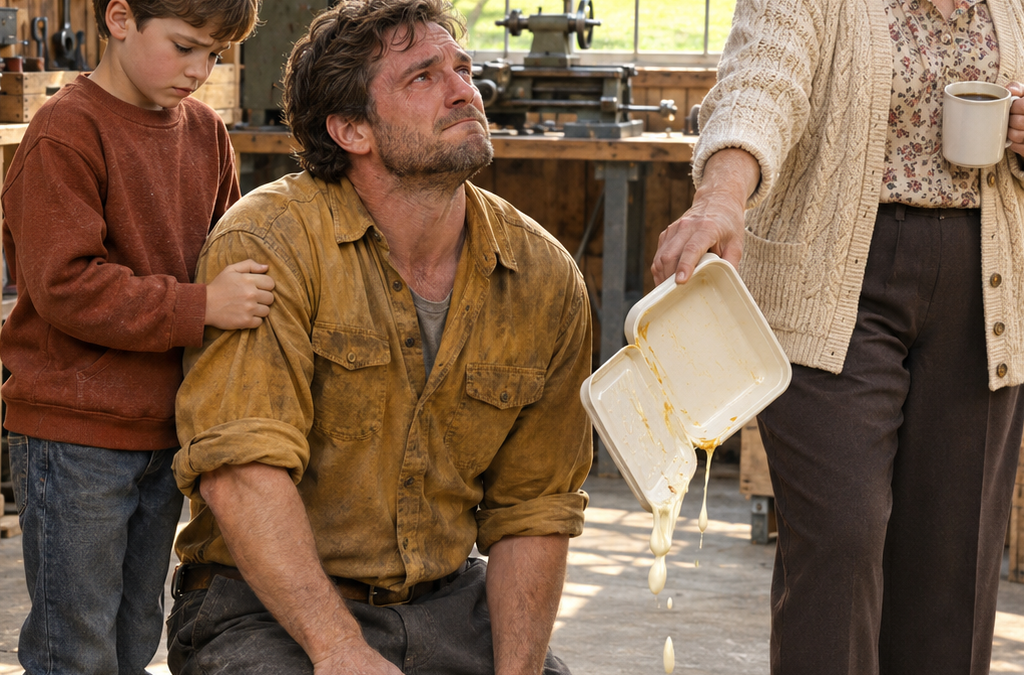
“Eat outside with the other rubbish”—my mother-in-law tipped my lunch onto Grandpa’s storage-room floor as my son watched his widowed father kneeling there.
Chapter 1 of 7
“Eat outside with the other rubbish.” My mother-in-law, Carol Price, pointed toward the back door.
“Ben and I can eat here,” I said.
My son, Ben, was eight, and he stood beside the doorway clutching the sleeve of my work shirt while mayonnaise soaked into the dust beside my knees.
The low sorting crate had held my open lunch container. Carol had tipped it without spilling her coffee.
“Are you going to let her do this?” I asked her brother, Neil Brooks.
Neil studied a shelf instead.
Behind him, Grandpa’s brass lunchbox sat among things marked for auction. A tag hung from its handle. The pickup cart rattled closer from the kitchen.
Nobody answered me.
I’m David Miller. I’m thirty-nine, and I’m raising my son alone. We live in Dayton, Ohio.
Grandpa left $240,000 to me, and my mother-in-law took it to support her own household.
Back then, kneeling beside my sandwich, I knew about the gift. I didn’t know what Carol had told people about it.
My late wife had been gone twenty months, and I still brought extra food to family gatherings because arriving empty-handed seemed like giving Carol another reason to complain.
That morning, I’d finished a repair shift before making the sandwiches.
Above Neil, the shelf I’d repaired held Carol’s holiday dishes. Ben’s old drawings remained taped to Grandpa’s crate. One showed Grandpa with six fingers and a purple lawn mower.
I had made keeping the peace look like permission.
Before lunch, I’d held the box. Its loose inner tray caught on a hard edge underneath. A corner of black casing showed through the gap.
Grandpa had dictated measurements and reminders for years instead of writing them down.
Neil tied an auction tag to the brass lunchbox Grandpa had given me.
Now Neil reached for its handle.
Carol shoved the clean sorting crate away with her shoe. She told me to finish separating the things on the floor.
“Just do what she asks today,” Neil said.
My knees hurt through my work pants, but Ben’s grip on my sleeve hurt worse. He was watching my face for instructions.
Carol had left the bread heel beside my knee, and Ben kept looking from that flattened sandwich to the clean container that still held his own lunch.
“You want Ben to watch me eat that?”
“Then teach him to do as he’s told.”
Neil finally looked at us. “Don’t make Ben watch another argument.”
Those words hurt more than her insults.
Then Carol pointed again. “TAKE YOUR FOOD OUTSIDE!”
“We’re not eating off the floor.”
I stood, keeping Ben beside me, and moved to the open doorway. Carol told Neil to get the tagged things onto the cart.
But Neil hadn’t lifted the box yet.
From the doorway, I called James Walker, Grandpa’s estate lawyer. He was elsewhere in the house sorting papers, and I kept my voice low.
“Carol says you gave her your inheritance for her house.”
I told him I hadn’t given it away. He said he hadn’t accepted her explanation.
“Carol, you told him I gave you my inheritance?”
She watched me from beside the crate without answering. Ben leaned against me; people here had been discussing a promise I’d never made.
The cart stopped outside the storage room. Neil carried Grandpa’s lunchbox toward it.
James came through the doorway with his briefcase. Linda Hayes, Grandpa’s former nurse, followed; she’d come to identify the medical belongings.
James caught the handle before Neil could lower the box. He removed the auction tag and put the box in my hands.
“I’m running the sorting here,” Carol said.
“Grandpa set this aside for David.”
Linda looked at the loosened tray, then touched the lunchbox. She turned toward Carol.
Carol’s hand stopped above the cart handle. She kept it there.
“Carol, tell him why you sent me away.”
“You sent me away after Grandpa said the money belonged to David.”
Carol’s fingers tightened around the cart handle until her knuckles whitened.
“You were paid to care for him.”
Linda stayed beside me, though her mouth trembled.
“Leave the personal gifts there until I check them,” James told Neil.
Then he stepped between the cart and the shelf.
Neil let his hand settle against the shelf without looking at me.
I remembered Linda’s blue coat from Grandpa’s porch. She’d answered his door and told us he was resting.
And I had taken Ben home without seeing him.
“You told me Linda didn’t want visitors,” I said to Carol.
Carol looked past me at my son.
“We’re not doing this in front of him.”
But she had let him watch her dump my lunch.
“He’s already here,” I said.
Linda kept watching Carol. I turned toward Neil.
He had visited when we were told another visit would exhaust Grandpa.
He’d come back talking about television shows and the neighbor’s barking dog.
But he had never mentioned Grandpa asking for us.
Ben’s purple lawn mower drawing was still on the crate. He’d made it after a canceled visit so Grandpa would know he hadn’t forgotten him.
Neil gripped the shelf, and it creaked beneath his fingers.
His face drained as he looked at Ben.
“Carol said you wouldn’t let Grandpa see Ben,” Neil said.
“Who told you I barred my own son from seeing him?”
The question came out louder than I intended. Ben pressed against my leg, and I lowered my voice before saying anything else.
“Neil. Who said that to you?”
He looked at Carol.
“Stop talking and help me finish,” she told him.
Neil’s lips parted, then closed again. I knew that look. I’d worn it at enough dinners, waiting for a less dangerous moment to say an ordinary thing.
There had always been a reason to wait.
Grandpa was tired. Carol was grieving. Ben was listening. My wife wouldn’t have wanted an argument.
I was ashamed of how often I’d accepted those reasons.
But I hadn’t kept Ben away.
Beside the shelf, James separated two small bundles from the auction pile and left them on the crate. He said they needed checking before anything else went out. No speech followed.
Carol waited for me to resume sorting.
I kept Ben beside me instead.
His sandwich was still in its container. I asked whether he wanted it, and he shook his head without looking at Carol.
That frightened me more than a complaint would have.
Ben usually wanted mustard spread all the way to the corners. That morning, he’d supervised mine like a foreman, pointing out a dry patch before I could close the bread.
Now he wouldn’t touch lunch.
“We’re done helping today,” I said.
Carol looked at the unsorted shelves. “You can’t leave everyone else with your work.”
I didn’t bend down again.
Linda remained by the door, leaving enough room for Ben and me to pass. James waited beside the cart. Neil stared at the drawing taped to Grandpa’s crate.
Then he spoke so quietly I almost missed it.
“She told him you refused his last call.”
Chapter 2 of 7
“‘David won’t take your call. He wants you to stop asking.’ That’s what Carol told him,” Neil said. “I was there.”
I stood in my kitchen with my phone on speaker. The day before, Carol had told me Grandpa believed I’d refused him. Now I had the words she’d used.
She’d told me he wanted no visitors. Neil admitted he’d repeated her account to Ruth, their older sister, without asking me.
“Did he believe her?” I asked. Neil said Grandpa had turned toward the window. He hadn’t asked again while Neil was there.
That hurt. I could picture the chair, the window, the driveway he’d watched whenever Ben and I were expected.
Carol had called me six times since the sorting session. I hadn’t answered. When Neil called the next morning, I answered because he’d finally begun telling me something true.
“You answer when this family calls you.” Carol’s voice came through sharply. Neil explained that he was at her house and had me on speaker.
I’d thought I was talking to him alone. I felt foolish for expecting even that much privacy.
Behind me, Ben sat at the kitchen table drawing roads across scrap paper. I moved into the hallway, where I could still see him but he couldn’t hear every word.
Neil said we needed to settle things before everybody got dragged in. Anna was gone, Grandpa was gone, and there wasn’t much family left to lose.
“Carol lost her daughter, David. You keep pushing her, everybody gets hurt. Ruth’s barely sleeping as it is. Can’t we get through one week without another fight?”
I’d heard versions of that since my wife died. Her mother’s grief required room. Mine required better manners.
I watched Ben make a bridge between two sheets of paper. For months, I’d accepted Carol’s “not today” messages because I was afraid of becoming another demand. I’d mistaken asking to visit for asking too much.
“What did you hear me refuse, Neil? A visit? A call? Tell me what I said, because I don’t remember you asking me anything.”
He started to explain that Carol usually handled the arrangements. I let him finish. Then I asked again.
“I never heard you refuse him.”
I was angry enough that I had to wait before answering. Neil had watched Grandpa turn away, then carried the story to someone else.
Carol interrupted before I could ask why he hadn’t called me. She said Grandpa had needed quiet, and she’d been the person managing his days. I wasn’t going to judge every decision from my kitchen.
“My house is where everyone comes. Stop acting like a guest who wants paying.”
“Not answering my calls now doesn’t help your case,” she added. “You disappear, then complain nobody tells you anything.”
I told her I’d asked to visit. She talked over me about appointments, meals, and how much work an old man could be.
Her voice softened when James’s name came up. She would explain everything to him, she said. He’d been kind about taking over, and she didn’t want him bothered by a family misunderstanding.
“I thought you understood his help was for the whole family,” she said. “My house is where everyone comes. Stop acting like a guest who wants paying.”
I asked, “When did you ask me whether you could use the money?”
She said I knew what her house meant to Ben. That was her answer.
Carol had resigned as executor, and James had taken over the unfinished work. She still had a $2,600-a-month agreement to look after Grandpa’s empty house, checking it and meeting repair people.
I hadn’t objected to her being paid for work. I’d spent enough years fixing fleet trucks to know that showing up mattered. But wages for checking a house had nothing to do with telling people I’d given her my inheritance.
“You told people I agreed,” I said. “I’m asking when you heard that from me. You can be upset with me and still answer.”
Neil told me she hadn’t meant to make me sound selfish. The word came easily, as though they’d already used it together.
I asked who thought I was selfish. He said people had opinions when a man stopped bringing his child around. Carol added that nobody appreciated what she’d done, especially me.
I felt humiliated sitting there in my own hallway. They’d made my missed visits into a character flaw, then used that flaw to explain away my money.
Ben appeared at the doorway to ask whether a road could go under a lake. I told him it could if he built a tunnel. He nodded seriously and went back to work.
“Call Ruth,” I told Neil. “Tell her I never refused that call. Tell her you heard it from Carol and never checked with me.”
He said he would talk to her when things cooled down. Carol was close enough to his phone that I could hear her tell him to leave Ruth out of it.
I waited for him to answer her. He didn’t.
That was when I understood how little a private apology could fix. Ruth had heard a finished story. So had other people, apparently, while I was still accepting messages about Grandpa needing rest.
I told Neil I wanted him to correct it, even if Carol stayed beside him while he did.
Carol answered instead.
“Ruth thinks you were already paid.”
Chapter 3 of 7
“Why are you asking to be paid twice?” Ruth asked. “Carol said you accepted the family arrangement. She said we only needed you to stop embarrassing everybody.”
“I haven’t received any money.”
I was still standing in Carol’s front room. She had called the gathering a chance to make peace, then told me to stay near the doorway. There were empty chairs, but she hadn’t offered one.
Carol sat between Ruth and Neil on the couch. Ruth Parker was Anna’s aunt, a retired school secretary who used to remember every birthday. She looked uncomfortable asking me the question, but she’d asked it anyway.
“Then where did it go?” Ruth asked.
I said that was what I wanted answered. Carol interrupted before Ruth could ask anything else. She reminded them that I’d agreed to come without Ben, as though showing up alone meant I’d accepted her terms.
I was humiliated. They had seats, an explanation, and each other. I had come straight from the garage, with a dark grease mark still showing on my cuff.
“We have done more for that boy than you recognize,” Carol said. “My daughter’s family didn’t disappear when she died. You need to remember that.”
I remembered plenty. Carol had collected Ben from school when a truck repair ran late. She’d fed him dinner when I couldn’t get away. Those were real things, and I’d thanked her for them.
Her front room still had the television remote wrapped in a freezer bag. Anna used to say her mother was protecting it from weather inside the house. I nearly looked toward her old chair before remembering she wasn’t there.
“Carol handled everything for Dad,” Ruth said. “When she said you’d worked it out, I believed her. I didn’t think I needed to ask.”
“Did you ever hear me give anything away?”
Ruth said no. She stayed beside Carol, her knees angled toward her sister. I’d hoped the answer would change where she sat, or at least how she looked at me.
Carol told her there was nothing strange about families helping each other. Grandpa had wanted the family secure. Her house was where Ben spent time, where holidays happened, where everyone could gather.
“I’m not arguing about Christmas dinner,” I said. “I’m asking why you told Ruth I’d been paid. You know I haven’t. Tell her that much.”
She said I was twisting what she’d meant. Ruth looked at her, waiting for more, but Carol began listing the afternoons she’d picked up Ben.
I hated how quickly I started counting them too. There were days I couldn’t have finished work without her. I had depended on her, and she knew exactly where that dependence hurt.
“Then we’ll stop the pickups,” Carol said. “I’m taking your name off my school-pickup schedule. You can find someone else to cover your shifts.”
“You’re making every favor sound like a debt,”
She meant the arrangement she kept for my workdays, not my right to collect my own son. But it still landed hard. She knew I couldn’t leave a disabled fleet truck halfway through a repair.
I asked whether she meant starting now. She said she wouldn’t be at school for him again. There was no hesitation, no suggestion that we should give Ben time to get used to somebody new.
I was scared then. The dependable after-school place I’d checked charged $180 a week. I’d kept the number because Carol sometimes canceled, but keeping a number wasn’t the same as finding room in our lives for it.
“You’re making every favor sound like a debt,” Neil said.
“A favor doesn’t buy the right to speak for me. I needed help with Ben. I never said that meant you could decide what I agreed to.”
Neil looked toward Carol. He didn’t repeat himself.
I could probably manage the care if I took fewer late jobs and watched everything else. Losing overtime would hurt. Taking more weekend work to replace it would leave fewer evenings when Ben and I weren’t rushing toward bedtime.
He already asked whether I would be home before he fell asleep. I was furious that she’d made me weigh that against telling the truth.
“Did David actually tell you yes?” Ruth asked Carol. “I mean, did he say it to you, or write it down? That’s what he keeps asking.”
Carol told her not to start taking sides. Ruth said she was asking a question.
For the first time, Ruth turned fully toward her sister. She didn’t move across the room, but she wasn’t looking at me as the problem anymore.
Carol said she wouldn’t be questioned in her own house. She’d buried her daughter and her father. If we wanted to sit there picking apart everything she had done, we could do it somewhere else.
“I’ll arrange Ben’s care,” I said. “You don’t have to collect him. But I’m not telling Ruth I received money I never got.”
It hurt to say it without asking for one more week. I wanted time to make calls, warn work, and explain the change to Ben. Asking her now would have made every school afternoon another chance to demand my agreement.
I turned toward the doorway. Carol called after me that Linda had once stopped me visiting because I upset Grandpa. She said I should think about why other people had found me difficult.
Ruth reminded her that Linda was still in town. We could ask her ourselves.
Carol looked straight at me.
“Ask Linda why she kept you away.”
Chapter 4 of 7
“Carol told me you were pulling away,” Linda said. “She said calling you directly would upset Ben. I believed her. I never asked you.”
We sat on Grandpa’s back porch, facing the bare patch where he’d tried growing tomatoes. Linda had agreed to meet me there because she couldn’t bear another conversation with Carol listening.
I had expected her to say Grandpa needed rest. Hearing that she’d been warned away from my son made me angry.
“Why didn’t you return my messages? I left my number every time. You didn’t have to go through her.”
Linda said Carol collected the messages beside Grandpa’s telephone. When Linda mentioned mine, Carol said she would arrange a visit herself. Later, she’d report that I wasn’t ready.
I remembered leaving one message from the garage, standing behind a truck so the running engine wouldn’t drown me out. I’d offered to come alone if having Ben there was too tiring.
“I’m sorry, David. I should have called you myself. I let her answer a question I should have asked you.”
Linda didn’t tell me how busy she’d been. She didn’t ask whether I understood. That made it easier to keep sitting beside her, though I wasn’t ready to make her feel better.
Grandpa used to leave his tomatoes on this porch until they split. He insisted the ugly ones tasted better. Anna had once called that his entire grocery-shopping philosophy.
“He asked for you.”
Linda said it while looking at the garden. I asked when, and she said during his last week. More than once. He’d asked whether Ben had school, whether my truck was running, whether we knew he was home.
I felt sick with grief. I had spent those evenings close enough to drive over, believing that staying away was kindness.
“He wanted to know if Ben still liked coming here,” she said. “I told him children got busy. I didn’t know what else to say.”
I remembered Ben asking whether Grandpa had stopped liking his drawings. I’d told him grown-ups sometimes needed quiet when they were sick. I had been trying to protect him from an explanation I didn’t understand myself.
Linda said Carol had told Grandpa I needed distance after losing Anna. Then she’d told me another visit would exhaust him. Neither of us had known the other was asking.
“I would have gone. Even for five minutes. She kept me from saying goodbye, and I was willing to come.”
“I knew he wanted you to have that money. She made it sound settled.”
Linda nodded. She didn’t reach for me or try to soften it. I was grateful for that much.
James had traced the money into Carol’s mortgage payoff and renovations, with no verified payment to me. The written will established my gift; the money trail showed where it went.
Her story needed my permission, and she had never asked for it.
“I didn’t know about her house,” Linda said. “I knew he wanted you to have that money. She made it sound settled.”
I told her it wasn’t settled with me. Before she could answer, Carol came around the side of the house carrying a bucket of cleaning supplies. She stopped at the porch steps.
Seeing us together frightened her. She looked at Linda first, then at me, and the bucket bumped against her knee.
“You should have called before coming over here,” Carol said. “I have work to do. This isn’t a visiting room anymore.”
I said we weren’t keeping her from anything. She climbed one step but didn’t come onto the porch. Linda stayed in the chair beside mine.
I was still hurt, but I no longer felt foolish for asking questions. Linda had answered them. Carol was the one trying to stop us talking.
“I was with your father when he gave his final instructions,” Linda said. “I heard what he wanted. You know I was there.”
Carol stared at her. Until then, she’d treated Linda as someone who could be dismissed for doing a poor job. Now she understood Linda had heard Grandpa for herself.
Carol asked what Linda thought she could add. Linda said she could tell James what she’d witnessed, including what Grandpa said about my gift.
“What Dad wanted doesn’t change what David agreed afterward. He knew my house needed help. You weren’t part of every conversation we had.”
I said I hadn’t agreed. Carol answered that I’d always been comfortable letting Ben use her house. She wanted me defending that again, explaining why accepting a meal wasn’t accepting everything else.
I was furious. She had kept us apart, and she still expected the afternoons Ben spent with her to cover whatever she’d done.
“Keep your memories out of my family’s business.”
Linda looked straight at her. “David is family too. James wants us together Saturday at two, in the front room. I told him I’d come.”
She said Ruth and Neil would be there too. James had asked, not ordered, us to attend. I had already arranged for Ben to be elsewhere.
Carol said James didn’t need an audience. Linda replied that nobody had to come, but she intended to answer his questions.
“I’ll be there,” I said.
Neil’s car pulled into the driveway. He came around the house and stopped below the steps when he saw us.
Carol turned toward him before he could ask anything.
She pointed at Neil. “You will back me on Saturday.”
Chapter 5 of 7
“I never heard you give her the money,” Neil said. “She wants me to say I was there because I’m her brother. Like that makes it true.”
He stood at the far end of my front steps. He hadn’t asked to come inside, and I hadn’t offered. Behind our screen door, Ben’s sneakers lay where he’d kicked them off after school.
Carol had sent Neil nine messages since telling him to back her. He said most reminded him who had looked after their father and held the family together.
“She wants another person saying it,” I said.
He nodded without looking at me. That hurt more than I expected. He understood what she wanted, but he’d still come to see what I would accept.
I sat on the top step. Neil stayed near the railing, leaving room between us for someone who wasn’t there.
“She’ll do the school pickups again,” he said. “And she’ll stop talking about you. If you can leave this alone, we can get back to something normal.”
I had already paid for Ben’s replacement care. That afternoon, he’d come home pleased because the woman there let him erase the whiteboard. He’d reported this as though he’d been promoted.
I wanted dependable afternoons for him. I also wanted my money, my goodbye with Grandpa, and the months we’d lost. Neil was offering back one favor and calling that normal.
“Does she stop saying I agreed, or do I have to start saying it too?”
He said nobody needed another argument. We could simply stop discussing it. I was furious that he could make that sound like a compromise.
Across the street, a man struggled to fold a lawn chair. Neil watched him longer than the job deserved.
“Ben wouldn’t have to get used to somebody new,” he said. “You wouldn’t have to keep paying. I’m trying to make this easier on you.”
I asked whether Carol had sent him with that offer. He said she’d mentioned the pickups, but the rest was his idea.
That sounded like Neil. At work, he sold appliances. At home, he tried to find the price that would make an unpleasant conversation end.
I didn’t want Ben learning another adult’s moods before he could feel safe after school. I was scared of how tempting the offer still was.
“Tell her no. I’m not putting Ben back in the middle so she can keep saying something I never said.”
Neil rubbed his jaw. He said Carol would hear that as me keeping her grandson away. I told him she could call me about seeing Ben without offering school rides as a bargain.
Inside, Ben laughed at something on television. Neil glanced toward the screen door. Neither of us called him out.
I kept my voice low because I wanted that laugh to last.
“Just say what you know,” I told him. “You don’t have to explain me to anybody. If you didn’t hear me agree, don’t tell people you did.”
He said he hadn’t used those exact words. Then he stopped.
I waited. My workday had started with a truck that wouldn’t hold coolant. I could sit on my own steps and wait for an answer.
“I told Ruth it was settled,” he said. “Other people too. Carol said you understood. I didn’t want her starting on me, so I let her start on you.”
I felt ashamed for him, and angry at myself for still wanting him to do better. He’d saved himself a fight by leaving me alone in one.
He asked whether I wanted him at the meeting. I said that was his choice, but staying home wouldn’t correct what he’d told people.
James had confirmed that the family meeting was still on; Ruth and Linda intended to come. He had the information about the disputed transfers and Carol’s existing caretaker agreement.
There was nothing Neil needed to rehearse with me. I wanted him to stop borrowing Carol’s memory.
He came up from the far end of the steps and sat beside me. We had never sat there together before. Usually he stayed in the car while Carol came to the door.
Then he called her.
“I can’t say I heard it.”
He hadn’t put her on speaker, but her answer carried through the phone.
“Then stop helping him pull us apart.”
Neil looked down at the cracked concrete between his shoes. He told her he was at my house. Her voice rose enough that I heard her tell him to leave.
I felt anxious watching him nearly get up. He leaned forward, then settled back beside me.
“I can think about it all night. That doesn’t mean I heard him.”
“He’s not asking me to say anything happened,” Neil told her. “You are. I wasn’t there for whatever you’re talking about.”
Carol spoke for a while after that, too quietly for me to make out every word. Neil said no twice. Then he told her he remembered the visit, not the conversation she was describing.
I remembered the short visit too. Ben had shown Grandpa a loose tooth. We hadn’t stayed long.
Neil said, “I can think about it all night. That doesn’t mean I heard him.”
He ended the call without promising to call her back. I was relieved, though I knew one uncomfortable afternoon didn’t undo what he’d helped spread.
Carol had stopped relying on what family supposedly understood. Now she was naming a particular visit, giving Neil something specific to repeat in front of everyone.
He looked at me.
“She’s saying you promised her the money on New Year’s Day.”
Chapter 6 of 7
“Say it before them,” I said to Carol.
We were already seated in Grandpa’s front room. James had invited us to discuss the estate, and everyone had chosen to come. Ben was with someone I trusted, far from this room.
Carol turned toward James instead of answering me.
“David gave me permission on New Year’s Day. I trusted him. We were family, and I didn’t think I needed a receipt for every conversation.”
Her voice was softer with James. She told him she’d spent years caring for her father. Her house was where his family gathered. She had believed David understood.
I was afraid she would make it sound reasonable again. Across from me, Ruth watched her sister without nodding.
“How could I have agreed before you asked me?” I said. “The next day, you said you hadn’t asked.”
Carol looked at me then. She denied saying anything like that and turned to Neil, seated beside her.
“You remember that visit. Tell them what he agreed to.”
Neil rose. For a moment, I expected him to leave.
Instead, he crossed the room and sat next to me. The cushion dipped beneath his weight.
“I never heard him give you that money.”
Carol gripped the back of his vacant chair.
“Stop making a scene and come back over here.”
He stayed beside me. I felt relieved, though I still remembered how long he’d let me stand alone.
I put the brass lunchbox on the table, removed its loose inner tray, and lifted out the voice recorder.
Carol’s eyes followed it. She stopped telling Neil where to sit.
Linda leaned forward. She recognized the worn black casing before I said anything.
“He used that for more than fifteen years,” she said. “Measurements, reminders. Sometimes he’d record what he wanted to tell somebody so he wouldn’t forget.”
Grandpa had once recorded instructions for warming leftover meatloaf. Anna had said he could make lunch sound like a machine repair.
Remembering that hurt. I wanted him here complaining that we were all sitting in his good chairs.
Linda said the conversation had happened the day after our New Year’s visit. She had been there with Grandpa and Carol.
“He asked me to tuck it under the tray afterward. He knew which box he wanted David to have.”
The batteries were fresh. I pressed play.
There was a scrape, then Grandpa cleared his throat.
“We need that money for my house, Dad. That’s where the family comes.”
“That money I left David, the two hundred forty thousand. I want him to get a home settled for him and Ben. He’s raising my great-grandson alone. Anna would want them settled.”
Hearing his voice made me miss him so badly I nearly stopped it.
Then Carol spoke.
“We need that money for my house, Dad. That’s where the family comes.”
Grandpa asked whether I had agreed to that.
“I haven’t asked him yet.”
His next words came slowly. “Then don’t count his money as yours.”
I stopped the playback after the exchange ended.
Linda confirmed both voices. She had heard those words in that order, with nothing missing between Grandpa’s question and Carol’s answer. The original remained on the device; an unchanged copy had been saved.
Carol stared at the recorder.
“He was muddled that day. I was trying to avoid another argument with him. You don’t know what those afternoons were like.”
James didn’t ask her to explain Grandpa.
“Why did you say you hadn’t asked David?”
She said her father had kept going over things. Sometimes it was easier to let him finish.
“That was your answer, Carol. Not his,” Linda said.
I was furious hearing her use his illness that way. The money had paid her own mortgage and renovations, not Grandpa’s care.
James looked directly at her.
“Your $31,200 caretaker job ends today.”
Carol’s mouth opened, but he continued before she could interrupt.
“Our agreement allows immediate termination for dishonesty involving the estate. You’ll be paid what you’ve already earned. Nothing beyond that.”
She looked from him to Ruth, then toward the chair Neil had left. Nobody offered to speak for her.
I hadn’t known how much I needed someone else to say plainly what she had done.
Carol stood and pushed her chair back.
“Neil, get up. We’re leaving this house together.”
He remained beside me. His knees were close together, his face red. I could see that staying cost him something, and for once he paid it himself.
Ruth said she would call the relatives she had spoken to. She would tell them I hadn’t received the money.
“You’ll make everybody think I stole from him,” Carol said.
“I told them he’d already been paid,” Ruth answered. “That wasn’t true. I’m not saying it again.”
James asked Carol to hand over the house’s work log. She said it was in her car. He told her he needed it before she left.
I felt tired now. There was no pleasure in hearing her bargain for the job, offering to finish the month without charging. James told her the appointment had ended.
Then she turned to me.
“You’re going to keep Ben from all of us now?”
“Ben won’t learn to belong by accepting this.”
I told her any visit would have to be arranged with me separately. School pickups weren’t coming back. She could ask to see him without asking me to change what had happened.
Carol stood between the empty chair and the doorway. Neil hadn’t moved, and Ruth was still watching her. She addressed her brother as though he only needed one more instruction.
“Tell Ruth I had permission.”
“I’m telling her you didn’t.”
Chapter 7 of 7
Neil called Ruth and the relatives he had misled. He told them he had never witnessed me give Carol permission, and he should never have spoken as though he had.
Ruth told me about her call. Two other relatives called me themselves. Neil hadn’t asked them to forgive him on my behalf.
“I should have checked with you,” he told me afterward. “I knew how to reach you. I just didn’t want the trouble coming back on me.”
I thanked him for correcting it. I couldn’t tell him we were all right, and he didn’t ask.
Over the next few months, he began doing smaller things without making them tests of forgiveness. When he offered to bring over something of Ben’s from Carol’s house, he brought it. He didn’t arrive with a message tucked into the favor.
I was still angry. Sometimes a perfectly ordinary call from him brought back the sight of him studying that storage-room shelf.
“You don’t have to invite me in,” he said once at the door. “I told Ben I’d bring his books. Here they are.”
That helped more than another apology would have. I let Ben thank him, and we went back inside.
The money took longer.
There were months of arguments about what Carol had done while she was executor. I answered questions, went back over conversations, and hated how often I had to repeat that I had never agreed.
On July 17, Judge Susan Grant ordered Carol to repay $240,000 for using estate money for herself during her time as executor.
The written will, the traced payments, my testimony, Linda’s account, and the preserved original recording all supported that decision. What happened in Grandpa’s front room had ended Carol’s caretaker job; it hadn’t settled the repayment.
“I thought you’d be happy,” Neil said when he called.
“I’m relieved. I’m tired, mostly. I’d like to stop explaining why I didn’t give away money nobody ever asked me for.”
I felt guilty about how flat I sounded. Then I remembered I didn’t owe anybody a more satisfying reaction.
Two months later, Carol voluntarily sold her house. After ordinary selling expenses, she had approximately $370,000. She paid the $240,000 she owed the estate, leaving her approximately $130,000.
She called me after the sale.
“Tell people we decided it was time for me to move. You can do that much. They don’t need every ugly detail.”
“We didn’t decide that together, Carol.”
“You know what I mean. Just call it a family decision.”
“Am I supposed to make an appointment with my own grandson now?”
I said no. She could tell people she had sold her house. I wasn’t going to supply another agreement that hadn’t happened.
It hurt to hear her talking about moving out. Anna had lived in that house. Ben had slept there, and I remembered carrying him down its hallway when he was too small to wake.
I could miss those things without changing my answer.
“What about seeing Ben?” she asked. “Am I supposed to make an appointment with my own grandson now?”
“You need to arrange it with me. We can meet somewhere public. You won’t collect him from school, and you won’t handle money for us.”
She said I made everything sound cold. I told her those were the arrangements I could offer.
I didn’t promise Ben a visit before one was settled. When Carol called him, I stayed nearby. Polite conversations didn’t put her back in charge of our afternoons.
Linda and I spoke occasionally. I still wished she had called me directly when Grandpa was alive. She never asked me to pretend that part didn’t matter.
“I know you can’t give those visits back to us,” I told her. “I’m glad you told the truth when you could.”
She said she wished she had done it sooner. So did I.
By December, the estate had recovered the money and its work had progressed far enough for my distribution. James kept handling Grandpa’s property and the remaining administration.
I bought a modest house in Dayton for $228,000, putting $70,000 down and borrowing $158,000. I still went to work, still packed lunches, and still paid for dependable after-school care.
The first time Ben left his coat on our new hallway floor, I nearly thanked him. I was that happy to have an ordinary mess.
Our kitchen had enough room for a table without pushing one side against the wall. One cabinet door hung crooked. I knew how to fix it, but for the first week I just lived with it.
That Saturday, Ben and I made lunch together.
He insisted on cutting his sandwich diagonally. Mine could stay square, he explained, because adults didn’t have to make everything interesting.
“You’re saying my lunch is boring?”
“I’m saying you picked square.”
I laughed, and he looked pleased with himself. It felt good to be teased in my own kitchen without waiting for the joke to turn.
We packed the sandwiches into Grandpa’s brass lunchbox, then carried it to the table. I had cleaned it carefully, but the dents remained. The recorder was put away safely; there was only lunch inside now.
Ben chose the chair facing the window. I sat across from him instead of eating over the counter.
I used to finish a sandwich standing up, one ear on my phone. Carol might need a shelf moved or a ride arranged. I had often left before I’d finished chewing.
That day, there was nowhere else I needed to be.
“Can my sandwich stay indoors?” Ben asked.
His voice was casual. His eyes weren’t.
“Yes,” I said. “We’re eating right here. Yours and mine.”
He looked at the lunchbox, then back at me. I was sad that he still needed to ask. I kept my chair where it was.
Outside, a delivery truck passed our window. Ben watched it, then told me which room he thought should hold our Christmas tree.
I listened until he finished explaining.
Belonging should never cost a child his father’s dignity.
I opened Grandpa’s lunchbox between our plates.







