Grandpa Left Me a Falling-Down Bee Shed and My Uncle Laughed and Offered $200—Then the County Clerk Called About the Ground Under It
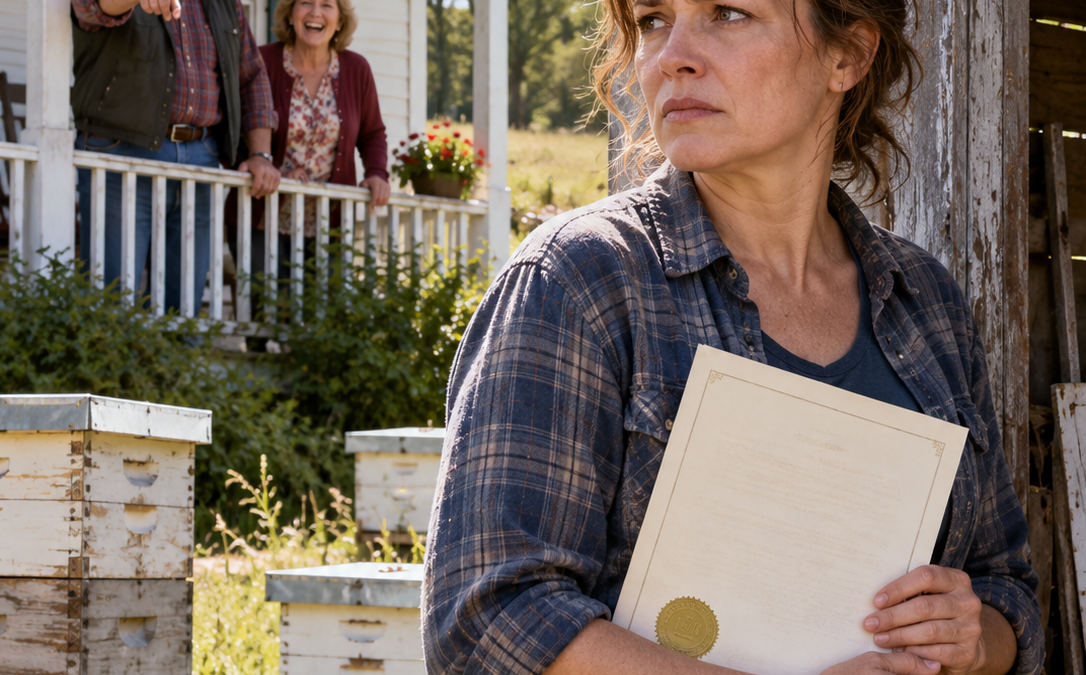
Complete story · 10 chapters · about 47 minutes · ending included
Chapter 1 · Chapter 2 · Chapter 3 · Chapter 4 · Chapter 5 · Chapter 6 · Chapter 7 · Chapter 8 · Chapter 9 · Chapter 10
Chapter 1: The Paper in My Uncle’s Jacket
My uncle Terry laughed at 10 a.m. Monday when the lawyer read that Grandpa had left me his bee shed, his hives, and his bee ledgers.
“It’s a shed, kiddo. There’s nothing under it but mice.”
I looked across the conference table at him.
“Okay.”
That was all I gave him.
I was forty-four years old, an elementary school nurse, and I had spent enough school days around loud people to know that answering louder usually made things worse.
Terry Huff had never learned that lesson.
He leaned back in his chair, still smiling in front of Peggy, the lawyer, and the rest of the room.
“You put Band-Aids on fourth graders. Don’t play landowner.”
I kept my hands folded on the table.
The lawyer had just finished reading the part of Grandpa Clyde’s will that mattered most to Terry. The farmhouse and 120 acres went to him. The property had been appraised at $410,000.
Terry sat back like a man who had expected exactly that.
Peggy sat beside him. She was Terry’s wife, sixty-one, a bank teller and notary. When Terry laughed, Peggy laughed too, though hers was quieter.
There were six of us in the lawyer’s office that morning, but I barely noticed anybody else after I heard Grandpa’s words.
My bee shed, my hives and my bee ledgers.
That was what came to me.
I had not gone there expecting land or money. Grandpa was ninety when he died on August 3. He had spent most of his life on that farm outside Harlan, Kansas, and I had spent more Saturdays than I could count carrying syrup jars to his hives and listening while he complained about weather, mites, and people who didn’t close gates.
He wrote everything down.
Hive strength.
Honey pulled.
Queen replacements.
Rain.
Which fields bloomed early.
Which bloomed late.
If Grandpa owned a pencil, he eventually turned it into a record.
I figured the ledgers might come to me. Maybe the old veil too, if nobody had thrown it away.
The shed surprised me.
The hives hurt a little.
Not in a bad way.
Just enough to make me picture him standing out there in his faded work shirt, tapping the side of a hive with two fingers before lifting the lid.
Terry leaned toward the lawyer.
“So that’s it?”
The lawyer glanced at the will.
“That is the distribution stated here.”
Terry looked at me again.
“Congratulations, kiddo. You got the luxury property.”
Peggy smiled.
I kept my hands folded on the table.
Terry had been my father’s older brother. My dad was gone, so Terry had become the loudest Huff left in most rooms. He farmed, sat on the local co-op board, and had a way of calling me kiddo that had stopped sounding affectionate years ago.
I said, “I want the bees.”
He gave another short laugh.
“You want the bees.”
“Yes.”
“What are you gonna do, drive out there before school and tuck them in?”
“I work at a school. I don’t sleep there.”
Peggy covered a smile with her fingers.
Terry shook his head.
Then he reached inside his jacket.
“I’ll save you the trouble.”
He pulled out a folded typed paper.
The lawyer looked up.
Terry flattened it on the table and turned it toward me.
“Two hundred bucks.”
I looked at him.
“For what?”
“The shed. The hives. Whatever junk Dad left in there.”
He took a pen from the same inside pocket and laid it across the paper.
“Sign that, I’ll give you two hundred dollars, and you don’t have to fool with any of it.”
The amount was so small I thought I might have misheard him.
Grandpa had three old hives behind that shed. I didn’t know what shape they were in after his last weeks, and the shed itself had been falling down for years.
Still, Terry had inherited property worth $410,000.
He was sitting in a lawyer’s office offering me two hundred dollars before Grandpa’s will was even back in its folder.
“It’s a shed, kiddo. There’s nothing under it but mice.”
He pushed the paper closer.
Then the pen.
“Two hundred. Sign there.”
I looked at the signature line.
Then at Terry.
“Not today.”
His smile stayed in place for half a second.
Then it tightened.
“What’s there to think about?”
“I didn’t say I was thinking about it.”
“Then sign it.”
“No.”
Peggy’s smile faded a little.
The lawyer reached across the table.
“May I see that?”
Terry put his hand over the top page.
“It has nothing to do with the estate.”
“You brought it into my office during the reading of the estate documents.”
Terry moved his hand.
The lawyer pulled the paper closer and scanned the top.
I watched his eyes move down the page.
Then he looked at Terry.
“I didn’t draft that. Who did?”
Terry’s neck went red.
Not his face at first.
His neck.
It started above his collar and climbed.
“It’s simple,” he said. “I had it typed up.”
“By whom?”
“Does it matter?”
“It matters if you’re presenting paperwork in connection with property distributed under this will.”
Terry reached across the table.
“Give it back.”
The lawyer lifted one hand, just enough to stop him.
“I asked who prepared it.”
“Nobody important.”
That answer made me look down harder at the paper.
Until then, I had seen it as exactly what Terry called it. A quick agreement for an old shed and some bees.
The first page was typed cleanly. My name. Terry’s name. A payment of $200.
Then I saw the staple in the upper-left corner.
There was another page behind it.
The lawyer had turned the first sheet just enough for me to see two words printed near the top of the second page.
Exhibit A.
Terry reached again.
“Come on. Hand it over.”
I moved before I had time to decide whether it was rude.
I put my palm on the paper.
The lawyer looked at me.
Terry did too.
“This is for her signature,” the lawyer said.
“I know what it’s for.”
“Then she may review it.”
Terry leaned back.
“You already said no, Jill.”
“I said not today.”
“You don’t need to carry that around.”
“I do if you want me to sign it.”
His jaw moved.
I slid the paper toward me.
I could feel Peggy watching.
The room had gone from mildly embarrassing to deeply uncomfortable, and I knew exactly who everybody probably blamed for that.
Terry had made a joke.
Terry had offered money.
I was the niece refusing to cooperate over a broken-down bee shed.
I had seen families turn small inheritances into lifelong grudges over less.
My face felt hot.
I hated scenes.
At school, I handled bloody noses, fevers, panic attacks, playground scrapes, and parents who arrived angry because their child had been sent home. My job was to lower the temperature.
That instinct told me to give Terry the paper.
Take the $200.
Keep the ledgers if he’d allow it.
Let the man with the farm have the old boards and mice.
Instead, I lifted the pages and put them in my purse.
Terry stopped smiling.
Picking up where the Facebook post left off
The change was so complete that Peggy looked at him.
He stared at my purse.
“You serious?”
“Yes.”
“About that shack?”
“Yes.”
“You haven’t even been out there since Dad died.”
“I’ll go.”
“For bees.”
“For Grandpa’s bees.”
Terry rubbed a hand over his mouth.
The lawyer closed the will.
“We can finish the remaining administrative items.”
Terry barely looked at him.
I sat there while the lawyer talked through things that should have held my attention. I heard words about filing, estate duties, and copies.
But I kept thinking about the paper in my purse.
Especially the second page.
Why would a shed need a stapled exhibit?
When the meeting finally ended, chairs scraped back from the table.
Peggy stood first and picked up her purse.
She avoided my eyes.
Terry buttoned his jacket with quick, hard movements.
I waited until he and Peggy were near the door before I stood.
The lawyer handed me a copy of the will.
“Keep your documents together,” he said.
“I will.”
Terry heard that.
He glanced back.
I tucked the will into my purse beside his typed paper.
Outside, the September air was warmer than I expected. The parking lot sat behind the lawyer’s office, bordered by a strip of dry grass that had gone yellow at the edges.
Peggy walked ahead toward their vehicle.
Terry stayed near me.
For a moment, he said nothing.
Then he nodded at my purse.
“You’re making this harder than it needs to be.”
“I haven’t done anything.”
“You kept my paper.”
“You asked me to sign it.”
“And you said no.”
“I said not today.”
He looked toward Peggy, then back at me.
The joking uncle from upstairs was gone.
His voice dropped.
“Offer’s good till Friday. After that the bugs are your problem.”
Chapter 2: The Chain on Grandpa’s Gate
Tuesday afternoon, I drove syrup out to Grandpa’s hives and found a new chain looped through the lane gate.
I parked on the county road and got out with the syrup jug in one hand.
Terry was already there.
He stood on the other side of the gate with his thumbs hooked in his pockets, watching me look at the fresh chain and padlock.
“You put Band-Aids on fourth graders. Don’t play landowner.”
I set the syrup down beside my car.
“I came to feed the bees.”
“Then you should’ve taken the two hundred.”
The gate had never been locked against me when Grandpa was alive.
He liked gates closed, and he liked latches where they belonged, but the lane was how I got back to the shed. I had driven it enough times that I knew where the gravel dipped after a hard rain and which cottonwood branch scraped a roof if you stayed too far right.
Now there was a shiny padlock where Grandpa’s old latch had been.
“Terry, open it.”
“No.”
“The hives are mine.”
“The shed’s yours. That’s what the will says.”
“The hives are mine too.”
He shrugged.
“Then carry them out.”
I looked past him.
The lane ran toward the farmhouse, then bent toward the shed farther back. I couldn’t see the hives from the road.
“I brought syrup.”
“I see that.”
“They need feeding.”
“Not my problem.”
That sounded familiar.
His Friday deadline from the parking lot had followed me all the way home the day before.
Offer’s good till Friday. After that the bugs are your problem.
Now it was Tuesday, and he was turning the threat into a chain.
I took out my phone.
Terry’s expression changed.
“What are you doing?”
“Taking a picture.”
“Of a gate?”
“Yes.”
He laughed.
“Go ahead.”
I photographed the chain, the padlock, and enough of the lane beyond it to show where I was standing.
Terry shook his head.
“You’re really doing this over an old shed.”
“You put the chain up.”
“Because this is a working farm.”
“Grandpa let me use this lane.”
“Dad’s gone.”
He said it flatly.
That was the part that got me.
Not the chain.
Not the mocking.
Just those two words.
Dad’s gone.
Grandpa had been dead a little over a month, and Terry said it like a legal condition had expired.
I picked up the syrup again.
“I’m feeding the bees.”
“You aren’t coming through this gate.”
We looked at each other through the metal bars.
I could have climbed it.
Maybe.
I was forty-four, not fourteen, and I was holding a gallon jug of sugar syrup beside a county road. The idea of throwing one leg over a chained gate while Terry watched was humiliating enough without imagining what would happen if I fell.
I set the syrup back down.
Terry noticed.
“There you go, kiddo.”
I hated the satisfaction in his voice.
“You could just sell me the junk and be done.”
“No.”
“Two hundred bucks for something that’s gonna collapse anyway.”
“No.”
His mouth tightened.
“Friday.”
I picked up the syrup and put it back in my car.
That was the price of refusing him that afternoon.
I had come to care for Grandpa’s bees.
I left them unfed.
Terry stayed behind the gate while I drove away.
That night, I was at my kitchen table with the typed paper from the will reading beside me when my phone buzzed.
Terry.
I expected another joke.
Instead, he sent one sentence.
Dad never would’ve sold a foot to anybody. He’s not here now. Take the $200.
I stared at the screen.
The words about Grandpa bothered me more than the offer.
Terry knew exactly what kind of man his father had been about land.
Everybody did.
Grandpa could complain about taxes, weather, machinery, and half the county, but selling ground was different. He had held onto that farm through years when other people would have taken the money.
I started to type a reply.
Then I stopped.
Terry wanted an answer.
I didn’t owe him one.
I saved the text instead.
I took screenshots and left the message where it was.
Then I pulled his typed paper from my purse.
The first page still looked simple enough.
Names.
Two hundred dollars.
A place for my signature.
The second page was the one the lawyer had exposed when Terry tried to get the paper back.
Exhibit A.
I spread it flat on the table.
The wording underneath meant almost nothing to me.
There were bearings.
Feet.
Directions.
A point of beginning.
More feet.
Then a number I understood.
6.2 acres.
I sat up straighter.
Grandpa’s will had said bee shed, hives, and ledgers.
Terry had talked like he was buying rotten boards and three boxes of insects.
His paper described 6.2 acres.
I read the lines carefully, but the descriptions might as well have been written for a surveyor.
North this many degrees.
West so many feet.
Then another direction.
I couldn’t picture any of it.
Maybe the shed sat inside a larger parcel.
Maybe Terry had used some standard legal description.
Maybe the acreage included useless ground nobody cared about.
I didn’t know.
And that bothered me more than if I’d understood it.
Wednesday came and went without another message from Terry.
I went to work, handed out ice packs, called one parent about a fever, and tried not to think about six-point-two acres every time my phone lit up.
Thursday afternoon, I was in the nurse’s office finishing a student medication log when the office phone rang.
The clock on the wall said 2:40 p.m.
“Harlan Elementary nurse’s office, Jill speaking.”
A woman’s voice answered.
“Is this Jill Huff?”
“Yes.”
“This is Lois Patrick with Cottonwood County.”
I put my pen down.
Lois spoke with the clipped precision of somebody who had made the same kind of call many times.
“I need to confirm your current mailing address.”
“My mailing address?”
“Yes.”
“For what?”
“A county notice.”
I looked at the closed door of my office.
Students’ health forms were stacked on one side of my desk. A box of adhesive bandages sat open beside the sink.
“Why would the county be mailing me a notice?”
“I handle the certified list for the upcoming hearing.”
“What hearing?”
There was a short pause.
Then Lois said, “Before we go further, I need to make sure I have the correct Jill Huff.”
She confirmed my name.
I confirmed it.
She asked for my mailing address.
I gave it to her.
I still didn’t understand why anyone at the county courthouse had my name on a hearing list.
I wasn’t on a board.
I wasn’t applying for anything.
As far as I knew, the only property Grandpa had left me was a falling-down bee shed I couldn’t even reach because Terry had chained the gate.
“Ms. Patrick,” I said, “why am I on your list?”
Her answer came without hesitation.
“You’re an owner of record on my certified list. Tract 2. Your grandfather’s deed.”
Chapter 3: The Deed Nobody Mentioned
Friday morning, I took the day off from school and went to the Cottonwood County courthouse with Terry’s paper folded inside my purse.
All I knew was that Lois Patrick had called me an owner of record.
Tract 2.
I had never heard Grandpa use that name.
Lois was behind a counter with a computer monitor angled toward her and stacks of county forms arranged so neatly they looked measured.
“Jill Huff?”
“Yes.”
She remembered me from the phone call.
“I’d like to see whatever has my name on it.”
Lois nodded.
“I can show you the parcel map and the public file. I can’t tell you what any of it means legally.”
“That’s fine.”
“I mean that literally.”
“I understand.”
That seemed to satisfy her.
She brought up a county parcel map and pointed with the end of a capped pen.
The farmhouse sat inside the large tract Grandpa had farmed for as long as I could remember.
Then Lois indicated a smaller outlined section.
“Tract 2.”
I leaned closer.
It wasn’t just the ground under the bee shed.
The shape ran from the shed toward the county road in a long narrow piece.
“What is that strip?”
“The map shows the tract boundaries.”
“I know, but is that the lane?”
Lois looked at the screen and then at me.
“I can show you where the boundary is drawn. I can’t advise you about access rights or ownership consequences.”
That was Lois.
Exact.
Careful.
No extra inch given.
But I didn’t need her to interpret the picture for me.
I knew Grandpa’s lane.
I had driven it Tuesday right up to the new chain.
The long strip on the map followed it.
My stomach tightened.
I took Terry’s typed agreement from my purse and unfolded Exhibit A beside the counter.
“Can I compare this?”
“You can compare anything that’s public record.”
I followed the description with my finger.
A bearing.
A distance.
Another bearing.
More feet.
Then 6.2 acres.
Lois turned the map so I could see the parcel dimensions more clearly.
The numbers on Terry’s Exhibit A matched the recorded tract to the foot.
I stopped.
His offer had never been for just an old shed.
He had put the legal description for Tract 2 behind a first page offering me $200.
“Where do I get the deed?”
“Register of Deeds.”
She pointed me down the hall.
“Ask for a certified copy if you’re going to rely on the record.”
“Thank you.”
“That isn’t advice.”
“I know.”
For the first time that morning, the corner of her mouth moved.
The Register of Deeds office pulled the document by recording information.
The clerk placed a certified copy in front of me.
Transfer-on-death deed.
Recorded June 12, 2019.
Clyde Huff had been eighty-three.
I found my name.
Jill Huff.
Then the property description.
6.2 acres.
I stood there holding a deed Grandpa had signed seven years earlier and had never mentioned to me.
The document had been sitting in county records while I brought syrup to his bees, changed hive covers, and listened to him complain about coyotes getting too close to the chickens.
I had known the shed.
I had known the hives.
I had not known I was supposed to get the ground beneath them.
Or the lane.
Back in Lois’s office, she handed me the notice that had triggered her call.
The heading said rezoning hearing.
I found Terry’s name as applicant.
Then the proposed use.
Quarry.
I looked up.
“A quarry?”
Lois folded her hands.
“The application is public.”
“For Grandpa’s farm?”
“The application identifies the affected tracts.”
I scanned the page.
Every tract was included.
Including Tract 2.
My tract.
The hearing was set for October 13 at 7 p.m.
Terry had offered me $200 on Monday.
He had chained the gate Tuesday.
And somewhere before either of those things, he had put together an application that treated the land as if all of it belonged to him.
I put the notice with the certified deed and Terry’s agreement.
“What does a quarry have to do with that lane?”
Lois’s face stayed neutral.
“That is a question for the applicant, an attorney, or the hearing record. I can’t answer it for you.”
Fair enough.
By the time I left the courthouse, I had more paper than answers.
Saturday morning, I drove back to the farm.
The chain was still on the gate.
This time I didn’t stand beside my car asking Terry to open it.
I put the certified deed inside a clear folder, tucked it under one arm, gripped the metal gate, and climbed.
It was awkward.
My shoe slipped once on the lower rail, and I banged my shin hard enough to make me mutter something Grandpa would have pretended not to hear.
But I got over.
I walked the lane.
The farther I went, the more the courthouse map settled into something real under my feet.
The gravel.
The ditch.
The bend toward the farmhouse.
The narrow approach past the field.
Then the shed.
Its walls leaned enough that I could see why Terry called it junk. One corner sagged lower than the others. The roof had patches Grandpa had added over the years, none of them matching.
Behind it sat three hives.
Still there.
I went straight to them.
The bees were active in the mild morning air.
I stood with Grandpa’s deed in my hand and looked back toward the lane.
Six-point-two acres.
The shed.
The hives.
And the road beneath my shoes.
A screen door slapped at the farmhouse.
Terry stepped onto the porch.
Peggy came behind him.
He spotted me and started laughing.
“Two hundred’s still good, kiddo!”
I didn’t answer.
I lifted the clear folder just enough for him to see the paper inside.
His laughter thinned.
Peggy looked from me to Terry.
Then she turned and went back into the house.
Terry stayed on the porch.
“You climbing fences now?”
“The gate was locked.”
“My gate.”
I looked down at the deed.
I wasn’t sure that was true anymore.
What I was sure of was that asking Terry’s permission had gotten me nowhere.
I checked the three hives and stood beside Grandpa’s falling-down shed until Terry finally went inside.
On the walk back to my car, one question followed me all the way down the lane.
What did a quarry have to do with Grandpa’s only road?
I couldn’t answer it with a school nurse’s paycheck, a county map, and paperwork I barely understood.
But I was done asking Terry.
On Monday, I recorded Grandpa’s death certificate with the county.
Then I called the only land attorney in Cottonwood County.
Chapter 4: The Skid-Steer in the Clover
Sunday morning, the day after I climbed Terry’s chained gate with Grandpa’s deed in my hand, I heard machinery before I reached the shed.
A skid-steer was pushing through the weeds beside the lane.
Terry was driving it.
I parked on the county road, climbed the gate again, and started down the gravel.
He saw me.
The machine kept moving.
By the time I reached the shed, two of Grandpa’s three hives were on their sides.
One box had split open.
Frames lay in the dirt.
Bees crawled through crushed grass and broken comb.
I stopped so hard my knees hurt.
“Terry!”
He killed the engine.
“What?”
I pointed.
“What did you do?”
“Clearing brush.”
“You hit the hives.”
“They were in the way.”
“They’re mine.”
He climbed down slowly.
“Then you should’ve moved them.”
“I was here yesterday.”
“And?”
“And you knew I was keeping them.”
He shrugged.
I called the sheriff’s office.
Terry stood beside the skid-steer while I waited.
He didn’t apologize.
A deputy came out and walked the ground with me. He looked at the broken boxes, looked at the deed I carried, then looked toward Terry.
Terry said the same thing.
“Clearing brush.”
The deputy rubbed his jaw.
“This looks civil.”
“He destroyed my property.”
“I understand what you’re saying.”
“Then do something.”
“I can document what I see. Ownership and damages are going to be civil.”
That was the answer.
Civil.
A word that meant nobody was going to fix the hive.
After the deputy left, I found an old bucket beside the shed.
I crouched in the grass and started scooping dead bees into it.
Some were mixed with bits of wax and dirt.
I worked carefully around the ones still moving.
Terry went back toward the farmhouse.
I never asked him for help.
The third hive was still standing.
That mattered.
It was also the only one left.
Monday morning, after I recorded Grandpa’s death certificate, I called Robin Chambers.
She was fifty-six, a land attorney, and apparently the only one in Cottonwood County whose practice centered on property disputes.
Her office was above a tax service downtown.
I put the certified deed, Terry’s $200 paper, the county notice, and pictures of the crushed hives on her desk.
Robin read quietly.
Then she held up Terry’s agreement.
“He gave you this?”
“At the will reading.”
“And you didn’t sign?”
“No.”
“Good.”
She turned to Exhibit A.
Then the deed.
She compared the descriptions.
After that she pulled up the county’s public rezoning file.
I watched her face change.
“What?”
Robin turned the screen toward me.
The application had Terry’s name on it.
Applicant and owner.
Then a sworn statement saying he owned all tracts included in the request.
All tracts.
Including Tract 2.
“That isn’t true,” I said.
“No.”
“He signed this?”
“Yes.”
She pointed to the date.
September 11.
Three days before the will reading.
Then she moved her finger lower.
Peggy’s notary stamp was beneath his signature.
I stared at it.
Peggy had sat beside him Monday morning and laughed when he called my inheritance a shed full of mice.
Three days earlier, she had notarized a document where Terry claimed ownership of the land Grandpa had already deeded to me.
Robin leaned back.
“You need representation if you’re going to fight this.”
“How much?”
“Four thousand to start.”
I knew exactly where that money would come from.
My car fund.
I had been saving because my sedan was getting old enough that every new sound made me turn down the radio.
Four thousand dollars was most of what I had set aside.
Terry had already offered me $200.
Later, he might offer more.
I could take money from him and be finished.
Instead, I opened my checkbook.
Robin watched me write.
“This can get expensive.”
“I know.”
I didn’t really know.
I knew what four thousand felt like.
That was enough.
By Wednesday, Terry had started telling people his version.
I heard about it at the co-op.
He stood near the counter with several men when I walked in.
His voice carried.
“Dad signed off on this quarry before he passed.”
One of the men glanced at me.
Terry kept going.
“Jill just wants cash now that she found paperwork with her name on it.”
I stopped.
“You swore you owned all of it.”
His face hardened.
“Don’t start.”
“You signed the application.”
“Dad wanted the quarry.”
“That isn’t what you swore to.”
Terry looked around.
“See? Money.”
I left before I said something that would help him.
The story followed me to school.
At afternoon pickup, two parents who normally spoke to me walked past without saying hello.
One looked directly at me first.
Then away.
I stood near the front entrance holding a student’s forgotten lunchbox and understood what Terry was doing.
He wasn’t just fighting over land.
He was making me look greedy for refusing to give it to him.
Robin sent her letter that week.
It went to Terry and his lawyer.
The letter said I held recorded title to Tract 2 and required access to my property.
The next time I drove out, the chain was gone.
The gate opened.
I stood beside it for a second with my hand on the latch.
I should have felt relieved.
Instead, I looked toward the shed and pictured two broken hives in the grass.
The gate had cost me $4,000, two colonies, and people at school who had already chosen Terry’s story.
I drove in and checked the last hive.
Two days later, Robin called.
“Terry retained counsel.”
“I figured.”
“They answered my letter.”
“How bad?”
She paused.
“They intend to challenge the deed.”
“On what grounds?”
“Capacity.”
I sat at my kitchen table with Grandpa’s papers spread around me.
Robin continued.
“They’re claiming Clyde lacked the mental capacity to execute the 2019 transfer-on-death deed.”
“He was eighty-three.”
“That will be their argument.”
“He kept farm ledgers.”
“I know.”
“He knew exactly what he was doing.”
“We may have to prove that.”
I looked at the balance in my savings account.
“What does that cost?”
Robin was quiet for a beat.
“It depends how far they take it.”
The written letter arrived the next day.
I opened it at my kitchen counter.
The wording was formal, but the message wasn’t complicated.
The deed would be challenged for lack of capacity.
Expect costs.
Chapter 5: The Lane That Holds the Farm
Robin and I walked the edge of Tract 2 with the survey map in one hand and orange-topped pins showing us where Grandpa’s paperwork became ground.
I had spent days thinking about Terry’s sworn application.
He had claimed he owned every tract.
I knew that was false.
What I still didn’t know was whether owning 6.2 acres actually gave me enough power to stop anything.
Robin stopped near the county road.
“Look back.”
I did.
The gravel lane ran behind us, crossed Tract 2, and continued toward the farmhouse.
Beyond the farm, the creek cut across one side of the property.
The rail line blocked another.
Robin pointed toward the neighboring ground.
“And that owner?”
“Grandpa said he’d never sell Terry anything.”
“So we have the creek, the railroad, and a neighbor who isn’t volunteering a road.”
I looked at the lane.
“This is it.”
“This is it.”
We walked farther.
The survey pins traced the same narrow strip I’d seen on the courthouse map. The part Terry had buried inside Exhibit A wasn’t stray acreage beside a falling-down shed.
It was the road.
The only road into the farmhouse.
And if somebody wanted to turn Grandpa’s farm into a quarry, it was the only road into that too.
I stopped beside one pin.
“So Terry can’t do the quarry without me.”
Robin gave me the kind of look lawyers must save for clients who say something almost right.
“Don’t turn that into a guarantee.”
“What am I missing?”
“A few things.”
We walked back toward the shed.
“A protest petition isn’t an automatic stop to a mining rezoning here,” she said. “You can object. Other landowners can object. That doesn’t mean the commission has to deny it.”
“So they can vote yes anyway.”
“Yes.”
“Even if he lied on the application?”
“They can consider the application and our letter. They are not a court.”
I looked at her.
“And the deed?”
“The county commission won’t decide title for you.”
“That seems like the important part.”
“It is. It’s also not their job.”
I rubbed my thumb over the edge of the map.
“What about the lane?”
Robin looked toward the farmhouse.
“A judge could decide Terry has an implied way to reach his house. Courts generally don’t like creating landlocked homes when there is a legal basis for access.”
“So he’d still get to use my road.”
“Possibly.”
“For quarry trucks too?”
“That is much less certain.”
I waited.
Robin was good at making sure I understood where certainty ended.
“A household access route and heavy commercial quarry traffic are not the same thing,” she said. “But if you’re asking me whether I can promise you today that no quarry truck will ever use this lane, I can’t.”
That was the problem with every answer I got.
None of them ended with and then you win.
They ended with possibly.
Maybe.
Depends.
Meanwhile Terry had a lawyer, a quarry company, and a contract I still hadn’t seen.
I had one hive left and an empty car fund.
Robin filed her letter for the hearing packet.
On Monday, September 28, it officially went into the county record.
The letter stated that I held recorded title to Tract 2, that Terry’s rezoning application included my property, and that ownership and access were disputed.
By that afternoon, Terry knew.
Robin called me.
“The land agent contacted his office.”
“What did Terry say?”
“He called it family paperwork.”
I looked at the phone.
“That’s what he’s calling a recorded deed?”
“Apparently.”
That evening, Terry texted me.
$5,000. Sign the paper and this ends.
I was sitting at my kitchen table.
My checking account was open on my laptop.
Beside it was the savings account where my car money used to sit.
Four thousand dollars to Robin had emptied what I had managed to save. My sedan still made that faint rattle when I accelerated from a stop, and now there wasn’t a replacement fund waiting if the rattle became something worse.
Five thousand dollars would have put me ahead of where I’d been before Terry crushed the hives.
I didn’t answer.
The next morning, another text came.
$20,000. Final offer.
I stared at that one longer.
Twenty thousand dollars was real money to me.
It was a car.
It was savings restored and then some.
It was enough to walk away from the lawyer bills before they grew.
I pictured Grandpa’s shed with its leaning wall.
The one hive still standing behind it.
Then I pictured Terry’s Exhibit A.
He had started at $200 for what he called junk.
Now he was offering one hundred times that amount.
Nothing about the ground had changed.
Only what I knew about it.
I typed one word.
No.
Terry didn’t answer.
When I showed Robin, she didn’t congratulate me.
She wasn’t that kind of lawyer.
“You understand the risk?”
“Yes.”
“Say it back.”
I gave her a look.
She waited.
“The commission could still approve the rezoning.”
“Yes.”
“And Terry could file a capacity challenge.”
“Yes.”
“And that could take years.”
“It could.”
I looked toward her office window.
“Twenty thousand would be easier.”
“Much.”
“I still said no.”
Robin nodded once.
Then she turned a folder toward me.
“Hearing procedures.”
The October 13 hearing started at 7 p.m.
Public speakers got three minutes.
“Three minutes?”
“That’s what you have.”
“To explain a deed, his application, the lane, the quarry, and everything he’s been saying?”
“You don’t need to explain everything.”
“It feels like I do.”
“You need to explain what matters.”
I took the hearing sheet home.
That night I put it beside the certified deed, Terry’s typed agreement, his text about Grandpa never selling a foot, and the county application.
Three minutes.
Terry could stand around the co-op talking as long as anybody would listen.
He could tell people Grandpa approved the quarry.
He could tell parents at my school I wanted money.
He could call my deed family paperwork.
I had three minutes to put something stronger into the record.
I started making notes and crossed out half of them.
Then I crossed out half of what remained.
My phone buzzed.
Terry.
I opened the message.
October 13. Whole county’s coming. Bring your bugs.
Chapter 6: The Woman With Three Minutes
By 6:55 Tuesday evening, all 63 folding chairs in the 4-H building were filled or nearly filled, and Terry looked more comfortable than I had seen him in weeks.
He stood near the front talking to neighbors like he was hosting a supper.
I sat three rows back with Robin beside me and my folder on my lap.
Three minutes.
That was all I would get.
Terry got called first because the rezoning application was his.
He walked to the microphone without notes.
“I own every foot from the county road to the creek.”
My fingers tightened around the folder.
Robin didn’t move.
Terry pointed loosely toward the county map displayed at the front.
“This isn’t some mystery project. It’s our farm. Been in the family a long time.”
A few people nodded.
He knew most of them.
So did I.
That was what made the room difficult.
These weren’t strangers I could accuse and never see again. They were people whose children came through my nurse’s office. People I passed at the grocery store. People who knew my grandfather and had known Terry even longer.
Terry kept going.
“Dad signed off on this quarry before he passed.”
That was the line he’d been using at the co-op.
Now he said it into a microphone.
He talked about twelve jobs.
He talked about tax revenue.
He talked about keeping working families in Cottonwood County.
Then he smiled.
“And apparently my niece and her shed are gonna stop all that.”
Several people laughed.
Not everybody.
Enough.
My face got hot anyway.
Terry glanced toward me like he’d been waiting for the sound.
“My niece and her shed,” he repeated.
The chair thanked him and asked him to sit.
Terry returned to his seat beside Peggy.
He looked pleased with himself.
Robin leaned toward me.
“Documents.”
“I know.”
“No speech about the bees.”
“I know.”
“No speech about Clyde.”
I looked at her.
“You’ve made your point.”
She sat back.
When my name was called, I carried the folder to the microphone.
The timer beside the chair showed three minutes.
I had practiced at my kitchen table until I could get through the important parts without rushing.
Still, seeing 63 neighbors made the words feel different.
I opened the folder.
“My name is Jill Huff. I own Tract 2 under a transfer-on-death deed recorded by Clyde Huff.”
A man near the back shifted in his chair.
I kept my eyes on the paper.
“The deed was recorded June 12, 2019.”
I gave the book and page number from the certified copy.
Then I held up Terry’s rezoning application.
“On September 11, 2026, Terry Huff signed this application under oath.”
I found the line.
“He stated that he owned all tracts included in the rezoning request.”
The room got quieter.
Terry leaned toward Peggy and said something I couldn’t hear.
I continued.
“Tract 2 is included in his application.”
I put down the application and lifted the certified deed.
“The county record says Tract 2 belongs to me.”
The chair looked toward Terry.
Terry stared back at me.
I moved to the page I had marked.
“This next document was given to me by Terry at my grandfather’s will reading.”
I held up the agreement.
“He offered me two hundred dollars to sign it.”
Someone behind me murmured.
I kept going.
“Attached to that agreement is Exhibit A.”
I placed Exhibit A beside the deed.
“This is the legal description on the deed.”
I put my finger on the first line.
Then I read the first bearing.
The first distance.
I moved to Exhibit A and read the same bearing.
The same distance.
Then the next one.
And the next.
Number by number.
Feet by feet.
I didn’t explain what they meant.
I didn’t need to.
The descriptions matched.
The land agent sat at a table near the wall with a legal pad in front of him. He had been writing through Terry’s presentation.
Halfway through my comparison, his pen stopped.
I noticed because he didn’t start again.
I finished with the acreage.
“Six-point-two acres.”
Then I looked toward Terry.
“That is the same 6.2 acres he offered me two hundred dollars for.”
The timer showed less than a minute.
I turned back to the commission.
“I am not asking you tonight to decide title. My attorney has told me that isn’t your job.”
Robin’s expression stayed neutral.
“I am asking you to look at the record Terry filed with this county and compare it with the county’s own recorded deed.”
I closed the folder.
“That is all.”
I stepped away from the microphone.
The chair stopped me.
“Ms. Huff.”
I turned.
“Stay nearby.”
I moved to the side instead of returning to my seat.
Terry was already standing.
“I need to answer that.”
The chair nodded.
Terry came back to the microphone.
His face was darker than before.
“This is exactly what I’ve been talking about. Family paperwork.”
Nobody laughed this time.
He pointed toward the deed in my hand.
“Dad was eighty-three. He didn’t know what he was signing.”
I heard Peggy take a breath from the third row.
Terry continued.
“He was an old man. Jill wasn’t around every day. She doesn’t know what condition he was in.”
My grip tightened on the certified copy.
I had promised Robin I wouldn’t turn three minutes into an argument.
But Terry had just dismissed Grandpa’s signature in the same room where he’d claimed Grandpa approved a quarry.
I looked at the typed agreement Terry had handed me himself.
Then at him.
“Then why did you type it up?”
His head snapped toward me.
“What?”
I lifted Exhibit A.
“If Grandpa didn’t know what he was signing in 2019, why did you type up a paper using the exact legal description from his deed and offer it to me?”
Terry’s mouth opened.
The chair raised a hand.
“Ms. Huff, please.”
I stopped.
Terry looked toward the commission.
“She doesn’t know what she’s talking about.”
The land agent still wasn’t writing.
A woman near the aisle folded her arms.
I could feel the room trying to decide which version of Clyde Huff it believed.
Terry’s version was an eighty-three-year-old man who couldn’t understand a deed but somehow approved a quarry before his death.
My version was sitting in the county record with a book number, a page number, and a legal description Terry had copied onto his own paper.
The chair looked down at the documents.
Then he looked at Terry.
“When did you first see this deed?”
Chapter 7: The Notary in the Third Row
Terry stood at the microphone while the chair waited for his answer.
“When did you first see this deed?”
The room had stopped moving.
Terry glanced toward Peggy.
Then toward me.
His first explanation, that Grandpa had been too old to understand what he signed, had already run into the paper Terry himself brought to the will reading.
Now he needed another one.
“She agreed to sell,” he said. “It just never got signed.”
My stomach tightened.
I had never agreed to sell anything.
The chair looked at me.
“Ms. Huff?”
I opened my folder again.
“I didn’t agree to sell.”
Terry turned.
“You knew what I meant.”
“No.”
“You were going to take the money.”
“No.”
His voice rose.
“You kept the paper.”
“Because you tried to get it back.”
A few people shifted in their chairs.
Robin touched my elbow lightly.
Documents.
That was what she’d told me before the hearing.
Use what Terry had written.
I took out my phone.
“I have a text from Terry sent the night after he chained the lane gate.”
Terry shook his head.
“Oh, come on.”
I read it aloud.
“Dad never would’ve sold a foot to anybody. He’s not here now. Take the $200.”
Nobody laughed.
I lowered the phone.
“That was his message to me.”
The chair looked at Terry.
Terry gripped the edge of the podium.
“That doesn’t mean anything. We were arguing.”
“You said Grandpa never would’ve sold a foot.”
“It’s an expression.”
“And you were offering me money for 6.2 acres.”
“I was trying to settle a family problem.”
The land agent shifted his folder closer to himself.
Terry noticed.
“This is ridiculous,” he said. “She got worked up after the funeral, and now she’s trying to blow up a project over some paperwork.”
A chair scraped behind me.
I turned.
Peggy was standing.
For most of my life, if Terry laughed, Peggy laughed.
If Terry told a story, Peggy usually let him finish it.
At the co-op, at family meals, at the lawyer’s office, they had always looked like one side of the same argument.
Now Peggy’s hands were clenched around her purse strap.
“Peg?” Terry said.
She looked at the commission.
Then at him.
“He found that deed in Clyde’s desk August twentieth. I was standing there.”
Terry’s face changed.
“Sit down.”
Peggy didn’t.
The chair said, “Mrs. Huff, you’re saying he saw the deed before he filed this application?”
“Yes.”
Terry stepped away from the microphone.
“Peggy.”
She kept looking toward the front.
“He found the copy in Clyde’s desk on August twentieth.”
The date settled over the room.
Grandpa had died August 3.
Terry found the deed August 20.
Then, on September 11, he signed the rezoning application swearing that he owned every tract.
Peggy swallowed.
“I notarized that application.”
Terry’s voice dropped.
“You don’t need to do this.”
Peggy finally looked at him.
“I already did it.”
She sat down.
She didn’t reach for his hand.
I understood what it had cost her to stand.
She wasn’t only contradicting Terry in front of 63 neighbors.
She was admitting that she had watched him find the deed, then later put her notary stamp on the sworn paper he signed.
Whatever public front they had carried into that building was gone.
Terry turned back toward the commission.
“She doesn’t understand the legal side of this.”
Neither did I, not fully.
But dates weren’t legal theory.
August 20.
September 11.
September 14, when Terry laughed at Grandpa leaving me a shed and offered me $200 for a tract he already knew was deeded to me.
The land agent closed his folder.
The click sounded small, but Terry heard it.
“What are you doing?”
The agent stood.
“Our company is withdrawing the rezoning request.”
Terry stared at him.
“You can’t.”
“We can withdraw our participation.”
“We have a contract.”
“We also have title requirements.”
Terry stepped toward him.
“This can be fixed.”
The agent took an envelope from his folder.
“I was instructed to give you this if title or access couldn’t be delivered.”
Terry didn’t take it at first.
The agent held it out.
Finally Terry grabbed the envelope.
“What is it?”
“A demand concerning the advance.”
Terry opened it.
His eyes moved down the page.
The room watched him.
I didn’t know the contract terms yet, but I knew the number when Terry said it.
“Twenty-five thousand?”
The agent didn’t answer loudly.
He didn’t need to.
Terry looked up.
“You’re pulling out over this?”
“We’re withdrawing.”
He collected his papers and left the table.
The commission took a short recess.
Nobody rushed out.
People stood in little groups, talking more quietly than before.
Two people who had laughed at Terry’s shed joke avoided looking at me.
Peggy stayed seated by herself.
Terry stood near the wall reading the demand again.
When the commission returned, the chair called the meeting back to order.
The discussion was brief compared with everything that had come before.
The title dispute wasn’t theirs to decide.
The deed challenge wasn’t theirs either.
But the application before them included land Terry could not show he owned, and the quarry company had withdrawn.
The commission voted to recommend denial.
Terry stood before the chair had finished.
“Over a shed?”
I was already gathering my folder.
He looked directly at me.
“Seriously, Jill? You’re doing all this over that falling-down shed?”
I stopped beside his row.
“You can’t sell what you offered me $200 for.”
His face went hard.
I didn’t wait for his answer.
Robin followed me toward the door.
Outside, the October night had turned cold enough to make me zip my jacket.
The $25,000 demand was still inside with Terry.
So were Peggy and the neighbors and whatever was left of the story he had been telling them.
I had something else to do.
Before the first hard frost came, Grandpa’s last hive needed checking.
I walked past Terry’s truck and headed for my car.
Chapter 8: The Pickup on the Flatbed
The quarry company’s letter gave Terry until Friday, October 30, to return the $25,000 advance.
Robin got a copy through the hearing file.
I read the deadline at her desk.
“Twenty-five thousand by the thirtieth.”
“Yes,” she said.
“Does he have it?”
Robin gave me a dry look.
“I don’t manage Terry’s checking account.”
I knew that.
But everybody in Harlan had seen the new pickup.
Terry had bought it after the quarry deal started moving. Bright paint, oversized tires, the kind of truck that looked expensive even standing still.
A week after the hearing, I learned where at least some of that advance had gone.
Terry had spent it on the pickup.
The quarry company wanted its money back because he couldn’t deliver clean title and access.
For days, one question kept bothering me.
Who pays now?
I already knew one answer.
Terry did.
A few mornings before the October 30 deadline, I drove toward Grandpa’s place to check the last hive.
A flatbed was parked in Terry’s yard.
I slowed without meaning to.
The new pickup sat behind it.
A man was fastening a strap near the front wheel while another worked the winch.
Terry stood beside the truck holding the keys.
He saw me through my windshield.
Normally, even when we were fighting, Terry performed for an audience. He would wave too big, grin too wide, or call me kiddo like nothing could touch him.
That morning he didn’t wave.
He just stood there with the keys in his hand while the pickup rolled onto the flatbed.
I kept driving.
There was no satisfaction in watching it.
Two hives were still gone.
My car fund was still gone.
Peggy had still stood in front of 63 neighbors and admitted what Terry had done.
The pickup leaving didn’t put any of those things back.
But it made the $25,000 demand real in a way the paper hadn’t.
Terry had treated the quarry advance like money he’d already earned.
Now the company wanted it returned.
Robin wasn’t interested in stopping with the quarry hearing.
“The rezoning request is one problem,” she told me. “The probate matter is another.”
Terry was still serving as executor of Grandpa’s estate.
That bothered her.
“He signed a sworn county application claiming ownership of Tract 2 after he had seen the deed.”
“And Peggy notarized it.”
“Yes.”
“What do we do?”
“We put it in front of the probate court.”
I looked at the new invoice on Robin’s desk.
Every new filing meant more time.
More letters.
More money.
The cleanest thing would have been to let Terry lose the quarry and leave him alone.
That was what part of me wanted.
He had already lost his deal.
His new pickup was gone.
The county had recommended denial.
Maybe that was enough.
Then I thought about the application.
Not the things Terry said at the co-op.
Not his jokes.
The sworn paper.
He had found Grandpa’s deed on August 20.
Then on September 11, he signed a document saying he owned all the tracts anyway.
And he remained the man responsible for handling Grandpa’s estate.
“File it,” I told Robin.
She did.
The petition laid out the recorded deed, Terry’s sworn application, and the conflict created by his claim over property that had passed outside the will.
Terry’s lawyer answered.
There were more letters.
More bitter messages passed through attorneys instead of family.
I stopped seeing Peggy with him around town.
Then Robin called.
“Terry is resigning as executor.”
I sat down at my kitchen table.
“He agreed?”
“He filed the resignation.”
“What about the capacity case?”
“Nothing has been filed.”
The threat had been sitting over me since his lawyer’s letter.
Grandpa was eighty-three when he signed the transfer-on-death deed.
Terry had promised to attack his capacity.
I had pictured years of depositions, old medical records, witnesses, and bills I couldn’t afford.
Days passed.
Then weeks.
The capacity suit never came.
Robin didn’t declare victory.
She only said, “Until somebody files a case, there isn’t one.”
That was enough for me.
A successor executor took over Grandpa’s estate.
The inventory had to be corrected.
The farmhouse was still there.
The acreage Terry inherited under the will was still there.
But the paperwork could no longer pretend Tract 2 belonged with it.
I got a copy of the updated inventory.
I sat at my kitchen counter with it and Terry’s old $200 agreement nearby.
Farmhouse.
Remaining acreage.
Equipment.
Other estate property.
Then the problem appeared in plain language.
The farm had no road included with it.
The lane was Tract 2.
Mine.
For months, Terry had acted as though Grandpa had left me a collapsing shed that happened to sit on his farm.
The corrected inventory showed the opposite problem.
Grandpa had left Terry a farm that depended on ground Terry didn’t own.
A few days later, Robin called me again.
“The successor executor had an inquiry from a buyer.”
“For the farm?”
“Yes.”
I waited.
Robin sounded almost amused, which for her meant her voice changed by about half a degree.
“The first question wasn’t about the farmhouse.”
“What was it?”
She paused.
“The buyer wants to know who owns the lane.”
Chapter 9: The Ledger Under the Syrup Jars
By November, Terry had lost the quarry deal, the pickup, and his place as executor.
Then the co-op board removed him.
I heard about it from someone who normally would have told me with a joke. This time there wasn’t one.
The board had seen the sworn application. They had seen what happened at the hearing. Terry had spent years speaking as if his name carried weight in Harlan.
Now it carried questions.
A few days later, Peggy called me.
“I need to bring you something.”
She came to my house alone.
She had moved in with her sister.
I didn’t ask whether that was permanent. Peggy didn’t offer.
She stood on my porch with a manila folder pressed against her coat.
“This was in Clyde’s desk.”
She handed it to me.
Inside was the copy of the transfer-on-death deed Terry had found on August 20.
The same deed Peggy had watched him pull from Grandpa’s desk before Terry signed the rezoning application.
“I should’ve said something sooner,” she said.
I didn’t tell her it was okay.
It wasn’t.
But she had stood up in that 4-H building when staying seated would have been easier.
“Thank you for bringing it.”
Peggy nodded.
She looked toward the street.
Then she left.
I added the desk copy to the folder with the certified deed and took both out to Grandpa’s shed the next Saturday.
The weather had turned colder.
The last hive was quiet but alive.
I had started clearing the shed a little at a time.
Old jars.
Feed sacks.
Bent hive tools.
Boxes of frames Grandpa had meant to repair.
The place smelled like old wood, wax, and syrup.
I worked my way toward the back wall.
That was where I found the ledgers.
I had known they were mine since the will reading.
I just hadn’t reached them yet.
Grandpa had stacked them under a shelf behind syrup jars, each notebook labeled by year in his block handwriting.
I sat on an overturned bucket and opened the 2019 ledger.
Most pages were what I expected.
Weather.
Bloom dates.
Hive notes.
A reminder to replace a cracked lid.
Then I reached May.
One entry stopped me.
Terry brought the gravel men. Told him no. Went to town.
I stared at it.
Gravel men.
May 2019.
The transfer-on-death deed had been recorded June 12.
I turned the page.
The next note was shorter.
If she knows, she’ll get asked to give it up.
I stopped moving.
For months, one question had bothered me more than Terry’s lies.
Why hadn’t Grandpa told me?
He had given me Tract 2 years before his death through the transfer-on-death deed.
He had kept the copy in his desk.
He had left the shed, hives, and ledgers to me in the will.
But he had never once said, Jill, the lane will be yours.
The ledger answered that in Grandpa’s own plain way.
He knew exactly what would happen if I knew.
Somebody would ask me to surrender it.
And Grandpa knew who.
Terry had brought men to look at the ground before the deed was even recorded.
Grandpa told him no.
Then Grandpa went to town.
I closed the ledger and rested my palm on its cover.
He hadn’t forgotten to tell me.
He had chosen not to.
Outside, tires crunched on the lane.
I looked through the shed doorway.
Terry’s truck stopped near the building.
Not the new pickup.
That one was gone.
He got out wearing his old cap.
He walked toward me slowly.
No audience.
No co-op men.
No Peggy beside him.
No lawyer.
When he reached the shed, he took off his cap and held it in both hands.
“I need to talk to you.”
I stayed by the workbench.
“Okay.”
He looked past me at the hive.
Then at the lane.
“The bank won’t accept this the way it is.”
I waited.
He rubbed his thumb along the edge of his cap.
“I need a road.”
“You have a road.”
“I need one on paper.”
That was different.
The corrected estate inventory had made the problem obvious.
The farmhouse and remaining acreage existed.
But the lane crossing Tract 2 did not belong to the farm.
A buyer saw it.
Now a bank had too.
Terry looked older than he had at the hearing.
“I need access a bank will accept.”
I thought about every version of Terry I’d seen since September 14.
The uncle laughing at my inheritance.
The man pushing a $200 paper across a lawyer’s table.
The man chaining Grandpa’s gate.
The man saying the hives were in the way.
The man telling the county he owned every foot from the road to the creek.
I could have said no.
Maybe some people would have thought I should.
Grandpa had given me the lane.
Terry had done everything he could to take it.
Nobody could blame me for making him live with the result.
But the farmhouse still stood across that lane.
The farm was still there.
Locking Terry out completely would have given me the cleanest kind of victory and the ugliest life afterward.
He was my uncle.
He was also going to be my neighbor unless something changed.
I looked toward Grandpa’s ledger.
The note said the land was meant to stay unsold.
It didn’t say Terry had to be trapped in his house.
“You’re not getting quarry access.”
“I know.”
“No commercial trucks.”
He nodded.
“One household.”
Terry looked at me.
“What?”
“An easement for one household. House traffic. No quarry trucks. No commercial haul road.”
He lowered his eyes.
I continued.
“It gets written properly. Robin handles it. It gets recorded.”
He nodded again.
Then he asked the question I had been waiting for.
“How much?”
I looked at the man who had once pushed a pen toward me and called six-point-two acres a shed full of mice.
“One household,” I said. “No trucks.”
Terry waited.
“And a price you already know.”
Chapter 10: The Check for Two Hundred
By March, Robin had the easement ready.
One household.
No quarry trucks.
No commercial haul road.
A recorded right to use the lane for the farmhouse and nothing more.
Terry sat across from me in Robin’s office with the document between us.
The last time we’d been together around legal papers, he had pushed a typed agreement and a pen toward me and offered $200 for what he called a shed full of mice.
Now Robin turned the easement toward him.
“Read the restrictions before you sign.”
Terry did.
He didn’t joke.
He didn’t call me kiddo.
The farmhouse and the land he had inherited still sat across Tract 2, but he no longer got to pretend the road beneath his tires belonged to him.
The quarry contract was gone.
The $25,000 advance had been demanded back.
His new pickup was gone.
He had resigned as executor.
The capacity suit his lawyer threatened had never been filed.
And now the bank wanted something simple enough to understand.
A legal road to one house.
Robin pointed to the signature line.
Terry signed.
Then she slid another paper toward him.
“The consideration.”
He took out his checkbook.
For the first time all morning, he looked directly at me.
“Still two hundred?”
“Yes.”
His mouth tightened.
He put the checkbook flat on Robin’s desk.
Pay to the order of Jill Huff.
He wrote my name.
Then his pen reached the amount line.
His hand stopped.
$200.
For several seconds, the pen stayed there.
I remembered that Monday morning in September.
Grandpa’s will had just given Terry the farmhouse and 120 acres, appraised at $410,000.
I had gotten the bee shed, the hives, and the ledgers.
Terry had laughed in front of everybody.
Then he had pulled a paper from his jacket and offered me $200 to hand over the ground he already knew Grandpa had deeded to me.
Now nobody laughed.
Terry finished writing the amount.
Two hundred dollars.
He signed the check and pushed it across Robin’s desk.
This time, I was the one granting something.
Not Tract 2.
Not the shed.
Not the lane itself.
A limited right to cross it.
Robin picked up the easement.
“I’ll have this recorded.”
Terry put his checkbook away.
He stood.
At the door, he paused like he might say something.
He didn’t.
Then he left.
I looked down at the check.
Robin looked at me.
“You planning to frame that?”
“No.”
“Good.”
That was about as sentimental as Robin ever got.
A few days later, after the easement was recorded, I drove to the courthouse.
I carried a jar of honey from Grandpa’s last surviving hive.
Lois Patrick was behind the same counter where she had first shown me the parcel map.
I set the jar in front of her.
“This is for you.”
She looked at it.
Then at me.
“I don’t accept gifts for changing records.”
“You didn’t change anything.”
“No.”
“You called a school nurse because her name was on a certified list.”
“Yes.”
“And you showed me where to find the public records.”
“Yes.”
“So it’s honey.”
Lois considered that.
Then she picked up the jar.
“Thank you.”
I waited.
She offered no comment about Terry.
None about the hearing.
None about the recorded easement.
That fit her better than anything else would have.
I smiled.
“You’re welcome.”
By April, the weather had warmed enough for me to work on the shed.
The wall still leaned.
Terry had been right about that part.
It was a falling-down bee shed.
Grandpa had patched it for years instead of rebuilding it, and once I started pulling loose boards, I found more work underneath.
I replaced what I could.
Straightened what I could.
A neighbor helped me hold one section while I fastened new lumber in place.
I kept the old shelves.
I kept Grandpa’s ledgers inside.
The 2019 book stayed where I could reach it.
Terry brought the gravel men. Told him no. Went to town.
And beside it:
If she knows, she’ll get asked to give it up.
By then I understood exactly why Grandpa had kept quiet.
He had known Terry.
He had probably known me too.
If Grandpa had told me in 2019 that the lane would become mine someday, I might have tried to make peace before there was even a fight.
I might have signed something.
I might have told myself family mattered more than six-point-two acres I didn’t understand.
Instead, Grandpa put the deed on record and left the rest for the day I needed to know.
I didn’t need to turn that into a speech.
I had a wall to fix.
The $200 check cleared.
I spent it on two packages of bees.
Not lumber.
Not groceries.
Not a frame for the check Robin had joked about.
Bees.
Two new colonies to replace the two Terry had crushed with the skid-steer.
When the packages arrived, I drove them down the lane myself.
The easement didn’t change my ownership.
It changed Terry’s right to cross.
One household.
No trucks.
The bank had its road.
The quarry didn’t.
Terry still lived across from me.
That was the part of my decision I would keep living with.
I could see his farmhouse from parts of Tract 2.
He could drive past my shed.
We would share the lane in the limited way the recorded paper allowed.
I hadn’t locked him out.
I hadn’t handed him everything either.
By dusk, the air had cooled.
I carried the first package to the hive stand.
The last old hive sat nearby, still alive after winter.
Behind me, the repaired shed wall stood straighter than it had in years.
Across the lane, Terry’s porch light came on.
I could see it through the trees.
No one came outside.
I set the new hive box in place and worked carefully.
The bees moved behind the screen in a restless brown cluster.
I removed the feeder.
Set the queen cage where it belonged.
Then I tipped the package.
Bees poured into the hive.
Some clung to the sides.
Others lifted around my veil before settling again.
I shook the box once more until most of them were inside.
The second package waited beside my boots.
Two colonies for two hundred dollars.
I looked once toward the porch light across the lane.
Then I lowered the hive lid into place and closed it.
THE END







