My Boss Handed Me a $25 Gift Card After 26 Years and Replaced Me With Software—Then the Buyer Opened the Folder I Carried In
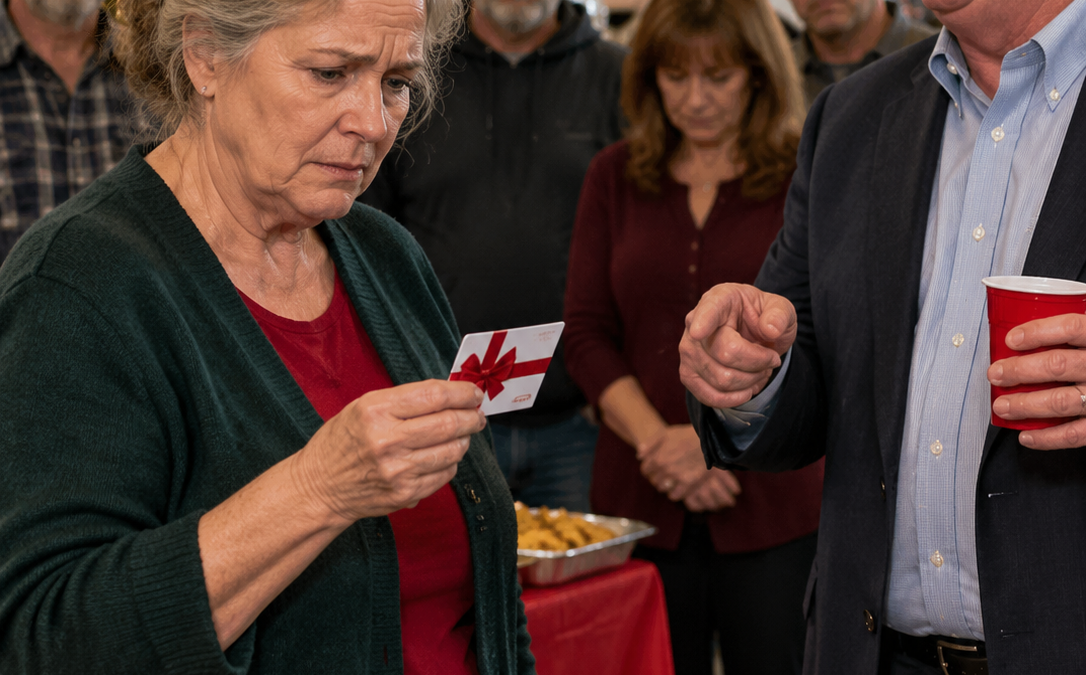
Complete story · 7 chapters · about 32 minutes · ending included
Chapter 1 · Chapter 2 · Chapter 3 · Chapter 4 · Chapter 5 · Chapter 6 · Chapter 7
Chapter 1: The Card From Bev’s Diner
At 6:20 p.m. on Friday, December 19, Joe Lloyd handed me a $25 card in front of forty drivers and said, “Twenty-six years, and a phone app does it better. Merry Christmas, Susan.”
The shop bay broke into laughter.
Anthony Wheeler didn’t laugh.
I looked at the little card in my hand, then at Joe.
“Do I sign for this?”
That cut some of the laughter short.
Joe gave his big laugh anyway, the one he used when he wanted a room to know he was still having fun.
“No paperwork on that one, Susan.”
I was fifty-eight years old, and I had been dispatching trucks for Lloyd Freight Lines since 1999. Twenty-six years of weather calls, late drivers, bad directions, missed dock times, title paperwork, fuel receipts, and knowing which customer would answer at 5:10 in the morning if a trailer had to move.
By then, I was dispatcher and title clerk because that was how small companies worked. If you stayed long enough and did things right, your job title got longer while your desk stayed the same size.
Deborah Doyle stood near the folding table with her paper cup held in both hands. She was our bookkeeper and notary.
She looked down at her shoes.
That hurt more than Joe’s joke.
Deborah knew what twenty-six years looked like. She had seen me stay through ice storms, driver shortages, and two office moves. She had watched me carry stacks of title applications between the office and the tag agency. She had cut more checks than I could count.
She also knew my last day was January 30.
Everybody did.
Joe had announced that part by email three days earlier. Short, like all his emails.
NEW SYSTEM LIVE JAN 31. SUSAN THROUGH JAN 30 FOR TRANSITION.
No thank-you. No meeting. No question about whether I wanted to stay in some other job.
A vendor had sold Joe dispatch software that could assign loads, send routes to phones, and flag late arrivals. According to Joe, that meant the part of my work he understood could now be done by an app.
The $25 card was for Bev’s Diner.
I turned it over once. Nothing written on the back.
Anthony was still watching me. He had been driving for the company since 1998, a year longer than I had been there. His face had that steady look he got when road conditions were bad and somebody else was pretending they weren’t.
Joe clapped his hands.
“All right, all right. We’re celebrating tonight.”
He raised his paper cup.
The room settled.
“I’ve got another reason.”
That got everybody’s attention.
Joe stood in front of the open shop bay with forty drivers around him, holiday trays on the workbench and folding chairs pushed against the wall. He smiled like he had been saving the best part.
“Lloyd Freight is sold.”
A few men shouted. Somebody whistled.
Joe lifted his cup higher.
“Kansas City carrier. Signing January 30, right here.”
He pointed down at the concrete floor.
“My last day too, I guess, if you want to get sentimental.”
More laughter.
Then he spread one hand toward the trucks outside.
“I built this company from nothing, with my own money.”
The applause came fast.
I looked at Deborah.
She was still looking down.
I stayed until the party was over.
That was not dignity. It was habit.
I cleared two route changes for Monday, put a driver’s medical-card copy where it belonged, and carried three title files back to the cabinet after everybody else had drifted toward the parking lot.
Walking out would have felt good for five minutes.
Leaving my work crooked would have bothered me all weekend.
That was the trouble with being the person who kept things straight. You still wanted them straight after somebody told you a phone app was worth more than you were.
At 7:43, the shop bay was quiet except for the heater and the metal click from the office door when it settled in its frame.
I sat down again.
My desk had the same scar along the right edge it had gotten during an office move years earlier. I had covered half of it with a blotter. The other half showed.
I opened the next truck file.
Registration.
Insurance.
Maintenance transfer.
Title.
I stopped.
At the bottom of the paper, under the lien information, was my name.
Susan Hobbs.
I stared at it.
Not the company.
Not a bank.
Me.
I knew why my name had once been there.
Picking up where the Facebook post left off
On March 12, 1999, Lloyd Freight had been in trouble. Real trouble. A bank was about to seize fourteen trucks. I had money from the sale of my house after my divorce, and Joe had needed money quickly.
I loaned him $60,000.
There was a note.
There was security.
There had been paperwork filed back then.
And in 2004, Joe had shown me a lapse notice.
He had tapped the page with one finger and told me the filing was dead.
I had believed the security was dead with it.
What remained, as far as I understood it, was the note and the $300 monthly check Joe kept sending.
Interest.
Nothing more.
I had never missed one of those checks. I kept every stub.
That did not mean I thought I still had a claim against a truck sitting outside in 2025.
I lifted the title closer.
The truck was not from 1999. It was one of the replacements that had come through later as the fleet aged.
My name was still printed as lienholder.
I opened the application behind it.
Joe’s signature was at the bottom.
A shadow crossed the office doorway.
“What are you reading?”
Joe stood there with his coat on and his keys in his hand.
I put the paper flat on the desk.
“Monday’s route.”
He looked at me for a second.
Then he shrugged.
“Don’t stay all night. Software doesn’t get overtime.”
He laughed at his own joke and kept walking.
I waited until I heard the outside door shut.
Then I pulled the title back out.
My heart was beating harder now, which annoyed me. A title was a title. Ink was ink. I had spent twenty-six years telling drivers not to turn a delay into a disaster before they knew what had happened.
So I did what I always did.
I checked the file.
The truck had replaced an older unit.
The application named me as lienholder.
Joe had signed it.
I went to the title cabinet and pulled the file for another replacement truck.
Same thing.
Then another.
Same thing.
By 8:05, I had stopped thinking about the party.
I had stopped thinking about the $25 card sitting beside my purse.
I was thinking about January 30.
Joe had just announced a sale.
I knew enough about our old note to remember one part even if I could not have quoted the whole page from memory.
The principal came due in 2029.
Or on a sale of the company.
At least, that was how I remembered it.
But I also remembered 2004.
Joe showing me that lapse notice.
Paperwork. Trust me.
For twenty-one years after that, I had treated the lien as dead.
So did a name on a 1999 deal still mean anything?
I didn’t know.
That bothered me more than if I had known the answer was no.
I knew titles.
I knew where they went, who signed them, which applications had to match, which truck had replaced which one.
I also knew better than to turn uncertainty into certainty just because I wanted Joe to be wrong.
I went back to the cabinet.
One file at a time.
I made a stack on my desk.
When I finished, I counted the titles.
Fourteen.
Then I counted the applications behind them.
Fourteen.
The folder held fourteen current titles naming Susan Hobbs as lienholder and fourteen replacement-truck applications signed by Joe Lloyd.
Chapter 2: The Box Under Her Bed
That night, I carried nothing out of Lloyd Freight except my purse, the $25 diner card, and a question I could not leave at the office.
At home, I went straight to the bedroom closet.
The file box was under a stack of winter blankets.
I had kept it since 1999.
Gray plastic. Black snap lid. One cracked corner from a move I had made fourteen years earlier.
Inside were tax papers, my divorce closing documents, old insurance records, and one thick folder with Joe Lloyd’s name on the tab.
I sat on the floor and opened it.
March 12, 1999.
The note was where I remembered it.
Sixty thousand dollars.
Thirty years.
Six percent.
Interest only at $300 a month.
Principal due March 12, 2029.
Then I found the sentence I had been thinking about since the party.
The unpaid principal also became due upon sale of the company.
I put my finger under that line.
Joe’s signature was on the last page.
Mine was below it.
Behind the note was the bank letter.
I had forgotten how blunt it was.
The bank was preparing to seize fourteen trucks.
Back then, Lloyd Freight had not looked like much. A small office. A gravel lot. Trucks that worked too hard and broke too often.
Joe had looked frightened in 1999.
I remembered that more clearly than the paperwork.
He had sat across from me and said the bank was going to take the trucks before payroll cleared.
I had money from the sale of my house after my divorce.
He needed $60,000.
I had it.
That decision had seemed temporary at the time.
Twenty-six years later, the original principal was still sitting there on paper.
I pulled out the payment stubs.
April 1999.
May 1999.
June.
Then year after year.
I had kept every one.
Some were narrow bank stubs. Some were copies I made at work. Some had coffee stains or folded corners.
All of them represented the same thing.
Three hundred dollars.
Month after month.
Interest.
In 2004, Joe had brought me a lapse notice from the old filing.
I could still see him standing beside my desk, tapping the page with one thick finger.
“Paperwork. Trust me.”
I had asked whether I needed to do anything.
He said no.
I had believed the filing ended the security.
After that, I kept processing replacement truck paperwork because that was part of my job and because the old agreement said the security followed replacements.
Joe kept signing the applications.
I kept filing them.
And I never connected those signatures to the possibility that anything was still alive.
Why would I?
The note had never gone into default.
The due date was still years away.
Until now.
Now Joe had sold the company.
I put the note back in the folder, but I did not close the box.
On Monday, December 22, Joe came into dispatch at 8:17 in the morning carrying a printed sheet from the software vendor.
He put it on my desk.
“Need all this entered by January 30.”
I looked down.
Customer notes.
Dock preferences.
Recurring route changes.
Driver restrictions.
Gate codes.
Seasonal problems.
Twenty-six years of things I had written down because somebody always needed to remember them later.
“All of it?”
“All of it.”
I looked at him.
“You’re replacing me with my own notes.”
Joe smiled.
“That’s called transition.”
The vendor’s representative was standing by the second desk with a laptop open.
He was younger than some of the route binders.
He pointed toward my shelves.
“We’ll migrate what we can, but Susan is basically the legacy process.”
Legacy process.
I looked at him.
Then at Joe.
Joe laughed.
“See? You’re historic.”
I picked up the printout.
“How much of this does the system already know?”
The vendor rep hesitated.
“Very little without the institutional data.”
Institutional data.
That was a nice way to say me.
Joe tapped the page.
“Just type it in.”
I set it down.
Then I opened my purse.
The copy of the note was folded inside.
I had brought it because I had spent the weekend deciding that saying nothing would bother me more than whatever Joe did after I spoke.
I unfolded it.
“Joe.”
His face changed before I even showed him the page.
Just slightly.
I held the note where he could see it.
“This says the principal comes due on a sale.”
The vendor rep looked away fast and became very interested in his laptop.
Joe stared at me.
“The filing died in 2004.”
“That isn’t what I asked.”
“You’ve been getting your money.”
“Interest.”
Joe’s mouth tightened.
I kept my voice level.
“You announced Friday that the company is sold. This says sixty thousand dollars becomes due when that happens.”
For a second, he said nothing.
Then he leaned closer to my desk.
“Put it in writing. See what happens.”
I looked at him.
“What happens?”
He gave me a short smile.
“You’ve got five weeks left here, Susan.”
Then he turned toward the vendor rep.
“Show her how to enter archived notes.”
That was the answer I got.
Not that the note had been canceled.
Not that the principal had been paid.
Not even that I had misunderstood the language.
Just a dare.
I spent the next several days feeding my work into the software.
Bridge closures.
Night-gate instructions.
Which customer required drivers to call from the east entrance.
Which warehouse would reject a truck fifteen minutes early and then complain if it arrived three minutes late.
The system took all of it without gratitude.
Christmas came and went.
So did New Year’s Day.
On Friday, January 2, I was entering a note about a loading dock when Deborah walked into dispatch.
She had an envelope in her hand.
She did not say anything at first.
She just placed it on my desk.
I looked up at her.
“Monthly?”
Deborah nodded.
Then she walked away.
I opened the envelope.
Inside was a check for $300.
The memo line said, “Note interest.”
The date was January 2, 2026.
And at the bottom was Joe Lloyd’s fresh signature.
Chapter 3: The Lawyer Who Read It Aloud
On Monday, January 5, I paid a lawyer to tell me whether I had spent twenty-one years believing the wrong piece of paper.
Michelle Vega’s office was on the second floor of a brick building downtown. She was fifty-five, sharp-eyed, and the kind of attorney who read the actual sentence instead of telling you what she remembered it said.
I brought copies of the note, the January 2 check, and the paperwork from the truck files.
Michelle spread everything across her conference table.
“The UCC filing lapsed in 2004,” I said.
“I see that.”
“So that killed the lien.”
Michelle looked at me.
“No.”
That one word cost me less than the rest of the meeting and was worth more.
She turned her monitor toward herself, found the Oklahoma statute, and read the part aloud.
For titled vehicles, the UCC filing rules and their five-year duration did not control a lien shown on the title.
Then she looked at the titles I had copied.
“Your name is noted as lienholder.”
“On fourteen.”
“And these replacement applications?”
“Joe signed every one.”
Michelle tapped the stack.
“A lien noted on the title stays active until it is released.”
I sat back.
For twenty-one years, I had treated the old filing lapse like a funeral notice.
Joe had too, or at least he had acted like he did.
Michelle picked up the note.
“Now the debt.”
She read the dates.
Thirty years from March 12, 1999.
Principal due March 12, 2029, unless the company was sold first.
“No default before now?” she asked.
“No.”
“No missed interest?”
“None.”
She looked at the January check.
“Then nobody has been sitting on an overdue claim. The principal was not due yet. The sale triggers it.”
“So no clock ran out.”
“Correct.”
That mattered.
I had spent the weekend wondering whether I had found fourteen impressive pieces of useless paper.
Michelle gathered the originals I had brought from the truck files.
“I want these in my safe.”
I looked at her.
“They belong in the title cabinet.”
“You are the lienholder.”
I thought about Joe telling me to bring them to signing.
Your last job.
I slid the folder across the table.
Michelle locked it away before I left.
That afternoon, she sent a certified payoff letter to Joe.
Sixty thousand dollars due upon the sale.
Payment first.
Releases after.
Nothing dramatic.
Just paper answering paper.
Joe answered two days later.
Wednesday, January 7, his email came in at 9:06 a.m.
I opened it at my desk.
That loan was paid off in 2004. The $300 is a loyalty bonus. Bring the titles to signing. Your last job.
I stared at the words loyalty bonus.
Then I opened my desk drawer and looked at the January check.
Memo: Note interest.
Signed by Joe.
A man could call something whatever he wanted in an email.
His pen had called it interest five days earlier.
I forwarded the message to Michelle.
Her reply came back in under ten minutes.
Keep everything.
That part I already knew how to do.
On Monday, January 12, Joe gave me another job.
He handed me a fleet list and told me to type the VINs into a certificate for the buyer.
All forty trucks.
I entered them one by one.
When I finished, I read the sentence above the signature line.
“All 40 trucks free of all liens.”
I looked at Joe’s office.
His door was open.
He was on the phone laughing.
Deborah came in ten minutes later with her notary stamp.
“Joe needs this?”
I turned the certificate toward her.
She read it.
Her eyes paused on the same sentence mine had.
Then she looked at me.
I said nothing.
Deborah carried it into Joe’s office.
A few minutes later she came back with the page signed.
She set it on the corner of my desk, pressed her stamp into place, signed her notary line, and lifted the page.
Her hand shook once.
Barely.
Then she took it away.
The next morning, my desk was gone.
Not my papers.
The actual desk.
Joe had maintenance move me into the tire room beside the inventory shelves.
The place smelled like rubber and cold concrete.
My computer sat on a folding table.
My chair had one wheel that stuck.
Anthony Wheeler found me there before eight.
“What happened?”
“Apparently I got promoted to tires.”
His mouth tightened.
Before I could say more, Joe came through the shop with three drivers behind him.
He raised his voice enough for everybody nearby to hear.
“Susan’s shaking down a retiring man over something from twenty-seven years ago.”
One driver looked at me.
Another looked away.
Joe kept walking.
I felt my face go hot.
That was the price of speaking first.
He still signed my checks.
He still controlled my last weeks.
And my health coverage ended January 31.
I had known that date already.
It felt different from the tire room.
Michelle called me that afternoon.
“We can contact the buyer.”
I looked through the open shop door.
Forty drivers depended on the sale going through.
Anthony had been there since 1998.
Some of the younger men had mortgages, kids, and no reason to care who was right about a note signed before half of them could drive.
“If we warn Kansas City now, what happens?”
“They may pause the transaction.”
“And the jobs?”
“I can’t promise you anything.”
That was the answer I expected.
I looked at Joe through the glass wall of his office.
He had committed his denial to email.
He had signed a certificate saying all forty trucks were free of liens.
He knew Michelle had sent the payoff demand.
He still had time to correct it.
“How late can I wait?”
Michelle was quiet for a second.
“The signing is January 30 at two.”
“I know.”
“If he refuses to pay, I may call Kansas City before then.”
I looked at the drivers moving through the bay.
Forty jobs.
One debt.
One false page.
“Give him until two o’clock,” I said.
“Signing day?”
“Yes.”
Michelle did not argue.
That was the deadline.
Joe had until two o’clock on January 30 to fix what he had sworn was not there.
Chapter 4: The Forty Folding Chairs
By Thursday, January 29, I knew two things for certain.
My lien was lawful, and if Joe’s sale collapsed, that did not mean I would ever see my $60,000.
The fourteen trucks were not new.
Some had hard miles on them. Some had repairs coming due. Michelle had warned me that if Lloyd Freight failed instead of selling, selling those trucks one by one might not cover the full principal.
That was the part Joe did not have to say out loud.
He knew I needed the sale too.
So did forty drivers who had spent most of January hearing that I was the woman standing between them and new ownership.
I kept the plan anyway.
At 7:12 Thursday morning, my phone buzzed on the folding table in the tire room.
Joe.
Titles on my table at two, or my lawyer reports stolen property.
I forwarded the text to Michelle.
She called before I finished my coffee.
“He can report whatever he wants,” she said. “You’re the lienholder. A lienholder may lawfully hold the titles.”
“So I don’t hand them over.”
“Not before payment.”
I looked through the tire-room doorway toward the yard.
“Could the police show up here?”
“They could show up anywhere somebody makes a complaint. That does not turn his complaint into ownership of your documents.”
“Good.”
Michelle paused.
“You sound calm.”
“I spent twenty-six years dispatching drivers through Oklahoma thunderstorms. Joe’s text is easier to read than radar.”
That got a small laugh out of her.
“Keep it,” she said.
“I keep everything.”
By ten, half the yard seemed to know about the titles.
Joe was efficient when the story helped him.
Anthony Wheeler found me at the fuel island near noon.
He was topping off his truck before a run, one gloved hand resting on the pump handle.
He did not circle around it.
“They say you’re holding up our jobs.”
I looked at him.
“Who’s they?”
“You know who.”
Joe.
Anthony glanced toward the shop.
“People are worried.”
“So am I.”
“You really have the titles?”
I could have explained the statute.
I could have told him about 1999, the bank letter, the note, the January check, and Joe’s sworn certificate.
Instead I said, “Ask him what’s in the folder.”
Anthony watched me for a second.
Then the pump clicked off.
He put the nozzle back without answering.
That afternoon, the shop bay started changing.
Folding chairs appeared.
Forty of them.
A banner went up across the back wall welcoming the Kansas City carrier.
Someone brought in bottled water and trays of sandwiches.
Joe had a table set at the front with two stacks of paper and a ceremonial pen in a black case.
He wanted the signing to look like an ending.
I spent the rest of Thursday entering route notes into the software.
Friday morning, January 30, I arrived before seven.
My last day.
I did not bring a box for my desk.
There was almost nothing left in the tire room worth packing.
At 12:40, Michelle walked in carrying the folder.
She kept it under her arm.
Joe saw her and stopped smiling.
At one o’clock, I went into his office alone.
He was standing behind his desk, straightening the cuffs of his shirt.
The banner was visible through the glass behind him.
I closed the door.
“Sixty thousand and fix that page before two.”
Joe looked at me.
“What page?”
“The certificate.”
His face hardened.
“All forty trucks free of liens.”
“My lawyer ran the search.”
“I know what your lawyer searched.”
“You planning to ruin this deal over old paper?”
“I’m giving you an hour to keep that from happening.”
Joe walked around the desk.
“You got every payment you were owed.”
“Interest.”
“You were paid for years.”
“Interest.”
His jaw moved.
I kept my voice flat.
“Pay the principal. Correct the certificate. Michelle gives you the releases.”
Joe stared at me.
Then he said, “Or what?”
I did not answer.
He knew.
The difference was that he still thought I would back down before the room filled.
At 1:25, Scott Burke arrived from Kansas City.
He was fifty, quiet, and dressed like a man who expected to read more than he talked.
Joe met him in the bay with both hands out.
“Scott. Big day.”
Scott shook his hand and looked over the table.
“Looks organized.”
Joe pointed toward the stacks.
“Everything ready.”
Scott nodded.
“I read titles last.”
My stomach tightened.
Michelle, standing beside me near the back row, heard it too.
That meant Joe would get through almost the entire closing before the folder mattered.
He seemed pleased by that.
Drivers started coming in from the yard.
Anthony took a chair in the second row.
Deborah sat near the aisle with her purse on her lap.
She had avoided me all morning.
By 1:55, every folding chair had somebody in it.
Forty drivers.
Some looked curious.
Some looked angry.
A few would not meet my eyes.
Joe stood at the front beside the banner and the ceremonial pen.
Scott sat at the signing table.
Michelle kept the folder tucked under one arm.
I stood near the tire-room door.
At exactly two, Joe picked up the microphone.
He thanked the drivers.
He thanked the buyer.
He thanked himself in three different ways without using those words.
Then he looked toward me.
His smile widened.
“Susan, come on up.”
Nobody moved.
Neither did I.
Joe lifted the microphone again.
“Susan’s last job.”
Forty faces turned toward me.
Joe pointed at Michelle’s folder.
“Hand the man his titles.”
Chapter 5: The Name on Fourteen Titles
Joe stood at the microphone with forty drivers facing him, a sworn certificate on the signing table, and a $4,200,000 agreement waiting for Scott Burke’s signature.
He had told me to hand the man his titles.
So I did.
Michelle walked beside me.
The shop bay seemed smaller than it had five minutes earlier. I could hear a chair leg scrape against concrete as we crossed the front row.
Scott looked up.
Michelle handed me the folder.
I put it on the table in front of him.
“Mr. Burke,” I said. “These are the titles Joe asked for.”
Joe smiled toward the drivers.
“Finally.”
Scott opened the folder.
He did not look at Joe.
He took out the first title and read down the page.
Then he stopped.
“Lienholder, Susan Hobbs.”
Nobody laughed.
Scott looked at me.
Then he took out the second title.
He did not read that one aloud.
He checked the lien line, placed it beside the first, and reached for the next.
One by one, he went through all fourteen.
I stood still beside Michelle.
Joe’s smile disappeared somewhere around the fourth title.
Scott laid all fourteen in a row beside the certificate Joe had signed on January 12.
“All 40 trucks free of all liens.”
The sentence sat there in black ink.
Joe stepped closer.
“That filing lapsed in 2004. My lawyer ran the search.”
Michelle opened the small statute book she had brought with her.
“I know.”
Joe looked at her.
She read one sentence aloud.
The provision for titled vehicles made clear that the UCC filing rules and their duration did not control a lien shown on a vehicle title.
Michelle closed the book.
“The lien remains until released.”
Joe pointed toward the titles.
“That’s old paperwork.”
I opened the second section of the folder.
I did not argue.
That was the part Joe never understood about records.
They did not need volume.
I put the 1999 note on the table.
Scott read the first page.
He saw the date.
March 12, 1999.
Sixty thousand dollars.
He turned to the signature page.
Joe Lloyd.
Then I laid down the replacement applications.
Fourteen of them.
Joe’s signature appeared on each application naming me as lienholder.
Scott went through those too.
His face stayed polite.
That somehow made Joe more nervous.
Finally, I took out the January 2 check.
Three hundred dollars.
Memo: Note interest.
Joe’s fresh signature at the bottom.
Scott looked from the check to Joe.
Joe’s face went red.
“She’s a bitter employee. Pay her the sixty and let’s sign.”
A few people shifted in their chairs.
My stomach tightened.
That was the outcome I had been trying to avoid.
I wanted the $60,000 because it was mine.
I also wanted those forty drivers to go home with jobs under a new owner.
Those two things had never felt like enemies until Joe made them stand in the same room.
Scott picked up the sworn certificate.
“You signed this?”
Joe snapped, “Yes.”
“And had it notarized?”
“Yes.”
Deborah moved in the second row.
I saw her hands tighten around her purse.
Scott looked at the certificate again.
“You certified all forty trucks were free of liens.”
Joe pointed at Michelle.
“My lawyer’s search was clean.”
Deborah stood.
Everyone looked at her.
She had spent weeks looking at floors, shoes, desks, anything that kept her out of Joe’s line of fire.
Now she faced him.
“I cut that check four weeks ago. Then I notarized your page.”
Joe’s head turned sharply.
“Deborah.”
She kept standing.
Her voice was quiet, but the shop bay carried it.
“I cut the January interest check. I saw the memo.”
Joe stared at her.
“You’re the bookkeeper. You don’t give legal opinions.”
“I didn’t.”
She sat down.
Anthony stood before Joe could say anything else.
“I saw those bank men in ’99.”
Joe’s face changed.
Anthony spoke in that slow way of his.
“They were out in this yard looking at trucks. I remember it.”
He looked at the note on the table.
“Nothing, huh?”
Joe lowered the microphone.
Nobody needed it anymore.
Scott closed the title folder halfway, then opened it again.
“I can pay a $60,000 lien,” he said.
Joe stepped toward him.
“Then do it.”
Scott looked at the certificate.
“I can’t buy from a man who swore there wasn’t one.”
Joe’s mouth opened.
Scott reached for the ceremonial pen.
For half a second, I thought he was going to sign.
Instead, he fitted the cap onto it.
One soft click.
Then he gathered the $4,200,000 purchase agreement.
Joe put one hand on the table.
“Scott.”
Scott slid the agreement into his case.
Unsigned.
“I have a loan commitment through tomorrow,” he said. “I’m not closing on this document today.”
The room stayed quiet.
Forty drivers were watching Joe now.
Not me.
Joe looked at Scott, then Michelle, then Deborah.
Finally he looked at me.
His expression had lost the big laugh completely.
“You happy?”
I looked at the software terminal through the open office door.
Twenty-six years of my route notes were sitting in it.
Everything Joe said a phone could do better.
“Software can route your trucks, Joe. It can’t release my lien.”
Scott snapped his case shut.
That ended the signing.
No applause.
No photographs.
No ceremonial pen.
Drivers started rising from the folding chairs in small groups.
Some looked at me as they passed.
Nobody called me a bitter employee.
Anthony gave me one slow nod.
Deborah stayed seated.
Joe stood beneath the banner with his hands at his sides.
The buyer’s loan commitment ended the next day.
If Scott walked away for good, the sale was gone.
If the sale was gone, my $60,000 was still due, but fourteen aging trucks might be all I had behind it.
Joe had gambled that I would choose fear over paper.
I was not yet sure what the paper had cost me.
Scott came around the table before leaving.
He reached into his jacket and handed me a business card.
“If I call,” he said, “answer.”
I put the card in my purse.
Then Michelle handed me the folder.
I tucked it under my arm and kept it there while Scott carried the unsigned agreement out of the shop bay.
Chapter 6: The Name on the Truck Door
January 31 came and went without a signature from me.
By Monday morning, Joe’s bank had called his credit line.
I knew because Joe called me at home at 8:34.
My health coverage had ended with January. So had my paycheck.
Joe still opened with the same voice he used when he wanted something to sound friendly.
“Susan, sign the release first. We’re family here.”
I stood in my kitchen with the phone against my ear.
For twenty-six years, I had heard Joe use the word family whenever the company needed somebody to stay late, skip lunch, or solve a problem that should have cost him money.
“Pay first,” I said. “That’s the order the law gives us.”
“You could settle this today if you wanted.”
“You signed the note.”
“The bank’s breathing down my neck.”
“That isn’t a release.”
He went quiet.
Then he hung up.
I put the phone on the counter.
No job.
No company health coverage.
No guarantee Scott Burke would come back.
And fourteen releases sitting unsigned because the $60,000 had not reached me.
I did not enjoy any of that.
But enjoying something and being right about it were different things.
The first February ice came before sunrise.
By seven, the roads around Tulsa had gone slick enough that even experienced drivers were taking extra room at intersections.
At 7:26, Anthony called my cell.
“Susan.”
His voice was slow as always, but I heard engines in the background.
“Where are you?”
“My kitchen.”
“We got six trucks pointed at a bridge that’s closed.”
I closed my eyes.
“Which bridge?”
He told me.
The software had routed six trucks toward the same closure.
Nobody had entered the ice restriction before the morning dispatch went out.
“Who’s running the board?”
“Software.”
“That wasn’t what I asked.”
Anthony gave a short grunt that might have been a laugh.
I pulled a legal pad from the junk drawer.
“Give me the six truck numbers.”
He did.
I knew the loads.
I knew which two could take the southern industrial road without losing clearance. I knew which three needed to turn west before the rail crossing. The last driver was carrying a trailer that could not make the tight corner by the warehouse district.
I called him directly.
“Backtrack three miles. Take the frontage road north, then stay on it until the second light.”
“You working again?”
“No.”
“Then why are you doing this?”
“Because you’re sitting on ice.”
That was enough.
For almost an hour, I worked from my kitchen table.
No paycheck.
No dispatcher login.
No Joe standing over me.
Just six drivers who needed somewhere safe to go.
By 8:21, all six were moving around the closure.
Anthony called again.
“Everybody’s clear.”
“Good.”
“You charging Joe?”
“No.”
“You should.”
“Probably.”
I hung up and made fresh coffee.
Helping the drivers did not mean Joe was getting his company back from me for free.
It meant Anthony had called.
I answered.
February 27 was a Friday.
Scott Burke came back to Tulsa with a different agreement.
The price was no longer $4,200,000.
It was $3,350,000.
Eight hundred fifty thousand dollars less.
There was no consulting agreement for Joe.
No transition period.
No ceremonial speech.
Scott’s condition was simple.
Joe was out that day.
We sat at the same table in the shop bay where the first signing had failed.
Michelle sat beside me.
Scott sat across from us.
Joe was at the far end.
Deborah was there for the paperwork.
The drivers stayed on.
That mattered to me before anything else on the page did.
At 10:18, my phone buzzed.
I looked at the banking notice.
$60,000.
The principal was finally there.
I showed Michelle.
She nodded.
Then I signed the first release.
Fourteen titles.
Fourteen liens.
Fourteen releases.
I signed each one only after payment.
Michelle checked every page.
When the last release was complete, I pushed the stack toward Scott.
“Those are yours now.”
He looked at me.
“Thank you.”
Joe said nothing.
By noon, the yard already looked different.
A sign crew was working down the line of trucks.
I stood outside with my coat buttoned while one man heated the lettering on a door and another worked a scraper underneath it.
Lloyd.
The first letters peeled away.
Joe came out of the office carrying a cardboard box.
His framed photographs were sticking out of the top beside a coffee mug and a stack of papers.
He stopped when he saw me.
For a second, neither of us said anything.
Then Joe looked at the truck door.
“I gave you a job.”
I looked at the box in his arms.
“I gave you the trucks.”
His face tightened.
He kept walking.
The scraper moved under another letter.
By the time Joe reached his car, half his name was gone.
Scott came out behind me.
“You ever think about staying?”
“I stayed twenty-six years.”
“I mean with us.”
“Full time?”
“That’s what I’m offering.”
I looked across the yard.
Anthony was climbing into his truck.
The door still had a pale outline where Lloyd’s name had been.
For most of my working life, somebody else had decided when I came in, when I went home, and what twenty-six years were worth.
I still had Joe’s $25 diner card in my purse.
I had never spent it.
I looked back at Scott.
“Three mornings a week,” I said.
He waited.
I named my rate.
Scott considered it for about two seconds.
Then he held out his hand.
“Three mornings.”
I shook it.
Chapter 7: The Last Twenty-Five Dollars
On Saturday, March 14, I carried the last thing Joe Lloyd had ever given me into Bev’s Diner.
The $25 card had been in my purse since December 19.
Three months earlier, Joe had held it out in front of forty drivers and told me twenty-six years of work could be done better by a phone app.
Now the debt was paid.
The fourteen releases were signed.
Joe was gone.
And the card was still worth exactly what it had been worth the night he handed it to me.
Twenty-five dollars.
Deborah Doyle was already in the window booth when I arrived.
Anthony Wheeler sat across from her with his coffee.
I slid in beside Deborah.
She gave me a careful smile.
“You’re late.”
I checked the clock over the counter.
“Two minutes.”
Anthony took a sip.
“Retirement made you reckless.”
“I work three mornings a week.”
“That’s close enough.”
Scott had kept his word.
Three mornings.
My rate.
No full-time schedule.
No pretending the software could replace experience while quietly asking me to repair what it missed.
I worked when we had agreed I would work, and when I left, I left.
Deborah stirred her coffee.
“I gave notice yesterday.”
I looked at her.
“At the office?”
She nodded.
“When are you done?”
“End of the month.”
Anthony leaned back.
“Everybody quitting but me.”
“You like driving too much,” I said.
“I like being away from offices.”
Deborah smiled at that, then looked down at her spoon.
For a second, I saw her again at the Christmas party, staring at her shoes while Joe handed me the card.
She had looked away then.
At the signing, she had stood up.
Both things were true.
I did not need to pretend one erased the other.
“You all right?” I asked.
She nodded.
“I should’ve said something sooner.”
I looked out the window.
Anthony’s truck was parked near the curb. The old company name was gone from the door.
“You said it when it counted.”
Deborah wrapped both hands around her cup.
That was enough for me.
The waitress came by with a coffee pot.
“Pie?”
Anthony looked at me.
“You buying?”
“I might.”
He pointed at my purse.
“What did you keep from the old place, anyway?”
I knew what he meant.
Not files.
Not money.
Something that had belonged to Lloyd Freight.
I reached into my purse and pulled out the card.
Bev’s Diner.
Twenty-five dollars.
I slid it across the table.
Anthony picked it up.
His eyebrows rose.
“No.”
“Yes.”
“The Christmas card?”
“The very one.”
Deborah looked at it and gave a small shake of her head.
“You kept that?”
“I keep every stub.”
Anthony turned the card over.
“What were you going to do with it?”
“I hadn’t decided.”
That was true.
For weeks, I had carried it because throwing it away felt too easy.
Then I carried it because I forgot about it.
After February 27, when the $60,000 hit my account and I signed the fourteen releases, I found the card while looking for Scott’s business card.
I could have thrown it in the trash then.
Instead, I put it back.
The card had started as proof that Joe thought twenty-six years could be reduced to a cheap joke.
But I had better proof of what those years were worth.
Three hundred twenty-two interest checks.
Fourteen titles.
Fourteen applications with Joe’s signature.
Forty drivers watching while Scott Burke opened the folder.
Six trucks I routed around a closed bridge from my kitchen after the software sent them the wrong way.
I did not need a piece of plastic to prove any of it.
Anthony set the card down.
“What’s the plan?”
I looked at the pie case.
“Three coffees. Three pieces.”
He grinned.
“Now you’re talking.”
Deborah chose apple.
Anthony wanted pecan.
I ordered cherry.
The waitress brought the plates out one at a time.
Anthony took one bite and pointed his fork at me.
“Worth twenty-six years?”
“No.”
Deborah laughed into her coffee.
I cut the point off my slice.
“Worth pie.”
That was better.
We ate slowly.
Nobody talked about Joe for several minutes.
Anthony told us about a driver who still refused to trust the new route screen without checking a paper map first.
Deborah said the new owners had changed the bookkeeping approval system.
I told them Scott had finally learned not to call me on Thursdays unless something was actually on fire.
Anthony looked at me.
“You answer anyway?”
“Depends who’s calling.”
He nodded like he understood exactly.
When the check came, the total was $24.60.
I looked at it.
Then I looked at the card.
“Close.”
Anthony laughed.
“Joe finally budgeted something right.”
I handed the card to the waitress.
She took it to the register.
I watched her run it.
For the last time, that little piece of plastic paid for something.
She came back and placed it beside my plate.
“There’s forty cents left.”
I pushed it back toward her.
“Keep it.”
She looked at me.
“The card?”
“The forty cents.”
She smiled.
“I can toss the card for you.”
I glanced at Deborah.
Then Anthony.
“No. You can toss it.”
The waitress dropped it into the trash under the register.
That was all.
No ceremony.
No speech.
I finished my pie.
Deborah finished hers too.
When we stood to leave, she touched my sleeve.
“Lunch again?”
“After your last day.”
She nodded.
Anthony held the diner door open for us.
Cold March air came in around him.
Deborah headed toward her car.
Anthony’s truck sat at the curb, engine idling, a new company name clean across the door where Lloyd had once been.
He climbed into the cab and rolled down the window.
“Monday?”
“Three mornings,” I reminded him.
He pointed at me.
“Tuesday, then.”
I lifted one hand.
Anthony pulled away.
I went back inside long enough to take the last drink of my coffee from the window booth.
Then I set the cup down and walked to my car.
THE END







