My daughter drove me, 70, to a nursing home ‘for lunch’ and handed the director admission papers with my forged signature. I’d never signed anything.
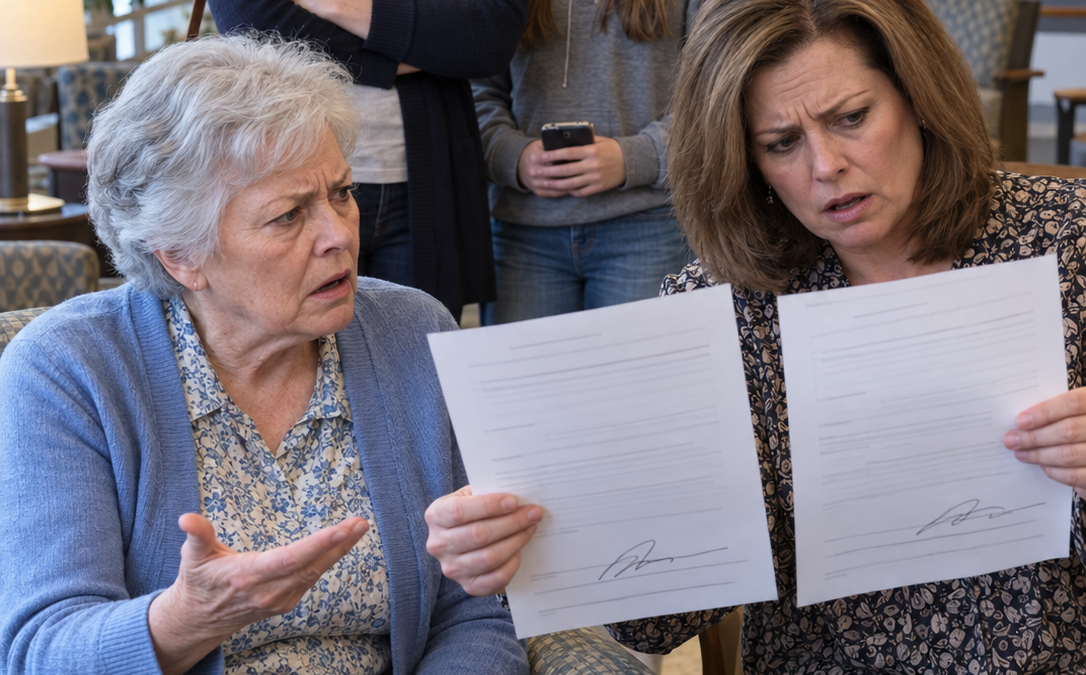
Complete story · 10 parts · about 40 minutes · ending included
Part 1 · Part 2 · Part 3 · Part 4 · Part 5 · Part 6 · Part 7 · Part 8 · Part 9 · Part 10
Part 1 of 10
At 12:30 Thursday, Tracy parked at Cottonwood Terrace and told me to leave my purse.
“The new lunch place,” my daughter said, pointing toward the doors.
Hannah followed with her phone, watching me instead of the building.
Inside, Tracy handed a packet to a woman named Christine.
The receptionist looked up, and two aides stopped beside the counter.
Christine turned to the last page.
My name sat above a printed line in round, upright letters.
“I never signed anything.”
Tracy spoke loudly enough for the aides to hear.
“You signed it Tuesday, Mom. You just don’t remember Tuesdays anymore.”
My face burned.
Christine pulled a calendar closer and wrote beside November 9.
“We have Room 14B available,” Christine said. “I’ll put you down for that.”
Tracy touched my shoulder.
“See, Mom? It’s settled.”
“I heard you.”
My daughter kept her hand there, pressing lightly through my jacket.
I moved away.
The receptionist lowered her eyes to the keyboard.
One aide adjusted a stack of towels against her chest.
The other looked at Tracy, waiting for whatever came next.
Nobody asked me to sit down.
Nobody asked whether I wanted that room.
Christine clipped the packet shut before I could see the page again.
I wanted to reach across the counter and take it.
My hands were shaking, and I hated that Tracy could see.
I pressed my palms against my skirt.
There was an aquarium beside the lobby chairs.
A little orange fish moved behind a plastic castle.
I knew that tank.
In March 2024, I had sat beside it with a walker between my knees.
I had been here after knee surgery.
Back then, getting to the end of that hallway had been an accomplishment.
I remembered gripping the walker and watching the fish while my knee stopped aching.
I remembered wanting my own kitchen.
I had gone home when my rehabilitation ended.
Now Tracy stood at the same counter, arranging another stay.
This time, my knee was fine.
Christine opened a drawer and took out a brochure.
“We can look at the dining arrangements,” Christine said.
Tracy accepted the brochure before I could touch it.
“Lunch was how I got her out of the house,” Tracy said, smiling.
My stomach tightened.
I had eaten a piece of toast that morning.
I had left soup in my refrigerator because my daughter promised lunch.
I looked toward the glass doors.
Outside, Tracy’s car sat near the entrance.
My purse was still on the passenger seat.
Hannah stood close enough that her sleeve brushed mine.
“Grandma’s hungry,” Hannah said.
It was the first thing my granddaughter had said since we arrived.
“We’ll eat in a minute,” Tracy said.
Christine’s smile softened.
“I know this can feel like a lot, Mrs. Palmer.”
I had taught third grade for years.
I knew that voice.
It was the voice an adult used when a child hadn’t understood instructions.
I understood the room number.
I understood the date.
What I didn’t understand was why my own answer had counted for nothing.
Tracy leaned closer to Christine.
“Keep things simple for her,” Tracy said. “Too much information gets her worked up.”
The receptionist stopped typing.
I watched the woman’s fingers rest above the keys.
I wanted the receptionist to look at me.
I wanted somebody to notice that I was standing right there, listening.
Christine placed a pen across the packet.
“We’ll make the transition as comfortable as possible,” Christine said.
Tracy nodded as if Christine had answered a question I had asked.
Then my daughter moved the brochure under her arm.
The packet stayed on the counter, beneath Christine’s hand.
I could see its corners.
I could still picture the name.
I had written Sharon Palmer on school forms, birthday cards, checks, and grocery lists.
My writing leaned to the right.
Those letters had stood straight up.
Who wrote Sharon’s name on that page?
My own question sounded strange in my head.
It was my name, and I was already thinking about it like evidence belonging to somebody else.
Hannah’s phone screen lit up.
My granddaughter tilted it toward her chest.
Tracy noticed.
“Put that away while we’re talking.”
Hannah lowered the phone without slipping it into a pocket.
Christine slid a small card toward Tracy.
“Call if you need anything before the ninth.”
My daughter put the card inside her purse.
I had nothing in my hands.
No brochure.
No page with my name.
No lunch menu.
I looked down at the counter, hoping Christine would open the packet again.
Instead, Christine tucked it into a file.
That hurt more than I expected.
A stranger had put my life in a drawer while my daughter stood smiling.
“Come on, Mom,” Tracy said. “Let’s get you something to eat.”
Hannah reached for my elbow.
I didn’t need help walking, but I let my granddaughter stay close.
We passed the aquarium on the way out.
My reflection showed in the glass beside the fish.
I was seventy, wearing the blue jacket I had chosen for lunch.
I had buttoned it myself.
I had locked my own front door.
At the entrance, Tracy held the door and checked her phone.
“Scott wants to know how it went,” Tracy said.
My daughter typed with one thumb.
I watched the movement until the outside air hit my face.
I felt angry now, enough that my jaw hurt from holding it still.
In the parking lot, Hannah opened the rear door.
“Sit with me, Grandma.”
Tracy looked up.
“Your grandmother usually sits in front.”
“I want her back here,” Hannah said.
My granddaughter’s voice was quiet, but Hannah held the door.
I got into the back seat.
Tracy retrieved my purse from the front and handed it over.
“There,” Tracy said. “You didn’t need to carry it around.”
I held the strap tightly.
My daughter started the car and turned toward the exit.
Hannah waited until Tracy was watching traffic.
Then my granddaughter slid the phone across the seat.
On the screen was a yellow legal pad covered in “Sharon A. Palmer,” written in my daughter’s handwriting.
Picking up where the Facebook post left off
Part 2 of 10
Tracy lifted my car keys from the kitchen hook Friday morning.
“On the doctor’s advice,” my daughter said.
I stood beside the stove with a piece of buttered toast.
“What doctor?”
“Mom, please don’t start.”
Tracy put the keys in her purse.
I set my plate down before I dropped it.
“My doctor hasn’t told me to stop driving.”
“We’re trying to prevent an accident,” Tracy said. “You should appreciate that.”
Scott came through the doorway carrying a tape measure.
My son-in-law nodded toward the living room.
“Need a little space in here.”
He stretched the yellow blade along the wall behind my couch.
“What are you measuring?”
“For a stager,” Scott said.
He looked at Tracy.
My daughter opened a cabinet and took down a coffee mug.
“Someone who helps arrange things,” Tracy said. “Makes a room easier to move around.”
I looked at the path between my couch and the doorway.
I had walked through it carrying laundry that morning.
Scott wrote a measurement on the back of an envelope.
“Your couch is a beast,” he said. “They don’t make them light anymore.”
I didn’t answer.
My purse sat on a kitchen chair.
Inside it was my wallet, my checkbook, and an empty pocket where I usually kept spare keys.
I had hung that spare set beside the first one.
The hook was bare.
Hannah’s picture stayed in my mind.
The yellow paper.
My name written over and over.
I hadn’t told Tracy what Hannah showed me.
My granddaughter had trusted me with something that made my stomach hurt.
I wasn’t going to give Tracy a reason to take Hannah’s phone.
Scott moved the end table with his knee.
“Careful,” I said.
“Just getting the width.”
I picked up my toast and carried it to the sink.
I couldn’t swallow another bite.
By the time they left, Scott had measured the couch and the window wall.
Tracy had my keys.
I waited until their car pulled away before finding Cottonwood Terrace’s number.
I wrote it on a grocery envelope so my hand would stop fumbling with the phone.
A woman answered and transferred me to the admissions coordinator.
“My name is Sharon Palmer,” I said. “I was there yesterday.”
Paper moved near the receiver.
“Yes, Mrs. Palmer.”
“I am not moving in.”
The coordinator paused.
“I didn’t agree to a room,” I said. “I didn’t sign those papers.”
“Your daughter told us you might call. I’ve put a note in your file.”
I gripped the edge of my table.
“What does the note say?”
“That you’ve called with concerns.”
“This isn’t a concern. I’m telling you I didn’t sign.”
“I understand this is upsetting.”
My throat tightened.
The coordinator sounded patient.
That made it worse.
I could hear that my refusal had become something to manage.
“Please tell Christine I said no.”
“I’ll pass your message along.”
When the call ended, I stayed at the table.
My coffee had gone cold beside the telephone.
Yesterday, Tracy had spoken for me in a lobby.
Today, Tracy had reached the person answering before I could.
I wrote down the time of the call.
Then I wrote what the coordinator had said.
I used to keep notes after parent conferences.
I wanted an exact record now.
Tracy and Scott came back that afternoon.
Scott had left his envelope beside my lamp.
He picked it up while Tracy set a grocery bag on the counter.
“I brought bananas,” Tracy said.
“I want copies of the papers.”
My daughter stopped unpacking.
“What papers?”
“The ones you gave Christine.”
“You’ll get what you need.”
“I need them now.”
Tracy looked toward the living room.
“Scott, would you explain that we’ve already handled this?”
He folded the envelope and put it in his shirt pocket.
“Your mom just wants to look things over.”
“Then give me copies,” I said.
Tracy pulled a banana loose from the bunch.
“I can’t spend the whole weekend doing this.”
My face grew hot.
I had asked for papers with my name on them.
My daughter made it sound like I had asked for a favor.
Scott rubbed the back of his neck.
“Maybe let her have a look, Trace.”
Tracy turned toward him.
“I’m her power of attorney. I decide where she lives.”
Scott looked down.
The banana snapped at the stem in Tracy’s hand.
I stared at my daughter.
I remembered signing a power of attorney after Walt died.
It had been June 2019.
There had been bills to organize and accounts to understand.
I had wanted help if I needed it.
I hadn’t thought about that paper in years.
“I want my copy,” I said.
“It’s handled, Mom.”
Tracy put the groceries away.
I stayed out of the kitchen until they left.
Then I went into the small room where I kept my desk.
The key was inside an old pencil box.
I took it out and unlocked the bottom drawer.
My fingers were steadier now.
I found the folder behind my insurance papers.
The date was where I remembered it.
June 2019.
I laid the document under the desk lamp and put on my glasses.
There was my signature.
Slanted letters, familiar enough that my chest hurt.
I followed the printed lines with my finger.
“Financial matters.”
I said the words aloud.
Then I turned back to the first page.
I wanted to find the part Tracy meant.
The part that let my daughter take my keys and choose a room.
I kept the document open on the desk.
If the POA said money, who gave Tracy the right to choose a bed?
I didn’t know enough to argue about the paper.
I knew who could answer a question about my memory.
My doctor’s number was written inside my address book.
I called before the office closed.
“Do you have anything Monday morning?”
The receptionist checked.
“The first appointment is available.”
“I’ll take it.”
“What should I put down for the reason?”
I looked at my car keys’ empty hook across the hall.
“I want a memory test.”
Part 3 of 10
Hannah set her phone beside my Halloween candy bowl Saturday morning.
“Grandma, that’s your house.”
The price under my front porch was $689,000.
I pulled out a kitchen chair.
My granddaughter stayed standing, one hand tucked inside her hoodie pocket.
The screen showed a real-estate site.
Above the price were the words “Coming Soon.”
Below the picture was my address.
I checked the street number, hoping somebody had made a mistake.
It was mine.
“When did this go up?”
Hannah pointed near the bottom.
“October twenty-third.”
Friday.
The listing had been there before Tracy took me to Cottonwood Terrace.
Before my daughter called it lunch.
I sat down because my knees felt weak.
“There’s more,” Hannah said.
My granddaughter moved a finger across the screen.
My living room appeared.
The couch cushions had been straightened.
My reading glasses were beside the lamp.
Walt’s old chair sat near the window.
I could see the corner where Scott had stood with his tape measure yesterday.
Hannah brought the phone closer.
I touched the blue afghan draped over the couch in the picture.
I had put it there during Sunday dinner.
October 18.
The house had been warm from the oven, and I hadn’t wanted it across my lap.
Scott had walked around with his phone that afternoon.
“Taking pictures of the grandkids,” he had said.
I remembered stepping aside so I wouldn’t spoil his shot.
He had thanked me.
My face burned.
“Did you know?” I said.
Hannah shook her head quickly.
“About the house, I mean.”
“No, Grandma.”
I believed my granddaughter.
Hannah looked frightened, and I hated that my question had caused it.
“You did right bringing this.”
My granddaughter finally sat down.
I pulled the phone between us and looked at the next picture.
My kitchen.
The table where we were sitting.
Somebody had moved the candy bowl out of view.
I looked toward the counter.
The bowl had been there after Sunday dinner.
I had thought I moved it myself.
“Can you keep these pictures?” I said.
“I already did.”
Hannah showed me the saved images.
The price was visible.
So was the posting date.
I wanted to call Tracy and demand an answer.
Instead, I asked Hannah to send the pictures to my phone.
My granddaughter helped me open them.
I left the image of my front porch on the screen.
A car door shut outside.
Hannah looked toward the window.
“Mom.”
My stomach tightened.
Tracy came in carrying a small bag of candy.
“For tonight,” my daughter said.
I already had candy.
I took the bag anyway and set it beside the bowl.
Tracy looked from Hannah to me.
“What are you girls doing?”
I turned my phone across the table.
“Why is my house on this site?”
My daughter leaned down.
For a second, Tracy’s mouth stayed open without a sound.
Then my daughter straightened.
“Hannah, you need to stop upsetting your grandmother.”
“I showed her a picture.”
“That’s enough.”
“Answer me,” I said.
Tracy looked at Hannah instead.
“We’re not selling anything. This is about her safety.”
“My house has a price on it.”
“People explore options, Mom.”
“I didn’t ask you to.”
Tracy pulled out a chair but didn’t sit.
“You don’t understand how much work this has been.”
My hands curled under the edge of the table.
I wanted to shout.
Hannah was watching me, so I made myself speak slowly.
“Take it down.”
“I’m not discussing this while you’re worked up.”
Tracy pushed the chair back into place.
The legs scraped my kitchen floor.
My daughter checked the time on her phone.
“I have errands. Hannah, be ready when I come back.”
Hannah nodded.
Tracy left the candy on the counter and walked out.
I listened until the car started.
Then I reached for my purse.
I wanted my checkbook in the desk with the power of attorney.
I wanted the things I could still put my hands on kept together.
The purse was on the chair where I had left it.
I opened the checkbook and stopped.
A check was missing.
The stub for number 1047 was blank.
No date.
No amount.
No name telling me who had received it.
I ran my thumb along the torn edge.
I had kept a check register since I started earning a paycheck.
I wrote things down when I paid them.
That habit had survived Walt’s death, knee surgery, and retirement.
“Hannah.”
My granddaughter came around the table.
“Did you write one?” Hannah said.
“No.”
I checked the purse’s inside pocket.
There wasn’t a loose check tucked behind my receipts.
I looked through the checkbook without finding it.
Number 1047 had been torn out.
I put the book flat on the table.
My mouth felt dry.
Someone had needed my name on papers.
Now a check was gone.
I couldn’t tell what connected them.
I only knew I hadn’t agreed to either.
Hannah kept a hand inside the front pocket of her hoodie.
My granddaughter watched the checkbook for a moment.
Then Hannah pulled out a folded yellow page.
I recognized the paper before it opened.
The same kind I had seen on the phone in Tracy’s car.
Hannah smoothed one corner against the table.
My name showed along the crease.
“Do you want it, Grandma?”
I looked at the paper, then at the blank stub.
What did Tracy need a blank check for?
I wanted the page in my desk.
I also knew Tracy walked into my house without waiting for an invitation.
My daughter had taken my keys from their hook.
I couldn’t leave Hannah’s page where Tracy might find it.
“You keep it. Somewhere she won’t look.”
Part 4 of 10
On Monday, November 2, I climbed onto the bus with my doctor’s address.
My car sat in my driveway without its keys.
I held the fare in my palm until the driver waited for me.
At seventy, I didn’t like being watched while I found a seat.
That morning, I liked depending on Tracy even less.
I sat near the front and kept my purse on my lap.
Inside was the appointment card I’d written for myself.
I knew where I was going.
I knew why.
Still, my hands were damp by the time I reached the doctor’s office.
At the desk, I gave my name and birth date.
The receptionist handed me a clipboard.
I filled out the form without calling my daughter.
When the doctor came in, I put my purse on the floor.
“My daughter says I don’t remember signing nursing-home papers.”
“Do you remember signing them?”
“I didn’t sign them.”
The doctor pulled a chair closer.
“Tell me what’s been happening.”
I explained the lunch that wasn’t lunch.
The room with a number.
My keys.
I kept my answers short because I wanted the doctor to hear them clearly.
Then I said what frightened me.
“If I get upset, Tracy calls that confusion.”
The doctor set the chart down.
“Let’s do the screening you requested.”
There were questions, words to remember, and instructions to follow.
I listened carefully.
When I couldn’t give an answer immediately, my face grew hot.
I pictured Tracy standing beside me, ready to point.
My daughter wasn’t in the room.
I took my time.
The doctor marked the page and turned it toward me.
“Twenty-nine out of thirty.”
I looked at the score.
“Does that mean I’m confused?”
“The screening doesn’t show cognitive impairment.”
My shoulders loosened, but I still needed something I could carry out.
“Would you write that down?”
The doctor nodded.
I waited while the letter printed.
It filled one page.
The words “no cognitive impairment” were there in plain type.
I checked my name at the top.
Then I folded the letter carefully and put it inside my purse.
On the bus home, I kept my hand over the clasp.
I wanted to get inside, make tea, and put the letter somewhere safe.
Tracy’s car was in my driveway when I returned.
The garage door stood open.
My classroom boxes were lined up beside Walt’s tools.
“DONATE” was written across the cardboard in black marker.
I stopped at the edge of the concrete.
One box held the books I’d bought for children who finished their work early.
Another held folders of things I had saved from my classroom.
Walt’s toolbox sat beside them.
I knew the worn place on its handle.
I had watched my husband carry it through that doorway for years.
Tracy came out of the house holding the thick marker from my kitchen drawer.
“You’re back.”
I pointed at the boxes.
“Those aren’t donations.”
“Mom, you can’t take a houseful of stuff.”
“I didn’t ask you to sort my things.”
Tracy pushed the cap onto the marker.
“Movers come the ninth. Pack one suitcase. Be grateful we found a bed.”
My stomach dropped.
I had a letter in my purse saying my mind was clear.
My daughter was standing in my garage deciding what I could keep.
“Leave Walt’s tools alone.”
“I’m trying to get ahead of this.”
“Put them back.”
Tracy looked toward the shelves.
“You can choose a few things later.”
I walked past my daughter and picked up the toolbox.
It was heavier than I expected.
I set it on the workbench before my grip gave out.
My arms ached.
Tracy watched without helping.
“You’re making this harder than it needs to be.”
I rested my hand on the lid.
“These stay here.”
My daughter carried the marker into the kitchen.
I stayed in the garage until I could trust my voice.
That evening, I opened a classroom box.
The first folder had my handwriting on its tab.
I sat on the garage step with it across my knees.
I felt humiliated.
I was going through my belongings as though I needed permission to save them.
I put the folder back and closed the box.
Upstairs, I placed the doctor’s letter inside the desk drawer with my power-of-attorney copy.
I didn’t tell Tracy about the score.
I wanted to keep the paper where my daughter couldn’t take it.
Tuesday passed with the garage boxes still marked.
I ate at my kitchen table and watched my own car through the window.
I could get to the doctor by bus.
I could write down a telephone call.
I still couldn’t make the people at Cottonwood Terrace listen.
On Wednesday, I kept my phone beside me while I sorted the mail.
At 2:15 p.m., it rang.
I recognized the facility number from the call I’d made Friday.
My chest tightened.
I expected another reminder about the room.
I answered.
A man’s voice came through, level and businesslike.
“May I speak with the account holder, Sharon Palmer?”
I looked down at the envelope beneath my hand.
My name was printed on that, too.
The account holder.
The man hadn’t asked for my daughter.
Why was the nursing home asking for me, not Tracy?
I moved the phone from my ear, ready to put it on speaker.
Before I could answer his question, a text appeared.
Tracy’s name filled the top of the screen.
“If you make a scene Monday, we go to court for a guardian.”
Part 5 of 10
“Eleven thousand eight hundred fifty dollars a month,” the man said.
I put the phone on speaker beside Tracy’s text.
“From whose account?”
“Your checking account, Mrs. Palmer.”
I sat down.
“My name is Ryan Castillo. I’m the business office manager at Cottonwood Terrace.”
I picked up a pen.
“Please say the amount again.”
Ryan repeated it slowly enough for me to write $11,850.
“The first bank draft is scheduled for November tenth.”
I wrote the date beneath the amount.
“And you have permission for that?”
“That’s what I’m calling to verify.”
Paper moved near his receiver.
“I verify each draft with the account holder before it goes through.”
“My daughter gave you my account number?”
“The packet includes an authorization form and a voided check.”
My pen stopped.
“What check?”
“Number one thousand forty-seven.”
I opened my purse and took out the checkbook.
The blank stub was where I had left it.
“I didn’t give anyone that check.”
Ryan waited.
“I authorized nothing,” I said. “No room. No payments. No admission.”
“Are you saying the signatures aren’t yours?”
“Yes.”
I had said it at the counter.
I had said it over the phone.
This time, the person listening didn’t tell me I was upset.
“Did you have a previous stay here?” Ryan said.
“After knee surgery. March 2024.”
“Did you sign your own admission papers then?”
“Yes.”
“I’m going to check the archive. May I put you on hold?”
I said yes before he finished asking.
The music was faint and tinny.
I looked at Tracy’s message.
A guardian.
I had been carrying that threat since it appeared on the screen.
Now somebody was looking for a paper I had signed myself.
I hadn’t known Cottonwood Terrace still had it.
While I waited, I brought my desk key to the kitchen.
Then I sat back down because I was afraid to miss his voice.
“Mrs. Palmer?”
“I’m here.”
“I have your March admission page.”
My fingers tightened around the pen.
“And the new one?”
“It’s in front of me.”
I heard him set something down.
“These are not the same hand, ma’am.”
I pressed my palm against the table.
Ryan had said plainly what I had seen in the lobby.
My eyes filled, and I wiped them before answering.
“I told them.”
“I’ve noted your dispute.”
“My daughter told admissions I’d deny it.”
“I can see the note.”
I waited for him to say the note mattered more.
Instead, Ryan asked a precise question.
“Has a court ever found you incapacitated?”
“No.”
“Has anyone been appointed your guardian?”
“No.”
“Then you sign for yourself.”
I looked toward the hall, as if Tracy might already be standing there.
“My daughter has power of attorney.”
“I have that document in the packet.”
Ryan read the words slowly.
“Financial matters.”
“That matches my copy.”
“That document doesn’t authorize her to choose where you live.”
I put the pen down.
I needed my hands free to hold the edge of the table.
“She said it did.”
“It doesn’t.”
“Can she have the money taken out anyway?”
“This draft will not run.”
I wanted to trust him.
I also wanted the words where I could see them.
I wrote them beneath the date.
“I’m flagging the account,” Ryan said. “The disputed admission page and your 2024 page go to Christine Monday morning.”
“Will Christine listen?”
“She’ll have the documents side by side.”
I looked at the doorway again.
“If Tracy hears first, she’ll file for guardianship.”
“Has she said that?”
“There’s a text on my phone right now.”
I read it aloud without changing a word.
Ryan waited until I finished.
“Keep that message.”
“I have a doctor’s letter, too.”
“Bring it.”
I told him the screening score.
Twenty-nine out of thirty.
For days, I had wanted to say that number to someone who would hear it.
Ryan asked me to bring my own copy of the power of attorney.
I wrote that down.
Then I asked him to repeat what would happen with the draft.
He repeated it without sounding impatient.
When the call ended, I stayed at the table.
The amount was still there on my paper.
So was check number 1047.
I opened the desk drawer and laid out the doctor’s letter and the 2019 document.
Until that afternoon, I had been gathering things without knowing where to take them.
Now I had a name.
Ryan Castillo.
I wrote it at the top of the page.
I still felt afraid.
Tracy had my car keys.
My daughter could walk into my house and talk about movers.
But Ryan had looked at the papers before deciding whether to believe me.
Would I walk into that lobby myself?
I looked toward the garage door.
My classroom boxes were still out there.
I knew what would happen if I stayed home.
Tracy would arrive with the packet, and I would be a person being discussed again.
I went upstairs and took a suitcase from the closet.
One suitcase, as instructed.
I set it open on my bed.
The doctor’s letter went in first.
Then my power-of-attorney copy.
I placed the checkbook beside them, open to the blank stub before closing its cover.
In my tutoring folder, I found the library sign-in slip from Tuesday, October 27.
One until four.
I had been at the public library that afternoon.
I laid the slip with the papers.
Then I folded a cardigan and placed it on top.
I touched the suitcase handle and spoke aloud.
“Monday, Christine can ask me herself.”
Part 6 of 10
At 10:00 Monday morning, Tracy wheeled a cart through Cottonwood Terrace’s front doors.
Boxes sat beneath a sheet cake that said “Welcome Home, Mom.”
Hannah held my arm while Scott carried a cushion from my recliner.
I stopped just inside the entrance.
My daughter had brought part of my chair.
I hadn’t seen Scott take it out of my house.
“Watch the cake,” Tracy said. “That corner wants to slide.”
Scott shifted the cushion under his arm and steadied the plastic lid.
I held my suitcase.
Inside were the papers I had chosen, with my cardigan on top.
Hannah’s fingers tightened against my sleeve.
“You okay, Grandma?”
“Yes.”
My mouth was dry.
Across the lobby, Christine looked up from the counter.
Ryan stood beside a folder.
I recognized his voice when he said my name.
“Mrs. Palmer.”
Tracy pushed the cart toward him.
“We made it,” my daughter said. “Quite a morning.”
I counted the faces turned toward us.
Eleven people watched.
Some stood near the hallway.
Others sat with coats across their knees.
The receptionist had stopped typing.
I knew Tracy wanted an audience for the cake.
I hadn’t wanted one for the papers.
Christine came around the counter.
“Mrs. Palmer, would you like to sit?”
I chose the chair beside the aquarium.
Hannah stayed next to me.
I set the suitcase between my shoes, where I could reach it.
Scott lowered the cushion against his leg.
“Where do you want this?”
“Just a moment,” Christine said.
Tracy smiled toward the people waiting.
“She gets nervous with changes.”
I looked directly at my daughter.
Tracy kept speaking to Christine.
“She won’t remember signing. She never does.”
My face burned.
Hannah’s hand moved from my arm to the chair’s wooden edge.
My granddaughter didn’t say anything.
Neither did I.
I watched Christine return to the counter.
Ryan moved the folder closer.
Christine opened it and lifted out the pages.
One was older, with a different heading.
The other was the admission page I remembered from Thursday.
Christine held them side by side.
I could see my slanted writing on one.
The round, upright letters sat on the other.
My stomach tightened even though I had expected the difference.
I had spent days explaining what I hadn’t done.
Now the pages were in somebody else’s hands.
Tracy stopped smiling.
“Is there a problem?”
“We need to review these before proceeding,” Christine said.
“The room was booked.”
“Yes.”
“And the movers are coming.”
Christine kept the pages raised.
“We still need to review them.”
Scott looked toward the cart.
The cake lid had fogged slightly at the corners.
He wiped a thumb across the plastic without lifting it.
Tracy glanced at Ryan.
“I gave admissions everything you asked for.”
Ryan placed a finger on the open folder.
“We’re reviewing what was submitted.”
His voice sounded the same as it had on the phone.
I needed that.
My own heartbeat felt loud in my ears.
Christine looked at the newer page.
“Mrs. Leonard, when was this signed?”
Tracy answered quickly.
“Mom signed every page herself, Tuesday night at our kitchen table.”
I bent toward my suitcase.
Hannah moved back to give me room.
The zipper caught at the corner, and I had to hold the fabric flat.
Tracy watched my hands.
I hated giving my daughter anything to point at.
I pulled the zipper free.
My cardigan covered the papers just as I had left it.
I lifted the sweater and found the library slip.
Then I stood.
Hannah reached toward my elbow.
“I have it,” I said.
The walk to the counter was short.
I made myself take it at my own pace.
Christine lowered the pages enough to look at me.
I laid the slip where Tracy could see it.
“On Tuesday I was at the library until four.”
Christine checked the date.
“October twenty-seventh?”
“Yes.”
Tracy folded her arms.
“I said that night.”
“I heard you.”
I left the slip on the counter.
It showed where I had been that afternoon.
It didn’t put me in Tracy’s kitchen afterward.
I wasn’t going to claim it did.
“I didn’t sign those papers,” I said.
My daughter looked past me toward the waiting chairs.
“Mom, please. We brought your things.”
I glanced at the cake.
My name wasn’t on it.
Just the words Tracy had chosen for a place I hadn’t chosen.
“I brought mine, too.”
Ryan moved the library slip beside the folder.
Christine looked between the signatures.
Tracy reached toward the newer page.
“May I?”
Christine kept hold of it.
“I’ll leave them here where we can compare.”
The paper edges touched the counter.
My real signature leaned across its line.
The other version looked careful and slow.
I remembered teaching children to loosen their grip on a pencil.
I pushed that memory aside.
I wanted my daughter to answer the question in front of us.
How would Tracy explain the two signatures?
Scott shifted the cushion to his other arm.
Nobody had told him where to put it.
Hannah stood close behind my shoulder.
Tracy looked down at my hands.
I laid them flat beside the library slip.
Christine touched the older page.
“Mrs. Palmer, is this your signature?”
“Yes.”
“And this one?”
“No.”
Tracy gave a small, impatient shake of her head.
“Her hand shakes now. Her signature changed after the knee surgery.”
Christine turned the 2024 page around so the heading faced my daughter.
“This is the admission page she signed during her knee rehabilitation.”
Part 7 of 10
Christine placed the 2024 page beside the new admission agreement.
My hands rested on the counter near the library slip.
Tracy kept looking at the signature from my knee rehabilitation.
Christine drew another document from Ryan’s folder.
“You submitted this with the packet,” Christine said.
“My power of attorney,” Tracy said.
Christine followed the printed paragraph with a finger and read it aloud.
At “financial matters,” Christine stopped.
Tracy lifted her chin.
“I’m her power of attorney. I decide where she lives.”
“Not here.”
Christine said it without raising her voice.
I looked at the document.
The same words had been in my desk, under my lamp.
I had needed someone at this counter to say what they meant.
Tracy reached for her purse.
“I’ve been handling her affairs for years.”
Christine left the document open.
“We’re discussing these admission papers.”
Scott rubbed his palm over the recliner cushion.
The fabric made a faint scraping sound.
I could hear it because nobody filled the pause for him.
Ryan opened the next section of the folder.
“There is also the payment authorization.”
Tracy stopped searching through her purse.
Ryan brought out a copy of the voided check.
“Check number 1047.”
My account information ran along the bottom.
The word “VOID” crossed the face.
Seeing it made me feel sick.
I had spent days wondering where that check had gone.
Now it lay beside a signature I hadn’t written.
I went back to my suitcase.
Hannah stepped away from the chair so I could open it.
My cardigan slipped onto the seat.
I took out my checkbook and returned to the counter.
My fingers found the missing check’s place.
I opened the book flat.
The stub was blank.
“No payee,” I said. “No amount. No date.”
Ryan leaned closer without touching it.
Tracy spoke toward Christine.
“She gave me that check for the deposit.”
“I didn’t.”
“Mom, you don’t write everything down anymore.”
I held the checkbook steady.
The paper trembled a little under my thumb.
I moved my hand away so nobody could mistake the shaking for an answer.
Ryan placed the check copy beside the blank stub.
“The authorization was for a recurring monthly draft,” Ryan said.
Tracy looked at him.
“A deposit,” my daughter said again.
Ryan didn’t repeat himself.
Christine examined the papers in front of her.
I stepped back from the counter.
My legs hurt from standing still.
Hannah moved close enough that I could feel the warmth of my granddaughter’s sleeve.
“You can sit, Grandma.”
“In a minute.”
Hannah put a hand into the front pocket of the hoodie.
I recognized the folded yellow corner.
My stomach tightened.
I had told Hannah to keep it safe.
I hadn’t asked my granddaughter to stand in front of Tracy with it.
“Hannah,” I said quietly.
My granddaughter looked at me, then walked to the counter.
The page opened beneath Hannah’s palms.
Creases crossed the rows of my name.
“Mom practiced Grandma’s name. Thirty-one times. I counted.”
Scott set the cushion down.
It rested against the base of the cart, below the cake.
Tracy stared at Hannah.
“Where did you get that?”
My granddaughter kept a hand on the page.
“It was in the kitchen.”
“You went through my things?”
I moved beside Hannah.
Christine pulled the admission page closer to the yellow paper.
The round letters were easy to see.
My name filled the legal-pad lines, repeated down the sheet.
I felt ashamed for a moment, though I had done nothing wrong.
People were watching my granddaughter show them what my daughter had done.
Then Hannah’s shoulder touched mine.
I stayed where I was.
Ryan bent over the page.
Christine looked from the practice sheet to Tracy.
“Mrs. Leonard?”
Tracy’s face had gone pale.
For a moment, I thought my daughter might ask me to leave with her.
Instead, Tracy looked toward the people sitting in the lobby.
“She’d never agree to it. Somebody had to keep her safe.”
My jaw tightened.
My daughter had stopped saying I signed.
I wanted Christine to hear that, too.
“You said I don’t remember Tuesdays anymore. I remember this one.”
Tracy turned toward me.
“Mom, don’t do this here.”
I didn’t answer.
I had already done enough explaining in my kitchen, on the telephone, and at this counter.
Christine laid the signature pages flat.
“Mrs. Palmer is not being admitted. Not today, not on these papers.”
My knees loosened so suddenly I reached for the counter.
Hannah caught my elbow.
This time, I let my granddaughter help me back to the aquarium chair.
Christine picked up the front-desk telephone.
“I’m calling Adult Protective Services.”
Tracy took a step forward.
“Can’t we discuss this privately?”
Christine dialed.
I watched the receptionist move a box of tissues closer to the telephone.
Nobody touched the cake.
Scott stood beside the cushion with his hands empty.
I could hear Christine giving the facility’s name.
Then my name.
The papers remained spread across the counter while Christine described what had been submitted.
Tracy looked toward the doors.
I wondered what happened to my daughter now.
I didn’t have an answer.
I knew only that Christine was speaking to someone beyond our family.
Hannah picked up my cardigan from the chair and handed it to me.
I put it on.
The lobby felt cold against my neck.
Tracy turned back toward us.
“Mom, we need to go.”
I buttoned my cardigan, keeping my eyes on my daughter.
“You don’t get to sign my name. I taught you yours.”
Part 8 of 10
That afternoon, a Loveland officer set his clipboard beside the lobby aquarium.
My suitcase was still between my shoes.
The cake sat on the cart with its plastic lid unopened.
“Mrs. Palmer, tell me what happened,” the officer said.
I started with Thursday’s promised lunch.
I gave him the date.
October 29.
Then I described the signature Christine had shown me.
“I told them I hadn’t signed.”
The officer wrote that down.
Tracy stood near the front doors with Scott.
My daughter could hear me.
I kept speaking.
I told the officer about my missing check and the listing.
When my voice caught, I stopped long enough to swallow.
He waited.
Christine came over with copies of the signature pages.
“This is from the March 2024 rehabilitation admission,” Christine said.
Christine placed it on top.
“This is from the packet submitted for the planned admission today.”
The officer looked at the signatures.
Then he asked who had brought in the packet.
“I did,” Tracy said.
My daughter stepped closer.
“I’m the one who’s been handling everything.”
He wrote that down, too.
Christine gave him the copies.
Hannah stood beside my chair, holding the folded yellow page.
The officer looked at my granddaughter.
“Is that something you want me to see?”
Hannah nodded.
My granddaughter opened the sheet before handing it over.
“My mom wrote these.”
Tracy’s lips pressed together.
The officer asked Hannah where the page had been found.
My granddaughter answered without looking toward Tracy.
I kept my hands in my lap.
I wanted to reach for Hannah, but I let my granddaughter finish.
The officer placed the yellow sheet with the other papers.
“I’m taking a forgery report,” he said.
The word made my stomach tighten.
I knew what Tracy had done.
Hearing someone write it into a report still hurt.
My daughter looked at me.
“Mom, this has gone far enough.”
“I didn’t sign.”
“You’ve said that.”
“Yes.”
I stood and opened my suitcase.
My own power-of-attorney copy was beneath the cardigan.
I took it out and checked the date.
June 2019.
The officer watched me turn to the signature page.
“I want to revoke this.”
He moved his clipboard toward me.
Christine brought a blank sheet from the desk.
I rested the clipboard on the counter.
My hand shook when I took the pen.
I set it down, opened my fingers, and picked it up again.
At the top, I wrote my full name.
Then I wrote that I revoked the financial power of attorney dated June 2019.
I named Tracy Leonard.
I wrote that Tracy no longer had authority to act for me under it.
I dated the page November 9, 2026.
Before signing, I checked what I had written.
My words were plain.
They said what I wanted.
I signed in my usual slanted cursive.
Christine made a copy while I stayed at the counter.
Then I took the signed page to Tracy.
The officer stood close enough to see me hand it over.
“This is my revocation.”
Tracy looked down at the paper.
“You’ll need help with things.”
“I’ll choose who helps.”
My daughter held the page by its corner.
I waited until Tracy had taken it before letting go.
Then I returned to my chair.
I was tired enough that sitting hurt.
My phone lay in my purse beside the checkbook.
I called the bank using the number I had saved.
After the identity questions, I explained the missing check.
I gave the representative its number.
“1047.”
Then I described the unauthorized monthly draft.
“Eleven thousand eight hundred fifty dollars,” I said.
The representative confirmed the amount with me.
The first draft was scheduled for tomorrow, November 10.
Ryan stood nearby while I spoke.
He supplied the facility’s payment details when I asked.
The bank representative put me on hold.
I watched the aquarium filter send bubbles toward the surface.
Across the lobby, Tracy folded the revocation and put it in her purse.
When the representative returned, I gripped the phone.
The draft was blocked.
I asked about the account information Tracy had already obtained.
We worked through the steps to open a new account.
I also told the representative that I had revoked Tracy’s power of attorney.
I wrote down where to send the bank its copy.
By the time the call ended, my ear ached.
The new account was open.
Tomorrow’s draft would not leave my checking account.
I wrote the confirmation beside the amount in my notes.
Then I opened the saved listing on my phone.
My front porch filled the screen.
“Coming Soon.”
$689,000.
I called the listing office.
“My name is Sharon Palmer. I’m the owner of that house.”
The person answering asked for the address.
I gave it without looking at the screen.
“I did not authorize this listing.”
There were questions.
I answered them.
There was another wait.
I kept the phone against my ear while Christine brought me water.
When the listing office confirmed its removal, I asked for written confirmation.
Then I closed the page and opened it once more.
The listing had come down.
I showed the officer the saved pictures and the posting date.
Scott stood beside the cart.
I looked at my son-in-law, waiting for him to speak.
Would Scott keep covering for Tracy?
He bent and picked up the recliner cushion.
Tracy adjusted the strap of her purse.
The officer turned toward my daughter.
“Expect a call from the district attorney’s office.”
Part 9 of 10
On Thursday, November 12, a caseworker sat at my kitchen table.
My doctor’s letter lay beside the sugar bowl.
I had put on coffee before the appointment.
“May I look at this?” the caseworker said.
“Yes.”
I slid the page across the table.
The caseworker checked the date, November 2, and read the letter.
I kept my hands around my coffee cup.
I wanted to explain before a question could turn into a doubt.
Instead, I waited.
“Twenty-nine out of thirty on the screening,” the caseworker said.
“Yes.”
“And the doctor wrote, ‘no cognitive impairment.’”
“Yes.”
The caseworker asked how I managed meals, bills, and appointments.
I answered plainly.
I showed where I kept my calendar.
When the caseworker asked about money, I explained the blocked draft and new account.
“My daughter no longer has power of attorney.”
“Do you have a copy of the revocation?”
I took it from the folder beside my chair.
The caseworker looked it over and returned it.
I was grateful for that small movement.
Someone had asked for my paper, examined it, and given it back.
Nobody tucked it away while discussing me with somebody else.
“Is anyone pressuring you to leave the house now?”
“Tracy hasn’t come over since Monday.”
“Do you feel safe here today?”
“Yes.”
I knew where my documents were.
I knew what had happened to my money.
I had a number to call if I needed help.
The caseworker wrote a final note.
“That’s everything I need for today’s visit.”
I walked the caseworker to the door.
There was no suitcase waiting in the hall.
After the car pulled away, I returned to the kitchen.
The coffee had cooled.
I drank it anyway.
The following Thursday, November 19, the detective called.
I was folding a dish towel when the phone rang.
“Your daughter was served a summons for forgery today,” he said.
I put the towel down.
“Today?”
“Yes, ma’am.”
I sat at the table.
The same spot where I had waited through the bank’s hold music.
I asked what I needed to keep.
“Your original documents and any messages connected to this.”
“I have them.”
He told me Scott had spoken to him.
My grip tightened around the phone.
“What did Scott say?”
“He said he ‘signed where she pointed.’”
I looked toward the living room.
Scott had stood there measuring my wall.
He had carried my cushion into the facility.
Now he had given the detective that short answer.
“That’s what he said?”
“Yes.”
I didn’t ask the detective to guess what Scott meant.
I wrote down the words.
Then I thanked him for calling.
That afternoon, an envelope from Tracy’s attorney arrived with both sets of my car keys.
I hung them back on the kitchen hook.
For a while, I left the dish towel unfinished.
I felt sad, and I was tired of pretending that meant I was uncertain.
I wanted my daughter to answer for what had happened.
I also wanted an afternoon when nobody called about my daughter.
My sister called before supper.
“I heard about the summons.”
I closed the folder on the table.
“Then you know what I know.”
“I called the cousins.”
I rubbed a finger over the edge of the folder.
Thanksgiving was a week away.
I hadn’t asked where anyone was eating.
I had been buying groceries for myself.
“They called Tracy,” my sister said. “They told her they aren’t coming.”
I pictured my daughter with a guest list and a shopping bag.
“What did Tracy say?”
“Enough that I don’t want to repeat it.”
I waited.
My sister knew I wasn’t going to fill the pause.
“We want to come to your house,” my sister said.
I looked at the chairs around my table.
“Here?”
“If you’re willing to host.”
I swallowed.
My house had been priced for strangers.
My chair had been carried toward a room I didn’t want.
Now my sister was asking whether I wanted people in my kitchen.
“I’d like that.”
“I’ll help with the food.”
“We’ll need to figure out who brings what.”
“I’ve already told the cousins to call you.”
I reached for a clean sheet of paper.
For once, I needed a list that had nothing to do with signatures.
My sister offered to come over and help get ready.
I said yes.
When the call ended, I opened the cupboard above the stove.
The serving dishes were where I had left them.
I took down the platter and checked its rim.
It needed washing.
That was something I could do.
What would I set on the table this year?
I wrote “potatoes” on the paper, then stood looking at the empty space below it.
A knock came at the door.
Hannah stood on the porch with a yellow legal pad against her chest.
“Can I come in?”
“Always.”
My granddaughter followed me to the kitchen.
Hannah laid the pad beside my grocery list.
I recognized the yellow paper immediately.
“The officer has the page,” I said.
“I know. This is the rest.”
Hannah lifted the cover.
The remaining sheets were blank.
“It was still in Mom’s kitchen.”
I touched the cardboard edge.
My granddaughter had brought back something I could use without having to prove anything.
Hannah pulled out a chair.
“Auntie said Thanksgiving’s here.”
“Yes.”
My granddaughter looked toward the stove, then back at me.
“Can I come early and help you cook?”
Part 10 of 10
On Thanksgiving, November 26, Hannah carried the potatoes to my dining table.
“Where do these go, Grandma?”
“Beside the turkey.”
My sister moved the gravy boat to make room.
The three cousins pulled their chairs closer.
I stood with a serving spoon in my hand, checking what I had forgotten.
“Sit down,” my sister said.
“I need to get the rolls.”
“I’ll get them.”
My sister pulled out the chair at the head of the table.
I started toward the empty place beside Hannah.
My sister rested a hand on my shoulder and waited beside my chair.
I sat.
My sister set the rolls down and passed me the carving knife.
Nobody reached across to take it.
I cut the turkey while Hannah held a plate beside the platter.
“More than that,” my granddaughter said.
“You can come back for seconds.”
“I plan to.”
One cousin asked for the potatoes.
Another wanted to know who had made the dressing.
Hannah lifted a hand.
“With supervision,” my granddaughter said.
“Very little,” I said.
I took a bite while the food was still hot.
For a while, I let people pass things without getting up.
My sister’s elbow brushed mine when the gravy came around.
I kept eating.
Hannah told us about a recipe that had looked easier on a phone.
A cousin described a pie crust that had stuck to the rolling pin.
I laughed with my mouth closed because I was still chewing.
Nobody asked me to explain a document.
Halfway through lunch, my sister looked toward the kitchen.
“Did we get whipped cream?”
I put down my fork.
“I forgot it.”
“We can have pie without it,” a cousin said.
Hannah looked at me.
“The store’s still open.”
I checked the clock.
There was time.
“Finish your potatoes,” I said. “Then we’ll go.”
After lunch, my sister started clearing plates.
I reached for a stack.
“Get the whipped cream,” my sister said. “We’ve got this.”
I took my keys from the kitchen hook.
The metal felt cold against my palm.
Hannah waited while I put on my jacket.
Outside, my granddaughter went to the passenger side of my car.
I unlocked it.
“Seat belt,” I said.
Hannah clicked it into place.
I adjusted my mirror and backed out of my driveway.
My granddaughter held the shopping list, although we needed only whipped cream.
At the first stop sign, Hannah looked over.
“What?”
“Nothing.”
“You’re smiling.”
“I like riding with you.”
I checked the road before turning.
“I like having you along.”
At the store, Hannah found the whipped cream while I waited beside the dairy case.
My granddaughter held up the can.
“This one?”
“That’ll do.”
I paid, put the receipt in my purse, and drove us home.
Through my front window, I could see my sister setting out dessert plates.
Hannah carried the bag inside.
“We saved Thanksgiving,” my granddaughter said.
“Good,” my sister said. “Bring it here.”
After pie, the cousins carried dishes into the kitchen.
My sister wrapped what was left for anyone who wanted it.
Hannah stayed at the table, using a fingertip to gather crumbs onto an empty plate.
I brought out the yellow legal pad.
My granddaughter stopped moving.
“What are we doing?”
“Do you want to learn some cursive?”
Hannah looked at the cover.
“On that?”
“If you’d like.”
I set a pen beside the pad.
My granddaughter moved the dessert plate away.
“Okay.”
I opened to the first blank sheet.
The top edge still showed where the other page had been removed.
Hannah touched it, then lowered a hand into the lap.
I moved my chair closer.
“You helped me,” I said.
“I should’ve shown you sooner.”
I placed my hand over Hannah’s.
My granddaughter’s fingers tightened beneath mine.
“I needed someone to believe me before I could prove it.”
Hannah leaned against my shoulder.
I kept my hand there until my granddaughter reached for the pen.
“Start with mine?”
“A capital H.”
I made the letter on a separate scrap, slowly enough to follow.
Hannah bent over the pad.
“Like that?”
“Loosen your fingers a little.”
My granddaughter tried the movement above the paper.
I showed how the line came down and turned.
Hannah practiced in the air, watching the pen tip.
“Now keep going,” I said. “Don’t worry about making it perfect.”
My granddaughter put the pen to the first line.
The capital H stood tall.
The smaller letters joined behind it, leaning right.
Hannah wrote her name across the page, slanting like mine.
I tapped the paper twice, the way I did in class.
THE END







