My daughter left me at the airport and demanded $18,000 for her anniversary cruise; she had no idea what I would change when I got home.
Chapter 1 of 7
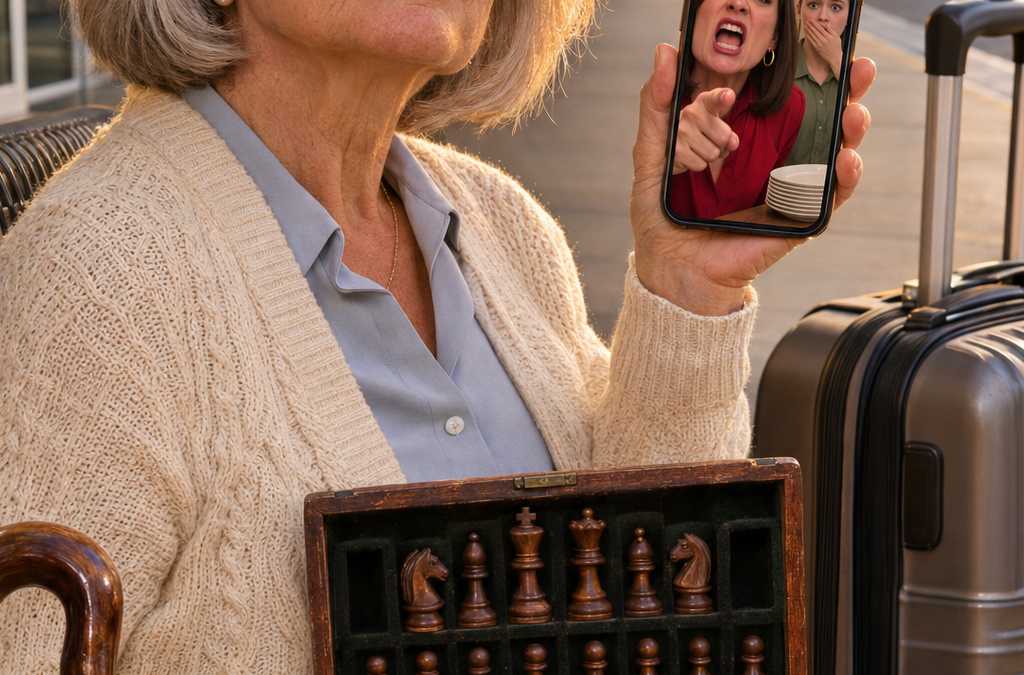
At 4:42 p.m., I sat on the public pickup bench, my cane against my leg. My suitcase stood beside me. My late husband’s travel chess set rested in my hands, two rook spaces empty.
Rachel’s face filled my phone screen. Behind her, Emma stood beside a stack of party plates.
“Dad would’ve paid without making this difficult.”
A bus hissed at the curb. I had to ask her to repeat herself.
“Mom. I said Dad would’ve helped.”
“I heard you. Where are you?”
“At home. These people will be here soon.”
“You said four fifteen.”
“I know what I said.”
The phone speaker crackled against the traffic. Rachel moved somewhere quieter, taking my granddaughter out of view.
“Are you still outside?”
“Yes.”
“Oh. I figured you’d have gotten a ride by now.”
“From whom?”
“There are cars right there, aren’t there?”
Cars kept passing the bench. Getting into one meant finding the right pickup zone, moving my suitcase, and managing the curb without falling. Rachel knew that. We had discussed it before I left.
“You confirmed my airport pickup yesterday,” I said.
“I thought I could make everything fit. I couldn’t.”
“You could have called.”
“I’m calling now. Well, you called, but we’re talking.”
An attendant pushing an empty wheelchair glanced toward me. I nodded that I was all right, though I wasn’t ready to stand.
Rachel leaned closer to her camera.
“Can we deal with the cruise before you get in a car? I need you to wire the eighteen thousand.”
“You know I’m still sitting here.”
“Yes, Mom. I just asked you that.”
She sounded impatient now, as though the bench were somewhere I had chosen to spend the afternoon.
Emma reappeared behind her. She had heard the remark about her grandfather; her face hadn’t changed since. I waited for her to say something.
She looked toward the kitchen instead.
My thumb found the banking app before I had answered. I opened the transfer screen, then stopped before entering a number.
I had paid for their emergencies until wishes started arriving dressed as emergencies.
“Mom? Did you lose me?”
“No.”
“If you’re doing it, use the same account as before. Don’t send it to the travel company. I need to make the payment from my booking.”
I stared at the blank amount field. My reflection floated over it, glasses crooked from the airplane nap.
“I’m not making a transfer from this bench.”
“You don’t need your computer. You did it on your phone when our refrigerator went.”
“That refrigerator was leaking.”
“And this has a deadline.”
A cart rattled past carrying orange traffic cones. The driver asked whether the suitcase was mine.
“Yes,” I told him. Rachel answered at the same time.
“Yes, exactly. You know how to do it.”
“I wasn’t talking to you.”
“Well, I can barely hear you out there.”
Her kitchen clock chimed through the speaker. She had never corrected it after replacing the battery, so it chimed whenever it pleased.
“What time are your guests coming?” I asked.
“Mom, please don’t do that.”
“I’m trying to find out whether you’re coming.”
“I can’t leave now.”
There it was, without a traffic excuse or a dead battery. She was home, and she intended to stay there.
“You arranged everything around being here,” she continued. “You always help us. We put the two thousand into our monthly budget. I can’t suddenly pretend that money doesn’t exist.”
“The monthly help isn’t this trip.”
“It’s all the same household. If we use our bill money for the balance, something else goes unpaid.”
Emma said, “Mom—”
“Just a second, honey.”
Rachel’s voice softened for her, then stayed soft for me.
“I’m asking you to finish what we talked about. I’m not asking for some random present.”
My ankle had begun aching inside my shoe. I shifted my heel, but there was nowhere comfortable to put it.
“Being your mother didn’t make my time worth nothing,” I said.
“I didn’t say it did.”
“You left me here.”
“I misjudged the afternoon. We can talk about that when you’re home.”
A couple stopped beside my bench to greet their arriving son. Rachel waited while their laughter swallowed her next sentence.
Then she said, “Please just do the transfer.”
I told her the request would go to Daniel. While she objected, I sent her a text.
Rachel stopped talking when my text reached her and began reading.
She read it twice. “Who else is going to hear this?”
The text said, “Put the request in writing; Daniel Brooks will review it.”
“Daniel?” she said. “You told me he was handling things. You didn’t say I’d have to explain our family to him.”
“You can explain what you’re asking for.”
“And you’ll tell him we discussed it?”
“I’ll answer his questions.”
I ended the call before she could turn that into a yes. Then I called my sister and asked for a ride.
Behind me, the doors of John Glenn Columbus International Airport opened onto another wave of passengers. I had come home to Columbus, Ohio, after twelve days in New England. This was my first long trip since Tom died.
I had wanted to tell Rachel about the harbor seals.
Instead, I sat with the little chess case across my knees and waited for my sister’s answer.
Susan could come. Her vehicle was low enough for me to enter safely.
Before leaving, I had funded what I privately called my apprenticeship trust. It was a new revocable trust, holding my own savings, with Daniel already serving as its independent trustee. I wanted help available for grandchildren learning trades, though its terms still allowed broad family assistance.
I could change those terms. Until that afternoon, I had left my wishes too loose.
Now I wanted written priorities, not another conversation everybody remembered differently.
At about 5:10, Daniel called from his office.
“Are you somewhere you can talk?”
“Still at the airport. My sister’s coming.”
“Rachel sent a request. I’m opening the attachment.”
“She wants the cruise balance.”
“There’s a reservation request attached to it, too. Wait.”
Daniel went quiet. Then I heard his chair start scraping.
“Forty-two thousand dollars?”
He read the breakdown: $18,000 for the cruise, plus twelve further monthly payments of $2,000.
“She’s asking you to set all that aside?” I asked.
“Yes. I haven’t approved anything.”
“The next monthly payment?”
“Still scheduled for November 2 under your existing instruction. We need to discuss what you want going forward.”
“I want a private appointment Monday. With my attorney.”
“I’ll send Patricia a note. You should call her office, too.”
After we hung up, I searched my phone for Patricia’s number. The screen opened first to my saved voice messages: appointment reminders, family calls, one from Rachel dated September 23. I kept ordinary messages the way other people kept photographs.
I left them alone and found the number.
Emma called while I was leaving the office a message.
“Are you getting home?”
“Aunt Susan’s coming.”
“Okay.”
Neither of us mentioned what her mother had said.
“I’ve still got your pieces,” she told me.
“The rooks can wait. Fix their bases properly.”
“My instructor said I rushed the first one.”
“Then don’t rush the second.”
Tom used to save practice scraps for apprentices, even pieces too small for anything but a mistake. We had talked in his workshop about helping grandchildren buy tools and training. He’d said a good clamp cost less than fixing a bad joint.
Emma said, “I’ll call you tomorrow.”
At 5:25, Susan pulled up. An attendant helped with the suitcase while she came around for me.
“Your ankle bad?”
“Enough.”
“Come on. I moved the seat back.”
Once I settled into her passenger seat, my phone lit with Daniel’s forwarded attachment.
“Everything all right?” Susan asked.
I read the final page again.
Rachel had named Emma Collins as witness to my definite financial promise.
Chapter 2 of 7
“You said, ‘We’ll work something out,’” Emma told me Monday morning, October 26. “That’s what I heard.”
“Did I say eighteen thousand?”
“No. But Grandma, you sounded like it would be okay.”
I stood beside the breakfast table. My toast had caught along one edge, the way Rachel liked it as a girl. She used to call it toast with a crust on the crust.
“Which part would be okay?” I asked.
“I don’t know. There were bills. Mom was talking about the trip, too.”
“And the monthly money?”
“You didn’t say how long. Nobody said how long.”
“Then why did she put your name down?”
“She said you’d both remember once somebody asked me.”
Outside, a garbage truck stopped in front of my neighbor’s house. Emma waited through the noise.
“I’m not saying Mom made everything up,” she said.
“I didn’t ask you to.”
“I know. I just don’t want you thinking I said you never offered anything.”
After we hung up, I left the toast on its plate.
At 9:30, I sat across from Patricia Hayes in her office. She had asked to see me alone. Susan had driven me and stayed downstairs.
“Tell me what you want changed,” Patricia said.
“I don’t want another afternoon like Friday.”
“Money changes won’t arrange your rides.”
“No. I know.”
“What do you want the money to do?”
That question had been easier when I worked at the vocational school. A student needed a course, a tool kit, a way to finish. I could usually find the person who knew the actual cost.
“Classes,” I said. “Required tools. Pay the school or the supplier. I want somebody to finish something.”
“And Rachel?”
“She works full-time. She’s good at her job.”
Patricia waited.
“She has a lot on her plate.”
“You can care about that and still change this.”
“She left me waiting.”
The words came out louder than I intended. Through the closed door, I heard a copier start.
“She knew where I was,” I said. “Then she asked for money. I keep trying to give you a reason she did that.”
“You don’t have to give me one.”
The trust already held my money, and Daniel’s existing instruction to send Rachel $2,000 remained active. Changing those priorities required a signed amendment under its terms, not an angry telephone refusal.
Patricia asked what I owned and what I needed to live on.
I told her about the $460,000 transferred into the trust, my separately held $28,000 reserve, and my mortgage-free house. My pension and Social Security brought in $3,450 each month.
“What happens if Rachel no longer gets regular help?”
“She’ll have to change her budget. She’ll be upset with me.”
“And your own expenses?”
“I can pay them.”
Patricia made notes while I explained who I wanted helped and why. When I drifted toward Rachel’s reasons again, she brought me back.
“Do you want routine gifts to adult households to continue?”
“No.”
“Do you want genuine commitments you already made ignored?”
“No. If I actually promised something, Daniel should review it. I’m not trying to erase my part.”
At 11:15, I signed the amendment. It put grandchildren’s vocational expenses first and ended routine adult gifts. Daniel could still consider genuine earlier commitments and related temporary household support.
Patricia would deliver it that afternoon.
“Will you tell Rachel today?” she asked.
“I haven’t decided what to say.”
“Keep it to what you know.”
Susan drove me home. I told her I had changed the priorities, and she asked whether I wanted lunch. I said I had food.
By the time I reached my kitchen, Rachel had started a family message with Susan and me.
Mom told us we’d work something out. We planned around that, including money she’s helped us with for years. Now I’m being told to submit paperwork like we’re strangers.
A second message followed.
Aunt Susan, maybe you can help us talk before this gets harder for everybody.
I read it standing beside the uneaten toast.
Susan called.
“Is she talking about the text you sent at the airport?”
“‘Put the request in writing.’ Yes.”
“Did she book without any encouragement from you?”
I wanted to answer quickly. Susan had come to get me. She had seen how hard it was getting into the car.
“I encouraged her to think we could discuss it,” I said.
“Linda.”
“I said we’d work something out.”
“For the cruise?”
“We were talking about several expenses. The cruise was one.”
“So she didn’t pull that out of nowhere.”
“No.”
Susan’s breathing filled the pause.
“Did you tell her not to book?”
“I don’t remember saying that.”
“That’s a little different from what I thought.”
“I know.”
She didn’t scold me. She asked whether I wanted her to come back, which somehow made it harder.
“Not today,” I said.
Afterward, I replied to the group message.
I did say we’d work something out. I didn’t specify a cruise payment or promise another year of support. Daniel will review your request.
Rachel answered only, Thank you for acknowledging the conversation.
That afternoon, Daniel forwarded an attachment Rachel had submitted. His note said he would review it with her account of our conversation.
I opened the booking confirmation at my kitchen table. Rachel and Mark were listed as the travelers. This was a purchase already made, not a trip she was still pricing.
The booking date was September 24.
On the final page, the remaining balance was $18,000, due November 2.
Chapter 3 of 7
“The booking is genuine,” Daniel told me Tuesday morning, October 27. “That confirms she bought the trip. It doesn’t confirm you agreed to pay.”
I was still in my robe. The furnace had started its first noisy cycle.
“Are you sending anything?”
“Not on the cruise request before I decide. The November 2 monthly payment is still scheduled.”
“So that hasn’t stopped.”
“No. I’ll finish the review before then.”
I had spent Monday signing my name and explaining myself. Tuesday still began with Rachel’s payment on a calendar.
“What do you need from me?”
“Answer questions as they come. Don’t try to settle her account for her.”
An hour later, Emma called from outside her training building.
“Mom says I have to pay for my room.”
“How much?”
“$450. Starting December 1.”
A truck backed up somewhere near her. I heard the warning beeps, then a door closing.
“She said if the help changes, everybody has to contribute. I’m working. I’m an adult.”
“Did she tell you this morning?”
“She left it by my lunch. Written out.”
“Was she angry?”
“She put a smiley face after December.”
I nearly said I would cover it. The amount had already become a calculation: twelve months, one transfer, no more crying outside school.
Then Emma said, “I didn’t call to ask you for money.”
“I know.”
“I just needed to tell somebody before I went in.”
My mouth was still shaped around an offer she hadn’t requested. Rachel would lose one payment and receive another through her daughter. Emma would have to thank us both.
“What time does your shift end today?” I asked.
“Why?”
“I’m wondering about the bus. If you stayed somewhere else, could you still get to work?”
“I checked. Some places, yes. Some places, I’d spend half my life changing buses.”
“And your tools?”
“I can leave most of them there.”
We talked about furnished rooms and whether utilities were included. Emma wanted somewhere she could study without wearing headphones.
“Don’t agree to a place just because the rent sounds low,” I said. “Count the ride, too.”
“You sound like the enrollment office.”
“I spent years telling people that a cheap class across town wasn’t cheap.”
She gave a small laugh.
The warning bell sounded through her phone. I let her go without offering a transfer.
That afternoon, Susan picked me up for a short visit at her house. She had said we ought to talk without a phone between us.
She hadn’t taken off her shoes when she started.
“Rachel says Emma’s getting moved ahead of her.”
“Moved ahead where?”
“With your money. Training gets paid, and her mother gets told to figure it out.”
“What did Rachel tell you about the training?”
“That it’s the reason you’re changing things.”
“It’s one of my priorities.”
Susan stood in the doorway between her living room and hall.
“Linda, I’m not arguing against school.”
“Then don’t make it sound like Emma asked to take something.”
“I didn’t say she did.”
“Rachel did.”
Susan looked toward the front window. Outside, a man was trying to fit a rolled carpet into a car too small for it.
“Why did you keep encouraging everybody?” she asked. “For years. If this wasn’t what you wanted.”
I had expected another question about the airport. This one left me sitting too straight, my ankle aching inside my shoe.
“Most of the time, it was what I wanted.”
“And the other times?”
“I didn’t want the phone call afterward.”
“What phone call?”
“The one where she sounded disappointed. Where I explained why I couldn’t, then found a way.”
Susan sat across from me.
“So you said yes.”
“Or I said enough that she could hear yes.”
“That’s a hard habit to change on her.”
“It was easier than telling the truth.”
Neither of us spoke for a while. Susan’s television offered captions for a game show neither of us was watching. Every answer seemed to be a kitchen appliance.
“I don’t know how much Rachel counted on,” Susan said.
“Neither do I. Daniel’s asking.”
She drove me home before dinner. We didn’t solve anything in the car.
Daniel called later about Rachel’s response.
“She’s asking me to consider reasonable reliance,” he said.
“On what I said in September?”
“And the regular support. She says a sudden withdrawal could leave household bills unpaid.”
“Has she told you about charging Emma?”
“Yes. She describes that as part of adjusting the budget.”
I pictured the note beside Emma’s lunch.
“Does that make her request different?”
“It’s part of what she’s asking me to review. I’ve agreed to hear her account. I haven’t agreed to fund it.”
I wanted him to say Rachel could manage. He hadn’t seen her grocery bills or her bank balance. Neither had I, despite years of helping.
After the call, his confirmation arrived: Patricia had delivered the amendment, and he had accepted it for administration. I read the short email once. There was no decision attached.
Near evening, another email from Daniel appeared. This one forwarded something Rachel had just sent.
Her subject line was “Concern about Emma’s involvement.”
She asked him to disregard the amendment until someone checked how it had been signed. Below that, she had written my granddaughter’s full name.
“I believe Emma Collins pressured my mother, Linda Parker, into signing the amendment.”
Chapter 4 of 7
On Wednesday, October 28, Patricia sent Daniel her account of our private meeting. I had attended without family, identified my assets and beneficiaries, and explained what would change for Rachel.
She called me after sending it.
“I confirmed what I observed,” she said. “You explained your instructions. You knew the regular payments could stop.”
“Does Rachel get all your notes?”
“No. Daniel has the relevant confirmation. My entire file isn’t being passed around.”
“Emma wasn’t even there.”
“I told him that.”
I had slept badly after reading Rachel’s accusation. My nightgown seam had left a red line along my shoulder.
“I came alone,” I said.
“Yes, Linda. You did.”
Daniel called next. He asked whether anybody else was with me.
“Just me.”
“Do you still want the amendment kept as signed?”
“Yes.”
“Anything you want changed?”
“No. I want the training priorities. I want the regular adult gifts stopped. And I want you to review anything I actually committed to.”
“All right.”
He didn’t ask whether I loved my daughter. I was grateful for that.
Before lunch, he sent Rachel the amended distribution categories and explained the review for earlier commitments. He copied me. The email was short enough to read without scrolling.
Rachel called while I was eating cottage cheese from the container.
“So this is already done.”
“The amendment is.”
“You said you changed priorities. You didn’t say the monthly help was being cut out.”
“Daniel sent you what it says.”
“Yes. I can read, Mom.”
I left the container open beside my lunch plate. There were crackers on it, sorted into broken and unbroken piles. Tom used to accuse me of making a waiting list for crackers.
Rachel continued before I could answer.
“I’ve heard back about your meeting with Patricia. I’m not going to argue that Emma sat there telling you what to sign.”
“She didn’t.”
“I said I’m not arguing it.”
“Then don’t leave that hanging over her.”
“I raised a concern. He checked it. Can we talk about what actually happens now?”
Her voice was measured. I could hear office phones behind her.
“You were able to make this decision,” she said. “That doesn’t make the timing fair.”
“What timing would have been fair?”
“Before I paid for something. Before we kept putting your help into our budget.”
“We’ve been through what I remember.”
“I’m talking about what I did because of it. You can decide differently now. But I can’t go backward and unbook September.”
For a moment, I watched a fly work against the kitchen window.
“That’s why Daniel is reviewing it,” I said.
“Exactly. That exception he sent me—it’s there because people make plans. They spend money. Then somebody changes the rules.”
“If I undertook something, he should consider it.”
“You keep saying ‘if.’”
“Because I won’t agree to every expense you chose.”
“I’m not asking for every expense.”
“You’re asking for another year.”
“I’m asking for time to adjust. You’ve never told us to plan for this.”
That part hurt because she hadn’t invented it. I had paid and renewed and paid again, often before she finished asking.
“I should have been clearer before,” I said. “I’m being clear now.”
“That doesn’t answer what happens to the bills already coming.”
“No. Daniel will have to answer the request.”
She said she needed to get back to work. We ended without either of us saying goodbye properly.
That afternoon, Daniel proposed meeting at his Columbus office on Friday, October 30, at 10:00 a.m.
“Rachel wants to explain her request in person,” he said. “Emma is the witness she named. Susan has heard the family account.”
“Does Susan need to be there?”
“Only with your permission. None of this needs a bigger audience.”
I pictured Rachel explaining afterward what everybody had supposedly agreed to.
“I’d like Susan there. Emma, too, if she’ll come.”
“I’ll keep it to the five of us. Records stay within that group.”
Patricia would be available by telephone if Daniel needed clarification. She wouldn’t be running the meeting.
I called Susan first.
“Friday at ten,” I told her. “Daniel’s office.”
“Am I supposed to convince somebody?”
“No.”
“Good. I’m getting tired of being asked what you meant.”
“You heard Rachel’s account. You’ve asked me things I didn’t like answering.”
“That’s hardly a qualification.”
“It is to me.”
She said she would drive me.
Emma was harder to reach. When she called back, she sounded tired.
“I have to say it with Mom sitting there?”
“You were named in the request.”
“I didn’t name myself.”
“I know.”
“What if I don’t remember something?”
“Then say that.”
She went quiet long enough that I checked whether the call had dropped.
“Is Aunt Susan going?”
“Yes.”
“Okay. I’ll come.”
Afterward, I checked the appointment email again. Five people, one room, Friday morning. I tried to picture hearing Rachel describe our September conversation without interrupting her.
At 6:18 p.m., my phone sounded on the kitchen counter.
Emma had sent a screenshot. There was no explanation above it, just her mother’s message.
Honey, if you can confirm to Daniel that Grandma made a definite promise to help us, I can waive the $450 room contribution. You wouldn’t need to pay it starting December 1.
Chapter 5 of 7
“The waiver would help me,” Emma said when she called Friday morning, October 30. “A lot. I haven’t said yes.”
I had been awake since six, rehearsing answers nobody had asked for.
“Please don’t make today about which one of you I love,” she said.
“You don’t have to choose.”
“It feels like that.”
“Tell Daniel what you actually heard. Even if I don’t like it either.”
“And then?”
“I don’t know, honey.”
She stayed on the line. I wanted to offer her something certain, preferably something I could pay for.
Instead, I asked, “Are you getting there all right?”
“I’m taking the bus.”
“We’ll see you there.”
Susan arrived early. On the drive to Daniel’s Columbus office, she kept the radio off.
“Rachel called last night,” she said.
“What did she want?”
“Me to remember that families don’t usually ask for receipts.”
“Did you agree?”
“I said families usually come when they’ve promised somebody a ride.”
I watched a school bus stop ahead of us.
“She says she’s apologized for that,” Susan added.
“She said she misjudged the afternoon.”
“Linda, I’m not grading her apology.”
“I know.”
Susan waited until the bus moved.
“I was going to suggest everybody give a little today.”
“What would Emma give?”
“I hadn’t got that far.”
“She’s already being asked.”
“I saw the screenshot.”
We passed the turn for the shopping center. Susan had once driven us there every December because I could never find my car afterward. This morning, she didn’t suggest stopping for coffee.
“Maybe Rachel did hear a promise,” she said.
“Then she should explain it.”
“Yes,” Susan said. “She should. Without everybody rushing in to make the question nicer.”
In the parking lot, I checked that my phone was charged. Daniel had the written request and booking confirmation; I had his forwarded copies. There was nothing else to print.
Susan took her parking ticket inside. She had a habit of losing them in the car and paying for a full day.
Emma was already in the waiting area, sitting beneath a framed photograph of downtown Columbus. Her work boots were clean except for pale dust caught along the stitching.
“You beat us,” Susan said.
“Bus was early. That happens when you don’t need it to.”
She gave us a tired grin. I sat beside her without asking about the message.
At 9:40, Rachel came through the door in navy pants and a gray jacket. She carried her booking confirmation and a typed account in a plain office folder. She looked ready for a meeting between appointments, not a family fight.
“Morning,” she said. “Everybody found it okay?”
Susan said we had.
Rachel sat opposite us.
“I’m glad we’re doing this together,” she said. “There’s been too much going through other people.”
Emma watched the receptionist answer a call.
Rachel looked at me.
“I wrote out the order things happened. Otherwise we’ll spend the whole morning on who remembers which sentence.”
“Daniel has what you sent,” I said.
“This is for me.”
She let that stand, then turned toward Susan.
“I know Mom can change her plans. I’m not disputing that. But we’ve had the monthly help for years. When we talked in September, there wasn’t any warning it was ending.”
Susan asked, “Did you ask how long it would continue?”
“No. We hadn’t needed to ask that every month.”
Her answer came without hesitation. I remembered all the months I had sent the money early.
“And the cruise?” Susan asked.
“I booked because Mom agreed to help. I wouldn’t have spent the deposit otherwise.”
Emma shifted beside me. Rachel glanced at her, then continued.
“I’m asking for a limited transition. The eighteen thousand, and the twelve monthly payments in the request. Time to rearrange things.”
“A year,” Susan said.
“Yes. A year. Our bills don’t stop because this got unpleasant.”
I could hear the elevator opening beyond the waiting area. Someone laughed, then apologized for being late.
Rachel looked back at me.
“I’m not saying it’s my trust, Mom. I’m saying we planned around you.”
I kept my answer short.
“I’ll answer Daniel’s questions.”
“That’s all I’m trying to do, too.”
At a few minutes before ten, Daniel came out and brought us into his meeting room. Emma sat between Rachel and me. Susan chose the chair across from us.
Daniel remained standing until we were settled.
“Two things today,” he said. “The cruise balance request, and whether monthly assistance continues.”
Rachel nodded.
“I’ll hear your account first. Then questions. Please let people finish, even if you disagree.”
“What if somebody gets a date wrong?” Rachel asked.
“We’ll check it.”
He sat down. The wall clock had a second hand loud enough to hear between voices.
Rachel turned to Emma.
“Honey, use the statement I sent this morning. It’ll keep you from having to start from scratch.”
Emma looked at her mother.
“You sent it while I was on the bus.”
“I know. You’ve had time to read it, though?”
Emma didn’t answer. She placed her phone faceup between us. The document had her name at the bottom, with no signature beneath it.
From my chair, I could read the opening sentence.
“I witnessed a promise of $18,000.”
Chapter 6 of 7
Before the family, at 10:00 a.m., Daniel asked Emma about the statement on her phone.
“Did you write that?”
“Mom did. I haven’t signed it.”
“Does it describe what you heard?”
“I heard Grandma say we’d work something out. I didn’t hear eighteen thousand.”
Rachel leaned toward her.
“Honey, I was helping you put it into words. You don’t remember every sentence.”
“No. I don’t.”
Daniel looked at Rachel.
“Tell me what you relied on.”
“September 18. Mom said we’d work something out while we were discussing expenses, including the cruise. She’d helped us for years. The monthly money was part of our budget.”
“Did she specify the cruise balance?”
“She knew what we were discussing. Families don’t always say an amount and shake hands.”
Susan watched him. So did I.
“I’m not asking you to undo her amendment,” Rachel continued. “I’m asking you to honor what came before it. We need a transition, not an indefinite allowance.”
I took Tom’s travel chess set from my bag and placed it before me. Across the table, Emma held the repaired rooks against her knee. She had moved beside Rachel while her mother spoke.
Daniel glanced at the booking.
“A verified earlier undertaking could allow the cruise payment and temporary household support. What definite commitment existed before you paid the September 24 deposit?”
Rachel repeated my September words. Hearing them again, I could hear my own easy reassurance. I had wanted everybody to leave my kitchen happy.
“I have a saved message,” I said. “From Rachel. After that conversation, before she booked.”
Rachel looked at my phone.
“What message?”
“September 23.”
I opened the dated entry and played it myself.
“Hi, Mom. Emma’s still working on those two rooks. Her instructor wants her to use the profiles for a supervised workshop exercise, so don’t think she’s forgotten you. About the anniversary cruise—I know you haven’t promised me any money. I’m booking it because I think we can manage the balance. We can talk when you have time. Call me back. Love you.”
The speaker clicked off.
Outside Daniel’s door, somebody asked where the extra copier paper was.
Rachel spoke first.
“Yes. That’s my message.”
Daniel checked the date on my screen against her booking confirmation.
“You sent this September 23?”
“Yes.”
“And paid the deposit the following day.”
“That’s right. But listen to how I said it. I wasn’t trying to pin her down. I was being careful.”
“Careful about what?”
“Making her feel obligated. Dad was gone. I didn’t want every conversation to sound like a demand.”
My shoe pressed against the fused place in my ankle.
Rachel continued, still looking at Daniel.
“We thought we could manage because she’d always helped. That’s what managing looked like for us. Her wording wasn’t definite, fine. But years of help don’t stop being part of your life because one message sounds cautious.”
“What did Linda promise after this message and before you paid the deposit?”
“We didn’t have another big discussion.”
“A smaller one?”
Rachel looked toward me.
“I can’t give you another sentence.”
Emma spoke without looking up.
“It was that week. The workshop thing. My instructor had me redo the bases.”
Rachel said, “Nobody’s disputing the message, honey.”
“I know. I’m saying I remember.”
She looked at me then.
“I forwarded Mom your Monday message. The one about what you did and didn’t promise. I thought if she saw your exact words, she’d stop asking me.”
My face grew hot. I had wondered how much of our conversations reached Rachel.
“Okay,” I said.
“It didn’t help.”
Rachel’s mouth opened, but Emma kept going.
“I’m not using that statement. And I’m not taking the room waiver.”
“The budget still has to work,” Rachel said.
“I know. I’ll pay for my own room. But I can’t say I heard an amount.”
Emma crossed the room to the vacant chair beside me. The repaired rooks stood beside their case. One still had a darker ring around its base.
She gave Daniel her application and course invoice.
“This is mine. For the training. You can check it.”
“I will,” he said. “Separately.”
He returned to Rachel’s request.
“Your own message doesn’t establish a commitment this exception lets me fund. You described booking without a promise and expecting to manage the balance. The earlier monthly gifts don’t establish another year of payments.”
Rachel stared at the booking.
“I am denying the cruise and monthly subsidy: the $18,000 request is denied, and the authorized $2,000 monthly payment ends now, including November 2.”
Rachel pushed her chair back. She folded the booking along a crease already worn white.
“Mom. You can still help me yourself.”
“I won’t finance a promise I never made.”
“I’m asking you. Not him.”
“I heard you.”
Her eyes stayed on mine. I wanted to explain until she looked less hurt. My mouth had gone dry, and I left it closed.
Susan moved her chair to our side of the table.
“I’ve got your ride home, Linda.”
Rachel looked at her.
“I wasn’t asking you to take sides.”
“I’m taking her home.”
Daniel turned his monitor enough for us to see the scheduled payment. Rachel’s name appeared beside November 2.
He opened the standing instruction and removed the recurring transfer. A confirmation appeared.
“The cancellation is recorded,” he said. “There will be no November 2 payment.”
Rachel asked him to send that in writing.
“I will.”
We stayed while he recorded the denied request and checked the cancellation entry. Emma asked whether her instructor should send enrollment confirmation directly. Daniel said yes.
Nobody asked Rachel to sign anything.
By the time we reached the corridor, it was 11:18 a.m. Rachel stood beside the elevator with her phone against her ear.
“Yes, the anniversary sailing. I have the booking number.”
Susan stopped beside me. Emma waited near the wall.
Rachel listened, her folded confirmation hanging at her side.
“Cancel our suite.”
Chapter 7 of 7
On Monday, November 2, the cruise cancellation confirmation arrived in Daniel’s forwarded email. Rachel had forfeited her $2,400 nonrefundable deposit.
His ledger entry, recorded at 9:00 a.m., showed no monthly transfer to her.
I read both before breakfast. There was nobody to call about correcting them.
Rachel texted an hour later.
Could you at least cover the deposit? That money is gone either way.
I typed, No, Rachel. I won’t cover it.
Her reply came while my oatmeal was still too hot.
Fine.
For most of that morning, I expected another message. I carried my phone into the laundry room, then back into the kitchen. Once, I checked whether I had accidentally muted it.
That afternoon, I sent her the arrangement I could manage. Account questions went to Daniel. If she wanted to talk with me, we could agree on a time. I wouldn’t stay on a call where she spoke to me the way she had at the airport.
She didn’t answer until evening.
I don’t have much to say right now.
Okay, I wrote.
I left it there.
On Friday, November 6, Daniel confirmed that he had paid Emma’s $3,600 course invoice directly to her training provider. Her enrollment had been checked. She called me after work.
“I’m on the list,” she said.
“For the class?”
“For the class, yes. And the cabinet project. I was waiting to find out whether I could actually take it.”
“What are you making?”
“A wall cabinet. Supervised. Before you ask.”
“I wasn’t going to ask.”
“You were.”
She sounded young again, talking faster than I could follow. There were doors to fit and a finish she wanted to try. Her instructor had already warned her against choosing anything complicated just to impress him.
“I switched my apprenticeship hours around,” she said. “Earlier starts twice a week. Then class.”
“Will you eat between?”
“Grandma.”
“I enrolled students for years. Half of them thought a vending machine was a meal plan.”
“I’ll pack something.”
She sent me a picture later of her project drawing. I enlarged it until the dimensions became blurry, then asked which part would be hardest.
“The doors,” she wrote. “Everything shows.”
I didn’t ask whether she had thanked her mother for anything. I didn’t ask what Rachel had said about the payment. For once, Emma got to tell me about her work without carrying a message between us.
On Monday, November 16, Rachel sent a short family update.
Starting the evening job tonight. Eighteen hours a week, $19 an hour. I’ll be slower answering messages.
I replied, Hope the first shift goes all right.
There was no heart beside it, no answer. I checked my phone before bed anyway.
Susan called the next day and asked whether I’d heard.
“Yes.”
“That’s a long week, with her regular job.”
“It is.”
Neither of us added anything for a moment.
“Do you want to come to the library sale Saturday?” she asked.
I said yes before asking who would drive. Then we worked out the ride.
By Tuesday, December 1, Emma had packed for Susan’s spare room. I came over after the heavy things were inside.
Her boots stood beneath the hall bench. In the bedroom, a bare desk faced the window, close enough to an outlet for her lamp. Susan had cleared the closet, though she warned that the vacuum cleaner still lived there.
“Long-term tenant,” Susan said. “Very quiet.”
Emma laughed for the first time that afternoon.
They had written down the ordinary details: $450 each month, shared kitchen, a warning before overnight guests. Emma had paid the first month from her apprenticeship wages.
“Bus is a little earlier,” she told me. “But I only change once.”
“Have you tried the route?”
“Yesterday. Both ways.”
I had almost asked whether she needed grocery money. Instead, I asked what she planned to cook.
“Things Aunt Susan won’t inspect.”
“I inspect smoke,” Susan called from the hall.
Rachel knew where Emma was living. The move hadn’t turned into a disappearance or a family celebration. Emma looked tired, and there were still things she needed to collect from her mother’s house.
“Mom said I could have stayed,” she told me.
“Do you wish you had?”
“I’ll miss some things.”
She looked around the small room.
“I want to try this.”
I stayed until she needed to leave for work. I didn’t pay her rent or slip money into her coat.
By Saturday, December 19, I had gone to a daytime concert and joined a library outing. For both, I arranged transportation when I booked. Rachel’s calendar never came into it.
We had spoken twice by then, briefly, at times we agreed on. One call concerned a recipe. The other lasted six minutes and included a long discussion of the weather. I was glad she called. I was glad when we finished, too.
She had no access to my accounts. Daniel still handled requests, and no automatic assistance had resumed.
Emma came that afternoon after finishing her errands. We sat at my kitchen table with Tom’s worn travel chess set between us.
The two rooks sat slightly unevenly on their repaired bases. Emma watched me notice.
“The old wood wasn’t square anymore,” she said. “I didn’t want to take off more.”
“They stand.”
“They do.”
I played Tom’s side of the board. Emma studied her opening so long that I asked whether the cabinet doors had followed her home.
“Those would be easier.”
My phone rang as I considered a move. Rachel’s name appeared on the screen.
“Do you need to get that?” Emma asked.
“She texted earlier. She wants to tell me about work. I’ll call after our game.”
Emma nodded and looked back at the board.
The call went to voicemail. Outside, a delivery truck stopped, then moved on. There was still plenty of afternoon left.
I moved his rook and took my time.







