My Daughter Left Me on My Son’s Steps After Chemotherapy; She Didn’t Know I Was Paying Her Mortgage.
Chapter 1 of 7
“Quit making everybody look after you.”
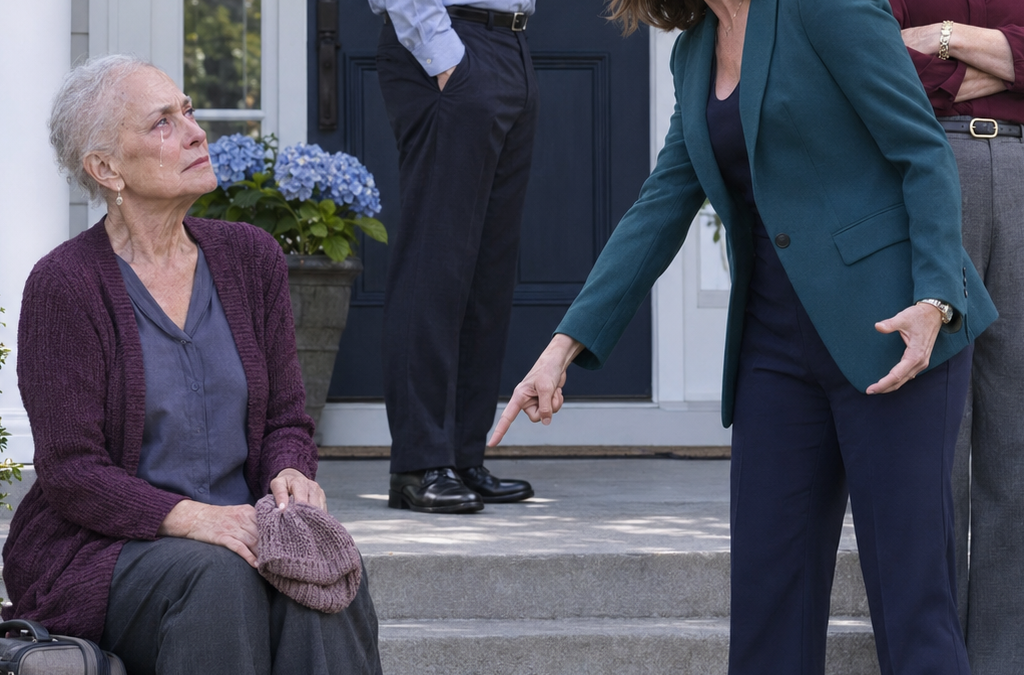
Dana stood below me while I sat on my son’s steps. My suitcase leaned against my knee. I held my knitted treatment cap because I couldn’t bear another warm thing against my skin.
My brother, Frank, looked toward the street. Connie, our cousin, gave Dana a little smirk.
I had just left the hospital after two nights of treatment for dehydration following chemotherapy. Getting from the car to the steps had used what strength I had.
I felt my face burn.
I asked whether we could go inside. Dana said my son was still at work, as though that settled where I belonged.
My name is Nora Ellis. I’m sixty-seven. I had been widowed for nine years, and I had retired six years earlier after twenty-eight years supervising payroll.
I knew what money could do for a worried household. For three years, I had covered Dana’s mortgage: thirty-six payments totaling $86,400. Three years earlier, I had also paid $8,600 for her roof.
Over four years, I had spent another $7,200 on my granddaughter’s expenses. I loved helping that girl. None of this was her doing.
I pay her mortgage, and I can stop.
Dana had never asked whose money actually funded those payments. She called it “Dad’s money,” and I had let that pass because correcting her always became an argument.
She knew an office sent the money to her lender. That was enough for her.
I was humiliated. My daughter had brought me from the hospital, but she was treating me like something she regretted picking up.
I had knitted the cap during my first treatment cycle. I could still make something for myself then. On those steps, I held it against my knee and wished Frank would look at me.
It hurt that Frank said nothing.
Dana began talking about my house before I could ask again about getting inside.
“Sell the house.”
She said there was no sense keeping a whole place while I needed help. There would be appointments, meals, people driving across town. Her own payment was $2,400 every month, and that couldn’t be allowed to fall behind while everybody worried about me.
“You’re upsetting her,” Connie told me.
For a moment, I thought she meant I had upset my granddaughter. Then I realized she meant Dana.
I was frightened of being left there. My son had been held up at his hospital job, and I didn’t know how much longer he would be.
“Just sign what she needs,” Connie said.
Nobody had asked what I needed. I needed somewhere to lie down and somebody to stop talking about selling my home.
“Stop being difficult,” Dana said.
I looked at Frank again. He was seventy-one, four years older than me. He had once driven across town to fix my dryer without being asked. Now he couldn’t manage a word.
“Stop making a scene,” Connie added.
I had mistaken being useful for being safe.
“All right,” I said.
I meant I had heard enough. Dana took it as agreement and told the others to come on.
My son arrived as they were leaving. He carried my suitcase inside and said there was a bed downstairs for me. I cried when I stood up. I hated that, but my legs were shaking.
He got me settled without asking me to explain everything first.
That afternoon, I called the man handling my money.
“No more extra advances,” I told him. “And I want to review the regular payment.”
He confirmed that he would stop additional advances. I wasn’t canceling the continuing payment yet. I wanted to consider that separately, without Dana talking over me.
I was angry enough to stop apologizing.
My phone rang while my son was nearby. Dana didn’t ask whether I had gotten inside safely. She started with the office, and how somebody there had made a mistake.
Dana shouted, “They refused my $4,800 advance!”
She wanted two months paid early. I hadn’t known she had already asked.
“Call them,” she ordered. “They’ve mixed something up.”
I told her there had been no mistake about stopping extra money.
“That’s separate,” she said. “This is Dad’s arrangement.”
She still thought I meant some small favor she could talk me into. She wanted me to complain to the office, then let her handle it from there.
I was hurt by how quickly she dismissed what I had said. Even after leaving me outside, she expected me to help collect her money.
“I’m not calling them again,” I said.
She demanded to know whether my son was listening. When I said he wasn’t part of the call, she told me to put him on anyway.
I ended the call.
My son asked whether I wanted my lawyer’s appointment canceled. It had been booked before my hospital stay, an ordinary review I had kept postponing. He had already helped relocate it to his house because I wasn’t up to another trip.
“No. I want to keep it.”
Dana called twice more. Then she sent a message telling me not to sign anything until she got there.
I hadn’t told her I intended to sign anything.
The ringing started again just as someone reached the front door.
Then my lawyer arrived: “She wants $180,000 from your house.”
My lawyer had spoken quietly, but I heard every word. Dana had contacted her about using a sale to pay off the remaining principal on Dana’s home loan.
I had never authorized that. I had never even agreed to sell.
I asked my son to leave us alone. He asked whether I was sure, then went upstairs. I was grateful he didn’t argue, though I could see he wanted to stay.
We were in his home in Dayton, Ohio, close enough to my own that I knew which streets I would take back.
Beth Lewis had handled my planning for years. She asked what I wanted to change, and I told her in my own words.
“My will and beneficiaries,” I said. “I want Dana removed.”
She asked me to explain why. I told her about the steps, but also about the sale demand. I wanted my money available for my care, and I no longer wanted Dana planning around what she expected after my death.
Beth went through each choice with me. The will covered my personal estate property; it didn’t control everything else.
Two independent adult witnesses attended while she supervised the signing. I knew what I was signing, and nobody rushed me.
For the trust, I signed new instructions leaving what remained after my lifetime needs to my son, Mark. Beth arranged for Owen Grant, the man administering my funds, to receive the change.
The IRA needed its own change. Beth helped me submit the separate designation naming Mark, and the electronic acceptance came through that afternoon. No money was being paid out.
I felt sad when it was finished. I had wanted a daughter I could depend on, not an afternoon spent removing her name.
Beth reminded me that these changes did not stop Dana’s regular mortgage payments. I understood. That decision was still separate.
When Mark came back, he offered to make scrambled eggs. He always cooked them too long and insisted the brown edges were intentional. For once, I was glad to have something ordinary to complain about.
Before I could answer, my phone showed a new message to the family group.
Dana had written, “Mark refused her a bed. Which of you will take her?”
Chapter 2 of 7
“I offered her the downstairs room,” Mark said. “I got held up about half an hour. Dana had my spare key.”
By morning, he was still upset about the message. He had left it unanswered because I had asked him to wait.
“She told me you wanted something else,” he said. “I thought she’d let you inside while you two sorted it out.”
Nobody had offered me anything to sort out. I had asked to go inside, and Dana had told me he was working.
From the doorway, I could see the bed where I had slept. Mark had cleared his exercise things out before my discharge. The room was ready, right down to space beside the bed for someone unsteady getting up.
It hurt to learn how little had stood between me and a place to lie down.
“Can I answer her now?” he asked.
“Yes. Tell them the room was available. Tell them she had your key.”
“I also want to explain what you’ve been through.”
“No. They don’t need my medical business.”
He started to object, then stopped. He was thirty-nine, a hospital pharmacist, and accustomed to explaining things until people understood. This was one problem I didn’t want explained across the whole family.
“And leave the money out,” I said.
I knew my money was not a family vote. Neither was my treatment.
Mark sent a short correction. He showed it to me first, though I hadn’t asked him to. It said he had offered me a room and expected Dana to bring me inside.
I let him bring breakfast to me. That was help I wanted.
He had made oatmeal with so much cinnamon that I sneezed over it. He blamed the container, which apparently had made the decision without him. I laughed, then had to rest before eating.
I hated being that tired. Still, I could be tired and decide who spoke for me.
When Owen called, I asked Mark for privacy. He went upstairs without hovering in the doorway.
“Your daughter has asked again about the advance,” Owen said. “My answer hasn’t changed.”
“And the regular payment?”
“Still scheduled. Those are separate instructions.”
I asked him to go over the arrangement with me. I had spent years checking other people’s payroll. Avoiding my own family’s money had become an embarrassing habit.
“The revocable trust holds your money,” he said. “Its terms let you end these voluntary payments. But I have to cancel the standing instruction.”
September’s payment had already gone to Dana’s lender. He couldn’t simply pull it back because we were discussing whether to continue.
“Leave that one alone,” I said. “I understand it’s paid.”
He confirmed that the additional advance remained stopped. I wasn’t ready to give the final instruction about future payments, and he didn’t push me.
Owen also confirmed receiving the signed estate changes from Beth. The IRA company had accepted its separate change, just as the message had shown.
“So everything I signed is finished?”
“Yes. The will doesn’t change an IRA recipient or stop a mortgage transfer.”
That was enough. I wanted the choices settled, not another afternoon spent studying them.
After the call, I felt relieved. Then I felt ashamed of the relief. Dana was still my daughter, even when dealing with her had become something I needed a rest from.
She called before I finished breakfast.
“What am I supposed to tell your granddaughter?”
“About what?”
“That you’re taking everything away.”
I told her my granddaughter hadn’t asked me for anything. Dana talked over that.
“You’re wrecking her future. She needs a stable home.”
I could hear ordinary household noise behind her. My granddaughter might have been nearby, and that frightened me more than Dana’s anger.
“Please don’t put her in this.”
“Then fix it.”
Dana said visits would have to wait until I returned things to normal. She couldn’t bring a child into all this hostility, she said. Somehow the hostility had become mine.
I wanted to bargain. I missed my granddaughter already, though only a little time had passed.
“I’m not paying for visits,” I said.
“Fine. Explain that to her.”
She ended the call before I could answer. I sat there feeling sick with worry, separate from the nausea I had gotten used to.
I sent my granddaughter a message directly. I told her I loved her and would enjoy hearing how school was going whenever she had time. I added that there was no rush to answer.
I didn’t mention Dana or money. That girl deserved one conversation without an adult handing her a problem.
Connie called next. She had seen Mark’s correction.
“Just apologize for the confusion,” she said. “Dana’s got enough going on.”
“I was left outside a prepared room.”
“Well, everybody was upset.”
“I asked to go in, Connie.”
She paused, then said Dana had been doing her best. I remembered her smirk on the steps. I was angry now, too tired to soften the fact for her.
“Please don’t call it confusion again.”
When Mark came downstairs, I asked whether he could help me check my follow-up arrangements later. I still expected Dana to keep the ride she had promised.
Before we could check anything, my phone sounded. Dana had forwarded the transport service’s cancellation for my upcoming oncology follow-up.
Under it she wrote, “Have Mark handle it.”
The ride booking showed canceled.
Chapter 3 of 7
I booked the replacement medical ride myself. The $145 charge covered the trip, but the available pickup meant a longer wait before my follow-up.
By the time the driver arrived, I was nauseated. Mark offered to drive me instead, though he would have to rearrange work.
“Go,” I told him. “I have a ride.”
I meant it, but I resented having to solve this while I felt so weak. Dana had promised transportation. Canceling it hadn’t made my appointment disappear.
The driver got me there safely. I still had to sit through the wait, trying to keep breakfast down. I was angry that Dana had turned an ordinary medical trip into another problem.
At the visit, I asked how to manage the nausea sooner. I also asked what I should drink when water tasted wrong, and when I should call rather than wait.
The nurse answered me directly. Nobody needed Mark or Dana to explain my questions.
When she asked about meals and laundry, I admitted I was struggling. Showering and getting dressed could use up most of my morning.
“Some help at home would give you more time to rest,” she said.
“Help doing what?”
“Meals. Laundry. Being nearby when you shower, if you’re worried about falling.”
I could accept that. I wanted someone to help me get through the day, not decide how I should live it.
Back at Mark’s, I found a message Dana had posted to the family group.
“I’m worried about Mom. She’s sick and taking medication, and Mark is using this to redirect family money. Please be gentle with her. She doesn’t understand what he’s doing.”
I read it twice. I felt humiliated all over again. She had made me sound confused to people who hadn’t even called to ask how I was.
I sent her a private reply.
“I understand my own decisions. Take that down.”
“Stay out of this.”
That was all she wrote to me. In the group, she was thanking people for caring about our family.
Mark saw the post when he came downstairs. He started listing everything he wanted to answer: the room, the ride, his work schedule, the appointment with Beth.
“I can show them I wasn’t even there when—”
“No. One correction.”
“She’s accusing me of taking your money.”
“I know. Tell them I asked you for no financial advice.”
He looked hurt, and I hated that she had pulled him into this. But a long fight between them would leave me sitting underneath it, talked about again.
I approved one message: I was making my own financial decisions, and Mark was not directing them. He sent it without adding anything.
Then he asked whether I wanted lunch.
There was leftover meatloaf. He ate his cold, standing in the kitchen, the way he had since high school. I told him owning chairs had been a wasted expense.
He sat down.
I laughed a little. It felt good to have him be my son for a minute, instead of somebody defending me.
Frank called while Mark was clearing lunch. He asked about the appointment before working his way around to Dana.
“She’s under a lot of strain, Nora.”
“So am I.”
“I know. I helped load her car before she picked you up. She was already running behind.”
I remembered him looking toward the street while I sat on the steps. I had been waiting for my older brother to notice me.
“Why did you watch me sit there?”
He didn’t answer right away. I could hear his television in the background.
“Frank?”
“She gets mad, she shuts people out.”
“You mean you.”
“Yes.”
He said he worried about losing contact with Dana’s daughter. He had gotten used to being welcome at their house. He didn’t want every visit to become an argument.
It hurt to hear him admit that keeping his place there had mattered more than helping me.
“You could have stayed with me,” I said.
“I should have.”
I had wanted him to say that since the hospital ride. Hearing it didn’t make me feel much better.
“I can’t make this easier for you,” I told him.
He said he knew. We ended the call without discussing Dana’s stress again.
I called the home-help service recommended at my visit. We discussed what I needed, what I could do myself, and how visits would fit around treatment.
Three weeks would cost $480 a week.
I authorized it. The help could begin at Mark’s and continue at my house when I was ready to return.
Afterward, I felt guilty about the expense. That embarrassed me. I had paid for other people’s needs without requiring them to be worn down first.
When I spoke to Owen, I told him I wanted $60,000 set aside in my planning for care. It would come from the money I already had.
“Meals, help at home, rides,” I said. “Whatever I actually need.”
He confirmed the amount. I didn’t ask whether Dana would think it excessive.
I was relieved once I had said it aloud. There would be help I could arrange without waiting for someone to feel generous.
Later, Owen forwarded a message from Dana. She had asked him to protect the next payment because Mark was influencing me. She wanted him to disregard any cancellation I requested.
Dana wanted the next $2,400 payment sent even if I said no.
Chapter 4 of 7
“Dana’s request isn’t an order,” Owen told me. “I’ll speak with you privately before acting on any final instruction.”
He came to Mark’s house and asked whether I wanted anyone with me. I said no. Mark was at work, and I preferred it that way.
I was embarrassed that my daughter had asked him to disregard me. Owen didn’t make me defend myself against every sentence she had written.
“What do you want to happen?” he asked.
“I want the extra advances stopped. That hasn’t changed. I’m still considering the regular payment.”
“And what are you considering?”
“How much help I need. Whether I can trust her to leave me enough for it.”
I told him I had arranged paid help and transportation. I wanted to return home when I was ready, without making Mark responsible for every meal and appointment.
Owen asked whether anyone had promised Dana the money permanently.
“I didn’t,” I said. “But I let her talk like her father had.”
That part was mine to admit. I had avoided correcting her because the payment kept things pleasant. Now I was ashamed of how long I had let that stand.
“Does that change what you want?” he asked.
“No. It means I should have spoken sooner.”
He went over my requests briefly. The extra advance remained refused. The care money would stay available for me. I hadn’t yet told him to end the regular transfer.
“Yes,” I said. “That’s what I asked for.”
He asked permission to explain the payment source to Dana. She had been calling his office, and another vague answer would only send her back to me.
“Tell her whose money it is,” I said. “Don’t tell her what I have left.”
“Or your new estate instructions?”
“Those are private.”
I felt relieved to say that. Being related to me had become Dana’s answer to every closed door.
Before we called, Owen asked if I needed a break. I did. I had eaten half a baked potato for lunch, and the smell of the other half was bothering me.
Mark had told me potatoes were the only food he couldn’t ruin. Then he had cooked three enormous ones for two people. I suspected he counted leftovers as evidence of planning.
We waited until I felt settled. Then Owen called Dana with me sitting beside him.
She answered sweetly when she heard his voice.
“Thank you for calling. I know this has put your office in an awkward position.”
“I have Nora’s permission to clarify the payment source.”
“Oh. Good.”
“All thirty-six mortgage payments came from Nora’s money. This is voluntary help she arranged. It isn’t a payment your father guaranteed.”
Dana didn’t answer immediately. I could hear her breathing through the phone.
“So she could have stopped it before?”
“Yes.”
She asked whether he meant all three years. He said he did.
For once, she seemed to hear the answer instead of searching for a mistake in it. I felt sad listening to her understand. She hadn’t sounded that shaken when she learned I had needed help getting up the steps.
Then her voice changed.
“I built my budget around that payment.”
“I understand,” Owen said.
“No, I don’t think you do. I bring home about $4,100. Everything else is $2,900 before the mortgage. Food, the car, utilities. I can’t just find another $2,400.”
I knew the arithmetic. After ordinary expenses, she had $1,200 left toward a $2,400 payment.
“I need a transition,” she said. “An actual plan. You can’t expect me to rearrange everything because Mom’s upset.”
“I’m here, Dana.”
“Then listen.”
She spoke to me as though Owen had left. The polite voice was gone.
I was angry, but I let her finish explaining the same bills again. I knew those bills were real. That didn’t make them mine.
“I won’t sell my home or keep paying indefinitely,” I said. “This month is already paid. I’ll settle the next payment with Owen before it’s due.”
“So you’re leaving me hanging.”
“I’m telling you what I’ve decided.”
She asked Owen to stay involved while we worked out a reasonable solution. He said he would remain available to discuss the payments with me.
Dana proposed a family gathering. Frank and Connie could help us look at the situation, she said. Mark should explain what he expected to do once I couldn’t manage alone.
I was hurt that she still treated my return home as an idea she could dismiss. I was not selling my home. I had said it plainly, and she was already arranging an audience to argue me out of it.
Still, I agreed to meet. I wanted her to answer me with the others listening.
We settled it: Sunday at two, at Mark’s house.
Dana would come with Frank and Connie. Owen agreed to attend. I would ask Mark about using his dining table, and Beth could be reached if I needed her.
After the call, I felt worn out. Owen asked whether I wanted anything changed immediately.
“No. I want to finish this myself.”
Mark agreed to host when he came home. He asked what we needed for lunch afterward, which nearly made me cry. He was still planning on everyone being hungry.
Then Connie sent the family a packing roster.
Frank had my garage. Mark had my bedroom. Connie assigned herself my kitchen.
Dana would supervise clearing the rest of my house.
Chapter 5 of 7
I called Connie before she could turn her packing roster into people at my door.
“No one is clearing my house,” I said. “The gathering is not permission to sell it.”
“Those were just suggestions, Nora.”
“You assigned my kitchen to yourself.”
She said Dana wanted us prepared. I told her no one had permission to enter for packing, and she needed to tell everyone she had included.
“Can’t you send that?”
“You sent the list. You correct it.”
I was furious. She had divided my home into chores without once asking whether I wanted to leave it.
Connie’s correction appeared in the family group while I was still downstairs. She wrote that packing was canceled and nobody should go to my house.
Dana answered, “We haven’t decided that.”
For once, Connie didn’t agree with her. She replied that she wasn’t organizing anything further.
It was a small change. I read it twice anyway.
I practiced the stairs with Mark nearby, close enough to help without pulling me along. I made it partway up before my legs began to tremble.
“Enough?” he asked.
“For now.”
I hated stopping. At home, I knew which step creaked and where the railing felt smooth. Here, I had to think about every movement.
But I had gotten farther than before. After resting, I called the home-help service to discuss moving the remaining visits to my house when I was ready.
I wanted someone there for meals and laundry. I could arrange rides separately.
Mark said I could stay as long as I needed. I believed him, which made it easier to tell him I wanted to go.
“I miss my own place,” I said.
He nodded. “We’ll get you there.”
I felt relieved that he didn’t hear leaving as rejection. I had begun worrying that every choice would hurt somebody.
At lunch, he served tomato soup with a grilled cheese cut into four strips. He had done that as a boy, claiming strips were better for dipping.
Apparently, adulthood hadn’t changed the engineering.
Beth called while I was resting afterward. She confirmed that the changes I had signed were finished and the necessary copies had reached the right offices.
“Do I need to show anything at the gathering?” I asked.
“No. Your cousins don’t need your estate documents.”
“And Owen?”
“He has the payment records already.”
That spared me something I had dreaded: sitting at Mark’s table while relatives inspected what I planned to leave behind.
I felt exposed enough. I wanted to discuss what Dana had done, not invite everyone to examine my private choices.
Beth said she would be reachable if I needed her. Then she asked whether I had any questions of my own.
I did, about returning home and paying for help there. She answered briefly, without treating it as a problem that required family approval.
When Mark came downstairs, he offered to handle the gathering.
“I can keep it on track,” he said. “You shouldn’t have to fight through everybody.”
“I need you to let me finish speaking.”
“I would.”
“You finish sentences when you think you know where they’re going.”
He looked embarrassed. I loved him for wanting to protect me, but I needed him to hear that.
I asked him to provide the room and stay with me. That was all.
He agreed, though he didn’t look happy.
Dana called before supper. She began with the house as though Connie’s correction had never happened.
“A smaller place makes sense,” she said. “You’d have less to manage. There’d be enough left to settle my loan.”
“The $180,000.”
“Yes. Then we could all breathe.”
She talked about the family needing stability. My house had become the answer to her budget, and she sounded irritated that I kept living in it.
“Where does my care fit?” I asked. “And wanting to stay in my own home?”
“Stop delaying.”
I was hurt, even after everything. I had asked a plain question, and she wouldn’t give me a place in the answer.
She said Owen understood that arrangements took time. She had included me on a message to him, thanking him for his patience and asking that the scheduled payment remain protected while the family “sorts things out.”
I had read it. She sounded so considerate in writing to him.
“You were very polite to Owen,” I said.
“He’s trying to help.”
“So am I.”
“Oh, please. Everybody’s tired of carrying you.”
I said nothing at all.
Mark had offered me a bed. I had paid for help and transportation. Still, her words landed hard. For a moment, I was ashamed of needing anything.
Then I remembered practicing those stairs. I had stopped when I needed to rest. Nobody had been harmed by that.
“We’ll talk at the table,” I said.
After the call, I asked Mark not to answer any more family messages for me. He agreed.
I was tired enough to go to bed early, but another message arrived before I did.
This one was a voice recording from Dana to the whole family. She said she was tired of being blamed for the hospital pickup. There had been no workable arrangement, she insisted, and she had done what she could.
Then she named my brother.
“Frank heard him refuse. He’ll tell you himself.”
Chapter 6 of 7
“Tell them again,” I said.
Dana looked around Mark’s dining table. All six of us were seated, with Owen at the end, away from the family photographs.
“Mark wouldn’t take her. There wasn’t a usable arrangement. I did what I could.”
I put my knitted treatment cap beside my hand. I had brought it because I wanted it near me, though the house was warm.
“There was a recovery bed downstairs. You had his key. Why was I outside?”
“The room was ready,” Mark said. “She could have gone straight in.”
Dana turned toward him, then back to me.
“You didn’t want that room. You were exhausted. I wasn’t going to drag you into an argument.”
I felt humiliated hearing my weakness used that way. I remembered asking to go inside, carefully, because even talking had tired me.
“You never told me I could go in.”
“You kept changing your mind.”
Then she told Owen that Mark had taken over everything since I arrived. My meals, my calls, my money. She made his help sound like a scheme.
I turned to my brother before she could keep going.
“You were there. What did you hear?”
Frank sat beside Dana. His place had been chosen before I came downstairs.
“I heard the call,” he said.
“What call?” Dana asked.
“The one before we picked Nora up.”
He spoke slowly, looking at me instead of her.
“I was carrying that last bag through your kitchen. You thought I was outside. Mark was on speaker.”
Dana stared at him. For once, she didn’t interrupt.
“He said the downstairs room was ready. Said he’d be held up about half an hour. He told you to use your key and get her settled.”
Frank stopped. I wanted to hurry him, but I let him find the rest.
“You said, ‘I’m not staying there waiting on her. He can do it when he gets home.’”
“You weren’t part of that conversation.”
“No. But I heard it.”
I was angry with him, too. He had known this while I sat outside hoping he would help me.
Frank went on without asking me to make him feel better.
“In the car, Nora asked why we weren’t going in. You told her Mark wouldn’t let anybody in while he was gone. Then she asked again on the steps.”
“I was trying to get everybody sorted out.”
“She asked to lie down, Dana.”
Connie looked at the printed packing roster she had brought. She removed it from the table without offering another explanation for Dana.
“I’m sorry, Nora,” Frank said. “I knew better. I let you sit there.”
He stood, crossed behind Owen, and took the empty chair beside me.
Dana pushed her chair back.
“That’s disloyal. After everything I include you in.”
Frank stayed beside me. I felt relieved, though I wasn’t ready to thank him for doing what he should have done sooner.
From the kitchen came the sound of Mark’s dishwasher struggling through its usual heavy cycle. He always called it his indoor gravel truck. Nobody laughed now, but the familiar noise helped me stay where I was.
Owen addressed Dana.
“Did you tell Nora the bed was available?”
“My mortgage is due whether this family likes me or not.”
“That doesn’t answer my question.”
“I needed a plan. She needed care. Selling would solve both.”
Owen waited, but she offered nothing else.
“An available room and a key don’t fit your explanation that there was nowhere to take her,” he said. “That isn’t my basis for handling the money, though. Nora’s instruction is.”
Dana looked toward Mark.
“He’s been working on her all week.”
“I spoke with Nora privately,” Owen said. “She explained her choices herself.”
I was tired, but I knew exactly what I wanted.
“Owen, cancel the recurring payment to Dana’s lender. No more payments.”
He used the payment screen on his laptop, checked the standing transfer, and canceled it.
“The $2,400 monthly mortgage support ends now.”
Dana leaned forward as though she hadn’t heard the whole sentence.
“Make an exception for next month. Just that one.”
Owen told her the next transfer was canceled. The house remained hers, and so did the payment.
She reached across the table for my hand.
“Mom. Come on. You know I can’t fix this in a couple of weeks.”
I wanted to take her hand. That hurt more than I had expected. For years, any small sign of tenderness had made me forget what came before it.
“No,” I said. “I’m not making another payment.”
She snatched her hand back.
“So you’re doing this in front of everybody.”
“You asked everybody here.”
She looked at Frank, waiting for him to help her. He stayed seated beside me.
Connie said she wouldn’t be coming to pack. Dana told her nobody had asked her about packing now.
Mark said nothing about money. He didn’t promise to cover a month or suggest that I reconsider. I was grateful he let my answer stand.
“I will pay for my care, not your excuses.”
My voice sounded worn out. I didn’t try to make it stronger.
“Any financial requests come in writing from now on,” I said. “No calls about money. No messages through my granddaughter.”
Dana asked whether she was supposed to beg by email. I told her writing would let me answer without being shouted over.
Owen said he would send confirmation of the cancellation. There was no bill coming to me, no balance I needed to settle on her house.
I felt sad looking at my daughter. She had come expecting the family to help persuade me to sell. Now she was counting expenses under her breath.
Her phone sounded. She read the confirmation, then read it again.
“I’m $1,200 short next month.”
Chapter 7 of 7
Dana covered the first due date from her own savings. She told me so in an email that began, “I hope you’re satisfied.”
I wasn’t satisfied. I was tired, and I had another treatment ahead of me. But I didn’t send money.
She listed her house because using savings every month wouldn’t close the continuing $1,200 gap. Nobody came to put her out. She chose an agent, considered offers, and kept making her own decisions about the property she owned.
For a while, she sent me complaints about showings. I read them without offering to solve them.
I felt guilty whenever her name appeared. Then I checked whether she had actually asked about me.
Usually, she hadn’t.
I returned to my own house before her sale was settled. Mark drove me home and waited while I walked through the downstairs rooms.
Nothing had been packed. My kitchen was still arranged the way I liked it.
“Do you want me to stay tonight?” he asked.
“Until after supper.”
“All right.”
He didn’t bargain for another night. That made it easier to ask him to come back when I needed him.
The three-week help arrangement cost $1,440 altogether. Some visits had been at Mark’s, and the remaining ones were at my house. After those ended, I paid for help as needed.
Someone could change the sheets while I rested. Someone could prepare meals without needing access to my money.
At first, I apologized every time I sat down.
One afternoon, the woman helping me asked whether I wanted the laundry finished or a conversation about why it needed doing.
“The laundry,” I said.
“Then rest.”
I was embarrassed, but I did.
Treatment continued on its own schedule. There were better mornings and days when getting dressed was enough. I still had nausea. Coming home hadn’t cured anything, but I slept better in my own bed.
Owen’s statement showed that three stopped transfers had left $7,200 available for my needs. I read it once and filed it.
There would be appointments and help to pay for. I was relieved that the money was there.
Mark returned Dana’s belongings from his house, and she returned his spare key. He told me when it was done, without making it another family discussion.
Frank began calling me directly.
“Would you like company?” he asked the first time.
“Are you bringing a message?”
“No.”
“Then come Thursday.”
He stayed less than an hour. We talked about his neighbor’s broken freezer and a television show neither of us liked enough to remember its name.
When he started to explain himself again, I stopped him.
“I remember what happened, Frank.”
“I know.”
We weren’t comfortable yet. I was still angry that he had needed an audience before he stood beside me. But he kept arranging visits, and he came when he said he would.
That mattered more than another apology.
Connie called, too.
“I shouldn’t have assigned people to pack your rooms,” she said. “You hadn’t agreed. I acted like you had.”
“Yes, you did.”
“I’m sorry.”
I accepted the apology. I didn’t invite her over that day.
Later, we managed a short call about ordinary things. I didn’t know whether we would become close again, and I stopped trying to decide that in advance.
My granddaughter answered my messages when school allowed. She sent pictures of a project and complained about group assignments.
Apparently, one student had contributed nothing except suggestions about the lettering.
I told her I had worked with his grown-up relatives for twenty-eight years.
She sent back laughing faces.
I missed seeing her. It hurt that visits had become difficult, but I didn’t ask her to explain her mother or carry invitations through an argument.
“You can always call me,” I told her.
“I know, Grandma.”
That was enough for that conversation.
On December 14, 2026, Dana’s voluntary house sale closed for $305,000. She forwarded the final statement herself.
After the $178,600 loan payoff and $21,000 in transaction costs, she received $105,400. She moved into a rental costing $1,650 a month.
She hadn’t lost her equity. She had sold a house whose monthly costs no longer worked without my contribution.
Her message beneath the statement said the rental was smaller than she wanted.
I believed her. Moving after a divorce, with a teenager, couldn’t have been easy. I could feel sorry about that without paying to undo it.
She sent one request to resume the payments temporarily while she settled.
I answered in writing.
“I won’t restart the payments. I hope the move goes smoothly. I’d be glad to hear how you and your daughter are doing.”
She replied, “You’ve made yourself clear.”
I left it there.
She received no access to my accounts and no permission to arrange a sale of my home. I left the estate choices I had signed unchanged. I didn’t send her another explanation.
That week, I invited Mark and Frank for supper.
I made chicken and rice, the plain kind my family had eaten for years. I still used the biggest pan because I never believed the smaller one would hold it. It always would have.
Frank arrived first and asked what needed doing.
“Set the table. Three places.”
Mark came carrying bread I hadn’t requested. I was pleased anyway.
By the time we ate, I was tired. When Mark got up afterward, I started to follow him with my dish.
“Leave it,” he said.
For a second, I heard Dana’s voice from the steps. I hated that it still came back so easily.
Then Frank asked whether I wanted coffee, and Mark was already carrying the dishes. Neither of them asked for anything in return.
I sat down.
“Half a cup,” I told Frank.
My kitchen needed cleaning, and I needed to rest. Both things could be taken care of while I stayed in my own house.
Being sick did not make my home anybody else’s money.
My knitted treatment cap was still in my coat pocket from the ride home. I carried it into the entryway.
I hung my cap beside the door.







