My daughter-in-law bagged my clothes during Christmas dinner while my grandson held my Army duffel: “Your room belongs to us now.”
Chapter 1 of 7
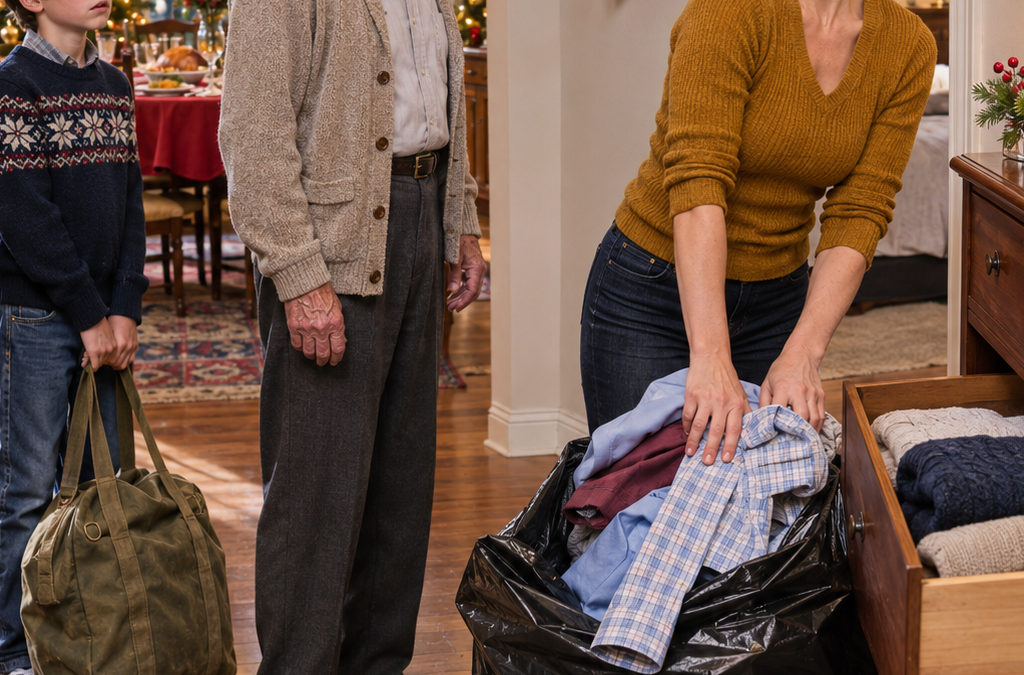
Claire pushed another shirt into the black garbage bag at my bedroom doorway, beneath the Christmas wreath they’d kept hanging while I spent eighteen days recovering from pneumonia.
“Your room belongs to us now.” She pressed my shirts down.
“I’m home, Claire. Those clothes stay here.”
Owen, ten, stood beside the dining-room arch with the bag I’d used through Army moves and now the hospital, its canvas bottom dragging against his sneakers.
“Are you going to let her do this?” I asked Daniel.
My son looked down at the carpet.
Linda’s wheeled suitcase waited beside my bed. “You don’t need all this space anymore,” she said.
“Who invited you to take my room?”
“Claire understands what everybody needs. You’d be better somewhere smaller.”
My mouth had gone dry. The oxygen tubing was gone, but hospital treatment and rehabilitation hadn’t left me much strength for standing in doorways.
My name was Frank Bennett. I was seventy-two, a retired Army lieutenant colonel, and sole trustee of the living trust that held my own house.
The three-bedroom house stood in Georgetown, Texas. Claire, Daniel, and Owen had lived there eight months without paying rent.
Owen’s bicycle stood repaired in the garage, and Daniel’s favorite potatoes waited under foil on the counter. Claire’s wet work shoes dried beside my heater, where I’d always told her to leave them.
And the Christmas tree still wore Owen’s crooked paper star because they’d saved Christmas dinner until I could come home.
I’d made helping so easy that nobody thought to ask.
Linda’s suitcase stood open beside my bedroom dresser.
Claire had emptied the top drawer. My socks lay beneath the shirts in her garbage bag, still paired the way I’d left them before the ambulance came.
My phone was in my hand, its blue case chipped at one corner. Beneath recent messages, the screen showed a saved twenty-seven-second voicemail from Linda before it went dark.
Claire pointed toward a folded brochure on the dresser. She said she’d found somewhere with meals and people to check on me.
The word somewhere hurt. My wife was dead, but this was still the home we’d made.
Then Claire pulled the remaining drawer open and told Linda it would hold her sweaters.
Daniel stayed beside the potatoes.
He’d spent much of his childhood with his mother in another state, and we’d never quite learned how to disagree without becoming strangers to each other again. But I couldn’t make that easier by disappearing.
“You’re telling me to leave so Linda can have my bedroom?”
“Yes. We’ve already worked everything out.”
Claire dragged the garbage bag toward the hallway. One sleeve caught beneath the dresser.
“TAKE YOUR THINGS AND GO!”
Owen flinched. That bothered me more than the shouting.
“Leave the bag there,” I said.
The porch offered cold air and somewhere to sit. Stepping outside wasn’t permission, and I didn’t tell anyone it was.
Through the window, Linda was still beside my bed. I called her phone.
“Why have you brought everything, Linda?”
“Claire promised me the room permanently. I’ve given notice on my rental. That’s $3,150 every month I won’t have to find.”
She sounded relieved to explain it. Her lease would end the following week.
So this wasn’t a guest arriving for dinner. Claire had arranged a permanent place for her mother while choosing another place for me.
My knees shook against the porch chair, and I waited until they stopped before calling Maria Torres. She was an officer I knew from neighborhood meetings. She said she could come by.
By the time Maria arrived, Claire had tape stretched across the garbage bag. Linda stood behind her, and Daniel had begun serving potatoes nobody was eating.
Maria came inside with me.
Claire looked at Maria’s uniform before she looked at me.
“This is a family dinner. We don’t need police.”
Maria stayed beside the dining-room arch.
“Linda says you promised her Frank’s room permanently.”
Daniel stopped with the serving spoon above his plate.
Linda looked toward Claire instead of answering.
The tape stayed stretched between Claire’s hands.
A red patch spread above her collar.
Owen watched her face from the archway.
Claire stopped pulling the tape.
Maria told Claire to leave my clothes where they were. Nobody was going to push me out or put my belongings on the porch while she stood there.
But she didn’t tell the others to pack, either.
“They’ve been living here,” she told me. “You can’t just put them outside. If you can’t agree, you’ll need to take this to court.”
I hadn’t asked her to carry anyone out. Hearing the limit still hurt. There seemed to be room for everyone’s needs except the man who’d just come home.
Claire recovered quickly.
“He needs help. We can’t keep doing everything.”
Maria asked whether I’d agreed to move. I said no.
Then Claire brought over the brochure. She opened it to a photograph of a narrow apartment with a kitchenette and a chair beside a window.
The building wasn’t a place for a few recovery nights. She’d marked a twelve-month option.
“His own place. Meals included,” Claire said.
Maria looked at the page without accepting it as an answer.
I could read the price beneath Claire’s finger. There was no signature, no promise from me, nothing except a choice she’d made while I was in the hospital.
Claire pushed the page closer to Maria.
Daniel stared at the photograph over her shoulder.
Linda’s mouth opened, then closed again.
The printed monthly price sat beneath Claire’s finger.
The apartment Claire had picked for me cost $4,600 a month.
“I’m not signing anything,” I said. “I’m not agreeing to live there.”
Claire said I was making a sensible arrangement ugly. Maria reminded her that picking an apartment didn’t mean I’d accepted it.
The potatoes were getting cold. For years Daniel had complained that I left the skins on, then eaten two helpings anyway. Looking at that covered dish made me want the evening we’d been promised.
Instead, I arranged temporary recovery lodging on my phone. A month to begin with, extended if I needed it. The expense was mine, and so was the decision.
I was humiliated to be booking a room from my own hallway. But I didn’t trust that I could rest here tonight, with Claire deciding what belonged in my dresser.
Maria stayed while I retrieved medication, clean clothes, and the discharge instructions. I pulled my shirts from the black bag. Claire’s tape had caught one cuff, but the fabric came free.
Nobody’s belongings went outside.
Owen still held the duffel. I told him he hadn’t done anything wrong and could leave it beside my bed. He asked whether we would still have Christmas dinner together.
“We’ll have dinner another day,” I said. “You and me.”
He nodded without looking convinced. Daniel finally came away from the counter.
“I thought we’d work it out.”
“You watched her bag my clothes.”
He started to answer, then said he should have stopped her. It was the first thing he’d said all evening that didn’t ask me to accommodate somebody else.
Claire stood near the front door with her keys. She wanted to know when I would collect the rest of my things. Maria said leaving for the night didn’t mean I’d agreed to move away.
I told Daniel I would contact him myself. There was no need for Owen to carry messages.
My phone lit up before I reached the porch. Claire had posted to the family group while we were still standing in the house.
“Frank has agreed to move out. Please don’t confuse him.”
Chapter 2 of 7
“I haven’t agreed to leave my home.”
That was all I posted to the family group. Daniel called before I reached my lodging and admitted Claire hadn’t asked me before sending her message. He said he’d told her to correct it.
“Don’t wait for her,” I said. “You can tell the truth yourself.”
Then I put the conversation away. I needed to find my medication and somewhere to sleep.
The next morning, Rachel Brooks asked why I’d brought a lodging receipt to a meeting about my house. Her office was in Georgetown, a short drive from where I was staying.
I told her things had gotten unpleasant. Daniel was under pressure, and having his mother-in-law arrive hadn’t helped.
“Where did you sleep last night?”
“At a recovery place. A furnished room.”
Rachel waited. I explained that I’d paid $3,200 for one month and could extend it if necessary. There was a shower seat, a small refrigerator, and someone available if I needed help.
I heard myself describing it like a choice I’d been eager to make. That embarrassed me more than the receipt.
“Did you want to leave?”
“No. I wanted to eat dinner and go to bed.”
She let that answer stand. I was grateful she didn’t ask me to explain why my son had watched.
Rachel obtained a certified copy of the recorded deed and examined the trust papers I’d brought. The deed showed that the house had actually been placed in my living trust. The trust papers showed that I alone had present authority to act for it.
I received a copy of the deed to keep. There was nothing wrong with needing proof, but sitting there proving I belonged in my bedroom hurt.
“Can I go home now?”
“You haven’t given up your right to live there,” Rachel said. “But getting everyone else out is a separate matter.”
She explained that eight months of living there mattered, even without rent. We needed to end the arrangement with proper written notice, then bring a possession case if they stayed.
“You actually sent us papers after everything we’ve done?”
Maria couldn’t remove them just because I showed her the deed. Neither could I. Rachel said to leave their belongings, locks, and utilities alone, and I told her I would.
By that afternoon, Rachel’s office had arranged delivery of a written termination notice covering the adult occupants. The stated end of their occupancy was more than thirty days away, and she kept the delivery record with my file.
Claire called while I was trying the microwave in my room. It had turned the edges of a frozen dinner hard while leaving the center cold.
“You actually sent us papers after everything we’ve done?”
“I asked you to leave my clothes alone. You didn’t.”
“This is going to tear Daniel apart.”
She said visiting me would upset Owen and split the household. Daniel needed to be home supporting his wife, she said, instead of helping me make trouble.
I hated hearing Owen brought into it. He’d already stood through enough adult ugliness without having his name used to keep his father away.
“Daniel can decide whether to visit me,” I said.
Claire went back to the senior apartment. If I would pay for a permanent place, she said, everyone could settle down. She made keeping the peace sound like another bill I’d neglected.
I refused the apartment. I also asked for a regular afternoon with Owen, arranged directly between the adults, with no messages for him to deliver. Claire said she would think about it and ended the call.
My dinner was beyond saving. At home, I would have made toast and eggs. Here, I ate crackers beside a refrigerator that clicked often enough to keep me listening.
Daniel came that evening with bananas and a container of soup. He’d remembered I didn’t like the sweetened kind of applesauce they’d served during rehabilitation.
“Claire said I shouldn’t come,” he told me.
He stood just inside the doorway, still wearing his work jacket. I pointed him toward the second chair.
He said Claire thought I was punishing them. I told him I’d been paying for their groceries and utilities while they saved money. Wanting my room back wasn’t punishment.
“I know. I should’ve stopped it.”
“You should have. Sit down, Daniel.”
He sat, and for a while we talked about the room’s bad television reception. I was glad he’d come. I was still angry enough that being glad annoyed me.
Eventually he asked about the trust. He remembered being named to take over someday and said Claire had understood that to mean they could make decisions while I recovered.
He admitted he hadn’t questioned her. Between my hospital stay and the papers he barely remembered, he’d treated my absence as permission.
I didn’t try to explain the whole document from my chair. Rachel had checked it; Daniel could ask her his questions. What I wanted from him was simpler than that.
“You could have called me before she emptied the drawer.”
He said he knew. Before leaving, he agreed to help arrange a visit with Owen without making the boy responsible for either household.
After he left, my phone lit up with a text from Linda.
“My landlord has accepted my notice. There’s no room for me to go back to.”
Chapter 3 of 7
“Ending your lease didn’t make my bedroom yours,” I told Linda when I called. “I understand you can’t go back. I’m not giving you my home.”
She said there were boxes everywhere now. Her former landlord had made other arrangements, and she couldn’t afford to move twice.
I believed her. That was part of what made the conversation hard.
“Claire’s the only one trying to keep us together.”
Linda sounded frightened rather than certain. But she still wanted me to solve her housing problem by accepting the room Claire had selected for me.
I told her I hoped she found somewhere she could afford. She ended the call without saying goodbye.
Over the following weeks, I kept my appointments and extended my lodging. I could shower without sitting down now, although getting dressed afterward still wore me out.
The room had begun to look occupied. Bananas ripened beside my medication, and clean socks dried over the shower rail. I hated getting used to it.
When the termination period ended, Rachel arranged delivery of a separate notice to vacate. She told me it allowed three full days. The delivery was documented, and I kept my copy with the papers from her office.
Claire called that afternoon. She didn’t mention the notice until she had asked whether I’d reconsidered the senior apartment.
“Daniel can’t keep running over there unless you settle this.”
He had visited twice since bringing the soup. Both visits had been short, fitted around his refrigeration jobs.
“What does settling it mean, Claire?”
She said I needed somewhere permanent, with people paid to help me. If I committed to the apartment, Daniel could stop worrying and the household could get back to normal.
The apartment meant a twelve-month commitment I hadn’t asked for. She was telling me to pay for my exclusion before my son could visit.
“I’m paying for the room I chose. That’s enough.”
Claire said she was tired of having every offer thrown back at her. She’d driven me to appointments, missed things, rearranged her schedule. Now she was supposed to help me put her family out.
Then she said I could find my own clinic rides from now on.
That hurt. I could arrange a ride. Hearing ordinary help turned into a price for my home was harder to get past.
A paid ride service took me to my next appointment. I booked it myself, allowed extra time, and carried my instructions in a folder because I was tired of searching my pockets.
At therapy, I couldn’t finish the last standing exercise. My legs shook before the final repetition, and I had to sit.
I was embarrassed, though nobody criticized me. All I could think about was getting strong enough to stop needing favors.
“Your wife said you couldn’t keep helping unless I moved.”
Back at the lodging, I paid for the extension. Between the room and transportation, refusing Claire was costing money I had expected to spend living quietly at home.
Dinner that night was a baked potato from the grocery deli. At home I ate the skin; here I left it because the plastic fork bent.
Daniel came the next evening. He noticed the ride receipt beside my appointment folder and said he could have taken me.
“Your wife said you couldn’t keep helping unless I moved.”
He looked tired, with a dark smear near his jacket pocket. He said Claire hadn’t meant he couldn’t see me. She meant they couldn’t keep managing two households.
I asked what she had been managing in mine.
He started with appointments, then stopped. We went through the rides together. There had been six clinic rides, spread across the time before my hospitalization and after I left rehabilitation.
“She did help,” he said. “I’m not saying she didn’t.”
Neither was I. I remembered waiting under the clinic awning and being grateful when her car pulled up. Gratitude hadn’t given her my bedroom.
Daniel admitted she hadn’t been nursing me around the clock. Then he asked me to “give her a little more time.”
They had already had the notice period. I asked whether they’d looked for a rental. He said they’d looked online, but Linda made everything more complicated.
I was angry with him again. He could name every difficulty except the one where I was paying to sleep elsewhere.
“You can help me without my giving up the house.”
He said he knew. His answer came quickly, but he didn’t offer a moving plan.
After a while, Daniel brought up Linda’s arrival. He remembered her handling the original arrangements by voicemail because I hadn’t been available for a live call. Claire had been working, and Linda had wanted the details sorted out.
My phone lay beside the appointment folder. After Daniel left, I saw that the old voicemail remained saved. I left it there and checked the confirmation for my next ride.
That night, Rachel called. Claire had sent her a statement and copied the relatives who had received the claim that I’d agreed to move.
It was written more neatly than Claire spoke to me. According to Rachel, it described all the ways Claire had made herself indispensable. It said moving the household would disrupt my care and endanger my recovery.
I looked across my rented room at the exercise sheet I still hadn’t finished. Claire had stopped the rides, then told people that making her move would leave me without help.
Rachel received Claire’s signed statement describing herself as my “full-time caregiver.”
Chapter 4 of 7
“Six clinic rides,” I told Rachel. “She waited for me, too. I don’t want that left out.”
Rachel asked whether Claire had provided daily care, managed my medication, or stayed with me through rehabilitation. I said no. I’d managed my own medication, and the rehabilitation staff had done their jobs.
The rides had mattered. They hadn’t been permission to empty my dresser.
Daniel brought a list of those trips to the courthouse in Georgetown. He’d checked them against his work schedule and Claire’s messages. Outside the hearing room, he offered it to Rachel, then stopped beside the door.
“Do I have to sit with either of you?”
“You can sit where you want,” I said.
He could document each favor down to the clinic entrance. Saying I had a right to come home seemed harder. That hurt more than I wanted to admit.
Claire arrived with Linda. Neither spoke to me at first. Linda looked tired, and Claire asked Rachel whether Daniel’s name was included in the trust papers she’d brought.
Rachel showed her the relevant pages before we went inside. Daniel stood close enough to read along.
“He’s named as a future successor,” Rachel said. “He isn’t acting now. Frank remains the sole trustee.”
Claire looked from the page to Daniel. She said he’d told her he was supposed to handle the house if his father needed help.
Daniel answered that he’d thought that was what the papers meant. His voice barely carried past us.
“Being hospitalized didn’t put Daniel in charge,” Rachel said.
For the first time, Claire stopped arguing that they’d already worked everything out. She read the page again, then asked whether my recovery had changed anything. Rachel said it hadn’t changed my authority.
I hated having my ability to make decisions discussed beside a courthouse door. But Claire finally seemed to understand that Daniel couldn’t give her permission over my objection.
“We need somewhere for our son. My mother gave up her rental.”
She turned to Linda and said they should ask for more time. By the time we entered the hearing room, she had put the trust papers behind her.
Judge Helen Reed asked short questions and waited for answers. Rachel showed that the house belonged to the trust and that I had authority to act for it. Then she went through the notices, their delivery, and the time allowed before the case was filed.
I listened from beside her. These were the weeks I’d spent elsewhere, reduced to papers the judge could check.
“Your Honor, we’re not trying to take anything,” Claire said. “We need somewhere for our son. My mother gave up her rental.”
Her voice was careful. She explained that Owen was settled and that another move would be difficult. Linda nodded when the judge asked about her former apartment.
I believed moving would be difficult. I’d been living out of drawers that weren’t mine.
Judge Reed asked whether they had left by the end of the notice period. Claire said no. She began explaining the help she’d given me, and Daniel confirmed the six rides when asked.
The hearing didn’t take long. Judge Reed awarded possession of the residence to me in my capacity for the trust. Rachel quietly explained that we still had to wait through the next required steps.
There was no relief big enough to cover everything. I was glad the judge had believed the papers. I was ashamed that I’d needed them.
Outside the hearing room, Claire waited until Rachel moved a few steps away.
“You can still tell them to leave us alone.”
“I’m not stopping this, Claire.”
She said I’d made my point. Linda couldn’t afford her old place now, and Owen shouldn’t have to pay for an argument between adults.
I told her Owen would still have a grandfather. He didn’t need to lose that because his parents needed their own home.
“You’ve got plenty of room. You’re choosing this.”
Linda looked toward the elevators. Daniel said nothing, though he stayed beside me until Rachel returned.
For supper, I bought a rotisserie chicken and took it back to my lodging. At home, Daniel always claimed the drumsticks before anyone else sat down. I ate one standing beside the little refrigerator, then wished I’d bought something different.
The waiting afterward was harder than the hearing. I kept expecting the judgment to make my rented room feel temporary again. Instead, every night there still ended with me checking that I hadn’t left my medication behind somewhere.
Later, the civil-process office’s arrangement reached us: Friday morning at nine, at my front door. Deputy Luis Alvarez would handle the handover, with Maria Torres there for civil standby. I would attend, and Claire, Daniel, and Linda were told to be present.
Rachel made clear that the remaining court steps still had to be completed. I didn’t pack up my lodging or tell anyone to leave ahead of them.
“Could you help me get settled afterward?” I asked David Collins.
My old friend said yes. I told him I’d need help carrying things and making sure I could reach what I used every day. He asked whether I wanted company afterward, too.
I said I did. Admitting that made me feel less lonely.
Daniel called that evening to ask whether I’d changed my mind. I told him I hadn’t. He said Claire was telling Linda that the court had only dealt with the house, not everything the family had agreed to.
Before I could ask what he meant, my phone showed a new post from Claire.
“Ask him what he personally promised my mother before you take his side.”
Chapter 5 of 7
“I never promised Linda a permanent home,” I told Daniel. “I’m going to ask her myself.”
Linda answered when I called, but she sounded as if she’d been expecting someone else. Behind her, I could hear the television I’d bought for my living room.
“Did you ever hear me offer you a home for life?”
“Claire handled the arrangements. You know that.”
I asked her to answer about me, not Claire. She said she hadn’t kept track of who said what. Moving had been difficult, and now everyone wanted her to remember every conversation.
It hurt to hear her retreat into confusion. She’d been certain enough when she told me how much rent she was saving.
“Then don’t let Claire tell people I made that promise.”
Linda said she needed to go. The television kept playing until the call ended.
By the following week, the appeal period had passed without an appeal or an order stopping the process. Rachel told me the writ had been issued. Deputy Luis Alvarez would handle it from there.
I didn’t feel ready. I wanted my home back, but I dreaded seeing Owen at the door while adults carried out what his parents should have arranged themselves.
“The handover is still set for next week,” Alvarez told me.
He called after the writ reached the house and the required notice had been posted. He wanted to confirm that I would attend and that I could get there without relying on Daniel.
I said David Collins would bring me. Alvarez explained that the occupants needed their belongings ready to move, and that he would direct the handover. Maria Torres would be there for civil standby.
There wasn’t much else to discuss. He didn’t ask whether I was a good father or whether Claire had driven me to appointments.
David came with me to the house for an arranged visit later that week. I needed to identify what I would use first when I returned, not carry anything in ahead of possession.
“Tell me what needs to be within reach,” David said.
My shower seat was still in the bathroom. The spare medical supplies were on a high closet shelf, where I couldn’t reach them without stretching. After I came home, David would help put them lower.
“Deputy Alvarez, could we clarify one thing?”
He wore jeans and a faded brown jacket. Seeing an old friend standing in my hallway made the house look familiar again, and that nearly undid me.
Claire had moved my reading chair against the bedroom wall. We left it there. David asked where I wanted it afterward, and I pointed toward the window.
In the kitchen, my toaster still needed two tries on the left side. David remembered that and asked whether I intended to retire before it did. I laughed, then felt foolishly close to crying.
“Deputy Alvarez, could we clarify one thing?”
Claire’s voice changed when Alvarez arrived to confirm access and the practical arrangements. She stood straight and listened without interrupting while he explained what needed to be ready.
She asked whether I could voluntarily postpone the handover. Alvarez said I could speak with my attorney about requesting a change, but he was proceeding on the arrangement already given.
Then he stepped outside with David to check the front approach. Claire turned toward me before they had reached the porch.
“Don’t make my mother homeless in front of Owen.”
Owen was at the dining table with a workbook. He looked up when she said his name. I hated that she’d made him listen for my answer.
“We’re not discussing this over his homework,” I said.
Claire told me not to tell her how to speak in her house. The last two words came out quickly. Neither of us corrected them.
Daniel came in from the garage and asked her to stop. Claire walked toward the kitchen, calling to Linda that they needed to sort another box.
“I let her unpack.”
Daniel stood beside the dining-room arch. He said he’d seen Linda’s suitcase arrive and knew Claire intended more than a visit. With me away, he hadn’t had to face either of us directly.
He’d told himself we could settle it after I recovered. Each day Linda stayed made it easier to avoid saying anything.
I was angry enough that I had to wait before answering. He’d been sleeping under my roof while I learned to sleep somewhere else.
“Helping me now won’t erase what you allowed.”
He said he understood. I told him he would still need his own home. Coming over to help me recover would not mean leaving clothes in a drawer or settling back into a bedroom.
Daniel nodded. This time he didn’t ask for another week.
Before David and I left, Claire called Daniel and Linda into the living room. She wanted me to hear her telling them that she wasn’t disputing the court order.
“He can do this. That doesn’t make it right.”
Linda sat on the edge of the couch. Claire said her mother had relied on a personal promise, and she wasn’t going to let the family forget it just because moving day was approaching.
I said Linda and I had already spoken. Linda looked toward the hallway.
Claire’s face reddened. Then she added a claim she hadn’t made before: I had said Linda could stay “for the rest of her life.”
“Tell them you never promised my mother the rest of her life.”
Chapter 6 of 7
At my front door, in front of everyone, Claire said I’d promised her mother a home for life.
“I never made that promise,” I said.
She looked past me toward Daniel and Owen. Linda stood beside her suitcase, while David waited near Maria and Deputy Alvarez on the porch.
“Now you’re abandoning the woman who helped this family.”
The doorway smelled of the lemon cleaner I kept under the sink. Someone had cleaned for our arrival. I was embarrassed by how much I wanted to get past them and sit in my own chair.
“Is there a signed order stopping this handover?” Alvarez asked.
Claire admitted there wasn’t. Then she turned to Daniel, asking him to explain why a promise should matter more than a moving deadline. He stayed beside Owen.
She knew the deputy had come to carry out the court’s order. She was asking me to stop him.
Linda kept looking down the driveway. Boxes filled Daniel’s vehicle, but her suitcase remained inside the house. Claire had left just enough unpacked to make departure look like an interruption.
“Linda described borrowing the rooms until I came home,” I said. “She left me a message.”
Claire glanced at her mother. She said that message had concerned deliveries and getting things moved while I was unavailable. It hadn’t settled anybody’s future.
For weeks, I’d watched Linda avoid answering a plain question. I was afraid she would do it again, even with her own words waiting on my phone.
“That message was about moving arrangements,” Claire said. “You’re twisting it.”
My phone was in my coat pocket, the chipped blue corner catching on the lining. I found Linda’s saved twenty-seven-second voicemail and played it myself.
“I said that. Claire, we talked about it before I unpacked.”
Her voice came through the small speaker, clear enough for everyone at the doorway.
“Claire said we’re only borrowing the rooms until you’re home. When you come back, we leave. That’s what I told her.”
Nobody reached for the phone. Linda looked at Claire, then at me.
“That’s my voice,” she said. “I said that. Claire, we talked about it before I unpacked.”
Claire answered that my illness had changed everything. There had been appointments, meals, worry. She started counting the things she’d done, then stopped when Linda shook her head.
“You told me he’d agreed. He hadn’t.”
It hurt to hear how close a plain answer had been all this time. Linda had let me ask twice while she protected the story that kept her in my bedroom.
Claire told her mother she wasn’t remembering the whole conversation. Linda said she’d never received a lifelong invitation from me. This time, she didn’t look away.
“I let him be treated like a burden,” Daniel said.
He picked up the old olive Army duffel from beside the hallway wall and came to stand next to me. He admitted he’d let Linda unpack without asking me, then waited for me to solve it.
I was glad he’d finally said it where Claire could hear. I was still angry. Standing beside me now didn’t give me back those weeks.
Maria asked David his connection to the household before he helped me inside.
“I served with Lieutenant Colonel Bennett,” he said. “He invited me to help him get settled.”
Daniel turned toward me. He’d known about Army offices and personnel work, but apparently the rank didn’t fit what he’d pictured. I had served twenty-four years before retiring in 2000; we’d spent too few of them together.
“Lieutenant colonel?” Daniel asked.
Claire began, “He worked in an office—” and stopped when Alvarez addressed her. David stayed where he was. He hadn’t come to argue my service record.
Alvarez held the enforcement copy where he could check it.
“The family disagreement doesn’t stop this writ,” he said. “I’m delivering possession to Mr. Bennett under the court’s order. Claire, I need the house keys. You, Daniel, and Linda need to leave now.”
Her rent-free family residence was the entire three-bedroom house she’d occupied for eight months. Alvarez stood at its door directing her departure, and Claire looked toward Daniel as though he could still change that.
She gripped the keys so hard the teeth pressed into her palm. Then she gave them to Alvarez. He passed them to me and checked that the doorway was clear.
I felt relieved, and terribly sad. My son’s belongings were packed in the driveway, and I wanted him to leave.
“Mom, tell him what this is doing to you,” Claire said.
Linda wouldn’t repeat the promise story. She said she needed to get her suitcase into the car. Maria stayed near the steps while Linda took it out herself.
Daniel carried the duffel over the threshold and left it inside for me. Then he stepped back onto the porch. He didn’t ask whether he could stay.
Owen waited beside the railing with his backpack on both shoulders. He asked whether he could still come over.
“Yes,” I told him. “We’ll arrange it with your dad. You haven’t done anything wrong.”
He nodded, then asked if the pancakes would still have burned edges. My wife used to call them that before I could call them crisp. I told him probably. His face eased a little.
Claire asked whether I really intended to keep the whole house to myself.
“You can visit when I invite you. You cannot live here.”
David went inside with me. I heard Daniel checking that Owen was buckled in, then his footsteps returning to the porch. He had a rental application, filled out but not yet accepted, and gave me his copy.
“This time, I’m putting our names on the lease.”
Chapter 7 of 7
On April 17, Daniel and Claire signed their own apartment lease. The rent was $2,250 a month, with a $2,250 deposit. Daniel sent me the signed pages and the receipt for their $4,500 move-in payment.
I hadn’t co-signed. They had paid it themselves.
“We’ve got the place,” he told me. “Owen’s picking which wall gets his bed.”
I congratulated him. Then I let the call end without offering to pay for anything. For once, Daniel hadn’t called to ask.
Linda rented a smaller room in another household. She paid for it herself and moved her things there rather than into Daniel and Claire’s apartment.
“I thought I could stay with them,” she told me.
Their lease didn’t allow her to move in without the landlord’s agreement. Daniel had told her they couldn’t promise her a room. I was glad he had said that before anyone started unpacking.
Linda said her new room had less closet space. Then she told me she understood that I hadn’t offered her my bedroom permanently. There was no explanation after it.
“I should have answered you when you asked.”
“Yes,” I said. “You should have.”
She didn’t ask to come back. After we hung up, I sat in my reading chair awhile. I was still angry, but I was relieved she had finally said it without Claire there to argue.
The house needed ordinary attention. I washed the bedding, restocked the refrigerator, and found the television remote behind a cushion. David helped lower the medical supplies, then stopped coming every day once I could manage comfortably.
“Call before you climb anything,” he said.
I promised I would. He had spent enough time helping me without having to worry about finding me balanced on a kitchen chair.
Daniel started asking before he visited. If I said an afternoon didn’t suit me, he suggested another. He drove himself over, parked clear of the garage, and went home afterward.
The first few visits were awkward. I still heard his silence from that dinner whenever he paused too long. It hurt, even when he was standing in front of me trying.
“Do you want me to look at that vent?” he asked one afternoon.
He’d noticed a rattle near the utility room. I said yes, and he fixed the loose cover before we ate lunch. He didn’t turn the repair into a conversation about everything he was doing for me.
Afterward, he left with the container he’d brought. No work clothes stayed in the laundry room. No boxes appeared in the garage while I wasn’t looking.
Once, a refrigeration job ran late. He called before our planned visit and asked to come another day.
“Tomorrow’s fine,” I told him.
He arrived the next afternoon as agreed. I began to relax a little when his truck pulled up, though I wasn’t ready to pretend those weeks away hadn’t happened.
We also talked about the years we’d spent apart. He asked about my Army work, and I answered without trying to make twenty-four years sound grander than they were.
“I knew you worked in an office,” he said. “Mom didn’t talk about it much.”
He’d been a child. I hadn’t called enough, and I told him so. Admitting that hurt, but I could admit it without agreeing that he and Claire had been entitled to take my room.
He listened. We didn’t fix our history over one lunch.
Claire’s messages stayed practical and written. She confirmed Owen’s visits, sent along school information, and asked whether certain pickup arrangements worked. I answered those questions.
She didn’t receive a key. I didn’t offer storage space or ask her to manage my appointments. When she asked Daniel to check whether I could keep a few cartons, I said no.
“You can tell her yourself,” I told him.
“Do you want me to start over?”
He did. The cartons went elsewhere, and I heard no more about them. I was grateful not to have another argument, but gratitude wasn’t the same as forgiveness.
Sometimes I missed having everybody nearby. I could miss the sound of Owen looking for his shoes and still be glad the hallway belonged to me again.
Owen came by invitation, with the arrangements made between adults. He brought homework sometimes and once spent most of a visit explaining a game I never quite understood.
“Do you want me to start over?” he asked.
“I’m afraid you’ll have to.”
He sighed like a man explaining taxes to a difficult customer. Then he started from the beginning. I laughed harder than he thought the situation deserved.
By summer, I could walk through the grocery store without planning where to sit. My breathing still made me slow down sometimes, but I no longer needed help getting dressed afterward.
I was proud of that. Recovery had taken longer than I wanted, and there were mornings when I resented every exercise on the sheet. Eventually I could finish them.
On one of Owen’s visits, I decided to move the reading chair. Claire had said Linda’s dresser had to stand near the window. I wanted the afternoon light there instead.
“Should we wait for Dad?” Owen asked.
“I can manage. You watch that corner.”
I moved it a short distance at a time, resting between pulls. Owen warned me before it caught the rug. When it was where I wanted it, we both stood back to look.
The chair fit. From it, I could see the yard without turning my neck. I was pleased by how little there was to discuss.
Owen noticed the old olive Army duffel on the closet shelf where Daniel had left it after the handover. It was empty now.
“Where does this belong?” he asked. “Out in the hall?”
“In the bedroom closet.”
He brought it down for me. There was room beside the spare blanket, and I could reach the shelf without stretching. Nothing needed to wait near the front door for another departure.
Family could ask for help without taking away my home.
Owen went to find his book while I checked that the bag was empty. I folded its sides inward and carried it to the closet.
I put the duffel away and left my bedroom door open.







