My fiancé’s mother took my late husband’s dog tags off my daughter’s gown at her eighth-grade graduation: “You’ll have a real father on Saturday.”
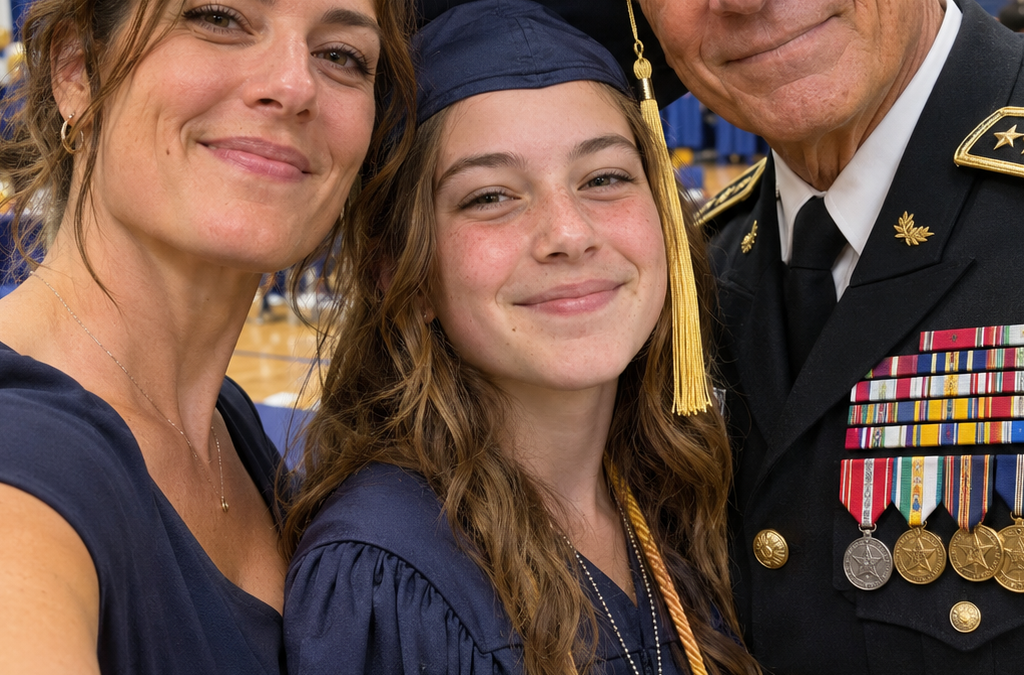
Chapter 1 of 7
Diane had unclasped the chain carefully, as though removing a price tag. Lily reached for it before Diane closed her fingers.
“Why are you taking her father’s tags?”
My thirteen-year-old daughter stood beside me in the reserved family row. Her classmates were gathering near the gym doors, ready for their entrance.
“Ryan, are you going to let this happen?”
My fiancé looked toward the stage instead of answering me. Behind him, a folder bearing Lily’s name stuck out from beneath the graduation programs, beside a rendering of the proposed memorial field house.
“She needs to start thinking about her new family,” Diane said.
Principal Ellen Brooks saw Lily reaching, saw my face, and lowered her eyes toward the registrar’s table while Ryan moved into the narrow space between our chairs.
“Let Mom handle it, Claire. You’re embarrassing Lily.”
Those words hurt more than Diane’s.
I was thirty-eight, and I was an Army major. At work, I was Major Bennett; here, I was Claire, Lily’s mother.
I’d come from my logistics assignment at Wright-Patterson Air Force Base in a navy civilian dress, with my duty bag still sitting at my feet beside the folding chairs.
Retired Major General Robert Hayes sat onstage. He had commanded both me and my late husband. His invitation included the military memorial announcement, which explained his ceremonial uniform.
At home, Ryan’s pressed wedding shirt hung on my closet door. Diane’s preferred tea waited in the kitchen cupboard. Lily’s gown hem lay straight because I’d repaired it after dinner.
We were supposed to be getting married in two days. I had spent the week making room for these people.
On the registrar’s table lay a transfer folder with my daughter’s name on it.
Lily glanced toward it, then back at Ryan.
“I can still go to day camp, right?”
She meant the local camp I’d approved that spring. Ryan had offered to send along the permission scan. Until then, her biggest summer worry had been getting a swimming slot.
Diane lifted the chain higher when Lily reached again. Then she told Lily to leave it alone and get ready for the entrance.
I moved toward my daughter, but Ryan stepped across the aisle.
“Stand back and let her get ready. STOP MAKING THIS ABOUT HIM!”
Lily’s mouth closed before she could answer, and I watched her smooth the repaired hem against her knees while Diane kept her father’s chain folded inside one pale fist.
My face burned.
“You’re letting her decide what Lily can wear?”
“Yes, and you need to stop arguing about it.”
He said it without looking at Lily. Diane nodded, pleased that he had finally spoken loudly enough.
Keeping the peace had taught them I would absorb the cost.
“I’ve heard you.”
I told Lily to stay beside me and moved only as far as Ellen’s table. Ryan followed us, leaving Diane beside the chairs.
The folder was half-covered by a program bearing the foundation’s logo. Beneath Lily’s name, I could see another school’s name and a line marked for a parent.
“Why does that folder have Lily’s name?”
Ellen looked toward Ryan before answering.
“It’s for a boarding academy. There’s a parent’s signature.”
“I am her only legal parent, and I never signed that form.”
Ellen stopped trying to slide the folder beneath the programs. I could hear chairs scraping behind us, and the microphone gave a brief squeal.
Across the gym, Robert had left his chair and was coming down the stage steps while Diane turned toward him with the chain still visible between her fingers.
He stopped in front of her and held out his hand.
Diane began explaining, but he waited until she surrendered the tags.
Then he knelt and fastened them around Lily’s neck.
He rose and offered her his arm.
“Major, your husband’s name is the one I came here to read.”
Ryan’s face changed at the way Robert addressed me.
“We were handling a family matter ourselves.”
“She may keep her father with her,” Robert said.
Behind us, Ellen drew the folder free.
Her eyes stopped on the bottom page.
The principal opened the folder, looked at the signature, then at my fiancé.
The audience began rising to welcome the graduates. Robert walked Lily toward the entrance, where she could join her class.
I stayed at the table.
Ellen explained that the folder concerned Cedar Ridge Academy in Colorado. There were four states between Ohio and the place they meant to send my daughter.
The proposed departure was the week after our wedding.
Ryan leaned closer, lowering his voice now that Robert was within hearing distance.
“It’s a paid educational opportunity. Don’t make it ugly.”
Diane came to stand beside him. She said Lily would thank us once she settled in.
Us. She included me without hesitation.
The boarding arrangement was for a year. Lily would be gone before the wedding flowers had wilted, and these people had been standing beside me discussing graduation pictures.
I could see Lily waiting near the doors. Robert stood a few steps away, leaving her room to talk with her classmates.
She kept looking back at me.
Ellen read farther down the page. She said Ryan’s name appeared with the application, and the school had received a request to prepare Lily’s records.
Ryan tried to turn the folder toward himself.
Ellen kept it against the table.
Diane said this wasn’t the place to discuss it.
But she had chosen this place to take the chain. Ryan had chosen it to shout at me.
Ellen checked the signature line a second time.
Ryan stopped reaching for the folder.
“Ma’am,” she said quietly, “who signed your name on this in April?”
“I didn’t.”
My voice came out thin, so I said it again. I had never applied to that school or agreed that Lily should leave home.
Ellen closed the folder but kept it beside her. She said she would not send Lily’s records while this was unresolved. Ryan started objecting, then stopped as his father approached the table.
Paul Mercer had been sitting farther down our reserved row. He held his phone with a finger pressed against the screen, as though he’d interrupted a message.
“I paid the reservation,” he said. “We weren’t just talking about it.”
I looked from him to Ryan. The wedding shirt at my house, the tea, the repaired gown: I had been getting ready for a family while they were arranging which part of mine to remove.
Lily returned after the entrance and the presentation of certificates. Before her class picture, she slipped the chain over her head and laid the tags in my palm.
“Hold Dad for a minute.”
Daniel had left those tags among his personal things. Years later, I had entrusted them to her because she asked, not because anyone thought she needed to prove whose daughter she was.
I held them until she came back, then let her put them on herself.
Ryan’s phone sounded beside us.
He read the screen and turned it toward me, insisting the arrangements could still work. It was a welcome message from Cedar Ridge Academy.
His email address appeared under “Family contact.”
Lily had been assigned a boarding room for the following week.
Chapter 2 of 7
“The room assignment came from the application Ryan Mercer submitted and the reservation Paul Mercer paid,” Megan Carter said. “It wasn’t a separate confirmation with you.”
I had called Cedar Ridge Academy from Ellen’s office the next morning. I gave Megan my name and Lily’s, then explained that I was Lily’s mother and only legal parent.
“I never agreed to boarding school.”
Megan identified herself as the admissions director. She said she would pause further processing while she checked the claimed consent. The application had arrived in April from Ryan’s email address.
Lily sat beside me, still wearing her backpack. She hadn’t wanted to leave it in the car.
“Did they already give my place away here?”
“No, honey. You’re staying here.”
I answered before I knew what Ellen’s computer showed. Lily watched me, waiting for the part where I might take it back. I was scared, too, but she needed an answer from her mother.
Ellen confirmed that no records had left Maple Creek. Lily’s path to the local high school hadn’t changed, and Ellen would check that nothing else was pending.
On speakerphone, Megan asked me to complete the academy’s parent-verification steps. While I did that, Ellen brought up the permission I had given Ryan months earlier.
It allowed him to receive routine school updates. During our eighteen-month relationship, I had sometimes needed help keeping track of school notices around duty hours.
“That let him get announcements,” Ellen said. “It didn’t let him choose another school.”
I wrote that I was withdrawing the permission immediately. Ellen disabled his access while we sat there, then confirmed it by email.
“Can I still do the camp with my friends?”
It embarrassed me to remember how grateful I’d been when Ryan offered to help. I had mistaken his interest in the school calendar for interest in Lily.
Ellen said Cedar Ridge would have to correct its own records. She could stop anything leaving her school, but she couldn’t erase an enrollment in Colorado.
Lily leaned forward when Ellen said that. I told her it meant the adults still had work to do, not that she had to pack.
“Can I still do the camp with my friends?”
“Yes. That’s the summer plan I approved.”
At home, Lily had marked swimming days with little blue squares. She’d also written “no raisins” beside the camp’s trail-mix activity, as if that were something she could negotiate.
I wanted those to be her problems again.
After verifying my identity, Megan sent the submitted form and the email that had accompanied it. Ellen printed copies for me.
The signature looked like mine. That frightened me more than a bad imitation would have.
The packet showed what the academy received and which account sent it. It didn’t establish who had put that signature there.
“I did not sign this document,” I told Megan.
She recorded my denial and said she would review the enrollment with the academy’s office. She didn’t promise an immediate answer. I appreciated that more than reassurance she couldn’t support.
We left Ellen’s office with copies, her confirmation about school access, and Lily still asking whether the academy might call her. I told her she could bring any call straight to me.
Ryan called as we reached home. I answered because I wanted him to hear plainly that the application was disputed.
He didn’t ask what Megan had said. He asked whether I understood how much his father had already spent.
“Dad paid twenty-four thousand dollars. You don’t get to waste that.”
The full year cost $48,000, he said. Tuition, boarding, everything. He described it like a kitchen renovation that would cost too much to stop halfway through.
I stood in my own kitchen, furious, while Lily went upstairs to change.
“Paying for school doesn’t give you my consent.”
He said I was turning a generous offer into an accusation. It was only one year. We would have time together, Lily would learn independence, and everyone could settle into the marriage without constant conflict.
He had a whole explanation for why my daughter should leave. I couldn’t remember him once asking what she wanted.
“I’m not sending her away so marriage is easier for you.”
He said I was twisting his words. Before I could answer, Diane joined the call from beside him.
Lily had come back downstairs carrying her graduation program. She stopped near the kitchen doorway when she heard Diane’s voice.
“This is homesickness before she’s even gone,” Diane said. “Don’t encourage it.”
Lily looked toward the stairs. It hurt to see her consider leaving her own kitchen so we could discuss sending her away.
I told Diane that Lily was home, and staying home. Then I ended the call.
Later, Diane sent the graduation pictures with instructions to use one posed family photograph. Ryan stood beside me in it, with Lily at the edge.
Lily chose the picture taken just after the ceremony instead. She asked me to keep it exactly as it was. Her father belonged in her graduation memory, she said.
I told her I would.
By evening, Paul had emailed the academy’s payment receipt and a proposed departure itinerary. There was a flight, a pickup arrangement, and a packing list Lily had never seen.
Ryan called before I finished reading it. He wanted an answer about the wedding.
“If you want tomorrow’s wedding, stop interfering with the year we already arranged.”
Chapter 3 of 7
On the morning I was supposed to marry Ryan, Lily asked whether she still needed her dress.
“No, honey. There won’t be a wedding.”
She stood in the kitchen wearing pajama shorts and one sock. Her dress hung upstairs, ready for pictures neither of us wanted anymore.
I told her I wouldn’t marry him under that condition. There were still arrangements to cancel and school records to straighten out. None of that meant she was going away.
“Can we have breakfast first?”
We had frozen waffles. Lily called the first one the practice waffle because our toaster always burned it. That morning, we split the second batch without making the usual joke.
I was sad, and embarrassed by how sad I was. I knew what Ryan had done. I still missed the morning I’d expected.
My cousin had already texted that she was leaving for the ceremony. I called her, then the other relatives I could reach. Saying it aloud got harder instead of easier.
Ryan arrived with his parents before we finished breakfast. Through the front window, I saw Diane in the dress she had bought for the wedding.
“We need a family talk, Claire. Come outside.”
Ryan stood closest to the porch steps. He had never lived with us and had no key. He waited for me to open the door as he always had.
I went onto the porch and left the door open. Lily stayed at the kitchen table, visible through the hallway. She said she wanted to finish eating, though her plate was nearly empty.
“You canceled the wedding.”
Paul said it before anyone asked how Lily was. His shirt was pressed, and he looked dressed for the ceremony, too.
“Yes,” I said. “I told Ryan that last night.”
He said people had traveled. There were meals ordered and relatives waiting for directions. I knew; I had been calling some of those same people.
“I wanted you to love her. That didn’t mean you could send her away.”
I felt humiliated standing there in yesterday’s jeans while they dressed for the celebration. But I wasn’t going inside to change for them.
“For eighteen months, you let me act like her father,” Ryan said. “Now my judgment counts for nothing.”
He listed rides, school notices, dinners he had paid for. I remembered those evenings differently now, but I had welcomed his help then. I didn’t pretend otherwise.
“I wanted you to love her. That didn’t mean you could send her away.”
He said I always did this when a decision wasn’t mine. Diane nodded before he finished, as though they had rehearsed which part she would support.
In the kitchen, Lily got up from the table. She stopped where she could still see me, and I stayed near the doorway.
Diane’s version of graduation had already reached the family message group. My phone showed her account beneath a cousin’s question about the wedding: I had allowed an old military friend to bully an elderly woman in public.
“Your general had no business humiliating me like that.”
I reminded her that she had taken something from Lily. She answered that she had been trying to help us move forward.
Paul called the academy a generous opportunity. He said most children would be grateful for that kind of investment, and now his family had paid to be publicly humiliated.
Their certainty made me furious. They spoke about gratitude while my daughter stood inside listening to them defend getting rid of her.
My cousin called again. This time she asked whether we could postpone things instead of canceling, just until everyone calmed down. Diane had sent her messages, too.
I told her there would be no ceremony. When we hung up, another relative had written that Ryan deserved a chance to explain. These were people who had watched Lily grow up.
“Did you cancel because I said I didn’t want to go?”
Lily had come to the doorway. She looked at me rather than Ryan, which hurt more than anything his parents had said.
“No. You told me what you wanted, and you were allowed to.”
I went on before she could apologize. I had canceled because Ryan arranged something without my agreement and then demanded I accept it. She hadn’t made that choice. He had.
Ryan started saying that children didn’t understand the sacrifices adults made.
“She didn’t cause this.”
I said it to him, then told Lily she could stay there or go back inside. She stayed beside the doorway, close enough that our shoulders touched.
Paul’s phone buzzed. He opened an old family conversation, looked toward Diane, and closed it before I could see anything. Diane asked him something under her breath. He didn’t answer.
Ryan watched his father, then turned back to me. His voice rose enough for Lily to move behind my shoulder.
“You said yes. Don’t act like this was all me.”
I asked him what he meant. He said he had the message and would send it to Ellen, since I apparently needed the school to settle our arguments.
I was afraid of what he could make another person believe. The signature had looked like mine. Now he was offering my own words without saying where they came from.
Diane told him to send it. Paul stayed near the steps, looking down at his phone.
A new email appeared on mine, addressed to Ellen with me copied. Ryan had attached a cropped image from an earlier family exchange. My name appeared above a single answer: “yes.”
Under it, he wrote that I had already approved the boarding plan.
Chapter 4 of 7
“The picture leaves out whatever came before your answer,” Ellen said. “I’ll keep his email. It doesn’t establish permission for boarding school.”
We spoke Monday morning while Lily ate breakfast in the next room. I sent Ellen the surrounding exchange privately. I hated having to explain my words while Ryan’s version traveled without me.
Ellen said the academy still needed agreement from Lily’s parent. A cropped answer couldn’t supply that. She saved his email with the other records without pretending it proved who had copied my signature.
Megan’s written confirmation arrived before we left for school. Cedar Ridge had finished checking the disputed consent and invalidated Lily’s enrollment. There would be no boarding placement or departure.
“Does that mean I can unpack?”
Lily stood beside the kitchen table. When I asked what she had packed, she admitted she hadn’t packed anything.
She had made a list, though, in case somebody told her to hurry.
I felt sick with sadness. While I had been making calls, my daughter had been deciding what she could carry away from home.
I showed her the sentence saying the enrollment was invalid. We read it together twice.
The money remained a separate matter between the academy and Paul. Megan would contact him about that. Her message settled the boarding placement, but it couldn’t correct what Ryan had told our relatives.
At Maple Creek Middle School in Beavercreek, Ohio, Lily needed to collect a sweatshirt from the lost-and-found. Ellen had also asked us to stop by her office.
Robert was there when we arrived. He wore a civilian jacket, and the field-house rendering stood against a bookcase.
“Would you want people to know more about your dad?” he asked Lily. “Besides his rank and where he served?”
Lily studied the rendering. She asked whether there would be room for anything besides names.
Robert said the family wording was still being discussed. He wanted Daniel remembered as a whole person, if that was what she wanted.
I was grateful he asked her directly. Too many adults had recently treated her wishes as an obstacle.
“He was funny sometimes,” she said. “But I don’t know what to put.”
Robert told her she didn’t have to decide. She could think about it, and nobody needed an answer that afternoon.
Lily described how Daniel used to call every bird outside our kitchen a chicken. She had believed him until kindergarten, when she corrected a teacher about a robin.
Robert laughed. He asked whether her dad had ever admitted being wrong. Lily said he blamed the bird.
For a moment, she sounded like herself. I was happy to hear it, even though remembering Daniel hurt.
Ellen offered to have the office assistant help Lily find her sweatshirt. I told Lily I would be there when she finished. We waited until she had left before discussing anything else.
Paul and Ryan arrived for a discussion about the already-scheduled project update. Paul carried construction photographs. Ryan stopped when he saw me.
“I didn’t know this was another family meeting.”
Ellen said it wasn’t. Robert was there to introduce the foundation’s part of the update. I had stayed to confirm arrangements with the school.
Paul recognized Robert from graduation. He said Mercer Construction had already sent progress information to the foundation office.
“I chair the foundation.”
Robert let that register before continuing. The Miami Valley Veterans Foundation was Mercer Construction’s client on the $1.4 million memorial field-house agreement.
Paul looked from Robert to the rendering. He explained that he had dealt with project staff and hadn’t realized Robert chaired the board.
The district owned the land, Robert added. The foundation administered the construction under its existing agreement with the school district.
The logo beside the graduation programs finally meant more to me than a sponsor’s mark. Robert was responsible for the organization paying to build the place.
“Of course, sir. We appreciate you making time.”
Ryan’s voice had changed. He asked whether Robert had received the latest photographs and offered to send another set himself.
I was furious at how easily he found that courtesy. He had shouted at me beside my daughter. Here, he knew how to wait until someone finished speaking.
While Paul and Robert discussed the project update, I stepped into the hallway. Ryan followed. The office door stayed open behind us.
“Then quit using Lily to make us look bad.”
“Keep your personal grudge away from Dad’s business.”
He said the crews had done their work. His father’s construction obligations had nothing to do with whether I was angry about the wedding.
I told him I hadn’t asked for a particular outcome for his father’s company.
“Then quit using Lily to make us look bad.”
I wanted to shout back. Instead, I said her school records and where she lived weren’t bargaining chips. I wasn’t trading a correction of his story for an agreement about his family’s business.
Lily returned with her sweatshirt before he answered. She looked at Ryan, then stood beside me. I was relieved she had missed what he’d said.
Ellen joined us and confirmed the public school-board meeting for Thursday, June 4, at 6:30 p.m., in the same gym. The project update remained on the agenda.
Robert and other foundation representatives would attend. The Mercer family would be there, along with Lily and me if we chose to come.
Ryan said nothing while Ellen spoke.
At the car, Lily asked whether she could wash the sweatshirt before wearing it. It smelled like the lost-and-found, she said, which apparently smelled worse than ordinary lost clothes.
My phone sounded before I could answer.
Ryan had sent a message.
“Show up at that meeting, and I’ll read your approval out loud.”
Chapter 5 of 7
“I’ll be there,” I told Ryan.
I didn’t ask what he intended to read. He had already told me. After the call, I asked Lily what would make the meeting bearable for her.
She was on the living room floor, sorting school supplies. Half her pencils had no erasers. She had made separate piles anyway.
“Do I have to stand up?”
“No. You don’t even have to come.”
I explained that I would attend either way. If she came, we could leave after the part that concerned us. She wouldn’t have to answer questions or tell strangers how much she missed her father.
She stopped sorting. I hated that she needed those promises from me.
“I want to sit beside you.”
She said she wanted the adults to hear that she had asked to stay home. She had asked Ryan, too, before graduation. He had told her she would understand when she was older.
That hurt. I had known about the application, but not about that small, private dismissal.
“You can say that if you want,” I told her. “You don’t owe anybody a speech.”
She asked what would happen if she changed her mind halfway there. I said we would find somewhere safe for her to wait with someone she trusted, or go home together.
That answer seemed to matter more than anything I said about the academy.
By the following afternoon, the wedding arrangements still covered our household calendar. There were reminders about flowers, a final guest count, and picking up Ryan’s suit.
I erased them. Lily’s camp orientation stayed, along with a dentist appointment I had nearly forgotten.
The blank spaces made me sad. For eighteen months, I had imagined ordinary married life with Ryan. I had never imagined checking whether my daughter was included.
“I saw what was happening. I looked down because I didn’t want a scene.”
Lily asked whether we could use the leftover wedding ribbon for her friend’s birthday present. I said yes, provided she didn’t expect me to make those fancy curled ends.
She said she had seen my wrapping before. She would handle it.
Ellen called while Lily was upstairs finding a gift bag. The academy confirmation lay beside my phone, where I could see it without opening another email.
“I owe you an apology for graduation,” Ellen said. “I saw what was happening. I looked down because I didn’t want a scene.”
She didn’t blame the crowd or say she had misunderstood. I was grateful for that, though it didn’t make remembering her lowered eyes easier.
I told her I appreciated her saying it. I still wished she had spoken when Lily was reaching for what Diane had taken.
“I should have,” she said. “At the meeting, I’ll explain the school’s part plainly.”
She would explain what permission Ryan had held and what the school had done since my complaint. She wasn’t asking me to approve a statement or accept an apology on Lily’s behalf.
After we hung up, I sat there longer than I needed to. I felt tired in a way sleep hadn’t fixed. Even a decent conversation now required me to revisit something cruel.
We stopped at Maple Creek Middle School in Beavercreek, Ohio, later that afternoon. Ellen had copies of the school’s confirmations for me, and Lily wanted to check where we would sit.
The gym doors stood open. A custodian was testing the microphone, saying the same number repeatedly until Lily whispered that she hoped the meeting had better material.
I laughed before I expected to.
Robert met us in the hallway. He said the project update remained on the agenda. He had received the foundation’s regular board materials, and there was nothing Lily needed to prepare for him.
“Can we sit near the aisle?” she asked.
He said we could choose seats where leaving would be easy. He didn’t ask whether she was brave enough to stay.
I was relieved. She had spent enough time being praised or corrected for how well she accommodated adults.
Paul and Ryan were near the office entrance when we came back down the hall. Paul had a rolled construction drawing under his arm. Ryan noticed us first and stopped talking.
Paul didn’t lower his voice enough.
“Are you going to tell the entire story?”
Ryan looked past him at me. He seemed more irritated by our presence than by the question.
“She approved the plan. Now she’s getting even because graduation embarrassed her.”
Paul said that wasn’t what he had asked. Ryan told him to stop making this harder, then complained that everyone was treating a good school like a punishment.
Lily moved closer to me. I was furious that he could still call it good without looking at her.
We didn’t stay to argue. In the car, Lily asked whether every adult at the meeting would believe him because he sounded so sure.
I told her I couldn’t promise what everyone would believe. I could promise that she wasn’t leaving home because Ryan repeated himself.
That evening, we chose clothes that were comfortable enough for folding chairs. Lily rejected a cardigan because, she said, she wasn’t interviewing to be somebody’s granddaughter.
I let her choose. There were plenty of decisions I still had to make for her. That wasn’t one of them.
My phone sounded while she was brushing her teeth. Ryan had sent a new message to the school-board correspondence address and copied the family group.
He wrote that I had approved boarding and that Diane had only helped carry out our decision as a couple. The attached image was the same cropped answer he had sent Ellen.
Beneath it, he had added: “This is the complete conversation.”
Chapter 6 of 7
“Say it before everyone,” I said at the microphone.
Ryan stood beside the front table in the Maple Creek gym. Behind him sat neighbors and relatives who had received his account. My cousin had come straight from work.
“Claire approved boarding. She told me to use her saved signature.”
He said I had changed my mind after graduation embarrassed me. Lily sat near the aisle, watching him instead of me.
“The application showed a new parent signature,” I said. “Now you’re saying you reused an old one. Where did I give you permission?”
Ryan explained that the signature came from real family paperwork. His father had paid real money. He had believed we agreed on an educational opportunity.
I felt humiliated hearing him offer that explanation to people who knew us.
“Did Claire authorize this school, or did you assume she would?” Ellen asked.
He answered that I had trusted him with school matters before. I turned toward his father. “Paul, show us what Ryan and Diane said before they submitted it.”
Paul stood beside Diane, then crossed the aisle with his phone. She told him to sit down. He kept walking.
“This is our original conversation,” he said. “Not the picture Ryan sent.”
He showed Ellen the screen, then read Diane’s message aloud: “She’ll say no. Use the camp signature.”
The signature came from Lily’s local day-camp permission form, he explained. Ryan had kept the scan.
Paul read the next message. “Ryan wrote, ‘Send it. I already booked her room.’”
Paul admitted he had paid the reservation knowing I hadn’t agreed. Ryan reached for the phone, then withdrew when Paul held it away. Diane insisted that paying for a better future ought to count.
“You knew I hadn’t agreed.”
I said it looking at Ryan. I was furious, but my voice stayed low.
Ellen faced the audience. Money and an emergency-contact listing, she said, had never authorized a transfer. Ryan’s permission covered routine updates only.
“Cedar Ridge has invalidated the enrollment. I’m voiding our transfer request. His school-record access remains revoked.”
Robert came to the microphone beside her. “Major Bennett, the foundation’s decision is separate.”
He faced Paul and Ryan. “Mercer Construction has lost the field-house contract.”
Susan Reed, the foundation secretary, handed Paul the written notice. Robert said all four board members had voted for it.
“The original agreement was $1.4 million. Total compensation for completed work and closeout is $200,000. Forty thousand remains payable after review.”
The foundation was choosing another builder under its existing contract, he said. This was a client’s decision, not a criminal sentence.
Paul looked down at the notice. Ryan stared at Robert.
For the first time, nobody in that family was explaining what I needed to accept.
“What about the crews?” Paul asked.
His voice sounded older. He mentioned a delivery and men scheduled to work the following week. Robert directed him to the foundation’s closeout contact, whose information was on the notice.
Paul asked whether he should call before sending anyone back to the site. Robert said yes. Susan stayed beside him while he read.
Ryan turned toward me.
“You did this because I wouldn’t let you control everything.”
My cousin looked away from him. Another relative who had urged me to postpone the wedding bent forward, elbows on her knees.
I had wanted those people to believe me. Seeing their faces change hurt, too. Lily had needed them to ask questions sooner.
“The payment doesn’t make what you did all right,” I said.
Ryan said I knew perfectly well what losing the job would mean. He kept looking at me, as though Robert might retract the notice if I apologized.
Ellen moved a chair beside mine before I sat down. Its legs scraped across the gym floor.
“I should have spoken at graduation,” she said, loud enough for the nearest rows to hear. “You and Lily should not have stood there alone.”
I thanked her. I wasn’t ready to say more.
Lily’s dog tags showed above her collar. She hadn’t touched them during the discussion. Her hands were tucked beneath her thighs, the way she sat when she wanted to keep from interrupting.
Diane leaned across the aisle toward her.
“We were trying to give you a real family.”
Lily looked at me first. I stayed beside her and let her decide whether to answer.
“He was already my real father.”
Her voice carried farther than she expected. She blinked, then looked down. Diane started to speak, but Lily turned back toward the front.
“I won’t marry someone who planned a home without my daughter.”
I felt proud of her and sad that she had needed to say it.
Ryan asked whether we were finished embarrassing his mother. I stood and went to the table where he waited.
I placed the engagement ring before him.
“I won’t marry someone who planned a home without my daughter.”
He looked at the ring without picking it up. Behind me, Lily’s chair creaked as she stood.
“We need five minutes alone, Claire. You owe me that.”
I told him there would be no private conversation. He could write about returning the remaining wedding things. He wasn’t to approach Lily.
I didn’t wait for his agreement.
The project agenda was still on the table. We left before the next speaker, passing my cousin without stopping. She said my name softly, but I couldn’t manage another conversation.
Outside, Lily complained that the gym always made her hungry. Every school event, she said, smelled faintly of pizza nobody offered her.
I laughed, tired and shaky. I told her we could get dinner on the way home.
Near the car, she stopped.
“Could the memorial say Dad taught me to swim?”
Chapter 7 of 7
By August 27, almost three months had passed since the meeting. The foundation had accepted Lily’s wording for the memorial plan: “My dad taught me to swim.”
I had forwarded her request without adding anything about his service. There would be room for that elsewhere. Those were the words she wanted beside his name.
The field house was still being completed. When we drove past Maple Creek Middle School in Beavercreek, Ohio, workers were carrying materials through an unfinished doorway.
“Will they tell us when that part’s ready?” Lily asked.
“Yes. Robert said they would.”
She looked out the window again. She didn’t ask to stop, and I didn’t offer.
Another builder had resumed the remaining work. Mercer Construction no longer controlled the project, though Paul’s company had been paid for what it had earned.
Eight weeks earlier, the foundation had paid its final $40,000 after the closeout review. That covered $20,000 in unpaid completed work and the agreed $20,000 termination payment. Susan had sent confirmation that the account was settled.
“So we don’t have to do anything else?” Lily had asked when I told her.
“Nothing about the construction money.”
Six weeks earlier, Cedar Ridge had returned $18,000 to Paul and kept the $6,000 reservation charge under its existing terms. Megan’s final message confirmed that Lily had no enrollment or payment obligation there.
Neither payment came from us. I was relieved, but seeing the academy’s name still upset me.
Ryan’s name no longer appeared among the people receiving Lily’s school information. Before her first high-school day, I checked with the office myself. He had no access and no role in decisions about her.
“He asked whether you’d meet for coffee,” my cousin told me.
“I’m not meeting him.”
She started to explain that he wanted closure. Then she stopped and said she would tell him not to ask through her again.
I had kept one email thread open for the remaining wedding things. His shirt went back with the other items through a relative. Anything that belonged to me came the same way.
When the exchanges ended, I told him the channel was closed. He received no private meeting, no chance to explain himself to Lily, and no place in her upbringing.
It hurt to finish those small tasks. Even returning a shirt meant remembering why I had once been happy to see it hanging in my house.
Paul wrote separately after the academy refund arrived. He said he wished he had spoken sooner, then asked whether we might have dinner together.
“Thank you for telling the truth at the meeting,” I wrote. “We won’t be coming to dinner.”
“I should have called you before I believed any of it.”
I also told him that none of the Mercers were to contact Lily directly. Any necessary adult matter had to come to me. He answered that he understood.
I didn’t ask whether Diane agreed. Her agreement wasn’t needed.
My cousin apologized in person for urging me to postpone the wedding instead of canceling it. I believed she was sorry. I still hadn’t forgotten how quickly she had asked me to accommodate Ryan.
“I should have called you before I believed any of it.”
“Yes,” I said. “You should have.”
We had lunch afterward, but we didn’t pretend everything was repaired. That felt more honest than hugging at the door and calling it finished.
Lily had spent the summer at her local day camp. She came home smelling of chlorine, arguing about team games and asking whether friends could stay for dinner.
Now she was starting high school with children she already knew. She complained about the building’s size and compared class schedules with friends on the phone.
“Everybody keeps asking if I’m excited,” she said. “I’m mostly trying to find science.”
I laughed. I was happy she could be irritated about something ordinary.
She still asked for reassurance sometimes. If an unfamiliar envelope arrived, she wanted to know who had sent it. I answered without telling her she ought to be over it.
On the afternoon of August 27, she found the invitation to a memorial-planning lunch on the counter. Robert had made clear that attending was optional.
“Do they need me to say anything?”
“No. Your words are already accepted.”
She read the invitation again. Then she asked whether we could go swimming instead, just the two of us, before the indoor pool’s family session ended.
I felt grateful that she asked for what she wanted.
“We can swim,” I said.
I sent our regrets and thanked Robert. He replied that he would pass along anything we needed to know. There was no disappointed follow-up, no request that Lily reconsider.
We packed lunch in the kitchen. Lily insisted on cutting her sandwich diagonally because, according to her, straight-cut sandwiches belonged in meetings.
“Your lunch has corners either way,” I said.
“That’s really not the point, Mom.”
She put hers in the cooler beside mine. There were grapes, too, and the chips she had chosen while I was still comparing prices at the store.
I had missed this kind of conversation without realizing how much. For weeks, everything between us had required an answer about safety or permission. Now she wanted to know whether I planned to swim or merely guard the towels.
“I’m getting in,” I told her.
She went upstairs for her bag and came back wearing Daniel’s dog tags. She had put them on herself. I didn’t ask whether she wanted to wear them to the pool.
At the door, she checked that I had my swimsuit. Then she waited beside me while I reached for our lunch.
A family should never ask a child to erase someone she loves.
Lily tucked the tags inside her shirt and took my hand.







