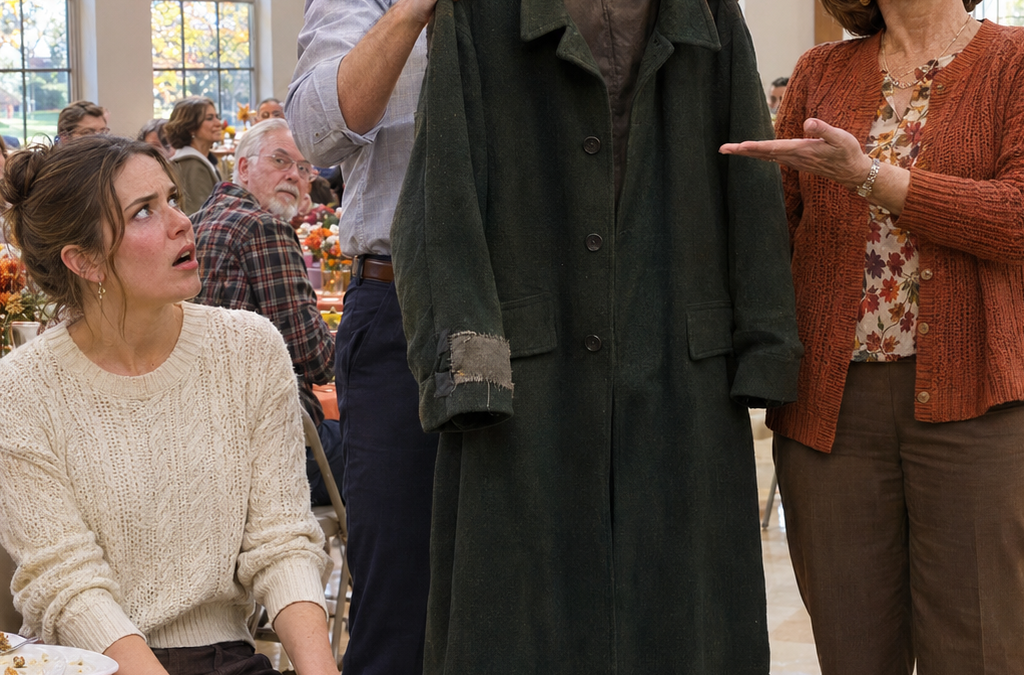
My husband held my only winter coat for bids at Thanksgiving supper while his mother said, “You can wait outside without it.”
Chapter 1 of 7
A draft lifted the paper table covering beside my bare wrists. We were in the fellowship hall at Mill Street Community Church in Delaware, Ohio. Half our Thanksgiving supper was still on our plates.
“That’s my coat. Please bring it down,” I said.
Mark Collins held it higher. His mother, Linda, stood beside him, surveying our relatives and church friends as if they were customers.
“Somebody here will appreciate a decent bargain,” she said.
“Are you really going to let him sell it?” I asked Emily.
Mark’s sister looked at her plate. Dad remained seated beside me, close enough that our elbows touched. My phone lit against the table, showing a notification for Mark’s saved voice message.
He was right there.
Nobody had offered money, but nobody had told him to stop, either, and the people nearest us seemed to be waiting for permission to laugh at me.
At twenty-eight, I handled payroll for a local public school district. My name was Rachel Bennett. I’d kept Bennett when I married Mark two years earlier.
Dad owns the house they live in.
Tom Bennett, my father, had worked as an electrician for thirty-three years. He was widowed, self-employed, and still came home with drywall dust caught in his eyebrows.
That morning, I’d peeled Linda’s potatoes until a pale mound filled her biggest pot, then pressed the shirt Mark now wore while he held my belongings above me.
Linda liked potatoes without even a speck of skin. Mark liked his collars stiff. Neither had thanked me, but I’d stopped noticing that part.
Then I noticed everything.
Mark’s saved voice message lit my screen beneath his raised hand.
The notification stayed there while I reached for the repaired cuff. My stitches were crooked, dark green against darker green. For a second, I caught it between two fingers before Mark pulled it away.
Keeping peace had started costing me ordinary things.
Earlier, I’d asked why our next household payment couldn’t wait until I bought groceries. Mark had called that question selfish, and Linda had offered this little sale as a solution.
Now she wanted me outside.
“Stop embarrassing Mark in front of everybody,” Linda said.
The humiliation burned up my neck. Dad’s dinner sat untouched beside mine, while Emily kept staring at the same patch of gravy across the table.
“You’re selling my coat because I questioned you?”
“Exactly. You don’t get to refuse and keep everything.”
Then Mark shouted, “STOP MAKING A SCENE!”
That was the part he wanted everybody to hear. My question had been quiet enough for our table; his answer reached the kitchen doorway.
I could have apologized.
That was my usual job: make Linda comfortable, make Mark look reasonable, explain afterward why I hadn’t meant anything by it.
“I’m done bidding for my things.”
I stood beside Dad instead of walking toward the outside door. My knees felt unreliable, but they held. Mark hadn’t expected that.
“Dad, has anything changed with the house?”
He looked up at me, then at Mark, before answering slowly. “No, honey. I thought you weren’t paying to live there.”
Mark had told me otherwise for months. There was a later debt problem, he’d said, and Dad was hiding the strain. Asking him would only make him ashamed.
So I hadn’t asked.
Dad had kept the housing papers, and he’d told me that when we moved in. I had trusted my husband’s explanation instead of asking the man sitting beside me.
I opened my transfer history and held the phone where Dad could read it. His eyes moved down the repeated entries.
Susan Ward was at the far end of the hall. She was the church treasurer, but I knew her through North Creek Bank and Dad’s housing arrangement, too.
I called her.
She answered while looking toward our table. I told her Mark said I owed money to keep the house out of trouble.
“There’s no overdue house installment,” she said. “May I discuss what you’ve told me at your table?”
“Yes. Please tell us here.”
Susan came toward us, still holding her phone.
She stopped beside Linda and ended the call.
Mark tried to wave the matter away.
“This is private. We’re handling it ourselves.”
Susan stayed beside our table.
“Rachel owes the bank no overdue house payment.”
Mark’s mouth stayed open for a moment.
Linda stopped looking for bidders.
Dad’s chair scraped against the floor.
Dad stood. “Susan, please tell Rachel what she owes.”
Susan looked at me rather than answering over my head. “What money have you been sending?”
“My wages. The money I earn at school.”
Saying that out loud hurt. These weren’t numbers that had appeared somewhere by accident. I’d worked for them, checked the deposit, and sent most of what I could spare to my husband.
And he’d accepted it every time.
Susan said the transfers on my screen were separate from the house’s actual loan. She needed to look at the existing file before discussing anything further.
Mark leaned toward me. “You’re making a household argument sound like something else.”
Dad asked how long it had been going on. I told him eight months. He stared at the list again, reading each entry as though one might explain the others.
Linda started talking about food.
Susan didn’t follow her there. She asked whether I’d sent the payments to the bank or to Mark.
“To Mark. He told me what to send.”
My thumb caught the saved message while I moved between screens. Mark’s voice came through the small speaker: “before you use your key.”
I stopped the playback.
Mark glanced toward the phone, then at Dad.
Dad hadn’t looked away from the transfer history.
He moved closer to read the total.
His lips moved over the digits.
Then he looked straight across the table.
“Rachel, where did those eighteen thousand four hundred dollars go?”
“To him,” I said. “Every payment went to Mark.”
There it was, in front of people who had watched me peel potatoes and carry serving dishes, who had heard Linda tell me to wait outdoors.
Mark reached across the table without quite touching me.
“Give me your phone. You’re mixing everything up.”
“No. You can look from there.”
I kept it against my palm. The screen was still on the transfer list, ordinary bank entries beneath an ordinary balance. Nothing about it looked like eight months of being afraid to miss a payment.
That made me angrier.
Linda said married people shared expenses. She said she’d never kept track of every bite her family ate. Mark nodded along before she finished.
But neither answered Dad.
Susan told them she wasn’t deciding anything about our marriage or our household spending at that table. She wanted to understand the claim that the bank needed my payments.
Mark turned his attention back to me.
“You know what I meant. Tell her that.”
For months, I’d done exactly that. Explained him. Softened him. Taken whatever he said privately and made it sound kinder when anybody else heard.
I couldn’t do it now.
“I kept your instructions,” I said. “When you told me what was due.”
His eyes moved to the phone again. I hadn’t saved that message expecting to need a witness. I’d saved it because I was tired, and he got angry when I remembered a household instruction wrong.
Dad stayed beside me.
“I’m not sending another payment without knowing what it’s for,” I said.
Mark stared at me from across the table. Then he took out his phone and typed, his jaw working while Linda watched him.
Mine buzzed in my hand.
“Send the next $2,300 by Friday, or don’t come home.”
Chapter 2 of 7
I turned my phone toward Susan before Mark could tell me to put it away.
“He’s making the house the condition,” I said. “This isn’t about buying food.”
Susan read the new text. Across the table, Mark watched her face instead of mine. Linda stood close enough to him that their sleeves touched.
Susan asked Dad and me to come to the side doorway. We stayed inside the hall, near the stacked folding tables. Mark didn’t follow us yet.
There was nowhere private enough to cry without somebody seeing. That embarrassed me almost as much as what had happened. I kept swallowing until the urge passed.
“I need to check the file,” Susan said. “Tom, may I?”
Dad said yes. She opened the bank’s secure file on her work device while supper continued behind us. Serving dishes passed between the remaining plates. Apparently people could still want more stuffing.
Dad looked at my screen again. He didn’t ask to hold it.
Susan read for a few moments, then checked another section. I watched her, wanting an answer quickly and dreading another thing I might have misunderstood.
“The trust’s loan is current,” she said. “You aren’t a borrower, Rachel. There’s no required payment from you.”
I asked whether the money I’d sent could come back. It came out before I could make the question sound less desperate.
“I can’t simply reverse completed transfers to Mark,” she said. “Those payments are separate from this loan.”
Eight months of money remained gone. The correction hadn’t put groceries in my refrigerator or restored the savings I’d stopped building.
“Why didn’t you tell me, honey?” Dad asked.
His voice was quiet. That made it harder. Anger would have given me something to push against.
Mark had told me Dad was worried about money. He’d said Dad would deny it, because helping us was one of the few things that still made him feel useful.
Saying that to Dad hurt. He looked down at the floor between us.
“I thought asking would embarrass you,” I said. “Mark said you needed us to handle it quietly.”
Dad rubbed his forehead. There was a small white streak near his hairline, missed when he’d washed after work.
“So you were protecting me.”
“Tom supplied the money for the old debt and the purchase. That hasn’t changed.”
I nodded, although hearing it that way made me ashamed. I’d protected Mark’s account of him. Dad had never asked me to keep a problem from him.
“I should’ve asked you directly how you were living,” he said.
He didn’t make me comfort him afterward. He stayed beside me while Susan finished checking the file.
“The bank manages the house,” she said. “Tom supplied the money for the old debt and the purchase. That hasn’t changed.”
Mark and Linda were still at our table. Neither could hear her over the conversations between us. Dad asked Susan to keep looking at what she needed, and she said she would.
I had known where our home came from. I hadn’t known my husband could turn my father’s help into a bill he collected.
For months, I’d compared prices in the school parking lot before going shopping. Mark called that sensible when I did it for groceries, then cheap when I couldn’t afford dinner out.
“Thank you for checking, Susan,” Mark said as he approached.
His voice was pleasant now. He stopped a careful distance from her, like an appliance customer had asked to speak to someone senior.
“We don’t need to take up your holiday,” he added.
Then he faced me.
“Stop humiliating my mother. Tell your dad you misunderstood.”
I wanted him to explain the text. Instead, he was waiting for me to repair the evening for him.
“I understood what you sent,” I said.
Mark glanced toward Dad. He said married people argued about money and regretted things. He didn’t say he regretted anything.
Linda joined him before Susan could answer. She looked past me toward the doorway, as though I’d already started leaving.
“Our family fed and housed you when you married him.”
The familiar accusation landed differently now. I still felt humiliated, but I no longer wanted to apologize.
“I earned the money you’re demanding,” I said. “Every transfer came from my paycheck.”
Linda said everyone worked. Mark told her not to bother explaining. They turned toward the tables together, leaving me with the impression that I had failed some simple test.
Susan asked whether I’d kept the instructions for those payments.
“I kept his messages.”
At home, I entered bills in a little budget on my phone. When Mark changed an amount or told me when something had to be sent, I saved it beside the other household reminders.
That was why the voicemail was still there. I hadn’t saved it to catch him. I’d saved it so he couldn’t say I’d forgotten.
Susan didn’t ask me to play it then. Dad asked whether I wanted some water. I said no, and he accepted that answer without asking twice.
Emily approached when Susan stepped aside to continue checking the file. Dad stayed nearby, giving us room without leaving me alone.
“Mark’s telling everybody you refused to help keep the home,” she said.
Her eyes were red, but I couldn’t make myself reassure her. She’d watched him demand my money.
“He knows that isn’t what happened.”
Emily looked back toward the tables. Then she lowered her voice.
“You can’t stay with Emily.”
For a second, I thought she’d misspoken. She was standing right in front of me, talking about herself as if she were repeating instructions.
“What?”
“He told me you can’t stay with Emily.”
Chapter 3 of 7
“He said you’d stopped helping,” Emily said. “That you wanted everybody else to carry you.”
She stayed near the stacked tables, away from Mark. Her voice was low enough that I had to lean closer.
“And you believed him?”
“I didn’t know about the money. I’m sorry, Rachel. I should’ve asked.”
She offered the apology without looking at me. I waited for her to say I could come anyway. She didn’t.
“I need you to be honest with me. I don’t need a bed you’re afraid to offer.”
Emily nodded, her eyes on the floor. I wasn’t going to ask her brother’s permission to sleep safely somewhere else.
“Dad, can I stay with you tonight?”
He answered before I could explain what I would bring or how little space I needed.
“Of course, honey. The guest room’s yours.”
Relief made my eyes sting. There had been an empty bed waiting all this time, and I’d stood there wondering whether anyone would let me use one.
Mark came toward us from the dinner tables. Susan was nearby, finishing something on her work device. He looked at her first, then at Dad.
“You taking her home with you?”
“I asked him,” I said.
Mark stopped in front of me. He wasn’t shouting now. He seemed pleased to have found something he could still decide.
“Leave with him, and your key won’t work.”
My key was still in my pocket. I could feel its edge through the fabric of my pants.
“Are you saying you’ll change the lock?”
“You want to walk out? Don’t expect to walk back in.”
Susan looked up. Mark turned toward her, his expression changing before he spoke.
“She’s an authorized resident. Leaving for the evening doesn’t change that.”
“I’m trying to calm my wife down, Susan. She’s upset.”
He said it as though I’d wandered away from him in confusion. I was embarrassed by how badly I wanted Susan to have heard his first words.
She had.
“No one is changing locks or excluding Rachel tonight,” Susan said. “She’s an authorized resident. Leaving for the evening doesn’t change that.”
Mark said he hadn’t changed anything. Susan told him the threat needed to stop, too.
He looked back at me. “You heard her. Nobody’s throwing you out.”
I could stay, apparently, if I pretended he hadn’t just threatened to keep me out.
“I’m still going with Dad.”
Mark glanced toward the relatives. Several were watching without turning their heads all the way.
“So now you’re abandoning your marriage over an argument.”
There it was again: whatever he did became something I had done to him. I’d spent two years trying to answer that without making him angrier.
“I’m leaving because you threatened me,” I said. “I’ll decide what that means for our marriage. Later.”
Dad stayed beside me. He didn’t tell Mark what kind of husband he was. He didn’t tell me what I had to do next.
His restraint helped more than a fight would have.
At home, Mark could keep an argument going until I agreed with enough of it to sleep. Standing beside Dad, I realized how tired I was. I wanted a room where nobody followed me in to finish explaining my faults.
“You don’t have to settle anything tonight,” Dad said. “There are clean sheets on the bed.”
I told him I’d stay. He said he’d quit using the guest room for sorting laundry before we got there.
That sounded like his house. A basket of unmatched socks, somewhere to sit, no speech required before I could come inside.
Mark waited for Dad to add a condition. When none came, he went back toward Linda.
I kept my phone with me. My key stayed where it was, too.
Across the hall, Linda began moving between the tables. She spoke quietly enough that I couldn’t hear every word, but the same phrases reached us.
Refusing to share. Household expenses. Poor Mark.
People who had watched me serve supper now found things to do when I looked their way. Chairs scraped back. Leftovers went into containers.
I felt ashamed, even knowing she was lying. Correcting her would mean approaching each little group and asking them to hear about my marriage while they packed pie.
I couldn’t make myself do it.
Susan remained near us. She asked whether I had somewhere safe to go, and I said Dad’s. She accepted that without asking me to justify leaving.
Linda passed close enough to hear.
“Your father can afford to indulge you,” she said. “Some families have to help each other.”
She kept walking before I answered. Dad watched her go, his mouth pressed flat.
I wanted to tell everyone about the transfers again. Instead, I stood there with my phone and let Linda have conversations I couldn’t hear.
That hurt worse than I expected.
Emily lingered between our side of the hall and her family’s table. Once, she started toward Linda, then stopped. I didn’t call her back.
Our relatives were beginning to gather their things. Linda looked around at them, then beckoned toward Susan.
Emily reached me before Susan crossed the hall.
“Mom wants everybody to stay,” she said. “She’s saying the house was promised to them permanently. She called Susan over to confirm it.”
Dad looked toward Linda. I stayed beside him.
Linda’s voice carried across the tables.
“Susan, tell them the bank promised us this house.”
Chapter 4 of 7
“Do you mean you were given the house,” Susan asked, “or permission to live there?”
Linda looked toward Mark before answering. He had come to stand behind her chair.
“We weren’t asking for ownership. We were told we could stay.”
“For how long?”
“For life. Why else would we have moved?”
She said it loudly, including the tables behind her. I remembered carrying boxes into that house, Linda directing us from the front room. She’d complained that the kitchen was smaller than she wanted. I’d thought we were all starting something better.
Dad said he had his copy of the housing papers in his truck. He asked Susan if she wanted them, and she said yes.
When he headed for the door, I nearly followed. Going with him would have been easier than standing there while Linda watched me.
But Susan was waiting for an answer to a question Linda hadn’t quite answered. I stayed.
“Who told you it was for life?” Susan asked.
Linda said the help had come through the bank. She’d understood it as family assistance, something arranged so they wouldn’t have to worry again.
She didn’t name Dad.
That omission hurt. His work had bought them security, and somehow he’d disappeared from the story they told about it.
Mark leaned against the empty chair beside her.
“The bank handled it. That’s what we were told.”
Susan asked him to wait until Tom returned. Mark said of course, using the agreeable voice I’d heard him use at work when a customer wanted a refund.
Emily remained near the end of the table. She hadn’t gone back to stand behind her mother. I noticed, but I wasn’t ready to make anything of it.
Linda looked at my face and shook her head.
“You’re enjoying making us explain ourselves to everybody.”
I wasn’t enjoying anything. My mouth was dry, and I wanted the evening over. But wanting it over had cost me enough already.
Dad returned with a plain work folder tucked under his arm. One corner was bent. It looked like everything else he carried between his truck and the kitchen counter.
He gave it to Susan without looking at Mark.
“Tom paid off your old housing debt,” Susan said to Linda. “That was $48,600.”
Linda started to speak. Susan continued before she could change the subject.
“He also supplied $174,500 toward buying the Maple Street house. The bank holds the title for his family trust.”
Mark straightened.
“You paid for it?”
Dad nodded. “I paid what Susan just said.”
Mark looked from him to Linda, then back to Susan. He seemed to be waiting for someone to correct her.
Nobody did.
“Tom’s support made the arrangement possible. The bank manages the house for his trust.”
I had known Dad helped us. Hearing the amounts made me picture him working overhead with sore shoulders, coming home too tired to make anything but eggs.
I was angry for him. He stood there in his good shirt while Mark tried to understand how much he’d been given.
“So this wasn’t some bank program?” Mark asked.
“No,” Susan said. “Tom’s support made the arrangement possible. The bank manages the house for his trust.”
Mark’s face changed. He understood now, and I could see him looking for somewhere else to put the blame.
He found Dad.
“You kept this quiet so you could control our marriage.”
Dad looked tired rather than surprised. He said he hadn’t asked either of us to run our marriage by him.
Mark turned toward me before Dad finished.
“You knew he was holding the house over us?”
“My father never required a payment from me. He never threatened my key.”
That was all I gave him. I didn’t explain Dad’s character or list the things he’d done for us. Mark had lived among those things every day.
Susan opened the folder and compared the signed pages with the bank’s copy on her device. Linda watched closely.
We had signed our own marriage papers with less attention than Mark was giving these. That thought made me sad in a plain, embarrassing way. I had wanted him to care about what he promised me.
Dad sat down while Susan checked the remaining pages.
At home, he saved every appliance manual, including one for a toaster he no longer owned. I used to tease him about keeping paper nobody needed. Tonight, I was grateful he hadn’t listened.
Susan finished checking and looked around our table.
“I’d like us to sit down here at 7:15 p.m.,” she said. “All six of us. The relatives who heard these claims can stay, too.”
She asked us not to argue across the hall in the meantime. She didn’t say what would happen afterward.
Mark drew Linda aside near the serving tables. Their heads stayed close together. I couldn’t hear them, and I didn’t move nearer.
Emily came to sit at the end of our table. Dad asked whether I wanted to sit, too. This time I did.
I was worn out. The folding chair felt hard beneath me, but being off my feet helped.
Across the hall, Mark bent over a sheet of paper while Linda spoke close to his ear. Every few words, he stopped writing and listened.
He had asked me for my phone as though the record was the problem. Now he was making a record of his own.
When he returned, he went straight to Susan.
Mark slid her a handwritten claim identifying the $18,400 as “voluntary household contributions.”
Chapter 5 of 7
Susan read the words on Mark’s page aloud. “Voluntary household contributions. That’s your description?”
Mark said it was. Linda nodded beside him.
The amounts hadn’t changed. Only his explanation had. My transfers could show where the money went, but they couldn’t show what he’d told me would happen if I stopped.
Those entries looked the same whether I’d sent the money freely or cried before pressing send.
“The record shows you paid him,” Susan told me. “It doesn’t establish why. Do you want your own evidence heard?”
“Yes. Here, with the people he’s already told.”
I was frightened of what Mark would say afterward. Even now, I caught myself calculating how long his anger might last.
Then I remembered I wasn’t sleeping beside him tonight.
Susan asked whether I understood that discussing the payments meant people would hear personal details. I did. They’d already heard Linda’s version while I stood across the hall.
I authorized her to say it.
Dad gave his permission separately. Susan could discuss his housing arrangement, including what he’d provided and what the signed papers said.
“You can have this conversation privately,” Susan told Mark and Linda. “You don’t have to defend your account here.”
Mark looked toward the relatives still gathered around the tables. He said he wanted the same people to hear his explanation who’d heard the accusations.
Linda agreed before Susan finished asking her.
So we stayed in the fellowship hall, with half-cleared tables around us and the smell of turkey lingering long after I’d lost any appetite for it.
Linda took the seat beside Mark. She pulled out the chair on his other side and looked at me.
There was barely enough room between that chair and the next table. I knew how it would feel sitting there, turning toward him every time he spoke.
I went around to Dad’s side instead.
“Sit wherever you need to, honey,” Dad said.
He didn’t move my chair or answer Linda’s look. I sat opposite my husband, with enough table between us that he couldn’t speak into my ear.
Emily remained standing behind Mark and Linda. Her arms hung at her sides. She looked at the empty chair Linda had offered me, then at me.
I wished she’d sit somewhere else. I hated that I still wanted that from her.
Susan sat at the end, where she could see all of us. Dad’s folder lay open beside her work device.
“Nobody charged Rachel rent,” Mark said. “That’s the part getting twisted here.”
He spoke to Susan, but his voice carried. He said a married couple could share expenses without calling it rent. A working wife could contribute to food, heat, and the things everybody used.
Linda began listing what food cost now. She mentioned the meals I ate at home, as though she’d been keeping count.
Dad started to answer.
“Let him finish,” I said.
It hurt to ask Dad to wait. But I wanted to hear how Mark explained eight identical payments without turning to me for help.
“What did you call the money when you asked me for it?”
Mark said he’d kept the household running. My contribution had let him cover the things that needed covering. He sounded almost patient.
For a moment, I heard him the way somebody else might. A tired husband explaining a money argument. A mother defending her son.
I understood how easy it would be to believe him.
“What did you call the money when you asked me for it?” I asked.
Mark’s patience thinned. He said we’d used different words at different times, like anybody did at home.
Linda said I knew perfectly well how much work went into feeding a family. She didn’t mention the potatoes I’d peeled that morning.
At home, Mark shook garlic salt over almost everything before tasting it. Linda used to blame me when the jar ran out. Remembering that absurd little complaint nearly made me laugh.
Then I looked at him, and it wasn’t funny anymore.
Susan let him finish before she spoke. “Sharing grocery costs voluntarily is different from requiring payment so Rachel can live there.”
Mark said he understood the difference. He leaned back as though that settled it.
I opened the saved message.
The original file was still there, with its full length showing. I checked the volume and watched the playback control beneath my thumb. Nothing had been trimmed away.
My finger hovered, then moved off the screen.
I was afraid to hear his voice with him sitting across from me. On the phone, alone, I’d always heard instructions I needed to follow.
Susan asked whether I was ready. I said I was.
“You’re making this bigger than it was,” Mark told me.
He didn’t use the patient voice for that. Linda looked down at my phone, then back at Susan.
The relatives had settled nearby. Emily still stood behind her mother, but she wasn’t looking at Mark anymore.
Linda brought out her house key and held it where I could see it. Mine remained in my pocket.
“A wife who walks out shouldn’t expect somewhere to come back to,” she said.
I left my hands where they were. I wasn’t going to reach for what she was offering or surrender what I already had.
I looked at Susan.
“Will he repeat that these were voluntary, with everyone listening?”
Susan turned toward Mark. He nodded, annoyed now, ready to explain me again.
Linda placed her key on the table and told Mark, “Tell them nobody made her pay to stay.”
Chapter 6 of 7
“Say it here,” I said.
Mark looked past me at the relatives and church friends gathered nearby. He seemed to count how many had stayed.
“I never made Rachel pay to live there. She contributed to groceries and household expenses. Voluntarily.”
Linda nodded. She said that was what they’d been trying to explain all evening.
I had wanted him to admit it without making me prove it. Even after everything, some foolish part of me had waited for him to stop.
“Your message ties the money to using my house key,” I said.
I placed my phone on the table and pressed play. Before the first word sounded, Mark spoke over it. I stopped the recording so nobody would miss what he said.
“Play a few words, and anything sounds bad. We were arguing about expenses.”
He didn’t deny leaving the message. He said husbands were allowed to ask their wives to help. He said I’d saved one bad moment and was presenting it as our whole marriage.
It hurt because there had been other moments. Saturday mornings, shared jokes, ordinary things I’d thought meant we were happy. None explained why he’d kept taking my money.
Susan waited until he finished.
“Could Rachel enter and live there without paying you?”
Mark said I’d always had a key. That wasn’t what she’d asked, and nobody helped him turn it into an answer.
The phone screen began to dim. I touched it, keeping the original message open. My hands were cold, but I knew how to do this.
“That’s Mark’s voice,” I said. “He left this on my phone when the last payment was due. I saved it with his other housing instructions.”
I started the message from the beginning and let it run.
“This isn’t groceries. Send the house payment before you use your key. Don’t ask your dad. He thinks you’re living here free.”
His recorded voice sounded impatient. Familiar. I remembered listening alone and checking whether my paycheck had arrived.
Now Dad was beside me, hearing why I hadn’t asked him.
Mark’s eyes moved from the phone to Susan. Linda stared at the key she’d put on the table. Behind them, Emily covered her mouth.
“I meant she shouldn’t come home and start another argument,” Mark said.
Susan asked whether that was his voice. He said yes, but insisted we were taking it wrong.
Nobody could make the opening about groceries now. And the last part wasn’t confusion about Dad’s help. Mark had known what Dad believed.
That was the part I couldn’t stop hearing.
Dad looked down. I wanted to tell him I was sorry, but I’d spent enough of the evening apologizing inside my own head.
Susan pointed once to the signed agreement.
“You both agreed Rachel could live there without a housing charge. It specifically forbids requiring money for her entry or residence.”
Linda began talking about feeding three adults. Susan didn’t follow her.
“You made a payment the price of her getting inside.”
Mark leaned forward. He said they could sort out the payments between themselves. Linda added that family shouldn’t lose a home over an argument.
“The bank won’t change locks or bypass the lawful process for getting possession back.”
Susan answered them both.
“Acting for North Creek Bank as the trustee managing this house, I am ending your rent-free right to stay in the $264,500 home. Written notice will give you until January 31 to leave.”
Mark stared at her. For once, he didn’t look toward me for an explanation.
“You may remain during the notice period,” Susan continued. “The bank won’t change locks or bypass the lawful process for getting possession back.”
She said the written notices would be delivered the next day, honoring the agreement’s minimum of sixty days. This wasn’t a demand to leave tonight.
Mark stood so abruptly his chair struck the table behind him. He reached toward my phone, then stopped short of touching it.
I stayed seated. Having Dad beside me helped, but I was still afraid of the look on Mark’s face.
“Tom, tell her to stop this,” Linda said. “You’re going to let her do this to us?”
Dad looked at me before he answered.
“Susan’s made the bank’s decision. I’m not speaking over Rachel about hers.”
Linda waited for more. Dad gave her nothing else.
Emily moved away from her mother. She crossed to the end of the hall where they’d left my dark green coat after trying to sell it.
Nobody offered a joke this time.
She brought it straight to me and put it into my hands. My repaired cuff faced upward, the same crooked stitches I’d caught before Mark pulled it away.
“I should have stopped him,” she said.
I nodded. I couldn’t offer forgiveness just because she’d finally done what I’d needed earlier. But I held what she’d returned, and she didn’t ask me for anything.
Mark told me we needed to go home and talk privately. He said everybody had heard enough.
I stood beside Dad.
“I won’t pay to be allowed inside my own life.”
The words embarrassed me a little once they were out. They were bigger than the way I usually spoke. But I meant them.
Susan’s decision concerned the house. Mine concerned the man still waiting for me to make this easier for him.
I looked directly at Mark.
“I’m leaving with Dad tonight, and I’m not coming back as your wife.”
Chapter 7 of 7
I slept in Dad’s guest room that night. Not much, but safely. Every time I woke, the house was quiet, and nobody needed an answer from me.
By morning, I still meant what I’d told Mark.
The bank delivered the written notices the day after Thanksgiving through its established notice procedure. The deadline remained January 31, 2027. Mark and Linda could stay until then; nobody changed the locks or put their things outside.
“Does this mean you’re satisfied?” Mark wrote.
I wasn’t satisfied. I was exhausted, and I needed clean clothes from a house I dreaded entering. Dad went with me to collect them, waiting while I decided what to take.
Mark wanted to discuss everything except the money. He wrote about loyalty, embarrassment, and whether I understood what marriage meant. I answered only the questions that needed answers.
“Put anything necessary in writing,” I told him.
That boundary was harder than it sounded. My first instinct was still to reply quickly, before he could get angrier. Sometimes I drafted three paragraphs, then deleted everything except one sentence.
On December 4, I filed for divorce.
Filing didn’t make me unmarried that afternoon. There were questions to answer and decisions still ahead. But I no longer had to wonder whether I’d really meant to leave.
Linda kept asking me to resume family dinners. Her messages called them a chance to settle things, as though a plate in front of me would make me easier to manage.
“I won’t be coming,” I wrote.
It hurt to refuse something I’d once wanted so badly. I’d married Mark expecting a larger family, Sunday meals, somewhere I belonged. I had to grieve that without going back to earn it again.
On December 11, Dad helped me move into a small rental. The rent was $975 a month, a number I’d worked through against my own paycheck.
There was no dining room. The bedroom door scraped the carpet unless I lifted it slightly. But I could pay for it without pretending groceries cost less than they did.
“Tell me where the boxes go,” Dad had said.
He brought his truck and carried what I couldn’t. He didn’t ask for a spare key or tell me which room should hold what. When I thanked him, he said helping me move wasn’t buying a vote.
I cried after he left. I was grateful, but I was lonely, too. A sensible decision could still leave an awful first evening behind it.
The money took longer than the move.
Mark’s apologies arrived before any repayment did. Some included explanations about pressure and his mother’s needs. Others ended by asking whether I would reconsider the separation.
I kept the repayment discussion separate.
Under a negotiated written agreement, he transferred $4,600 on January 15. I checked my own account to make sure it had arrived before acknowledging it.
“Received,” I wrote. Nothing about forgiveness.
The remaining balance was $13,800, payable in twenty-three monthly installments of $600. Seeing it laid out that way made me angry again. I’d sent the money in frightened monthly pieces; getting it back would take nearly two more years.
On January 24, Mark and Linda voluntarily surrendered the house. The bank documented its return before the notice deadline. There was no lockout, no police removal, no final confrontation for me to attend.
Susan confirmed that the house had been returned. I didn’t ask where they’d gone. Necessary arrangements could reach me in writing; their next home wasn’t mine to organize.
The first $600 installment arrived on February 15. Twenty-two installments remained afterward. I kept the agreement and checked each payment against it instead of treating one payment as proof that everything had changed.
Emily and I met once for coffee. She came alone and didn’t bring anything Mark wanted me to hear.
“I don’t want to be his messenger,” she told me.
I told her I didn’t want that either. She apologized without asking whether I understood how difficult her position had been. That helped more than a long explanation would have.
We exchanged a few messages afterward. I wasn’t ready to invite her into every part of my life, and she accepted that. She didn’t ask me to explain the divorce to her.
By the fourth month after Thanksgiving, I could get through most workdays without checking my phone whenever it vibrated. I still struggled some evenings. My marriage had lasted two years; leaving it hadn’t erased every habit it had taught me.
That Saturday, Dad came by before breakfast.
Rain had darkened the rental steps, and the bare branches across the street shook in the wind. He waited at the bottom, looking up at my window.
“Still want that walk?” he called.
I stood inside with my coffee cooling on the kitchen counter. There were eggs in the refrigerator and bread beside the toaster. Breakfast could take ten minutes whenever we came back.
Linda would have said the weather was miserable and found something indoors that needed doing. I could almost hear her asking why we couldn’t eat first, since I was already in the kitchen.
“Give me a minute,” I said.
Dad nodded and stayed where he was.
“As long as you don’t scramble them to death.”
He hadn’t brought breakfast or a bag of groceries I hadn’t requested. He’d come because I’d mentioned wanting company for a walk. The smallness of that made me happy.
The divorce was still in progress. Mark still owed most of the money. Neither fact required me to spend this morning answering him.
“Eggs afterward?” I asked through the doorway.
“As long as you don’t scramble them to death.”
He’d complained about my eggs since I was sixteen. For once, an old family complaint made me laugh.
I went back for my dark green winter coat. The repaired cuff had held through the rest of the winter. I hadn’t replaced it just to prove I could.
Being somebody’s wife should never mean needing permission to stay warm.
For a moment, I stood beside my own door, glad to have somewhere to return. Dad waited below the steps while I reached for the sleeve.
I put my coat on and stepped outside.







