My Husband Made Me Eat in the Car at His $75,000 Promotion Dinner—Then His New Boss Walked Out and Knocked on My Window
Complete story · 7 chapters · about 33 minutes · ending included
Chapter 1 · Chapter 2 · Chapter 3 · Chapter 4 · Chapter 5 · Chapter 6 · Chapter 7
Chapter 1: The Plate in the Passenger Seat
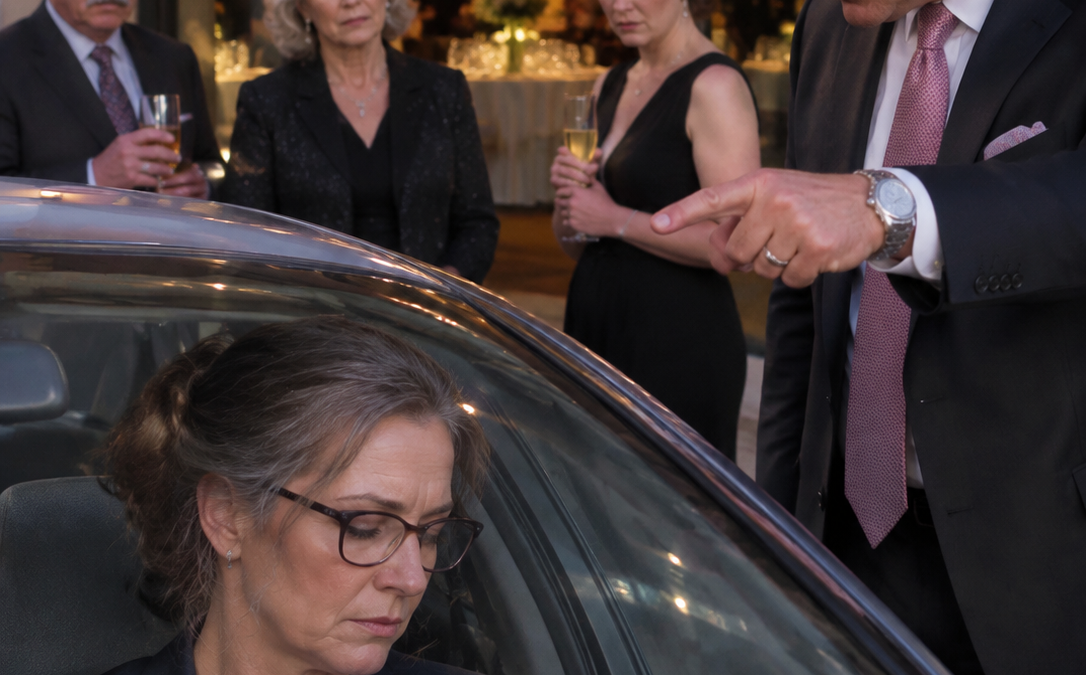
At 6:41 p.m., Steve pointed at the Camry and said, “Eat in the car, you’ll embarrass me.”
His eyes moved over my navy court trousers, cream blouse, and jacket.
Then he looked past me toward Rivergate Banquet Center’s glass wall.
Men from his department stood inside with drinks in their hands.
A woman near the doors had stopped talking.
She was watching us.
I held out the speech.
“Joke’s on page two.”
Steve took the pages without looking at them.
He raised his voice so the people inside could hear.
“You type what smarter people say. Nobody has ever read a word you wrote.”
A man beside the doors stopped with his drink halfway raised.
The woman looked from Steve to me.
He didn’t lower his voice or appear embarrassed.
His eyes stayed on my court clothes.
I had driven across Fort Wayne after finishing a court calendar.
I was still wearing the clothes I had worked in all day.
I had thought I would change in the restroom before dinner.
Instead, I stood in the parking lot holding the speech my husband planned to deliver.
Steve turned toward the doors, leaving me beside the car.
The dinner was for 110 coworkers.
His new title came with a $75,000 raise, moving his salary from $142,000 to $217,000.
He had spent weeks talking about the promotion as if the room had been built for him.
I had spent weeks preparing the packet that supported it.
The glass wall faced the lot, so there was no way to pretend I hadn’t been seen.
People could look out while waiting for drinks or listening to someone speak.
A few turned back toward the room when Steve went inside.
The woman by the doors kept watching until I opened the driver’s door.
I sat down and closed it.
My place card had been pulled at four that afternoon.
By the time I arrived, there was no card with my name.
Steve hadn’t explained it.
He had only told me what to do with the car.
I put the key in the ignition but didn’t turn it.
The shorthand machine case sat on the passenger seat.
It was black, hard-sided, and scuffed along one corner from years of being carried into court.
I moved it onto my lap and waited.
At 7:02, the banquet doors opened.
Erica Robbins came across the lot with a foil-covered plate held in both hands.
She was Steve’s assistant and had worked at Maumee Wire & Coil for eleven years.
She usually spoke softly and was careful not to meet anyone’s eyes for long.
That evening, she kept her eyes down.
“I was asked to bring this out,” she said.
“Thank you, Erica.”
She set the plate on my shorthand machine case.
The foil had been folded over the edges.
I could see food through a small gap near one corner.
Erica looked toward the doors.
“They’re starting soon.”
“I know.”
She nodded and went back inside.
She didn’t turn around.
The plate was warm against the case.
I left the foil closed for a minute.
Through the glass, the room was bright and crowded.
People were finding their seats.
Steve stood near the front, holding the speech I had given him.
For twenty-three years, I had helped him prepare for rooms like that one.
I was fifty-two and had worked as a court reporter in Allen Superior Court for twenty-seven years.
I knew how to listen without losing a word.
My machine recorded speech in shorthand, not ordinary letters.
The symbols came quickly beneath my fingers.
I could turn them into a clean transcript while other people were still deciding what they had heard.
Steve knew that when he first asked me to help with a quarterly report.
He had the figures from his quality team, but he needed someone to put the material into clear language.
I agreed to help with one report.
Then another quarter came.
Then another.
By October 2026, there were ninety-two reports, beginning with Q4 2003 and ending with Q3 2026.
The figures came from Steve’s team.
They were accurate.
I wrote all ninety-two reports.
I built the explanations, shaped the summaries, checked the language, and made the pages sound like a director’s work.
I did it after court, before court, and during the hours when the house was quiet.
Steve sent me the source material and gave me deadlines.
I returned polished pages.
He never wrote a report himself.
Tonight’s packet was the one that helped justify the $75,000 raise.
I had prepared that too.
Steve had taken the finished pages to work under his own name, as he had done with the other ninety-one.
The footnotes were the only part I had never changed into ordinary language.
Every footnote read like a reference marker.
“Ref. TPOR/STAOEF.”
A person reading the report would pass over it as document control.
It looked like the kind of small notation that belonged in a company file.
Steve called them document control.
He said the codes made the reports look consistent.
They were my machine shorthand.
I had used the same keys I used in court.
Picking up where the Facebook post left off
Nobody in that building could read them.
Not Steve, not his department, not the people who approved his work.
They saw a reference number and moved on.
I had never explained the codes to him.
He had never asked.
I peeled back the foil and took a bite of chicken.
It had gone lukewarm by then.
I ate slowly, keeping the plate balanced on the hard case.
The case tilted when I adjusted my legs, so I steadied it with one hand.
Inside, someone raised a glass.
Steve stood beside the podium, smiling while a man in a gray suit spoke to him.
I wondered whether Steve had told the new boss who prepared the packet.
He hadn’t mentioned my name when he discussed the dinner.
He had said the promotion was a team effort.
That was true in the way a locked door was true about a room.
At 7:20, my phone lit up.
The message was from Steve.
“New boss keeps asking about you. Told her migraine. Say you have a migraine. Go home.”
I set the phone beside the plate.
The new boss had never met me.
I didn’t know what Steve had told her about me, or why she wanted to see me.
I knew only that she had asked more than once.
Steve had answered for me, then sent me a script to repeat.
I looked through the glass again.
He was laughing with the people nearest the podium.
The speech I had written rested on the lectern.
I could see the second page folded slightly beneath the first.
The joke was still there.
I had written the speech as carefully as I had prepared the packet.
I had expected to hear Steve deliver words I had put together.
Instead, he was inside while I ate beside the car.
I picked up my phone.
The easiest thing would have been to start the car.
I could tell myself I was tired, that the court clothes were wrong, that the dinner had never been mine.
I could go home and let Steve explain my absence however he pleased.
That was what he had typed.
I looked at the plate, then at the passenger seat.
My shorthand machine had recorded other people’s words in court for twenty-seven years.
Tonight it was holding my dinner.
I pulled the key out of the ignition and placed it on the passenger seat.
Then I folded the foil back over my plate and looked toward the banquet doors.
Chapter 2: The Email He Forgot He Sent
At 7:34, Steve opened my door.
He leaned down, one hand resting on the roof.
“You type what smarter people say. Nobody has ever read a word you wrote.”
“Your tie’s crooked.”
His hand went to his collar.
The knot had slipped toward his left shoulder. He looked down, fixed it, and glanced toward the glass wall.
“Go home, Rochelle.”
I kept my hands in my lap.
Steve waited a moment, then pushed the door shut.
I watched him cross the lot and return to the banquet room.
He didn’t look back.
My phone was still beside the plate. His message remained on the screen, telling me to claim a migraine and leave.
I opened my inbox instead.
I searched for Steve’s work address.
The results filled the screen, one quarter after another, from Q4 2003 through Q3 2026.
Ninety-two messages.
The dates fell three months apart, year after year.
The subject lines followed the same pattern, and the attachments were the source material I had used each time.
Every quarter was there.
Each message came from his company account and carried an attachment containing company data.
The wording in the body barely changed.
“Need by 6. Same format.”
I had kept every message.
I had kept them because the attachments mattered when I prepared the reports. I had kept them because I was careful with records.
I called it good recordkeeping and left it there.
The oldest message had arrived in 2003.
I opened the attachment and found the first report.
Q4 2003.
The figures were Steve’s team’s. The explanations were mine.
At the bottom sat the first footnote, entered in machine shorthand.
It had been a love note.
I remembered typing it after the report was finished, when the house was quiet.
I had wanted him to know I was there, even if my name never appeared on the page.
The note was small enough to pass as a reference code.
I had been proud of that.
I moved forward through the years.
By 2011, the footnotes had changed.
I had stopped leaving him love notes. I had started keeping track.
One entry came back to me as soon as I saw the shorthand marks.
“Done 2:10 a.m. He says nobody reads me. Fine.”
I had typed it after finishing another report at 2:10 in the morning.
The next day, he had sent another file.
I had done that work too.
I liked being needed.
I liked that he came to me with something he couldn’t do himself.
When a new quarter arrived, I knew he would send the material.
I knew there would be a place for me in the work, even if there wasn’t one beside him at dinner.
That was how I had let the arrangement last.
It was a simple bargain.
He sent the numbers, I made them readable, and he came back each quarter.
I returned to the 2011 messages.
One email was shorter than the others.
“Keep your little codes. They make it look official.”
I rested my thumb against the phone.
Steve knew I used the codes.
He had seen them in the reports and told me to keep them.
He had never asked what they meant.
I had never explained that they were machine shorthand, either.
He called them document control when anyone asked.
I let him.
The emails showed something else.
The company data had come to me directly from his work account, quarter after quarter.
He had sent it himself.
I had returned the finished reports, and he had carried them into work under his name.
There was no mystery about where the material came from.
I could see the whole arrangement in the inbox.
A new message. An attachment. A deadline. My finished pages. His name.
I closed the oldest report and set the phone on my knee.
Inside, the dinner continued.
Steve had moved closer to the podium. He was speaking to a man near the front, one hand around a drink.
I could see his tie through the glass.
It was straight now.
At 7:52, a woman in heels crossed the lot.
She carried a binder against her side.
A yellow flag protruded from the pages near the top.
She didn’t head toward the main entrance.
She walked past the doors and kept coming toward the parked cars.
I looked through the windshield.
Inside the banquet room, Steve saw her.
His smile stopped.
He lowered his drink and set it on the nearest table.
The woman kept walking.
The binder stayed tucked beneath her arm, the yellow flag bright against its dark cover.
I looked down at my phone, then back toward her.
She stopped beside the Camry.
Two knuckles tapped the driver’s window.
“You must be the migraine. I watched him point at this car.”
Chapter 3: The Woman Who Read the Footnotes
I unlocked the passenger door.
The woman opened it and slid into the seat beside me.
She moved the plate from the shorthand machine case and settled it on her knees.
“Thank you,” she said.
I looked at the yellow-flagged binder tucked beneath her arm.
“I’m Gina Rogers,” she said. “I believe you’ve heard my name.”
I had.
She was the new Chief Operating Officer at Maumee Wire & Coil.
Steve had mentioned her several times since June, usually when discussing the promotion.
I hadn’t expected her to be sitting in my car.
Gina opened the binder but didn’t take anything out yet.
“May I see the report?”
I brought up the Q4 2003 attachment on my phone.
She leaned toward the screen.
Her eyes stopped at the footnote.
“For Steve,” she said.
I turned toward her.
She looked at me.
“That’s what it says.”
“You can read that?”
“I used to take depositions in Cleveland. Machine shorthand.”
She shifted the plate slightly to make room for the phone.
“I’ve read all ninety-two of you.”
For a few seconds, I didn’t answer.
She wasn’t looking at the reference number as if it were an odd company notation.
She was reading what I had put there.
“You read the footnotes in all the reports?”
“Yes.”
“How?”
“Carefully. And with some practice.”
She opened the binder and removed a printed sheet.
“This is the IT transfer log. We requested the records yesterday.”
She placed it between us.
Two times had been marked in yellow.
5:55 a.m.
6:02 a.m.
“Your report file arrived at 5:55,” Gina said. “At 6:02, Steve forwarded it from his company account.”
I looked at the two entries.
“Every quarter?”
“The pattern is there in the records.”
She turned the sheet toward me.
The dates matched the reports I had prepared.
The files had come in under the same routine for years.
I had finished them, and Steve had sent them onward.
Gina took another document from the binder.
“This is what he signed today.”
The heading identified it as a Certification of Original Authorship.
Near the bottom was Steve’s signature.
The time beside it was 3:15 p.m., October 16, 2026.
I read the certification.
Steve had declared the packet his “sole original work.”
I looked at Gina.
“He signed this today?”
“At 3:15. In my office.”
She tapped the signature with one finger.
“He knew exactly what he was signing.”
“What happens now?”
“The promotion letter requires my countersignature. It takes effect only if I sign it.”
She placed the certification beside the IT log.
“And my signature is contingent on this certification being true.”
The unsigned promotion letter was behind the certification.
I could see Steve’s name printed near the top.
His new title.
His new salary.
The $75,000 increase.
Gina hadn’t signed it.
I looked back at the certification.
“He said those reports were his.”
“I know.”
“He said the codes were document control.”
“I know that, too.”
Gina didn’t sound angry.
She sounded like someone checking figures before approving a payment.
I showed her Steve’s message from 7:20.
“New boss keeps asking about you. Told her migraine.
“Say you have a migraine. Go home.”
I handed Gina the phone.
She read the message without changing her expression.
“I asked him to bring you tonight,” she said.
I took the phone back.
“He told you I was sick?”
“He said you weren’t feeling well.”
“He told me to say I had a migraine.”
Gina glanced toward the banquet room.
“I wondered why he was so determined to keep you away.”
I opened my email and searched for the 2011 message.
The subject line was still there.
“Keep your little codes. They make it look official.”
Gina read it.
“That’s his email?”
“From his work account.”
“And he knew you were putting the codes in the reports.”
“He knew they were there. He never asked what they meant.”
“Did you tell him?”
“No.”
She nodded and returned the phone.
I could see Steve through the glass.
He was standing near the podium, talking to two men from his department.
His drink was back in his hand.
He had no idea what Gina was carrying.
“Why did you want to meet me?” I asked.
Gina closed the binder halfway.
“Because I’ve read your work. I wanted to meet the person who wrote it.”
I looked down at the plate on her knees.
The potatoes had begun to stick to the foil.
“You could have called.”
“I could have. But I wanted to see you before I made a decision about that letter.”
She glanced at Steve again.
“I also wanted you to have a choice.”
“What choice?”
“Monday, he can leave quietly. I don’t countersign the promotion letter. We handle the employment matter internally. Nobody needs to know who wrote those reports.”
“And tonight?”
“Tonight, the room hears the truth.”
She let that sit between us.
“But I won’t read a word of your shorthand without your permission. I won’t use your name, your work, or your records unless you say yes.”
I looked at the binder.
The IT log.
The certification.
The letter that could give Steve another $75,000.
“What happens to me if I say yes?”
Gina didn’t answer immediately.
“You have a joint mortgage, Rochelle?”
I nodded.
“Steve earns $142,000. You earn $61,000 at the court.”
She had done her homework.
“If this becomes public, his salary may not be there Monday. Your household income changes. You’ll have to decide what happens with the house and the mortgage.”
I looked toward the banquet room.
Steve was smiling again.
He had a room full of people congratulating him on work I had done.
Gina continued.
“And there’s something else. You let him, too. People will say so.”
I turned toward her.
She didn’t soften the words.
“They’ll ask why you did it for twenty-three years. Why you never put your name on the reports. Why you kept sending them back.”
I looked at my hands.
There were small marks along my fingers from years of working the machine.
I knew what people might say.
I had agreed to the first report.
I had agreed to the next one.
I had kept the emails and the footnotes. I had watched Steve take credit, then prepared another report when the next quarter came.
I had liked being the person he needed.
That part would be mine to explain.
“I’m not asking you to protect me from that,” Gina said. “I’m asking whether you want the truth read tonight.”
I looked at the second page of the packet inside the room.
The same page Steve had taken from me at 6:41.
The joke was still there.
Gina opened the binder again and placed the unsigned letter on top.
“Monday is still available. You can go home tonight, and nobody in that room needs to know.”
“And if I stay?”
“Then he speaks first. After that, you decide what happens.”
I looked at the shorthand machine case between us.
The plate had left a small damp ring on its black surface.
I moved it aside and rested my fingers on the case handle.
“What time does he speak?”
“Eight forty-five.”
Chapter 4: The Machine Case on the Back Wall
At 8:15, Steve came out of Rivergate Banquet Center.
He walked straight toward the Camry, his face set.
Gina was still in the passenger seat.
Steve stopped beside my door and looked through the window.
“Get out.”
I opened the door but stayed seated.
“Go home,” he said. “Walk in there and I tell Legal you’ve had company files for 23 years. I call your judge Monday.”
Gina closed the binder on her lap.
Steve looked at her.
“This is between my wife and me.”
“Then you should have brought your wife inside,” Gina said.
His jaw tightened.
“She doesn’t belong in that room.”
I looked at him.
“You brought my work into that room.”
Steve lowered his voice.
“Those are company files. You had no business keeping them.”
“You sent them to me.”
“I trusted you to help me. Don’t turn that into something it wasn’t.”
He glanced toward the glass wall.
A few people were standing near the entrance. Someone had noticed him outside.
“Get in the car and go home, Rochelle.”
He stepped away from the door.
I watched him return to the banquet center.
Gina waited until he was through the doors.
“He means the threat about Legal,” I said.
“I know.”
“And my judge.”
“I heard him.”
I looked down at my hands.
I had worked for Allen Superior Court for twenty-seven years. My salary was $61,000. My work depended on accuracy, confidentiality, and people trusting me with their words.
Steve knew exactly where to aim.
If he called Judge Summers, I would have to explain why company files had passed through my hands for twenty-three years.
The fact that Steve had sent them himself wouldn’t make the conversation easy.
The mortgage was in both our names.
Steve earned $142,000 before the promotion. My $61,000 paid part of the household bills, but the house depended on both incomes.
If he lost his position, the mortgage would still come due.
If I lost my court job, I would have no income to fall back on.
Gina rested the binder against her knees.
“I won’t make that decision for you,” she said.
I looked through the windshield.
Steve had reached the podium. He was speaking to someone with his usual broad smile.
The promotion letter and engraved nameplate were waiting there.
I could still leave.
Gina’s Monday offer remained available. Steve could go quietly, and nobody would need to know who had written the reports.
I could return to my court job on Monday and keep the house for now.
I could also spend the rest of my life knowing what had happened in that room.
“What happens if he tells the truth?” I asked.
“Then I read nothing.”
I looked at her.
“You mean it?”
“Yes.”
I took out my phone and opened our message thread.
My fingers hovered over the keyboard.
I had spent twenty-three years making sure Steve had the right words.
This time, I needed him to choose his own.
I typed:
“Let him speak first. If he tells the truth, read nothing.”
I sent it.
Gina looked at the message on her phone.
“Agreed.”
I put my phone away.
The shorthand machine case was on the seat beside me. I lifted it by the handle and placed it on my lap.
Gina moved the plate off her knees.
“Are you ready?”
“No.”
She nodded.
I opened the car door.
The night air felt cooler than it had when I arrived.
I stepped out carrying the machine case.
Gina took the binder and walked beside me.
At the front entrance, Erica Robbins stood near a small table with seating cards.
She saw me approaching and looked down at the cards.
Then she looked toward Gina.
“There’s no card for you,” Erica said.
“I know.”
Erica shifted her weight.
“Steve said the arrangements were already settled.”
I held the machine case against my leg.
“I don’t sit at work.”
Erica looked at me.
For eleven years, she had watched files arrive from my computer at 5:55 in the morning.
She had watched Steve forward them at 6:02.
She had also watched him take credit for the finished work.
Her eyes moved briefly toward the room.
Then she shifted a chair out of the row, making room for me.
“You can come in,” she said.
I thanked her.
Gina entered ahead of me.
I followed with the case.
The room was still full.
There were 110 coworkers, seated at tables facing the podium. Plates and glasses covered the tables. Conversations continued in small groups while people waited for Steve’s speech.
Nobody announced my arrival.
Nobody needed to.
I was wearing the same navy court trousers and cream blouse.
I carried the same machine case that had held my dinner outside.
A few people glanced toward me.
One man stopped talking long enough to watch me pass.
I kept walking.
Gina went toward the front while I followed the wall to the back.
The podium stood at the opposite end.
Steve was still there, speaking with two men.
The promotion letter rested beside his engraved VP nameplate.
He looked comfortable.
I found the back wall and set down my case.
At 8:44, I positioned the tripod and placed my shorthand machine where I could reach the keys.
The 110 backs between me and the podium made a solid row.
From the front, I would be almost impossible to see.
I opened the case and checked the machine.
The familiar arrangement of keys waited beneath my fingers.
Gina stood near the podium with the binder.
She glanced toward me once.
I nodded.
Steve noticed.
His eyes followed hers across the room.
He stopped speaking to the two men.
For a moment, he stared toward the back wall.
Then he turned toward the microphone.
The room began to settle.
A chair scraped against the floor.
Someone placed a glass on a table.
Steve picked up the first page of the speech I had written.
He adjusted his tie, stepped closer to the microphone, and looked toward Gina.
She stood beside the unsigned promotion letter.
Steve tapped the microphone beside the letter and his engraved nameplate.
Then he began on page one.
Chapter 5: The Footnotes Read Out Loud
Steve smiled into the microphone.
He looked down at the first page of the speech I had written and began with the joke on page two.
A few people laughed.
He waited for them to finish, then folded the pages together and set them beside the podium.
“I want to thank everyone who helped make this possible,” he said.
His eyes moved across the tables.
He thanked the department heads, the quality team, and the people who had supported him through the years.
Then he put one hand on the podium.
“I wrote every word of those ninety-two reports myself.”
My fingers began moving across the shorthand keys.
The machine clicked steadily at the back wall.
Steve continued.
“My wife’s home with a migraine. She sends her love.”
He looked toward the front tables, nowhere near the back wall.
A few people nodded.
One woman looked toward the entrance, as if she expected me to appear.
Steve picked up his glass.
I kept recording.
Gina stood.
“Steve, before we proceed with the promotion letter, I have a question about the footnotes.”
He lowered his glass.
“What footnotes?”
“The reference codes appearing in all ninety-two quarterly reports.”
Steve smiled at the room.
“Those codes are document control. I built that system.”
Gina opened the yellow-flagged binder.
“Would you mind explaining what this one means?”
She held up a copy of the Q4 2003 report.
Steve looked at the page.
“It’s an internal reference. Nothing important.”
Gina turned toward the tables.
“Actually, it says, ‘For Steve. Love. First one.’”
The room grew quieter.
She placed that page on the podium and picked up another.
“This is from Q3 2011.”
She read:
“Done 2:10 a.m. He says nobody reads me. Fine.”
A man near the front turned toward Steve.
Steve shifted his feet.
Gina took out the third page.
“This one is from Q1 2019.”
Her voice remained level.
“3:40 a.m. He wrote up Erica for one copied paragraph. He copied sixty-two of mine.”
Heads began turning toward the back wall.
I could feel people looking past the tables.
My fingers stayed on the keys.
Steve leaned toward the microphone.
“It’s a private joke. Rochelle types my drafts and fixes my commas.”
Gina didn’t answer immediately.
She took a printed email from the binder.
“This is a message Steve sent in 2011 from his company account.”
She read the subject and then the sentence.
“Keep your little codes. They make it look official.”
Steve’s expression changed.
Gina placed the email beside the reports.
“He knew about the codes. He knew they were in the reports.”
She turned another page.
“This is the IT transfer log. The files arrived at 5:55 a.m. The finished reports were forwarded from Steve’s company account at 6:02.”
Someone at the nearest table whispered something.
Gina raised her voice enough for the room.
“He sent her those files himself.”
Steve put down his glass.
“That’s not the whole story.”
Gina held up another sheet.
“This is the message he sent his wife tonight at 7:20.”
She read it aloud.
“New boss keeps asking about you. Told her migraine.
“Say you have a migraine. Go home.”
A woman two tables away turned her attention toward me.
Another turned to Steve.
He gripped the edge of the podium.
“My wife was helping me. That’s what married people do.”
He straightened his jacket.
“Every man in this room has a wife who helps him.”
Nobody answered.
Gina closed the binder.
Erica Robbins stood near the side of the room.
Her chair scraped against the floor.
Steve looked toward her.
“Erica, sit down.”
She didn’t.
Her hands were shaking, but her voice carried.
“You wrote me up for one copied paragraph. I’ve watched her file land at 5:55 for eleven years.”
Steve stared at her.
Erica continued.
“You made me sign a statement about my work. You said copying wasn’t acceptable.”
She glanced toward the back wall.
“I knew whose work those reports were.”
Then she sat down.
Steve scanned the tables. The people who had been congratulating him were no longer smiling.
Gina picked up the unsigned promotion letter.
She lifted it off the podium and held it in one hand.
Then she took the engraved VP nameplate.
Steve reached toward it.
“What are you doing?”
Gina moved the letter and nameplate away from his hand.
“This promotion requires my countersignature. I have not signed it.”
Steve’s face had gone red.
“Gina, we can discuss this privately.”
“We already discussed the certification this afternoon.”
She turned the letter so the room could see it.
“You signed a statement at 3:15 saying the reports were your sole original work. The records in this binder contradict that statement.”
She placed the nameplate beside the letter.
Then she looked toward me.
“Rochelle, I’d like to offer you the position of writing these reports under your own name.”
I kept my hands on the machine.
She continued.
“The salary is $118,000. You would prepare the quarterly reports for the company, with your name on the work.”
A man at the front leaned toward his neighbor.
Gina waited until the movement stopped.
“I’d also like you to read back Steve’s statement from the tape.”
Steve turned toward the back wall.
For the first time that evening, he looked directly at me.
I took my hands off the keys.
The machine had recorded his words in order.
I could read them back without changing a single one.
I stood behind the machine.
The room was looking at me now.
My husband stood beside the podium where he had planned to celebrate a $75,000 raise.
His engraved nameplate was no longer in front of him.
I looked down at my notes.
Then I read.
“I wrote every word of those ninety-two reports myself.”
I paused.
“My wife’s home with a migraine. She sends her love.”
A few people lowered their eyes.
I continued.
“Those codes are document control. I built that system.”
Steve took one step away from the podium.
I looked at the final line I had recorded.
“It’s a private joke. Rochelle types my drafts and fixes my commas.”
I stopped.
Steve leaned toward the microphone.
“That’s not what I meant.”
I looked at him across the room.
“Twenty-three years, Steve. All of it verbatim.”
Chapter 6: The Résumé He Sent at 5:55
At 9:40 p.m., the banquet room was nearly empty.
I stood beside the Camry with the keys in my hand.
Steve came through the glass doors carrying nothing.
His promotion was gone, but his job as Director of Quality remained.
He stopped beside me.
“Are you leaving?”
“Yes.”
“How am I supposed to get home?”
I leaned across the passenger seat, took hold of the foil plate, and lifted it out.
The chicken was cold. The potatoes had hardened around the edges.
I handed it to him.
“You should eat something.”
He looked down at the plate.
“You’re really going to leave me standing here?”
I closed the passenger door.
Steve didn’t move toward the car.
I got behind the wheel, started the engine, and pulled out.
In the mirror, he was still standing beneath the banquet center lights.
On Monday, October 19, I arrived at Allen Superior Court before eight.
I had slept very little over the weekend.
The house was quiet when I left, and Steve hadn’t spoken to me since Friday night.
I knew he might call Judge Summers.
He had threatened to do it in the parking lot, and I didn’t intend to let him tell the story first.
At 8:30, I went to the judge’s chambers.
Judge Leland Summers was sixty-eight and had little patience for unnecessary explanations.
He looked up from his desk.
“What’s wrong, Rochelle?”
“I need to tell you something about my husband before he calls you.”
I explained the reports.
I told him about the ninety-two quarterly documents, the company files Steve had sent me, and the work I had completed under his name.
I also told him about Friday’s dinner and Steve’s threat.
Judge Summers listened without interrupting.
When I finished, he leaned back in his chair.
“You wrote your husband’s homework. Court’s at nine.”
I looked at him.
He picked up the file beside his desk.
“Do your job, Rochelle. We’ll deal with anything that actually comes through my office.”
I nodded.
The conversation lasted less than ten minutes.
At nine, I was at my machine.
Steve never called the judge.
He had another problem to deal with.
That morning, Maumee Wire & Coil terminated his employment.
Gina told me the company had completed its review of the records.
Steve had used his company account to send company information to my personal inbox for years.
He had also signed the policy prohibiting that practice.
The IT records established the repeated transfers.
His certification of sole original authorship had added another problem.
The promotion letter was never countersigned.
The association he belonged to dropped him after the company action became known.
By lunchtime, his director position was gone, along with the professional standing he had spent years building.
I didn’t celebrate.
I had a court calendar to finish.
Erica called me later that afternoon.
Her voice sounded different from the careful tone I remembered.
“Rochelle, they removed the write-up.”
I set down my pen.
“What write-up?”
“The 2019 one. The copied paragraph. It’s been removed from my employment record.”
I remembered the footnote.
3:40 a.m.
He wrote up Erica for one copied paragraph. He copied sixty-two of mine.
“I’m glad,” I said.
“Gina told me you were the reason they looked at it.”
“I told the truth.”
“So did I.”
There was a short pause.
“Thank you,” she said.
I told her she didn’t owe me anything.
After we hung up, I returned to my desk.
The next few days were occupied with decisions I had avoided making for years.
I filed for divorce.
The house went on the market.
I signed the papers that allowed the listing to proceed, knowing that the mortgage would no longer be something Steve and I managed together.
I had lived there for years.
I knew the sound of the front door, the marks on the kitchen counter, and the place where the afternoon light reached the dining room floor.
I would have to leave it.
There wasn’t a clean way around that.
On Tuesday morning, I opened my personal inbox before leaving for court.
An email from Steve had arrived at 5:55 a.m.
There was an attachment.
His résumé.
The subject line contained two words.
“Need by 6.”
I opened the message.
He had attached the document and written the same kind of instruction he had sent me for twenty-three years.
He needed it cleaned up.
He needed the wording fixed.
He needed it ready by six.
I looked at the clock.
5:58.
I closed the message.
I didn’t answer.
For years, his deadlines had been part of my mornings.
Now I had a different deadline to meet.
Gina had sent the formal $118,000 offer.
The position involved preparing the quarterly quality reports under my own name.
I wanted the job.
I also wanted two conditions.
I called Gina during my lunch break.
“I’ll accept if my name goes on the cover.”
“It will,” she said.
“And Erica comes onto my team.”
Gina was quiet for a moment.
“She’s already asked about the opening.”
“She knows the records. She knows the work.”
“I agree.”
“I don’t want her reporting to someone who treats her like a problem for speaking.”
“I’ll make sure the arrangement is clear.”
I looked at the offer on my desk.
The salary was $118,000.
It was nearly twice what I earned at the court.
But money wasn’t the only thing I was considering.
I had spent twenty-seven years building a career in court reporting.
I knew the judges, the courtroom schedules, the attorneys, and the particular rhythm of a hearing.
Leaving meant walking away from work I understood completely.
It also meant giving up the security of a familiar place.
“I’ll take it,” I said.
Gina told me she would send the revised offer.
When it arrived, Erica’s name appeared in the team section.
Mine appeared on the cover.
I printed the document and placed it beside my court calendar.
That evening, I spread the machine’s cables and accessories across the kitchen table.
I checked the keys, the cables, and the equipment I had used for years.
The black case had carried my machine into thousands of hours of testimony.
It had also held a cold dinner outside Rivergate.
I closed the lid.
The next morning, I gave notice at Allen Superior Court.
Judge Summers accepted it without a speech.
He asked when I planned to finish.
I gave him the date.
He nodded and returned to his paperwork.
I packed my machine and the few personal items I kept at work.
Then I placed the signed $118,000 offer inside my case.
The cover carried my name.
For twenty-three years, Steve had sent me work with the same two words.
Need by 6.
Now I had a blank report waiting on my desk, and nobody else’s name at the top.
I signed the offer and closed the case.
Chapter 7: The Last Footnote
On Friday, April 16, 2027, I drove to Rivergate Banquet Center for the spring dinner.
The building looked the same as it had in October. The glass wall still faced the parking lot, and the entrance lights still made long reflections across the pavement.
I found the space where I had parked that night.
The Camry settled between the same painted lines.
For a moment, I sat with my fingers curled around the wheel. Then I took my purse, locked the car, and walked toward the front doors.
Nobody pointed me toward the lot.
Nobody asked me to wait outside.
I went through the front entrance.
A woman near the greeting table checked the seating list and smiled when she found my name. She handed me a small card.
Table 2.
My name was printed across the center.
I carried it inside.
The room had been arranged for the spring dinner, with round tables and white cloths. Coworkers stood in small groups, talking over the sound of plates being set down.
The podium was at the far end.
There was no engraved VP nameplate beside it.
I didn’t look for one.
Erica was near table 2, checking the place settings. She wore a dark green dress and had her hair pinned back.
When she saw me, she straightened.
“You made it.”
“I said I would.”
She smiled and moved a chair out for me.
I placed my purse beside it.
The first report under my own name had gone out that morning. I had checked the figures, reviewed the explanations, and read the finished pages from beginning to end before submitting them.
My name was on the cover.
It was a small line of print, but I had stopped over it longer than I expected.
Erica noticed the copy Gina carried when she came to the table.
“Is that the report?” she asked.
“It is,” I said.
Gina set it down beside my place card.
“I brought the finished version,” she said. “I thought we’d look at it before dinner.”
She had been COO long enough to make the work feel ordinary again. She asked about the quarterly figures, the wording in the summary, and the schedule for the next report.
I answered each question.
Erica listened, then glanced at the cover.
“Your name looks right there,” she said.
I pulled out my chair.
“It took me a while to put it there.”
Erica sat across from me.
“I still think about that night,” she said. “When I stood up.”
“You had reason to.”
“I was afraid I’d lose my job.”
“You could have stayed seated.”
“I know.”
She looked down at the tablecloth and smoothed one small wrinkle with her palm.
“I’d spent eleven years watching those files come in. I knew what was happening, but I kept my head down.”
I set my napkin beside my plate.
“I did that for twenty-three years.”
Erica looked up.
I didn’t want her to mistake what I meant. I wasn’t asking her to feel sorry for me, and I wasn’t pretending I had been forced to keep writing.
“I liked being needed,” I said. “I kept saying yes. That part belongs to me.”
She nodded.
“I thought wanting credit meant I was being difficult.”
“Wanting your name on one page of a life you wrote isn’t ingratitude.”
Erica held my eyes for a moment.
Then she looked at the report again.
“I wish I’d understood that sooner.”
“So do I.”
Gina opened the report and turned through the pages.
She checked the summary, paused at a chart, and made a small note beside one paragraph.
“Good,” she said. “This reads clearly.”
She turned to the last page.
I knew what was there.
The final footnote sat alone beneath the report’s closing section.
AEUT/EUPB/SAOEUD.
Gina stopped.
Her mouth moved as she worked through the shorthand.
Then she laughed into her napkin.
It wasn’t a loud laugh. She bent her head and pressed the napkin briefly against her mouth, her shoulders moving once.
Erica looked from Gina to me.
“What does it say?”
Gina passed the report across the table.
“Rochelle should tell you.”
Erica leaned toward the last page.
I rested one finger beside the code.
“Ate inside.”
Erica looked at the words, then at me.
“That’s what it means?”
“Yes.”
She glanced toward the glass wall.
The lot was still bright, and cars moved past the windows as people arrived for dinner.
“That was the night Steve told you to eat in the car,” she said.
“Yes.”
“And now?”
“Now I eat inside.”
Gina folded her napkin and set it beside her plate.
“I thought it belonged on the last page,” she said.
I looked at the report.
There had been other footnotes before it. The old ones recorded hours, words, and things I had once believed were private enough to hide in shorthand.
This one didn’t need to hide anything.
My name was on the cover.
The report had gone out under my name that morning, and the company had accepted it as my work.
Steve was no longer there to collect the credit.
The divorce was still moving through its paperwork, and the house remained listed. I had left a twenty-seven-year career at the court. None of those things disappeared because I had a place card at table 2.
But the chair was mine.
A server brought our plates.
I thanked her and moved my report away from the edge of the table.
Gina began asking Erica about the next quarter’s schedule. Erica answered without looking down.
I listened while the room filled around us.
Through the glass, the parking lot slowly lost its color. The lights came on over the spaces, and the last daylight slipped away.
My Camry sat empty in the same space.
My plate was hot.
THE END







