My husband ordered our newborn out of our $310,000 home for his sister, and he didn’t know what I had already set in motion.
Chapter 1 of 7
“A laptop hobby doesn’t buy you a bedroom.”
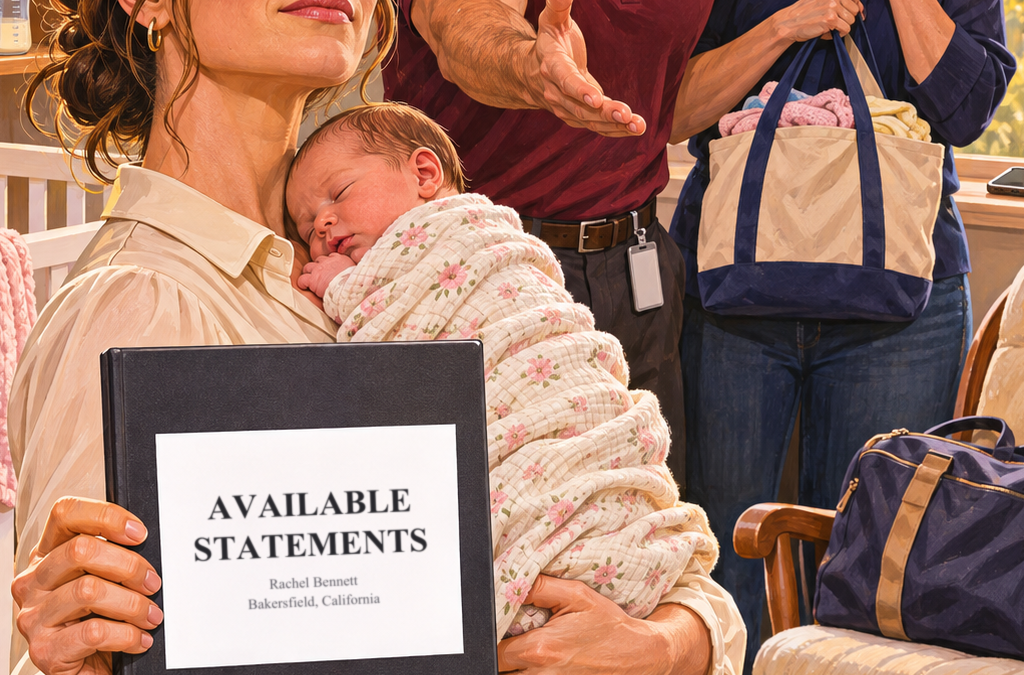
Mark said it beside Lily’s crib, with his lawyer on speakerphone. Susan stood behind him carrying a clothing tote.
It was 5:40 p.m., Friday, July 10. Outside our Bakersfield window, the air conditioner rattled against the California heat. Lily was exactly three weeks old.
“Start with her clothes,” Mark told me. “Susan can work around the furniture.”
I had Lily against my shoulder. Her mouth kept searching the damp collar of my shirt.
“Work around it for what?”
“Until we move the crib.”
His lawyer spoke from the phone on the windowsill.
“Mark. Who’s there?”
“Rachel and my sister. We’re sorting out the space.”
“You said you were calling from somewhere private.”
“It’s fine, Daniel.”
Susan’s overnight bag rested against the rocking chair. She carried her tote past me and set it where I kept the clean bottles and pump parts.
“Those need to stay clean,” I said.
“Oh. Sorry, honey.”
She left the tote there.
Mark leaned against the doorway. He still had his work badge clipped to his belt.
“Susan will pay nine hundred a month. That keeps the household practical.”
“And Lily sleeps where?”
“With you.”
“Where am I sleeping?”
“We can discuss that downstairs.”
“No. You brought her things upstairs. Discuss it here.”
Lily made a small, angry sound against my neck. Susan looked toward the crib, then back at Mark.
“She’s hungry,” Susan said.
“I know.”
“You could feed her while we do this.”
“There isn’t a ‘we.’”
Mark glanced at the phone.
“This is what I was explaining. Every practical conversation turns into this.”
Daniel didn’t answer.
I reached toward the bottles, meaning to clear Susan a place. The movement came before a thought did. Someone needed space, and I was already making myself smaller.
I stopped before touching them.
I had paid problems away until he stopped calling them problems.
“Move your bag, please,” I told Susan.
“Rachel, she just got here,” Mark said.
“She didn’t ask.”
“She’s family.”
“Being family didn’t make me disposable.”
Susan’s face colored. She looked at the little cloth draped over my shoulder instead of my face. It had dancing carrots on it; Mark had bought it because he thought they were tiny orange ghosts.
“Daniel,” Mark said, “she’s contributed nothing toward a workable arrangement. She has a computer. She can work anywhere.”
“You asked me to pack our daughter.”
“I asked you to be flexible.”
“You didn’t ask.”
Susan stepped back toward the rocking chair, but her bag stayed against it. There was nowhere to sit without asking her to move.
I remained standing.
“I’m not packing Lily’s things.”
“We can keep this civil,” Mark said. “Susan will help the transition.”
Susan said nothing.
“Tell me what he asked you to do,” I said to her.
“Can we lower our voices?”
“Mine is low.”
“Rachel,” Mark interrupted, “don’t put her in the middle.”
“Her clothes are in the middle of the nursery.”
I had asked for one thing before he brought his sister upstairs.
The folder containing my available statements lay beneath my phone on the dresser. I could see its bent corner behind the diaper cream.
Mark followed my glance.
“If you need your work stuff, take it. Nobody’s stopping you from working.”
“I’m not leaving.”
“Then we’ll have to let the lawyers handle what you won’t discuss.”
“They’re already handling it.”
He straightened away from the doorway.
“What does that mean?”
On the windowsill, Daniel’s voice cut through.
“Hold on. I’ve just received something from her attorney.”
Mark looked at me.
“What did you send?”
“I didn’t send him anything.”
“Rachel.”
“Let him read.”
Mark stepped close enough that I could smell the laundry detergent on his shirt. Lily’s cheek was between us, warm against my neck.
“Don’t make this harder than it needs to be.”
Daniel interrupted him.
“Mark, I need to speak with you privately. It’s Elaine Foster’s filing.”
Mark took the phone off speaker.
“Why didn’t you tell me she’d already filed that?”
He spoke into the phone, but watched me.
Elaine had asked the court yesterday to let me stay in the house while the divorce went forward. I hadn’t asked Mark’s permission.
He listened, then said, “No, I haven’t agreed to anything.”
“Neither have I,” I said.
Susan looked at the folder.
“Is this about money?”
“It’s about where we’re going to live.”
Mark put Daniel back on speaker when I asked to hear what concerned me. Daniel said only that the court would decide if we couldn’t agree.
My folder held our household payment history.
Money from Bennett Ledger LLC went into my personal checking account. From there, I had paid household bills for years. Those payments had continued through maternity leave.
Mark called the work a hobby. My clients still expected their books done.
My phone displayed Elaine’s earlier message: “The older copies are still pending.”
She had requested the bank’s archive on June 29. I remembered her asking for both sides while I juggled my phone and feeding supplies.
“I’m asking to keep the house too,” Mark said. “Daniel’s preparing my request.”
“So this was supposed to happen before anybody heard mine?”
“I need stability. My job is here. Moving into Susan’s spare room for eight hundred seventy-five a month makes no sense.”
“For you,” I said.
Daniel asked whether Mark’s proposed arrangement left Lily’s crib here.
“She stays with Rachel,” Mark answered. “We’ve been over that.”
Daniel went quiet.
Then he said, “Mark, your request puts the baby out too.”
Susan stopped with a drawer halfway open.
Lily began crying. I couldn’t keep holding her upright to make this conversation easier for everyone else.
“Move the bag,” I told Susan.
This time she did. I sat and settled Lily beneath my shirt. Her crying broke into impatient little breaths before she latched.
Mark stayed by the doorway.
“I’m not asking for an answer about everything tonight. Just acknowledge that you’ll leave voluntarily while we sort out the house.”
“No.”
“It doesn’t give up ownership.”
“Then you can leave voluntarily.”
“My work isn’t portable.”
“Neither is her bed.”
Daniel spoke briefly. “Don’t sign anything without Elaine reviewing it.”
Mark’s jaw shifted.
“I wasn’t asking her to sign away the house.”
“I heard you,” Daniel said.
Susan’s voice came from beside the dresser.
“You told me she had somewhere.”
Mark turned toward her.
“We discussed options.”
“You said it was arranged.”
“Can we talk about that later?”
Susan looked at me. “I wouldn’t have brought all this if—”
“But you did,” I said.
Her fingers closed around a brass nursery key. The room had been my bookkeeping office before it became Lily’s nursery. The keyed knob had protected client files; I had never locked a baby inside.
“Why do you have that?”
“Mark gave it to me.”
“Leave the door open.”
“It is open, Rachel.”
“I want it to stay open.”
She backed away from the drawer. Her tote remained on the feeding shelf, one sleeve hanging down beside a clean bottle.
Mark ended the call without another explanation to me. He stayed in the doorway while Lily fed, typing on his phone.
By 6:35, my back hurt from the angle of the chair. Susan hadn’t unpacked anything else. Mark hadn’t said he would take her belongings out.
My phone chimed on the dresser.
Mark’s forwarded reservation named Rachel Bennett and Lily Collins: six motel nights beginning July 11.
Chapter 2 of 7
At 8:10 Saturday morning, I read the reservation again. Check-in July 11. Checkout July 17. Six nights.
“Where do you expect a nursing newborn to live on the seventh night?”
Mark stood beside the kitchen counter, still in his sleep shirt.
“Your mother can handle the next part.”
“Handle what?”
“You staying there. Until things settle.”
“Did she tell you that?”
“She’s your mother, Rachel.”
Lily slept against me in her carrier. One sock had worked loose overnight. I had found it inside my bra while getting dressed.
Mark glanced toward the hallway.
“This house isn’t a good place to recover right now. You’ve got family who know you. Who can help.”
“You booked a motel.”
“Because I thought you’d want a few days to yourself first.”
“With a newborn.”
“You know what I mean.”
I didn’t answer. He had made a reservation without asking me. Now he was describing it as something I wanted.
“Did you talk to my mother?” I asked.
“We don’t need to make every detail into a dispute.”
I went upstairs and closed our bedroom door. Lily stirred when I sat on the bed.
My mother answered on the fourth ring.
“Everything okay?”
“Did Mark ask if Lily and I could stay with you?”
“What? No.”
“Did he mention us coming?”
“He sent a message asking how you were doing. I told him tired, probably.”
I watched Lily’s sockless foot move against my shirt.
“He says you can take us after Friday.”
“Rachel, where would I put you? You’ve seen that spare room.”
I had. It held her sewing table and boxes she couldn’t lift alone. There wasn’t a bed.
“I know.”
“I could clear some things. But you’d be on the couch, and the baby—give me some time to think.”
“Mom. I’m asking whether anything was arranged.”
“No, honey. Nothing was arranged.”
She started apologizing. I stopped her twice before she let me say goodbye.
Downstairs, Susan was eating toast over the sink. Mark had gone into the backyard, his phone against his ear.
“Your mother all set?” she asked.
“She didn’t know anything about it.”
Susan looked through the window.
“He said you’d talked.”
“I just did.”
“Well, maybe he thought—”
“He didn’t ask her.”
A piece of toast broke off against the sink. Susan left it there.
“I can help get your things together,” she said. “You shouldn’t be hauling boxes yet.”
“I’m not packing.”
“I’m trying to help.”
“Then please stop planning my move.”
She looked away. Outside, Mark paced along the fence, talking.
My phone buzzed with a scheduled client payment. The work covered the previous month’s bookkeeping, finished between feedings after Lily came home.
For a few seconds, I watched the notification without opening it. Then I checked the business books, recorded the receipt, and transferred money for household expenses.
The electricity bill was next.
The kitchen had a strip of faded labels beside the switches. Years ago, we’d named the disposal “the monster” after it swallowed a measuring spoon. Mark still said “feed the monster” when he scraped a plate.
I paid the bill that kept every switch working.
Then I opened an existing bank download and the previous electric bill. The payment amount agreed with the bill’s receipt. I checked it once, the way I checked a client’s work, and saved both.
Susan watched from the doorway.
“Is that work?”
“House bills.”
“Oh.”
She walked away before I could say anything else.
I used to pay them before breakfast so nobody had to think about them. That morning, my toast stayed cold beside the laptop while I wondered why I had helped make it so easy not to notice.
I emailed Elaine about the motel and my mother. She called later, while Lily was feeding and Mark was out.
“He says I can’t just refuse forever,” I told her.
“You’re joint owners; neither of you gets to decide alone who leaves. Under California Family Code section 2045, the court can decide who uses the house temporarily.”
“So staying today doesn’t settle it.”
“Correct.”
I looked at the bedroom doorway. My slippers were still on either side of Mark’s shoes.
“I’ve been checking the bills against what I downloaded.”
“Keep what you have. Your LLC registration and your account being in your name don’t automatically make marital earnings separate property.”
“I’m not asking for extra because I paid things.”
“I know.”
“I need somewhere I can feed her without wondering when somebody wants the room.”
“That’s what we’re asking for.”
After the call, I stayed on the bed until Lily finished. Downstairs, a cupboard closed. Water ran through the pipes.
Nobody packed that weekend. Nobody promised to stop asking.
On Monday, July 13, Elaine sent me Mark’s served request.
I read it at my laptop while Lily slept nearby. His proposed arrangement described my work as portable. It described Susan’s promised household payment as reliable income.
Mark’s commute stayed in place. My desk, feeding supplies, and daughter’s bed could apparently be gathered up and carried somewhere else.
When he came into the kitchen, I asked, “Have you read this?”
“Yes.”
“You’re still asking us to leave.”
“We need a decision, Rachel. We can’t keep doing this.”
“Your sister doesn’t live here.”
“She’s offering a workable arrangement.”
“For whom?”
He looked toward the laptop.
“Daniel has it now. Let the attorneys deal with it.”
He went upstairs. I went back to the last page and read the request again.
It asked that Lily and I leave, and Susan occupy the former nursery.
Chapter 3 of 7
“He’s asking us to move the crib, the feeding chair, everything.”
It was 7:30 a.m. on Friday, July 17. Elaine was on the phone while Lily slept beside my bed.
“Tell me what a day actually looks like,” she said.
“She feeds when she wakes. Sometimes she’s hungry again before I’ve eaten. I keep her diapers here, clean clothes downstairs. Her pediatric appointments are already arranged from here.”
“And your work?”
“Around her sleep. Mine, too, when I can get it.”
“Write that down. Where you’d sleep elsewhere, how you’d work, how you’d get to appointments.”
“There isn’t a place to write down.”
“Then say that. Keep it specific.”
Lily shifted in her bassinet. I waited through two small grunts before answering.
“I don’t want to sound like having a baby means I get everything.”
“You’re asking to stay in her established home. We still need a payment plan.”
“I’ll send one.”
After we hung up, I checked my account. Mark’s agreed household transfer wasn’t there.
His message arrived before I could ask.
“I’m suspending the $900 for now. I can’t fund two households while we’re waiting for a decision.”
I found him downstairs, drinking coffee beside the refrigerator.
“What second household?”
“I have to plan for somewhere to live.”
“You’re still living here.”
“For now. Same as you.”
“The bills haven’t gone on hold.”
“Rachel, you have income. We both need to keep money available.”
“You agreed to that transfer.”
“Before we had attorneys deciding everything.”
I stood in the doorway. The refrigerator clicked off, leaving the kitchen oddly loud with his chewing.
“So the money stops because I asked to stay?”
“That’s not what I said.”
“It’s what happened.”
“I’m trying to avoid spending money twice. You can discuss it with Elaine.”
He left for work with his coffee unfinished.
I covered the missing amount from current earnings. Afterward, I revised the payment plan I had promised Elaine. The new version had less room for groceries and none for catching up on sleep by turning down work.
Then a client emailed about a rush cleanup. Could I finish it over the weekend?
I started typing yes.
Lily had been awake through much of the night. The previous afternoon, I had read the same invoice four times and still entered it incorrectly. My back ached whenever I sat without support.
I deleted the yes.
“I can do the regular work next week,” I wrote. “I can’t take the rush assignment.”
The client found someone else. That fee disappeared from my forecast, and I left it out.
At lunch, I ate from the chipped bowl we called the fancy china. Mark had once insisted we save it for guests because the chip made a perfect thumb rest.
I ate standing up anyway.
The family messages began while I was rinsing it.
Mark had written that he’d paid for a transition plan, offered help, and tried to avoid unnecessary legal expenses. Rachel had chosen to stay and contest the arrangement.
There was no mention of the checkout date.
A relative replied that everyone should think about the baby. Another said we needed to stop making things harder.
Then Susan wrote, “He did arrange a place and offer to help. It wasn’t supposed to become all this.”
I read that twice.
I could have described the feeding shelf under her clothes. I could have told them my mother hadn’t even known she was supposedly expecting us.
Instead, I posted the reservation confirmation.
“Six nights. Checkout today. No housing was arranged after that.”
Nobody answered the date.
Susan sent me a separate message.
“I wasn’t trying to embarrass you.”
I didn’t answer it.
For years, I had let Mark describe “his” household budget at family dinners. I paid the invoices and kept eating while he explained what we could afford.
Correcting him had seemed petty when the lights stayed on.
Now people who had never seen a bill were discussing whether I deserved help paying one.
I sent Elaine the transfer message and the family exchange. Then I finished the regular client work I had already promised. Lily slept through most of it, waking just as I reached the final reconciliation.
I saved the file unfinished.
On Monday, July 20, Elaine called while I was sorting clean baby clothes.
“His sworn financial declaration came in,” she said. “I’m sending it now.”
“Does it include stopping the transfer?”
“We’ll go through the expenses. His deposition is noticed for July 24, at ten in the morning. Daniel’s office here in Bakersfield.”
“Will I be there?”
“Yes. You won’t need to argue with him.”
“I wasn’t planning to.”
“Good. Read what I send. Flag anything that doesn’t fit your records.”
Before I opened the attachment, Mark appeared at the bedroom door.
“I’ve been thinking about the contribution.”
I waited.
“If you’ll agree to the motel departure, I can start sending it again.”
“The reservation ended Friday.”
“I can arrange another one. But I need an answer before I commit more money.”
“For how long?”
“We’ll work that out.”
“And after?”
“Can we agree on the first part?”
“No.”
He glanced at the clothes spread across the bed.
“You keep saying you need help with expenses.”
“I need you to pay what you agreed to pay.”
“I’m offering a way forward.”
He went downstairs before I answered.
The smallest pajamas still had both feet tucked inside themselves from the dryer. I left them that way and opened Elaine’s email.
Mark had signed the declaration. Under monthly housing expenses, it identified him as the person making the $1,462 mortgage payment.
Chapter 4 of 7
The court reporter swore Mark in at ten on Friday, July 24. We were in Daniel’s Bakersfield office, around a conference table with one uneven leg.
Elaine began with the mortgage.
“What account were you referring to when you listed yourself as paying it?”
“I considered that part of the household provision I managed.”
“That wasn’t my question.”
“I paid into the household. Rachel handled transactions.”
“From what account did the mortgage payment leave?”
“I’d have to see the records.”
There was no judge to look toward. Daniel sat beside him. I sat across from them, with the raw edge of my thumbnail catching against my finger.
Elaine presented the historical statements we had disclosed.
“These are from Rachel’s checking account. Have you reviewed them?”
“Not all of them.”
“Take the time you need.”
The air conditioner made a ticking noise above us. Mark read longer than I expected.
Elaine’s summary listed $94,780 in recorded household outlays. He stayed on that page.
“I’m not disputing that she moved money,” he said finally.
“Your declaration identifies you as making the monthly mortgage payment.”
“That needs context.”
“Then give me the context.”
“The business operated out of our house. I advanced office costs. Operating costs, too. Some of what you’re calling household contributions were reimbursements.”
Daniel leaned forward slightly.
“Let him finish the answer.”
Elaine waited.
“Rachel handled the accounts,” Mark continued. “That doesn’t tell you who ultimately carried the expense.”
I had heard him explain broken fleet schedules over dinner. Calm voice, sensible sequence. A delay became something another person should have anticipated.
“Which expenses did you advance?” Elaine asked.
“Equipment. Space. Things we needed to keep her working.”
“Equipment you purchased?”
“Some purchases were mine. Some costs were absorbed through the household.”
“Those are different things.”
“They were mixed together. That’s what I’m trying to explain.”
“Do you have a reimbursement schedule?”
“Not with me.”
“Receipts identifying what Rachel owed you?”
“I’ll need to go through what we have.”
Daniel spoke before Elaine’s next question.
“We can address the supporting records. The source and purpose of these payments need to be traced.”
“We’ve requested those records,” Elaine said. “I’m asking for his explanation under oath today.”
“And he’s giving it.”
Nobody laughed at my business. Somehow that made it harder to sit there. Mark had found a way to discuss it seriously without giving me credit for doing it.
Elaine continued through the expenses. She asked whether his declaration distinguished direct payments from money transferred to me. It didn’t.
“I used the category as I understood it,” he said.
“Will you review it for accuracy?”
“With Daniel.”
During a short break, Daniel asked whether I would answer some questions that morning. Elaine spoke with me privately first. Then the reporter swore me in.
“What did your business actually use in the house?” Daniel asked.
“A laptop. A printer. Internet. Before Lily, I worked in the room that’s her nursery now.”
“Exclusively?”
“The room? No. There were household things in there.”
“Did Mark contribute to those costs?”
“He bought things for the house. So did I.”
“Office equipment?”
“Sometimes. I’m not saying he never bought anything.”
“Did you repay him?”
“If I owed him for something, yes. I didn’t have an agreement that every household bill I paid was money I owed him.”
Mark watched me from across the table.
“Did clients come to the house?” Daniel asked.
“No.”
“Did you store inventory there?”
“I keep books. There wasn’t inventory.”
“Your work required dedicated space.”
“A desk, mostly. Now I work wherever I can hear Lily.”
At home, I used a rolled receiving blanket behind my back. It was printed with tiny lemons, and one corner always stuck out of my chair. I missed that ridiculous corner more than I wanted to admit.
Elaine asked one question before we finished.
“Did you agree to rent that room from Mark?”
“No.”
She identified the bank archive request still outstanding.
“We’ll provide the remaining records when the bank completes it,” she told Daniel.
“We’ll review them.”
Nothing had been decided. Mark still lived in the house. The bills were still coming.
Outside the office, the heat rose from the parking lot. Elaine stood with me in the narrow shade beside the building.
“He makes it sound like I had a company taking over the house,” I said.
“His records will have to support his explanation.”
“And if mine show I paid?”
“We need accurate expenses and an accurate declaration. Paying bills doesn’t automatically decide who stays.”
“I know. I’m not asking you to make it do that.”
“Then tell me what you’re asking for.”
I looked past her toward my car.
“Lily already lives there. I can cover the running costs. I sent you the revised budget.”
“Yes.”
“He has a room at Susan’s apartment. He told me what it costs.”
“We’ll address that.”
“And they brought clothes into the nursery. That wasn’t a suggestion about someday.”
“We have the messages.”
“I need the court to hear that part.”
“It will.”
The noticed hearing was Friday, August 14, at nine, in Kern County Superior Court. Elaine said we would both attend with our lawyers. Susan was coming as Mark’s supporting witness.
I asked whether Susan would have to answer questions, too.
“If she testifies, yes.”
At 11:46 a.m., before I left the parking lot, Mark’s message arrived. An undertaking was attached.
“I’ll resume the household contribution if you sign the undertaking to leave by July 31. Otherwise, I won’t continue voluntary payments.”
Chapter 5 of 7
“I won’t sign an agreement to leave by July 31.”
That was my whole reply. I forwarded the undertaking and my answer to Elaine, then drove home to feed Lily.
The contribution didn’t resume.
On Friday, August 7, Elaine sent Daniel our available hearing exhibits and witness information. His office sent theirs. The statements, messages, reservation, and household budget were included.
Elaine also identified the bank archive we were still waiting for.
I read the exchange email with Lily asleep across my lap. One attachment took three tries to open. Her heel covered the corner of the screen.
By Thursday, August 13, I knew my payment plan without looking.
That afternoon, Elaine and I went to Daniel’s Bakersfield office for a scheduled document handoff. We brought originals his office had asked to inspect. His assistant had copies ready for Elaine.
Susan came out of the conference room first.
“Oh. Rachel.”
Mark followed her. Daniel remained beside the open door.
“We’ve just finished going over tomorrow,” Susan said. “The questions and everything.”
“I figured.”
She still wore her medical-office badge. Once, she had told me the clip ruined every decent blouse she owned, but she kept buying blouses.
Now she stood beside Mark, waiting to help him keep our house.
Daniel addressed Elaine.
“The lease and landlord’s permission are included. Same documents we exchanged.”
“I have them,” Elaine said.
Susan looked at me.
“That’s my apartment paperwork.”
“For Mark’s room?”
“Yes. The landlord approved adding him.”
Mark spoke before she continued.
“It’s available. That doesn’t make it the most practical arrangement.”
“We’re not holding the hearing in the hallway,” Daniel said.
“I know. I’m explaining why we haven’t resolved this.”
Elaine stayed beside me.
“Briefly, then.”
Mark looked tired. There was a missed patch beneath his jaw where he had shaved too quickly.
“My job has a fixed location,” he said. “Same wages, same schedule. Keeping me in the house preserves that continuity. Rachel can serve her clients from anywhere.”
“Anywhere with somewhere to sleep,” I said.
“Of course. Nobody’s suggesting otherwise.”
“And space to work. And Lily’s things.”
“Your clients don’t come to the house.”
“No. Their deadlines do.”
He glanced toward Daniel.
“I’m not questioning her work. I’m saying we shouldn’t disrupt the income that requires somebody to be physically here.”
“I can cover the mortgage and running costs,” I said. “My budget is based on regular clients. It doesn’t depend on extra work.”
“There are expenses on my side, too.”
“I know.”
“That seems to get left out.”
“I’m not asking anyone to rank our jobs.”
Daniel interrupted.
“Both budgets are in the papers.”
Mark continued, more quietly.
“The account activity also needs context. Rachel handled business reimbursements. Those transactions don’t describe the whole arrangement.”
Elaine said, “We have your testimony.”
“And the move was discussed as a supported family arrangement,” Mark said. “It wasn’t just a motel reservation and nothing afterward.”
Susan watched the carpet between us.
“Who agreed to provide the afterward?” I asked.
“We discussed family help.”
“My mother didn’t.”
“I’m not going to argue about individual conversations here.”
“Good,” Daniel said. “We’re finished with that.”
A copier ran beyond the reception desk. Someone laughed behind a closed office door.
I had a bottle cooling in an insulated bag in my car. At home, Lily would need feeding again before I could finish the client report waiting on my laptop.
Mark was still describing work that could happen anywhere.
Susan spoke before we left.
“My rent is thirteen fifty. Paying nine hundred at the house would have helped. That was why I considered it.”
“And Mark can still take the room at your apartment?” Elaine asked.
“Yes. Eight seventy-five.”
Susan looked at him when she answered. He didn’t dispute it.
“I haven’t given notice,” she added. “I couldn’t do that before we knew.”
“So the room is available.”
“Yes.”
Daniel called Mark back into the conference room. Elaine went to reception to check the copies.
Susan and I remained beside the hallway.
“Did you hear me agree to move?” I asked.
“No.”
The answer came quickly.
“Will you tell them that tomorrow?”
“I’ll answer what they ask.”
“Susan.”
“I wasn’t there for every conversation you had.”
“I’m asking about the ones you heard.”
“I know.”
She looked toward the conference room door.
“He thought it would work.”
“That wasn’t my question.”
“I already answered.”
Elaine returned before I could speak again. Susan stepped aside, her badge catching against the doorframe.
On the drive back to Elaine’s office, I watched the traffic lights change.
“She knows I didn’t agree.”
“Then I’ll ask her.”
“What if she gives you all the other conversations she wasn’t there for?”
“I’ll ask again.”
At her office, we reviewed only what she planned to use. There were fewer pages than I expected.
“Can you identify this account?” she asked.
“Yes. It’s mine.”
“These statements?”
“The copies I downloaded.”
“And this budget is current?”
“Yes.”
She asked how I scheduled work around Lily. I explained the regular deadlines and the assignments I had stopped accepting.
Halfway through the expenses, I lost my place.
“Start with the mortgage,” Elaine said.
I did. This time I got through the list.
At 4:48 p.m., an email arrived from the bank. Both attorneys were listed as recipients of the completed archive.
Elaine read the message on her screen.
“The 42 pages of payee details missing from the download are now included in the archive.”
Chapter 6 of 7
At nine on Friday, August 14, our temporary possession hearing began in Kern County Superior Court, Bakersfield.
Judge Patricia Morgan asked about the bank’s newly delivered attachments.
“Historical payment-detail pages,” Elaine said. “Both counsel received the complete archive yesterday.”
“I’ll allow fifteen minutes before we use them.”
Daniel accepted. After the recess, he confirmed that he wasn’t challenging the packet’s authenticity.
“We dispute what it establishes. Payment traffic shouldn’t determine final ownership.”
“Agreed,” Judge Morgan said. “That isn’t today’s question.”
After we were sworn, Mark explained his position. Susan sat behind him.
“I managed provision for the household. Rachel handled transactions, including reimbursements for business costs I carried. Her work used the house.”
He spoke directly to the judge.
“I’m asking to preserve a stable arrangement. My job requires me here. Hers can move. Who routed a payment shouldn’t decide who keeps the property.”
The judge looked toward me.
“Ms. Bennett?”
I placed my marked payee-detail page beside the mortgage statement we had already exchanged.
“The January 6, 2025 debit. Fourteen hundred sixty-two dollars. This attachment was missing from my download.”
“What does it identify?”
“Our mortgage servicer. Our loan number. The payment reference matches this mortgage statement.”
The reverse-side attachment Elaine had requested while I juggled feeding supplies was there in front of us.
“That payment went directly from my checking account to our home loan,” I said. “Not to Mark. Not to an office supplier.”
Mark answered evenly.
“I advanced underlying costs. Rachel paying something onward doesn’t account for what I supplied beforehand.”
“May I show the incoming entries?” I asked.
Judge Morgan nodded.
“The complete credits are here. These deposits came from Bennett Ledger LLC. There isn’t a corresponding advance from Mark. The monthly sequence continues through the archive.”
Elaine identified the thirty-six payments from January 2023 through December 2025. The attachments showed the same destination: our mortgage.
Daniel said, “Marital business earnings don’t become separate property because they passed through her account.”
“I’m not finding otherwise,” the judge said. “These records establish source and use for the payments identified.”
She turned to Mark.
“Which advance corresponds to this January payment?”
“The office occupied space we both owned. Internet, equipment, household overhead. It wasn’t always a separate transfer.”
“That explains a business arrangement, not the mortgage debit from her account.”
Mark looked toward Daniel. The judge continued with Susan’s testimony.
“Did you hear Ms. Bennett agree to leave?”
“No,” Susan said.
Mark remained facing forward.
“I was told there was a family arrangement,” she added. “Rachel never agreed in front of me. And Mark can use my spare room. The landlord approved it.”
“For eight hundred seventy-five a month?”
“Yes.”
When Susan was excused, she passed Mark’s row and took the empty seat behind me.
Judge Morgan returned to our requests.
“The baby’s established home is here. Ms. Bennett has presented a feasible payment plan. Mr. Collins has available housing. The proposed replacement of the nursery weighs against his request.”
My knees pressed together beneath the table.
“Ms. Bennett is granted temporary exclusive occupancy. Mr. Collins must vacate by five p.m. August 21. Seven days. Neither party may install a new occupant.”
Mark’s lips parted, but she continued.
“Corrected sworn financial information is due August 28. This order does not change title or equity, decide custody, or determine final division.”
He had lost possession of our home. The $310,000 house he had planned to keep with Susan now had a departure deadline, spoken by the judge before both attorneys and his sister.
Daniel asked about arrangements for collecting belongings.
“Counsel can coordinate access in writing,” Judge Morgan said. “The deadline remains.”
Mark stood when we were excused.
“So she gets my equity too?”
“No,” Daniel said. “Your ownership claim remains. This is occupancy.”
“The whole house.”
“Yes.”
He stared at the table where my copies still lay.
Susan came toward me.
“Susan, wait,” he said. “We need to discuss what happens now.”
“I heard.”
“Then give us a minute.”
She came anyway.
“Here, Rachel.”
She handed me the brass nursery key. Its teeth pressed into my palm.
“I should’ve given it back before.”
I couldn’t manage an answer yet. Elaine stayed beside me while Daniel asked Mark to step away from the table.
At the courtroom door, Mark turned back.
“We could still avoid another move. Temporarily. Until the settlement.”
“Lily and I won’t move to make this easier for you.”
He looked toward Susan, but she was watching me.
In the hallway, my phone showed a message from my mother. Lily had finished her bottle. Then: “Your child burped like a retired trucker.”
I read it twice before putting the screen away.
Mark approached with Daniel beside him.
“Until I organize the move, can you keep paying things as before?”
“The mortgage and household bills are in my budget.”
“I mean the accounts you’ve always handled. It’s easier than changing everything this week.”
“Which accounts?”
He glanced at Daniel.
“The usual ones.”
“I’ll pay obligations we specify in writing. I’m not routing your personal expenses through my account.”
“I’m not asking you to buy me anything.”
“Then list what you’re asking.”
Daniel said he would send Elaine a proposed list. Elaine said she would review it with me.
Susan waited near the elevators. She didn’t ask where she could put her things.
Mark checked his phone, then looked back at us.
“I’ll need access for the moving truck on August 21. Three to five p.m.”
Chapter 7 of 7
At 3:00 p.m. on Friday, August 21, the moving truck arrived.
I had confirmed the three-to-five window in writing through Elaine. The pickup list went through both attorneys; Mark would collect his belongings while my mother stayed upstairs with Lily.
Susan came with him.
“Everything on the list?” Mark asked from the doorway.
“Yes. Tell Elaine if anything’s missing.”
“I can ask you.”
“You can. I’m still keeping a record.”
He looked past me toward the stairs, then went to get his boxes.
Susan carried bedding. Mark took his clothes, tools, and the things we had agreed he could remove. Nobody discussed where the crib belonged.
Near the end, Susan asked whether the small fan in the hall was his.
“That stays,” he said. “It’s hers.”
I hadn’t expected him to remember.
At 4:52, the truck pulled away. Mark was going to Susan’s spare room, at $875 a month.
Upstairs, my mother was explaining the washing machine to Lily.
“Your grandmother thinks appliances need introductions,” I told her.
“She’s been listening very politely.”
I stayed with them until the rinse cycle ended.
On August 28, Elaine forwarded Mark’s corrected sworn declaration. It identified the mortgage payments made directly from my account and corrected the household expenses.
“Does Daniel have the same copy?” I asked.
“Yes. It’s been served.”
I read the changed entries. Then I returned to the client reconciliation waiting on my screen.
The following month, Mark called while I was working at the kitchen table. Lily was asleep nearby, and my lunch had gone cold.
“Could you keep handling a few payments until I get everything switched?”
“Which payments?”
“My phone. The truck insurance. Just send me the total.”
“You need to set those up from your account.”
“I’ll transfer the money first.”
“I’m still not doing it.”
He paused.
“You already have the logins.”
“I’ll send you what you need to change them.”
“It would take you five minutes.”
Behind his voice, I heard Susan’s television. I could picture him standing in her kitchen, waiting for me to finish an errand he had assigned.
“I’m eating lunch, Mark.”
“It’s barely noon.”
“Yes.”
He ended the call. I sent the account information that afternoon, without paying anything.
Later that fall, he arrived for a scheduled visit with Lily. We had agreed on the time beforehand. He brought diapers in the next size up and asked if they were right.
“They’ll fit soon.”
“She’s getting big.”
“She is.”
He spent most of the visit on the living room rug. Lily watched him make the same ridiculous face until she laughed.
When she fussed, he looked toward me.
“Bottle?”
“On the counter. She might just need a different position.”
He tried that first. She settled.
Before leaving, he glanced toward the thermostat.
“You’re still keeping it this cool?”
“It’s fine for us.”
“I could adjust the schedule.”
“Please don’t.”
He stayed where he was.
“Same time next visit?”
“That works.”
His visits stayed on the calendar. Decisions about the house stayed with me.
On Friday, December 18, we signed the settlement.
Elaine went through the numbers beside me. The house’s agreed value remained $310,000, with $100,000 in equity. Mark’s half was $50,000.
Bennett Ledger LLC had an agreed net community value of $16,000. He would receive $8,000 for his share, and I would keep operating it.
“So fifty-eight thousand altogether,” I said.
“Yes.”
Mark studied his copy.
“And the business is hers after this?”
“Under this agreement,” Daniel said.
The other community assets and debts had been balanced separately. There were no more disputed columns waiting for somebody to remember them.
I signed knowing what keeping the house would cost. Mark signed knowing what he would receive.
On Tuesday, December 29, after the six-month minimum had passed, the court entered our stipulated dissolution judgment. My lender-approved refinance and the settlement disbursement closed that day.
The closing statement showed the new $248,000 loan replacing the $210,000 mortgage. That left $38,000 toward Mark’s $58,000 payment.
“My twenty thousand makes up the rest,” I said to Elaine.
“From the documented earnings after separation.”
“And the closing expenses are separate.”
“Yes. Forty-two hundred, paid from your later earnings.”
I checked the final total once more. The money was accounted for, including the months of regular work that had built my contribution.
When the disbursement was confirmed, I had a mortgage in my name alone. Mark had received his agreed share.
That evening, Susan called.
“I owe you an apology,” she said.
I waited.
“I believed him when he said you had somewhere to go. But I didn’t ask you. I brought my things into her room.”
“Yes.”
“I wanted the cheaper rent. That was part of it.”
Her voice was quieter than I remembered.
“I’m sorry, Rachel.”
“Thank you for saying that.”
“Could I see Lily sometime?”
“We can arrange an occasional visit. Call first, and we’ll choose a time.”
“Okay.”
“No overnight stays. And no coming in when I’m not here.”
“I can do that.”
She didn’t ask whether I forgave her. We chose an afternoon, and she said she would call before leaving her apartment.
By Thursday, December 31, Lily was six months old. Her pajamas had little purple moons, and she objected whenever a sleeve took too long.
Bedtime ran late because she kept pulling away from her bottle to inspect the lamp.
“It’s the same lamp,” I told her.
She checked again.
After she settled in her crib, I stood beside the nursery door. The old keyed knob had been replaced with a nonlocking interior one. Before long, she would be reaching for everything.
My laptop was closed on the desk. There was work waiting, but none of it needed finishing that night.
I would start in the morning, after breakfast.
The brass nursery key no longer opened anything in the house.
I laid the nursery key inside my desk drawer.







