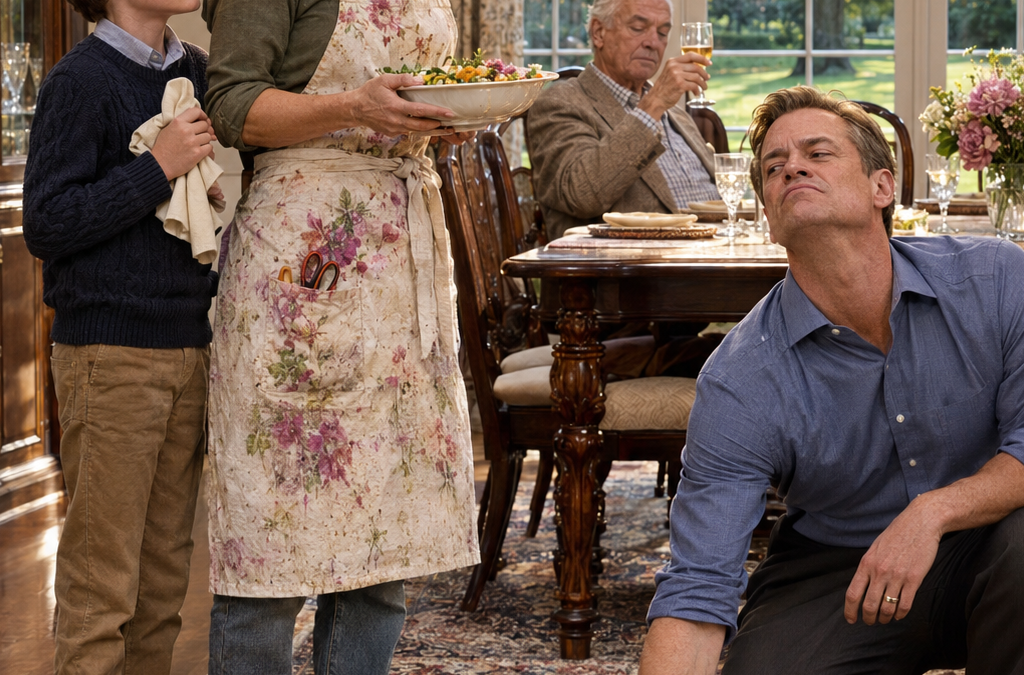
My husband put my supper beside the dog’s bowl during my flower shop’s celebration, saying, “Eat after you’ve served everybody.”
Chapter 1 of 7
The plate touched the floor beneath the banner celebrating Brookside Flowers’ new hotel contract.
“Are you really making me eat there, Brian?”
My husband, Brian Mercer, pointed toward the serving dish still balanced against my apron. Our fourteen-year-old daughter, Mia, froze with her fork above her plate, while our ten-year-old son, Noah, stood beside me holding the napkin he had folded.
Brian told me to finish passing the food before I sat down.
My phone rested in my other hand, its screen showing the edge of a boat photograph.
“Frank, are you going to let him do this?”
My father-in-law, Frank Mercer, looked toward his raised glass instead of answering me. Both Brian’s parents were seated for supper, waiting for his toast.
That hurt more than Brian’s order.
My name is Hannah Brooks. I’m forty-three, and I live in Centerville, Ohio. I own the flower shop.
I had founded Brookside Flowers twenty years earlier, before Brian and I married. My family knew I had opened it, but they had come to believe Brian owned it with me. At home, I usually said our shop. I hadn’t corrected them.
The baked macaroni had the crunchy corners Mia liked, and Noah’s chicken had no pepper because he inspected every dark speck before deciding whether supper was safe.
Brian wore the pressed blue shirt I had brought downstairs. My own flower-stained apron still covered my clothes.
And the phone case had little daisies Mia had painted. Brian had sent the photograph earlier, and I had mistaken it for another afternoon of wishful shopping.
A fishing boat glowed on my phone beneath our celebration banner.
Brian pulled out my chair and draped his jacket across it.
“Keep serving while Dad gives the toast.”
There was another chair available, but taking mine made his meaning clear. He wanted me standing while everyone thanked him.
On the table in front of him sat a celebration card reading Brian — Founder. I had been finishing supper when that appeared.
Frank cleared his throat.
“He’s kept your suppliers reasonable for six years.”
That was true. Brian negotiated purchases, caught price increases, and knew which deliveries needed chasing. He was paid for useful work, and I had never pretended otherwise.
Frank added that those margins didn’t look after themselves.
He spoke as though I had refused to thank Brian, while the food I had cooked cooled beside a bowl on the floor and our children watched me.
I stayed where I was.
Brian’s face reddened when the serving dish didn’t move.
“Just DO what I told you!”
Noah backed against my apron. The napkin had become a tight little square between his hands.
“You’re celebrating my contract while making me stand beside the dog’s bowl?”
“Yes, until you finish serving everybody their supper.”
“Then serve it yourself.”
I put the dish on the table and stepped away. My face burned, but I wasn’t going to bend down for that plate.
And Frank still held his glass ready.
My phone vibrated before he could start speaking. Our invited friend, Rachel Lane, had reached the entryway. Rachel was also the branch manager at Riverbend Community Bank, where the shop kept its accounts.
Rachel’s message appeared beneath the boat photograph: “Did you know Brian requested shop money for a $73,000 boat?”
I told her I hadn’t approved it, then looked toward the dining room.
Rachel stood just inside, looking from my supper to my missing place at the table.
Without greeting Brian, she knelt beside the dog’s bowl and lifted my plate.
“You’re here as a guest, Rachel,” Brian said.
Rachel stayed calm. She told him she wouldn’t join that toast.
“Hannah didn’t know you were spending her shop’s money.”
Brian’s mouth opened without an answer. The red in his face began to fade.
Rachel carried my plate to the table, covering Brian’s name on the founder card.
Frank’s raised glass dipped, but he kept his eyes off me.
Rachel asked Brian, “What did you tell Hannah about the boat?”
“She knew I was looking. Don’t make this ugly.”
Brian spoke to Rachel more gently than he had spoken to me. He even tried a small laugh, as though she had walked into an argument about paint colors.
“Looking isn’t spending,” I said.
He turned toward me, dropping the laugh.
“You said we could discuss it over dinner.”
“And you haven’t discussed spending shop money with me.”
The distinction seemed so obvious that saying it aloud embarrassed me. Yet he kept looking around for someone to agree with him.
I opened our conversation and held the phone where Rachel could see. Brian’s sentence sat beneath the photograph: “That boat will be mine.”
My answer had been that we could discuss it at dinner. There was no agreement to pay for it.
The shop had $216,000 saved for expansion. That was company money, set aside for more cooler space and the work we had already booked. It wasn’t Brian’s personal savings.
For months, I had measured the cramped back room and worked around buckets crowded into the aisle. He knew what that money was for.
But he was staring at my phone now, not at me.
The daisies on its case looked childish against his pressed shirt. Mia had painted them at the kitchen counter while I finished estimates, carefully leaving space around the camera.
I wished she weren’t watching this.
Brian leaned forward before Rachel had finished reading.
The boat photograph lit the phone between us.
Mia’s fork clattered against her supper plate.
Brian reached across the table for the phone in my hand.
I drew it back against my apron. His fingers closed on air, and there was no struggle.
“Keep your hands to yourself, Brian.”
He remained half out of his chair. Then he sat, looking toward his parents.
Past the end of the table, the kitchen sink was full of pans. I caught myself calculating how quickly I could clear them, even now.
That habit shamed me.
Brian’s mother, Linda Mercer, finally spoke from beside Frank.
“Hannah, let’s get everyone settled before we talk.”
Getting everyone settled had always meant me doing whatever would make Brian stop. I had smoothed over sharp remarks, finished interrupted meals, and explained away his moods before the children could ask.
I had made everyone comfortable at my own expense.
“We can stay unsettled for a while,” I said.
Linda looked toward Brian, then back at the serving dish. She didn’t ask me to pick it up again.
Rachel remained beside the table. She showed no bank records and made no announcement about what would happen to an account. She had come for supper, and I wasn’t asking her to hold a bank meeting in front of my children.
But I wanted Brian to answer me.
I asked him how much he had requested.
He glanced at Rachel instead.
“We can straighten this out at the branch.”
“Answer me here,” I said.
Noah was still standing. I told him he could sit and eat, and he returned to his chair without unfolding the napkin.
Brian pointed toward the macaroni.
“At least finish dinner before you start all this.”
“The food’s on the table. I’m not serving you.”
My voice shook on the last word. I let it shake.
Frank lowered his glass beside his plate without giving his toast. Brian watched him do it, then looked back at me.
“The deposit is $18,250. I already sent the instructions.”
Chapter 2 of 7
“The $18,250 request is real,” Rachel said. “Brian submitted it using his existing signing authority.”
On Monday morning, I stood behind the counter at Brookside Flowers while she confirmed what I had spent the weekend hoping he had exaggerated. He had asked the bank to send company money toward the $73,000 boat.
“We’ve logged your objection. That request won’t be released while the authority review is open.”
A birthday arrangement waited beside me, half finished. The customer wanted yellow roses and nothing that smelled strong.
I was frightened by how far Brian had gotten without telling me. He had eaten breakfast across from me all weekend.
“So telling him no didn’t stop anything?”
“It told him no. It didn’t change the authority already on the account.”
Rachel had stopped at the shop before returning to the branch. She remained on the customer side of the counter while I worked, giving me space to finish something ordinary.
I cut three roses too short and had to rebuild the center. Usually, this arrangement would have taken twenty minutes.
“He didn’t need another signature from you to submit a request,” she said. “He was already a signer.”
That was the part I kept missing. I had appointed him because he bought stock for the shop. Access had made that work easier, and over six years, I had stopped thinking about it.
Now he had used the same access for a boat.
“But nothing’s been paid?”
“Nothing from this request. It’s pending, Hannah. That isn’t the same as paid.”
I felt foolish asking twice, but I needed the difference stated plainly. There was no missing deposit to chase that morning.
I finished the roses and checked the customer’s card against the order. Then I went into the office behind the cooler.
The ownership folder was where I kept the insurance renewals and lease papers. My operating agreement and current membership ledger showed that I remained the company’s sole member and manager. I had never transferred any ownership to Brian.
“These are the current ones,” I told Rachel.
She looked through the packet, then said she would compare it with the bank’s existing company records. She also needed to verify the instructions governing who could act on the account.
She didn’t promise an answer before she had done that work.
I was angry that I needed to find records for a business I had built. Still, I copied the pages she needed and kept my originals together.
“Will you let me know what you find?”
“Yes. And bring any account question to me directly.”
After she left, I cleaned the work counter and returned to the day’s orders. A birthday still needed flowers. Someone still expected an anniversary bouquet.
By afternoon, the family group on my office computer had filled with messages.
Brian had written that I had humiliated him in front of a friend after six years of keeping suppliers affordable. He listed the freight charges he had negotiated down and the holiday stock he had secured when our usual source ran short.
Those things were true. I remembered being relieved when he found that stock.
Then he wrote that apparently six years of work didn’t earn a man one reward.
“Ask your mom why I don’t deserve anything,” he had posted, tagging Mia and Noah.
I hated that he had brought them into it. Their names appeared beneath an argument about money they had never been responsible for.
Frank had replied that a marriage needed generosity. Linda had asked everyone to stop arguing in the group.
Neither message told Brian to leave the children out.
When Mia and Noah came to the shop after school, Noah went straight to the office. Mia stayed near the counter, still wearing her backpack.
“Dad said you’d explain,” she said.
She sounded careful, as though there was a correct way to ask. I remembered using that same voice at home.
I brought them both into the office. Noah sat on the spare chair while Mia leaned against the wall.
“You still don’t have to ask me for money for him.”
“Listen, neither of you has to choose. You don’t have to argue for Dad or for me.”
Noah asked whether the boat was supposed to be his birthday present too. Brian had apparently told him they could fish together.
That hurt. Noah had already imagined himself on it.
“You can want to go fishing with him,” I said. “You still don’t have to ask me for money for him.”
Mia wanted to know whether she had to answer the group. I told her she didn’t. Then Noah asked if he could use the office stapler for his homework, and I nearly laughed with relief.
He stapled the wrong corners together. For a minute, that was our problem.
I answered Brian privately from the computer.
“Your wages paid for your purchasing work, and the shop’s expansion money is not a bonus we agreed to.”
I read it once before sending it. There was no apology to soften the sentence.
His answer came while the children worked nearby: “Don’t lecture me about what I earned.”
I felt worn out, and it was still a working afternoon. I closed the conversation rather than let another answer become something the children overheard.
The hotel’s first scheduled delivery needed checking before I could leave. I had negotiated the flowers around their lobby space, including stems that would hold well between changes.
I opened the supplier portal to confirm the standing order.
The expected release confirmation wasn’t there. Instead, a yellow status box appeared beside the flowers I needed.
I checked the order number against my delivery sheet. It matched.
The order had been paused.
Under the status, the supplier had recorded who made the change: Brian Mercer.
Chapter 3 of 7
“I paused it to preserve cash,” Brian said. “That’s what you pay me to watch.”
He stood in the shop office the next morning, still wearing his jacket. I had asked about the order before he could leave for another supplier.
“Until we settle the family reward, no major stock purchases.”
The hotel flowers were due that afternoon. The supplier had already allocated part of our held stock elsewhere. Restarting the order wouldn’t bring those stems back.
I was furious. He knew exactly how little room that left me.
“Brian, purchasing is your job. Holding up a delivery until I agree to a boat isn’t.”
He said I could approve this week’s budget with him or handle the consequences myself. Then he left, as though he had given me two reasonable choices.
I found replacement flowers at a wholesaler across town. They had enough of the right stems, but getting them ready outside their regular schedule and collecting them myself would cost extra.
The company paid $480 for the rush collection. I entered it as a delivery expense, then stared at the receipt.
That money should have bought something we needed.
By the time the flowers were ready, Noah needed picking up from school. Brian had agreed to collect him and take him home, but his message said his supplier visit was running long.
“Can I come with you?” Noah asked when I reached the school. “I brought my math.”
He climbed into the van with his homework bag pressed against his knees. I told him we had to collect flowers first. He asked whether that meant the big refrigerator place, and I said it did.
“And please keep your seat clear. Those stems don’t need help getting broken.”
He liked the cold warehouse because his glasses fogged when he came back outside. Usually, he made a production of walking like a confused old man.
That day, he stayed close to me.
The loaded buckets were heavier than they looked. Water shifted against my legs as I carried them, and the last bucket left my shoulder aching. Noah offered to take one.
“Your bag’s enough,” I told him. “And please keep your seat clear. Those stems don’t need help getting broken.”
He made a space for himself among the empty delivery crates. Then he asked whether I was mad at him for needing a ride.
It hurt that he thought he had added to the problem. I told him I was glad he was with me, and that grown-ups sometimes had to change their plans.
On the drive back, he read a word problem aloud. Two trains were traveling toward each other, and he wanted to know why nobody stopped them.
I laughed harder than the question deserved. He looked pleased and read it again.
“Put the order back under my control,” Brian said when we returned. “You’re making work for yourself.”
He was at the office computer. Noah went to the back table with his homework, where he could still hear us if we raised our voices.
I kept mine low. Brian had negotiated good prices before this, but today I had paid extra and hauled buckets because he wanted leverage.
“You don’t get to use delivery orders to bargain for a private purchase.”
He said I was acting as though the family never benefited from the shop. I went past him to the workroom. There were flowers to condition, containers to fill, and no time to answer a different argument.
I felt humiliated working around him in my own shop. Every hurried cut reminded me that he could have let the scheduled order arrive.
Mia came in after school while I was finishing the hotel arrangements. She put her backpack beside Noah’s and waited until Brian went outside.
“Dad wants me to keep telling Grandpa you agreed to a family boat.”
She said the last three words carefully, repeating his version. Apparently, Frank had asked questions after dinner, and Brian thought hearing it from Mia would help.
I told her she could decline. She didn’t have to explain our spending to her grandfather.
She asked what she should say if Brian kept asking. I suggested, “Please ask Mom yourself,” then told her she could use her own words.
She nodded and went to check Noah’s math.
I was sad watching her bend over his worksheet. She should have been complaining about homework, not practicing how to refuse her father.
“The delivery’s ready,” I said, mostly to get myself moving.
The children stayed in the shop office with their homework while Brian worked there. I loaded the arrangements and drove them to the hotel myself.
The flowers looked right in the lobby. I checked the water, cleared away the packing, and left with the first delivery completed. The $128,000 annual contract still meant a year of work ahead of us.
Back at the shop, Brian told me he had contacted Rachel.
“She can explain who gets to direct the money,” he said. “I asked for a meeting at the branch.”
He sounded satisfied. He reminded me that he had signed on the account for years and saved the company money. His parents understood that, he said, even if I didn’t.
I was exhausted, but I didn’t argue. I checked the next delivery instead.
A forwarded message from Brian appeared on the office computer before I finished. Above it, he had written, “You need to answer before we lose it.”
The dealer’s notice said they would release the reservation unless the deposit was arranged.
The boat reservation expired Friday.
Chapter 4 of 7
Rachel met us at the shop’s loading entrance, where Brian had been waiting beside the empty delivery crates.
“The dealer’s deadline doesn’t change our review,” she said. “We can meet Friday at ten.”
Brian said that would work, provided someone finally explained why his request was still waiting. He held the door for her. I followed them into the workroom, past the flowers conditioning for our next hotel delivery.
Rachel had brought the bank’s verified ownership conclusion. She hadn’t brought the boat request for us to argue over beside the cooler.
“Hannah is the sole member-manager in the records governing this account.”
Brian looked at the page she showed him. He read it twice, lingering over my name.
He asked where his appointment appeared. Rachel explained that his appointment was recorded under account signing authority. No membership transfer had followed it.
I felt exposed watching him read what I had always known. For years, I had let him describe our work as though we had started together.
“Surely six years counts for something, Rachel.”
His voice stayed pleasant. He reminded her that he handled suppliers, caught billing errors, and found stock when my usual sources couldn’t deliver.
Rachel said his work wasn’t in question. The ownership verification was complete.
Brian stopped looking at the page. He looked at me instead.
“You let me build this, then pull rank.”
I wanted to remind him about the years before he joined. Instead, I looked at the hotel order sheet hanging beside the cooler. We had work due whether he was angry or not.
“You were paid for purchasing,” I said. “Any bonus needed an agreement.”
He gave a short laugh and asked whether I knew how much he had saved on freight alone. He had worked evenings, too, he said. He had taken supplier calls during vacations.
Some of that was true. I remembered him standing outside a rental cottage, arguing down a delivery surcharge while Noah waited to go swimming.
It hurt that useful work had become his reason for taking whatever he wanted.
“I never agreed to replace the expansion with a boat.”
Brian told me to stop making it sound as though he had asked for money to burn. The children would use it. We would have somewhere to go together instead of spending every weekend around buckets.
Then he turned back to Rachel.
“The next cooler needs room for finished arrangements and incoming stock,”
“There’s a business side, too. Clients could come out.”
He sounded almost conversational with her. He mentioned entertaining people away from a counter, giving them a reason to remember us.
I thought about the hotel arrangements waiting behind me. They needed consistent stems, clean water, and delivery before their lobby got busy. Nobody had asked me to take them fishing.
“The next cooler needs room for finished arrangements and incoming stock,” I said. “Separate space. We’re already working around both.”
Brian rolled his eyes. He knew the back room was crowded, he said. I had told him enough times.
I was angry, but I kept explaining the work. The hotel flowers had to hold between changes. Summer wedding orders needed their own space, and finished pieces couldn’t sit where fresh buckets blocked the door.
“You keep talking about shelves,” he said. “I’m talking about our family.”
There it was again. If I talked about the business, I was neglecting them. If I talked about the money, I was insulting him.
I had spent twenty years learning what flowers could survive and what promises I could keep. I wasn’t willing to risk booked work because he found that dull.
Rachel waited until he stopped, then spoke.
“The bank can act on a verified company instruction. We can’t settle your marriage, award ownership, or decide every compensation claim.”
Brian nodded at her, though he hadn’t nodded once while I spoke. I felt humiliated by how easily he could give another woman basic courtesy.
He asked whether his parents could attend the meeting. They understood his contribution, he said. He wanted people there who knew the whole situation.
“Frank and Linda can hear the account discussion,” I said. “I give my permission.”
Rachel confirmed that we would use Riverbend Community Bank’s private meeting room. It would be the five of us, discussing the company account.
Brian said he would tell his parents. He sounded more satisfied once they were included.
After Rachel left, he stayed in the workroom while I checked the hotel stems. The cooler fan filled the space between us.
For years, we had joked that the cooler’s bad rattle was our oldest employee. Brian used to claim it deserved vacation pay. That morning, neither of us mentioned it.
“You could still make this easy,” he said.
I asked what he meant. He said we needed to arrive united instead of looking like a couple who couldn’t agree on anything.
I felt tired enough to sit on a delivery crate. I stayed standing because there were orders to finish.
That afternoon, Brian sent a message to the office computer. He had written something for us to sign before the appointment, he said. A family decision would keep the discussion from turning embarrassing.
I opened the attachment while the printer beside me warmed up for delivery slips.
The page called the boat a “previously approved business celebration.” Brian’s name appeared beneath the statement, with spaces for his parents farther down.
At the bottom was a blank signature line labeled “Hannah Brooks.”
Chapter 5 of 7
“I didn’t approve a business celebration,” I told Brian. “I’m not signing this.”
By the next morning, his parents’ signatures were on the family decision page. Mine was still missing. Brian had left it beside my breakfast bowl, where I couldn’t pretend I hadn’t seen it.
He said Frank and Linda had signed as witnesses. He had told them I agreed to the boat but disliked when he brought it up.
“So they witnessed something you told them?”
“They know us, Hannah. That ought to count.”
I felt insulted by the page sitting beside my cereal. He had made my refusal look like the last small obstacle to something already settled.
The children were upstairs getting ready for school. Brian kept his voice low, but he leaned across the counter as though I were the one creating a scene.
“This keeps us from looking ridiculous at the bank.”
He said his parents’ signatures would show that we could make decisions together. The children needed to know we were still a family, he added.
I looked toward the stairs. Noah had left one sneaker at the bottom and apparently taken the other upstairs.
“The children don’t need a boat purchase to prove that.”
Brian told me to think about how this would look later. He didn’t say later to whom. His parents, Rachel, the children—he kept moving between them whenever I answered.
I left the signature line blank and went upstairs.
Noah was searching beneath his bed for the missing sneaker. I told him where it was. He said he had already looked downstairs, which was his usual defense against being told something was downstairs.
Mia stood in the hallway with her backpack.
“Are we going to the bank with you?”
“No. The adults are handling business.”
She asked whether Grandpa was going. I said he was, and that she didn’t need to send anything with him or explain anything afterward.
I hated how relieved she looked. She should never have needed permission to stay out of this.
Noah wanted to know whether the meeting would take all day. I told him I would be home after school, and we worked out their usual plans without discussing the boat.
For once, Brian didn’t add anything from the kitchen.
At the shop, I finished the next hotel order before dealing with my bag. The flowers needed water checked and delivery cards matched, regardless of what anyone had signed at home.
I put my existing ownership packet and identification in my work bag. I checked that Brian’s boat conversation was still saved, then put the phone away.
That was enough preparation for the moment. I had work waiting.
“Your parents may hear the account discussion,” I told Rachel when she confirmed the meeting arrangements. “That hasn’t changed.”
She said she would need my identification when we arrived. Nothing in her voice suggested that she wanted a family explanation over the telephone.
I was grateful for that. All week, people had treated my refusal as an invitation to keep asking.
“Hannah approved a celebration. We got tangled over the details.”
By the following morning, I had arranged the shop’s work so I could leave for the branch. I checked the delivery list once, then stopped myself from checking it again.
Brian wanted us to meet his parents at their house and travel together. I drove myself instead.
Linda opened the door before I reached the porch. Frank was ready in the front room, wearing the jacket he usually saved for church. Brian stood beside him.
“We’re just getting this cleared up,” Brian said pleasantly. “Hannah approved a celebration. We got tangled over the details.”
He spoke toward his parents, though I stood close enough to interrupt. Frank nodded before looking at me.
I felt lonely in that doorway. They had heard a version of me who agreed with Brian, and they seemed to prefer her.
“Let the bank clear up the misunderstanding,” Linda said.
“I will speak for myself.”
Linda’s mouth stayed open a moment. Then she asked whether I wanted coffee before we left. I said no, thank you, and she accepted that answer.
Brian walked ahead with Frank. He was explaining that we shouldn’t waste Rachel’s time rehashing supper. Linda stayed beside me, quiet all the way to the cars.
At Riverbend Community Bank in Centerville, Brian chose two adjacent waiting-area chairs and motioned his father into one. Linda sat across from them. I took the chair nearest the meeting-room door.
I was nervous enough that the ordinary sounds bothered me: the air moving overhead, a door closing farther down the hall.
“Dad can help keep this sensible,” Brian said.
I didn’t answer. Frank looked uncomfortable, but he stayed beside his son.
Rachel came to collect us with an empty folder. She asked for my identification and the ownership packet, checked what she needed, and returned my identification without discussing the boat.
Brian began explaining why his parents had come. Rachel said she understood that I had permitted them to attend.
The correction was small. I was glad she made it.
We moved into the private meeting room. Rachel left my folder at my place while she gathered the remaining materials. Brian pulled out the chair beside his father and told him we could finally settle this.
I sat across from them. Linda joined us without asking me to move closer to Brian.
Frank unfolded the family decision page. He placed it on top of my folder, both parents’ signatures visible above my empty line.
“Brian told us you already agreed to the $18,250.”
Chapter 6 of 7
Rachel asked for the founder’s version.
It was ten o’clock. She sat across from Brian, with both his parents facing the family decision page.
“Hannah approved a business reward,” Brian said pleasantly. “Now she’s punishing me for wanting to celebrate.”
“When did I authorize you to spend $18,250?” I asked.
He mentioned the boat photograph and our conversation. He looked toward Frank, who still had one finger resting near his signature.
I felt humiliated, hearing my refusal described as punishment. But this time I didn’t spend my answer reassuring him.
I brought out my phone and opened the saved conversation where Rachel could see it. Mia’s painted daisies showed around the edges.
“That boat will be mine.” I read his sentence aloud, then my answer about discussing it at dinner. “Where did I say you could pay for it?”
Brian said people didn’t write every detail of a marriage in messages. Linda glanced at the screen, then down at the unsigned line bearing my name.
I kept the conversation open. I remembered receiving that photograph between estimates, assuming we would talk about what we could afford.
I hadn’t known he had already asked the company to pay.
“I could take clients out on it,” Brian said. “Calling it mine doesn’t mean the business couldn’t use it.”
He addressed Rachel again. He described suppliers, customers, an afternoon away from work that might lead to more orders.
I was angry that he could make it sound so reasonable here. The cooler space I needed had become shelves to him. His boat had become a business plan.
“Rachel, please show us how he described the purchase when he requested the company’s money.”
She brought out the bank-retained original and positioned it between us. Brian leaned forward before she identified his entry.
“Personal purchase; sole title Brian Mercer,” she read. “Where did Hannah approve this personal purchase?”
Frank’s finger left the family decision page.
Brian said the dealer used routine wording for boat sales. Personal title didn’t rule out taking clients fishing, he added. Rachel let him finish.
“That wording is your instruction on our request,” she said. “It didn’t come from the dealer.”
I turned the phone toward Frank, leaving Brian’s boast visible beside the request. Frank read one, then the other.
I felt sad watching him work through it. He had trusted Brian enough to sign my name into an agreement I had never made.
Brian pushed his chair back.
“Stop humiliating me in front of my parents.”
His voice had lost its pleasantness. Linda flinched, but she didn’t ask me to settle him down.
I had heard that order in different forms for years. Usually, I would have offered him a way out.
“You submitted it,” I said. “I’m asking you to answer for it.”
He turned to Rachel and reminded her that he was a signer. Surely she could explain why that counted when he paid suppliers but counted for nothing now.
Rachel said his access had been delegated by the company’s authorized manager. It had never made him an owner.
“The first wire to a new payee required verification,” she said. “This account also requires an owner callback above $10,000.”
She had completed that callback with me and verified the company records. My objection remained on file. The disputed payment had never left the reserve account.
There was no deposit to recover.
I felt relieved hearing that in front of his parents. The money for the cooler and our booked work was still there.
“Reject this transfer,” I told Rachel. “Remove Brian’s signing authority from the company accounts, effective now.”
She confirmed that she was acting on my verified instruction under the account mandate. Then she addressed Brian directly.
“I’m removing your signing access to $216,000 in company savings, effective now. The disputed transfer will not be released.”
Brian stared at her. He asked whether I could really do that without his agreement.
Rachel said yes.
I handed him the short employment notice I had brought. My fingers shook, and I was too tired to hide it.
“Your purchasing employment ends today,” I said. “Your earned wages will be paid on the normal cycle.”
“I called you the founder. Hannah was already running that shop before you married.”
For six years, I had depended on his supplier work. Losing that help frightened me. Depending on him after he had paused the hotel order frightened me more.
He looked at the notice without picking it up.
Frank shifted his chair away from his son. He moved my displaced folder back in front of me, leaving the family decision page apart.
“I withdraw that dinner toast,” he said. “I called you the founder. Hannah was already running that shop before you married.”
Brian told him that wasn’t the point. Frank said he had let me stand beside supper on the floor, and he was ashamed of it.
That hurt enough that I couldn’t answer immediately.
Brian stood.
“Dad, get up. You’re coming with me.”
Frank stayed seated. Linda looked from him to me instead of reaching for her bag.
Rachel finished the access change at her computer. She gave no advice about forgiveness and asked for no family vote.
“You don’t get to spend my work to buy my silence.”
Brian looked at me as though he were waiting for the apology that usually followed.
I offered none.
Linda asked whether I needed a moment before leaving. I said I wanted to get back to the shop. She accepted that.
Rachel confirmed the change was complete. Brian could no longer direct the company’s savings.
We left the meeting room separately. At the corridor door, he stopped beside me.
“I’m not coming home tonight.”
Chapter 7 of 7
Brian stayed with Frank and Linda after the meeting. The children stayed home with me.
I told them where he was before they had to ask. Noah wanted to know whether he could call him. Mia wanted to know whether she had to.
“You can talk to Dad. Neither of you has to explain anything for me.”
Brian and I arranged calls and visits directly. I didn’t ask the children what he said about me, even when Mia came home unusually quiet. Some evenings, leaving the question alone took effort.
The dealer canceled the unfunded boat reservation the next business day. Brian forwarded the notice without a message.
No company deposit had been paid, so none was forfeited. I filed the notice and went back to the orders waiting on my counter.
“Are you satisfied now?” he asked during a call about collecting his clothes.
I told him when I would be home. I was sad afterward, standing in our bedroom with an empty laundry basket. I still wanted him to understand why I had refused. I couldn’t make collecting his shirts depend on that.
Four weeks after the meeting, Brian voluntarily moved into an apartment renting for $1,150 a month. He signed the lease and paid for it himself.
We agreed on a day for the larger belongings. I didn’t change the locks or use his absence to decide who owned the house. That question hadn’t belonged to Rachel or Frank.
“Dad’s kitchen is tiny,” Noah reported after his first visit. “You can reach the fridge from the table.”
He sounded impressed. I said that might save him some walking, and he demonstrated how Brian could probably cook without leaving his chair.
I was relieved he could tell me something ordinary about being there. Mia took longer. Eventually, she asked whether she could keep clothes at both places instead of carrying everything back and forth.
We bought a second hamper. That helped more than another careful conversation would have.
On September 14, after we each received independent advice, Brian and I signed a six-month separation and parenting arrangement.
It didn’t end our marriage on paper. It gave us a way to manage school nights, weekends, expenses, and changes without negotiating every exchange in the driveway.
“The schedule says I have them,” Brian said during the first week.
He had missed a school event added to our shared written schedule. I pointed it out, and we arranged a later pickup there, in writing.
I was nervous when I answered him. My shoulders stayed raised long after the exchange ended, though there had been no shouting.
“Did you get the extra cooler space finished?”
We kept shop business out of handoffs. When he asked about a supplier while Mia was getting into his car, I told him we weren’t discussing work there. He complained, then shut the car door and left.
His purchasing job stayed ended. His earned pay went through normally, and his account access wasn’t restored.
I handled the purchasing he had done. It took longer at first, and I missed a freight discount once. I corrected the next order without calling him.
“Did you get the extra cooler space finished?” Frank asked when he brought the children home one afternoon.
They were back when the schedule said they would be. Noah headed upstairs, while Mia stayed to retrieve a book she had left in Frank’s car. Linda waited beside him on the porch.
Frank asked me the question. He didn’t begin with what Brian thought we needed.
“Yes,” I said. “The hotel orders have their own space now.”
He nodded, then looked toward the kitchen behind me.
“I should have stopped that dinner. When he put your plate down, I sat there with my glass up.”
I felt hurt again, hearing how plainly he could describe it now. I had wanted that plainness while I was still wearing my apron.
“Yes. You should have.”
He said he was sorry. He didn’t ask whether we were all right or tell me he was too old for family trouble.
I thanked him for bringing the children back. It was what I could offer.
Linda waited until Mia had her book before speaking.
“Brian’s having a rough time. Maybe if you called—”
She stopped when I shook my head. I told her I would speak with him about the children, but I wasn’t going to call to settle his mood.
“All right, Hannah,” she said.
She left it there. I was grateful, though gratitude didn’t make me ready to invite them in.
At the shop, the expanded cooler held hotel arrangements without buckets blocking the doorway. Finished pieces stood on their own shelves, checked against delivery cards I had prepared.
I could see the whole order at once.
One afternoon, I finished checking the water and found there was nothing else that needed doing before morning. I stood there longer than necessary, looking for something I had forgotten.
Then I closed up and went home. I didn’t ask Brian whether I had earned the evening.
“Mom, yours is getting cold,” Mia said at breakfast a few days later.
She was carrying plates to the table. Noah had made scrambled eggs, with my supervision and an alarming amount of butter. He insisted the toast needed cutting into strips because squares were for sandwiches.
My breakfast was already at my place.
I wanted to fetch the juice, find Noah’s school form, and check whether Mia needed anything signed. Instead, I told them what was missing. Mia got the juice. Noah found the form beneath his homework.
I felt happy watching them manage without waiting for me to stand up.
My phone rested in my hand, the little painted daisies worn faint around the corners. On its screen was a picture of the children outside Brian’s apartment, Noah making horns behind Mia’s head. She had sent it because, she said, he thought he was being subtle.
There was nothing in it for me to answer or fix.
A family shouldn’t need one person to disappear.
I set the flower-painted phone down and took my seat.







