My Husband Took My Flower Shop’s Founder Award and Ordered Me to Clear Plates; He Didn’t Know I Owned Most of the Business.
Chapter 1 of 7
“Go clear the dirty plates.”
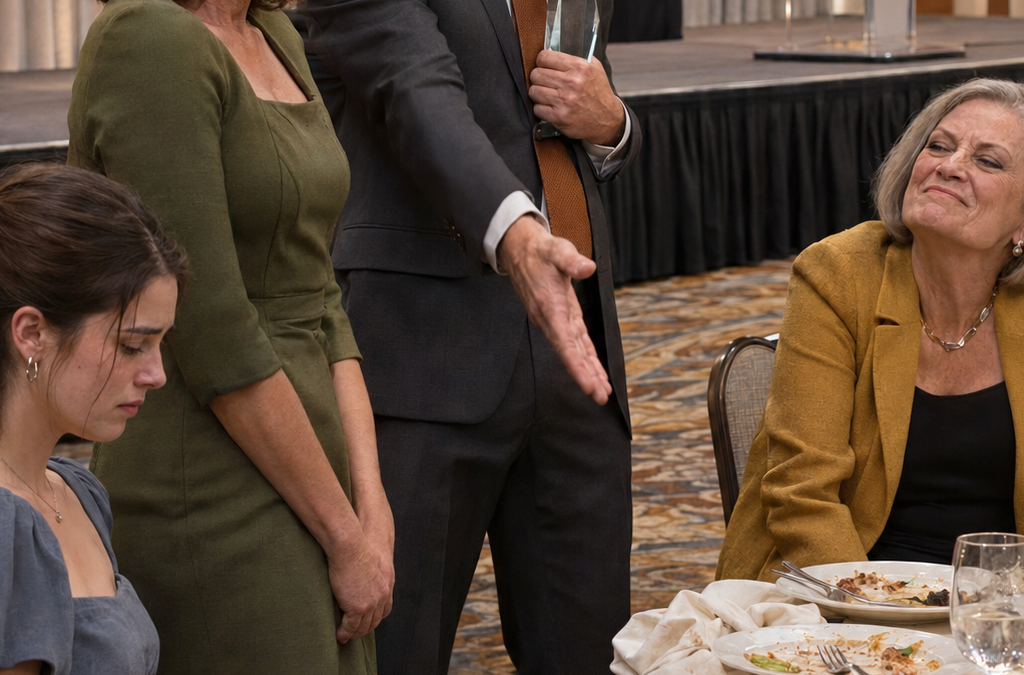
Mark held the founder’s award against his chest as he said it. He had just returned from accepting it, and people were still applauding.
My daughter, Emily, sat immediately beside me, folding her napkin instead of defending me. Across the table, his mother smirked. His father looked toward the stage.
“Let him have his moment,” his mother said.
I hadn’t interrupted him. I had only stood when the host asked for the founder to join the official photograph.
Mark looked at my empty seat.
“Sit down first. You’re blocking people.”
I felt humiliated, and several people nearby had heard him.
My name is Laura Bennett. I’m fifty-four. I was widowed fifteen years ago, when Emily was five.
I married Mark eleven years ago. Emily had called him Dad since childhood. I had been grateful that she had someone else to love, someone who could show up when I couldn’t.
Nine years earlier, I put $140,000 of savings from before that marriage into a flower business. I designed the arrangements, ordered flowers, handled the books, and answered customers after supper. For years, I did that work without a separate paycheck.
I had also paid $9,600 toward Emily’s current year of college. She was twenty now, old enough to understand what her stepfather had just done.
Her silence hurt more than his order.
I owned seventy percent of the flower business. He managed it; he did not own it.
Our independent business partner owned the rest. Neither Mark nor his parents had ever asked to see who owned what. He had let a possible arrangement discussed at home become a certainty in his own mind.
Under the table, Emily returned my old digital recorder into my hand.
“I forgot to give this back.”
I had used it for spoken flower orders for nine years. She didn’t meet my eyes, and I felt terribly alone beside her.
Mark noticed that I was still standing.
“What are you doing? They need this cleared.”
There were hotel servers working their way between the tables. Nobody had asked a guest to carry dirty plates. He wanted me occupied while he stood in the photograph.
“I’m supposed to be up there,” I said.
He laughed, just once, loud enough for the next table.
“You only swept the floors.”
I felt ashamed, although I knew I hadn’t done anything shameful. That was the part I hated. I knew better, and my face burned anyway.
His mother leaned forward.
“You’re holding everyone up.”
Mark had done real work at the shop. He could remember a customer’s anniversary after one conversation. He covered shifts, trained assistants, and sold arrangements to people who arrived planning to buy a single rose.
I had never denied any of that. Hearing him deny my work made me furious.
He shifted the award beneath his arm and spoke more quietly.
“Stay away from the microphone.”
His mother looked at the plates between us.
“Take those plates.”
Emily kept her eyes down. She had borrowed my recorder for an audio-storytelling class after the new shop cooler arrived. She had spent an afternoon following our work, asking questions, seeing exactly what I did.
Now she couldn’t look at me.
I had never felt so small in front of my own daughter.
At home, Emily and I sometimes ate scrambled eggs for dinner, standing in the kitchen, arguing over who had burned them. I wanted that girl beside me—the one who could tell me plainly when I was wrong.
Instead, I was waiting for permission to stand in a photograph.
I didn’t owe him my disappearance.
“I’m staying,” I said.
I left the dirty plates untouched and walked toward our other owner, who stood near the stage. I asked her to tell the host who had founded the shop.
That was all I asked. I wasn’t asking her to punish my husband.
She looked past me toward our table, then spoke to the host. He listened, asked her something, and looked at me.
Behind us, Mark had started forward with the award. His mother was already smiling toward the photographer. He moved around me as though I had finally understood where I belonged.
The host raised his arm across Mark’s path.
The host called me forward and stopped Mark beside the stage.
Mark nearly walked into him.
“Sorry, there’s been a correction,” the host said. “We need the founder here.”
Mark gave him the easy smile he used with important customers.
“Of course. My wife helps with everything.”
The host looked toward our other owner again. She shook her head.
“She founded it,” she said. “Please use her name.”
I stepped into the space Mark had been heading for. I was embarrassed by the attention, but I stayed there while the photographer arranged the picture.
Mark stood just beyond the edge.
“Laura,” he said. “Come here a second.”
The host asked me to look forward. For once, I let Mark wait.
After the photograph, I returned to our other owner. My face still felt hot. Across the aisle, I could see Emily sitting where I had left her.
We already had a business review scheduled after the ceremony. I had come prepared to keep working around Mark, as I always did.
“I don’t want to put off the question about his job,” I told my partner.
“You want us to consider removal?”
“Yes.”
She studied me before answering. “Then we’ll follow the agenda. He gets to speak.”
Mark approached before I could respond.
“Enough. Tell her we’re done with this.”
He was addressing our partner, but looking at me.
She didn’t move aside for him.
Mark heard our other owner say, “She’s calling the removal vote.”
His expression changed from confusion to anger.
“What vote? You can’t just get people together.”
He looked between us, apparently counting allies. I could see him settle on an answer that reassured him.
“You don’t have the votes for that.”
I didn’t tell him the numbers there beside the stage. Our partner told him the review would go ahead as planned.
He turned toward his parents, expecting them to follow him. I stayed where I was. I was frightened of what would happen next, but I no longer wanted to spare him the discussion.
That evening was supposed to have been a celebration for Bennett Bloom LLC, our flower shop in Fort Worth, Texas.
Our other owner, Diane Price, had sent notice of the meeting well before the awards dinner. Reviewing whether Mark should remain manager was already on its agenda. This hadn’t been invented because my feelings were hurt over dinner.
Until then, I had intended to preserve the arrangement.
Diane was sixty-two, a former wholesale-flower operator, and nobody’s easy audience. She had invested her own money. She cared about the business surviving, not about helping me win a fight with my husband.
“We’ll hear him out,” she said.
“I know.”
Near our table, Mark’s mother, Ruth, was talking to his father, Walter. Ruth kept glancing at me. Walter remained seated, his gaze following Mark without calling him back.
The host, Tom Wilson, came over long enough to apologize for the mistake. I thanked him. I didn’t explain my marriage to him.
Emily finally left the table and came toward me.
“Mom, I didn’t know what to do.”
I wanted to comfort her automatically. I had spent years smoothing things over before she could feel uncomfortable.
This time, I let her stand with what she had said.
“I kept making his work easier until mine disappeared,” I told her.
She looked toward Mark. He was speaking to someone from the shop now, smiling again.
Emily’s phone lit up. She read something, then looked back at me.
“What?” I asked.
She turned her screen toward me. Mark’s staff message read, “Laura retired. Ask me, not her.”
Chapter 2 of 7
I read the rest of Mark’s message on Emily’s screen. He had told the shop’s work group that I was retiring after the award ceremony and that all questions should go through him.
One employee had already replied, “Congratulations, Laura! You’ve earned a rest.”
I had not retired.
The reply hurt because it was kind. Someone believed I had chosen this, perhaps even looked forward to it. Mark had turned my disappearance into something people could celebrate.
“How long has that been there?” I asked.
“Since we were at the table.”
Emily looked toward him. He was laughing with a man from another business, looking pleased with the evening.
I found the employee who had sent the congratulations near the reception entrance. She occasionally helped with wedding setup and had come with two others from the shop.
“I saw your message,” I said. “There’s been a misunderstanding. I haven’t retired.”
“Oh. Mark said you wanted less responsibility.”
“I didn’t tell him that.”
Her expression changed, and I hated that she now had to wonder what else was wrong.
“Please keep doing your work,” I added. “You don’t need to get between us.”
She nodded, visibly relieved to have one clear instruction. I wished someone could have offered me the same thing.
Diane waited in a quiet alcove off the reception area. A woman I recognized from company calls joined us there.
Susan Reed was forty-six, a Texas business attorney retained by Bennett Bloom. She worked for the company, not for me personally, a distinction I needed to remember tonight.
“I heard about the retirement announcement,” she said.
“It wasn’t mine.”
“Then the staff needs a correction.”
“I’ve started.”
Susan opened her company file on a narrow table. She passed over the formation registration, then showed us the signed operating agreement and current member ledger.
“The registration establishes the company and records its manager; it doesn’t establish ownership,” she said. “These identify Laura at seventy percent and Diane at thirty.”
Diane checked her copy without comment. She had put $60,000 into this business, and she wasn’t going to treat it as scenery for my marriage.
Seeing our names there steadied me. It also made me angry. I had spent years behaving as though exercising my own authority required Mark’s permission.
“Can we send everyone home?” I asked. “Finish the discussion without an audience?”
“The crew can leave when their work here is done,” Diane said. “But we still have customers to serve.”
She was right. I couldn’t walk out and leave the consequences behind me.
The company’s money was not my purse. Its equipment belonged to the business, and its wedding deposits had been received for work we still owed. Even our mortgage remained a shared bill, whatever happened to Mark’s job.
Refusing his order at dinner hadn’t removed him as manager. That decision still had to be made.
Mark found us as Susan was reviewing the meeting notice. He glanced at the file, then asked me to step away.
I went only far enough that we could speak without interrupting them.
“Keep this up and explain the mortgage.”
He said it quietly. I knew that voice from discussions at home, when he wanted me to understand that any trouble afterward would be my fault.
“We both have to deal with the mortgage,” I said.
“You think flowers sell themselves?”
“No.”
“Then quit doing this.”
For a moment, I was scared enough to consider it. I pictured our house, the payment coming due, all the ordinary expenses that wouldn’t wait for us to settle anything.
Then I looked past him and saw Emily standing beside Ruth.
“Your mother is throwing away the household’s $2,740 monthly payment,” Ruth told her. “Ask her how that’s supposed to work.”
Emily’s face flushed. Walter stood nearby, listening without joining in.
“Don’t put that on her,” I said.
Ruth turned toward me. “She lives there too.”
“I’ll address the household bills separately. I’m not keeping quiet at work to keep peace at home.”
Mark gave a short laugh.
“Tell the bank that.”
He left me there and returned to his parents. I felt exposed, arguing about our house within earshot of strangers. Ruth kept talking, but Emily moved away from her.
Back in the alcove, Susan waited until I was ready to listen.
“The notice already covers removal, compensation, and appointing a replacement,” she said. “Nothing has to be added tonight.”
“And his pay?” Diane asked.
“The signed agreement sets his annual salary at $67,400. It doesn’t guarantee severance.”
Susan paused before continuing.
“That agreement alone doesn’t answer whether a separate ownership promise was made. We’ll hear what he says.”
I appreciated that she didn’t offer me an easy answer simply because I was upset. I needed this handled properly, even if that meant listening to him dismiss my work again.
Across the reception, Mark had left his parents. He was speaking to the shop employees near the exit. One started to answer him, then stopped.
I watched them longer than I wanted to.
We had three weddings that weekend, with $18,400 in deposits already received. I had designed those orders around customers’ plans, budgets, and hopes. They weren’t involved in our marriage.
The employee I had corrected earlier came toward us.
“We need to know what we’re doing about loading,” she said.
“Did something change?” Diane asked.
She looked at me, then at Susan. I could see how much she disliked bringing us this.
“He told us to hold all three wedding deliveries.”
Chapter 3 of 7
“Which truck gets loaded first?” the employee asked. “We’ve got three deliveries, and he told us to wait.”
Mark had paused the loading schedule. He hadn’t canceled the weddings or taken their money. The flowers were at the shop, and the customer orders were still available.
But the crew needed instructions before they left tonight. Mark still held the manager’s job. I couldn’t tell them his instructions no longer counted simply because I wanted him removed.
“Let’s get out of this doorway,” I said.
We moved into the hotel service corridor, away from the reception chatter. Two other crew members joined us there.
I asked what had already been prepared. One had cleared space in the delivery van. Another had checked the buckets and packed the supplies they would need at each venue.
Then everyone had stopped.
I was angry that Mark had put them in this position. They had come to an awards dinner, and now they were watching their employers fight over whether they could do their jobs.
“The garden wedding goes first,” I said. “They’ve given us the shortest setup window.”
“The arch is going in that van?”
“Flat. The flower panels travel separately. We attach them there.”
One of the crew frowned. Mark had told him they could load it assembled.
“It’ll fit upright,” he said.
“It will. But the weight pulls on the upper corner when you brake.”
I had rebuilt that corner twice before I liked it. The bride wanted the flowers heavier on one side, as though they had grown there.
Mark appeared at the corridor entrance.
“There you are.”
Nobody answered immediately. I hated seeing the crew become careful around us.
He looked at the employee who had brought me the problem.
“I told you I’d handle it.”
“She asked about loading,” I said.
“Run tomorrow without me.”
He spoke loudly enough for all three employees to hear.
“They call me when things go wrong. They know who answers.”
That was true. He answered early calls and found replacements when someone missed a shift. More than once, he had talked an anxious customer through a change I would have handled too abruptly.
His usefulness had become the reason I swallowed everything else. I was frightened now because we really would miss that work.
I turned back to the crew.
“The bridal bouquet for the restaurant wedding stays in our cooler until pickup. Don’t leave it beside their fruit delivery.”
“The restaurant said they had cold space.”
“They do. But that bouquet has sweet peas. Ask them to clear the fruit first, or keep it with us.”
The youngest crew member looked at me differently.
“You know which flowers are in each one?”
“I designed those flowers.”
I hadn’t meant to sound sharp. Her question hurt, though she hadn’t meant it cruelly.
“I mean, I knew you did some,” she said.
“All three of these.”
She nodded, embarrassed, and asked which arrangements could travel together. I answered that instead of making her apologize again.
Diane joined us while we were sorting out the last route. She listened, then addressed Mark.
“Let them finish the preparations we promised the customers.”
“You’ve got Laura doing it.”
“We’re reviewing your employment. The weddings still need to go out.”
He looked toward me, waiting. I wouldn’t ask him to save us from a problem he had created.
“Fine. Prep can go ahead,” he told the crew. “Use the existing orders. I’m not sorting out her changes.”
“The designs haven’t changed,” I said.
He ignored that.
“And don’t call me all weekend because she forgot something.”
The employee nearest him asked about the working dispatch schedule. Mark had the latest copy, with the loading notes he usually carried.
“I’ll leave it at the shop,” he said.
It was enough to let them move forward. It wasn’t cooperation I could depend on.
After he left, I told the crew I would meet them at the shop early. We went through the routes once more, including who could lift the arch panels without damaging them.
My feet already ached. Tomorrow would involve work Mark normally did before I arrived, followed by the design checks I had always done.
I felt tired just considering it.
Emily waited until the crew returned to the reception. Then she approached me beside a closed service door.
“Why did you let him talk to you like that?”
I wanted to object to the word “let.” Instead, I looked at her and saw how upset she was.
“After your father died, I wanted the house quiet,” I said. “When Mark came along, quiet felt safe. I kept confusing the two.”
She leaned against the wall.
“He wasn’t always like this.”
“No. And I wasn’t always quiet.”
She looked down, and I remembered how she used to announce family meetings over whose turn it was to clean the microwave. She had once charged Mark a cookie for leaving spaghetti uncovered.
The memory made me sad. We had been happy sometimes. That didn’t make tonight less real.
“You don’t have to referee our marriage,” I told her.
“What am I supposed to do?”
“Tell the truth when someone asks you. You don’t have to fix us.”
Susan came down the corridor carrying a page from her company file. Beyond her, Mark stood near the reception entrance, watching us.
“Mark has asked me to put the current member list in his hands.”
Chapter 4 of 7
Susan gave Mark the verified list beside the service corridor entrance. He read my name and seventy percent, then Diane’s name and thirty percent.
His eyes went down the page again.
“Seventy and thirty,” he said. “That’s still what you’ve got.”
“Yes,” Susan said. “Those are the current interests.”
He looked at me. He understood now why I hadn’t needed to gather supporters around the dinner table.
“So you never changed it.”
“We discussed a possibility,” I said. “We didn’t make you an owner.”
“You offered me forty percent.”
“We talked about what might work.”
“At home. You and me. That doesn’t count now?”
I felt afraid of answering him in front of other people. At home, I usually softened my words until he could accept them. Here, Susan waited for an answer I actually meant.
“It counts as a conversation we had,” I said. “It wasn’t a transfer.”
Mark looked toward Diane, who had joined us near the corridor entrance.
“You knew about this?”
“I knew you wanted an interest.”
“And you just let her—”
“I didn’t agree to admit you.”
He stopped looking at her.
For years, he had treated Diane as the investor who occasionally checked our numbers. Now she stood between him and something he believed he had already earned.
Susan kept her voice level.
“Admission requires written consent from both members. Removal of a manager requires more than fifty percent.”
“So she can fire me.”
“The members can vote on your appointment.”
He stared at me again. I wished he had looked this closely when I was trying to tell him how unhappy I had become.
“Nine years,” he said. “I stood in that store nine years.”
“I know you did.”
“You want me back where I was?”
I knew what he meant. Before the shop, he had spent six months unemployed. He had hated every question about how the search was going, even from people who wanted to help.
“I’m not going back to sitting home,” he said. “Waiting for somebody to call.”
His fear was real. So was mine. I had been afraid of losing him, then of upsetting him, then of what keeping him comfortable was teaching Emily.
“We’re discussing your job,” I said. “I’m not trying to punish you for being out of work.”
“Easy for you.”
Susan checked the signatures against the company file while Diane reviewed her copy. Nothing about their pace changed because Mark was angry.
“The notice was delivered ten days ago,” Susan said. “Removal is expressly listed. The meeting can proceed.”
“And that settles everything?” Mark asked.
“No. This is a company decision. It doesn’t settle marital property or every possible contract claim.”
I was relieved she said it plainly. I wanted a boundary around tonight, too. I couldn’t decide our whole marriage in a hotel corridor.
Mark walked toward his parents near the reception entrance. We followed far enough to hear him change his voice.
“I’m trying to keep the shop stable,” he told them. “We’ve got a personal disagreement spilling into work. I’d rather not let that hurt everybody.”
Ruth looked past him at me.
“Then she needs to stop.”
Walter asked whether the weekend deliveries were going out. Diane told him preparations had resumed. He nodded, but kept watching his son.
It hurt to hear Mark sound so reasonable after what he had said to the crew. He could explain away an entire evening without mentioning one thing he had done.
He came back toward me as Susan answered a question from Walter. His parents couldn’t hear us from there.
“You bought the walls. I made it matter.”
We leased the storefront. He knew that. He meant the money, the beginning, all the work he could dismiss as something I had purchased.
I wanted to list every order I had saved and every funeral arrangement I had made while he slept. I could have stayed there all evening trying to make him remember.
Instead, I looked toward Diane.
“Please proceed with the agenda.”
She considered me for a moment.
“All right.”
I felt sad rather than brave. I had wanted a husband who would hear me without requiring witnesses.
Susan confirmed the arrangement already made with the hotel. The meeting would begin at nine o’clock in the Magnolia Room, immediately after the awards program ended.
Diane and I would vote. Susan would record the action. Mark would have time to speak as manager.
“What about us?” Ruth asked.
“You aren’t members,” Susan said. “You can attend if both members consent.”
Diane agreed. So did I. When Emily asked whether she could stay, we agreed to that too.
Ruth seemed offended at needing permission. Walter asked where the room was.
Emily stood apart from them, near me. At home, she usually filled an awkward pause by announcing she was hungry. She once called cereal “a cold casserole” just to make me object.
I missed how easily we used to be ridiculous together.
“Are you coming in?” I asked her.
“I think so.”
“You don’t have to decide for anyone else.”
She nodded, though she looked past me toward Mark.
He approached her as Diane and Susan headed toward the meeting room. I stayed a few steps away, giving them space without leaving her alone with the responsibility.
“Em. You remember the conversation at home.”
She didn’t answer.
“Don’t get confused because your mother’s upset.”
He looked at me, then back at her. Emily’s phone sounded while he was still standing there. She read the message without replying.
Then she silently turned the screen toward me.
Mark’s message to Emily read, “Tell them you heard her promise me a piece.”
Chapter 5 of 7
“I won’t say something because he needs it.”
Emily said it to me, though Mark was close enough to hear. She looked miserable, but she didn’t take the words back.
“Then describe only what you actually heard,” I said. “Or you can leave. You don’t have to stay for either of us.”
“I’m not asking her to lie,” Mark said.
Emily didn’t answer him. I was relieved she had refused, and ashamed of how much that relief meant to me. She was still the daughter, not the person who should have to protect me.
We went into the Magnolia Room while the last guests drifted toward the hotel lobby. Without the reception noise, I could hear the air conditioner struggling overhead.
Susan had arranged the voting materials at one end of the table. Diane took a seat beside hers, and I sat opposite Diane.
Mark brought his parents in behind him. He directed Walter toward a chair with a clear view of us, then waited while Ruth settled beside him.
Emily sat next to Ruth.
I wanted her beside me. I left the empty chair alone.
Susan told us she had checked the member identities, signatures, and meeting notice. The materials were ready for the review.
Diane asked whether the crew had confirmed the loading preparations. Before I could answer, the employee who had approached us earlier appeared in the doorway.
“They’re getting started at the shop,” she said. “Using the customer orders, like we discussed.”
That eased one immediate worry. I asked her to confirm that the arch panels would travel flat and the restaurant bouquet would stay in our cooler. She repeated both instructions, then asked who would meet them in the morning.
“I will,” I said. “Before loading starts.”
She needed someone to help check the van and handle the first customer calls. I agreed to those too.
When she left, I pictured the work waiting for me. I would need to check the flowers before answering calls, then get back to the designs between interruptions. Mark had usually handled those interruptions.
I felt exhausted already. The customers would still need their flowers whether I slept or not.
Mark watched me return to my seat.
“Getting harder already?”
“Yes,” I said.
He seemed irritated that I hadn’t argued.
At home, he used to complain that I wrote shopping lists on the backs of envelopes. Once, he had come home with six limes because he’d mistaken a flower count for groceries. We had laughed about that for weeks.
Now I wondered which of our ordinary jokes I would still be able to remember without hurting.
Diane asked Mark whether there was anything he wanted us to consider about his continued employment.
He leaned toward her rather than me.
“There’s a way to finish this without wrecking the store.”
“What are you proposing?” she asked.
“Recognize my forty percent. I keep running the front. We get back to work.”
He made it sound simple enough that Ruth nodded before anyone answered. Walter looked down the table at me.
I had spent years letting Mark make the first explanation. His version was usually easier to hear.
“I’m not agreeing to that transfer,” I said.
“Then what were the nine years for?”
“Paid work. Important work.”
“Don’t give me that.”
I let him finish. He talked about opening the store, covering absent employees, remembering customers who expected to be remembered. He named a funeral order he had delivered himself when the driver got sick.
I remembered that delivery. I had stayed behind to finish the family’s other arrangements.
“You did those things,” I said. “I’m not denying them.”
“You’re keeping what they earned me.”
His certainty hurt. Even with both of us in the room, he spoke as though his work had happened alone.
Ruth turned toward Emily.
“He missed family dinners for that shop.”
Emily watched the far end of the table.
“So did I,” I said.
Ruth gave me an impatient look. “You worked in the back.”
Susan asked Mark whether his proposal depended on an immediate ownership transfer.
“Yes. Otherwise there’s no point.”
Diane answered him without looking at me.
“I’m not consenting to that.”
He sat back. For a few seconds, he studied her as though he had misunderstood the question.
Then he turned to his parents.
“This is what I’m talking about. They can show you a list. That doesn’t mean she kept her word.”
My face grew hot again. I hated being discussed as though I had stepped outside.
Mark looked directly at me.
“You offered it at home.”
“We discussed a possibility.”
“You said forty percent. You know you did.”
“I know what we discussed.”
He shook his head and addressed the table.
“The salary paperwork was about my pay. I signed it. I’m not disputing the amount. But there was a separate promise about ownership.”
Susan asked him to explain the distinction he was claiming.
He answered her more carefully.
“The pay agreement didn’t replace what we discussed at home. That understanding still stood.”
Then he looked at me again.
“Now you’re hiding behind paperwork.”
Emily shifted beside Ruth but stayed seated. I didn’t ask her to help me.
I was angry, but I wanted him heard accurately. He was no longer claiming the member list showed his name. He was claiming that I owed him something beyond it.
Susan asked whether he wanted that position recorded.
Mark reached inside his jacket. He had brought a written demand, already signed.
He put it beside my voting materials.
“Put that claim in the minutes.”
Chapter 6 of 7
Before the vote, Susan recorded Mark’s demand as a disputed claim, not an ownership transfer. He turned toward his parents and Emily.
“She put up money. Did the back-office stuff. I built the business people actually walk into.”
Ruth nodded. Walter watched him without answering.
“She promised me a piece,” Mark said. “Now she wants me gone before she pays it.”
I was angry enough that speaking took effort. Even now, he expected me to explain myself to his parents.
“You say the proposal survived our pay discussion,” I said. “You accepted salary instead of ownership.”
“That isn’t what happened.”
I placed the old recorder on the table and pressed play.
His recorded voice came through clearly.
“Sixty-seven four annually? For managing the storefront, staffing, customer calls?”
Then my voice: “Yes. I’ll still handle the designs and purchasing. Including those wedding orders we went through.”
I paused the playback when Mark interrupted.
“That’s pay. I already told you I agreed to the pay.” He looked at Susan. “There was an earlier arrangement. Then we talked at home. That was separate.”
Susan waited without answering for either of us.
“And this was her school thing,” he added, looking toward Emily. “Practice interviews. You can’t play a bit and call it the whole meeting.”
Emily stood. Ruth turned toward her, expecting her to lean closer.
Instead, my daughter came around the table and sat beside me.
I felt relieved, then frightened for her. Mark had stopped looking at the recorder.
“We both asked if you were okay with it,” Emily said. “You and Mom said yes. I recorded the whole discussion.”
“Em, you did interviews all week.”
“This was Thursday. After you talked at home on Monday.”
“How do you know which—”
“Please let me finish.”
Her voice shook. I wanted to help, but she had asked to finish, so I waited.
She told us the second cooler had just been installed. I restarted the file, and a little double beep sounded behind her recorded introduction.
“That’s the cooler,” she said. “The new one did that while we were figuring out the door alarm. And that’s me explaining my assignment.”
On the recording, she asked us to speak normally and ignore her when possible. Mark laughed.
I remembered that afternoon. He had kept asking whether a florist could become a radio star. Emily had told him he needed to stop talking over his cohost first.
The memory hurt. We had sounded comfortable together.
“Keep going past that,” Emily said.
I let it play.
My recorded voice asked, “What about what we discussed at home Monday? The possible forty percent?”
Mark answered over a faint hum.
“Leave that. Sixty-seven four works better for me right now. Guaranteed pay.”
“So this replaces that proposal?”
“Yeah. The $67,400 salary instead. No ownership. I’ll sign it.”
Nobody needed me to explain whose voice it was. Still, I hated hearing how easily he had answered then.
Susan checked the compensation agreement already in her file.
“This was signed at that Thursday discussion,” she said. “The amount matches.”
Mark stared at Emily.
“You sat there all night knowing you had this?”
“It was Mom’s recorder. I gave it back.”
“You knew what I meant.”
She stayed beside me.
Diane waited until he looked toward her.
“Do you dispute that it’s your voice agreeing to replace the proposal?”
He rubbed his face, then answered.
“No. It’s me. But I thought we’d revisit it. After everything I did, I deserved more than wages.”
“You could ask us to reconsider,” Diane said. “That didn’t make you an owner.”
He turned to me.
“And you’ve just been waiting to use this?”
“No. I came tonight expecting us to keep working together.”
I felt sick saying it. Until dinner, I had still been willing to make the arrangement last.
Susan read the resolution in short sections: removal, no future manager salary, and my appointment as interim manager. Earned wages would still be paid.
“I vote my seventy percent in favor,” I said.
My voice sounded ordinary. I had expected it to fail me.
Diane cast her thirty percent in favor. Susan recorded both votes and the result.
Then Diane addressed Mark.
“Your appointment ends now, and so does your $67,400 salary.”
His chair scraped backward as he stood.
“Dad. Say something.”
Walter looked at him, then at me. I had watched him avoid unpleasant family conversations for years.
“You said you hadn’t agreed to that,” he told Mark.
“That’s what you’re worried about?”
Walter didn’t answer again. Ruth’s mouth opened, but no defense followed. She looked at Emily, who remained seated beside me.
I felt sad watching them, although I no longer wanted their approval.
“Come on, Em,” Mark said. “We’re leaving.”
“I’m staying here.”
He waited. She didn’t get up.
Susan asked for the company property. Mark put the shop keys and company card on the table, hard enough that Ruth flinched.
Then he leaned toward me.
“Five minutes outside. We can fix the job part.”
“No. I won’t discuss reinstatement privately.”
“You really need them watching?”
“You don’t get to erase me to make yourself bigger.”
I didn’t add anything. I was tired of explaining my work as though he might finally recognize it if I found better words.
His wedding ring had come off while he rubbed his finger. He slid it back onto his own hand.
“Then we need separate lawyers.”
Chapter 7 of 7
We retained separate family-law attorneys and began living apart by agreement. Mark went to his parents’ house while Emily and I stayed temporarily in the home we still jointly owned.
I hadn’t evicted him. He collected his clothes, tools, and personal papers, and we arranged another visit for anything he missed.
“Leave the garage shelves,” I told him. “We can sort those when we sort the house.”
“I know what’s mine.”
“So do I. We’ll make a list.”
It was an ugly little conversation. I cried afterward, standing in the bedroom with half the closet empty. Wanting the separation hadn’t made eleven years easy to pack.
Susan sent the signed company decision to the bank and payroll provider the next morning. The following Monday, after checking it against its requirements, the bank confirmed that Mark’s business signing access and company card had been canceled.
Payroll paid everything he had earned. There would be no further manager salary.
I checked the figures with Diane. We corrected one ordinary payroll entry and moved on. His last paycheck wasn’t mine to withhold because I was hurt.
By then, the wedding weekend had already taught me how much work we had ahead.
At the shop, I answered a customer’s call while trying to finish the restaurant bouquet. She wanted to know whether ivory flowers would look yellow against her dress.
Mark could have reassured her in two minutes. I explained flower colors until she sounded more worried.
Diane finally pointed toward the unfinished bouquet.
“Ask her to send a picture.”
I did. The dress was ivory too.
“Oh,” the customer said. “Then we’re fine?”
“Yes. We’re fine.”
Afterward, I sat on an overturned bucket and laughed until I nearly cried. I was exhausted, and there were still stems to clean.
Diane stood beside the cooler.
“We can’t keep all the walk-in hours this week.”
“I don’t want people thinking we’re failing.”
“Then let’s finish their orders instead of looking busy.”
We cut the quietest storefront hours and posted the changes. Diane covered the counter while I finished designs. I handled calls between deliveries, sometimes badly, then called back when I had a better answer.
All three weddings received their flowers. The arch traveled flat, the sweet peas stayed cool, and nobody getting married needed to know about our dinner.
That mattered more than proving I could do everything.
For the next several months, I worked too much and learned to stop calling that a virtue. Diane and I reviewed staffing, paid for help we actually needed, and left some requests unaccepted.
I missed Mark’s skill with customers. I didn’t miss being told that skill made the rest of us incidental.
At home, grief arrived in inconvenient ways. I could discuss the house calmly with my lawyer, then get upset because a television show we had watched together started a new season.
Emily once found me crying and stayed in the doorway.
“Do you want company?”
“For a little while.”
She sat with me. I didn’t tell her what Mark’s lawyer had said or ask whether she thought I was being fair. She had school the next morning.
On October 16, the divorce decree approved our negotiated settlement. We divided the $84,000 in joint savings into $42,000 each and agreed to sell the marital house.
The sale went through afterward. We each moved into a separate place and took the belongings we had agreed upon.
Under the settlement, I retained my recorded seventy-percent interest in Bennett Bloom. Mark released his disputed equity claim. That had taken months of negotiation between separate attorneys; our company vote hadn’t decided it.
I felt relieved when it was finished. I also felt sad signing away the house where Emily had grown up.
Both feelings lasted longer than I expected.
Emily told me about lunch with Mark after she had already arranged it.
“We’re meeting somewhere near campus,” she said. “Just lunch. I told him I had to leave afterward.”
“You don’t need my permission.”
“I know. I didn’t want you hearing it from somebody else.”
“Thank you.”
I wanted to ask whether he had apologized. I didn’t.
When she came home, she said they had eaten and talked. I let that be enough.
Later, Mark contacted me directly about helping at the shop again.
“Just Saturdays,” he said. “You know you need someone.”
“I won’t put you back on staff.”
“So that’s it?”
“For working together, yes.”
I didn’t reopen shared accounts or give him private access to the company. He could build a relationship with Emily without coming through my business, and she could see him without carrying messages between us.
We still had awkward days. Sometimes Emily started defending a pleasant memory before I had criticized it.
“You’re allowed to have had fun with him,” I told her.
“So are you.”
That hurt, but she was right.
Six months after the awards, we spent part of a Sunday at the shop. Emily had offered to help clear space for the next flower delivery before meeting friends.
She brought a sandwich cut into four triangles.
“College lunch,” she said.
“Looks like kindergarten lunch.”
“Tuition’s expensive. I’m revisiting the basics.”
I laughed with my mouth full. She looked pleased with herself.
We had finished when a woman stopped outside and asked whether I could make something small for her sister. Nothing formal, she said. Just flowers that looked as though somebody had gathered them from a garden.
Mark used to keep Sundays clear of small custom orders. Once the week’s schedule was settled, I rarely challenged it.
This time, I wanted to make the flowers.
“I can do that,” I said. “Tell me what she likes.”
Emily stayed long enough to help me choose a few stems.
“I need to go.”
“Go. Have fun.”
She left without apologizing, and I didn’t invent another task to keep her there.
The old recorder was beside my work space again. I used it for my own orders, especially when a customer talked faster than I could write.
With the woman’s permission, I recorded her preference for loose garden flowers. I stopped playback with a small click and returned my hand to the stems.
Keeping a family should not require disappearing.
I had room for this little order. I made one final note aloud.
I pressed record and named the flowers myself.







