My Sister-In-Law Made Me Cook Six Days After My C-Section, Then Took a Church Award for Saving Me—Until I Requested the Recording
Complete story · 7 chapters · about 35 minutes · ending included
Chapter 1 · Chapter 2 · Chapter 3 · Chapter 4 · Chapter 5 · Chapter 6 · Chapter 7
Chapter 1: The Spoon She Put In My Hand
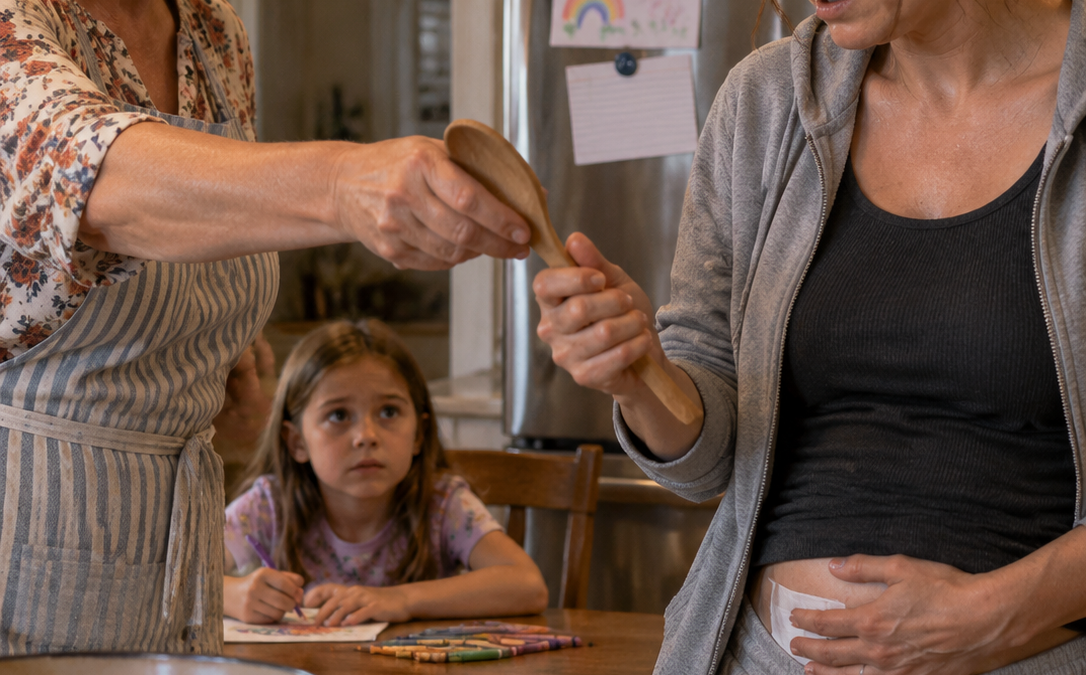
At 4:41 p.m. on the sixth day after my C-section, Michele Beal put a wooden spoon in my hand and told me to make dinner.
“Six days is plenty. I had three kids and never sat down.”
“I have staples.”
“Then stir gently.”
The pot was already on the stove.
The guests were due at six, and Michele had decided there was no reason dinner should be late because I had spent the morning resting.
I was thirty-nine years old.
Fourteen years on a 911 console had taught me to keep my voice level when somebody else was losing theirs.
It had not taught me how to argue with my husband’s older sister in my own kitchen while my seven-year-old stepdaughter watched.
Elsie sat at the table coloring.
The index card I had made with her in July was still on the refrigerator, beside the wall phone.
Our address.
What was wrong.
STAY ON THE LINE.
We had practiced it until she could say the address without looking down.
Jude was asleep in his bassinet.
He had been born by C-section on August 31.
I had come home from the hospital on September 3 with fourteen staples across my incision and instructions to take it easy.
Zach was out on a storm call-out.
He was a utility lineman, and when the weather damaged lines, his phone could ring at any hour.
He had kissed my forehead before leaving and told me Michele would help until he got back.
She had helped with meals and laundry.
She had also made it clear that help came with a schedule, and the schedule did not include me lying down whenever I wanted.
I looked at the spoon in my hand.
My abdomen pulled when I stood too long.
A dull ache had settled under the bandage, but I could still move.
I could still stir a pot.
Elsie had stopped coloring.
Her crayon rested against the paper.
I could have handed the spoon back.
Instead, I turned toward the stove.
I did not want another argument in front of her, and I did not want Elsie to think the adults in the house were angry with each other because of her.
Michele moved a dish towel away from the burner.
“Keep it from sticking.”
I stirred.
At 4:44, the kitchen clock clicked over.
The smell of the food made my stomach turn.
I set my free hand against the counter and waited for the nausea to pass.
“Are you all right?” Michele asked.
“I’m fine.”
It was the answer I used at work when a caller was shouting and I needed the next address.
It was not the truth.
I had been getting up more than I should have since we came home.
There were bottles to wash, diapers to change, and a baby who did not care that I had an incision.
I had told myself that doing a little more each day was how I would get back to normal.
The bandage pulled when I shifted my weight.
Then I felt wet heat beneath it.
I stopped stirring.
Michele was checking the table.
“Sabrina?”
“I need to sit.”
“Just finish this part. We have people coming.”
I kept one hand on the counter.
The spoon dragged against the bottom of the pot.
My vision narrowed at the edges, and I tried to focus on the clock.
4:50.
I remember the spoon slipping from my fingers.
I remember reaching for the counter and missing it.
Then the kitchen was gone.
I had no memory of the ambulance, the trip to the hospital, or the hours after I went down.
I woke that night after surgery, with a dry mouth and a pain that seemed to begin beneath the bandage and reach all the way through my back.
A nurse explained that I had suffered a postpartum hemorrhage.
The doctors had taken me into surgery and given me a transfusion.
I listened because listening was what I did when somebody gave me information that mattered.
I asked what time it was.
Zach sat beside the bed.
His work clothes were gone, and his face looked gray with exhaustion.
“What happened?” I asked.
“You collapsed in the kitchen.”
“Who called?”
“Michele called it in. She saved you.”
I looked at him.
“She called 911?”
“Yeah. She was right there.”
I had no reason to question him.
He had been out on a storm call, and I knew he had come as soon as he could.
My memory ended at the stove.
His began with the hospital.
Michele came in later carrying soup.
She set it on the rolling tray and adjusted the spoon beside the bowl.
“Anyone would have,” she said when I thanked her.
The soup was warm.
My hands shook a little as I lifted the spoon, so Michele steadied the bowl without making a comment.
“Thank you,” I said.
She tucked the blanket near my knees.
“You just worry about getting better.”
“Thank you,” I said again.
I believed I owed her both times.
By September 10, I was home again.
The kitchen looked as it had before, except I moved through it slowly and kept one hand near the counter.
Jude slept in his bassinet.
Zach was careful with anything he lifted, including the laundry basket, and asked me before he left the room.
I had started noticing what was missing.
The index card was gone from the refrigerator.
I stood in front of the empty spot longer than I needed to.
I had written it in block letters because Elsie was still learning to read quickly.
Picking up where the Facebook post left off
In July, I had shown her how to find the address first, then tell the call-taker what was wrong, then stay on the line.
We had practiced with pretend emergencies, and I had made her repeat the address until she knew it without help.
The wall phone was still there.
Elsie did not go near it.
She took the long way around the kitchen when she needed to get past the refrigerator.
If I asked her to bring me something from that side of the room, she looked toward the phone before moving.
I thought she might be nervous because of what had happened to me.
She had seen the ambulance crew come into the house, or heard the adults talking afterward.
I could not remember what she had seen on September 6.
I asked Zach if he knew where the card had gone.
He looked at the refrigerator.
“Maybe it got moved.”
“Did you move it?”
“No.”
He said it without suspicion or anger.
He was tired, and there were still things to do around the house.
I did not press him.
I could have made another card.
I had the address memorized, and I could write the instructions in less than a minute.
But the old one had been made with Elsie.
She had helped choose the words and had practiced what to say.
I wanted to know why it had disappeared before I replaced it.
That evening, I found her coloring at the table again.
She kept her chair angled away from the wall phone.
When it caught my eye, I remembered the way she had stopped moving when Michele handed me the spoon.
I remembered her watching me turn back to the stove.
I had spent fourteen years hearing frightened people try to explain what was happening while the seconds passed.
I knew children could go quiet when they were scared.
I knew a quiet child was not necessarily an untroubled one.
Still, I did not know what to ask her.
At bedtime, I sat beside Elsie until she settled under the blanket.
Jude was asleep in the next room.
Zach was checking the doors downstairs, and the house had finally grown still.
Elsie kept her eyes open.
“Are you hurting?” I asked.
“A little.”
“Do you want me to get Dad?”
She shook her head.
Her fingers pinched the edge of the blanket.
I waited.
At work, I had learned not to fill every pause.
Sometimes a person needed a few seconds to find the words.
Elsie turned toward me.
Her voice was so low I leaned closer.
“Do kids go to jail for calling 911?”
Chapter 2: The Run Sheet In The Discharge Packet
The question Elsie asked stayed with me after I tucked her in.
“Do kids go to jail for calling 911?”
I told her no. If somebody needed help, calling 911 was the right thing to do.
She nodded, but she did not ask anything else.
I did not know what had made her afraid. I only knew the fear did not fit what Zach and Michele had told me.
I had thanked Michele for saving my life. I had said it twice in the hospital, and I had meant it.
By September 20, I could no longer make those two things sit together.
That Sunday, Pastor Arlen Teague stood near the front of Saguaro Hills Community Church and made an announcement.
The church would present its Servant’s Heart Award at Harvest Sunday on October 25.
He explained that the church was preparing to fill a new paid position: Care Ministries Director.
The position would pay $41,500 a year. The award recipient would be the leading candidate for the job.
People turned toward Michele.
She sat with the prayer circle near the aisle, her hands folded over her purse. She lowered her chin as if the attention embarrassed her.
After the service, I heard her telling the women gathered around her.
“I called 911 the second she fell.”
She said it gently, almost as if she were correcting a detail nobody had asked her to correct.
One woman touched her arm. Another said the church was lucky to have her.
I stood nearby with Jude’s diaper bag over my shoulder. My incision still pulled if I carried too much.
Michele glanced at me.
“She was so pale,” she said. “I knew we needed help right away.”
I did not answer.
The sentence sounded familiar because I had heard the same version from Zach. Until then, I had treated it as the only account available.
At home, I brought the discharge packet to the kitchen table.
I had checked the medication schedule and follow-up appointments, but not every page.
Near the back, I found the medics’ run sheet.
One line had been entered under the call information:
“RP juvenile female, line disconnected, callback no answer.”
I read the line carefully.
RP. Reporting party.
Juvenile female.
A child had called.
I heard the refrigerator motor start behind me. Elsie was in the living room with Jude, and Zach was putting away the groceries.
I carried the page to the counter.
“What does this mean?” I asked Michele when she came in.
She looked at the paper without taking it from me.
“It means Elsie lost the call,” she said. “I called right back on my cell. You don’t remember, honey.”
I looked at the words again.
“Why does it say the callback had no answer?”
“She was upset. She probably put the phone down.”
“But you called?”
“Of course I did.”
Her answer came quickly. Then she touched my shoulder.
“You were very sick, Sabrina. You can’t expect to remember everything.”
I knew I had lost hours between the kitchen and the hospital. The doctors had explained why.
But the run sheet did not say Michele had called.
It said a juvenile caller had disconnected, and the callback had gone unanswered.
I put the page back on the table.
Michele picked up a dish towel and began folding it.
“You need to stop putting yourself through this,” she said. “You have a new baby.”
She left the kitchen before I could ask another question.
That evening, I searched the date on Michele’s Facebook page.
I entered September 6 and scrolled until I found a post stamped 6:19 p.m.
“Sunday dinner still happened. Some of us don’t get to fall apart.”
I stared at the timestamp.
At 6:19, I had been in the hospital after surgery. I had lost enough blood to need a transfusion.
Michele had been sitting down to dinner.
I printed the post and placed it beside the run sheet.
The two pages did not prove what had happened in the kitchen. They did show that the story I had been given left things out.
Zach came in while the printer was finishing.
“What are those?”
I showed him the run sheet first, then the post.
He read the line about the juvenile caller. His jaw tightened, but he did not speak.
Michele came through the doorway before he could answer.
“She’s doing this again?” she asked Zach.
“I’m trying to understand the paperwork,” I said.
Michele looked at him instead of me.
“She has the baby blues. She nearly died, and now she’s looking for something to blame.”
Zach glanced at me.
“She’s asking what the report means,” he said.
“And I explained it.” Michele put her purse on the counter. “Elsie should stay with us until Sabrina is feeling like herself again.”
I felt my fingers close around the edge of the printed page.
Elsie was seven. Her mother had died in 2022. Zach was her father, and I was the woman who had helped raise her since then.
Michele had not asked whether Elsie was frightened. She had not asked what Elsie needed.
She had offered to take her.
Zach looked down at the papers.
“She’s staying here,” he said.
Michele’s expression changed, but only briefly.
“I’m trying to help.”
She picked up her purse and left.
I wanted to ask Zach whether he believed her. I wanted to ask why he had accepted the story without looking at the paperwork.
Instead, I gathered the pages and put them in the folder.
The next morning, September 21, I went to work.
I did not touch the county call system. The house was just beyond the Tucson city limit, and its emergency calls went to a separate county center.
My own console could not retrieve that recording.
I asked my supervisor what would happen if I used a work system to search for a call involving my family.
He did not hesitate.
“A personal lookup is a dismissal issue,” he said. “You know that.”
At a 911 center, access was not permission to satisfy curiosity. Every search had to belong to an assigned call or an authorized task.
I had spent fourteen years protecting that rule. I was not going to risk my job by breaking it now.
That afternoon, I completed the county’s public-records request form as any member of the public could.
I listed the date and the address. I requested the 911 recording and the call log.
I signed my own name and submitted it.
The caller had been identified as a child, and I was not Elsie’s legal parent.
When the call from county records came, I stepped away from the kitchen and answered.
The clerk explained that the request involved a minor caller.
Then she said, “The caller is a minor. I need a parent’s signature. A stepparent can’t sign.”
Chapter 3: The Twenty Seconds From The County
Zach read the county clerk’s message on my phone and pushed it back across the table.
“No,” he said.
I had expected hesitation. I had not expected the answer to come so quickly.
“She raised me. She saved you.”
The request form lay between us. The signature line was still blank.
“She’s Elsie’s aunt,” I said. “I’m not asking you to say anything about what happened. I’m asking you to let the county release its own recording.”
“You think Michele did something wrong.”
“I think the run sheet says Elsie called.”
“She was seven. She got scared. Michele handled it.”
I kept my voice low.
Jude was asleep in the next room, and Elsie was watching a cartoon with the volume turned down.
Zach rubbed his forehead.
“I know what you think you saw in that paperwork,” he said. “But I know my sister.”
I wanted to tell him that I knew my own job, too.
A disconnected call from a child was not a harmless detail.
It was the kind of thing a call-taker followed up on, if a callback could be made.
But Zach was not ready to hear that from me.
I left the form on the table.
That night, he took a blanket and went out to his truck.
He did not slam the door or tell me he was leaving.
I heard the front door close, then saw the porch light catch the side of his truck.
I stood in the kitchen for a while, looking at the blank signature line.
In the morning, I made a new card.
I wrote our address in large letters, then added the three instructions Elsie already knew: tell them what happened, give the address, stay on the line.
I taped it to the refrigerator, beside the wall phone.
Elsie came in while I was smoothing the tape.
“Is that the new card?”
“Yes. The old one went missing.”
She looked at the phone.
“Aunt Michele said I tied up the line,” she said.
I turned toward her.
“What do you mean?”
“She said kids who play with 911 go to jail.”
The marker was still in my hand.
I set it on the counter.
“Did you call 911, Elsie?”
She looked down at the floor.
Zach was in the hallway.
I had not heard him come in.
He stood just beyond the kitchen doorway, still wearing the clothes he had slept in.
Elsie nodded once.
“Aunt Michele said I tied up the line and kids who play with 911 go to jail.”
Zach stepped into the kitchen.
“Elsie, who told you that?”
She looked from him to me.
“Aunt Michele.”
He crouched beside her chair.
“You’re not in trouble,” he said.
Elsie pressed her lips together.
She did not answer.
Zach stayed beside her until she went back to the living room.
Then he returned to the table and picked up the request form.
“I need to show you something,” he said.
He took out his phone and opened a message thread dated September 6.
At 4:38 p.m., Michele had sent him a text.
“Got her up finally. Told her six days is plenty. Dinner’s at 6.”
Below it was Zach’s reply.
“thx”
He held the phone out to me.
“I was on the storm call,” he said. “I saw it. I thought she was helping you get up and moving around.”
“You knew she had me cooking?”
“I knew there was dinner. I didn’t know you were bleeding.”
His thumb hovered over his own reply.
“I should have asked what she meant.”
I did not tell him he should have known.
I had been in that kitchen, and I had taken the spoon.
I had also believed the story about the call because I wanted to believe it.
Zach sat down.
“She raised me,” he said again, but his voice had changed. “I owe her a lot.”
“I know.”
“If I sign this, the county gives you the recording. Whatever’s on it, I can’t take it back.”
“I know.”
He looked toward the hallway where Elsie had disappeared.
Then he signed.
He did not hand me the form immediately.
He kept his hand on the paper for a few seconds, as if he were waiting for the ink to dry.
When he finally slid it across the table, I put it in the envelope with my request.
Weeks passed before the county released the recording.
The file arrived with the call log.
I waited until Jude was asleep and Elsie was in her room before opening it.
Zach sat beside me at the kitchen table.
The new card was still on the refrigerator.
The wall phone hung beneath it.
I pressed play.
A small voice came through the speaker.
“My mom fell down and there’s blood.”
I stopped breathing for a second.
Elsie had never called me Mom to my face.
Not once.
I had never asked her to.
I had understood that the word belonged to a place she was not ready to give me.
On the recording, the address came next, but the county had bleeped it.
Michele’s voice cut through.
“Who are you talking to? Hang up right now. She’s being dramatic.”
There was a click.
The recording ended.
Zach did not move.
I looked at the call log.
One call. Two callbacks unanswered.
The recording was twenty seconds long.
I checked the file details, then played the section once more.
The same small voice. The same order. The same click.
Zach covered his mouth with one hand.
“She told her to hang up,” he said.
I nodded.
He pushed his chair back, then pulled it in again without standing.
“She told me she called you in.”
I looked at the printed text beside the log.
At 4:38, Michele had said she had finally gotten me up.
At 4:50, I had collapsed.
At 4:52, Elsie had called.
The medics arrived at 5:03.
Michele had not called 911.
Elsie had.
And Michele had ordered her to stop.
I saved the recording to my phone and made a second copy with the county paperwork.
I put the printed log and the 4:38 text in the same folder.
Zach sat with his hands flat on the table.
“What are you going to do?” he asked.
I looked toward the refrigerator.
The new card was at Elsie’s eye level.
The words were plain and large enough for her to read.
I could take the recording to the church.
I could let the people who planned to give Michele an award hear the voice she had tried to silence.
But I wanted to speak to her first.
“She gets one chance to hear it from me,” I said.
Zach looked at the phone in my hand.
“And if she denies it?”
“Then she’ll know what everyone else is going to hear.”
I put the phone in my pocket.
The next conversation would be with Michele, alone, and this time I would have the recording.
Chapter 4: The Chance She Gave Back
Michele was rinsing a coffee cup when I approached her at the kitchen sink.
Zach was outside with Jude, and Elsie was in the living room.
I had my phone in my pocket.
The recording was saved, along with the county log and the printed messages.
Michele did not know I had heard her voice.
“Withdraw it,” I said. “Tell Elsie she did right.”
She turned off the faucet.
“What are you talking about?”
“What you told her about calling 911. You frightened her. She thinks she could go to jail for asking for help.”
Michele set the cup upside down on the drying mat.
“She was playing with a phone. Who’d believe a woman who can’t remember her own emergency?”
I looked at her.
“She wasn’t playing.”
“She was seven, Sabrina. Children get confused. She probably pressed something and panicked.”
“She knew our address. She knew what was wrong.”
Michele picked up the dish towel.
“You were unconscious. You don’t know what happened.”
“I know what Elsie told me.”
Michele’s face softened in the way it did when other people were watching.
“You need to stop putting this on a little girl. She’s already been through enough.”
“Then tell her she did the right thing.”
Michele folded the towel and put it beside the sink.
“I think you need more rest.”
She walked out of the kitchen.
I stayed where I was, listening to her footsteps move down the hallway.
I had given her the chance I promised Zach I would give her.
She had refused without knowing what I possessed.
Two days later, I received a call from my supervisor at the Tucson 911 center.
Michele had contacted the center and asked to speak with someone about my condition.
She had described herself as a concerned family member.
According to my supervisor, Michele questioned whether I was ready to return to a high-pressure job after my medical emergency.
She mentioned my memory.
She mentioned my confusion.
She said I had become fixated on something that happened while I was unconscious.
My supervisor did not accuse me of anything.
He explained that the center needed to review my fitness for duty before allowing me back on the console.
My return was placed on hold.
I stood beside the refrigerator, listening with the phone pressed to my ear.
“I know the job,” I said. “I’ve been doing it for fourteen years.”
“I know, Sabrina. This isn’t a disciplinary action. We need your medical clearance before you return.”
“How long?”
“That depends on the documentation.”
I thanked him and ended the call.
My fourteen years at the console had not disappeared.
I knew the procedures, the streets, the questions to ask, and how to keep a frightened caller talking.
But now somebody had put my ability to do that work in question.
I had spent years listening to people describe emergencies they could barely understand.
I knew how easily a frightened person could sound confused.
Michele had found a way to use that against me.
When I told Zach, he sat at the kitchen table without taking off his work boots.
“She called your supervisor?”
“Yes.”
“What did she tell them?”
“That she was concerned about my memory and my judgment.”
He looked toward the living room.
“She shouldn’t have done that.”
“No. She shouldn’t.”
I took the county folder from the drawer and placed it between us.
“I need you to understand something. If I go up in front of that church and shake, if I lose my words or look confused, people will think she’s right.”
Zach looked at the folder.
“They already know you had surgery.”
“They also know she saved me. She’s been telling them that.”
He rubbed his palms against his jeans.
“What happens if they think you’re not ready to go back?”
“I could lose the console.”
He looked up.
I had never told him how much that possibility frightened me.
The work was demanding, but it was mine. I had earned my place there over fourteen years, one call at a time.
I could not afford to have my medical emergency turned into proof that I was unreliable.
Zach reached for my hand.
“I don’t want you losing your job over this.”
“Neither do I.”
He glanced toward the folder again.
“Michele thinks she’s protecting the family.”
“She told a seven-year-old she could go to jail.”
He did not answer.
That afternoon, Pastor Arlen called.
He said Michele had spoken with him about Harvest Sunday.
“She mentioned that you might like to say a word of thanks to the congregation,” he said. “People have been praying for your recovery. It would be nice to hear from you.”
I looked at the church calendar on the refrigerator.
October 25 was circled.
The Servant’s Heart Award would be presented that morning, followed by the announcement of the Care Ministries Director position.
“Did Michele ask you to put that in the bulletin?” I asked.
“She thought it would be meaningful.”
I could picture Michele explaining it.
A recovering woman.
A grateful family.
A church that had supported us.
“I can say a few words,” I told him.
“Thank you, Sabrina. I’ll make sure it’s included.”
The next bulletin listed my name beneath the Harvest Sunday program.
A word of thanks from Sabrina Duncan.
Michele had arranged the moment in which I was supposed to thank her.
I could have called Pastor Arlen back and withdrawn.
Instead, I kept the slot.
The recording stayed on my phone.
I did not tell Michele it existed.
I also did not want Elsie to hear adults arguing about her call again.
She had already begun avoiding the kitchen phone.
One evening, I found her sitting at the table with a box of crayons.
I pulled out the chair beside her.
“Elsie, I need to tell you something about September sixth.”
She stopped coloring.
“You remember when I fell in the kitchen?”
She nodded.
“You called 911 because I was hurt. You told them I had fallen and there was blood.”
Her eyes moved toward the refrigerator.
“Aunt Michele said I shouldn’t.”
“I know what she said.”
I kept my voice gentle.
“The recording shows that you called for help. Aunt Michele told you to hang up. But you did the right thing.”
Elsie pressed the crayon against the paper.
“Am I going to jail?”
“No. You are not in trouble. You helped me when I needed help.”
She looked at me.
“Even though Aunt Michele said I tied up the line?”
“Even then.”
I reached across the table and covered her small hand with mine.
“You can always call 911 when someone needs emergency help.”
She nodded.
I told her she did not have to come to church on Harvest Sunday.
She could stay home with Zach if she wanted.
There would be a lot of people, and she did not owe anybody an explanation.
Elsie thought about it.
“Can I stand by you?”
I looked at her.
“On Sunday?”
She nodded.
“I know the address.”
My throat tightened, but I kept my voice steady.
“Yes. You can stand wherever you feel comfortable.”
She returned to her coloring.
I left the new card on the refrigerator where she could see it.
On October 25, the fellowship hall at Saguaro Hills Community Church was already filling when we arrived.
There were 120 people expected.
Tables had been arranged along the walls, and the front of the room held a microphone and a display table for the award.
Pastor Arlen greeted people near the entrance.
Michele stood in the church hallway wearing a carefully pressed blouse.
She looked pleased.
When she saw me, she stepped forward and adjusted the collar of my dress.
Her fingers smoothed the fabric near my shoulder.
“Under a minute. Smile. Fall apart up there and Elsie comes home with me.”
I looked past her.
Elsie stood beside Zach, holding his hand.
Then I looked back at Michele.
She smiled and patted my collar into place.
The microphone was waiting inside.
Chapter 5: The Woman Holding The Plaque
At 11:30 a.m., the fellowship hall at Saguaro Hills Community Church held 120 people.
Michele stood at the front with Pastor Arlen beside her. The plaque rested on a small table, its polished face turned toward the audience.
I sat near the aisle with Elsie beside me. Zach stood behind us, holding Jude against his chest.
The bulletin had promised a word of thanks from me. Michele had made sure of that.
Pastor Arlen introduced the Servant’s Heart Award and spoke about service, care, and the people who showed up when families needed help.
Then he invited Michele forward.
She accepted the plaque with a modest smile. People applauded.
“I called 911 the second she fell,” she said. “She insisted on cooking. I begged her to lie down. I never once sat down until I knew she was safe.”
A few people nodded. Someone near the front said, “Amen.”
Michele held the plaque against her chest.
I felt Elsie’s hand find mine.
I had spent the week imagining this room. In every version, I walked to the microphone alone, explained the recording, and kept my voice steady.
Now Elsie was beside me.
I stood and offered her my hand.
She took it.
The applause had faded by the time we reached the front. Pastor Arlen looked surprised, but he stepped away from the microphone.
I faced the room.
“My name is Sabrina Duncan. I’m a 911 dispatcher for the city of Tucson. I’ve worked at the center for fourteen years.”
The room settled.
“After I collapsed at home on September sixth, I was told Michele called for help. I thanked her for saving my life. Later, I found a county run sheet showing that the caller was a juvenile girl.”
Michele’s smile tightened.
“I filed a public-records request for the call. Elsie’s father signed the consent because she is a minor. The county released the recording.”
I took my phone from my pocket.
“I want you to hear what happened.”
I placed the phone near the microphone and pressed play.
The first voice was small.
“My mom fell down and there’s blood.”
The address was bleeped.
Then Michele’s voice came through the speaker, clear enough for the people nearest the front to hear.
“Who are you talking to? Hang up right now. She’s being dramatic.”
A click.
The file ended.
No one moved.
Elsie kept hold of my hand. Her thumb rubbed the side of my finger.
Michele stepped toward the microphone.
“She lost the call. I called right back on my cell.”
I looked at the printed county log in my other hand.
“The log shows one call and two callbacks unanswered.”
I held the page high enough for the front rows to see.
“There is no second call listed.”
Michele shook her head.
“I thought she’d fainted. I was trying to keep a child calm.”
Zach came forward then, Jude resting on his arm.
He carried the printed text and Michele’s Facebook post.
He stopped beside me.
“On September sixth, at 4:38 p.m., Michele texted me,” he said.
He read the message aloud.
“Got her up finally. Told her six days is plenty. Dinner’s at 6.”
He let the page face the room.
“My reply was ‘thx.’ I was on a storm call-out. I saw the message and believed she was helping Sabrina.”
His voice caught, but he continued.
“I should have asked what she meant.”
Then he raised the printed post.
“This was published at 6:19 that evening.”
He read the words.
“Sunday dinner still happened. Some of us don’t get to fall apart.”
Michele turned toward him.
“Zach, you know what that day was like.”
He did not answer her.
A chair scraped behind the front tables.
Clay Beal stood.
Michele’s husband had been sitting near the aisle, his hands folded in his lap. He looked at the plaque, then at his wife.
“We sat down at six-nineteen,” he said. “I asked about the hospital. You said pass the rolls.”
Michele stared at him.
Clay did not add anything.
He sat down again, but he did not look away.
The room had gone so quiet I could hear Jude make a small sound against Zach’s shoulder.
Elsie’s fingers tightened around mine.
“Am I in trouble?” she asked.
Her voice carried farther than she intended.
I bent toward her, but I did not turn away from the room.
“No,” I said. “You did the right thing.”
She looked up at me.
I faced the congregation.
“That’s who saved my life. She’s seven.”
Pastor Arlen stepped toward Michele.
He held out his hand.
For a moment, Michele kept the plaque against her chest. Her eyes moved across the room, searching faces that had applauded her a few minutes earlier.
Pastor Arlen left his hand extended.
Michele finally placed the plaque in it.
He held it carefully, then turned and set it face down on the table.
“I will be calling the elders together on Tuesday,” he said. “We need to decide what happens next.”
No one applauded.
Zach moved closer to Elsie and me. Jude had fallen asleep against his shoulder.
I kept my hand around Elsie’s until Pastor Arlen finished speaking.
The plaque remained face down.
The elders would meet Tuesday.
What would be left for Michele on Monday morning?
Chapter 6: The Key On The Counter
On Tuesday, October 27, Pastor Arlen called before lunch.
The elders had met that morning.
They had reviewed the recording, the county log, and the statements from Sunday.
Their decision was to withdraw the Care Ministries Director position and remove Michele from the church care team.
The paid position had been listed at $41,500 a year.
Pastor Arlen told me the elders would not be filling it immediately.
“I understand,” I said.
“I know this has been painful for your family,” he said. “I’m sorry the church became part of it.”
I thanked him and hung up.
The award plaque was no longer on display in the fellowship hall.
Pastor Arlen had kept it in his office until the elders finished their decision.
He did not tell me what Michele had said when she heard.
I did not ask.
Zach had a school matter to handle.
He sat at the kitchen table with a sheet of paper and wrote a short notice to Elsie’s school.
He stated that Michele Beal was no longer authorized to pick Elsie up or make arrangements for her release.
He signed it as her father and delivered it to the office himself.
When he came home, he put the school’s copy on the counter.
“They said they’ll update the file today,” he told me.
Then he picked up his truck keys.
“I’m going to get our house key.”
Michele still had a key to our house.
She had been given it so she could help while I was recovering, and she had kept it after I came home.
Zach drove to her place alone.
I stayed with Jude and Elsie.
I did not call him while he was there.
He had made the decision, and I wanted him to have room to carry it out.
He came back less than an hour later.
The key was in his hand.
“She said I was throwing away family,” he told me.
I waited.
“She set the key down on the counter and said, ‘I raised you.’”
He looked at the key.
“I told her, ‘I know. Thank you. I’m done.’”
His voice was quiet.
He sat down and looked at the key for a while.
Michele had helped raise him when he was young.
That history did not disappear because he had finally seen what she had done.
But he had taken back the key.
And he had put the school notice in writing.
The lawyer’s letter went out later that week.
It addressed Michele’s statements about my memory, judgment, and fitness to return to work.
The letter told her to stop repeating claims that I was unfit or confused.
It also made clear that further statements would be documented.
I did not send it to the church or show it to anyone there.
It was meant to stop the damage, not create another public argument.
My supervisor had been waiting for my medical clearance.
I called my doctor’s office and arranged to bring in the paperwork confirming I could return to my regular duties.
The doctor reviewed my recovery and signed the clearance.
I carried it to the center myself.
My supervisor read the document, added it to my file, and told me the fit-for-duty hold was lifted.
“You’re cleared to return,” he said.
I thanked him.
I did not get my console back that afternoon, but I had the clearance I needed.
The next schedule would put me back on the floor.
I could think about work without wondering whether Michele had managed to take it from me.
A few days later, she came to the house.
I saw her through the front window before she knocked.
Zach was at work, and Elsie was in the living room with Jude.
I opened the door but kept the screen door between us.
Michele held her purse in front of her with both hands.
“I wanted to talk,” she said.
I waited.
“I’m sorry for how it came across.”
She said it carefully, as if she had practiced the sentence on the drive over.
I looked at her.
She did not say she was sorry she had told Elsie to hang up.
She did not say she was sorry she had frightened her.
She did not say she was sorry she had let me believe she called for help.
“I was trying to keep things from getting worse,” she added.
“Write it down,” I said. “Elsie can decide when she’s grown.”
Michele’s fingers tightened around her purse.
“You’re going to keep her from me?”
“Zach made the school decision. He took back the key.”
“I’m her aunt.”
“I know.”
She looked past me, toward the hallway.
“Can I at least see her?”
“Not today.”
Michele’s mouth tightened.
I kept one hand on the screen door.
She stood there another moment, then stepped back from the porch.
I closed the door after she left.
Elsie had been looking on in the living room.
She came to the hallway but did not come all the way to me.
“Is Aunt Michele mad?” she asked.
“I don’t know.”
“Is she mad because I called?”
I crouched so I was looking at her.
“You did the right thing, Elsie. You were never in trouble.”
She looked down at her socks.
“But she said I tied up the line.”
“I know.”
“And she said kids go to jail.”
“She was wrong.”
Elsie nodded, but her face did not change.
I had told her the truth.
Zach had told her, too.
Still, the person who frightened her had been someone she trusted, someone who had been in our home and around her since she was little.
I could not make that fear disappear by repeating the right words.
The next morning, an envelope arrived from the county center.
It was addressed to Elsie, with Zach’s name listed as her parent.
Inside was a short note from a call-taker named Ofelia Ruiz.
She had handled the September sixth call.
The note said she would like to meet the child who had made it.
I read the last line, then looked toward the living room, where Elsie was coloring.
For once, the next person who wanted to talk to her was not asking her to explain herself.
The call-taker wanted to meet her caller.
Chapter 7: The Girl Who Read The Card
Ofelia Ruiz did not begin by asking Elsie why she had called.
She began by showing her where the calls came in.
The county center had arranged a visit after the note arrived. Zach brought Elsie, and I went with them.
Ofelia met us near the entrance and introduced herself as the call-taker who had handled the September 6 emergency.
Elsie stayed close to Zach.
“Would you like to see where I sit when people call for help?” Ofelia asked.
Elsie nodded.
Ofelia took us to the console area and showed Elsie the equipment from the visitor side. She explained how a call appeared, how the address was checked, and how help could be sent while the call-taker stayed on the line.
Elsie looked at the screens.
“Is that where you heard me?”
“That’s right,” Ofelia said. “We got your call.”
“Even though I hung up?”
Ofelia pulled a chair closer.
“They were rolling before she hung you up. You did it right.”
Elsie looked at Zach.
He nodded.
Ofelia continued in the same calm voice.
“You gave the address. You told us what was wrong. We had enough information to send the medics.”
“Did they come because of me?”
“Yes, sweetheart. Your call got help moving.”
Elsie looked at the console again.
I watched her shoulders lower a little.
For weeks, I had told her she was not in trouble. Zach had told her, too. She had heard the same thing from me in the kitchen, at bedtime, and whenever the wall phone caught her attention.
But Ofelia had been on the other end.
She knew what Elsie had said, and she knew what happened after the call disconnected.
The county center gave Elsie a paper commendation.
It had her name printed on it and recognized her for calling for emergency help.
There was no wooden plaque or church presentation.
Ofelia handed it to her with both hands.
“You can keep this somewhere safe,” she said.
Elsie held the paper by its edges.
“Can I show my dad?”
“That’s why it’s yours.”
Zach thanked Ofelia.
Elsie tucked the commendation carefully into the folder we had brought.
On the drive home, she sat in the back beside Jude’s empty car seat space, holding the paper on her lap.
She did not ask whether she was going to jail.
I returned to the Tucson 911 center after my doctor’s clearance lifted the hold.
My first schedule put me back on nights.
The familiar console looked the same. The screens, the headset, the call queue, and the maps were all where I expected them to be.
My supervisor checked that my access was restored and showed me the schedule.
I took my seat.
There was no announcement about my return. No gathering, no applause.
I put on my headset and waited for the next call.
A frightened boy came through one night.
He was trying to explain what was happening at home, but his words kept running together.
I asked for his address.
He gave it to me, then began crying.
“Stay with me,” I said. “I need you to tell me what’s happening.”
He answered in short pieces.
I kept my voice even and asked one question at a time. I confirmed the address, got the information needed for the response, and kept him talking while the medics were sent.
“Are they coming?” he asked.
“They’re on their way. I need you to stay on the phone with me.”
He went quiet.
I could hear movement on his end and the uneven sound of his breathing.
“Can you hear me?”
“Yes.”
“Good. Keep talking to me.”
I stayed with him until he heard the medics knocking.
“They’re here,” he said.
“That’s good. Go with them now.”
The call ended.
I entered the final information and moved to the next assignment.
My hands were steady on the keyboard.
On December 20, Zach was making Sunday dinner.
He had decided to cook, although his first attempt was not going particularly well.
The smell reached the hallway before I entered the kitchen.
Something was scorching in the pan.
Zach stood at the stove with a dish towel over one shoulder, trying to save the food.
“It’s fine,” he said when he saw me.
I looked into the pan.
“Is it?”
“Mostly.”
I laughed.
My incision had healed. I could stand without the pulling pain, bend without bracing myself against the counter, and carry Jude without thinking about every step.
The wooden spoon lay beside the stove.
It was the same spoon Michele had put in my hand on September 6.
For a long time, I had avoided using it.
That afternoon, I reached for it.
Elsie was at the refrigerator with a sheet of paper and a roll of tape.
She had written Jude’s name at the top in careful block letters.
Underneath, she had copied our address.
Then she added the instructions we had practiced in July.
WHAT’S WRONG.
STAY ON THE LINE.
She pressed the paper against the refrigerator and smoothed the tape along the top.
“It’s for Jude,” she said.
I looked at the card.
“You made him one?”
“He’ll need to know when he’s bigger.”
I smiled.
“That was thoughtful.”
I turned back toward the stove and picked up the wooden spoon.
Before I could stir the pan, Elsie came beside me.
She took the spoon from my hand.
Then she walked over to Zach and passed it to him.
“Dad’s got it. Sit down, Mom.”
I stopped moving.
The word had come so naturally from her that I almost missed what she had said.
Mom.
Elsie looked at me, then pointed toward the chair.
“Your food is getting cold.”
Zach held the spoon.
He did not make a joke or ask her to repeat herself.
He simply turned back to the stove and stirred.
I pulled out the chair and sat down.
Elsie climbed into the chair beside mine, her paper commendation tucked safely in the folder on the counter.
Jude slept in his bassinet nearby.
The new card hung above the wall phone, with Elsie’s careful letters facing the kitchen.
Zach stood at the stove, holding the wooden spoon.
I sat beneath the card, and the wall phone stayed quiet.
THE END







