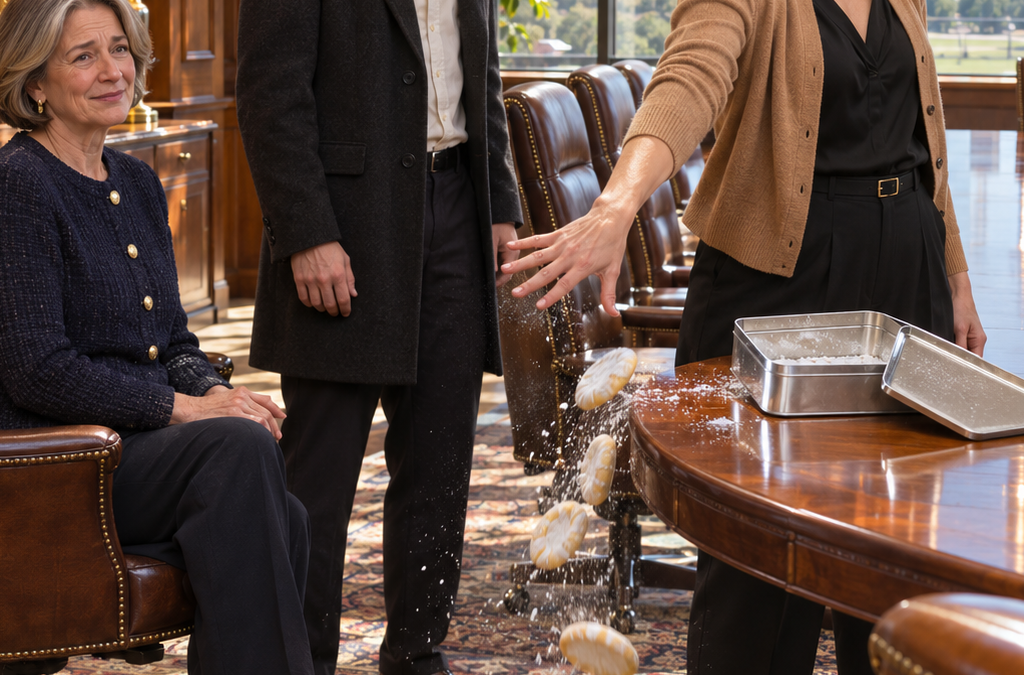
My sister swept the funeral cookies I’d baked after leaving work to nurse Mom onto the lawyer’s floor and said, “Clean that up before you leave.”
Chapter 1 of 7
“Do you really want me cleaning this now?” I asked.
Dana Cole brushed crumbs from Mark Ellis’s conference table. She hadn’t eaten one; the cookies had barely cleared the carrying tin before she’d shoved them away.
“Don’t bring food nobody asked you to make.”
Our aunt Linda Ross gave a nervous laugh. Powdered sugar had landed on her shoe.
“Are you going to let her do this?” I asked her.
“Please, Evan. We’ve all had a hard week.”
Then she looked away.
Mark’s Dallas office smelled like coffee left on a warmer. We’d come voluntarily to discuss Mom’s papers after the funeral, and Dana had brought a folder bearing our street’s name beneath her elbow.
It wasn’t something Mark had given her.
At thirty-two, I was still Evan Parker, the boy Mom had legally adopted at eight. Dana was thirty-nine; she’d come back after eleven years away and moved straight into the house.
The house Dana had moved into was my own house.
I was a baker. For five years, I’d cut my shifts around Mom’s needs. When her final illness worsened, I left work to nurse her.
My flour-streaked apron still hung behind her kitchen door, beside a grocery bag she’d saved because she claimed they didn’t make them that sturdy anymore.
Her last toast had been cut into little squares. She’d managed three.
Linda always requested these cookies, with extra lemon zest, and even that morning I’d checked every bottom for burning before packing them into the carrying tin.
I kept feeding people who treated me as disposable.
Dana’s house-sale folder lay beneath Mom’s funeral program.
The print showed through its clear cover. My eyes stayed on the word sale until Dana shifted her elbow over it.
She hadn’t mentioned selling anything.
Mark had provided copies of the will Mom signed eight years earlier. He’d explained that this meeting was a chance to discuss her arrangements, not a ceremony where somebody handed out everything she’d owned.
Dana had heard what she wanted.
“Leave Mom’s spare keys before you go.”
They were in my coat pocket. My coat was still on because I hadn’t planned to stay long.
She leaned toward me, away from Mark.
“The will leaves it to me. I decide what you take.”
Linda nodded without looking at the floor, where the cookies she requested at every family gathering lay broken beneath our chairs.
“Stop upsetting the family, Evan. Just do what she asks.”
That hurt more than Dana’s order. My face burned, and I couldn’t make myself look at Linda’s shoe again.
“You’re keeping the house and deciding what I’m allowed to take?”
Dana said yes, and she wanted the keys now.
Then she pointed down.
“Pick up EVERY LAST ONE!”
Several cookies had broken beneath the conference table, but one whole cookie rested against Mark’s chair, its fork marks still visible beneath the dusting of sugar.
“Keep your hands off my things,” I said.
And I stepped outside.
The office door shut behind me. In the hallway, my hands shook too much to select Laura Reed’s number on the first try.
Laura was the lawyer I’d hired for myself. She answered before I could put together an explanation.
“Dana’s filing lists the house as estate property. She’s also asked permission to pursue a sale.”
So that was the folder.
I told Laura where I was. She confirmed that the papers she’d filed for me the previous Friday were moving forward, then told me to send anything new.
We ended the call.
The following morning, I returned for the personal belongings Mark had arranged to give me.
He placed Mom’s smoke-marked cookbook in my hands. Its taped spine bent against my palm.
Dana and Linda were there for their papers.
Then Ben Ortiz arrived, identifying himself as a Dallas County deputy constable.
He confirmed Dana’s name and handed her papers.
“This is a family matter,” she told him.
“These are court papers concerning your claim to the house.”
Dana looked toward Mark, expecting him to intervene.
“Having the will doesn’t settle the house question,” he said.
Her fingers moved toward my coat beside the book.
Ben unfolded another page. Dana stopped reaching for the keys.
Her name was on the first sheet. Mine appeared farther down, spelled out in full: Evan Parker.
Dana read that part twice.
Then she looked at me over the top of the papers. Her expression settled into something almost relieved. She thought she understood now.
“You’re mad because Mom left things to me.”
Linda moved closer to her chair. Neither of them looked at the book.
The papers identified me as the person contesting Dana’s treatment of the house. They didn’t say she had to leave that morning. Ben hadn’t asked for keys or told anybody who owned anything.
He’d delivered papers.
But Dana kept talking as though Mark could make them disappear if she explained our family correctly.
“He was adopted. She raised him, but that doesn’t mean—”
Mark interrupted. “You need to read what you’ve been given.”
I barely heard her answer.
The cookbook’s cover had softened with years of use. Mom used to prop it against the flour canister, though she could have made most recipes without looking.
This time, the back felt wrong.
There was something stiff beneath the rear sleeve.
My thumb caught an edge inside the cover.
A folded sheet slid halfway into view.
Dana stopped talking and watched the paper emerge.
I opened it across the book’s stained pages.
A raised seal pressed against my fingertips.
Inside Mom’s cookbook, the county stamp named a deed.
There was my name again.
Mom’s name appeared above it. The property description followed. Dallas County’s recording information sat along the edge, with a number and a stamp I didn’t know how to read.
I knew she had transferred the house. I hadn’t known she’d kept this copy here.
For a moment, I wanted to ask her why she’d chosen the cookbook. Grief could still do that. It could make a question feel possible before I remembered there was nobody left to answer it.
“Give me that book,” Dana said.
“No.”
She stood.
Linda looked between the paper and Dana. Then she looked at Mark, who remained beside the table.
“Those are family papers. Dana ought to have them.”
The book smelled faintly of old smoke. Ruth Parker, my mother, had written substitutions in its margins, sometimes correcting a recipe she’d already corrected twice. That handwriting was easier for me to recognize than any stamp.
My throat hurt.
I’d spent weeks trying to get her to eat. Now I was standing in her lawyer’s office, defending the right to hold a book she’d used to feed us.
“Your mother brought it here for Evan,” Mark said. “She asked me to give it to him.”
Dana turned toward him. Her voice changed.
“Mark, surely she meant for us to sort through it together.”
“She said Evan.”
Linda suggested I let Dana look so we could stop fighting. I kept the book open where both of them could see the sheet.
Dana took out her phone.
She photographed the stamped copy, leaned closer, and took another picture of the names. I didn’t stop her. Then her attention moved from the paper to the blackened corner of the cover.
Her expression changed.
Dana pointed at the scorch and said, “Mom tried to burn that book before you could get it.”
Chapter 2 of 7
“Evan, it’s Grace Bennett, from next door. Your mom’s stove fire was an accident. I pulled that book out myself.”
The voicemail came two days after Dana pointed at the scorch. I listened outside the room I was renting, with my breakfast going cold in a paper bag.
“I still have your mom’s messages. I’m away helping my sister, so I can’t bring the phone yet. Call me when you can.”
Grace had driven Mom to appointments when my bakery shifts ran late. She knew which side door stuck and how loudly Mom liked the television.
Linda had called me at work about the smoke. I remembered flour on the phone screen and asking whether Mom had breathed any of it.
Nobody had mentioned Mom trying to burn anything.
Relief came first. Then I felt sick that Dana had made me wonder.
“Can you send me that voicemail?” Laura asked when I called her.
She listened without interrupting. Then she told me she had checked the recorded deed against the Dallas County record.
“The certified copy matches. Your mother completed the transfer, but the court still has to resolve Dana’s challenge.”
Mom’s decision existed somewhere besides a sheet Dana could demand from me. I needed to hear that, even though it didn’t give me anywhere to sleep.
“Then can I go home?”
“You own it. Don’t change the locks while she’s occupying it. We’ve asked the court to resolve that too.”
I hated needing permission to approach my own front door. But I told Laura I wouldn’t go there.
The room cost $210 a week. It had a narrow bed, a dresser with one drawer that wouldn’t close, and a window facing a fence.
My grocery bag held two breakfast tacos. Mom used to call those an excuse to eat potatoes twice, then ask me to bring her one.
I ate both standing up. There wasn’t a table.
Afterward, I called people I used to work with. I asked about early shifts, weekend shifts, anything paid. Saying I was ready to come back was easier than explaining where I’d been sleeping.
One former supervisor offered me a trial shift that afternoon. She couldn’t promise regular hours.
I said yes before she finished.
“Did Dana ask where I’m staying?”
“Just withdraw it for a month,” Linda said when she called later. “Let everybody settle down.”
I was sitting on the bed, checking whether my work shoes still had enough tread. She sounded tired, but she hadn’t called to ask about me.
Dana had sent her a message for the family group. Linda read parts aloud: I was suing our dead mother’s estate, threatening Dana’s only home, making grief harder than it needed to be.
“Did Dana ask where I’m staying?” I asked.
“She’s frightened, Evan. You have to understand.”
Her answer hurt. My room key lay beside a receipt for another week, and she was asking me to protect Dana from feeling unsettled.
“You can call me without carrying her messages.”
Linda stopped reading. For a moment, I heard only her television.
Then she said she was trying to keep us together.
I told her I had to get ready for work. After we hung up, I sat there longer than I should have, ashamed that part of me still wanted her to call back and choose me.
The bakery smelled of warm butter and the floor cleaner they’d used for years. My former supervisor had saved an apron, though someone else had inherited my locker.
For the first hour, my hands remembered everything. Dough gave under my palms. I could judge portions without checking each one twice.
The supervisor asked me to finish a tray of pecan rolls while she handled an order.
It felt good to be useful at something I understood. Nobody needed me to defend the years I’d spent beside Mom’s bed.
Then my phone buzzed.
Dana’s family message had reached me directly. The preview began with Mom and ended with taking away the only place I have.
I knew I shouldn’t open it. I read it anyway, standing near the cooling racks while the oven timer counted down behind me.
She’d written that she had nowhere else to go. She’d asked everyone to tell me to stop before I destroyed what remained of our family.
The timer sounded. I silenced it without taking out the tray.
By the time I smelled the sugar burning, the bottoms were black.
“I need you watching the oven,” my former supervisor said.
I apologized and threw the rolls away. I was humiliated; she had trusted me with work I’d done hundreds of times.
She let me finish cleaning. Then she offered two short shifts the following week, fewer hours than I’d hoped for.
I thanked her. There wasn’t anything else to say.
Outside, I turned off notifications from the family group. It wouldn’t replace the lost hours, but I couldn’t afford another tray.
Dana’s next message came while I was walking back to my room.
The photograph showed my baking equipment piled behind the utility-room door: sheet pans on their edges, cooling racks wedged together, my mixer on the floor. Its bowl was missing from the picture.
I’d kept that equipment clean through every apartment and every borrowed kitchen. Seeing it shoved there made me angry enough to stop walking.
A second message arrived with an attachment labeled as a property form. Dana said Linda would handle bringing things over.
I hadn’t opened the attachment when the last line appeared.
Dana’s message said, “Linda has your mixer. Sign my form and she’ll bring it.”
Chapter 3 of 7
The form called itself a receipt for my belongings. Below the list of equipment, it said I would withdraw my claim to the house and stop contesting Dana’s treatment of it as Mom’s property.
My mixer wasn’t being offered back. It was being used to get my signature.
“I’m not signing this,” I told Linda over the phone.
She said we could discuss it when I came over. Dana was already at her house, and I could hear her asking who Linda was talking to.
That Monday, I walked up Linda’s driveway with the unsigned form on my phone. Her garage door stayed closed.
Linda stood beside it in the cardigan she wore to every family dinner. Dana waited near her car, still dressed for work, her employee badge hanging against her blouse.
“Where’s my mixer?” I asked.
Linda said it was safe. She didn’t offer to open the garage.
Dana looked down at my work shoes. Flour had settled into the stitching.
“You can’t support yourself without what Mom bought you.”
Mom had bought me plenty over the years. School shoes. A winter coat. Groceries when my first bakery job cut hours. The mixer wasn’t one of those things.
“I bought it with my own wages,” I said. “It’s my work equipment.”
Linda suggested we go inside and talk. But the garage stayed shut, and neither of them moved toward it.
I was humiliated standing there explaining a purchase I’d made as an adult. Linda had eaten birthday cakes mixed in that bowl. She knew what it was for.
“Eleven thousand one hundred dollars, Evan. I can’t just find another place.”
“I’m not paying for permission to collect my own tools.”
Dana said nobody had asked me for money. Then she followed me toward the sidewalk.
She had six months of unpaid rent from her apartment. She said it quickly, as though the number would become less embarrassing if she didn’t pause.
“Eleven thousand one hundred dollars, Evan. I can’t just find another place.”
The total was $11,100. Her voice cracked on the last word, and for a moment she looked exhausted rather than angry.
I knew she worked. I knew a paycheck could disappear before the next one arrived. But she was asking me to keep renting a room so she could live in my house.
“Let me keep it. You could buy peace for once.”
Peace meant leaving my equipment behind her aunt’s garage door. It meant giving up my kitchen, too.
I told her I wasn’t agreeing to that. Then I left without the mixer.
Nothing had changed when I reached my rented room. The house was still occupied, and refusing the form hadn’t settled anything. My work shoes dried beside the bed.
A former coworker let me use bakery equipment during a gap between production runs. It was temporary, and I had to be finished before the next shift needed the space.
“The mixer’s yours until they start bread,” she told me.
An office had asked about four dozen boxed lunches, including rolls and cookies. With the borrowed time and limited oven space, I could manage two dozen.
I called and reduced the order. The customer accepted, but the smaller job meant less money after ingredients and packaging.
Mom used to count every slice when we made sandwich platters. She called the heel “the cook’s tax” and ate it before we could object.
Remembering that made me laugh once in the empty prep area. Then it hurt. I wanted her there complaining that I’d sliced the bread too thick.
“Dana’s response came in,” Laura said that afternoon.
She waited while I stepped away from the bakery’s refrigerator. Dana now said I had used Mom’s dependence on me to get the house. She also said the fire showed Mom regretted giving it away.
Laura didn’t call either claim ridiculous. She said they would need to answer with evidence.
The accusation made me feel ashamed before I could stop myself. I’d helped Mom dress. I’d read labels when her eyes were tired. Dana had turned those ordinary things into something I had to defend.
After the call, I reached Grace.
“Dana wasn’t there when the pan caught,” she said. “I was next door. I came over when I smelled smoke.”
Grace described an accident, not an argument. She had rescued the book, and Mom had later asked for a ride to Mark’s office.
Grace had watched her entrust it to him.
I asked whether she could tell Laura. She said yes, and mentioned the original message thread still on her phone. She didn’t read it to me.
For the first time that day, I could sit without feeling I needed to get up and fix something. Somebody else remembered Mom making a decision.
“I’ll be there for Dana when this gets to court,” Linda told me that evening.
She had called after forwarding a family post. Before I opened it, two relatives who’d offered to help move my things into storage canceled. One said it was best not to get involved. The other only apologized.
Linda said Dana needed someone beside her. I asked whether she thought I didn’t.
She answered that she wasn’t choosing sides.
My storage reservation was still on my phone. So was the list of equipment I couldn’t collect. I hadn’t asked anyone to fight Dana for me; I’d asked for help carrying boxes.
After Linda hung up, I opened the forwarded post. Dana had written about me manipulating Mom while she was weak. Beneath that was the sentence Linda had sent to the rest of the family.
“He made her sign when she couldn’t manage alone.”
Chapter 4 of 7
“Depending on you isn’t the same as being pressured by you,” Laura said. “But we do have to answer that accusation. Adoption has nothing to do with it.”
We were in her office. Dana’s post was open on my phone, though Laura already had a copy.
“She did depend on me,” I said.
Laura waited.
I bought Mom’s groceries. I scheduled appointments, kept track of refills, and answered calls when she didn’t feel well enough. Denying it would have meant pretending away most of our last years together.
“Did you decide who she could talk to?”
“No. She called people herself. Sometimes to complain about me.”
Mom once called Linda because I bought reduced-sodium broth. She said she was sick, not serving a sentence.
The memory almost made me laugh. Then I remembered Linda’s post, and it hurt again.
Laura asked who had seen Mom making her own decisions. She wanted people who were actually there, not relatives willing to say she’d always been stubborn.
That was how Karen Price entered the conversation.
Karen had handled the house transfer for Mom. With the necessary permission arranged, she provided her file and spoke with Laura while I sat nearby.
“Ruth contacted my office,” Karen said. “My instructions came from her.”
Her voice was measured. She didn’t sound offended on Mom’s behalf, which disappointed me at first. I wanted somebody to sound as angry as I felt.
But Karen could tell us what had happened.
Mom had met with her privately. I hadn’t arranged the appointment or attended it. Karen’s records showed the completed transfer and the county recording before the stove fire.
“Was I working that day?” I asked.
Laura said we could get my work records. Karen wasn’t going to guess about where I’d been.
I liked her better after that.
The file contained appointment notes and copies of the signed papers. Reading Mom’s name in somebody else’s account made her seem briefly alive and busy, with a place to be that didn’t involve me.
I was relieved. I was also sad enough to lose track of a question Laura asked.
She repeated it without making me apologize.
“Grace drove her,” I said. “Ask Grace about the ride.”
Grace joined a later call from her sister’s house. She remembered taking Mom to Karen’s office and waiting while Mom went inside.
She could also describe the accidental fire and what she’d rescued. Her messages were still on her phone.
“I can tell you what I saw,” Grace said. “I wasn’t with Ruth every minute.”
Laura told her that was all she wanted. Grace wasn’t being asked to explain every decision Mom had ever made or give a medical opinion.
Afterward, I stopped trying to remember witnesses for every grocery trip. It was exhausting, turning ordinary care into a defense.
Laura sent the records to Dana’s newly retained lawyer, Robert Wells. Nothing went through Linda or the family group.
Dana called me after she received them.
“So she actually signed the house over.”
“Yes.”
“Before she died. Not something you were supposed to get later.”
I said yes again. For once, Dana didn’t interrupt.
I could hear her breathing. She had photographed the copy at Mark’s office, but now another lawyer had shown her the same transfer in records she couldn’t dismiss as something I’d found in a book.
“Robert says the will can’t get it back by itself,” she said.
She sounded almost accusing, as though I had persuaded him too.
“Then listen to him.”
Her next words came louder.
“You don’t get rewarded for hanging around.”
I was sitting on my rented bed, still wearing clothes from a short bakery shift. My feet hurt. I hadn’t been paid for the hours I’d spent helping Mom reach the bathroom.
“I wasn’t hanging around.”
Dana told me she had to go. She hung up before I could say anything else.
By evening, her account had changed.
In a message copied to Laura and Robert, she wrote that she understood the papers existed. Her concern, she said, was how a vulnerable mother had come to sign them while relying on one child for nearly everything.
“She wants the transfer set aside. We’ll answer it with the witnesses and records.”
She called me her brother in that message.
Privately, she sent another: You knew what you were doing.
I forwarded both to Laura. Then I put the phone across the room so I could eat.
“The argument now is undue influence,” Laura told me later. “She wants the transfer set aside. We’ll answer it with the witnesses and records.”
A hearing notice followed. We would appear Tuesday, May 12, at nine in the morning, before Judge Helen Brooks in a Dallas County statutory probate courtroom.
Both the ownership question and our request that Dana surrender the house were included. Laura said Karen and Grace would testify; Dana and I would attend with our lawyers. Linda and other relatives could come too.
I wrote the appointment on the back of my shift schedule. I was afraid of losing hours, afraid of being questioned, and ashamed that I still wanted Linda to sit beside me.
Her call came while I was checking the bus route.
“Dana’s trying to get everything straight,” she began.
I asked what that meant. Linda hesitated long enough that I thought she might hang up.
Then she said, “Dana sent Grace a statement. Grace won’t sign it.”
Chapter 5 of 7
“Dana wrote that your mom meant to destroy the gift,” Grace told me. “I never saw anything like that. I wasn’t signing it.”
We were at Laura’s office the day before the hearing. Grace had come back from helping her sister and brought her original phone, still in its faded blue case.
She sounded annoyed rather than frightened. Dana’s proposed statement had described an intention Grace couldn’t possibly have witnessed.
Laura asked whether Grace had answered Dana. Grace said she’d told her no, and why. There hadn’t been another conversation.
That helped. I’d spent weeks hearing people repeat Dana’s account until it seemed louder than anything I remembered.
“The whole conversation, please,” Laura said. “We need the dates and the messages around it.”
Grace gave her permission to have the thread copied. She explained which number had been Mom’s and how long they’d used it to arrange rides and errands.
The phone stayed on Laura’s desk while they checked the copies against it. There were exchanges from before the transfer and others after the fire. I watched Grace recognize them without having to search her memory.
Laura sent the material and Grace’s identifying information to Robert and submitted it to the court that afternoon. She offered him access to the phone and time to review everything with Dana.
I was relieved, but the relief embarrassed me. Grace had simply kept conversations with her friend. Now she had to explain them to strangers because my sister had made caring for Mom sound suspicious.
“Will this change tomorrow?” I asked.
Laura said Robert would tell us after he reviewed it. She wasn’t going to predict what he’d ask for.
While Grace waited outside, Laura asked me to describe my part in Mom’s care. Once, plainly, without trying to answer every accusation Dana might make.
I started with appointments. Then meals, laundry, the calls from the pharmacy. Before long, I was counting missed shifts.
My voice sounded ugly to me. Mom had needed help, and I was making it sound like an unpaid balance.
“I don’t want to do this,” I said. “I don’t want to count everything.”
Laura said she needed to understand what I did, not what I thought Mom owed me. I could explain the ordinary days without assigning them a price.
Mom had liked her scrambled eggs barely set. If I cooked them too long, she called them packing material. During her last illness, I’d made them softer and softer, hoping she’d eat another forkful.
That was the part I could tell.
“He’ll argue that later affection and generosity don’t answer whether there was pressure earlier,”
I can describe loving her without sending anyone a bill.
The thought settled me enough to finish. There were things I couldn’t remember exactly, and I said so.
Later, Laura called to say Robert had reviewed the new material and would proceed. He wasn’t asking to delay the hearing.
“He’ll argue that later affection and generosity don’t answer whether there was pressure earlier,” she said.
I hated how reasonable that sounded. Laura reminded me that he represented Dana. His job wasn’t to accept our explanation before the judge heard the evidence.
Dana’s offer came through the lawyers that evening.
I could collect my equipment. She would stop circulating accusations. In exchange, I would abandon my claim to the house and agree that it belonged with the estate.
There was no payment offered for the house. My mixer was still part of the bargain.
“She says this protects your mother’s memory,” Laura told me. “And keeps a roof over her head.”
For a few seconds, I wanted the fighting to stop badly enough to picture signing. Then I pictured another week in that rented room, asking for borrowed oven space while Dana decided what I could collect.
“No,” I said. “Please tell Robert I’m declining.”
Laura asked whether I wanted to propose anything else. I didn’t.
That night, I washed my work clothes in the sink and hung them over the shower rod. The shirt I’d saved for court was already clean.
I barely slept. By morning, I was tired enough to resent the effort of buttoning it.
“Come sit here,” Grace said when I reached the courthouse corridor.
She’d left room beside her. Karen waited farther down, keeping her transfer file with her while Laura checked where the witnesses should wait.
Linda arrived carrying Dana’s hearing folder. Dana walked beside her in a dark jacket, talking before they’d reached us.
Several relatives from the family messages had come too. One told Linda that Dana had asked them to hear what really happened.
I felt humiliated all over again. They’d dressed to watch me explain myself.
“I’m saving the family home,” Dana told Linda. “He pressured her, and now I’m supposed to disappear.”
Linda glanced toward me but kept the folder.
Dana noticed my work shoes beneath my good pants.
“You could’ve ended this yesterday,” she said.
I didn’t answer. Grace stayed beside me.
When Robert approached, Dana’s voice softened. She thanked him for coming early and asked whether he had everything he needed. A moment later, she was telling Linda I’d dragged them all there.
Laura came back for us. Karen remained where she’d been told to wait until she was called.
Inside, Robert guided Dana to their table. Linda followed into the seats behind her, still carrying the folder. Grace sat beside me until Laura needed me at our table.
Dana opened the folder Linda had carried. Beneath the hearing papers were the proposed sale documents I recognized from Mark’s office.
Dana pushed the proposed sale papers toward Robert and said, “Put that on the record.”
Chapter 6 of 7
“Tell the judge what you say your brother did,” Judge Brooks said.
Dana had been sworn in. That morning, she looked past Robert toward the relatives seated behind him.
“Mom depended on Evan for everything. Food, medicine, getting dressed. He used that.”
She acknowledged the recorded deed. But she said Mom had signed because she feared losing my help.
“Then she tried to burn the cookbook. That was her trying to stop it.”
Linda sat holding Dana’s folder. Grace and Karen waited to testify. Everyone Dana had invited heard her say it.
I was angry, but mostly I wanted Mom out of that account. She had hated needing help. Dana was making that need her whole life.
When Laura called me, I answered questions about my work and Mom’s care. Then she asked about the book.
“She kept the proof after the fire,” I said. “She took it to Mark herself.”
The cookbook lay beside Laura’s papers. When directed, I brought it forward and identified the taped spine and rear sleeve. The copy had already been compared with the county record.
Mom’s penciled correction showed beside a biscuit recipe: less milk, fool.
She’d meant herself. Seeing it there almost undid me.
“Please ask Grace how it got to Mark,” I said. “If Mom wanted it destroyed, why bring it to him afterward?”
Robert questioned me about the help Mom needed. I answered without pretending she had managed alone.
When Dana returned to testify, she had an answer for the book.
“Maybe she was scared to upset him. Saving a book doesn’t mean she wasn’t scared when she signed.”
Robert kept his argument narrower. Later affection, he said, didn’t settle whether the original decision had been free.
I hated that I couldn’t answer by telling them how much I loved her. Love wasn’t something anyone could check against a file.
“Ruth contacted me herself,” Karen testified.
She identified her appointment records and the papers Mom had signed. They had met privately. I hadn’t scheduled the visit, attended it, or given Karen instructions.
Karen described Mom completing and delivering the transfer. The county recording followed before the fire.
Robert asked whether she knew everything that happened at home. Karen said she did not.
That answer frightened me less than it once would have. She wasn’t guessing to help me.
Grace came forward with her original phone. She identified Mom’s number and explained how they used messages for rides and errands.
Laura had her compare the copies with the conversation on the device. Robert had reviewed them and questioned her about the surrounding exchanges.
Then Laura asked her to read the message sent three days before Mom met Karen.
“Evan says not to change anything. I’ve decided anyway.”
My face grew hot. I remembered asking Mom to leave things alone. I hadn’t known she had told Grace.
Grace read the request for a ride that came with it. Mom had already chosen whom she wanted to see.
Under Robert’s questions, Grace agreed she hadn’t heard every conversation between us. But those words had come from Mom’s number, in their ordinary conversation, before the appointment.
“The kitchen fire was a pan catching,” Grace said. “Dana wasn’t there. Evan was working.”
She described rescuing the cookbook. Three days later, Mom asked her for another ride, this time to Mark’s office.
Grace drove her and watched her hand the book to him for me. She hadn’t inspected the rear sleeve. The certified copy was there when Mark delivered it to me.
I felt relieved enough to notice how hard I’d been pressing my feet against the floor.
Judge Brooks recalled Dana and asked whether she had attended Mom’s private meeting with Karen.
“No.”
Had she been present for the fire?
Dana said no again.
After testimony ended, I returned to the front bench while the lawyers finished. Linda stood across the aisle.
“I told you Evan was working when the pan caught,” she said to Dana.
Then she crossed over and sat beside me.
“Sit back down. You’re making this worse.”
Linda stayed. Her knee shook beside mine. I didn’t reach for her.
Judge Brooks looked at the evidence before giving her decision.
“Her independent instructions beforehand and deliberate preservation afterward defeat this account of coercion and destruction on the evidence presented.”
The completed transfer stood. The house was mine, not estate property.
Then she ordered Dana to surrender possession of the home, valued at $457,000, by June 2.
Twenty-one days.
Dana stared at Robert. Behind her, nobody offered an explanation that could turn those words into something else.
After we were excused, Dana stood and reached for the folder Linda had left behind.
“Stop this,” she told Robert. “Ask her to stop it.”
He spoke quietly about reviewing the written order and her remaining options. He didn’t promise a reversal or tell her she could ignore the deadline.
“You don’t get to make me smaller to keep yourself comfortable.”
The relatives moved into the corridor without gathering around her. One paused near Linda, then kept walking. I felt sad watching them leave. None had asked where I’d been sleeping.
Dana turned to me.
“You know I can’t move that fast.”
“You don’t get to make me smaller to keep yourself comfortable.”
My voice shook. I let it.
I told her all access and moving arrangements would go through Laura. There would be no private bargain over my equipment, no meeting at Linda’s garage.
Linda started to speak, then stopped when I said I wasn’t ready.
Laura and Robert discussed belongings, access, and the deadline. Dana listened with her phone in her hand. A message arrived while they were still talking.
She read it twice.
Dana turned her phone toward Robert. “Truck confirmed for June 2.”
Chapter 7 of 7
On June 2, the moving truck backed into the driveway while I waited beside Laura’s car.
Dana carried out two bags, then went back for a box. Linda stood near the sidewalk. She didn’t ask me to help or tell me how hard this was for Dana.
I stayed outside until the truck was loaded.
“That’s everything,” Dana told Laura.
She gave Laura the keys, including the spare she’d demanded from me at Mark’s office. Laura confirmed that Dana had finished moving out, then handed them to me.
Only then did I walk to the door.
I hadn’t changed the locks or gone inside ahead of the handover. Now I could enter without asking. I was relieved, but my fingers wouldn’t stop shaking against the key.
“The payment arrived too,” Laura said.
Dana had paid $2,400 toward my legal expenses under the written settlement our lawyers negotiated afterward. The judge hadn’t ordered it as punishment. It covered only part of what the dispute had cost me.
Dana stood beside the open truck door, checking something on her phone.
“My studio’s sixteen twenty-five a month,” she said. “Before electricity.”
I knew she meant $1,625. She waited as though I might offer to make up the difference.
“That’s between you and your landlord,” I said.
She looked at Laura, then at Linda. Neither answered for me. Her old apartment debt remained hers, too. I hadn’t promised to pay it, and I wasn’t going to.
The truck left before I entered the kitchen.
There was an empty square where Mom’s small radio had stood. I’d packed it away myself after she died, but for a second I looked for it anyway.
The faucet dripped. One cabinet door hung crooked, and the window above the sink wouldn’t stay raised.
I chose the faucet first. It was something I could fix without deciding what to do with the rest of the room.
“Do you want me to stay?” Laura asked from the doorway.
“No. Thank you. I think I’m all right.”
She said she’d send the last paperwork, then left me there.
I cried after her car pulled away. I’d wanted this kitchen back so badly that I hadn’t let myself think about being in it without Mom.
The refrigerator motor started. Outside, Linda was still waiting beside her car.
“Your mixer’s in the back,” she said when I came out. “The bowl too. All the pans.”
We carried everything inside. She’d brought the smaller things in grocery boxes, with my cooling racks laid across the top. Nothing was missing.
“I looked away when Dana threw your cookies,” Linda said. “And I kept your mixer when you needed it for work. I knew it was yours.”
She didn’t add that she’d been confused. She didn’t say we’d all made mistakes.
I was grateful for that, though I still felt hurt looking at her.
“You could’ve opened the garage,” I said.
“I know.”
“And you don’t get to arrange things here for me.”
We stood beside the equipment. For weeks, I’d imagined telling her exactly what those lost jobs had cost. Now I mostly wanted her to understand that returning it didn’t erase what she’d done.
“I’m not ready to have you dropping by.”
“I won’t.”
“And you don’t get to arrange things here for me.”
She said she understood. When she asked whether we could eat together sometime, I told her Sunday. One meal, at my invitation. She could bring herself; I didn’t need her bringing anything else.
That Sunday, she arrived when I’d asked her to. She left without inspecting the cabinets.
Over the next few weeks, I settled into regular bakery shifts. There were early alarms, sore feet, and paychecks I could plan around. I wasn’t opening a shop. I wanted steady work and enough left over to keep the house in decent shape.
My mixer went back on the counter. I used it for small orders on my days off, when I actually had the time.
The first night I slept in my old bedroom, I woke up thinking Mom had called.
That hurt worse than the empty kitchen. I lay awake until I could hear traffic outside, then got up and made breakfast for one.
“Keep a spare key for me,” Dana wrote a few weeks later. “For emergencies.”
She sent it as though we were discussing where to leave a package.
“No,” I wrote. “You can reach me by message.”
She called twice. I let both calls go, then repeated that I would read messages. There was no emergency, and I didn’t owe her another argument.
After that, our contact became occasional and brief. We didn’t become close. I stopped expecting each message to turn into an apology.
Nine months after Mom died, her separate estate closed.
The final accounting started with $18,400. Funeral expenses and her last ordinary bills came to $6,200. Administration cost another $3,200, leaving Dana the $9,000 Mom’s will entitled her to receive.
I checked the figures, then put the accounting away.
It didn’t upset me that Dana received the money. Mom had signed that will, and it still mattered for what remained in her estate. The house wasn’t part of it.
For once, there was nothing I needed to defend.
Later that month, I had a Saturday morning off. Nobody was coming for breakfast. There were no orders waiting.
I opened Mom’s cookbook on the kitchen counter.
The taped spine held. Smoke still marked the edge, though the smell had faded. I found her orange rolls, the ones she always said needed more filling than the recipe admitted.
I wanted those. Not for a customer, or because someone would complain if I made something else.
The faucet no longer dripped. My work apron hung behind the door, and the window stayed open on its own now.
I missed Mom. I wished she could have seen me there, working in the kitchen without watching my phone.
Being family never meant I had to disappear.
I turned Mom’s scorched page and started the next batch.







