My Son Emptied My 8-Year-Old Grandson’s $2,140 Coffee Can of Lawn Money—Then Held Up the Cash in Front of 80 Parents
Complete story · 7 chapters · about 35 minutes · ending included
Chapter 1 · Chapter 2 · Chapter 3 · Chapter 4 · Chapter 5 · Chapter 6 · Chapter 7
Chapter 1: The Coffee Can on My Bench
Samuel was halfway through reading the serial number on a twenty at 4:10 p.m. on Saturday, July 26, 2025, when my son Justin walked into the garage and said, “It’s just lawn money, buddy. Daddy needs it more.”
He looked at Samuel, then at me.
“He’s eight. He won’t remember this in a month.”
I didn’t answer.
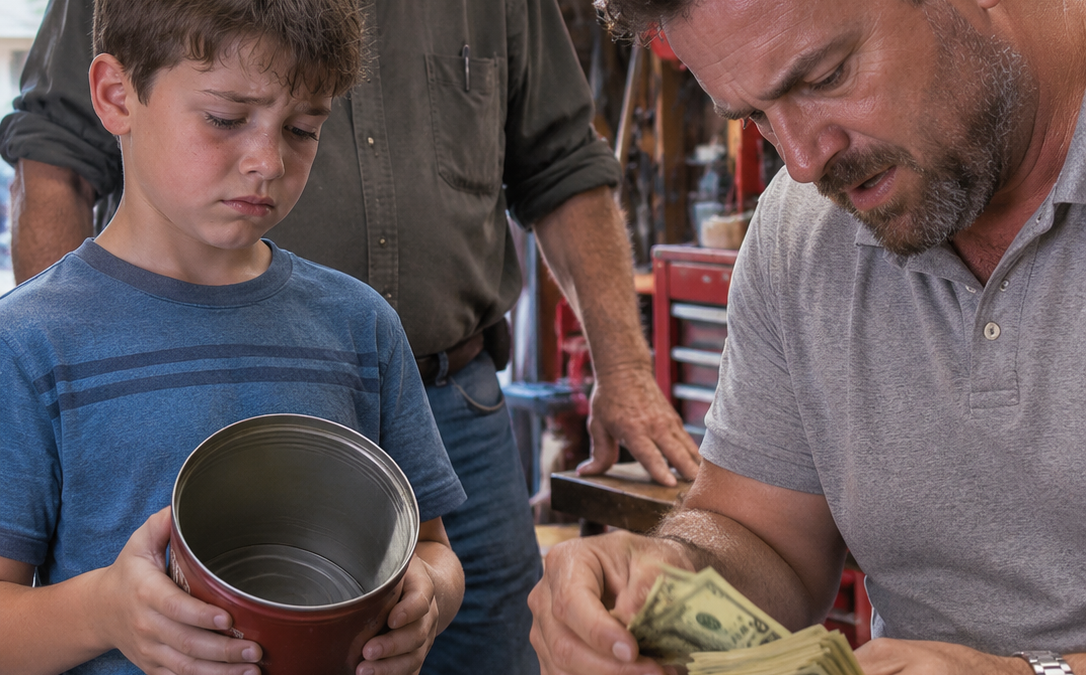
Justin walked straight to my workbench, where Samuel had arranged the bills in neat stacks. Then he picked up the coffee can.
Samuel stopped speaking.
The can had held 107 twenties. Two thousand, one hundred and forty dollars. Every dollar had come from mowing lawns over two summers.
That money belonged to my eight-year-old grandson.
Justin knew exactly what it was for.
I was seventy years old, and repairing engines in the two-bay garage behind my house on the east side of Tulsa had been my livelihood for decades.
I kept records on everything. Parts, labor, customer payments, oil changes, and the occasional favor I did for somebody who couldn’t afford a repair.
Samuel had picked up that habit from me.
He was a third grader and played second base in his little league. He liked numbers and took the business of saving money seriously.
In May 2024, he had asked whether he could earn money for a baseball camp in Kansas City.
The camp was scheduled for June 2026.
He had seen the flyer and decided he wanted to go.
I told him that if he wanted the money, we could find him some work.
His first customer was our neighbor, Doreen Perkins, who was seventy-seven. On Saturday, May 4, 2024, she agreed to pay him twenty dollars to mow her lawn.
Samuel pushed the electric mower.
I handled the slopes and the places where the machine couldn’t safely go.
When we finished, Doreen handed him a twenty.
He put it in his pocket until we got back to the garage.
Then he dropped it into an old coffee can on my workbench.
That was how it started.
We made a Saturday count part of our routine. Samuel brought out the money, arranged the bills, and read each serial number aloud.
He was practicing numbers, and I was making a record.
I took a photograph of every bill with my phone.
By July 2025, the can held 107 twenties.
Samuel knew the total without looking at his ledger.
Two thousand, one hundred and forty dollars.
Justin had never attended one of those Saturday counts in two summers.
He sold trucks for a living and had his own schedule, his own expenses, and his own opinions about money.
He was also president of the Mudcats booster club.
That afternoon was the first time in two years he had walked into my garage while Samuel was counting.
I hadn’t expected him.
Neither had Samuel.
Justin lifted the coffee can and turned it upside down.
The bills slid across the wooden bench.
He was the only person who touched them.
Samuel’s hands stayed at his sides.
Justin put the empty can into Samuel’s hands.
Then he started counting the twenties.
I watched my son sort through money his own child had earned.
I could have stepped between them.
I could have grabbed the bills off the bench or called for somebody to come outside.
But Samuel was standing there, holding an empty can, watching his father take the money.
I wasn’t going to turn that garage into a fight he would remember for the wrong reasons.
“Count it twice,” I said.
Justin glanced at me.
He counted the bills again, folded them into a thick stack, and pushed them into his pocket.
Then he walked out.
His truck started in the driveway.
A few seconds later, I heard it pull away.
Samuel was still holding the coffee can.
He looked down inside it, turning it slightly as if something might have gotten caught along the bottom.
There was nothing.
He didn’t cry or complain.
He looked at me.
“Did we take today’s picture?”
“Every one.”
I brought up the album on my phone.
There were 107 dated photographs.
Each one showed a twenty-dollar bill and its serial number.
I had started keeping those photographs in 2019, after Justin pawned my torque wrenches.
The wrenches had stamped identification numbers. I had recorded them, and those numbers helped me get them back.
After that, I made a habit of photographing the serial numbers on things I couldn’t afford to lose.
I never told Justin about the pictures.
There was no reason to.
A photograph of a twenty-dollar bill didn’t prove anything until that particular bill showed up somewhere it shouldn’t.
And telling Justin about the photographs would give him a reason to exchange the money.
I scrolled through the album.
Samuel leaned closer.
“That’s a lot of pictures, Grandpa.”
“One for every bill.”
He pointed to the first photograph.
“That’s the one from Mrs. Perkins.”
I knew the number without looking at the screen.
PJ 48213907 A.
Samuel had been proud of that first twenty. He had brought it home from Doreen’s lawn and asked me whether we could keep it separate until he had enough money for camp.
I had told him every twenty counted the same.
He had insisted on reading its number anyway.
Now that first bill was somewhere in the stack Justin had taken.
Samuel looked down at the empty can.
“Are we still saving?”
“Yes, sir.”
He nodded, although I could see he was trying to understand how we could still be saving when the money was gone.
I closed the album.
“That stays between us.”
He looked at my phone, then at me.
“Okay, Grandpa.”
I put the phone in my pocket and helped Samuel gather his pencil ledger.
The ledger was a small notebook with dates, addresses, and the amounts he had earned.
He had written each lawn down himself.
Some entries had little check marks beside them. Others had notes about places where I had needed to handle the slopes.
He carried that notebook like it was something important.
Because it was.
I locked the garage and drove him home.
Samuel sat in the passenger seat with the empty coffee can resting on his knees.
He didn’t ask about the money again.
Picking up where the Facebook post left off
At a red light, I glanced over.
His thumb was moving along the rim of the can.
I wanted to tell him that I would replace every dollar.
I could have gone to the bank the following Monday and withdrawn $2,140 from my own account.
I had enough to do it.
But Samuel had earned that money himself. He had spent two summers working for it, and I knew handing him my money wouldn’t give him back what his father had taken.
I kept driving.
When we reached Justin and Heather’s house, I walked Samuel inside.
Heather was at home.
She was forty-one, Justin’s wife, and Samuel’s mother. She dispatched buses for a living and usually kept the household running even when Justin’s schedule made things difficult.
I didn’t see Justin’s truck outside.
“He’s in his room,” Heather said when Samuel came through the door.
Samuel carried the can with him.
I followed him into the kitchen.
A flyer was attached to the refrigerator with a small magnet.
I had seen Mudcats announcements before. The league held fundraisers, organized equipment purchases, and depended on parents to help pay for things the players needed.
This one announced the annual banquet.
Saturday, August 16, at St. Mark’s parish hall.
The printed information included the time, 6:40 p.m., and a note about the new scoreboard.
I moved closer.
Under the announcement was a line naming the donor.
Justin Wood presents $2,000 for the new scoreboard.
I studied the flyer.
Then I started at the top and followed the printed information down to the donor’s name once more.
Two thousand dollars.
My son had taken $2,140 from an eight-year-old boy and was listed as the person presenting $2,000 to a baseball league.
I looked at the date.
August 16.
Three weeks away.
Was Justin really planning to give away his son’s money and accept the credit in front of the entire league?
I knew where the money had come from.
I knew the serial numbers of every bill.
But I didn’t yet know whether the cash was still in Justin’s possession, whether he had already spent some of it, or whether he intended to put it somewhere nobody would think to look.
The banquet was August 16.
My eyes returned to Justin’s name beneath the $2,000 pledge.
Behind me, Samuel walked to the counter.
He set the empty coffee can beside his pencil ledger.
Chapter 2: The Voicemail From My Son
Justin’s voicemail came Sunday morning, July 27, while I was drinking coffee at my kitchen table.
I let it play through the speaker.
“Pop, it’s just lawn money. I’ll have it back before he counts again.”
Then the message ended.
I sat with my coffee and looked at the phone.
My son had taken 107 twenties from his own boy, and now he was calling it lawn money as if that made it harmless.
He hadn’t said he was sorry.
He hadn’t asked whether Samuel was upset.
He had only told me he planned to return the cash before the next count.
I opened the message Justin had sent me on Monday, July 14.
It was still there.
“Lot’s dead. They cut me to 30 hours. Can you cover the truck note?”
I had received it twelve days before he walked into my garage.
At the time, I had understood that his truck sales were slow. I knew he had expenses, and I knew his hours had been reduced.
I hadn’t agreed to cover his payment.
Now I understood why he had been looking for money.
The text explained his circumstances. It didn’t explain why he had chosen Samuel.
I saved the voicemail on my phone.
I didn’t call Justin back.
Instead, I drove over to see Samuel.
He had his pencil ledger open on the kitchen table, carefully looking over the entries.
I pulled out a chair.
“How are you doing, buddy?”
“Fine, Grandpa.”
He kept his pencil between his fingers.
I didn’t want him thinking the camp was gone just because his father had taken the money.
“I can give you another $2,140,” I told him. “My own money. You can keep saving for Kansas City.”
Samuel looked up.
He didn’t answer right away.
“That’s yours,” he said. “Mine has the numbers.”
I rested my hands on the table.
He wasn’t being stubborn.
He was telling me something I already knew. Those bills had been earned one lawn at a time. He had read their serial numbers every Saturday, and he knew they belonged to his savings.
My money couldn’t replace those particular bills.
“All right,” I said.
Samuel returned to his ledger.
I didn’t push him.
On Monday, I went to the police station.
I hadn’t planned on walking out without making a report. I wanted to know what could be done about the money and whether the photographs on my phone would help.
I explained that my son had taken $2,140 from his eight-year-old child.
I told the officer about the coffee can, the 107 twenties, and the photographs I’d taken during our Saturday counts.
He listened without interrupting.
Then he asked whether Samuel had seen his father take the money.
“Yes.”
The officer explained that if I filed a report, a detective would need to investigate the theft.
That detective would likely need to interview Samuel about his father.
I looked down at the phone in my hand.
Samuel would have to sit in a room and answer questions about the man who had emptied his savings can.
He would have to explain what happened, how much money was there, and what his father did with it.
I could picture him trying to give the right answers.
He was eight.
“Is there another way?” I asked.
The officer said he couldn’t promise what would happen without a report.
I thanked him and left.
I filed nothing.
On the drive home, I kept thinking about the difference between knowing what happened and being able to prove it in a way that didn’t put Samuel in the middle.
I had 107 photographs.
I had the ledger.
I had Justin’s voicemail.
But the photographs only identified the bills. They didn’t tell me where those bills were now.
If Justin spent them, mixed them with other cash, or exchanged them, the numbers might never help us.
I had one more private option.
I could give him a deadline.
Saturday, August 2, I drove to Justin’s house.
His truck was in the driveway.
I parked behind it and walked toward the front of the house.
Justin came outside.
He didn’t look surprised to see me.
I stopped a few feet from him.
“Put it back.”
He shook his head.
“Pop, we’re not doing this again.”
“You took Samuel’s money.”
“I borrowed it.”
“You didn’t ask him.”
Justin glanced toward the house.
“I needed it. The truck payment was due, and things have been slow.”
I kept my voice low.
“Then you should have asked me.”
He rubbed his forehead.
“I told you. I’ll get it back.”
“When?”
He looked at me.
“He’s eight. He won’t remember this in a month.”
I stood there for a moment.
I remembered Samuel holding that empty coffee can. I remembered his thumb moving along the rim while we drove home.
“He’s saving for camp,” I said.
Justin shrugged.
“I know what he’s saving for.”
“Then you know what you took.”
Justin shifted his weight.
“I’m not putting two thousand dollars back into a coffee can just because you’re upset.”
I looked at him.
“That wasn’t your money.”
He turned toward the truck.
I had given him a chance to put the cash back without involving anybody else.
He had refused.
I could have told him about the photographs right there.
I could have explained that I had a record of every serial number, including the first twenty from Doreen Perkins’s lawn.
But I kept my mouth shut.
Justin still believed the bills were untraceable.
I wanted him to keep believing that.
I left his driveway without another argument.
The next few days passed without any money coming back.
Samuel continued writing in his ledger, but he didn’t bring the coffee can out for another count.
I didn’t ask him to.
I also didn’t tell him what had happened at the police station.
He didn’t need to know that his grandfather had considered making him answer questions about his father.
By Saturday afternoon, I went back to Justin and Heather’s house.
I wanted to speak with Heather privately.
She was in the kitchen when I arrived, standing at the sink with a dish in her hands.
I waited until she turned off the water.
“Did Justin tell you what happened with Samuel’s money?”
She kept her eyes on the sink.
“Yes.”
“Then you know he hasn’t returned it.”
She placed the dish beside the faucet.
“He says it’s a loan. Leave it, Gary.”
Chapter 3: The Twenty on the Truck Seat
Saturday, August 9, came around without a count.
Samuel arrived at my garage with the empty coffee can in his hands.
I had cleared a space on the workbench where we usually spread the twenties. His pencil ledger was still in the drawer, and my phone was charging beside the old vise.
For two summers, Saturday had meant counting.
That morning, Samuel walked in, looked at the bench, and carried the can over to the shelf.
He put it up there.
Then he turned toward my truck.
“What’s there to count?”
I looked at the empty bench.
“Nothing today, buddy.”
He nodded and went back to my truck.
I didn’t call him back.
The coffee can stayed on the shelf.
I finished the small repair I had been working on, but I didn’t take out my phone or open the photograph album.
There was no new twenty to record.
All week Samuel didn’t bring the can down either.
Our routine had stopped.
I had tried to get Justin to return the money. I had offered Samuel my own savings. I had even gone to the police station and walked away without filing a report.
Heather had made her position clear.
Justin called it a loan.
As far as I could tell, he still had no intention of returning it.
The photographs remained on my phone, but I had a problem. They showed what Samuel had saved. They didn’t prove where the money had gone.
By Wednesday evening, August 13, I was beginning to think those photographs might never be useful.
At 9:22 p.m., a notification from the Mudcats team chat lit up my phone.
I opened it.
Justin had posted a photograph.
It showed a fan of twenty-dollar bills spread across the passenger seat of his truck.
The caption read:
“Two grand cash, Saturday. Top that, dads.”
I sat back in my chair.
Justin was advertising his donation before the banquet.
He wanted the other fathers to see how much cash he planned to bring on Saturday, August 16.
I enlarged the photograph.
The bills overlapped, but the top twenty was visible enough to make out its serial number.
I recognized it.
I brought up the album on my phone and found photograph 61.
The number on the bill in Justin’s truck matched the number in my photograph.
I checked the two images side by side.
The same bill.
I moved closer to the screen.
There was no question about the number.
That twenty had been in Samuel’s coffee can before Justin emptied it onto my workbench.
Now it was sitting on Justin’s truck seat, being shown off to the Mudcats parents.
I had spent weeks wondering whether he had already used the money.
He hadn’t used all of it.
At least one of Samuel’s original bills was still in his possession.
And Justin was planning to hand over two thousand dollars in cash three days later.
I looked at the photograph again.
The date on the message was August 13.
The banquet was August 16.
Justin had put his plan in writing, and he had attached a picture of the money.
I didn’t respond in the team chat.
I didn’t send him a private message.
I didn’t ask where he had gotten the cash.
If Justin knew I had recognized that bill, he could replace the entire stack before Saturday.
I needed him to bring the money exactly as he had shown it.
I needed somebody else to see the numbers.
I went to the garage and took the old ledger from the drawer.
Samuel had written the date of each lawn, the customer’s name, and the amount he had earned. His handwriting changed as he got better at keeping the entries straight.
The first page had Doreen Perkins’s name.
May 4, 2024.
Twenty dollars.
I turned through the pages.
Every lawn was there.
I remembered Samuel coming home sweaty from the yard, putting his earnings on the bench, and waiting for me to take the picture.
He had never complained about the work.
He had never asked me to round up his pay or give him an extra twenty.
He wanted the camp, and he was saving for it.
I looked toward the shelf.
The empty coffee can was still sitting where Samuel had left it.
I brought it down and placed it beside the ledger.
Then I went inside and connected my phone to the printer.
I printed all 107 photographs.
It took a while.
I checked the pages as they came out, making sure each photograph was clear enough to show the bill’s serial number.
I didn’t want a blurry picture or a missing page to give Justin a way to dismiss the evidence.
When the last page came out, I arranged the photographs in order.
I clipped them to Samuel’s ledger.
The folder was thicker than I expected.
On the first page was the date of Samuel’s first lawn.
Behind it were the photographs of every twenty he had earned.
Photograph 61 was among them.
I placed Justin’s team-chat post in a separate sleeve at the front.
His own words were visible beneath the picture.
“Two grand cash, Saturday. Top that, dads.”
I sat at the workbench with the folder in front of me.
For the first time since Justin had taken the money, I had something that showed the cash had survived.
But I still needed a person who could check it without asking Samuel to identify his own father’s money.
The banquet would have eighty parents at St. Mark’s parish hall.
Justin would be standing there with an envelope, ready to accept credit for a donation.
I couldn’t walk up to him and start comparing serial numbers in front of everybody.
I needed someone who understood the league’s money and could verify what was being handed over.
Eric Jordan came to mind.
Eric was forty-seven, a shop teacher, a coach, and the Mudcats league treasurer.
He was careful with records and didn’t like making a scene.
I had known him through the league long enough to trust that he would look at the evidence before deciding what to do.
But taking the folder to Eric meant taking the matter outside my family.
It meant admitting that my son had stolen from his own child.
It also meant risking what little peace remained between Justin and me.
I looked at the photograph of the twenty on the truck seat.
Justin had posted it himself.
He was bringing that money to the banquet, and I had three days to find someone who could check it.
Who at that banquet could verify one bill without asking Samuel to say a word?
I closed the folder.
Then I went to the kitchen, set my alarm for Eric’s first class the following morning, and placed the folder beside my keys.
Chapter 4: The Coach Who Read the Bylaws
I arrived at Eric Jordan’s shop classroom on Thursday morning, August 14, carrying the folder under one arm and Justin’s team-chat photograph in my hand.
The banquet was two days away.
Eric was already inside, checking a workbench before his first class. He was forty-seven, taught shop, coached baseball, and served as treasurer for the Mudcats.
He looked at the folder.
“What’s all that?”
“Samuel’s money.”
I set the folder on his desk and showed him Justin’s photograph.
Eric studied the picture.
“That’s a lot of cash.”
“Two thousand dollars, according to Justin.”
He looked at the caption.
“Two grand cash, Saturday. Top that, dads.”
I opened the folder.
The first page showed Samuel’s original lawn entry from May 4, 2024. Behind it were the photographs of the 107 twenties, each with its serial number.
I showed him photograph 61.
Then I showed him Justin’s post.
Eric leaned over the desk.
“Where did you get these?”
“I photographed every bill when Samuel counted his savings.”
“Every one?”
“107 of them.”
He looked through several pages.
I explained what had happened on July 26. Justin had walked into my garage, emptied the coffee can, counted the money, and driven away with it.
I told him about the voicemail.
I told him about the text saying Justin’s hours had been cut to thirty a week.
I also explained that I had visited the police station but hadn’t filed a report.
Eric listened without interrupting.
When I finished, he closed the folder.
“Gary, I don’t want a scene in front of my students.”
“I didn’t come here to make one.”
“Then let’s figure out what can be done without dragging the kids into it.”
He pulled a chair toward his desk and opened a drawer.
Inside was a copy of the Mudcats league bylaws.
He turned to the section covering cash gifts.
“Here,” he said.
I moved closer.
The rules required two league officers to count any cash donation.
The donor also had to sign a form confirming the source of the money.
Eric pointed to the sentence.
“This is my own money.”
I read it.
The donor wasn’t simply handing over an envelope. He was signing a statement that the cash belonged to him.
“What happens if it isn’t?”
“The gift is void. The treasurer records it, and the money goes back to the appropriate parent.”
He turned the page.
“That’s why we have two people counting. Nobody gets to walk in with an envelope and tell us to take his word for it.”
I looked at the folder.
“Can you check Justin’s money against these photographs?”
“I can arrange the count.”
“Saturday?”
“If he signs the form.”
I waited.
Eric tapped the bylaws with his finger.
“Gary, I need you to understand something. I’m not going to accuse your son because his father brought me a folder.”
“I understand.”
“If Justin signs and the bills match your photographs, we’ll have something concrete. If they don’t, I won’t pretend they do.”
“And if they’re clean?”
Eric looked directly at me.
“Then you apologize to Justin in front of the same eighty parents who hear the accusation.”
I wasn’t expecting that part.
“An apology?”
“Yes. If we check the money and every bill is clean, you stand up and tell him you were wrong.”
I looked at the folder again.
Eric wasn’t trying to protect Justin.
He was making sure the procedure worked both ways.
If I wanted him to verify the money, I had to accept the possibility that the numbers would prove me wrong.
“That’s fair,” I said.
Eric didn’t move.
“Are you sure?”
“Yes.”
He made a copy of the photographs and Justin’s team-chat post.
I watched him place the copies in a separate folder.
He would have his own record before Saturday.
I knew there was still a risk.
Justin could change the bills before bringing them to the banquet. He could take the cash from somewhere else, replace the twenties, and walk in with an envelope that had nothing to do with Samuel’s savings.
If that happened, I might never prove what he had done.
And if the bills matched, I would have to stand before eighty parents and apologize to my own son.
I could lose Justin over this.
He could keep Samuel away from my garage. He could decide that Saturday visits were finished.
Those Saturdays had been part of my life for two summers.
I wasn’t sure I could stand losing them.
Eric put his copy away.
“One more thing. Don’t confront him in the parking lot and then expect me to sort out the mess inside.”
“I’ll wait.”
“And don’t bring Samuel up to the counting table. He doesn’t need to be involved.”
“I agree.”
I gathered my original folder.
Eric kept his copy.
Before I left, I asked him to make sure the league secretary would be available to count the envelope with him.
He said he would arrange it.
That afternoon, I called Heather.
She answered while I was sitting in the garage.
“I need a favor Saturday,” I said.
“What is it?”
“I want you to bring Samuel to the banquet. Sit near the front with him.”
There was a pause.
“Why?”
“I need him there.”
“Is this about his money?”
“Yes.”
Heather didn’t say anything for a few seconds.
I could hear something moving on her end of the call.
“Gary, Justin doesn’t want another argument.”
“I’m not asking for one.”
“Then what do you want me to do?”
“Bring Samuel and sit near the front. That’s all.”
I didn’t mention the photographs.
I didn’t tell her about Eric’s copy or the serial number on Justin’s truck-seat photograph.
I wasn’t ready to put that information into Justin’s hands through his wife.
Heather finally answered.
“All right. I’ll bring him.”
“Thank you.”
I hung up and placed the phone beside the folder.
The rest of Thursday passed slowly.
I worked on a customer’s truck, replaced a worn belt, and finished an oil leak repair.
But my mind kept returning to Saturday.
Justin had promised $2,000 for the scoreboard.
He had already advertised the cash to the other fathers.
Now Eric had agreed to check it, provided Justin signed the form.
I had agreed to apologize if the bills were clean.
There wasn’t much room left for me to retreat.
Friday evening, I was putting away a wrench when my phone vibrated.
Justin’s name appeared on the screen.
I opened the message.
“Stay home Saturday. Or that’s your last Saturday with Samuel.”
I stood beside the workbench.
The empty coffee can was still on the shelf.
Below it sat the folder containing the photographs of every twenty Samuel had earned.
Justin had given me a choice.
I could stay home and keep my Saturdays with my grandson, or I could walk into St. Mark’s parish hall and risk losing them.
The banquet was the following evening.
And my son had just made sure I knew what he was willing to take away if I showed up.
Chapter 5: The Envelope at the Podium
At 6:40 p.m. on Saturday, August 16, I found Justin in the parking lot outside St. Mark’s parish hall.
He was holding a manila envelope.
I walked over before he reached the doors.
“Give it back before you go in.”
Justin looked at me.
“Go home, Pop.”
“There’s still time.”
He tucked the envelope under his arm.
“I’m not doing this here.”
Then he walked inside.
Eighty parents had gathered for the Mudcats banquet. Tables filled the parish hall, and the new scoreboard announcement was printed on the program.
Heather sat near the front with Samuel.
I took a seat where I could see the podium.
Justin had his booster club lanyard around his neck. He greeted people as he passed, shaking hands and smiling like a man who had brought good news.
The envelope stayed in his hand.
Eric Jordan stood near the front with the league secretary. He had the bylaws and his copy of my folder.
When Justin reached the podium, he raised the envelope.
“Every dollar is my overtime. Sixty-hour weeks all summer.”
Some parents applauded.
Justin waited for them to finish.
He placed the envelope on the table and signed the donor form.
Eric collected the form.
Then he and the league secretary moved the envelope to a separate table where they could count the cash.
Justin remained beside the podium.
He looked pleased with himself.
Eric opened the envelope.
One by one, the two officers counted the twenties.
There were 100 bills.
Two thousand dollars.
Eric picked up a bill and read its serial number aloud.
I opened my folder to the corresponding photograph.
“That’s a match,” I said.
Eric selected another.
He read the number.
I found it on my printed page.
“That’s a match too.”
They continued.
The numbers matched the photographs.
I watched the secretary move each verified bill into a separate stack.
Then Eric picked up another twenty.
He turned it toward the light and read the serial number.
“PJ 48213907 A.”
I looked down at my page.
I knew that number.
I had known it since May 2024.
Before I could answer, Samuel spoke from his table.
“That’s Mrs. Perkins’s lawn.”
Several people turned toward him.
Samuel was looking at the bill in Eric’s hand.
“That’s the first one, Grandpa. From my first lawn.”
I nodded.
“Yes, buddy.”
Justin shifted beside the podium.
Eric finished the count.
The secretary looked through the verification sheets.
“A hundred for a hundred.”
Every one of the 100 twenties matched a photograph in my folder.
The seven missing bills accounted for the $140 Justin had spent.
Justin reached for the microphone.
“I’ve never touched that boy’s can.”
I stood up.
“Justin, you left me a message.”
He turned toward me.
I took out my phone and walked to the microphone.
Eric stepped aside.
I held the phone close enough for the microphone to pick up the recording.
Justin’s voice came through the speakers.
“Pop, it’s just lawn money. I’ll have it back before he counts again.”
The room became quiet.
I lowered my phone.
Justin stared at me.
“That’s not what I meant.”
I didn’t answer.
He turned toward the parents.
“I pulled it from the credit union Friday.”
Eric reached for the second folder.
He held up a printed copy of Justin’s Wednesday team-chat post.
The photograph showed the fanned twenties on the truck seat.
Beneath it were Justin’s words.
“Two grand cash, Saturday. Top that, dads.”
Eric held the page where the parents could see it.
“Justin, this was posted Wednesday, August 13.”
I opened my folder again.
I had the message from July 14 printed behind the photographs.
I read it aloud.
“Lot’s dead. They cut me to 30 hours. Can you cover the truck note?”
Justin looked at me.
“That was before things picked up.”
“You said sixty-hour weeks all summer.”
He turned toward the room.
“He’s my son. A father can borrow from his own kid.”
Nobody applauded.
Justin pointed at the folder.
“The old man faked those pictures. He’s hated me for years.”
Eric didn’t argue with him.
He simply placed the original verification sheets beside the photographs.
The league secretary checked the final tally.
The 100 bills were accounted for.
Heather pushed her chair back.
She stood beside Samuel’s table.
“You told me you borrowed it, Justin. From our son.”
Justin turned toward her.
“Sit down, Heather.”
She stayed where she was.
“You told me it was a loan. You knew where that money came from.”
Heather’s hands were shaking, but her voice was clear.
Samuel looked up at his mother.
She didn’t sit down.
I watched her stand there in front of the people she had known through the league, knowing that the next conversation at home wouldn’t be easy.
Eric picked up the donor form.
He drew a line through the signature section and marked the gift void under the league bylaws.
Then he took the scoreboard plaque from the table.
It had the words “Wood Family” printed across the front.
He turned it face down.
Justin watched him do it.
Eric picked up the envelope containing the 100 twenties and handed it to Heather.
She took it with both hands.
Then she walked over to Samuel.
“This is yours, sweetheart.”
She placed the envelope in front of him.
Samuel looked inside.
He didn’t reach for the money immediately.
He looked at me first.
I nodded.
He put both hands around the envelope.
I knew what he was thinking.
That money had taken two summers to earn.
Now it was sitting in front of him again, counted and returned, without him having to answer a single question about his father.
Justin stood beside the podium.
His face had changed.
He looked at the plaque lying backward on the table, then at the envelope in front of Samuel.
I stepped toward him.
“Seven twenties are gone,” I said.
He didn’t answer.
I looked at the boy sitting with his mother.
“It’s just lawn money, Justin. You still owe him $140.”
Justin lowered his eyes.
The room stayed quiet.
Nobody moved to congratulate him.
Nobody asked him to pose with the envelope.
He reached up, unclipped his booster club lanyard, and held it in his hand.
For a second, I thought he might say something to Heather.
He didn’t.
He turned away from the podium and walked toward the exit.
Eighty parents watched him pass.
The lanyard hung from his fingers as he crossed the parish hall and disappeared through the doors.
Samuel kept the envelope in front of him.
Heather sat down beside her son.
I looked at the empty space where Justin had been standing.
He had brought two thousand dollars to the banquet expecting to leave as the man who paid for the scoreboard.
Instead, he had walked out owing his own boy $140.
And I still didn’t know what would be left of my family after tonight.
Chapter 6: The Seven Lawns He Owed
On Monday, August 18, Samuel had two thousand dollars back in his savings, but Justin had lost his position as Mudcats booster president.
The league board met that morning.
Eric called me afterward and told me the decision had been made. Justin was removed as president, effective immediately.
The board also decided that the scoreboard would still be purchased.
The parents would cover the cost themselves.
Nobody was going to let the players lose something they had been promised because of what Justin had done.
Heather took the envelope to the bank that afternoon.
She deposited the $2,000 into Samuel’s savings account.
She called me when she finished.
“It’s in his account, Gary.”
“Good.”
“He asked whether the bank would keep track of it separately.”
I smiled.
“Tell him they will.”
“I will.”
I knew Samuel would want to see the deposit slip. He liked having something in writing for every dollar he saved.
The seven missing twenties were still a separate matter.
Justin had spent that $140 on a late truck payment.
He owed Samuel that money, and the fact that the other two thousand had been returned didn’t change it.
That evening, Justin called me.
He didn’t ask about Samuel.
He didn’t mention the banquet or the league board.
He went straight to his problem.
“Pop, I need help with the truck note.”
I was sitting in my garage, putting away a set of sockets.
“How much?”
He told me the amount.
I knew what he wanted. He wanted me to cover the payment so he could keep the truck.
He had already told me his hours had been cut to thirty a week. Now he had lost his booster position, and the money he had taken from Samuel was back where it belonged.
“I can’t lose this truck,” he said. “I need it for work.”
I put the socket into its drawer.
“No.”
There was a pause.
“Pop, I’m asking you for help.”
“I heard you.”
“You helped me before.”
“Not this time.”
He started to say something else, but I ended the call.
I knew what would happen if I paid his note.
The lender would get its money, Justin would keep driving, and the $140 he owed Samuel would remain unpaid.
I wasn’t going to cover one debt so he could continue avoiding another.
The lender took the truck.
I didn’t see it happen.
Justin called me afterward and told me the vehicle had been repossessed. He sounded angry, but he didn’t ask me to change my answer.
I didn’t offer to go get him.
Heather made another decision that week.
She sent Justin to stay in his cousin’s spare room.
She had spent enough time trying to keep things quiet inside their house. After the banquet, she wasn’t willing to pretend nothing had happened.
I understood that she wanted a quiet home for Samuel.
I didn’t argue with her decision.
A few days later, Justin came to my garage.
He arrived without the truck.
He looked tired and carried a folded sheet of paper.
“Heather wants me to sign this.”
He handed it to me.
It was a note stating that he owed Samuel $140.
Heather had written the amount clearly.
Justin was to repay it.
He read the paper once, then signed his name at the bottom.
I took it and put it in the folder with the other records.
“That’s between you and Samuel now,” I said.
“I know.”
I went to the side of the garage and brought out the push mower.
It wasn’t the electric mower Samuel used. This was an older machine that needed a little more effort, but it ran properly.
I checked the fuel and pulled the starter cord.
The engine caught.
Justin watched me.
“Seven lawns,” I said. “Twenty dollars each.”
He looked at the mower.
“You’re serious?”
“One hundred and forty dollars.”
“I know how much I owe.”
“Then you know the work.”
He took the handle.
I explained which lawns were on Samuel’s old route and reminded him that the payment was for the work actually completed.
He didn’t argue.
The first time I saw him mowing, the afternoon sun was beating down on the neighborhood.
He pushed the machine along a customer’s yard while sweat ran down his neck.
A car passed slowly.
Two Mudcats parents were inside.
I recognized them, and I knew they recognized Justin.
They didn’t stop.
They drove past while he kept pushing the mower.
A few minutes later, another vehicle went by.
Justin lowered his head and continued working.
I stood near the garage entrance, watching him finish the row along the sidewalk.
It wasn’t pleasant seeing my son reduced to that kind of work.
I knew he had once been proud of being the man who could bring money to a league banquet.
Now he was earning twenty dollars at a time to repay an eight-year-old boy.
But I didn’t take the mower from him.
He had signed the note.
The money had to come from somewhere.
Some days he said little.
Other days he asked whether I had another yard ready.
I kept track of each completed job.
Twenty dollars at a time.
By the time winter ended, Justin had finished six of the seven lawns. The seventh, Doreen Perkins’s, was still owed.
He had paid back $120.
The final twenty was still missing.
I still had my Saturdays with Samuel. Justin’s threat hadn’t stopped his grandson from coming to my garage.
Justin continued staying in his cousin’s spare room.
Heather kept the $2,000 in Samuel’s savings account.
The league parents covered the scoreboard, and Eric kept the booster club records in order.
Justin had lost his office, his truck, and his place in the house.
He still had one lawn to repay.
I sometimes wondered whether Samuel understood everything that had happened.
He knew the money had come back.
He knew his father had signed a paper promising to repay the missing part.
He also knew our Saturday counts had stopped.
The coffee can remained on the shelf in my garage.
I never moved it.
I didn’t ask Samuel to start saving again.
He had already lost enough of his summer to something that should never have happened.
One afternoon, he came into the garage while I was finishing a repair.
He looked at the shelf.
“Grandpa?”
“Yes, buddy?”
“Can I ask you something?”
“Sure.”
He pointed toward the coffee can.
“Do we still have to leave that up there?”
I wiped my hands on a shop rag.
“No. It’s yours.”
He stood looking at it for a few seconds.
Then he reached up and took it down.
He carried it carefully to the workbench.
The same workbench where he had once arranged 107 twenties.
He set the empty can beside my tools.
Chapter 7: The Boy Who Took the Picture
The coffee can was back on my workbench, and Justin had one lawn left to pay.
Saturday, April 4, 2026, was our first mowing day of the new season.
Samuel was nine now.
He stood beside the workbench with his pencil ledger open, looking at the empty space where he had once kept track of every twenty he earned.
Six twenties from Justin’s first six lawns were already in the coffee can.
The seventh was supposed to come that afternoon.
Justin had spent the previous weeks pushing the mower along Samuel’s old route. Seven lawns at twenty dollars each. One hundred and forty dollars.
He had signed the note promising to repay his son, and I had kept track of every completed lawn.
Doreen Perkins’s yard was the last one.
She was seventy-seven and had been Samuel’s first customer back in May 2024.
I remembered that first Saturday clearly. Samuel had pushed the electric mower while I handled the slopes. When Doreen handed him his first twenty, he had brought it to my garage and asked me to photograph it.
Now Justin was finishing that same lawn.
He didn’t have his truck anymore.
He had to work with the push mower, just as Samuel had done when he started.
I wasn’t there to watch him finish. Heather was.
She had gone to Doreen’s while Justin completed the last stretch along the sidewalk.
When he finished, he handed her a twenty-dollar bill.
She put it in her pocket and brought it to my garage.
I was checking the mower when she came through the door.
“That’s the last one,” she said.
She took the twenty out and placed it on the workbench.
I looked at it.
“Seven?”
“Seven.”
I nodded.
Heather glanced toward Samuel.
“He knows it’s the last payment.”
Samuel was already looking at the bill.
He didn’t grab it.
He waited until Heather moved aside, then pulled his ledger closer.
I picked up the note Justin had signed and checked the amount.
One hundred and forty dollars.
Paid.
I put the note away with the other records.
Samuel took his pencil and opened the ledger to a clean section.
He wrote the date first.
Then he added the money.
Under the savings entry, he wrote:
$2,000 in savings.
Under the coffee can entry, he wrote:
$140 in the can.
He added the two amounts on the page.
Then he wrote the camp goal.
$2,400.
He studied the figures before writing one more line.
Thirteen lawns from camp.
I looked over his shoulder.
“That’s right.”
“Thirteen more?”
“At twenty dollars a lawn.”
He nodded and drew a small line beneath the total.
He had his original $2,000 back in savings, and the $140 Justin had owed him was finally in the can.
He still needed another $260.
That was thirteen lawns.
I had expected him to be excited about getting the last twenty.
Instead, he seemed more interested in getting the ledger right.
He checked the can and counted the bills.
Six twenties.
Then he picked up the new bill Heather had brought and placed it with the others.
“One hundred and forty,” he said.
“That’s what the note says.”
He smiled.
“Now it’s paid.”
“Yes, sir.”
Heather stood beside the workbench, watching him.
She hadn’t said much about Justin since the banquet. I knew the arrangement at home hadn’t become simple just because the money was returned.
Justin was still staying in his cousin’s spare room.
The truck was gone.
His position with the Mudcats was gone too.
But he had finished the seven lawns and paid the amount he owed.
I didn’t tell Samuel what to think about his father.
That was something he would have to work out in his own time.
For now, his money was accounted for.
Samuel closed the ledger.
Then he looked at my phone beside the vise.
“Grandpa, can I use that?”
“What for?”
“Today’s picture.”
I picked up the phone and handed it to him.
He held the twenty between his fingers and turned it until the serial number faced upward.
Then he looked at me with a grin.
“It’s just lawn money, Grandpa.”
I smiled.
He had borrowed his father’s words, but they sounded different coming from him.
Justin had said them while taking something that didn’t belong to him.
Samuel said them while holding money that had finally been returned.
He brought the bill closer to his face.
“Ready?”
“Go ahead.”
Samuel read the serial number aloud.
He took his time with each letter and digit.
I stood beside him while he checked the number on the screen.
He adjusted the phone slightly.
“Did I get it?”
“Looks good.”
He grinned again.
Then he looked at the old photographs in the folder.
“Did you take all these?”
“Every one.”
“Even the first one?”
“Especially the first one.”
He set the folder beside his ledger.
I watched him examine the twenty from Justin’s seventh lawn.
It wasn’t the same bill that had been in Samuel’s coffee can two summers earlier.
It was payment for work Justin had done to repay what he owed.
But Samuel still wanted its number recorded.
He wasn’t going to leave the record to me anymore.
He held my phone over the bill.
The camera made its small clicking sound.
Samuel checked the photograph, satisfied that the number was clear.
Then he placed the twenty inside the coffee can.
It landed on top of the other six.
He put the lid beside the can rather than closing it.
His ledger remained open on the bench, with the savings total and thirteen remaining lawns written in his own handwriting.
I returned the phone to its place beside the vise.
Samuel carried the pencil ledger to the shelf and put it where he could reach it next Saturday.
I gathered the tools I had left out.
He stayed beside the workbench, looking at the seven twenties.
I walked to the garage door and reached for the light switch.
Samuel was still there when I turned off the garage light.
THE END







