My son-in-law put my $340,000 home up for sale while I bathed my dying sister in Ohio; he didn’t know what I had brought back.
Chapter 1 of 7
At 3:10 Monday afternoon, Mark stood beside my couch, describing where the buyers’ sectional would fit. My suitcase was still beside the door.
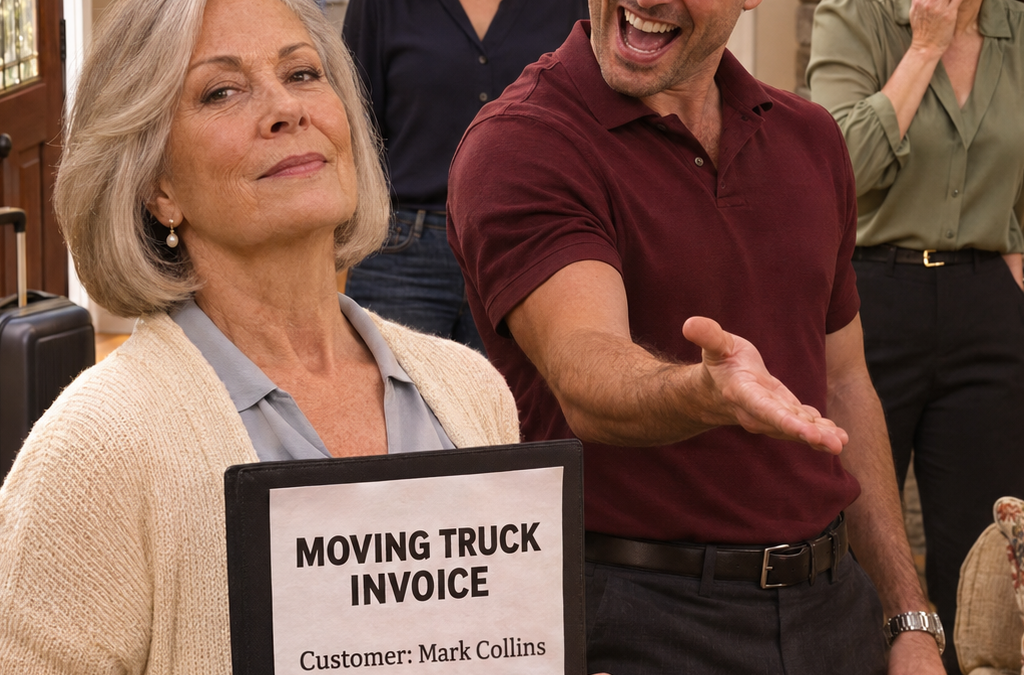
He handed me a moving-truck bill for $1,295.
“You’ll need to cover that, Ruth.”
My fingers went toward the checkbook in my purse, then stopped.
“Why would I pay to leave my own house?”
“You’re never home, so let someone useful have it.”
Amy stood by the kitchen doorway. She heard him. So did the couple beside my fireplace.
The woman’s face changed first.
“We thought you were moving,” she said.
“I came home for four days.”
Mark gave a small, embarrassed laugh, as though I had mentioned something private.
“She’s been back and forth. It’s hard on everybody.”
“I’ve been caring for my sister.”
“Of course,” the woman said. “We weren’t—”
“The dining area gets good afternoon light,” Mark interrupted. “You asked about that.”
He started toward my table. Nobody followed.
My brass key was still in my coat pocket. I had used it minutes earlier, expecting stale air and a refrigerator that needed cleaning.
Instead, strangers were measuring my living room with their eyes.
Amy gave the woman a sheet of paper.
“These are the utility companies. I can coordinate the transition.”
“Put that down,” I said.
“Mom.”
“That’s my account information?”
“Just the providers. And the usual monthly amounts.”
The man looked at his wife. He had work boots on, carefully wiped, and looked more uncomfortable by the second.
“Maybe we should come back.”
“We’ve all arranged our schedules,” Mark said. “Let’s get through the walkthrough.”
My bedroom door was open behind him. My blue bathrobe hung on its hook. Someone had folded the quilt back to show the mattress underneath.
“Who went into my bedroom?”
“The buyers need to see the whole house, Mom.”
Amy sounded tired with me already.
I had driven back to Richmond, Virginia, with a plain bookkeeping folder beside my overnight bag. My sister’s hospice aide had promised to stay late so I could leave without rushing.
“This is my only home,” I said. “My sister needs help. That’s temporary.”
Mark looked toward the buyers.
“Nobody’s trying to make this unpleasant.”
“Then stop showing them my house.”
“They’ve paid for inspections. They’ve made plans.”
“I didn’t ask them to.”
The woman looked down at the utility sheet.
“We were told you wanted a smaller place. Near your family.”
“I have a place near my family. This one.”
Amy’s eyes went toward Mark.
“Mom, we talked about how much you had going on.”
“We talked about the roof.”
“Please don’t do this in front of them.”
“Helping my family did not make my home community property.”
Mark’s voice softened.
“Ruth, these people acted in good faith. Can we consider them for a minute?”
“I am considering them. That’s why I’m saying it while they’re here.”
The man spoke before Mark could answer.
“We don’t want anybody pushed out.”
“Nobody is being pushed,” Mark said. “There’s paperwork. The title office is checking everything.”
“What paperwork?”
“The authorization you gave me.”
“For repairs.”
“Let’s let the people handling it explain.”
Amy’s utility sheet had my handwriting across the bottom. I used to write the trash pickup changes there because our family missed every holiday schedule.
The woman offered it back to me.
“I’m sorry. I don’t think we should have this.”
Amy accepted it instead.
Mark began explaining the furnace. His regular working voice came back, confident and practical. He supervised HVAC installations; that part, at least, belonged to him.
I stepped into the adjoining hall with my phone.
“Where are you going?” Amy asked.
“To make a call.”
“We’re all standing here.”
“I can hear that.”
The notary’s number was still in my contacts. I sent an image from my folder, then asked whether she could take a private video call. She answered while Mark described the ductwork beyond the wall.
Linda stopped turning pages and leaned toward her screen.
“Who described it that way?”
“Which part?”
“Before I say anything else, is that the copy you received?”
“Yes.”
“Give me a minute. Don’t hang up.”
Her face disappeared as she lowered the phone. From the living room, Mark asked whether the buyers wanted another look at the kitchen.
I could hear a cabinet open. That cabinet held the good plates Amy said were too heavy.
Linda returned to the screen.
“I have my notebook here. May I send you a picture of your specific entry?”
“Yes. Please.”
By about 3:35, the image was on my phone. The description included the word “general.”
I had kept books for small businesses long enough to know how often a careless label became the thing everybody repeated. A mislabeled expense could travel through six reports before anyone asked for the receipt.
“I need a journal correction,” I told her. “I arranged roof-repair help.”
“I’ll review what I wrote,” Linda said. “I won’t erase the entry.”
“I’m not asking you to.”
The folder held repair receipts and my retained partial scan. I remembered signing the extra middle sheet, too; Helen had kept an office original with the rest of her file.
Linda gave me the title officer’s contact information after I explained what was happening.
“Tell him directly,” she said. “He needs to hear from you.”
I called from the same hall. David Reed answered with the brisk politeness of someone between appointments.
“I’m the owner,” I said. “I’m standing in my house, and I did not agree to sell it.”
He asked me to confirm my identity, then pulled up the pending file.
“I’d flagged the authorization copy as incomplete,” he said. “We’ve been trying to clarify—”
David stopped mid-sentence and looked away from his camera.
“Why is your daughter listed as the owner’s only contact?”
“She shouldn’t be.”
“This email address. Is it yours?”
He read it aloud. It was Amy’s.
“Keep me on the call,” I said.
I went back to the living room. Mark had reached the back door. The buyers stood together, no longer looking at anything.
“Amy, why does the title office have your email instead of mine?”
Her mouth opened, then closed.
“You were already overwhelmed.”
“So you took my messages?”
“I was sorting things out.”
“Were you going to forward them?”
“Mom, some of them were just scheduling.”
“Were you?”
“I was going to explain when you got here.”
Mark came toward us.
“Ruth, let’s separate the family discussion from the closing questions.”
“Did you tell them I agreed?”
Amy looked at him again.
“We said you were open to it.”
“I wasn’t.”
“We needed to know what was possible,” she said.
“What did you need?”
Mark answered.
“There’s a replacement house. A manageable place. We’ve put a lot of work into this.”
“Who’s buying it?”
“Amy and I would be the purchasers.”
“And my house pays for yours?”
“There was a proposed allocation for the work and moving arrangements. Forty-five thousand. Nothing’s been paid.”
Amy stared at the utility sheet.
The woman beside my fireplace said, “We’re going to leave.”
Mark turned toward her.
“I’ll call you this evening.”
“Please let the title officer call us,” her husband said.
They left without another look at the kitchen.
David was still on my phone.
“I heard part of that,” he said.
“Hear this part. I won’t pay that truck bill. I’m not approving a sale.”
Mark said, “There are commitments already made.”
“You made them.”
By 4:05, David told me the file was expressly on hold for review of Mark’s authority. He would contact me directly from then on.
“Has anything already been signed?” I asked.
Mark said my name, almost gently.
I kept looking at the screen.
“The proposed deed was signed October 2. Your name is on it, with Mark signing as agent.”
Chapter 2 of 7
At 8:30 Tuesday morning, Helen had me enlarge the signature block on my screen.
“That’s Mark signing as your claimed agent,” she said. “It isn’t your signature, and it hasn’t transferred your house. David still has an undelivered proposed deed. Nothing’s been recorded.”
I sat at my kitchen table in Richmond. Helen was calling from her office in Dayton, Ohio, where I had expected to be that week.
“He keeps saying durable.”
“Durable authority is still limited by what the document actually permits. The papers he signed earlier still need review, even if you stop him from acting now.”
“So we stop him.”
“Yes. I’ll prepare that today.”
The doorbell rang before we finished. Amy stood outside with coffee from the place near her medical office. She had remembered mine without sugar.
“I asked for the emails,” I said.
“I thought we should talk first.”
Helen stayed on speaker.
Amy saw her name on the screen. “Oh. You’ve got company.”
“Come in,” I said. “We’re looking at what Mark signed.”
She stayed near the end of the table.
“Mom, you’re bathing Aunt Carol. You’re driving back and forth. You barely sleep.”
“What does that have to do with my address?”
“It has to do with what’s manageable.”
“My house is manageable.”
“You’re not here to manage it.”
Helen said nothing. Neither did I.
Amy tried again.
“I could filter the calls. Going forward, I mean. You wouldn’t have to deal with every little question.”
“I needed my messages, not a spokesperson.”
“I wasn’t trying to be—”
“Send them. While you’re here.”
“There are a lot.”
“Then we’ll be here awhile.”
Her coffee sat unopened. Mine smelled good, which irritated me more than it should have.
The first forwarded message arrived with three others attached. Amy had written to the title office that I was staying in Ohio and that she would handle owner correspondence.
Below that, she had supplied her own email address in place of mine.
“You didn’t just forget to forward these.”
“I knew where you were.”
“You knew my phone number, too.”
Another message contained a question from the buyers. They wanted confirmation that I was comfortable leaving the house before they made further arrangements.
Amy’s reply said I was ready for something easier and relieved the family was handling it.
I read it twice.
“When did I say relieved?”
“You said you couldn’t keep doing everything.”
“I was talking about lifting Carol.”
Amy looked toward the window.
“You were upset. We talked about several things.”
“That one I remember.”
Helen’s voice came through the speaker.
“Amy, forward the full threads. Attachments, too.”
“Okay.”
“No summaries.”
“I said okay.”
The refrigerator started its uneven rattle. For years, Amy had called it the ice machine’s motorcycle. That morning she glanced toward it, almost expecting me to make the joke.
I waited for the next email.
David called after Helen contacted him. He sent the purchase agreement while we talked.
“There’s a condition here,” he said. “Completion depends on our approval of Mark’s authority.”
“So they can’t just come take possession?”
“We haven’t approved him. I won’t release funds without that approval.”
“Who pays for what he’s done?” I asked.
“That isn’t something I can award. I’m deciding whether we can close this file, not whether Mark owes damages.”
Amy leaned closer to the phone.
“He thought he was helping.”
David paused.
“I need the documents, Amy.”
Afterward, Helen requested her archived file from the Richmond drafting practice. Its paper records were stored off-site. She emailed me the retrieval receipt.
“Three business days,” she said.
“You can’t get somebody to drive over?”
“That’s the retrieval schedule. I’ve asked for the earliest delivery.”
I wanted to argue with somebody who hadn’t done anything wrong. Instead, I asked what I could sign that day.
By early afternoon, Helen had sent the revocation. I read every line before signing. Amy waited through the printing, scanning, and the email to Helen.
“You don’t trust any of us now,” she said.
“I’m checking what has my name on it.”
Helen sent copies to Mark and David. David acknowledged receipt. Mark replied later that afternoon that he had received it and would discuss the existing arrangements with the title office.
I asked Helen whether that ended those arrangements.
“It stops him relying on your permission for anything new,” she said. “It doesn’t settle what he already signed.”
Amy’s phone buzzed while Helen was still on the call.
“It’s Mark,” she said.
“What does he want?”
She read the screen, then lowered her eyes.
“Amy.”
“He says the guest room would work. At the house we’re looking at.”
“For whom?”
“For you. Between trips.”
“I have a bedroom.”
“He’s trying to offer an option.”
“What else?”
She didn’t answer until I asked her to read it aloud.
“He wants me to tell Aunt Carol you’re making the housing situation difficult for everybody.”
My breakfast plate was still beside the sink. One bite of toast was missing. I couldn’t remember taking it.
“Leave Carol out of this.”
“I wouldn’t tell her.”
“Then tell him that.”
Amy looked at her phone but didn’t answer him.
“If I need help, I’ll ask,” I said. “You don’t get to arrange my life because I’m tired.”
“I thought you needed us.”
“I needed you to send my mail.”
Before she left, one more forwarded message appeared. It had been buried beneath a scheduling reply in her inbox.
The middle sheet was missing.
David’s email stated, “Your agent supplied sheets one and three. Please supply the missing middle sheet before Friday’s review.”
Chapter 3 of 7
Mark called at 9:00 Wednesday morning, October 7.
“That other sheet was repair detail, Ruth. I kept it with the roof estimates. I can’t locate it right now.”
“David asked you for it.”
“I know. I’m explaining why it wasn’t in the closing upload.”
I stood in my Richmond kitchen, still wearing yesterday’s sweater. The toaster had burned one corner of my bread and left the other pale.
“Then explain it to David.”
“I will. But we need to talk about the rest of this.”
“What rest?”
“The driving. The contractor. Everything Amy and I have been trying to cover.”
He sounded tired. He probably was. I waited.
“I can’t keep taking time off for the airport drive while this is hanging over us,” he said. “And I can’t meet the roofer here.”
“You said you would.”
“That was before we had all these extra appointments and calls.”
“The roofer isn’t an extra appointment.”
“Ruth, I have a crew waiting on me every morning. Amy has patients calling all day. We’ve reached our limit.”
I scraped the blackened corner over the trash.
“Are you asking me to approve the sale so you’ll drive me?”
“I’m asking you to help resolve it. There’s a difference.”
“I haven’t stopped anyone from reviewing anything.”
“You could make this easier. That’s all I’m saying.”
“What do you want me to tell the roofer?”
“That you’ll need to be there. Or reschedule.”
He had offered that help before I left for Ohio. I had thanked him twice.
“I’ll handle the ride, too,” I said.
“I don’t want you thinking we’re abandoning you.”
“I heard what you said.”
After we hung up, I called the contractor. He could move the visit earlier, before I returned to Dayton. I would have to stay home for the whole arrival window.
Then I changed my return reservation and booked a car service to the airport. The revised trip cost more. I paid from my checking account and wrote both charges in my expense book.
I had budgeted for gas, groceries, and meals on the road. I crossed out what I had expected to spend.
Carol called while I was checking the confirmation.
“Did you find anything decent in your refrigerator?”
“Mustard. Three kinds.”
“Well, you always did entertain fancy.”
I laughed with my mouth closed around a bite of cold toast.
She sounded worn out. I told her when I expected to be back, then let her go.
Amy came by that afternoon. She texted from the driveway instead of ringing.
Can you come out? I only have a little time.
I went outside without inviting her in.
Her car smelled like the peppermint gum she kept for work. A lunch container sat on the passenger seat. She moved it to the floor, and I got in.
“Mark said you’ve arranged transportation.”
“Yes.”
“He wasn’t trying to punish you.”
“Did you ask me out here to tell me that?”
“No. I have the thing you asked about. The money.”
“Send it.”
“I wanted to explain it first.”
“Send it, Amy.”
The email arrived while we sat beside each other. It was a preliminary disbursement request from the pending file, prepared from Mark’s instructions. No owner approval appeared on it.
Beside $45,000, the description read family relocation allowance.
“Whose family?” I asked.
“Ours.”
“I’m paying to relocate you?”
“That’s how it was listed. It’s not final.”
“Who asked for that amount?”
“Mark.”
“Did you know?”
“Yes.”
Outside, a delivery van stopped across the street. Amy watched the driver search between two houses.
“The place we applied for is $265,000,” she said. “We couldn’t make the numbers work without this.”
“Then you couldn’t afford it.”
“We thought—”
“You thought my house would cover the difference.”
“It wasn’t just taking money. He’s spent time on this. Arranging people, checking things, making calls.”
“What did I approve?”
“Mom, I’m trying to explain.”
“I’m asking you a question.”
“He wasn’t charging you by the hour.”
“I’m not arguing about what his hours are worth. Who authorized that payment?”
Amy’s work badge was still clipped to her blouse. Her picture on it looked cheerful and rested.
“I don’t have anything with your signature,” she said.
“Do you have an email from me?”
“No.”
“A text?”
“No.”
“Then don’t send me an explanation of what he deserves.”
She stared through the windshield.
“The application’s already in.”
“I didn’t submit it.”
“I know.”
I stayed there another minute, waiting for her to say more. She asked whether I needed groceries before my trip.
“No, thank you.”
By the time I went inside, the car-service charge had posted.
Mark called before supper.
“Amy said you saw the proposed allocation.”
“I did.”
“Nothing was going to be released without review.”
“Then let them review it.”
“There’s also the conversation we had after you got to Ohio.”
“What conversation?”
“The phone call. You gave me permission to move ahead. That wasn’t limited to a contractor appointment.”
I stopped looking for something to eat.
“I didn’t tell you to sell my house.”
“Amy was there, Ruth. I’m going to ask David to hear her account.”
He ended the call before I answered.
A few minutes later, David forwarded the message to me. Amy was copied on it.
Mark’s email to David read, “Amy heard the call. Please include her when you review the earlier authorization.”
Chapter 4 of 7
At 8:45 Thursday morning, Amy stood outside my front door.
“You said, ‘Handle things until I get back.’ Those were your words.”
“Before that. What were we talking about?”
“I’m telling you what I remember.”
“Was it the roof?”
“Mom, I can’t give you every word in order.”
Her jacket was zipped crookedly. She had done that as a child, too, then insisted the zipper was defective.
“You remember the part Mark needs.”
“That’s not fair.”
“Did I say sell?”
“You said you needed things handled.”
A neighbor’s sprinkler ticked beyond the porch. Water struck the same strip of sidewalk again and again.
“Come inside if you want,” I said. “But don’t stand there changing the question.”
“I have to get to work.”
“Then go.”
“I could explain this tomorrow. You wouldn’t have to sit through everything.”
“Explain it for whom?”
“For you. To them.”
I left that unanswered. She waited a few seconds, then went down the walk.
Inside, my laptop chimed from the kitchen table. Linda’s email had gone to the closing participants, including Mark. Attached was an explanatory addendum dated October 8.
The original entry remained unchanged, she wrote. She would bring her journal.
Mark called within minutes.
“I’ve just received Linda’s note. I didn’t know you’d asked her to correct the description.”
“I asked Monday.”
“All right. If she wrote the wrong description, she should explain it.”
I had expected an argument over that word, general. He passed right over it.
“But that doesn’t tell David what was on the sheet we’re missing,” he said.
“Linda can explain her own work.”
“Exactly. And David still has the opening page you signed. He also has what Amy remembers from our call.”
“I remember that call.”
“Then we should all discuss it together. The correction doesn’t settle what you told us afterward.”
The kitchen clock clicked before its minute hand moved. I had been meaning to replace the battery.
“Did you call to ask me something?” I said.
“I’m asking you not to treat a corrected notebook entry as the whole conversation.”
“I haven’t.”
“Good. Because the buyers need an answer, too.”
After he hung up, I called Linda.
“He’s right about one thing,” she said. “My note isn’t a substitute for your document.”
“I didn’t ask you to make it one.”
“I know. I just want us clear.”
Her journal recorded whose signature she had acknowledged and the signing. It did not decide what Mark could do with my house.
“I’m leaving the original line alone,” she said. “The addendum explains my description. I won’t say I remember language I didn’t examine.”
“Will you be there tomorrow?”
“Yes.”
“Thank you.”
“I wish I’d been more careful.”
I looked at the little brown mark on my table. Amy had made it with a hot glue gun during a school project. I had covered it with placemats for years.
“So do I,” I said.
Helen called before lunch. The archived paper file was still being retrieved.
“No delivery yet?” I asked.
“Not yet. The request is moving.”
“I keep checking my email like that’ll speed it up.”
“It won’t. Eat something.”
“That sounded like Carol.”
“She’d probably tell you what to eat.”
“She’d tell me whatever I chose was wrong.”
Helen laughed once, then asked whether Amy would attend.
“She offered to explain things for me.”
“Do you want that?”
I looked toward the doorway where Amy had stood Tuesday, waiting for me to accept her version of my mail.
“If I get tired, she’ll start answering.”
“You can ask for a break.”
“And everyone waits?”
“Yes.”
It sounded inconvenient. I had spent years avoiding being the reason everybody waited.
“I want you there,” I said. “But I don’t want either of you answering questions meant for me.”
“Fine.”
I would speak for myself.
At 2:20, David called with the arrangements.
“Friday at eleven.”
“At your office?”
“Yes. Here in Richmond. You, Helen, Mark, Amy, Linda, and the Turners.”
He gave me the parking instructions. I wrote them on the back of a grocery list.
“Are they expecting to leave with my house?” I asked.
“They know we’re reviewing authority before anything can be funded.”
“Does Mark know that?”
“He’s been told.”
“Tell him again.”
“I will.”
Afterward, I emailed Amy. I said she could describe what she remembered, but she was not attending as my representative.
Her answer came during supper.
I was trying to spare you some stress.
I read it beside a bowl of soup that needed salt. For once, I didn’t write back to make her feel better.
Mark emailed next, copying David.
He wanted an in-person yes-or-no answer by eleven. He wrote that the buyers had waited, arrangements were costing money, and everyone deserved to know whether I would approve completion.
I called Helen.
“He wants me to answer before the review.”
“You don’t have to.”
“He’ll say I dragged everybody there.”
“You’re going because your name is on the file.”
I finished half the soup. Then I cleared my place and checked the parking instructions again.
David’s next email arrived before I closed the laptop. He was forwarding Amy’s proposed witness statement for tomorrow’s review.
I checked the sender, then the attachment.
Amy’s newly submitted statement said, “My mother approved selling the house during our call.”
Chapter 5 of 7
At 9:15 Friday morning, I called Amy about the statement.
“Did you read it before you sent it?”
“Yes.”
“Did Mark write it?”
“No, Mom. I wrote it. I thought once you saw everything, you’d agree.”
She wrote it herself. I couldn’t blame that sentence on somebody borrowing her phone.
“You told David I had already agreed.”
“I thought we were getting there.”
“We weren’t.”
“I know you’re upset about the money. We could change that part.”
“This isn’t a price disagreement, Amy.”
She went quiet long enough for me to hear voices at her end.
“Where are you?”
“Outside work. I’m leaving now.”
“For the meeting?”
“Yes. Mark wants me there.”
“I’m asking whether you’re coming.”
“I said yes.”
I looked at the clock above my stove. Its new battery made the second hand sound too loud.
“Then tell them what happened. Don’t tell them what you hoped I’d say.”
Helen called after I hung up. She was in Richmond, and the archived original had arrived.
“You can collect it here,” she said. “Then we’ll go over separately.”
“Is everything there?”
“Yes.”
I wanted to ask more. Instead, I checked how long the drive would take.
Before leaving, I ate a piece of American cheese over the sink. Carol called that a bookkeeper’s breakfast: no plate to wash, every slice accounted for. The wrapper clung to my sleeve until I reached the car.
At the drafting office, Helen met me near reception. She had traveled with an overnight bag and looked as though she’d slept badly.
“You didn’t have to come all this way,” I said.
“You asked me to be there.”
“I know.”
“That’s usually how this works.”
The closed file was waiting for me. I kept it against my side while she confirmed the address of David’s office.
“Do you want me to carry it?” she asked.
“No. I’ve got it.”
“All right.”
She didn’t ask again.
The Turners arrived at the title office just ahead of me. I recognized his carefully cleaned work boots. She carried a folder with bent corners.
We stood together near a bowl of wrapped peppermints nobody seemed to want.
“I’m Ruth Bennett,” I said. “We didn’t properly meet Monday.”
“Beth Turner. This is Paul.”
“I’m sorry you were put in that position.”
Beth glanced toward the hallway.
“We’ve extended where we’re staying. Again.”
“And I changed shifts,” Paul said. “Which isn’t your problem. But it’s been—”
“A lot,” Beth finished.
“Yes,” I said. “I can see that.”
“We wouldn’t have kept going if we’d known,” she said.
“I believe you.”
Paul looked at the file under my arm.
“Are you saying there’s still a chance today?”
“I’m here to answer questions about what I allowed. I’m not here to approve a sale.”
He nodded, though his face dropped.
Beth said, “Thank you for telling us straight.”
Mark came down the hall wearing a clean work shirt. He greeted the Turners by name and asked whether they’d found parking.
Then he turned to me.
“Ruth. I’m glad we can all sit down.”
Helen arrived behind me. Linda was already inside, her journal in a worn tote beside her chair.
Mark waited until everyone could hear him.
“There may be a simple way through this. Ruth can approve the transaction now. The Turners keep their plans, and we discuss the family allocation separately. It doesn’t have to hold them up.”
“That discussion wouldn’t change my answer,” I said.
“I’m not asking you to settle everything with me today.”
“You’re asking me to sell.”
“I’m asking whether we can preserve what’s already been arranged.”
Paul watched us. Beth kept her folder against her coat.
“I know they’ve spent money,” I said. “I’m sorry about that. I still didn’t agree.”
Mark nodded as though I’d raised a point he intended to address.
Amy appeared in the doorway. A rental tag hung from the truck keys she held.
“Did you get the blankets?” Mark asked.
“They’re in the cab.”
“Good. We’ll sort out the loading afterward.”
She looked at me, then toward the Turners.
Mark pulled a chair beside his.
“Here, hon.”
“I’m okay.”
“We may be here awhile.”
“I’ll stand.”
He let it go. David came in and introduced himself to Helen, then checked that everyone had a seat available.
It was 10:55.
“Before we begin,” Mark said, “I want to be clear about what I’m asking you to review.”
David remained beside his chair.
“Go ahead.”
“Ruth gave me broad authority before she left. Later, we talked by phone, and she confirmed moving forward with the sale. Amy heard that conversation.”
Amy’s face had gone blotchy above her collar.
“I know your scan is incomplete,” Mark continued. “But the documents were signed before the revocation. I’m asking you to consider the authority I had then, including that call, and let us complete today if you approve it.”
He spoke calmly. He didn’t look at me when he finished. He looked at David.
Beside me, Helen waited.
David checked the clock. “We’ll hear from everyone.”
Amy came around the empty chair. She was looking at her phone.
“Mom,” she said.
Mark turned toward her.
“What is it?”
“I need her to see the whole thread.”
Amy placed her phone in my hand. Above the messages arranging our call was Mark’s instruction: “Keep it to the repair estimate.”
Chapter 6 of 7
“Before you release anything,” I said as the clock reached eleven, “Amy, tell them what that call concerned.”
“The roof estimate.”
She looked toward Paul and Beth.
“Mom asked what the roofer had said. That was why we called.”
Mark stayed seated.
“Yes. My message concerned the estimate. That doesn’t settle the authority Ruth gave me before she left.”
Amy looked at him.
“The opening language covers property transactions,” he continued. “I signed before the revocation. I’m asking you to review that original grant separately from the call.”
David turned toward me.
“Do you have the complete executed instrument?”
“Yes.”
I opened the file and placed the signed middle sheet beside Mark’s submitted opening sheet. The complete office original was there, all three sheets.
“That belongs between these,” I said.
David read it once, then leaned closer.
I read the sentence aloud.
“No authority to sell, convey, mortgage, or distribute proceeds of my home.”
Beth’s coat slipped from her knees. She didn’t reach for it.
Linda compared my signatures with the acknowledgment and her journal.
“This is the instrument I acknowledged September fourteenth,” she said. “I wrote ‘general’ as shorthand. That was my error.”
“You didn’t record that restriction,” Mark said.
“No. I wasn’t copying its terms into my notebook.”
“Then could that sheet have been a later repair instruction?”
“I signed it that Monday,” I said. “With the rest.”
David looked at Linda.
“Was this restriction part of the instrument when she signed?”
“Yes. There were three sheets. This was the middle one.”
Mark kept his voice even.
“The scan I submitted didn’t contain it. I understood the repair detail to be separate. Does the complete file establish when it became part of the authorization?”
David turned to Helen.
“Where has this original been?”
“In my practice’s paper file since execution. Ruth signed a second original for that file. All three sheets went into the off-site archive together.”
“Any later replacement?”
“No.”
The air vent above us whistled. Mark’s eyes stayed on the middle sheet.
“Mark,” David said, “what supports treating this as a later instruction?”
“The copy available for closing didn’t include it. The opening language was broad. I understood our later conversations to confirm proceeding.”
David waited. Mark added nothing.
“A missing page in your scan doesn’t establish a later change,” David said. “This is the complete original retained at execution.”
He looked directly at Mark.
“The signed restriction controls; the journal entry cannot enlarge it. I will not insure or fund this sale. There will be no $45,000 disbursement.”
He crossed out the proposed allocation and closed the funding instruction.
Mark’s mouth opened. David was already looking toward the Turners.
“Do you want to use the agreement’s authority-review exit?”
Beth answered first.
“Yes.”
Paul nodded.
“We want out under that condition. We don’t want another date.”
“I’ll arrange the release paperwork,” David said.
Paul’s shoulders dropped against his chair. Beth’s coat remained on the floor.
Mark stood.
“Amy, let’s go. We need to talk about the other house.”
She stayed where she was.
“We still have an application,” he said. “We can look at a different down payment. Something smaller, maybe.”
“The truck’s outside,” she said.
“I know. We’ll deal with it.”
She put the truck keys in front of him. The rental tag caught beneath one key.
Mark glanced toward the Turners.
“Can we have this conversation elsewhere?”
“I need to correct what I sent David.”
“You’ve explained the call.”
“No. I said Mom approved selling. She didn’t.”
Her face was red now. She looked at me, then at Beth.
“I wanted that house. I thought she’d come around. So I wrote it like she’d already agreed.”
Paul stared at the carpet.
Amy continued, less steadily.
“And I kept her messages. When she asked for them, I tried to talk her out of needing them.”
Mark said, “We were trying to reduce what she had to manage.”
“I know what we called it.”
She crossed the room and stopped beside my chair.
“Can I sit here?”
“Yes.”
There was room between us. She left it there.
I had been pressing my toes against the ends of my shoes. They hurt when I finally relaxed them.
“You can ask to visit. You cannot decide where I live.”
“I know.”
“I’ll need some time before a visit.”
She looked down.
“Okay.”
Mark remained standing beside the chair he had pulled out for her.
“Ruth, could we have five minutes privately? Without making any decisions. There are costs we should sort through.”
“No.”
“I’m not asking you to reconsider in front of everybody.”
“I’m not negotiating this privately, either.”
My brass key was still in my coat pocket. Its worn edge pressed against my leg. I would be going home after this, to the laundry I had left in the dryer.
One fitted sheet would have swallowed everything else. Carol always accused me of buying sheets with an appetite.
David asked the Turners to wait outside while he arranged their next steps. Beth paused near me.
“I hope your sister’s comfortable,” she said.
“Thank you.”
I couldn’t get another word past my throat. She waited a moment, then followed Paul.
Amy was looking at Mark now.
He said, “We should at least talk to the lender together before you do anything.”
She swallowed.
“On Monday I’m withdrawing from the application for the $265,000 house.”
Chapter 7 of 7
On Monday, October 12, Amy sent me confirmation that she had withdrawn from the mortgage application.
“I asked them to remove me,” she said when she called. “Nobody made me.”
The confirmation named the $265,000 house. That purchase would not go forward as their joint plan.
“Mark wants to know if there’s another arrangement you’d consider.”
“No.”
“I told him you’d say that.”
“Then don’t ask me for him again.”
She stayed on the line.
“I’m sorry. I shouldn’t have.”
I waited until she said goodbye. Then I finished booking my return to Dayton.
Tuesday, October 13, David confirmed that everyone had signed the buyer-release paperwork. The Turners had received their $5,000 deposit back.
“The file is closed,” he said. “No proposed deed was recorded.”
“Thank you for telling me.”
“I thought you’d want that in writing, too. It’s in your email.”
I printed the confirmation and put it away. There was no reason to keep it beside my breakfast plate.
I returned to Ohio and resumed caring for Carol. The first evening, she complained that I had put too much water in her washbasin.
“You planning to bathe me or launch me?”
“I can pour some out.”
“Now you’re thinking.”
She had less breath for talking than before. I stayed near enough that she didn’t have to raise her voice.
At night, I slept in pieces. Some mornings I wore the same clothes until lunch. When she needed me, I could go to her without first reading a message about somebody else’s housing plans.
Once, she asked whether everything at home was settled.
“Yes.”
“Good. That towel’s scratching my neck.”
I found a softer one.
Carol died on Tuesday, November 3. I was beside her. I had nowhere else I needed to be.
For days afterward, I kept waking when it was time to check on her. I would sit up before remembering.
On Friday, November 6, the truck rental company emailed me. Mark had paid the $1,295 invoice in his name.
I received the notice because I had disputed being listed as the payer. The balance was now zero, and the company had removed my information.
That was a bill he had actually incurred. The $45,000 he had expected from my house had never been his money. I had paid neither.
I saved the confirmation. Then I called Amy back about a visit.
We agreed on Friday, November 20, from two until two-thirty, at my house in Richmond. She asked whether she could bring anything.
“Just yourself.”
“And Mark?”
“He isn’t invited.”
“Okay.”
She arrived at two. I had been home long enough to put away my travel clothes, but Carol’s number still sat at the top of my recent calls.
Amy stopped inside the doorway.
“Where should I sit?”
“The couch is fine.”
She kept her coat on at first. I sat in the chair beside the window.
“How are you doing?” she asked.
“I miss my sister.”
“I miss her, too.”
I nodded. We sat for a while without filling it.
Then Amy said, “I need to say this without explaining it away.”
I waited.
“I gave the title office my email instead of yours. I kept messages you needed to see, and I answered as if I knew what you wanted.”
“You knew how to reach me.”
“Yes.”
She looked toward the kitchen, then back at me.
“And I said you’d approved selling. In writing. You hadn’t. I wanted the other house, and I wanted you to agree.”
“You kept telling me I was overwhelmed.”
“You were tired. I used that.”
Her voice broke on the last word. I stayed in my chair.
“I keep wanting to tell you I didn’t think we’d get that far,” she said.
“You took it quite far.”
“I know.”
“You won’t have authority over my house again.”
“I’m not asking for it.”
“And a visit doesn’t become permission to come whenever you want.”
“Can I call?”
“You can call. I may not answer right away.”
“All right.”
She took off her coat then. There were still twenty minutes left.
We talked about Carol’s habit of correcting restaurant menus aloud. Amy remembered being mortified when her aunt asked a waitress why the chicken was “resting on a bed of lettuce.”
“‘It’s dead,’” Amy said. “‘It doesn’t need a nap.’”
I laughed, then cried before I could stop myself.
Amy leaned forward but didn’t get up.
“Do you want me to stay?”
“Until two-thirty.”
She nodded.
When the time came, she stood without making me remind her.
“Thank you for letting me come.”
“I’m glad you said what you said.”
“I’ll call first.”
“Yes.”
I watched her reach her car. I hadn’t asked about her marriage, and she hadn’t offered me a job fixing it.
By Sunday, December 20, I had stopped buying groceries as though I were leaving again in three days.
That afternoon, I chose a pork chop, a sweet potato, and green beans for my supper. At the checkout, I went back for the bread I liked instead of the smaller loaf.
Amy called as I reached my driveway. I let the car run while we talked.
“Would you like to come Wednesday?” I asked. “Around four. We could have coffee.”
“Yes. I’d like that.”
“Just you.”
“I know. Mark won’t come.”
“I have plans afterward, so about an hour.”
“I’ll be there at four.”
She asked what I was making for supper. I told her.
“That sounds good.”
“It does.”
After we hung up, I carried my grocery bag up the walk. The porch light was off; there was still plenty of daylight.
I turned my brass key and let myself in.







