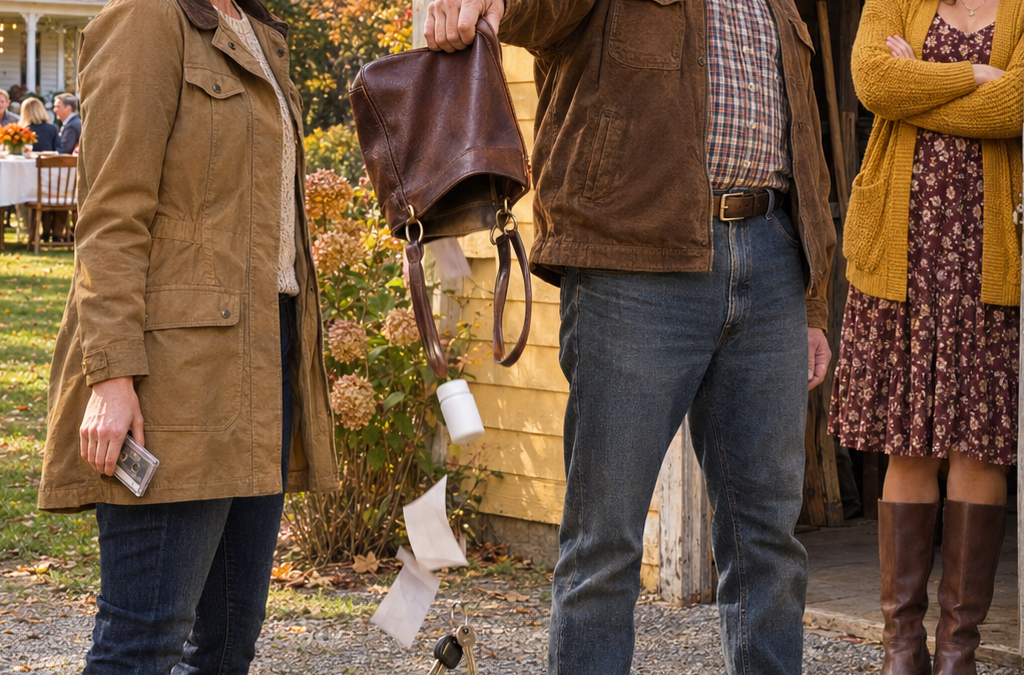
My stepfather emptied my purse onto the Thanksgiving gravel and said, “Empty your pockets. You always take things.”
Chapter 1 of 7
My wallet landed open beside his boot, but the cassette stayed in my hand.
I’d lifted it from a box inside Mom’s shed. Its label read “Claire Bennett — 1997,” in blue ink.
“Adam, are you going to let him do this?”
My brother looked toward the house.
Frank Dalton held my empty purse by its bottom seam. He watched the cassette, not the things he’d dumped.
Laura stood behind him. “Those boxes belong to Dad now.”
Ruth Walker had arranged to collect Dad’s stored correspondence that afternoon. We were supposed to leave those boxes available.
“You always make these things difficult,” Laura said.
My face burned. Through the kitchen window, I could see the pie I’d brought, still in its grocery bag beside the stack of serving plates I’d washed that morning.
At forty-six, I was Claire Morgan, married, with twenty-four years of electronics repair behind me. Cassette decks had once filled most of my workbench.
Dad had left my own farmhouse solely for me.
Ruth, his attorney, had reached me at my married address last week. Before that, I hadn’t known. This farmhouse outside Lancaster, Ohio, was still the place where I waited to be told where to sit.
The shed latch worked because I’d repaired it. And Adam’s work radio sat on the kitchen counter in the replacement case I’d fitted around its battered innards.
For four months, I’d carried meals to Mom, including the macaroni she liked with the corners baked brown enough that everyone else complained it was dry.
I had made myself useful instead of making myself heard.
Frank shifted toward the box I’d opened.
Beneath the cassette lay envelopes with my maiden name, crossed out.
He blocked my view.
The envelopes hadn’t looked like Mom’s recipes or old utility bills. Dad’s handwriting ran across the top one, the last letters crowded together where he’d run out of room along the edge.
Then Frank dropped my purse.
He said taking things from the shed was stealing. He told Laura to count Mom’s serving dishes before I went inside.
That hurt worse than the gravel.
Nobody asked what else had been in my bag. My grocery receipt lay beside my allergy tablets, and my open wallet showed the family photograph that Frank had walked past on my mantel more than once.
But he kept watching the cassette.
“PUT THAT BACK RIGHT NOW!”
“You’re calling me a thief for taking something addressed to me?”
“Yes, and you can leave it here.”
He said I wasn’t coming to dinner carrying stolen property. Laura moved into the shed doorway, blocking the box.
“I’ll step outside.”
We were already outdoors, but I meant outside their little circle, beyond the shed’s open door. My coat-pocket phone was still with me.
The cassette came too.
From beside the fence, I called Ruth, who answered over the sound of a car heater.
“Frank’s asked to remain for life. He says you agreed.”
“I never agreed to that.”
My fingers went cold around the phone. Ruth said she would ask me directly when she arrived. She and June Ellis were already coming for the collection arranged earlier that week.
So I stayed beside the fence.
A few minutes later, June was at the gate, setting down her folding seat. At seventy-two, she’d learned to bring somewhere to sit instead of trusting anyone to remember.
Ruth came through behind her, and Frank straightened to offer help carrying their things.
But Ruth stopped beside my open wallet.
She looked from it to the purse.
“I need Claire’s answer about your request.”
“This is family business. We can handle it.”
Ruth said she couldn’t accept his answer for mine.
Laura came away from the shed door.
Adam stopped looking toward the kitchen window.
Ruth faced Frank across my scattered belongings.
His mouth opened, but she continued first.
“Frank, why did you tell me Claire wanted you here for life?”
Frank’s expression changed. He looked at me as if I’d interrupted a conversation he’d expected to finish without me.
“It’s just paperwork. She’s upsetting everybody over nothing.”
I hadn’t known he’d asked for anything. Last week, Ruth had been trying to explain what Dad had left. Meanwhile, Frank had been telling her what I wanted.
Laura said he only needed some security after losing Mom.
Ruth didn’t dispute that he needed security. She said she needed an answer from the person whose agreement he’d claimed.
“You have my answer,” I said.
Then Frank started talking about the house.
“We’re not discussing ownership in an argument outside the shed,” Ruth said. “We came for the correspondence.”
June had brought equipment and empty archive cartons. She’d kept Dad’s personal files after retiring from his office, under an arrangement he’d made with her.
Now she looked into Mom’s open box.
“That’s our old office labeling.”
She didn’t touch anything yet.
Frank said old office rubbish wasn’t worth spoiling Thanksgiving. His voice had lost its earlier carrying power. Laura glanced at the kitchen, but she stayed.
Ruth asked me to show her what I’d found.
My knees felt unreliable as I returned to the doorway. I hated having to pass Frank with everyone watching. He didn’t move until Ruth asked him to make room.
The box was wedged beneath a shelf.
I pulled it into the open doorway.
June leaned forward from her folding seat.
Frank said we should leave it alone.
Ruth asked me to lift the loose papers.
Seven unopened letters slid out, each addressed to me.
They were still sealed.
The crossed-out names were mine, though nothing on those envelopes explained the marks. I hadn’t seen any of them before.
Ruth crouched beside the box and began listing what was there. She kept her notes to the cassette and the letters. Mom’s tablecloths and Christmas decorations stayed where they were.
“These personal items are disputed,” she said. “We’ll record them before Claire takes them.”
Frank complained that she was making a production of a box nobody wanted.
He’d wanted it badly enough five minutes earlier.
Then Ruth turned to Adam. “Please gather your sister’s things.”
He bent over the gravel.
His work boots scraped near my wallet. He collected my tablets, receipts, and keys, checking beneath the shed step for anything he’d missed.
Then he handed the purse to Ruth. She checked with me before putting the loose contents back.
Adam still hadn’t looked at my face.
I was humiliated all over again, standing there while someone accounted for my belongings like they’d come out of a lost-and-found drawer.
June had an old portable player among her equipment. She offered to check the cassette briefly, provided it turned freely.
I checked it first.
The reels weren’t seized. June connected the player, and I pressed play.
There was a click, then a scrape close to a microphone.
“Hey, Cricket.”
My thumb stopped above the button.
It was Dad’s voice. Older than the voice I’d kept in my head, with a little roughness at the end.
The greeting continued for another few seconds before I stopped it. I couldn’t listen properly there, with Frank watching and my purse still gritty against my coat.
But June didn’t urge me.
Ruth gave me the letters and a copy of Frank’s request. His request said I supported letting him remain for the rest of his life.
I folded the copy without answering him.
One envelope came open along its brittle seal. Inside was a birthday letter in Dad’s cramped handwriting. I read the first lines twice, trying to make them mean something else.
“Three letters came back marked refused.”
Chapter 2 of 7
“Three came back,” I told Daniel. “That’s what he wrote. I never refused anything.”
We were at our kitchen table the morning after Thanksgiving. My husband had moved his breakfast aside so I could spread out the envelopes.
None of these had a return mark. These had stayed in Mom’s shed.
“Did you ever see the ones he meant?” Daniel asked.
“No. Nobody told me there were any.”
He read the line I showed him, then waited. He didn’t tell me what Dad would have wanted. I was grateful for that.
For years, I’d been ashamed of wanting a father who apparently didn’t want me. Now I couldn’t tell which parts of that hurt belonged to whom.
My own cassette player was on the workbench downstairs. Before loading anything, I checked its belts and cleaned the tape path. Then I tested playback with a shop tape.
Daniel followed me down carrying coffee in the mug we both hated. Its handle only admitted one finger, but neither of us would throw away a perfectly good mug.
“Want me upstairs?”
“Stay. Please.”
The motor ran evenly. I kept the volume low at first.
“Hey, Cricket. Porch light’s on.”
Dad paused, and I heard a faint cough.
“Remember that red boot in the rain barrel? You said you were washing it. Your mother wanted to know why you couldn’t wash the other one.”
A laugh broke through his words.
I remembered standing on a brick to reach the water. One boot had floated sideways while my sock got wet inside the other.
Daniel had never heard that story. I hadn’t thought of it in years.
“That happened,” I said. “I really did that.”
He stayed beside me while the message continued. Dad asked about school. He said he hoped I’d have a good birthday.
Hearing him hurt. I’d expected some relief, but I wanted to answer him, and there was nowhere for an answer to go.
The recording was real. That didn’t tell me how it had ended up in the shed.
“So saying no to his request doesn’t end what he already has?”
Ruth met me at her office later that morning. She had the relevant pages from Dad’s trust and Frank’s signed permission agreement ready.
“The house is held solely for you,” she said. “I hold title while I finish administering the trust. Frank has permission to live there, but that permission can be ended.”
She showed me where his agreement required written notice and time to leave. His request to stay for life had never been approved.
“So saying no to his request doesn’t end what he already has?”
“Correct. He’s allowed to be there now.”
I couldn’t change the locks or arrange a quick sale around him. Ruth would have to deal with his existing permission separately.
That distinction disappointed me, though I hadn’t arrived asking her to remove him. Part of me had wanted my refusal to mean more than it did.
“What happened to your first letter to me?”
Ruth checked her file. Her first mailing had gone to the old family address and come back. Separately, Frank had asked that family matters pass through him.
She hadn’t accepted that arrangement. Using Dad’s contact material and Mom’s obituary, she had found my married surname and reached me directly.
“The returned envelope doesn’t tell me who sent it back,” she said.
I appreciated her saying what she didn’t know. Everyone at the farmhouse had sounded certain about me for so long.
By the time I got home, Laura had started a group message with Adam and me.
Dad says you took Mom’s keepsakes while we were trying to have Thanksgiving.
Another message followed before I finished reading.
She barely has a household left and you’re already pulling it apart.
Mom had been dead for weeks. Laura still slipped into the present tense sometimes. I did too.
But that didn’t make her accusation fair.
My first reply filled most of the screen. It explained the label, the purse, Ruth’s appointment, every meal I’d carried over. Reading it back made me feel sick with embarrassment.
Then I deleted it.
“Items bearing my name are being inventoried,” I wrote.
Laura said I knew what she meant. Adam didn’t answer.
Daniel asked if I wanted lunch. I said yes, though I wasn’t hungry. He made enough for two and didn’t ask to see the thread.
That afternoon, I returned to the seven unopened letters Ruth had found in the box. One was open now, its brittle seal already broken at the farmhouse. Six remained sealed.
I opened those carefully and kept each page with its envelope.
The birthdays ran from seventeen through twenty-three. At nineteen, Dad had asked whether I was still fixing everybody’s broken radios. At twenty-two, he’d written that he didn’t know whether I wanted to hear from him.
I had believed he’d stopped thinking about me before I was grown.
The letters disproved that much. They didn’t explain why he hadn’t found another way to reach me. They didn’t tell me whose hands had kept these originals from mine.
I was angry with him too. That surprised me enough that I stopped reading for a while.
Near evening, my phone lit up again. Laura had changed the subject.
Dad’s booked a house-clearance pickup for the remaining shed boxes. Everything left is his.
Chapter 3 of 7
By morning, Ruth had obtained Frank’s written confirmation that the pickup would exclude the disputed boxes and anything belonging to the trust. He could still clear his own things. Mom’s photographs and personal belongings needed a separate inventory.
She copied me on his reply.
Apparently a cleanup is an investigation now.
The boxes would stay. That should have relieved me more than it did. Instead, I kept imagining what might have gone out in a truck if Laura hadn’t mentioned the pickup.
“Bring whatever else needs identifying,” Ruth told me. “He wants to show me some expenses, too.”
When I reached the farmhouse, Frank had spread receipts across the kitchen table. Ruth sat opposite him. Laura was heating gravy at the stove.
The chair where I usually sat held Frank’s coat.
“I kept this place standing for six years,” he said. “Everybody seems to have forgotten that.”
His figures came to $8,400. The largest bill was a $5,600 roof repair. There were smaller payments for plumbing, furnace work, and materials.
I remembered the roof leaking. Mom had called while I was at work, frightened by water running down the bedroom wall.
“You don’t get to spend my work twice.”
Frank looked at me when he said it, though Ruth was the one checking his receipts. I stood beside the refrigerator, embarrassed that I was still waiting for somebody to offer me a chair.
“Ruth can verify every legitimate cost,” I said.
“You know I paid it. You were here.”
“Yes. She can check the payments.”
He wanted something larger than agreement about a roof. Every answer I gave seemed to disappoint him unless it ended with me leaving the letters alone.
Ruth asked for the bank records matching two of the invoices. Frank’s voice softened immediately.
“Of course. I can get those for you.”
He also showed her his pension statement. His monthly income was $2,180. For the first time, his fear looked like something I could measure.
Moving would be hard on that income. I knew it, and knowing it hurt. He had lived here long enough to think of every room as his, regardless of what he’d signed.
“I’m only asking not to be uprooted,” he told Ruth. “I’ve just buried my wife.”
Laura said he deserved some peace. Ruth said she would review the expenses separately from his request to remain.
Then Ruth stepped onto the porch to answer a call. Laura went downstairs for the payment records.
Frank leaned back in his chair.
“Leave those old messages alone. You’ve caused enough trouble.”
“They’re addressed to me.”
“Your mother’s gone. Stop picking through her life.”
For a moment, I wanted to explain that I missed Mom too. Then I saw how easily we could spend the whole afternoon discussing whether my grief counted.
I left without taking off my coat.
Outside, Laura followed me as far as the porch.
“We’re doing leftovers later. Adam’s coming.”
She let that sit before adding that it would be better if I didn’t come. Frank needed an evening without questions.
It hurt more than I wanted it to. Through the window, I could see the saucepan Mom used for gravy, the one with a handle that always needed tightening.
“I keep thinking I should call and smooth it over.”
“Okay,” I said. Laura looked relieved.
At home, Daniel found me staring into our refrigerator. There was plenty to eat. None of it was what I wanted.
“We could go somewhere,” he said. “Or stay here. I don’t care.”
“I keep thinking I should call and smooth it over.”
He waited while I shut the refrigerator.
But smoothing it over would mean apologizing for finding my own name. Or offering money until Frank felt secure enough to let me sit at the table again.
We stayed home. Daniel made grilled cheese with mustard inside, his stubborn contribution to our marriage. I usually complained about it. That afternoon, I ate both halves.
Adam called after lunch and asked to meet outside. We walked along a public path in Lancaster, away from either house.
He still had on his utility jacket. He looked tired, but I didn’t ask how the leftovers plans were going.
“I remember envelopes,” he said. “From Dad’s office. Frank brought some home.”
I stopped walking.
“When?”
“When we were kids. I don’t know exactly.”
He remembered office envelopes among things Frank carried in. He couldn’t say what was inside them. He couldn’t remember seeing Mom open them.
“Did you see my name?”
“Maybe. Claire, I don’t want to say I did.”
“Then don’t. Please don’t make it certain for me.”
I wanted certainty badly enough to be ashamed of it. One clear memory from Adam would have made the afternoon easier. Making him invent one would have made everything worse.
He said he was sorry he couldn’t remember more. He didn’t mention the gravel, and I couldn’t bring myself to ask why he’d looked away.
By evening, Ruth had matched the remaining payments. She confirmed the maintenance total and said she was arranging repayment separately from any decision about Frank staying.
June had also begun checking her retained archive cartons. Ruth had given her the birthday years from the letters. There was nothing more to report yet.
I was grateful for work that didn’t require me to persuade anyone I deserved it.
Before we ended the call, Ruth said another message from Frank had arrived. He had written that Mom promised he could stay forever.
Then she read me his final instruction.
“Do not consult Claire about the farmhouse. She isn’t handling this well.”
Chapter 4 of 7
“Claire will be consulted,” Ruth told Frank. “The house is held solely for her benefit. Nora didn’t own it, so she couldn’t leave it to you.”
We stood on the farmhouse porch. Frank had opened the door before Ruth knocked, already explaining why I shouldn’t have come.
He started again about Mom’s promise. Ruth waited until he stopped.
“Your wife couldn’t give you ownership of this house.”
The screen door pressed against Frank’s shoulder. He let it close behind him.
I had expected him to look at me. Instead, he studied Ruth, searching her face for some qualification she hadn’t mentioned.
“So Adam and Laura get nothing?”
“Neither has an interest in this property.”
He stopped interrupting her after that. He asked whether she’d like to come inside, using the careful voice he’d used with Mom’s surgeon. There was coffee, he said. He could clear the table.
It hurt to hear how easily he could be polite. My presence had never required that effort.
Ruth went to her car for the appraisal she’d brought. Frank stayed beside the door, close enough that I could smell his coffee.
“You’d throw away a family over old boxes.”
“You asked for my house without asking me.”
“You never cared about this place until somebody gave it a price.”
I’d spent years coming through that door with food, tools, or clean laundry. He knew that. For once, I didn’t offer him the list.
When Ruth returned, he held the door for her. I followed them inside without asking whether I should take off my shoes.
The kitchen smelled of toast. Mom’s old toaster still burned one corner of every slice. She used to say that was where the vitamins were.
I nearly laughed, then wanted to cry. Missing her had become difficult in ways I hadn’t expected.
“The current appraisal is $427,000,” Ruth said.
Frank stood behind his chair. He asked whether that included the land, and Ruth said it covered the house and attached residential acreage.
That number belonged to the same place where I still checked Frank’s face before sitting down.
While they talked, I walked into the dining room. The table had one short leg resting on a folded square of cardboard. I’d offered to fix it twice. Frank had said it was fine.
I knew which kitchen drawer stuck and which upstairs window needed lifting from both sides. But I couldn’t remember the last time I’d come here without a job to do.
From the doorway, I could see the couch where Mom had slept during her last weeks. I was relieved it was empty, and ashamed of the relief.
Ruth called me back to ask whether she could compare my letters with the personal correspondence June was sorting.
“You can use the copies,” I said. “I want to keep the originals with me.”
She agreed. June had begun matching the birthday years with Dad’s retained material. There were references to letters he’d written, though the archive wasn’t fully sorted.
“Some packets came through me when they were little. Nora handled all the mail.”
“The unopened originals contradict the idea that Claire received these and ignored them,” Ruth said. “They don’t tell us who kept them from her.”
I wanted her to say more. That embarrassed me, though she hadn’t looked in my direction.
Frank sat down.
“Some packets came through me when they were little. Nora handled all the mail.”
He said it as if we’d been discussing an ordinary errand. Laura had come down the hall and stopped near the stove. She watched him rather than me.
“Some packets?” I asked.
“Office things. Birthday stuff. I brought things home for your mother.”
Ruth asked which years he remembered. He said he couldn’t be expected to remember every envelope after so long.
Then he became certain again.
“Paul wasn’t sending her anything once she was grown.”
Laura nodded. She said Mom would have mentioned it if there had been more.
I couldn’t bear hearing Mom brought in to answer questions nobody could ask her. I kept my eyes on Ruth while Frank explained how distant Dad had been.
Ruth proposed that we all meet outside the shed on Wednesday at ten. She would ask June to attend, along with Adam, Laura, Frank, and me.
“We can address the correspondence, the verified expenses, and your continued permission to stay,” she told Frank. “It’s voluntary. You can hear what’s available and respond.”
He asked whether she expected him to stand outside in the cold. She said we could bring chairs and keep it brief.
Laura said she’d make sure he had a coat. Neither of them asked whether I could come.
By the time I left, I was exhausted. Nothing had been settled about the letters, but Frank could no longer talk about the house as though my absence would solve everything.
At home, I tried to work on a receiver with a dead left channel. I traced the same connection three times before admitting I wasn’t concentrating.
Adam arrived before I put the cover back on. He stayed near the basement stairs, still wearing his work jacket.
“Frank’s saying you told Dad to stay away,” he said. “That it came from you.”
“I never told him that.”
Adam looked down at his phone. I waited for him to answer, but he opened the family thread instead.
He showed me Frank’s message: “She told Paul herself never to contact her again.”
Chapter 5 of 7
“I never asked Dad to stop contacting me,” I said. “Not in a letter. Not over the phone.”
Adam stood beside the basement stairs with Frank’s message still on his screen. He said that was what he’d heard for years.
“From Frank?”
“Yeah. Mostly.”
He had started typing a reply to the family thread. I saw the words before he erased them: He was only trying to—
Adam put his phone away. He didn’t apologize for believing it. I wished he would, but I couldn’t pull an apology out of him and trust it afterward.
“I’ll come to the meeting,” he said.
Then he asked whether I needed help putting the receiver back together. I told him I could manage. He stayed another minute before going upstairs.
That night, I couldn’t work out whether his coming meant he doubted Frank or wanted everyone to stop fighting. I was afraid to count on him. His empty chair would hurt, but so would having him there, looking away again.
Laura called the next morning while I was sorting parts at my workbench. She wanted to know whether I’d read all the letters.
“Yes.”
There was a pause. Then she said I could at least stop reading them to other people. I hadn’t read them to her.
“We could still have a peaceful Christmas,” she said. “Put them away. Everybody leaves them alone. Dad stops talking about it, you stop asking.”
Her proposal sounded practiced. I wondered whether she’d offered Frank the same bargain or only promised to make me agree.
“They’re my letters. I’m allowed to read them.”
“You already have. What else do you need?”
I couldn’t answer that neatly. I needed years back. I needed to know why I’d spent them ashamed whenever someone asked about my father.
Instead, I told her I would be at the meeting.
She said Frank wasn’t sleeping. I said I was sorry to hear that, and meant it. Then she waited for me to offer something more.
For once, I let her wait.
After the call, Daniel found me upstairs holding a bag of hamburger buns against the freezer door. I’d forgotten what I’d gone in for.
“Those are from the cookout,” he said. “They could probably support a porch now.”
I laughed hard enough that it startled us both. We had soup for lunch, without the buns.
June called while Daniel was washing the bowls. She had finished checking her personal archive cartons and would bring an original item herself.
“Would you like me to pick you up?” I asked.
She said she could drive. She wanted to bring her own chair again, and she didn’t need anyone making an extra trip.
That was all she told me. I didn’t ask her to promise that whatever she’d found would make this easier.
Later, I stopped at Ruth’s office to confirm I would attend. She put the verified reimbursement paperwork into her folder, followed by two papers concerning Frank’s permission to stay.
She checked that she had everything and closed the folder. The preparation took less time than finding a parking place.
“You don’t have to answer every accusation,” she said.
“I know. I just don’t know if I can sit there.”
She waited while I tried to explain. It wasn’t the shouting I dreaded most. It was hearing Frank describe me as unwanted and watching the others accept it because they’d heard it before.
I felt embarrassed admitting that to her. I was forty-six, sitting in an attorney’s office, afraid of where my brother would look.
Ruth said she would keep the discussion on what could be established. She couldn’t promise how anyone would behave.
By the following morning, frost still lay along the shaded side of the shed. I carried the cassette in my coat pocket. Daniel had offered to drive, but I wanted him at home when I came back.
Frank had brought out mismatched chairs and a small folding table. Laura sat beside him, wearing Mom’s old quilted coat. Seeing it hurt before either of them spoke.
Adam arrived behind me. He put his chair between Frank’s side and the place I’d chosen, leaving enough space that he belonged to neither.
“Your father sent a few things when you were kids. That stopped years ago.”
“June’s getting something from her car,” Ruth said.
Frank complained that we could have done this in the kitchen. Laura agreed, though neither got up. I sat with my coat buttoned to my chin.
He looked at Adam first.
“Your father sent a few things when you were kids. That stopped years ago.”
Adam rubbed his palms together against the cold. He didn’t answer.
Frank turned toward Laura, who nodded. Then he looked at me and said any later recordings had to be copies Dad had kept at the office.
“You don’t know what he did with them,” he said. “Finding them doesn’t mean they were ever sent.”
I kept my hands in my pockets. I wanted to ask why they’d been in Mom’s shed, but Ruth was watching him, letting him finish.
“I protected this household,” Frank said. “Your mother had enough to deal with. You both remember.”
Laura said she remembered Mom being upset. Adam stared at the gravel.
June came around the house carrying a blue dispatch book. Frank stood and offered to take it “with the other office things.”
She passed him and placed it on the table beside me.
When Frank reached for it, June kept her hand on the blue dispatch book.
Chapter 6 of 7
“Say it before everyone,” I said.
Frank’s hand stopped short of the book. He looked at Laura, then Adam.
“Paul didn’t send those birthday messages when you were grown. Your mother handled the correspondence. Ask her children.”
“I’m her child too.”
June kept the book beside her. She said it was her original outgoing-packet record from Dad’s office, kept with his personal correspondence after she retired.
I brought my player out of the bag beside my chair. The cassette rested next to the book while I connected the speaker. My fingers were clumsy with cold, and I hated how long it took.
Then Dad’s voice came through.
“Twenty-one, Cricket. I keep trying to picture that.”
Adam looked up. Dad began talking about a birthday cake he’d once dropped, and I stopped the player.
“Did you collect this one from Dad’s office?”
Frank studied the cassette without touching it. The blue writing looked faint outdoors. Beneath my maiden name and the year, there were smaller marks I’d mistaken for an old stock number.
“That could be an office copy,” he said. “Somebody can change a label. You don’t know where that’s been.”
He turned toward Ruth. His voice became careful.
“Surely you see this isn’t fair. June can’t remember everything I carried home.”
“I recorded them,” June said.
She waited until he looked at her.
“A letter and the cassette. That little code is here too.”
“Your father couldn’t work the recorder reliably. He’d press the wrong button and talk anyway. I helped with the seven annual greetings. Then I put the recordings and letters together.”
Her ordinary description hurt. Dad had needed help pressing a button while I’d been waiting for him to remember me.
June opened the book to a marked page. She explained that Dad had sometimes added greetings to a tape before sending it again. The original year on the label wasn’t its only identifier.
“This entry is Claire’s twenty-first birthday packet,” she said. “A letter and the cassette. That little code is here too.”
She pointed out the collection date and the signature beneath it. The code matched the small marks on my cassette.
“I handed that packet to you, Frank. I watched you sign. These entries were made then.”
Frank leaned over the book. June let him turn it toward himself. Nobody hurried him.
I felt sick watching him read. For years, I’d imagined some explanation that would leave everyone less responsible. Here was one small part I could no longer explain away.
Ruth waited until he finished inspecting the page.
“Do you dispute that signature?”
Frank straightened. He said he’d spent years keeping the house livable while Dad stayed elsewhere. He had fixed what broke. He had paid bills nobody else wanted.
Ruth didn’t interrupt him. Laura watched his face, waiting for him to get back to the question.
“You signed for an adult birthday packet,” Ruth said. “That contradicts your claim that it was never delivered. June has described handing it to you.”
Frank said bringing something home didn’t make him responsible for everything that happened afterward. Ruth agreed that the record didn’t establish every later event.
But it established that this packet had reached him. I held on to that much without making it answer for all the missing years.
“And the house?” he demanded. “My work means nothing now?”
“The repairs count as expenses,” Ruth said. “They don’t give you a permanent right to Claire’s home.”
He said Mom had understood what he deserved. Ruth reminded him that his signed permission could be ended. His later request claimed my support for staying for life.
“I never gave that support,” I said.
Ruth opened her folder.
“The verified $8,400 maintenance claim will be paid. Separately, I’m terminating your rent-free occupancy under the agreement you signed.”
She personally handed him the written notice.
“You have sixty days, through January 31, to leave. You don’t have to leave today.”
Frank stared at the paper. Then he stood so abruptly that his chair scraped backward into the shed wall.
“Laura, get your things. We’re done sitting out here.”
She stayed seated. Her eyes went toward his coat, then the ground. She wouldn’t meet his eyes.
Adam crossed the space between us. He moved my bag and returned belongings beside my chair, away from Frank’s feet, and sat next to me.
“You let us call her unwanted.”
Frank told him he didn’t understand what their household had been like. Adam remained seated. His knee was close enough to mine that I could see it shaking.
I was grateful he had moved. I was still hurt that it had taken this.
“You don’t get to speak for me again,” I told Frank. “Talk to Ruth about the move. Only Ruth.”
He said I’d enjoy making him ask permission for everything. Ruth said she would handle the arrangements, and recorded his receipt on her delivery copy. He left his notice lying on the table.
Laura whispered that she needed a minute. Frank walked toward the porch without her.
I started the player again.
Dad finished the story about the dropped cake. Then he said he hoped there were people around me who knew what I liked.
Adam sat through the whole message. June stayed in her folding chair. I listened without trying to answer Dad aloud.
At the porch, Frank turned back. Ruth waited beside the table.
He came back and took the notice, its final line giving January 31 as his move-out deadline.
Chapter 7 of 7
On January 31, Frank’s moving truck left the farmhouse while I was home with Daniel. Ruth stayed to check the rooms and receive the keys.
He had left voluntarily. Nobody had changed the locks on him or put his belongings outside.
“Everything he intended to take is gone,” Ruth told me afterward. “He returned possession. I have the keys.”
I asked whether he’d left anything requiring an answer from me. She said no.
For two months, I’d kept that boundary even when Laura called to describe his distress. Ruth handled the move. I didn’t pack his kitchen, find boxes, or reassure him that he was still in charge.
Keeping away had made me feel guilty. Going back to manage his feelings would have made me miserable.
“He’s signed for an apartment,” Ruth said. “The handover is finished.”
The apartment cost $1,150 a month. His moving bill was $680, which he paid himself. These were expenses he now had to plan around, not charges Ruth had imposed.
Before finishing the property work, Ruth paid the verified $8,400 maintenance settlement from trust resources. That closed his claim. I didn’t have to deny what he’d spent to refuse what he thought it bought.
Daniel drove out with me the next afternoon. The rooms held pale squares where furniture had stood, and the refrigerator was clean and unplugged.
“Want to stay a while?” he asked.
I did, though I couldn’t think what to do there.
We stood in the kitchen without fixing anything. I opened a cupboard because I wanted to know what remained, then closed it without checking whether anyone disapproved.
The relief embarrassed me. Mom was still gone, and Frank had lived here with her. But I was glad I could stand in that kitchen without listening for his footsteps.
Two months later, after Ruth finished the property administration, the deed was recorded in Claire Morgan’s name. Until then, the house had been held for me; now I held title myself.
“You’ll want this copy with your house records,” Ruth said.
I thanked her for seeing the work through. She said she was glad the handover hadn’t required a fight over possession.
That was how our final office visit ended. I went home with an envelope and stopped for groceries.
The letters took longer.
Some evenings I read only a paragraph. Other times I read one aloud to Daniel, then got angry when a birthday greeting sounded so ordinary.
Dad had remembered things about me. He had tried to send them. Eventually, he had stopped finding ways to reach me, and that still hurt.
“I wish he’d come himself,” I told Daniel.
“I know.”
“Not that I remember, Claire. I can’t tell you more than that.”
There wasn’t a kinder explanation Daniel could give me. He stayed beside me anyway.
June answered what she could when I called. She remembered making the recordings and handing over the packets. She didn’t pretend to know what happened inside Mom’s kitchen afterward.
“Did Mom ever ask you about them?”
“Not that I remember, Claire. I can’t tell you more than that.”
I hated leaving that question unanswered. Mom had let Frank decide too much while she was alive, but I couldn’t turn what I knew into certainty about every private choice she’d made.
June returned to her own life. I kept the letters together and stopped expecting the next page to give me all the missing years.
Laura remained angry.
“He’s paying rent now, Claire. He can barely settle.”
I told her I hoped the apartment became comfortable. She said I sounded like someone from a customer-service desk.
It hurt because I knew how to make my voice warmer. I knew exactly which promises would bring her relief.
Instead, I told her visits required a direct invitation. Frank wouldn’t have keys or be there alone. She wouldn’t receive my house records or make arrangements for me.
“So I’m supposed to make an appointment with my sister?”
“You can ask me to come over. I can ask you.”
She didn’t ask. I didn’t invite her just to end the argument.
Adam came by my workshop one evening and stayed near the stairs until I finished testing a radio.
“I watched him dump your purse,” he said. “You asked me for help, and I looked away.”
I waited. He didn’t say he’d been confused or that Frank had surprised him.
“I left you standing there. I’m sorry.”
My eyes filled before I could decide whether I wanted them to. I told him I was still angry, and he nodded.
He asked whether he could help at the farmhouse sometime. When I said I wasn’t ready, he said okay. He kept calling without asking whether I’d forgiven him yet.
By six months after Thanksgiving, the kitchen table was set for three. Daniel had come straight from work, and Adam arrived with potato salad.
“I made it,” Adam said. “You don’t have to look that worried.”
His potatoes were cut so large that Daniel asked whether we needed steak knives. Adam admitted he’d called the chunks rustic.
We ate chicken sandwiches with the windows open. No holiday had brought us there. We’d simply all had the afternoon free.
I was happy, and noticing it made me stop chewing for a moment.
The cassette player sat on the counter. I loaded the tape, its blue label worn but readable, and turned the volume up enough to hear from the table.
Frank used to call from another room whenever music or conversation got too loud. My hand hovered near the volume control, then dropped.
Dad called me Cricket.
Adam listened. Daniel asked for another spoonful of the enormous potatoes.
Being family didn’t give anyone the right to make me smaller.
When we finished eating, Adam stood without waiting for me to start clearing. He gathered our plates while Dad’s voice reached the end of the recording.
I stayed seated for another moment, then went to the player.
Adam carried the dishes while I turned the tape over.







