My stepmother blocked my wheelchair from our graduation photograph after I paid Dad’s $18,000 rehab bill; she had no idea what was already on my phone.
Chapter 1 of 7
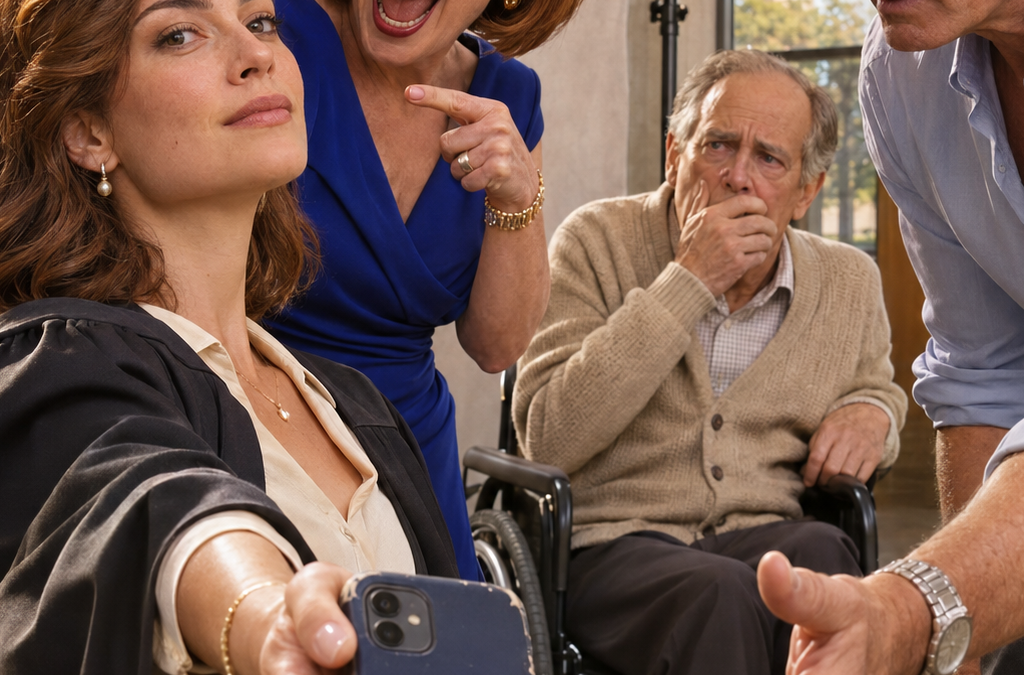
Diane stood across the opening between the backdrop and a lighting stand.
“Wait outside; this picture is for our successful children.”
My phone rested against my thigh, its navy case chipped white at one corner. Kate’s graduation hood finally lay flat. I had just untwisted its lining while everyone waited.
Dad sat in his wheelchair beside the empty space meant for me. In March, I had paid his uncovered rehabilitation balance from my savings.
He looked down at the floor tape.
“The photographer’s ready,” Diane said. “Let’s not make this difficult.”
It was three o’clock Thursday, two days before commencement. Through the lobby windows, other graduates passed with their gowns over their arms.
“I’m in this appointment,” I said.
“Yes, honey. We’ll get to yours.”
Diane turned toward the photographer before I could answer.
“Her sister has a teaching position waiting. We wanted something nice for the announcement.”
Kate watched the photographer adjust the light. Her hood had slipped again, showing the pale lining at her shoulder. I left it alone.
“Both graduates together first?” the photographer asked.
“Just this arrangement, please,” Diane said. “We’ve finally got her father comfortable.”
Dad could move his own chair. There was nothing between him and the opening except Diane.
“Dad.”
He looked toward the windows.
“It’s only a picture, Nora.”
“Then why am I outside it?”
Kate’s shoes squeaked against the polished floor.
“Can we just do this one?” she asked. “People are waiting.”
There were two families behind us. One little boy was eating crackers from a sandwich bag. His mother looked away when I noticed her watching.
I could have backed up. I could have checked Kate’s hood again, told the photographer where Dad preferred his chair angled, made the next ten minutes easy.
“I could be family without being useful.”
Diane’s mouth opened, then closed.
I had kept one thing she had never asked to see.
“Of course you’re family,” she said. “Nobody said otherwise. We’re talking about arrangements.”
“You told me to wait outside.”
“Outside the shot, sweetheart. Please don’t put more into it.”
The photographer lowered his camera.
“We can leave room,” he said.
Diane gave him an apologetic look, the kind meant to include him.
“We have limited time. Could you take this grouping, and then we’ll sort out the rest?”
Kate moved where he indicated. Dad stayed beside her.
The camera clicked once. I watched my father look directly into its lens.
Someone near the lobby entrance said my name.
The man approaching wore an open-collar shirt and carried a college visitor badge. He chaired my company’s board and had come to check the reception arrangements between campus meetings.
Diane stepped away from the backdrop.
“Oh, good,” she said. “You can help me persuade her. We’re trying to get everyone through pictures.”
He looked at me.
“Are you finished?”
“I haven’t started.”
The photographer checked his screen without saying anything.
“We’re doing separate combinations,” Diane said. “You know how families are.”
“Sometimes,” he said.
He stayed beside my chair instead of joining her. Diane glanced toward the waiting families.
“The college sent the reception preview,” he told me. “Did yours come through?”
“Yes.”
“Mine keeps opening at the guest entry. May I check yours?”
I passed him my phone. Behind him, Kate asked the photographer whether her hood looked crooked.
I knew exactly how to straighten it from there. I kept my chair where it was.
Dad cleared his throat.
“Nora, we can take another afterward.”
“With everybody?”
Diane answered for him.
“Let’s finish what we’ve started.”
The board chair looked from my screen to the college media coordinator approaching from the hallway. She carried the afternoon’s appointment list.
“I need the graduate’s confirmation before I close this,” she said.
“I’m right here,” I told her.
Diane spoke quickly. “There’s been some uncertainty about Saturday evening. I was trying to save everyone calls.”
The coordinator checked the entry on her list.
The board chair stopped scrolling. “Who canceled your place?”
“I didn’t,” I said.
The coordinator looked at Diane. “You reported that she couldn’t attend.”
“I said she might be exhausted. Two ceremonies, all these photographs—”
“Your reception place is marked unconfirmed,” the coordinator told me. “We haven’t removed you.”
“Confirm it.”
“Certainly.”
Diane’s gaze stayed on the screen.
The board chair, Robert Ellis, returned to the preview. Across the phone appeared my name, Nora Bennett, above “Graduate Community Impact Award.”
Underneath it read “founder and owner, Open Door Mobility.”
The opening showed Dad testing our first used accessible van. His jacket was caught behind his back, and he complained about the seat belt buckle before laughing.
“Leave it running through the ramp check,” he told me in the footage.
A delivery truck rattled past the open van door. Then the preview paused.
The coordinator checked the sound level. We were still in the portrait lobby at Lakebend College in Austin, Texas, with somebody’s crackers scattered beneath a bench.
“The full tribute is six minutes?” Robert asked.
“Yes,” I said.
Diane looked toward Dad, but he was watching the frozen image of himself.
“We’ll use the approved copy Saturday,” the coordinator said.
A notification sounded on Robert’s device. He read the first line, frowned, and opened it while Diane began explaining that she needed to leave soon.
Robert checked a message. “Why is Diane listed as Monday’s manager?”
Diane stopped speaking.
“One of your staff is asking whether Monday’s schedule should go through her,” Robert told me.
“I haven’t told anyone that.”
“I’ve been introducing myself,” Diane said. “It seemed sensible to prepare.”
Robert looked at her.
“You’ve been presenting Monday as settled?”
“I’ve been discussing the expected start. There’s a difference.”
“Approval is still outstanding.”
“I know that. I went through the interview, Robert. I’m not confused.”
He didn’t argue with her. That was worse than an argument; she had to wait while he read the rest.
The coordinator asked whether I wanted my reception confirmation sent directly to me.
“Yes. Please send it to me.”
Diane watched me answer. I didn’t turn toward her afterward.
The photographer came around the lighting stand.
“We’ve still got time for your solo portrait,” he said gently. “We can make it really nice.”
“I don’t want a consolation picture.”
“I didn’t mean—”
“I know. Thank you.”
He stepped back. Kate stayed on the backdrop, her graduation gown making a dark triangle against the pale paper.
“Should I take this off?” she asked nobody in particular.
Dad turned his chair toward me. His front wheels crossed the edge of the floor tape.
“Nora.”
I waited.
Diane stood beside him now, holding her appointment envelope against her dress.
“We’ll talk at home,” she said.
Dad looked at the space between us. He could have crossed it. The photographer had moved the lighting stand out of his way.
Instead, he said, “Don’t leave angry.”
“I’m leaving without a family picture.”
Robert returned my phone. Another notification appeared, this one from the company’s shared inbox.
It was a new calendar invitation, sent while we were still standing there.
Diane saw me reading.
“That’s just so people can plan,” she said.
The invitation read, “Mandatory staff meeting—Monday, May 18, 8:00 a.m. Host: Diane Mercer.”
Chapter 2 of 7
At nine Friday morning, our dispatcher stood beside my desk with a van key and no van.
“The lift won’t cycle. Driver’s still at the shop.”
On the screen, two pickups sat beneath the same vehicle number. One passenger had a clinic appointment. The other bought groceries every Friday and booked us home afterward.
Robert arrived while I was checking the other routes.
“I checked the invitation,” he said. “Diane sent it herself, as preparation. It isn’t an approved staff meeting.”
“Does everyone who received it know that?”
“They will. She has no staff authority. Saturday’s appointment decision is still pending.”
I nodded toward the dispatcher. “Give me a minute.”
Our Austin depot had six accessible vans, but no spare driver waiting around. Moving one trip meant checking everything behind it.
“Call the clinic passenger first,” I said. “Ask whether she can leave earlier. Don’t tell her we’ve changed anything yet.”
“And the grocery trip?”
“I’m looking.”
The dispatcher left my office door open. From the bay came the squeal of a cart wheel that nobody admitted needed replacing.
Robert sat across from me.
“The conditional offer is real, Nora.”
“I was there for the interview.”
“I know. Yesterday was ugly. That doesn’t erase her application.”
Diane had run an outpatient clinic’s front office. She knew scheduling, billing questions, and families who called frightened and took it out on whoever answered. During her interview, she had answered practical questions without once calling me sweetheart.
“I didn’t ask you to erase it,” I said.
“Good. I’ve told staff to keep using the current reporting lines.”
The dispatcher returned.
“Earlier works. She asked if we could still use the side entrance.”
“Yes. Put her on the south route before its first appointment.”
That left the grocery passenger. The west-route van had room, but its return schedule was tight.
“Ask the driver whether the roadwork still blocks that store entrance.”
Linda arrived carrying the meeting records in a plain office folder. She was our CPA and the other independent director. She took the small table beside the printer, where yesterday’s route sheets were drying beneath a leaking air-conditioning vent.
“I need that table fixed before summer,” I said.
“You need the vent fixed,” she said.
“That too.”
She checked the signed operating agreement against the membership ledger and formation records. Our agreement gave the three-person board its authority, and hiring family required approval from both independent directors.
Nearby lay the launch archive: the first van’s invoice, early insurance paperwork, and Dad’s signed acknowledgment of unpaid assistance, with no membership interest attached. Linda checked the dates and continued through the stack.
I had started Open Door Mobility three years earlier. Most mornings, owning it looked like this: a broken lift, a damp table, and somebody waiting for a ride.
Diane arrived before ten.
She wore the same low heels she had worn to her interview. At the doorway, she waited until the dispatcher finished speaking.
“The store entrance is open,” the dispatcher told me. “Driver says he can take the grocery passenger, but the return needs covering.”
“Check the north van after its last morning drop-off. Call both passengers before you move either booking.”
Diane watched her leave.
“That’s the kind of thing I could take off your plate.”
“Today, it’s handled.”
“I can see that.”
Robert stayed in his chair. Linda kept working.
“I wanted to explain the invitation,” Diane said. “People need notice. I wasn’t trying to take over your office.”
“You called it mandatory.”
“For planning purposes. I expected we’d settle the details Saturday.”
“You sent it to people who work for me.”
Her eyes moved toward the open doorway.
“Can we discuss this without an audience?”
“Everyone here received the invitation.”
She paused, then came farther inside.
“All right. Your father and I have eleven thousand dollars left in emergency savings. That sounds comfortable until you start subtracting.”
I watched the route screen. The north van still had a blank space where I needed its driver’s confirmation.
“Dad needs something?”
“He always needs something, honey. That’s what ongoing care is.”
“Is there a bill?”
“Nothing I’m asking you to pay today.”
The word today sat between us.
“A stable salary would let us plan,” she continued. “I could work. Your father could stop worrying. And you wouldn’t keep getting calls whenever something goes wrong.”
“Then talk about the work.”
“I am talking about why I need it.”
“That can’t be the hiring instruction.”
Diane looked at Robert.
“I’m not asking for charity. I have experience.”
“Yes,” he said. “We considered it at the interview.”
“And I can do this job.”
“We’ll decide Saturday.”
She turned back to me.
“Surely you want us to manage without leaning on you.”
“I do.”
“Then I don’t see why you’re making that harder.”
Under my desk, my shoes rested against the footplate. One lace had come loose hours ago.
I had paid every crisis until help started looking like rent.
“I won’t pay for another emergency by giving you authority here.”
Her face changed, just slightly.
“That’s a harsh way to describe employment.”
“It’s the answer to what you asked.”
Robert waited until she stopped looking at me.
“Nora refusing another payment doesn’t settle your application,” he said. “We still owe you a decision on the offer.”
Diane thanked him. She left without asking to see the depot.
By eleven, the clinic passenger was checked in, and the grocery passenger had reached the store. I confirmed the north van for her ride home and asked the dispatcher to call her directly.
Then a message from Dad appeared in the desktop message window.
“I signed her recommendation.”
Chapter 3 of 7
At one Friday afternoon, Dad was at the kitchen table, eating toast over yesterday’s crossword.
“What did you sign?” I asked.
“A recommendation. Diane worked in that clinic for years.”
“For the job, or for what you think I owe her?”
He looked toward the sink. “Both, I suppose. There ought to be room for family after what we put into getting you started.”
Dad always buttered toast all the way to the crust. He used to inspect mine when I was little, then eat the neglected edges himself.
“What did the recommendation say?”
“You’ll get it when she sends it.”
“I’m here now.”
“It said she deserves consideration. That my early work ought to count toward a family position.”
“Would you read it to me?”
“I don’t have it in front of me.”
“We can wait.”
“Nora, I’m trying to get somebody to take my wife’s work history seriously.”
Diane came in from the hallway.
“Your father shouldn’t have to defend recommending someone.”
“I asked what he signed.”
“And he told you.”
Dad’s toast stayed on his plate. The butter had soaked through, leaving a yellow patch on the crossword.
“I can recommend her,” he said.
“Yes. You can.”
He looked relieved before I added, “And I can ask you about it.”
Diane sat across from him.
“I’ve written to the family,” she said. “Before this gets any further.”
“What did you tell them?”
“That your father helped give this company its beginning. That he’s upset about being left out of the story now.”
“He’s in the tribute.”
“Being shown doing a task isn’t the same as being acknowledged.”
Dad studied a crossword clue.
“You’ve told everyone?” I asked.
“Only the family thread. People were asking why things felt strained yesterday.”
“They could have asked me.”
“I wasn’t going to leave your father looking unreasonable.”
I stayed through the end of his lunch. He asked whether my gown needed pressing, then remembered I had already picked it up. Neither of us found much to say after that.
Back at my apartment, I opened the family thread on my laptop.
Diane’s message began with how proud they were of both graduates. She described Dad’s early mornings, his patience during testing, his belief that I could build something useful.
Then came the part about me.
“Frank feels those contributions are being edited out of the graduation story. We hope there’s still time for a celebration that acknowledges how this began, without anyone having to argue for their place.”
A relative had answered with a heart. Another wrote that Dad had always been generous.
An aunt had sent me a separate message. She was giving up her reception place.
“Love you. Just don’t want to be sitting in the middle of a family disagreement.”
She had promised to come early so we could eat before everyone got busy. I had been looking forward to that more than the reception itself.
I wrote, “I wanted you there.”
Then I deleted it and sent the coordinator the cancellation.
Kate called a few minutes later.
“Please don’t answer that thread right now.”
“Hello to you, too.”
“I know. Sorry. I’m between errands.”
“Did you call Dad?”
“No. Mom said you stopped by.”
“Then you’ve heard from her.”
“Nora, I’m not doing sides. I just want tomorrow to be normal.”
My graduation gown hung from the closet door. Beneath it sat the shoes I had bought for commencement, still stuffed with tissue.
“What would normal look like?”
“No company talk. No explaining things to people at dinner. We both worked hard for this weekend.”
“I wasn’t planning a presentation at dinner.”
“You know what I mean.”
“Do you want me not to answer when someone asks?”
“Could you just say it’s being handled?”
“That depends on what they ask.”
Kate let out a breath against the receiver.
“I have relatives coming who haven’t seen me in years.”
“So do I.”
“I didn’t say you didn’t.”
“I won’t bring the dispute to your guests. But I’m going to speak for myself.”
“Even tomorrow?”
“Especially if someone else has already spoken for me.”
She said she had to finish her errands. After we hung up, I left the laptop open beside the gown.
Dad called later. Diane was with him; I could hear the kitchen clock behind her voice.
“We’ve been discussing the film,” she said.
“Dad?”
“I’m here.”
Diane continued. “If he’s disputing how things are being presented, renewing permission looks like endorsing that presentation.”
“I want to hear what he wants.”
“He’s worried that saying yes will settle everything without—”
“I asked you, Dad.”
The clock clicked several times.
“I don’t want everybody watching me while they’re wondering why we’re fighting,” he said.
“We don’t have to show it.”
“You put work into it.”
“Yes.”
“And those people at the college.”
“Yes.”
“I need a little time.”
“All right. Tell me when you’ve decided.”
I called the college media coordinator afterward.
“He hasn’t given me a clear yes for this screening,” I said. “Don’t run the full tribute without it.”
“We can still do the award presentation without the film.”
“Then we’ll do that if we need to.”
“It would be shorter.”
“That’s okay.”
Afterward, I sat beside the open laptop. Dad had laughed in that footage. I had wanted to sit with him while other people heard it.
At 3:30, the coordinator’s message appeared.
“Final screening consent: Friday, 5:00 p.m. If unresolved, we hold the film until Saturday.”
Chapter 4 of 7
At four Friday afternoon, I told the college media coordinator to hold the full tribute.
“The short version has only you,” she said. “Your portrait, the vans, the award announcement. No footage of your father.”
“Use that.”
We were in the campus reception office. On the monitor beside the doorway, my portrait appeared above the words “Graduate Community Impact Award.”
The next screen read “Nora Bennett, founder and owner, Open Door Mobility.”
Seeing it that large made me wish I had chosen another picture. The photographer had caught me mid-laugh, with one eye nearly closed.
“Everybody picks the serious one,” the coordinator said. “Yours looks like somebody told a decent joke.”
“It was a terrible joke.”
“Those work, too.”
Diane arrived while we were checking the captions. She was confirming Kate’s reception arrangements and had brought a question about guest seating.
She stopped beside the monitor.
The caption changed to a photograph of our vans outside the Austin depot. Diane stayed through the award announcement, then watched the loop begin again.
This time, she read the ownership line without looking away.
“Is this going out publicly?” she asked.
“It’s the approved college teaser,” the coordinator said.
Diane looked at me. “And the longer one?”
“On hold.”
“Your father hasn’t decided.”
“I know.”
The coordinator excused herself to check Kate’s guest entry. Diane waited until she was out of earshot.
“I’m not disputing that you own the company, Nora.”
I said nothing.
“I’ve seen the records Linda sent. You put up the money. Your name belongs there.”
“Then what are we discussing?”
“What your father was told he could expect.”
A group of graduates passed the open door, arguing about where to eat. One had a gown draped over a pizza box.
Diane watched them go.
“You can own every bit of it and still have made a promise,” she said.
“What promise are you asking the board to consider?”
“The recommendation explains it.”
“You haven’t sent it.”
“I wanted to make sure he was comfortable with the wording.”
“Is he?”
“He signed it.”
That wasn’t an answer to the question I had asked.
Diane moved away from the doorway so the coordinator could return.
“Kate’s guest count is correct,” the coordinator told her. “The hotel coordinator will handle the seating tomorrow.”
“Thank you. I appreciate you checking.”
Her voice had gone back to the pleasant one from her interview.
Then she turned to me.
“I want the decision completed before Monday. Your father and I need to know where we stand.”
“The meeting is tomorrow.”
“Then let’s keep it about the application. I don’t want another day of relatives calling.”
I had spent part of the afternoon watching replies collect under her account of our family. I wasn’t going to help her revise it here.
“Send the recommendation to everyone who has to decide.”
“I will.”
She left without asking the coordinator to change my caption.
I stayed until my portrait came around once more.
By the time I reached the small conference room the coordinator had offered, Robert had answered my request for a call. Linda joined from her office.
“Diane wants confirmation that tomorrow’s decision is happening,” I said.
“It is,” Robert said. “Same meeting everyone was notified about. Saturday, May 16, 6:15 p.m. Oak Room.”
“All three of us?”
“All three,” Linda said.
Robert continued, “Diane can attend. Relatives who agree to observe can stay for that portion.”
“And the reception staff know?”
“Yes. Company reception after commencement, board meeting before the tribute. Nobody’s moving the argument into the ceremony.”
From the hallway came a burst of cheering. Somebody had collected a graduation packet.
“I don’t want our employees walking into a family hearing,” I said.
“They’re guests,” Robert said. “They won’t be asked to participate.”
Linda asked whether Diane had submitted anything new.
“Not yet. She says Dad’s recommendation explains a promise.”
“The records we checked establish your ownership,” Linda said. “They can’t tell us every conversation you had with your father.”
“So you’ll ask him.”
“Yes.”
“And her offer?”
“Still conditional. It leaves approval with us.”
Robert waited a moment.
“Nora, I’ll read whatever she sends.”
“I expect you to.”
“I wanted you to hear that from me.”
The call ended without anybody telling me it would be fine.
I called Dad through the conference room’s desk telephone. He answered after several rings.
“Are you still at the college?”
“Yes. They’re holding the full film.”
“I haven’t said no.”
“I told them that.”
There was a television playing behind him. He lowered the volume, and I could hear him breathing near the receiver.
“Do you want the complete film shown tomorrow?” I asked.
“I want to give you my answer myself. Saturday.”
“Before they need to run it?”
“Yes, Nora. Before that.”
I looked at the empty chairs across the table. Tomorrow morning, I would graduate. I still didn’t know whether I would get to share the part I had made for him.
“All right.”
“You don’t have to sound like that.”
“I don’t have another answer ready.”
He stayed on the line a moment longer.
Then he said he would see me tomorrow.
At 4:56 p.m., an email from Diane reached all three directors. I opened the attachment on the conference room computer.
Dad’s recommendation filled one page. Below the paragraph about his early testing mornings, it stated that I had promised “a future family management position” in return for his launch assistance.
At the bottom was Frank Bennett’s signature.
Chapter 5 of 7
After commencement, I found Dad near the auditorium doors.
“Will you answer the directors’ questions yourself tonight?” I asked. “About the recommendation.”
“Yes.”
“In person. Not through Diane.”
“I said yes, Nora.”
His graduation program lay open across his knees. He had circled my name and Kate’s in different sections.
Our ceremony had started at ten that Saturday morning. I received my business degree; Kate received hers in elementary education. Nobody interrupted either of us.
When my name was called, Dad’s whistle carried above the applause. It was the same sharp whistle he used when I couldn’t find him after school.
My award would wait until the reception. For those few minutes, I had only been a graduate.
“Did you hear me?” he asked.
“Everybody heard you.”
“Good. Acoustics were worth the tuition.”
I laughed before I could help it.
At 5:30 p.m., I entered the Oak Room at the downtown Austin hotel. The doors were wide, and the paths between tables left room for Dad and me to pass without guests rearranging themselves.
A company employee was testing the microphone. Beyond him, the screen showed the college’s welcome slide.
Linda sat at the meeting table along one wall. In front of her were the operating agreement, membership ledger, Dad’s original acknowledgment, Diane’s conditional offer, and yesterday’s recommendation.
“Everything here?” I asked.
“Everything submitted.”
“Dad’s coming.”
“I saw him in the lobby.”
She looked past me toward the buffet.
“Eat before we start.”
“Did Robert tell you to say that?”
“No. You’ve been looking at the potatoes for a full minute.”
I got a plate.
Dad arrived while I was eating. He went straight to the reception coordinator, who checked the permission form he had signed.
“You’re authorizing the complete tribute this evening?” she asked.
“Yes. The full thing.”
“Thank you. I’ll confirm with the media coordinator.”
Dad turned toward me.
“And if they ask, I’ll tell them that’s me in the van.”
“They may ask whether you remember the recording.”
“I remember. You kept asking if the camera bothered me.”
“It was new.”
“So was the van. To us, anyway.”
The coordinator went to check the playback arrangements. Dad stayed beside my table, close enough that neither of us needed to raise our voices.
“Your gown looked good,” he said.
“Thanks.”
“I thought it might catch in your wheels.”
“We checked it before the ceremony.”
“Right. Of course you did.”
Diane joined us a few minutes later. She greeted the employees, then asked one how often missed trips reached the office before a complaint did.
“Depends who takes the call,” the employee said.
“That’s where I’d start,” Diane said. “One report, whoever answers. Otherwise you end up with three people fixing the same problem.”
Robert had come over during her answer.
“What would you keep out of dispatch?” he asked.
“Billing disputes. Routine questions about eligibility. Anything that can wait while a dispatcher finds a driver.”
“And when somebody insists it can’t wait?”
“Then the office person takes the heat. You don’t send every angry caller to the person watching the routes.”
It was a good answer. I had lost whole mornings doing both jobs.
“What about an uncovered shift?” Robert asked.
“Confirm who’s actually available before promising coverage. At the clinic, people would offer a slot before checking whether we had staff. Then I got to call the patient back.”
An employee nodded.
Diane glanced at me. “I’m guessing you’ve made those calls.”
“Yes.”
“I wouldn’t want you doing them while you’re trying to run everything else.”
For a moment, I could hear the interview again. She had sounded like this then, describing work I needed somebody to do.
Then one of our relatives asked whether Monday was still her first day.
“That’s what we’re here to settle,” Diane said.
The employee excused herself to get dinner. Diane waited until she was beyond the table.
“I know there’s been confusion,” she told the relatives nearby. “I’m not asking for Nora’s company. I’m asking that Frank’s early work be honored the way he says it was supposed to be.”
Dad looked at the screen.
Robert stayed beside the table.
Diane continued, “I’ve done the interview. I’m willing to be accountable for the work. But I don’t think his contribution should disappear because the business has grown.”
“The directors will hear Dad directly,” I said.
“I hope they will.”
Kate arrived with two relatives and stopped beside Dad. She asked him whether he had eaten. He said he had been getting to it.
At 6:10, Robert asked Linda and me to take our designated places.
“All three directors are here for the meeting everyone received notice of,” he said. “We’ll begin at 6:15.”
He addressed the relatives next.
“Before we start, is everyone comfortable remaining as observers?”
They answered yes. Kate sat beside Dad.
“Please let each person finish,” Robert said.
I asked him, “Can we introduce the complete tribute during the discussion, instead of waiting until afterward?”
“With your father’s permission confirmed, yes.”
The coordinator nodded from beside the screen.
Diane waited until Robert looked back toward her.
“I brought an alternative, too. If you need more time on the history.”
The wall clock read 6:14.
“An interim appointment,” she said. “Same annual salary rate—seventy-two thousand. The work starts while you finish considering the rest.”
The page bore only her signature. Beneath the proposed role, one sentence read, “Acting authority begins immediately.”
Diane placed the addendum in front of Robert.
Chapter 6 of 7
Before the board could call the vote, Diane stood.
The clock read 6:15 p.m.
“I’m asking you to confirm the appointment you interviewed me for,” she said. “Frank’s signed account supports it. If you need more time, the interim proposal lets the work begin.”
Robert looked at the addendum.
“This grants nothing by itself. We’re considering both requests.”
“I understand. My experience hasn’t changed because we’ve had a difficult weekend.”
“No,” he said. “It hasn’t.”
“You called it a job we owed him,” I said. “He said it wasn’t.”
Diane faced me.
“Families don’t document every promise, honey. Your father gave you mornings he could have spent recovering. Unpaid doesn’t necessarily mean nothing was expected.”
“You’re saying he traded those mornings for a family job.”
“I’m saying there was an understanding. He’s put that in writing now.”
Robert turned toward Dad.
“Was a future job part of the original arrangement?”
Dad looked at the recommendation in front of Linda.
“I wanted to help her get started.”
“Was there a job commitment?”
“Well. Later, when things got bigger—”
“Frank,” Diane said gently, “you signed that yesterday. You read it first.”
“I read it.”
Robert waited. Linda’s eyes stayed on Dad.
Neither of them had dismissed the recommendation. Diane remained standing beside him, and he still hadn’t answered.
“I want to play the whole recording,” I said.
Robert looked toward me. “You made it?”
“Yes. January 12, 2023. Dad knew I was recording. This is the uncut van test from our archive, included in the approved tribute.”
My phone, in its chipped navy case, held the same copy. The coordinator had the reception playback ready.
“Please start with the test,” I told her. “Keep going after the ramp check.”
Onscreen, Dad complained about the buckle. Someone near the back gave a small laugh.
“Leave it running through the ramp check,” his recorded voice said.
The ramp lowered. Traffic passed behind the van. I heard my younger voice asking whether he wanted to stop for lunch.
Then we were talking about his help.
“No shares, no wages, and no job for me or Diane. I’m helping my daughter. That’s all.”
The coordinator paused the playback.
Dad stared at himself.
“Is that complete and accurate?” Robert asked.
“Yes.”
“Does it reflect what you agreed then?”
Dad’s answer came more quietly.
“Yes.”
Linda looked from the original acknowledgment to the paused screen. The paperwork had recorded unpaid help without ownership; now Dad had answered the separate question about a job.
Diane sat down.
“Frank, that was at the beginning.”
“I know when it was.”
“There were conversations afterward.”
He looked at her.
“I signed that recommendation to keep peace. Nora never promised you that job.”
His chair moved away from hers. He came through the space between the tables and stopped in the open place beside mine.
Robert let him settle before speaking.
“Diane, do you dispute his identification of the recording?”
“No.”
“Do you have evidence of a later agreement?”
“Nothing written. But I’m qualified, Robert. You heard my answers tonight. If you set the family history aside, you still have someone who can do this work.”
“I heard your answers.”
“Then consider me on those. I shouldn’t lose consideration because Frank expressed himself badly.”
“His words rule out the family debt you asked us to recognize,” Robert said.
Linda spoke next.
“I considered your experience. I can’t approve this request, or its interim version, on the basis you’ve presented.”
Diane looked between them.
“The reporting problems still need fixing Monday.”
“They do,” Robert said. “Linda, your vote on the appointment and interim request?”
“No.”
“My vote is also no.”
He waited until Diane looked at him.
“The board declines the $72,000 appointment, including the interim request.”
I hadn’t voted. Across from me, Diane’s mouth stayed slightly open.
“My company is not payment for being your daughter,” I said.
Dad looked down at his knees.
“Any further candidate contact goes through the board,” I added. “Not through Dad or the family thread.”
Diane closed the addendum and stood.
“Frank. We should go.”
“I’m staying for Nora’s photograph.”
“We’ve had a long day.”
“I know.”
She waited beside his chair. He stayed where he was.
Kate rose from the reception table and moved her own place setting farther down. She left room for both chairs, then looked at me.
“Here, if you want.”
Dad’s voice reached me without anybody answering for him.
“I’m sorry about Thursday. I could’ve moved over. I sat there and let you leave.”
“You looked at the camera.”
“Yes,” he said. “I did.”
I let him sit with that.
Diane left the meeting table. A relative asked whether she wanted dinner saved. She said she would let them know.
By 6:45, Robert had closed the meeting. The employee at the microphone asked whether guests needed coffee before the award presentation.
Dad asked for decaf.
“You hate decaf,” I said.
“I hate being awake at three more.”
A laugh escaped me, small and rough.
Around seven, the tribute resumed. This time it ran through the college’s closing recognition and the applause I hadn’t known how much I wanted.
Afterward, Dad asked whether he could sit beside me for the picture.
“Yes.”
Kate made room without being asked again. Both wheelchairs fit beneath the screen.
Before the photographer called us to look up, Dad turned toward me.
“I’ll correct the family message myself. Not through you.”
Chapter 7 of 7
On Friday, June 12, Dad sent his correction to the same family thread.
“Nora never owed us a family job. I helped her because I wanted to. I signed a recommendation that said otherwise, and that was wrong. She didn’t ask me to write this.”
I read it on my laptop before opening the depot schedule.
My aunt answered first.
“I’m sorry I missed your reception, Nora.”
“Thank you,” I wrote.
Other replies arrived during the morning. A few people thanked Dad for explaining. Nobody asked Diane a question.
Dad called that evening.
“Did I leave anything out?”
“It was yours to write.”
“I know. I’m asking if I got it right.”
“Yes.”
He waited, and I could hear the television behind him.
“I should’ve done it sooner,” he said.
“Yes.”
We talked about a loose panel on one of the vans afterward. I described the noise. He suggested checking the fasteners before replacing anything.
For once, we ended a call without my agreeing to fix a family problem.
The company had closed Diane’s candidacy on Monday, June 1. Robert sent the final notice, and Linda confirmed that the recruitment invitations and applicant scheduling access had been removed.
There was no employee account to shut down. Her proposed Monday start had passed without a shift or any salary beginning.
Diane replied to Robert, not me.
She asked whether another recommendation might reopen the appointment. He answered that the decision was final.
When a question about missed-trip reports came up at work, the dispatcher brought it to me. We kept improving the reporting process without putting Diane in charge of it.
I didn’t copy Dad on company correspondence.
Later in June, he mentioned that Diane was applying for administrative work elsewhere in Austin.
“She’s got an interview next week,” he said.
“I hope it goes well.”
“She wondered if you could—”
He stopped.
“If I could what?”
“Nothing. She can ask the people she worked with.”
“I can’t be her reference, Dad.”
“All right.”
He didn’t sound pleased. He also didn’t call back with a different version of the request.
I heard nothing further from Diane about the company. We exchanged brief greetings when Dad called from home and she was nearby. Once, she asked whether I wanted to join them for dinner.
“I’m not ready for that,” I said.
“Your choice, honey.”
It was. I let the answer stand.
On Wednesday, July 1, Dad called after paying a new medical bill.
“I set up a plan,” he said. “Nine hundred total. Six payments.”
“Can you manage it?”
“First hundred and fifty went through this morning.”
I waited for him to explain what had gone wrong, or what he needed before the next payment.
Instead, he said, “They offered automatic payments. I’d rather keep track myself.”
“Okay.”
“I’m telling you because I said I’d handle things differently.”
“Thank you for telling me.”
I didn’t ask him to send the bill. That evening, I bought groceries and paid my own electric bill. His payment stayed his payment.
Over the summer, we began arranging visits a week ahead.
Sometimes I could offer Saturday lunch. Sometimes I had work, or plans, or wanted the day alone. Dad learned to ask for another date without needing an explanation for the first one.
Once, he arrived early and called from downstairs.
“I know. I’m early.”
“I’m still finishing something. I’ll see you at noon.”
“I can wait.”
He did.
Another time, he wanted help comparing two repair estimates for their bathroom.
“I’m asking your opinion,” he said. “Not asking you to pay.”
I read them with him. He chose one, called the contractor himself, and didn’t leave either estimate with me.
The first time he asked whether Diane could come to lunch, I said no.
“She’s still my wife, Nora.”
“I know.”
“I’m not leaving her.”
“I haven’t asked you to.”
His next question came slowly.
“Can I still come?”
“Yes. Just you.”
He came. We ate, argued about whether a van needed new tires, and watched half a baseball game. He went home to her afterward.
Diane received no company authority or access to my accounts. Dad never asked me to change that.
Kate called in August after setting up her first classroom.
“I found three boxes of dried-out markers,” she said. “Apparently those get passed down.”
We talked for twenty minutes before graduation came up.
“I should’ve said something at pictures,” she said.
“Yes.”
“I keep trying to think of a better way to say that.”
“You don’t need a better way.”
She sent me a classroom picture later. I answered when I had time.
The college sent the reception photographs that fall. In the one beneath the screen, Dad’s chair sat beside mine. Kate stood behind us, her hood crooked again.
I saved the photograph with my graduation files. I didn’t send it to the family thread.
On Saturday, December 19, Dad arrived at my apartment at 11:30 a.m., as invited.
I had chosen tomato soup and grilled cheese. He had asked for a later lunch, but I had plans that afternoon, so he had accepted the time.
“You still burn one side?” he asked.
“Only for honored guests.”
His sandwich was fine. Mine had a dark corner.
We ate at my kitchen table while sunlight crossed the floor. He told me about a grocery-store display he had knocked crooked with his chair. I told him about a passenger who called every driver “captain.”
After lunch, Dad looked toward the window.
“We haven’t taken a picture.”
“Of lunch?”
“Us. Just here.”
I checked the space beside the table.
“You want one?”
“Yes. If you do.”
My phone still wore its chipped navy case. I propped it on the kitchen shelf, checked that the timer could see both wheelchairs, and returned to the place I had chosen.
Dad looked at me before looking toward the lens.
“Ready?”
“Yes.”
The timer flashed. Both chairs fit in the photograph.
I stayed in the frame.







