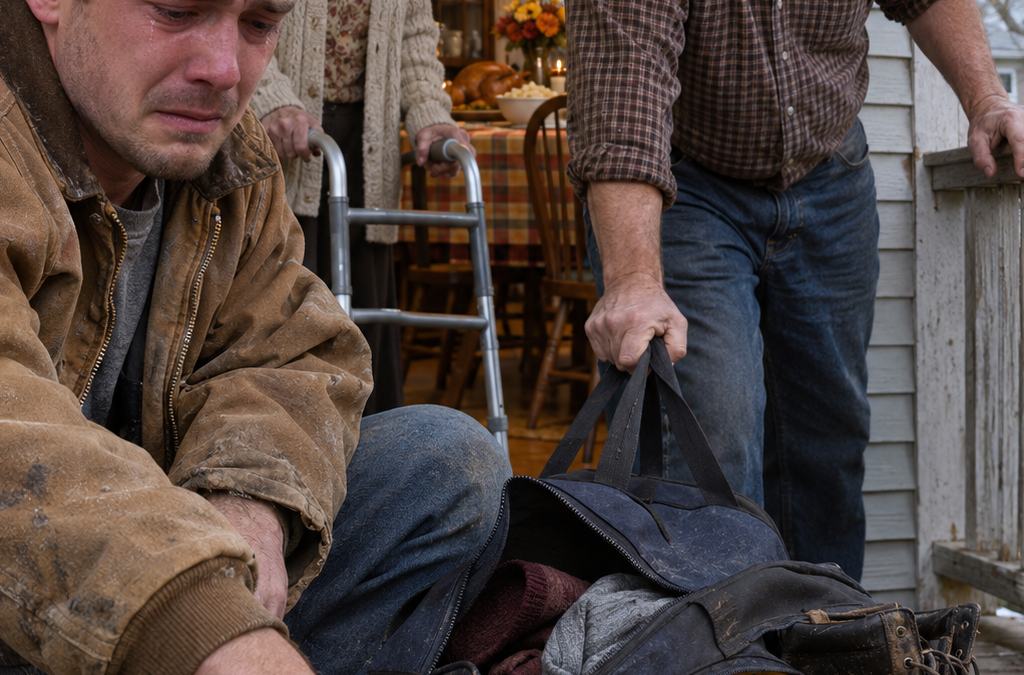
On Thanksgiving, my stepfather dragged my overnight bag onto the porch of the house I owned and said, “Sleep somewhere else tonight, freeloader.”
Chapter 1 of 7
“Mom, are you going to let him do this?”
Linda looked away. Behind her, my grandmother Ruth stood beside the dining-room doorway, braced on her walker. One rear wheel had a fresh, pale scrape.
“He said you can’t stay here tonight,” Eric said.
“I heard him. I’m asking my mother.”
Russell Grant kept one hand on the porch rail. Through the doorway, an envelope marked “optional hospitality” lay beside the scholar-room keys on his sideboard.
“You bring dirty work gear into this house,” Russell said. “We have guests coming.”
Fourteen relatives were there for Thanksgiving, including me. Nobody moved toward the bag.
Ruth was seventy-eight. Watching her try to look past Russell hurt more than hearing him call me a freeloader. Linda kept her eyes on the dining table.
At thirty, I was still introduced as Linda’s youngest, as though that explained everything. My name was Owen Brooks. I was a licensed professional surveyor and the sole owner of Brooks Surveying in Athens, Ohio.
I owned my own house. Five years of surveying profits paid the down payment. Russell thought the college owned it and I only handled repairs, because he had never asked who signed the other side of its lease.
The rail beneath his hand was the one I’d repaired. Behind him was Ruth’s accessible threshold, which I’d spent a Saturday leveling.
My battered measuring wheel slipped from the bag. I caught its handle and folded it back beside my muddy field boots. The potatoes Linda had asked me to bring were still warm in my car.
Then Russell moved across the doorway, blocking my view of the sideboard.
The envelope beside his keys said, “Room Three—optional hospitality.”
Bellweather College leased the six-bedroom house for visiting scholars. Russell served as its resident host, with Linda and Ruth living in the family suite. He’d invited Dean of Faculty Helen Carter for a short holiday walkthrough before dinner.
He’d talked about her visit all afternoon. He wanted the family-suite arrangement renewed and wanted Helen to see how well he ran things.
Apparently, my bag spoiled the picture.
“Eric, keep his stuff outside until he leaves.”
Eric was Russell’s nephew, though family gatherings had blurred that distinction for years. He stood between me and the doorway as if Russell had assigned him a shift.
“You always make your work everybody else’s problem.”
The bag held clean clothes for the holiday weekend. My boots and wheel were there because I’d come straight from work. Russell knew that. He’d watched me carry the potatoes inside first.
“I can leave the gear in my car,” I said.
Linda finally looked at me, but only briefly. Then she turned toward the kitchen, where the food I’d brought waited beside hers.
I’d made rescuing them so routine that nobody called it help anymore. Loose rail, broken threshold, groceries on the way over—there was always something. Being useful had become my admission price.
I’d mistaken being useful for belonging.
Russell pushed the bag farther across the boards with his shoe. Its bottom caught on a raised nail near the steps. My face burned, and I hated that Eric could see it.
“GET OFF THIS PORCH RIGHT NOW!”
“You’re putting my bag outside, in front of Grandma?”
“Yes, and you need to leave it there.”
“All right.”
I retrieved the bag and stepped down onto the path. Nobody had to move aside for me. That part seemed to suit them.
Beside my car, I called Helen Carter.
Her number was already in my contacts. We’d spoken about house repairs before, usually while I was between field jobs. This time I could see Russell through the front window, directing everyone back toward dinner.
“Helen, it’s Owen. Are you still coming over?”
“Yes. I’m on my way.”
Her voice changed when I mentioned the envelope.
“Two scholars say Russell’s charging them to stay.”
“What do you mean, charging them to stay?”
“They’ve sent complaints. And copies of payments.”
Until then, I’d assumed the envelope held grocery money. Scholars sometimes joined family meals; that much I’d seen. But payments for staying in rooms already assigned by the college were another thing.
I stayed beside my car with the bag against my leg. Through the window, Russell noticed I hadn’t driven away. He came back toward the front door just as Helen arrived for her scheduled visit.
Helen stepped onto the porch. “Russell, explain these room charges.”
He opened the door wider for her.
“Dean Carter. Come inside, please. We’re about to eat.”
His voice had lost its edge. Eric backed away from the entrance, and Linda came out of the dining room. The other relatives remained gathered beyond her, close enough to hear.
Helen stayed where she was.
“I’d like to see that envelope, with your permission.”
“Of course. There’s nothing unusual in it.”
Russell brought it to her. Helen compared its contents with a complaint on her phone. She read without speaking while he stood close enough to point at the page.
“Meals and rides,” he said. “That’s what those cover.”
“Your guests have described them as room charges.”
“They’re confused about what the college provides.”
I stood at the bottom of the porch steps. Linda kept glancing from me to Helen, waiting for me to make this easier. I knew that look. Usually, I found some way to oblige her.
But Helen was still reading.
Russell said the scholars had asked for extra help. He mentioned shopping, pickups, meals after kitchen hours. The list sounded practiced, though his explanations grew faster when Helen compared another payment with the envelope.
Then she stopped reading and faced him.
Helen looked up. “The scholars paid you nine thousand six hundred dollars?”
Linda’s mouth opened, but Russell answered before she could.
“Across several visits. You’re making it sound like one bill.”
Helen didn’t answer that. She asked permission to see the scholar hallway, and Russell agreed immediately. His eagerness made me uneasy; a few minutes earlier, he hadn’t wanted me past the front door.
As Helen went inside, Eric hung back beside Russell.
“You told me the truck balance was handled,” Eric said quietly.
“It will be. Keep your mouth shut.”
I was close enough to hear. Eric glanced toward Linda, then lowered his voice further.
“She still doesn’t know about the repairs?”
“Leave it alone.”
So that was what Russell had been trying to clear before my mother found out: a truck-repair balance matching the money Helen had just named. I stayed by the doorway. There was plenty I didn’t know, and I wasn’t going to fill it in for him.
Linda came toward me instead.
“Owen, just apologize for upsetting everybody. Let her finish her visit.”
“I’m not apologizing for asking questions.”
“It’s Thanksgiving.”
“I brought dinner, Mom. He put my bag outside.”
She looked at the empty spot on the porch where it had been. It hurt that she could look at that now, when explaining it away had become harder.
Inside, Helen paused beside the sideboard. Russell had brought the envelope back in with him, and a second sheet protruded beneath the first.
“May I see the rest?” Helen said.
“Sure. It’s the same kind of thing.”
Ruth remained at the dining-room doorway. She hadn’t followed the others toward the hall. I could see how firmly she was holding the walker, and I stayed near enough that she could see me too.
Helen read the second sheet. This one concerned Dr. Leah Foster’s next stay in Room Three, a room the college had already reserved for her.
Russell started explaining the meals again.
Helen turned the bill toward him. “This says Leah needs a $1,200 ‘family clearance’ payment before she can stay in Room Three.”
Chapter 2 of 7
“She said I needed his approval,” Leah Foster told us over Helen’s speakerphone. “The college reservation wasn’t enough. That’s what he meant by family clearance.”
Russell stood beside the sideboard, close enough for her to hear him.
“You misunderstood. Those were optional services.”
“I asked whether I could go upstairs without paying.”
Helen interrupted before Russell could answer. “I’ll speak with you again tomorrow, Dr. Foster. Please keep the bills and payment records.”
The call ended. Russell looked toward the dining room, where dinner was still waiting.
“Dean Carter, I’d like a quiet solution.”
“I need more than this bill to understand what happened.”
He nodded as if she had agreed with him. Then, when Helen turned toward the hall, he leaned close to me.
“Look what you’ve done to Thanksgiving.”
I left before the food was served. Nobody offered to bring Ruth outside, and I didn’t ask her to cross the porch while everyone watched.
At a motel across Athens, I paid for two nights at $145 a night. The clerk didn’t need to know why a man who owned a six-bedroom house needed a room.
That embarrassed me more than I expected. I left my bag by the bed and ate a vending-machine sandwich with the television off.
By morning, Helen had arranged another call with Leah and me. Leah sounded tired, but she had her records open.
“Dr. Daniel Reed paid too,” she said. “We compared what Russell sent us. Four transfers from me, four from him. Twelve hundred each.”
She had sent Helen her own confirmations. Daniel had supplied his separately.
Eight payments. The total was no longer something Helen had read from an envelope while Russell talked over her. Two people could account for money that had reached his personal account.
But Leah kept coming back to the same thing.
“I wouldn’t have paid him for rides. I have a car.”
Helen asked what Russell had said about meals, and Leah admitted she had eaten with the family several times. That mattered too, even though I wished it didn’t.
The bills called everything “optional hospitality.” The transfers showed who paid and who received the money. They didn’t show what Russell had said beside the stairs.
After Leah left the call, Helen shared a copy of the master lease with its attached host schedule. Her cursor pointed first to the bedroom plan, then to the line prohibiting separate room charges.
“Because he says the rooms were available without the extras. Leah says they weren’t.”
The college rented the house from me under one master lease. Separately, it gave Russell the family suite in exchange for hosting the visiting scholars.
“These four bedrooms are reserved for scholars,” Helen said. “He can’t charge them again for those rooms.”
“So why is he still explaining it as groceries?”
“Because he says the rooms were available without the extras. Leah says they weren’t.”
It hurt to hear how much remained unsettled. I believed Leah, but my belief couldn’t tell Helen what had happened in that hallway.
Linda called before I had put my phone away.
“Your grandmother barely ate.”
“Did Russell let her finish dinner?”
“Owen, please. She thinks she’s going to lose her home.”
By then, Eric had started sending messages to the family. He said I was risking Ruth’s accessible bathroom over an argument about where I slept. Other messages arrived beneath his, asking why I couldn’t settle this privately.
Linda didn’t mention the porch.
“She’s seventy-eight,” she said. “She can’t just start over somewhere.”
“I know how old Grandma is.”
My voice came out sharper than I intended. I was ashamed of snapping at the person who should have been saying those things to Russell.
That afternoon, I went back to see Ruth. Linda let me in, but Russell met me before I reached the accessible doorway.
“Stop making your grandmother pay for your pride.”
“I’m here to talk to her.”
“Then tell her you’re dropping this mess.”
Ruth called my name from the sitting room. He let me pass.
She was beside the doorway, her walker within reach. The television was showing a cooking program, though she wasn’t watching it.
“Sit where I can see you, honey.”
I pulled a chair close. From there, I could hear Linda moving around the kitchen.
“Your mother says there’ll have to be changes,” Ruth said.
“I don’t know what changes yet.”
She looked toward the bathroom door.
“At my age, I’m scared of ending up somewhere I have to ask permission to use the bathroom.”
I had wanted her to tell me she knew Russell was wrong. Instead, she was frightened about getting through an ordinary day. That hurt, and it made me careful.
“I won’t decide where you live without you, Grandma.”
She looked back at me. “You promise that much?”
“That much.”
On her television, a pie crust collapsed when the cook lifted it. Ruth watched for a moment.
“Your mother always said mine were too thick.”
“Yours held the apples.”
“That was the idea.”
She laughed once. I stayed until she began to look tired.
Later, Helen called while I was back at the motel. I told her the family was saying Ruth would be put out.
“The college’s lease continues,” she said. “Your family still occupies the suite. Don’t interfere with that while I review the complaints.”
Nobody was changing the locks.
I understood her, but I hated returning to a room where my dinner came in a paper bag. Leaving the confrontation had been my choice. Living with what it cost was harder.
Then Eric forwarded Russell’s new message.
It said Russell was withdrawing my access and asking the college to exclude me from the next housing review as an “interfering contractor.”
Chapter 3 of 7
“Russell calling you a contractor doesn’t make him right,” Helen told me Monday morning. “But I need to verify the college’s existing relationship before another on-site review.”
“Am I supposed to stay away from Grandma?”
“Pause the informal visits. Let me arrange access first.”
I hated needing an appointment to see Ruth. Still, I agreed. She was already frightened, and another argument in her doorway wouldn’t help.
Russell had sent Helen a complaint over the weekend. She forwarded the parts that concerned me and asked for a response.
The writing sounded different from his family messages. He described my visits as unexpected and intimidating. He said scholars needed privacy and that my habit of arriving with work equipment made residents uncertain about which rooms I might enter.
He didn’t deny taking the money. He barely mentioned it.
Instead, he described himself as the person keeping the house orderly while I disrupted it.
Some of that was built around ordinary facts. I did come after fieldwork. Sometimes Linda asked me to fix something while I was there. Russell had turned those visits into a picture of a man wandering through occupied bedrooms.
I’d never entered a scholar’s room without being asked. Having to write that down embarrassed me.
A boundary survey was waiting that morning. I had already loaded the truck when Helen asked whether I could meet her outside the house. She needed to understand which entrance I used and how repairs had been arranged around the scholars.
The client wanted the fieldwork completed before another crew started. I called and asked whether we could shift it to the afternoon.
They said they’d try.
By the time I reached the house, Russell had sent Helen a second message questioning whether I should come onto the property at all. She called to say she was sorting that out and would be delayed.
I waited outside the familiar side entrance. The concrete step still had the shallow dip where rain collected. I knew to stand left of it.
My phone lit up with the cancellation.
They had found another surveyor who could come that morning. The $1,800 field job was gone.
For a moment, I wanted to send Russell a picture of the message. I wanted him to see an actual cost instead of another complaint he could call oversensitive.
But he would have said I’d chosen to come.
That was partly true, which made me angrier.
Helen arrived while I was still beside the step. We stayed outside. She asked where repair requests usually came from and whether I ever entered through the scholar hallway.
“Linda called about most things,” I said. “Russell called when he wanted something done quickly.”
“Did either of them arrange access with the scholars?”
“Sometimes. Otherwise, I waited.”
She made no announcement about who owned the house. Before leaving, she said she would compare my account with the college’s records.
Then Eric’s messages started.
He told the family I wanted Russell, Linda, and Ruth out so I could use the house for business storage. Within minutes, relatives were asking where Ruth was supposed to go and whether my equipment mattered more than her bathroom.
I read the thread sitting in my truck. Nobody asked whether it was true.
There was a time I would have answered every message. I would have explained how little storage a surveying business needed, then apologized for sounding defensive.
Instead, I sent one correction to Helen.
“I’m not asking to store business equipment there or change the college’s use of any scholar room.”
That was the allegation that could hurt the rental relationship. The rest could sit unanswered.
It still hurt. Being quiet didn’t make me immune to seeing people believe it.
Later, Helen called after meeting Leah away from the house. Leah had repeated that Russell’s approval depended on payment. She had also confirmed that he’d provided some meals and rides.
“So he’s using the help he actually gave her,” I said.
“He says those were what she purchased.”
“And she says she couldn’t get her room without paying.”
“Yes.”
“Could you withdraw it before they examine his host arrangement?”
Helen sounded tired. The bills still said “optional hospitality,” and the payments didn’t settle what Russell had told Leah before she sent them. I understood why Helen kept asking. I wished understanding made the waiting easier.
Linda called while I was buying groceries.
She asked if we could speak privately, away from the family messages. I stood beside the frozen vegetables and listened while she lowered her voice.
“Could you withdraw it before they examine his host arrangement?”
“Leah made her own complaint, Mom.”
“You could tell them there was a misunderstanding.”
She said Russell would write something short. All I had to do was agree that nobody had meant to charge for rooms.
I felt humiliated again, standing there with a basket against my knee. She was asking me to help explain away something I hadn’t done.
“I won’t sign something that isn’t true.”
“Owen, I’m trying to keep us together.”
“I’m still willing to see you. That doesn’t mean I’ll sign it.”
She said she had to get back inside. Neither of us said goodbye properly.
At home, I put away enough food for one person. I’d bought a family-size package of rolls without thinking. Linda always said six disappeared before dinner even started.
I froze most of them.
Helen called again before I ate. Russell had sent another request while she was checking the room assignments. Leah was still assigned to Room Three, but he wanted it held for family use through the upcoming review.
His reason was “family needs.”
Chapter 4 of 7
Helen denied the room change before I arrived.
When Russell raised it again at the dining table, she gave him the same answer.
“Room Three remains assigned to Dr. Foster. Family needs don’t change that.”
Linda sat beside him, still wearing her dental-office sweater. She’d come home for this meeting. My usual chair held a stack of folded tablecloths, so I sat at the other end.
Helen had brought the college’s existing house file. Russell seemed relieved to see it, as though paperwork would finally get us away from the complaints.
“Then we need to settle who’s allowed to interfere,” he said.
“That’s one reason we’re here.”
Helen opened the file to the college’s owner information and the deed copy she’d checked against it.
“The house belongs to Owen.”
Russell looked at me, then back at her.
“He represents the business, you mean?”
“No,” I said. “The deed names me personally. Brooks Surveying doesn’t own it.”
His hand stopped on the back of his dining chair. He’d been about to pull it closer.
Linda stared at the file. She knew I’d handled the purchase, but we’d never sat down together over what that meant. There had always been something more urgent to discuss.
Russell had no answer for several seconds. I’d imagined that moment before, usually after some insult I hadn’t answered. Sitting through it hurt more than I expected.
He finally sat down.
“You let me think this was college property.”
“You never asked. You called when something needed fixing.”
Helen kept her voice level. “The ownership records don’t cancel our lease or change anyone’s possession today. Now we need to return to what happened with the scholars.”
That stopped him from turning the meeting into an argument about whether I’d deceived him. It didn’t stop the look he gave me.
Linda spoke without looking up.
“Why didn’t you tell us more?”
“Would it have changed Thanksgiving?”
She didn’t answer. I hated that I still wanted her to.
Russell leaned toward Helen, using the careful voice he’d used on the porch.
“Dean Carter, there’s a family arrangement here that hasn’t been explained properly.”
He described late arrivals, meals, shopping trips, and keeping the house ready. Some of it was real work. I knew that. Hosting people wasn’t effortless, even when Russell talked as though nobody else helped.
Then he brought me into it.
“If Owen owns the place, we can put the extras under family management. He approves them. Everybody knows where they stand.”
“You’re proposing that now?” Helen asked.
“I’m trying to preserve some stability.”
He said it warmly, with Linda beside him and the family suite just beyond the hall. I could hear how easy it would be to agree to something vague and spend months arguing about what I’d approved.
Helen asked whether he meant future services or the money already collected.
“All of it should be understood together,” he said.
There it was. My ownership had stopped being interference and become a signature he needed.
“I’m not approving yesterday’s charges.”
Linda rubbed at a spot on her sweater. “Could you at least hear him out?”
“I am hearing him.”
I was angry, but mostly I was embarrassed for still hoping she’d say something else.
“Across from the accessible sitting room. It’s one of the four scholar bedrooms.”
Helen turned to the bedroom plan. Russell referred to Room Three as an overflow guest room near the family area.
“That’s not the room you mean,” I said.
I recognized the jog in the hall and the wider doorway beside it. Years of reading site plans made that part easy. It was people I kept giving the benefit of the doubt.
“Room Three is here,” I said. “Across from the accessible sitting room. It’s one of the four scholar bedrooms.”
Helen confirmed it from the assignment record. She didn’t turn it into another lesson about the lease.
Linda went to check whether Ruth wanted coffee. In our family, coffee meant a mug reheated until somebody complained it could strip paint. For a second, I almost asked for mine that way.
Instead, I stayed where I was.
Helen stepped into the front room to check where everyone could sit for a longer meeting. Russell followed me only as far as the dining-room doorway.
“Sign it, and stop embarrassing your mother.”
He’d dropped the pleasant voice.
“Sign what?”
“An approval. Don’t make this harder than it is.”
“You haven’t even written it.”
His face hardened. “You know what I’m asking.”
I did. That was why I stayed in the doorway until Helen came back.
She set the review for Friday at two, in the front room. She wanted Russell, Linda, Eric, and me there, with Ruth included if she wished. Leah and Daniel would be available to answer for their own payments.
“I’ll conduct it,” Helen said. “Resident-host appointments are within my authority.”
Russell agreed before anyone else could speak.
On my way out, Linda asked whether I wanted leftover turkey. I said no, then wished I’d said it more gently. I wasn’t refusing food to punish her. I just couldn’t carry another family container home and pretend we’d had an ordinary visit.
Later, she came to my office at Brooks Surveying.
She stood just inside the door, holding a single page. Seeing her there made me sad. She rarely visited unless she needed something, and I’d usually been glad to have a reason to help.
“Russell thinks this will keep Friday from becoming a fight,” she said. “Eric’s already signed. Would you add yours?”
Linda set down a declaration calling the eight transfers voluntary family hospitality. Eric’s signature filled the line below.
Chapter 5 of 7
The declaration said scholars could decline every extra service without losing their assigned rooms. Beneath that, Russell had called the eight transfers “voluntary family hospitality.”
Eric’s signature sat below an account he hadn’t been there to witness.
“I can’t sign this, Mom.”
Linda looked toward my office window. Outside, my truck still needed unloading.
“Could you change a few words?”
“The claim would still be the same.”
She stayed long enough that I wondered whether she wanted to tell me something else. Then she picked up the page and folded it along its existing crease.
It hurt to watch her protect that piece of paper. She’d been less careful with my bag on the porch.
By Friday afternoon, I’d finished a surveying job outside Athens and driven straight to the house. There was dried mud along my cuffs. I checked it before getting out, then hated that I’d checked.
Inside, Russell had arranged the front room so everyone faced the chair he’d chosen for Helen. Eric sat beside him. Several relatives had come, too, crowding the doorway and the space beneath the front windows.
Their coats were piled on the piano nobody in our family could play. Linda still insisted it only needed tuning.
I left my coat on top.
Russell looked at my boots.
“Wipe those before you come any farther.”
They were dry. I used the mat anyway, unwilling to spend the afternoon arguing about dirt.
Ruth was near the family-suite doorway in a wheelchair. For a meeting this long, sitting there would be easier than getting up and down from her usual chair. Linda had positioned herself close enough to help her.
“Grandma, can you see all right from there?”
“I can see you.”
Russell leaned toward her before I could say anything else.
“This will upset you. You’d be better off watching television.”
“I live here too, and I’m staying.”
She said it quietly. Russell looked toward Linda, but Linda only moved her own chair closer to his.
Ruth remained beside them. I couldn’t tell whether she was angry with him or simply tired of being sent out of conversations.
I found a place across the room. I wanted her beside me, and I was ashamed of wanting it so badly that even where she sat could hurt.
Helen arrived without anyone accompanying her. She greeted Ruth first, then took the chair Russell indicated. The college’s lease, payment records, and room assignments were already available to her; she didn’t make a display of them.
Leah joined by speakerphone. Helen checked that she could hear us before beginning.
“I have delegated authority over resident-host appointments,” she said. “Today I need to establish what happened.”
Russell nodded.
“Of course, Dean Carter. That’s what we want.”
“I think we all want to keep this from tearing the family apart.”
Helen asked everyone to separate what they had seen from what someone had told them. She looked around the room as she said it, including me.
That helped. I hadn’t come to ask her to believe everything I said because Russell had treated me badly. The porch was mine to describe. The scholars’ payments weren’t.
Linda spoke before Russell began.
“I think we all want to keep this from tearing the family apart.”
Helen acknowledged her, then asked Russell to explain the charges.
He sounded prepared without sounding as though he was reading. He described meals, rides, grocery runs, and answering the door for late arrivals. Hosting, he said, meant being available when other people had finished work.
Some of that sounded exhausting. I knew how often Linda reheated dinner when somebody arrived late.
“Those were services beyond the college’s basic arrangement,” he said. “The scholars chose to purchase them.”
I asked why the bill called the payment family clearance.
His face changed when he turned toward me.
“You don’t get to rewrite what people bought.”
“I’m asking about your wording.”
“Let me finish explaining it.”
Helen told him to answer the question. He said clearance meant coordinating arrivals with family routines, making sure someone would be there.
It was a better explanation than his hurried Thanksgiving list. I resented how reasonable it sounded now that he’d had time to practice.
Helen turned to Eric.
“What did you personally observe?”
“He told me they wanted the extras.”
“Did you see the conversations before payment?”
“Some people ate with us. I saw that.”
She waited.
“No. Not the payment conversations.”
Eric looked down afterward. His name was still on the declaration, but his spoken answer had become much smaller.
Leah’s voice came through the phone.
“I understood that I needed to pay before I could use my room. I already had a college assignment.”
Russell waited until she finished.
“Dean Carter, she’s asking for her money back. Obviously she has a reason to describe it differently now.”
Leah started to answer, then stopped when Helen asked her to wait.
I looked at Linda. She was watching Helen, searching for some indication that compromise was still possible. Ruth sat close beside her, looking toward the phone.
Nobody looked comfortable. That should have reassured me. Instead, I felt sick with the familiar fear that everyone would agree to call this confusion and expect me to help clean it up.
Russell reached across the gap between his chair and Helen’s.
“This is our family’s account.”
He slid the signed declaration toward her.
“No scholar ever lost room access for refusing an extra payment.”
Chapter 6 of 7
“Tell them again. Could Leah use her room before she paid?”
Russell looked past me toward Helen.
“Yes. Her assigned room was available without buying anything extra.”
Linda watched him say it. Eric sat beside him, and Ruth remained near the family-suite doorway. The other relatives could hear every word.
My battered measuring wheel rested beside my chair after that morning’s fieldwork. I’d brought it in without thinking, then spent half the meeting wishing I hadn’t.
“You charged her for the room the college already paid for.”
The attached room plan lay open near Helen. Room Three wasn’t overflow space Russell could offer on his own. We’d already established that.
“The transfers happened,” Russell said. “Nobody’s disputing your ownership, either. That doesn’t make meals and rides free.”
He described short-notice arrivals again, then the errands. He knew which parts of his account could survive questions.
“Now she wants everything refunded,” he said. “So now she says she couldn’t get upstairs.”
“I waited downstairs with my suitcase,” Leah said through the phone.
Helen asked her to hold on. Russell settled back, apparently satisfied that we’d reached the same disagreement again.
I was scared she would leave it there. My jaw ached from keeping it clenched.
Ruth had been watching the phone. At the mention of the suitcase, she looked toward the sitting-room doorway across the hall.
“Grandma, what happened when Leah brought in her suitcase?”
She looked at Linda first. That small hesitation hurt. She still needed the bathroom behind that doorway, still needed somewhere safe to sleep afterward.
“I was watching my afternoon program,” she said. “Couldn’t tell you which one now.”
Russell leaned forward, but Helen asked him to let her finish.
“Leah was standing by the stairs. She had her coat on. Russell had the room key.”
Ruth’s voice came slowly. Nobody hurried her.
“He said, ‘You can have Room Three after the transfer clears.’ She asked if she could put her suitcase upstairs while she did it.”
Leah made a small sound through the speaker. Ruth kept looking at Helen.
“He told her to wait. I went to offer her a chair. Caught the back wheel of my walker against the doorway doing it. Took the finish right off.”
The pale scrape finally had a cause. I remembered seeing it while Russell put my bag outside.
Helen leaned toward Ruth.
“Was the room available to her before she paid?”
“No. He kept the key.”
Russell started speaking before she finished.
“Ruth, you misunderstood what we were waiting for.”
“You said, ‘You can have Room Three after the transfer clears.’ Right there beside the stairs. I could see you from my chair.”
“I let you take all the shame, Owen. I’m not doing that anymore.”
She paused, looking down at her lap.
“I should’ve said it before. I was afraid you’d make us leave.”
Then Ruth propelled her wheelchair away from Linda. I moved my chair enough to leave space, and she crossed the room herself.
“I let you take all the shame, Owen. I’m not doing that anymore.”
I wanted to touch her shoulder, but she was still facing Helen.
Helen addressed Russell directly.
“Optional help doesn’t explain withholding a room we had already paid for. Russell, your resident-host appointment ends today. Its housing benefit, valued at $33,600 a year, ends with it.”
He stared at her. Linda’s mouth opened, but no words came.
“The college will arrange continued scholar access directly,” Helen said. “We’ll address the occupied family suite separately.”
Russell stood so quickly that Linda flinched.
“Get up, Linda. We’re done sitting through this.”
She started to rise, then looked toward Ruth. Eric pushed the declaration back across the table. He didn’t tear it up or apologize. He just moved it away from himself.
“Mom,” Linda said. “You really saw him keep it?”
Ruth’s wheelchair was close enough that I could hear her breathing.
“Yes, Linda. I saw him.”
“Why didn’t you tell me?”
“I was scared. And you kept telling Owen to apologize.”
Linda lowered herself into her chair. I felt sad for her, and angry that sadness still came so easily. She’d heard enough before this afternoon to stop asking me to fix it.
Russell remained standing. The relatives nearest the doorway moved aside, though he wasn’t trying to leave yet.
“It was a truck repair,” he said. “I was going to settle it.”
Linda looked up.
“The truck? You told me that was paid.”
“I was handling it. You don’t need to start.”
Nobody helped him explain. From beside me, Ruth asked if Leah was still on the phone.
“I’m here,” Leah said.
“I’m sorry I left you waiting there.”
“Thank you for saying what happened.”
Ruth nodded toward the phone. I was relieved she didn’t have to answer more questions, and ashamed of how long I’d needed her to speak for anyone to listen.
Russell turned to me.
“Come into the kitchen. We can work this out.”
“I’m staying here.”
“Don’t put on a show for everybody.”
He was still using the voice that had usually sent me toward a broken fixture or an unpaid errand. For once, I didn’t move.
“You don’t get to charge people for belonging here.”
He glanced at Helen, then lowered his voice.
“You could approve the extras. Say we should’ve explained them better.”
“No. I’m not signing that, and I’m not paying this off for you.”
It hurt to say the second part. Paying had always been easier than staying while someone was angry with me.
Helen gathered her copy of the declaration. Nobody went into the suite to pack. Nobody touched a lock.
Russell took the keys from his pocket and closed his fist around them. He faced Helen.
“I’m not handing over the family suite.”
Chapter 7 of 7
Losing the appointment hadn’t meant Russell had to leave that afternoon. Nobody took the keys from his fist.
The following Monday, he signed an agreement with the college to surrender the suite and repay the scholars’ money. Helen had made clear that his host position wasn’t coming back. He could keep refusing to discuss leaving, but it wouldn’t restore his job.
The agreement gave them a January deadline. Until then, their belongings stayed where they were, and they continued using the family suite.
I hated how uncomfortable those weeks were. But I didn’t want Ruth watching people carry out furniture during another shouting match.
Helen arranged scholar access directly. Russell no longer decided who received a room key or needed his approval.
Ruth called me most evenings. Sometimes she wanted to talk about moving. Sometimes she wanted to tell me what the grocery store had substituted in her order.
“Three cans of peaches instead of pears,” she said once. “Apparently they’re all the same fruit now.”
Hearing her complain about something ordinary relieved me more than I could explain.
When we finally talked about where she wanted to live, I asked instead of presenting a plan.
“Would you rather stay in the suite, or look somewhere else?”
“Are you staying?”
“If the college agrees. I’d like to.”
She thought about that.
“I know where everything is here. And I don’t want another bathroom.”
“Then I’ll ask.”
“You ask for yourself too, Owen. Don’t make it all about me.”
That embarrassed me a little. She knew how easily I could turn a choice into another obligation.
The college gave us written permission to occupy the former family suite. Its existing lease continued, with the four scholar bedrooms still reserved for visiting faculty. I wasn’t taking back the whole house or changing anyone’s room assignment.
Ruth would stay because she wanted to. I would move in because I wanted to.
On January 15, 2027, Linda carried her last carton through the side door.
She had written “kitchen” on it, though a corner of her winter coat stuck out beneath the flap. I almost reached for it. Then she shifted its weight against her hip and kept walking.
Russell handed Helen the host keys without a speech. She checked that the scholar-room keys were included, then let him finish loading their car.
The college confirmed receipt of his $9,600 refund. It returned the money to Leah and Daniel, covering the four transfers each had made. Leah sent a brief message thanking Ruth and me. Daniel confirmed that his refund had arrived too.
There was nothing left for them to argue over with Russell.
Linda lingered beside the car.
“The new place has stairs,” she said. “Not many.”
I didn’t know whether she was simply telling me or waiting for an offer. It hurt that I couldn’t tell anymore.
“I hope the move goes all right.”
She nodded, watching the house.
I didn’t offer their new rent. I didn’t ask what remained on the truck balance or offer to clear it. Standing there without trying to solve either problem felt awkward and mean for a moment.
Then Linda got into the car, and the feeling passed without my paying for it.
Moving into the suite took me longer than expected. My belongings fit easily enough. Getting used to being there was harder.
For the first week, every car in the driveway made me look toward the door. Ruth noticed but didn’t tease me. She was adjusting too.
One evening she asked whether she could move the small table nearer the window.
“Grandma, you don’t have to ask me about a table.”
“I know. Give me a little time.”
I needed time too.
Eric apologized by phone after the move. He admitted that he’d repeated Russell’s claims without knowing whether they were true.
“I shouldn’t have signed that thing either.”
“No, you shouldn’t.”
“I thought I was helping everybody settle down.”
“He humiliated you in your own home. I watched him do it.”
I let him finish. Then I told him not to bring me another message from Russell or add me to another family discussion about the house.
He said he understood. I thanked him for calling, but I didn’t invite him over. His apology mattered. It didn’t make me ready.
Linda asked to visit alone several weeks later.
Before I answered, she said, “He humiliated you in your own home. I watched him do it.”
I sat down on the edge of my bed.
“And you asked me to apologize.”
“Yes. I did.”
She didn’t add anything about keeping the peace. That made it possible to keep listening.
We agreed on a short afternoon visit. I told her there wouldn’t be overnight stays, and Russell wouldn’t return to manage anything at the house.
“He’s not asking to manage it.”
“I need you to hear me anyway.”
“All right.”
The visit was stiff. She asked about work, then listened to my answer. Ruth showed her where she’d moved the table. Nobody asked me to fix anything before Linda left.
I was sad afterward. I’d wanted an apology to make being her son feel easy again. Instead, it gave us somewhere small to begin.
By spring, I could finish a job without checking the family messages between every measurement.
One mild afternoon, I got home early from fieldwork outside Athens. Ruth had made scrambled eggs and toast for dinner, with sliced tomatoes she admitted weren’t worth buying yet.
My battered measuring wheel was muddy from the job. At the side entrance, I paused beside the threshold I’d leveled for her years before. Through the open door, I could see two plates.
“Boots off before you sit,” Ruth called.
“Wasn’t planning to eat in them.”
“You’ve done stranger things.”
I laughed. The scholars had their rooms upstairs. Ruth had her table by the window. My place was ready without an errand attached to it.
Being family never gave anyone permission to make me smaller.
I rolled the wheel inside and took my seat.







