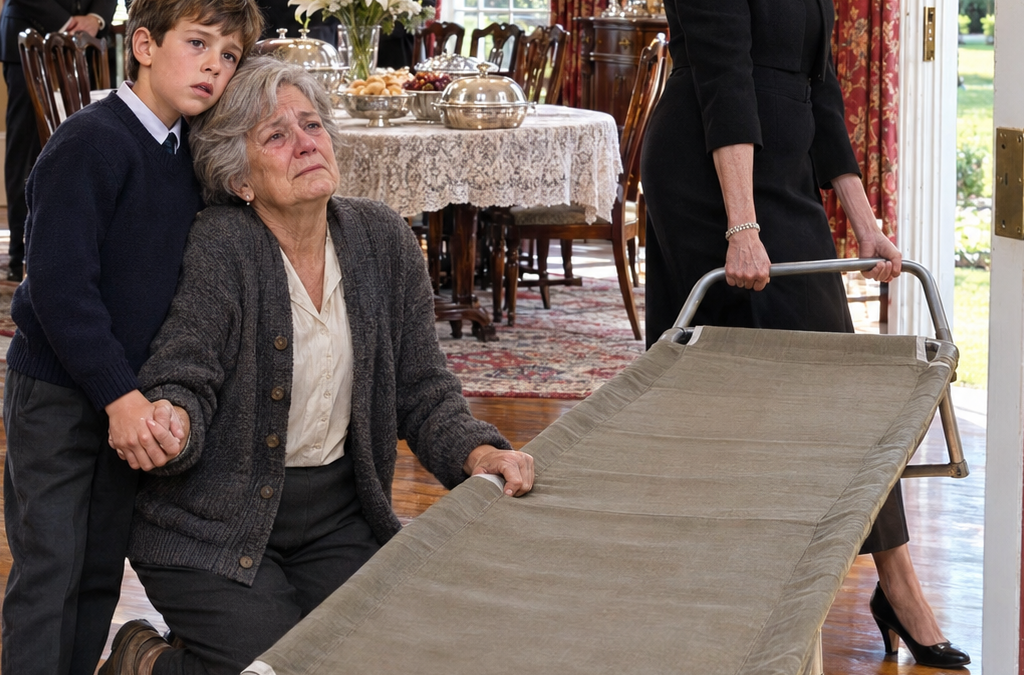
“Take your little burden somewhere else,” my sister said, dragging my grandson’s sleeping cot toward the doorway while our family waited to say grace.
Chapter 1 of 7
I was kneeling beside the empty cot, with eight-year-old Noah standing against me, holding my hand.
My older sister, Patricia Miller, was seventy-two and still stronger than she looked.
“Take your little burden somewhere else.” She repeated it while Noah watched the bed scrape past his shoes.
“He’s standing right here. Can’t this wait until after dinner?”
My brother, David Brooks, looked toward the covered dishes instead of answering, while our cousin, Linda Foster, stood between his chair and the dining-room sideboard.
“Patricia’s only trying to get things settled,” Linda said.
An unfamiliar envelope lay beside her elbow.
David had been about to say grace. Nobody had eaten since Mom’s funeral, and Noah had stopped asking when we could rest.
It hurt to hear her call him that. He was looking at her like he’d misunderstood.
My name is Helen Carter. I’m sixty-nine, a widow and a retired home-health aide in Denton, Texas. Noah is my grandson, and I’m his legal guardian.
His mother, my daughter, died about two years ago.
Mom and Patricia had both signed the original agreement giving Noah and me a home for life.
I kept it, although I hadn’t understood everything it protected.
That morning, I had pressed David’s funeral shirt and kept Linda’s favorite corn casserole warm while Noah’s school shoes waited beside the work shoes I still wore for errands.
Linda liked the corners nearly burnt. She always claimed those portions had fewer calories.
I had let Patricia explain things because arguing always cost more.
But I hadn’t understood why she’d brought an envelope to the funeral meal.
Patricia’s new envelope said, “For the new owner.”
Then Patricia pulled my overnight bag from beneath the dining table.
It held Noah’s clean clothes and mine from our last visit to Mom in rehabilitation. She dropped it beside the cot, as though we’d already packed to leave.
“You’re making this harder for everyone,” Linda said.
I reached toward the frame, but Patricia stepped between us.
The front legs caught against the threshold as Patricia tugged again, and Noah pressed against my shoulder while David watched the casserole dish I had carried from the oven.
“GET THAT BED OUT!”
Noah’s grip hurt my fingers. I stayed on my knees another moment so he wouldn’t see my face.
“Are you making Noah leave his own bed? Will you really let her do this, David?”
David’s eyes stayed lowered.
“Yes, Helen. He’s leaving with you,” Patricia said.
So I stood without pulling against her and took Noah into the adjoining kitchen.
There was no point wrestling over a bed with him watching. He had already watched us bury his great-grandmother.
I wouldn’t help her make this look ordinary.
My sewing drawer was beneath the kitchen counter. Inside it, I found the fabric pouch holding our agreement and Mom’s old digital-tape camcorder, which had come to me among her ordinary belongings.
I held the camcorder against my ribs while Noah leaned beside me.
Patricia was hauling the cot again when Carol Bennett answered my call.
Mom’s longtime friend worked in the county clerk’s recording division. She was already arriving for the meal.
“Your mother sold the house. Patricia handled the arrangements,” Carol told me.
She said Patricia had told her I’d chosen to leave. I hadn’t agreed to move anywhere, and Patricia knew that.
Carol was outside. Through the kitchen doorway, I saw Linda shift my bag clear of the cot.
David stayed beside his untouched place setting as Carol entered through the dining-room door.
She blocked Patricia’s path with her body, then bent to unfold the legs.
“You need to stay out of this, Carol,” Patricia said.
Carol straightened, her coat still buttoned. “Your mother told me Helen and Noah were staying.”
Patricia’s hand stopped on the frame while I brought Noah back, holding our belongings against me.
He sat on the restored mattress beside my knee. Nobody went back to dinner.
Carol turned from the cot to Patricia.
Patricia’s lips parted, but she made no sound.
“Tell Helen, Patricia. What did you promise the new owner?”
“You promised the new owner Helen and Noah would leave willingly,” Carol said.
Patricia backed into her chair, scraping it across the floor.
“I never agreed to leave,” I said.
She sat, but Carol stayed beside Noah’s cot. I stayed beside him, too.
“I was sparing everyone another argument. Mom had enough to worry about.”
Patricia said it to me as if I had caused this.
I looked at the envelope beside Linda. Mom had sold our home while she was alive, and Patricia had never told me.
We had discussed casseroles, funeral flowers, even Mom’s shoes. Not this.
Carol wasn’t deciding who owned the house. She was refusing to let Patricia speak for me.
Then she turned toward my brother.
“David, what did Patricia tell you?”
“This isn’t the time,” Patricia told him.
Linda opened her mouth, but David pushed his chair back. She stopped.
I waited for him to look at me. He looked at the table instead.
He had watched the cot scrape past Noah’s shoes without objecting.
Now he stood and planted both palms against the table.
Patricia’s face went pale before he spoke.
David said, “I repeated Patricia’s story to Mom before she died.”
He stared at the place where Mom used to sit.
“I carried it to her like it was true,” he said. “I didn’t ask you.”
Patricia told him to sit down. He stayed standing, but he still wouldn’t meet my eyes.
I had counted on him to object when she dragged the cot. Now I learned he had helped carry her story into Mom’s last weeks.
That hurt worse than his looking away.
Noah tugged my sleeve. He wanted to know whether we were sleeping in our rooms that night.
“Yes, we are,” I told him. “What Patricia said was mean. You didn’t cause any of this.”
I sat beside him until his fingers loosened around mine. He was tired enough to lean against my arm, but he kept watching Patricia.
David came around the table, stopping short of the cot.
“There’s more I need to explain,” he said quietly. His eyes went toward Noah. “I can’t do it properly with him sitting here.”
“Then don’t start and stop halfway again.”
He nodded, accepting that without asking me to soften it.
Linda lifted the cover from her casserole and asked whether I could help serve. The request was so familiar that I nearly stood.
“No, Linda. You can serve it.”
She looked offended, then looked at Noah and said nothing.
I kept the pouch and camcorder in my lap. Patricia watched them but didn’t ask what I was holding. Carol offered to stay until Noah was settled, and I accepted.
For once, Patricia wasn’t deciding when a visitor had stayed long enough.
David retrieved his jacket, then paused beside me. He offered to come back in the morning, when we could speak without Noah listening.
“Tomorrow, I’ll tell you what I said to Mom.”
Chapter 2 of 7
“I told Mom you wanted a smaller place,” David said. “Patricia said you’d asked her to arrange a move. That you’d already accepted what the new owner proposed.”
He sat across from me on my back porch. Noah was at school, and his empty chair stood between us.
“You never asked me.”
He admitted he hadn’t. He had come wearing the same jacket he’d worn after the funeral, though the morning was warm.
I had spent the night wondering what Mom believed about me. Now I knew she’d died thinking I wanted to leave.
“Mom asked if you were happy here,” he said. “She wanted to know if you felt stuck looking after everybody. I told her you were ready for something easier.”
“Those were Patricia’s words?”
He nodded. He couldn’t look toward Noah’s chair, either.
Mom had asked me whether I was getting enough rest during our last visits. I’d thought she meant the driving and the hours beside her bed. I had told her we were fine.
I felt sick remembering how relieved she’d looked.
David’s phone rang. He silenced it without checking the name, then admitted it was Patricia.
“She’s been calling since I left my house.”
“Why was it easier to ask her than me?”
He rubbed his knee through his trousers. That was all he did for a while.
“Because she usually knew what was going on. With the house. With Mom. I figured you two had talked, and asking you would start another argument.”
I’d heard that excuse in smaller forms for years. Patricia knew the schedule. Patricia had already checked. Let Patricia handle it.
When I worked as a home-health aide, I kept other people’s household records straight. At home, my family treated me like I couldn’t understand my own arrangements.
His phone rang a second time. He let it stop.
“I wasn’t trying to push you out, Helen. I thought you’d chosen it. That’s why I didn’t come around much. I figured you were busy getting ready.”
“You could have come to help.”
“I know what she did. I’m asking about what you told Mom.”
He stared past me toward the yard. I was angry enough that I didn’t rescue him from the answer.
David had a habit of diagnosing every porch noise like a bus engine. Usually, he’d tell me which board needed attention before he said hello. That morning, the loose board beneath him creaked, and he ignored it.
“She did do the hard stuff,” he said eventually. “The appointments. Getting people to come fix things. When Mom needed something, Patricia knew who to call.”
“I know what she did. I’m asking about what you told Mom.”
The third call came while he was trying to answer. This time he rejected it, but he wouldn’t send a reply saying he was with me.
I noticed that. He was willing to hear me privately. He wasn’t ready for Patricia to know it.
I had learned the new owner was Tom Wilson, that Mom had signed the sale herself, and that the money remained hers. Tom hadn’t demanded a lockout; Patricia was the one saying I had chosen to leave.
A message appeared on David’s phone. He read it, then turned the screen enough for me to see.
“Don’t let Helen turn you against me.”
I felt humiliated. Even with me sitting in my own chair, she was describing me as trouble he needed to resist.
“There’s another one,” he said. He read it aloud, stumbling once. “‘I managed twenty-four months of care and family problems while the rest of you just visited. Now she wants to make me the bad one.’”
I remembered Patricia waiting through appointments and arguing over repair bills. Those hours were real. So were the days I’d washed Mom’s clothes, brought her meals, and stayed when she didn’t want to be alone.
I wasn’t going to argue over who had loved her longest each afternoon.
The fourth call interrupted him as he started explaining what Patricia meant. He stopped explaining. For the first time, he looked embarrassed by the ringing.
“She shouldn’t have written that,” he said.
“No. But you’re still answering her for me.”
He said he wasn’t, then caught himself. His mouth stayed open a moment before he looked down.
I wanted my brother beside me. It hurt that I still had to ask.
“Maybe I could go over there,” he said. “Apologize for how yesterday went. Get her settled down, and then we could work this out without everybody hearing.”
“Apologize to Patricia? For what you told Mom about me?”
He said he meant a quiet conversation, something that wouldn’t make her dig in. His phone rang for the fifth time. He watched it until it stopped.
“Correct your own words, David. Tell her you never heard me agree to move. Tell the people you said it to.”
He asked whether I needed that done today. I said yes.
He didn’t promise. He said he needed to think about how to put it, and I hated how familiar that sounded.
The sixth call came before he stood. He didn’t answer it.
For a moment, I thought he might finally call her back in front of me. Instead, another message arrived with a photograph attached.
It showed a prepared statement saying I had chosen to leave the house. There was a blank space for my signature.
Patricia’s caption read, “Linda will bring this to Helen.”
Chapter 3 of 7
Linda had already contacted Noah’s teacher when she arrived with Patricia. My sister had told her I wanted help arranging a school transfer.
I didn’t know that yet. I only knew Linda carried the statement David had shown me, and neither woman had asked whether she could come.
“I understood you’d already agreed,” Linda said as they entered my sitting area. “Patricia said you just needed help getting things moving.”
Noah was in his bedroom after school. I had promised to check his spelling words before supper.
Patricia took the chair nearest mine. Linda stayed beside her, holding the page.
I had the original agreement in its fabric pouch against my knee. Before they arrived, I’d read it again, including the places where Mom and Patricia had signed.
“This will stop everyone worrying,” Patricia said. “Nobody needs another argument. Sign it, and we can get on with helping you.”
She spoke as though I had called them there.
Linda offered me the page. It said leaving was my choice. Beneath that, it said I would arrange another place for Noah and me.
I felt humiliated reading it in the room where I lived. Patricia had even left space for me to thank the family.
“I won’t sign anything saying I chose to leave,” I said. “I didn’t choose it. You don’t get to write that for me.”
Patricia glanced at the pouch. She didn’t ask to see what was inside.
Our sitting area had never impressed her. The television stood slightly crooked because Noah insisted it looked straight from his favorite seat. I liked that he had a favorite seat here.
Linda said we could change a few words. I told her the problem wasn’t how it sounded.
“You can’t keep making a child live in uncertainty,” Patricia said. “He needs to know where he belongs. You’re dragging this out because you’re angry with me.”
“I told her he might be transferring. She was going to check with you.”
I was angry. I was also tired of hearing concern for Noah from the woman who had dragged his bed.
Linda began telling me children needed stability. She mentioned his teacher, then stopped halfway through a sentence about giving the school enough time.
I asked what his teacher had to do with this.
“I called because Patricia said you’d asked us to help,” Linda said. “I told her he might be transferring. She was going to check with you.”
Patricia turned toward her. “Linda, stop talking. You’re making this more complicated.”
Noah appeared in the doorway before I could answer. He had heard his name. His spelling sheet hung at his side.
“Should I empty my cubby tomorrow?” he asked.
I hated that he had been carrying that question home without telling me. He explained that his teacher had asked whether he knew when he might move.
“I didn’t ask you to call his school.”
Linda looked at Noah instead of me. She said she hadn’t meant to upset him.
I told him his cubby could stay exactly as it was. He wasn’t changing schools, and I would speak to his teacher myself. He asked whether his library book should stay there, too.
That nearly undid me.
“Yes, sweetheart. Your book stays.”
He went back to his room after I promised we would talk before supper. Patricia waited until his door closed, then said I should have kept my voice down.
The school hadn’t changed his enrollment or agreed to a transfer. Still, he would miss his normal classroom start while I went in with him to clear up something I had never requested.
He liked being there early enough to feed the class fish. I was furious that tomorrow he would be explaining why his grandmother needed to speak to someone.
“I’m responsible for Mom’s estate now,” Patricia said. “The court appointed me. If you keep fighting, don’t expect me to support that early money you asked for.”
I had asked whether a small part of my eventual share might come early. I hadn’t been promised anything, and I knew there were bills to settle first.
She had found a way to make even asking sound shameful.
My lawyer, Daniel Hayes, had asked the court to settle our right to stay and look at the payments I’d made.
“My home isn’t a favor I have to buy from you,” I said. “And I won’t trade it for your help getting money.”
Linda sat down then. Until that moment, she had looked ready to leave as soon as I signed.
Patricia told her to give me the statement again. Linda kept it in her lap. I felt a little less alone, though I wasn’t ready to mistake hesitation for support.
“She hasn’t agreed, Patricia,” Linda said. “We can’t keep saying she has. I thought this was something she wanted.”
Patricia told her I changed my mind whenever anyone tried to help. Linda didn’t repeat it.
I asked Linda to call the teacher back and correct what she had said. I would still go myself. Noah needed to hear me say it where the confusion had started.
Patricia stood and told me I was making a mistake. I stayed seated.
As she reached the doorway, my phone sounded. David had sent a voice message.
I pressed play.
“Those six hundred dollars weren’t reaching Mom.”
Chapter 4 of 7
“Patricia called it family bookkeeping,” David said. “I carried some of your envelopes straight to her. Later I found out Mom never got the money.”
He sat at my dining table, where I’d left his usual chair pulled out.
“She told me not to bring it up with Mom. Or tell you what Mom said about money. She didn’t want you comparing things.”
I asked why he had agreed to that.
He looked at me then. He looked ashamed, but I needed more than that.
“Because she’d tell me to take over,” he said. “The appointments, the repairs, finding somebody when Mom couldn’t be alone. I didn’t want all that landing on me.”
I had expected another excuse about trusting Patricia. His answer hurt because it was uglier and more honest.
He had protected his own afternoons while I counted out money I believed Mom needed.
Noah was still at school. I was glad I didn’t have to lower my voice.
“You let me thank you for taking those envelopes. You told me it was helping her. Did you know then?”
David said he hadn’t known during the first deliveries. Afterward, Mom had mentioned being grateful that I lived there without having to pay her.
He’d nearly corrected her. Patricia had stopped him later, saying Mom didn’t need to worry about household money.
That was when he understood there were two different stories.
“I should have said something. I know that now. She kept saying it all came out the same, that you didn’t understand what things cost.”
“You knew enough to keep us from talking.”
He started to say he couldn’t make Patricia do anything. I told him I wasn’t asking why he hadn’t controlled her.
Keeping quiet had been his choice.
His phone sounded. Patricia wanted to know where he was. He read the message without answering.
“I kept thinking you two would straighten it out,”
I felt foolish remembering all the times I’d worried about being late with that money. Some months, I had put off replacing shoes until the next check.
David knew what six hundred dollars meant in my house.
Our family had always teased him for counting restaurant fries before eating them. He could spot a short portion across a table. Somehow, he had managed not to ask where my money went.
“I kept thinking you two would straighten it out,” he said. “Then another month went by. After a while, telling you meant admitting how long I’d known.”
I held Mom’s old camcorder in my hands. It had been sitting beside me since before he arrived.
David recognized it before I asked.
“That’s the one from the day you all signed,” he said. “Mom wanted a recording. I ran it for part of the time. Patricia was sitting next to her.”
He remembered Mom asking Patricia to explain the arrangement. He remembered where everyone sat, and stopping once because he thought he hadn’t pressed the right button.
He didn’t try to tell me exactly what anyone had said.
I was sad that he could remember that ordinary afternoon so clearly. I remembered feeling safe afterward.
His second message arrived while he was talking. The third followed before he finished.
Carol had located the matching recorded agreement, protecting my stay for my lifetime, rather than only until Mom died. My payment records and Patricia’s acknowledgments showed she had kept twenty-four payments of $600, totaling $14,400.
Mom had put our right to stay in writing.
I said those words aloud. David nodded, but I wasn’t saying them to comfort him.
His fourth message asked whether he was with me. He left it unanswered.
Patricia arrived before we finished talking. She came into the dining room and told David she’d been trying to reach him.
“Get your jacket. We need to talk somewhere else.”
He stayed in his chair. The camcorder was out of her sight beside me.
For years, she had only needed to sound impatient. I felt nervous waiting to see whether that would still work.
“I’m staying until Helen finishes,” David said. “You can sit down if you want. I’m not leaving because you came to fetch me.”
Patricia remained standing.
I told her the county copy matched mine. The protection covered my lifetime, my two bedrooms, Noah living with me, and our use of the kitchen. Mom’s death hadn’t ended it. Neither had the sale.
Patricia looked toward David, then back at me. She stopped telling me what Mom’s death had changed.
“You started paying afterward. That changed what you agreed to. And you were willing to move before you decided to make this everybody’s problem.”
“I paid because you said Mom required it.”
She dismissed that with a sharp shake of her head. She said the money was for Mom, not herself.
I was furious, but I didn’t raise my voice. David had heard her say it, sitting in the same chair where he’d admitted what he knew.
He didn’t rescue her by changing the subject.
The hearing was set for Friday, July 10, in Denton County’s probate courtroom. Carol and Tom would be there with David, Patricia, and me.
Patricia turned toward my brother.
“You carried the envelopes. Don’t forget that.”
Chapter 5 of 7
Patricia wanted David to call the payments his own collection arrangement if anyone asked. She told him that in my kitchen, with Linda beside her, expecting his shame to do the rest.
“I delivered envelopes,” he said. “That didn’t give you permission to keep what was inside. Don’t ask me to call it my idea.”
It was the afternoon before the hearing. Patricia had come to “settle this as siblings,” although she had brought our cousin along.
David had arrived first. When Patricia sat beside him, he had drawn his elbows close, leaving her plenty of table.
I recognized that movement. We had both spent years making room for her.
“You knew what was happening, David. Mom depended on you, too. Tell everyone I failed her, and they’ll ask where you were.”
He looked at the doorway. I couldn’t tell whether he wanted to leave or wished he had never let her in.
I was angry that she knew exactly where to press. He had finally admitted what he’d done, and she was using it to keep him quiet.
Noah was spending the afternoon with a school friend. I had wanted him away from tomorrow’s worries, and I was grateful he couldn’t hear this.
Our kitchen table had an extra leaf that never quite matched. Mom used to say nobody noticed once the food arrived. Without dishes covering it, the pale strip looked enormous.
“Stop making everyone pay for your pride.”
Patricia said it to me when I asked David whether he wanted to stay.
He answered before I could. He wanted to stay.
Linda sat across from us, still wearing her purse over one shoulder. She had declined coffee but hadn’t taken off her purse, as if she could remain merely a visitor to whatever happened.
Daniel had already shared the certified copy and payment evidence with the other side, while the old tape’s transfer was still being completed.
There was nothing left for me to fetch for Patricia. She had come for an answer.
“I’ll tell them you paid rent because you accepted a different arrangement,” she said. “You discussed moving. I understood you’d agreed. That money supported Mom.”
“I discussed nothing with you.”
“You complain, then pretend nobody offered help.”
I felt the old urge to explain myself until she approved my wording. It embarrassed me that the urge was still there.
David interrupted her. He said I had never discussed a move with him, either.
Patricia reminded him that he had told Mom otherwise.
He went red. She waited, giving him time to feel it.
Then he stood and carried his chair around the table. He set it beside mine, close enough that I had to shift my knee.
I didn’t thank him. I was glad he had moved, but it hurt that sitting beside me required this much effort.
“You can sit wherever you like,” Patricia told him. “That won’t change what you did. You’re the one who told Mom Helen was ready.”
“Helen never asked me. I should have checked with her before I said anything.”
He said he knew.
She seemed to have expected him to argue. When he didn’t, she turned to Linda and asked her to explain how confused everyone had been.
Linda’s purse finally slipped from her shoulder.
“I called the school because you told me to,” she said. “Helen never asked me. I should have checked with her before I said anything.”
Patricia told her that wasn’t what they were discussing.
It was what I wanted discussed. Noah had returned to his regular classroom routine, but he still asked whether a change in plans meant we were moving.
Linda looked at me and said she was sorry.
I told her I had heard her. I couldn’t give her more than that yet.
Tom Wilson knocked at the kitchen doorway then. He had come by to confirm we would all be attending the next morning, and Patricia immediately spoke more carefully.
“Tom, perhaps you can help us clear this up. Helen seems to think we’re trying to put her out without considering what was agreed.”
He remained near the doorway. “I bought with her agreement still in place. I never heard Helen say she was giving it up. You told me she intended to leave.”
Patricia said that had been her reasonable understanding.
Tom looked at me instead of asking her to explain me. That small courtesy made me feel less helpless.
I told him I had never agreed to leave. He nodded and stayed where he was.
Patricia lowered her voice. She said we could stop hurting each other before strangers heard things that belonged inside a family.
“You stay, and we stop discussing the money,” she told me. “David won’t have to explain himself. We can have meals together again. There’s no need to ruin everything.”
For a moment, I pictured another dinner with everyone passing dishes around what she had done.
I was tired enough to want the easy part. I wanted a brother who could visit without looking frightened and a cousin who didn’t arrive carrying instructions.
But Patricia was offering to stop threatening something she had no right to take.
“I’m not keeping quiet about my payments,” I said. “And you don’t get to promise my home back to me. I never gave it away.”
David remained beside me. Linda didn’t tell me to reconsider.
Patricia looked from Linda to Tom. Then she pointed directly at my brother.
“He collected those payments for me.”
David rose from his chair to answer.
Chapter 6 of 7
Before the probate judge, David admitted carrying my payments to Patricia.
“Mom never received those envelopes. Patricia did. I delivered them because Helen believed she had to pay.”
Linda sat behind him, with Carol and Tom nearby. Patricia looked at David as though he had spoken out of turn at dinner.
Judge Susan Reed asked her to respond.
“Helen paid rent and planned to move,” Patricia said. “We understood she’d accepted a different arrangement. I was trying to follow what everyone wanted.”
Her voice was careful now. I remembered her shouting over Noah’s empty bed.
“Where is Helen’s signed agreement to give up her home?” Judge Reed asked.
Patricia said there had been conversations. I waited until the judge turned toward me, then produced the original from its fabric pouch.
“I never signed my home away.”
My voice sounded thin in that Denton County courtroom. I felt exposed, holding up something my own sister had signed.
Carol identified the matching certified copy and its recording reference. She said what appeared in the county records. She didn’t offer an opinion about what the judge should do.
Tom confirmed that he had bought with my agreement still in place. Patricia, not I, had told him we intended to leave.
“The payments came afterward, Your Honor,” Patricia said. “People change arrangements without writing everything down. If I misunderstood Mom, it was an honest mistake. That money went toward her needs.”
She glanced at me, her expression hardening.
Judge Reed asked to hear the remaining evidence before deciding.
The completed video transfer had arrived that morning; both sides were given time to examine it before it was used.
I personally put Mom’s old camcorder on the evidence table and asked to play the passage.
I explained that it had come to me with Mom’s ordinary belongings, the original cassette still inside. Eric Dawson, the transfer technician, briefly confirmed that he had copied the recording without changing the source.
David identified the afternoon we signed, the people present, and their voices. Daniel arranged the playback.
I was frightened of hearing Mom. I hadn’t expected that part to hurt so much.
On the screen, she sat at her table, looking toward Patricia.
“Tell me what I’m signing here,” Mom said. “For Helen and the boy.”
Patricia’s voice came through clearly.
“It’s Helen’s lifetime, Mom. Selling the house doesn’t end it.”
I looked across at my sister. She was staring at the screen.
Mom asked about the six hundred dollars we had discussed contributing each month.
“That’s voluntary help. It isn’t rent, and she can stop.”
I had gone without things because Patricia said Mom required that money. Hearing her explain otherwise, so plainly, made me furious.
David faced his sister.
“I helped you hide this. I won’t help you keep it.”
Patricia stood before he finished.
“That clip is incomplete. David, tell her Mom changed her mind afterward. You were there when we discussed it.”
Judge Reed told her to sit and said she could identify any other passage she wanted considered. Patricia remained standing another moment.
David said Mom had never told him she required rent. He described delivering my sealed envelopes to Patricia and later learning that Mom believed I lived there without paying her.
My payment records and Patricia’s acknowledgments matched the money traced to her. All twenty-four payments, totaling $14,400, had stayed with Patricia rather than reaching Mom.
I felt ashamed of how long I had trusted her. Then I looked at the signature she had put beside mine.
“Paying money doesn’t establish that Helen gave up her home,” Judge Reed said. “Neither does a story repeated through relatives. And your own explanation on this recording contradicts an innocent misunderstanding.”
Patricia began saying that nobody understood how much work she had done.
The judge waited, then gave her decision.
She enforced my lifetime right to stay, with Noah living with me, against Patricia’s claim that I had surrendered it. Tom remained the owner.
Then she removed Patricia from the estate position, ending her $625 monthly role, and ordered her to repay $14,400 to the estate within sixty days.
Patricia leaned toward the microphone.
“You mean I don’t handle anything now?”
“You don’t get to make my grandson homeless to hide your choices.”
The judge confirmed that she did not.
Patricia looked behind her at Linda, then toward David. Neither answered for her.
I was relieved, but I couldn’t stop shaking. When Patricia turned toward me, I said what I had wanted her to understand since the funeral.
“You don’t get to make my grandson homeless to hide your choices.”
In the hallway, she reached for David’s sleeve. He stopped walking but didn’t move closer.
“Don’t leave with her. We need to work this out.”
Linda stood beside the courtroom door. Patricia asked her to explain how confused everyone had been.
Linda said she wouldn’t say that again. She looked miserable, but she didn’t follow Patricia when my sister stepped toward me.
Patricia lowered her voice and offered a private family settlement. I told her no. I wasn’t discussing another arrangement in a hallway.
Tom asked me directly whether the kitchen faucet was still dripping. I said it was. He would arrange a repair and check with me before anyone came.
That ordinary question nearly made me cry.
I had my pouch and camcorder with me when we headed toward the exit. David walked alongside me without asking me to make Patricia feel better.
Behind us, she called him back.
She asked him to cover the repayment until things settled down. He said he wouldn’t pay money she had kept.
“Then I’ll have to list my condo.”
Chapter 7 of 7
Patricia sold her condo and moved into a smaller rental. Nobody took it from her. She chose to sell rather than find another way to repay what she had kept.
On September 8, 2026, she paid the full $14,400 to Mom’s estate, within the time the judge had allowed.
David told me about the move. He didn’t ask me to feel sorry for her, but I could hear him waiting.
“I’m glad she paid it back,” I said. “I don’t need to know whether her new kitchen is smaller.”
He said that was fair. I still felt mean for saying it, which annoyed me almost as much as his hesitation.
The money wasn’t mine to spend. Someone outside the family had taken over Mom’s estate, and it remained open while the ordinary work continued. There was no sudden check that made everything easy.
I kept buying our groceries and paying my agreed share of utilities. Tom owned the house. Our two bedrooms and use of the kitchen remained protected, and I no longer paid Patricia for the privilege of living there.
“She asked me about coming over,” David said. “Just once, privately. She said she wants ‘to put this behind us.’ I told her I’d ask.”
He had come alone. Noah was at school, and I was grateful not to have to explain why his aunt wanted another closed-door conversation.
I hadn’t heard from Patricia directly since the hearing. Even now, she had chosen someone else to carry her words.
“No unannounced visits,” I said. “If I agree to see her, it won’t be alone. And she doesn’t contact Noah without me there. Tell her that much.”
David asked whether I wanted him to arrange anything. I told him no.
I wasn’t ready for a visit. I didn’t know when I would be. That answer frightened me less than it once would have.
He stayed a little longer, talking about his neighbor’s broken lawn mower. Before leaving, he asked whether he could come by the following week without bringing news about Patricia.
“I’d like that,” I said. “But being here now doesn’t fix what you let happen. Some days I’ll be glad to see you and still be angry.”
He said he understood. He didn’t tell me how bad he already felt.
That helped more than an apology repeated until I had to comfort him. During his later visits, he talked to Noah, asked me questions, and waited for my answers.
Linda came separately. She called first and accepted the afternoon I offered instead of suggesting a more convenient one.
“I’m sorry I contacted Noah’s teacher,” she said. “You never asked me to do that. I believed Patricia without checking, and then I helped upset him.”
“I won’t call anyone about him again,”
I told her I appreciated hearing her say exactly what she had done.
She asked whether Noah was doing all right at school. He was. He had stopped asking me to check whether his belongings could stay in his cubby.
It hurt to remember how carefully he had asked.
“I won’t call anyone about him again,” Linda said. “And I won’t ask you to host dinner so everybody can act like we’re all getting along.”
We had coffee, but I didn’t invite her to stay for supper. She left without making me explain why.
I could accept an apology without handing back all the trust that used to come with it. I was still learning to stop there.
Two months later, I invited Carol over for supper.
By then, four months without the position had cost Patricia another $2,500 in management income. That was time passing without the monthly payment she had counted on. Nobody had added a punishment; the job simply wasn’t hers anymore.
I thought about that once, then went back to planning dinner.
“Nothing fancy,” I told Carol over the phone. “Baked potatoes and whatever I can manage beside them. Come hungry, but don’t expect me to peel anything.”
She laughed and said a potato with its jacket on suited her.
Our house had always eaten baked potatoes split into quarters. Noah called them potato boats, although his usually sank under too much cheese. I bought broccoli, too, mostly for appearances.
Patricia used to make a visitor sound like another burden I had created. I had stopped inviting people rather than listen to her complain.
I was embarrassed by how much permission I had imagined I needed.
“Sit here, near me,” I told Carol when she arrived. “You don’t have to take the end chair. We can hear each other better from this side.”
Noah ate with us and told her about a classroom project. She listened without turning every answer into another question.
After supper, he asked to lie on the cot. It was the same one Patricia had dragged through the doorway, now open in his room. He still liked it some nights.
I tucked him in and returned to Carol before he was fully asleep. There was nothing we needed to discuss in whispers until then.
Tom had fixed the dripping faucet. He checked with me before arranging repairs, and I checked with him about the house when something needed attention. We had found a plain, workable way of being owner and resident.
“He sleeps safely here,” I told Carol. “I don’t listen for someone coming to tell us we have to leave anymore. I didn’t realize how tired that made me.”
Carol said she was glad. She didn’t tell me everything had happened for a reason.
We talked softly after that, mostly about ordinary things. I felt happy, and then sad that Mom wasn’t there to eat a potato with us.
Before Carol left, I went to check on Noah. His blanket had slipped below one knee, and his mouth hung open.
The hallway lamp was on. I decided to leave it that way and return to my guest. There was still tea in the kitchen, and I wanted her to stay a little longer.
Family didn’t excuse what I finally stopped allowing.
Beside the cot, I left the door open.







