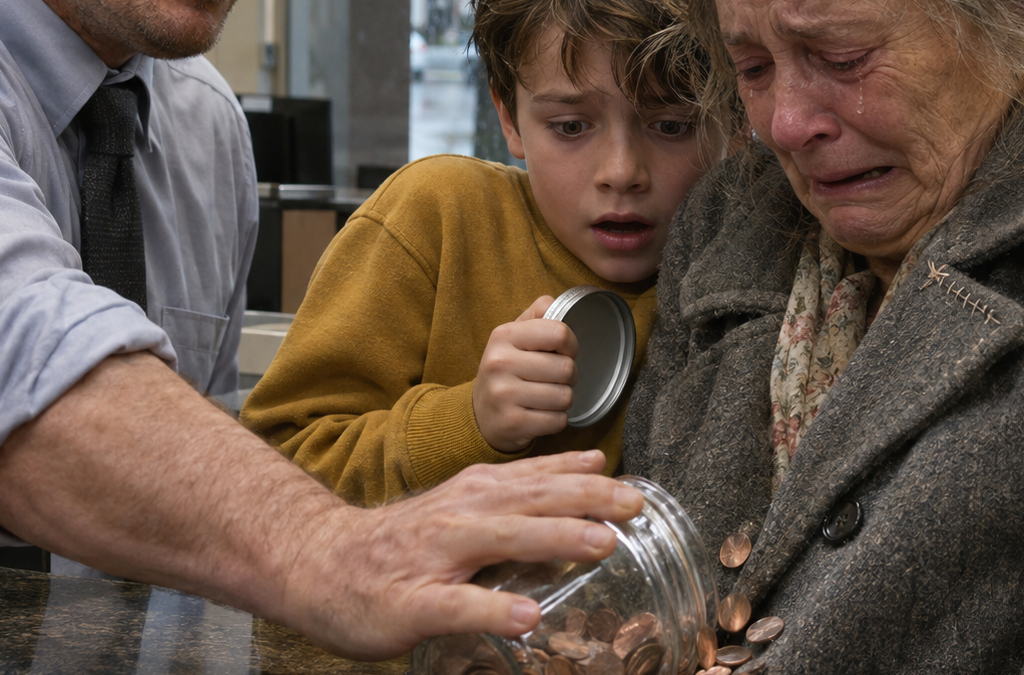
The bank’s teller supervisor shoved my grandson’s coin jar across the counter, spilling pennies onto my old coat, and said, “Take that mess somewhere else.”
Chapter 1 of 7
Noah stood against my right side, holding the loosened lid. He was nine. Pennies struck the repaired seam below my collar and dropped between us.
“Why did you push his money back?” I asked.
Mark Dalton’s name was on his badge. He looked past me toward the waiting chairs. “Move aside so we can serve our customers.”
“We are customers. Julia, will you help him pick it up?”
Julia Reed smirked, then looked down at her screen. Beside it, a children’s coin-deposit sign stood half-hidden behind a display.
“We can’t hold the whole line up,” she said.
Noah pressed closer. His school-project label, “Room 4: Small Savers,” had wrinkled where he’d glued it himself.
I caught the jar before it reached the counter’s edge. Then I bent for the pennies.
At sixty-eight, I still did that first: made excuses for busy people. Helen Parker could wait. Helen Parker could clean it up.
I founded and still owned the bank behind all nine branches.
Cedar Creek Bank had begun in 1993. Professional executives handled daily operations now, though I still approved bank-wide payroll funding. This was our North Oak branch in Dayton, Ohio.
My husband had been dead five years. He used to tell me I could excuse anybody having a bad day.
I’d brought sandwiches when this branch opened. Julia had been behind this counter then. This morning, I’d carried Noah’s jar under my coat through the drizzle to keep his label dry.
Mark pointed toward the chairs, then at the little sign.
“Julia, turn that around. They’re holding everybody up.”
Julia turned the children’s coin-deposit sign toward the wall.
That hurt more than his first remark. The sign offered the very thing Noah had come to do.
He was saving toward $48 for used binoculars. His class was keeping savings charts, and he’d colored his boxes green. At breakfast, he’d practiced explaining his deposit while eating peanut butter toast folded like a taco, our usual compromise over crumbs.
Now he wouldn’t look above the counter.
“His account is already here,” I said. “We brought the coins for that service.”
“You need to move away from this counter.”
Mark stepped closer as though I hadn’t heard him. Julia stayed behind her screen.
“The coin service isn’t available right now,” she said. “You can bring it back another day.”
I gathered the accessible pennies into my cupped palm. A few had fallen behind the counter into its catch tray. Nothing remained where someone might step.
“GET THAT JAR OFF MY COUNTER!”
Noah flinched hard enough to bump my elbow. My fingers went clumsy around the coins.
“You’re refusing his deposit and refusing to help?”
“Yes. Move along and let us work.”
“Then we’ll step aside.”
The jar came with us. I wasn’t leaving Noah’s savings where Mark could shove it again.
We settled beside the waiting chairs, clear of the line. Noah still held the lid, although there was no reason to keep holding it.
“I loosened it too early,” he said.
“The lid didn’t push the jar.”
He stared at the jar’s school label. Across from him, the bank’s advertised children’s service faced a painted wall.
I wanted to get him out of there. That was the honest part. His face had gone blotchy, and leaving would have been easier than standing there while Julia avoided us.
But he was waiting for me to decide whether Mark had been right.
I called David Ellis, our chief executive for nine years.
“David, I’m at North Oak with Noah.”
“I’m nearly there for the branch visit.”
“Please come through the customer entrance.”
He paused. “Helen, is this about coin deposits?”
I hadn’t mentioned coins.
“Some parents called about being kept off the waiting list,” he said. “I was going to ask about it today.”
“I’ll be here.”
There was no need to say more with Noah listening.
A few minutes later, David came through the customer entrance alone. He joined the line rather than approaching the staff door. Mark recognized him immediately.
His shoulders straightened. And the voice he used with David had none of the sharpness he’d used with us.
“Good to see you, David. We’re moving nicely today.”
David looked toward Julia’s counter.
“Mark, why is the children’s deposit sign facing the wall?”
Julia’s eyes flicked toward Mark. He gave a small, agreeable laugh, as if David had noticed a crooked picture.
“We’re having trouble with the coin sorter,” Mark said. “I didn’t want families waiting for something we couldn’t do.”
David stayed where he was. He hadn’t greeted me, and I hadn’t gone to him.
“The waiting figures looked better this week,” he said.
“Yes. We’ve worked hard on that.”
“Under three minutes.”
“That’s right. Better than the four-minute target.”
Mark spoke with the pleasure of someone finally getting to the subject he’d prepared for. He indicated the nearly empty chairs.
But David looked at the turned sign again.
“I’d like to understand what happened to the coin customers.”
“We explained the equipment trouble. Offered another visit.”
A notification lit Julia’s bank-issued work phone. She turned it face down beside her keyboard.
I remembered how quickly she’d obeyed him about the sign. Noah had watched her do it too. That made me ashamed in a way I hadn’t expected; I’d brought him here expecting him to feel welcome.
Then David moved out of the line so regular service could continue. Mark came to the end of the counter, careful now to keep his voice pleasant.
“The calls I received described families being turned away without joining the queue,” David said.
“That would be because we couldn’t complete those transactions.”
“Three families described the same thing.”
Mark glanced at me. For a moment, the courteous expression slipped. Then he turned back to David, ready with another explanation.
“Mark, why didn’t those three families get a number?”
“Giving them tickets wouldn’t fix the sorter,” Mark said.
David let that answer stand for a moment.
“Keep the normal posted services available. If something isn’t working, tell me specifically what happened. I’m going to hear the accounts before deciding anything.”
Mark’s mouth flattened. Julia looked at Noah, then away.
“I’m sorry,” Noah whispered.
He said it to me, but David heard.
“He shouldn’t have to apologize for saving.”
David nodded once. He didn’t make Noah explain himself.
Then Rachel Bennett arrived from the library across the street, where she worked. My daughter had expected us to meet her afterward. Instead, she found Noah pressed against my side.
“What happened?”
“His coins spilled,” Mark said. “We’re trying to settle it.”
Rachel looked at Noah’s face.
“Mom, let’s just take him home.”
I understood her. I wanted the same thing, and it hurt to see how relieved Noah looked at the suggestion.
“We can leave when he’s ready,” I said. “But he didn’t cause this.”
Mark turned away from us and lowered his voice to David.
“I need this handled fairly before my promotion review. The branch numbers have improved since I took over.”
“Then we’ll look at what happened,” David said.
“I’ve been supervising here four months. I don’t want one complaint sending me back to a teller window.”
But David didn’t answer that. Mark returned to his workstation and began typing.
Rachel stayed beside Noah. I could see her trying to understand why a small savings deposit had become something we needed to defend.
Mark said he needed to enter the incident while it was fresh. David went behind the counter to read it privately. Then he brought the screen around toward me.
Beside Noah Bennett’s name were the words “deliberately scattered coins.”
Chapter 2 of 7
“Deliberately scattered coins.”
Below that, Mark had written that Noah disrupted service after being told the equipment was unavailable.
“He didn’t throw anything.”
I waited until David looked at me.
“Mark pushed the jar toward Noah. It started to tip, and the coins spilled when I caught it.”
David kept the screen angled away from the waiting area.
“This is an unverified incident entry, Helen. It hasn’t restricted his account or stopped him using it.”
That mattered, but Noah’s name still sat beside a lie.
Mark leaned toward the screen. “The problem is how they behaved afterward.”
“We stepped aside when you asked.”
“You need to control him before coming back.”
Rachel looked at him then. Until that moment, she’d mostly watched Noah.
“He’s standing right here,” she said.
Noah lowered his head. He had stopped trying to explain anything. I was humiliated for him, standing between adults who could discuss his behavior without asking him a question.
David asked Julia to help the next customer. Then he checked Noah’s account privately, keeping the details out of Mark’s conversation with us.
“Noah has an eligible savings account, with you as the adult custodian,” he told me. “The posted service here accepts loose-coin deposits up to $50 per visit for existing account holders.”
He had checked the service information before saying it. I appreciated that more than a quick assurance.
Mark stayed at the end of the counter.
“I never said they weren’t customers. We couldn’t do the transaction.”
“You also said he deliberately scattered coins.”
“That’s what I observed.”
Rachel moved between Noah and the counter, blocking his view of Mark. She’d done that when he was little and frightened by loud dogs.
“Mom, he hasn’t said a word since I got here. We can sort this out later.”
She meant we could get him somewhere safe first. I knew that. Still, leaving with those words attached to him felt like agreeing.
Then Noah looked up at me.
“Does saving coins make more work for people?”
His question hurt worse than Mark’s insults. I’d brought him for an ordinary errand, something he could learn to do himself, and now he was worried about being a burden.
“Counting them takes work,” I said. “That’s part of what the bank offers. You didn’t do anything wrong.”
“The other families who called—can we check whether they had accounts too?”
“Even little ones?”
“Even pennies.”
Rachel was still watching the door. Noah needed an answer he could trust, not another reason to stand there while I argued.
I turned back to David. “The other families who called—can we check whether they had accounts too?”
“I can check what’s needed,” he said. “You can’t inspect their accounts to establish what happened to them.”
“I don’t need their balances.”
“I know. Their information still stays private.”
He hadn’t said it harshly. And I didn’t ask again.
David brought up the waiting figures on the branch screen.
“This measures customers who received tickets,” he said. “Someone turned away before taking a number doesn’t appear here.”
“So a shorter wait doesn’t tell us everybody got served.”
“Correct.”
Mark shifted his attention to David.
“We can’t give people tickets for work we can’t perform.”
“I’m checking what people were told, Mark.”
For years, I’d read neat reports and asked questions about the numbers. Beside Noah, I was ashamed of how rarely I’d asked who wasn’t in them.
Mark returned with a printed slip and addressed Rachel instead of me.
“This lets us close it without more trouble.”
Rachel read it where she stood. Over her shoulder, I could see that the family had chosen to leave without completing the transaction. Below that was a reference to the disruption already recorded.
“Does signing this mean I agree he did that?” she asked.
“It means you’ve accepted the resolution.”
“That isn’t what she asked,” I said.
Mark’s voice sharpened. “Let his mother handle this for once.”
Rachel went pink. I hated that he’d found another person to embarrass.
“We’re not signing anything that leaves blame on Noah,” I said.
“Mom, please.”
She wanted the argument to stop. For a moment, I was angry with her anyway.
Then I noticed Noah staring through the windows at the library across the street. Keeping him there wouldn’t make the entry any less false.
“Take him over,” I told her. “I’ll stay.”
Rachel left the slip unsigned.
“We’ll be nearby,” she said.
Noah looked back once from the entrance. I raised my hand, keeping my face steady until he’d gone.
David checked the complaints he’d received, making brief calls away from the counter. He didn’t put anyone on speaker or bring their account details back to me.
When he returned, he said all three families had described being stopped before receiving tickets. Each had come intending to make a coin deposit.
Mark started to answer.
“Continue ordinary service,” David told him. “I still need to establish what happened.”
Mark went back to his workstation. I stayed near the chairs, suddenly tired now that Noah wasn’t there to watch me.
Rachel’s call came before I’d decided whether to sit.
“Mom, we’re outside the library.”
“Is he all right?”
“He’s looking at the activity board. Listen—Mark just sent me a message.”
I looked toward the counter. Mark was facing his screen.
“He wants me to come back,” she said.
“Then I’ll meet you at the door.”
“No. There’s another part.”
Rachel read it aloud.
“Come back without your mother.”
Chapter 3 of 7
Rachel came back with the message still open on her phone. Noah had stayed at the library activity across the street.
She showed David the screen before she approached Mark.
“I wanted a quiet parent-to-parent conversation,” Mark said. “Your signature keeps his school project from becoming an unpleasant complaint.”
He looked at me when he said unpleasant.
“Her signature won’t make that account true,” I said.
“Let her answer without coaching her.”
Rachel stood beside the unsigned slip. She’d come without her lunch, though this was her break. It hurt to see her spending it defending her son.
“I won’t sign anything saying Noah threw coins,” she said. “He told me what happened.”
Mark leaned closer, keeping his voice down now that David was listening.
“Your mother is making this bigger than it needs to be.”
For years, I’d paid the extra charge or apologized first. Sometimes I’d accepted blame just to let an embarrassed person escape. Rachel had watched me do it.
Now Noah was learning the same habit from us.
“We’re not closing it that way,” I said.
Rachel turned toward me. “Then what does closing it look like, Mom?”
“Taking out what didn’t happen.”
“Fine. But David’s here, and everybody’s watching. Noah just wanted to bring in his savings.”
She wasn’t defending Mark. She was asking me to notice what staying was costing our family. I knew that, and I still resented having to explain myself.
“He asked whether his pennies were too much work,” I said.
“I heard him.”
“Then you know why I stayed.”
“And I know he’s happier across the street.”
That stopped me. Rachel had taken care of the child while I argued about the account of him. Both things needed doing, but I hadn’t thanked her for hers.
A woman waiting near the chairs spoke before I could answer.
“Did he tell you the sorter was broken?”
Her name was Ruth Morgan. She introduced herself as a retired school cook, sixty-four, and said she lived nearby. She’d been waiting with a deposit envelope.
“That’s what he told me earlier this week,” she said. “I had $18.20. Mostly change from a coffee can.”
Mark turned from Rachel toward her.
“We’ve already explained the equipment issue.”
Ruth looked at him, then at me. “I wasn’t asking you again.”
There was nothing grand about her voice. She sounded tired of repeating an ordinary errand.
I asked her to tell us only what she remembered herself.
“Did you see anyone try to count it?”
“No. He stopped me over there.” She indicated the entrance to the line. “Said the machine was down and I should come another day.”
“Had you taken a ticket?”
“Hadn’t reached the dispenser.”
She’d carried the money home on foot. Her coffee can had no lid anymore, she explained, so she’d used a bread bag. I was ashamed that she seemed to expect us to find that funny.
Mark gave her a tight, impatient look.
“Another jam would explain another refusal.”
“I didn’t say I knew what was wrong,” Ruth said. “I said what you told me.”
He turned on me.
“Stop dragging strangers into your grandson’s bad behavior.”
Rachel moved closer to my chair. I hadn’t realized I’d sat down.
“She spoke for herself,” Rachel said.
David asked Ruth whether he could speak with her a little longer. She agreed, settling into the next chair with her envelope on her lap.
“Is that the main result you want considered for the opening?”
Mark’s manner changed as he addressed David.
“We’ve had the same workload with tighter expectations. I’ve been in charge four months, trying to keep us inside four minutes.”
David stood at the open end of the counter.
“Is that the main result you want considered for the opening?”
“It’s the clearest improvement since I came here.”
“The promotion?”
“Yes.”
David asked whether Mark had included the customers sent away in his account of that improvement. Mark said the figures came from the system everyone used.
Their voices were low, but I was close enough to hear. The opening carried a $9,000 annual raise. Mark wanted the better job, and he wanted his short record here to support it.
“I don’t want this putting me back at a teller window,” he said.
David didn’t reassure him. He asked what else had changed at the counter.
Listening, I could understand why those waiting figures mattered to Mark. That made his choices clearer. It didn’t make Noah responsible for protecting them.
Rachel sat beside me.
“I’m not asking you to let him blame Noah,” she said quietly.
“I know. I should’ve thanked you for taking him out.”
She looked toward the library windows. “He’s making a paper owl. They’ve got the wings on backward.”
At home, Noah called every crooked craft a prototype. I almost smiled. For a moment, he was an ordinary fourth grader again.
Julia came to the end of the counter while David was still questioning Mark. She looked toward the screen where Noah’s name had been entered.
“Does his mother get a copy of that?”
“She should get a correct account,” I said.
Julia’s face reddened. I still remembered her smirk. I wasn’t ready to make this easier for her.
She glanced at her work phone.
“I don’t delete whole threads anymore,” she said. “I keep the whole work conversation.”
I started to ask what she meant.
“Julia, don’t discuss branch operations with customers,” Mark said.
She stopped speaking. Her eyes stayed on me.
Then Mark asked David to verify my identity before allowing me any further part in staff discussions. He pointed toward me.
“Ask her who she actually is.”
Chapter 4 of 7
“Her name is Helen Parker,” David said. “She founded Cedar Creek Bank. She still owns the company that operates all nine branches.”
Mark paused. He straightened his badge, then faced David.
“I wasn’t given that information.”
He sounded courteous again. There was no apology for Noah, no question about where he’d gone.
“I didn’t ask you to recognize me,” I said.
Mark kept his attention on David. “You can understand the position this puts me in.”
Julia stood behind her counter. Ruth remained in the waiting chair, her deposit envelope resting on her lap. Nobody had moved closer, but Mark lowered his voice.
“If an owner complains about a staff member, how does that staff member get a fair hearing?”
It was a reasonable question. I disliked hearing it from him, which didn’t make it unreasonable.
David answered without looking at me.
“By having me check what happened.”
“The same rules should apply to everyone.”
“I agree.”
Mark turned toward me then. He seemed almost irritated that I’d said it.
“Then equipment problems apply to your family too.”
“Yes,” I said. “So does the service you advertise when the equipment works. That’s what David needs to establish.”
My face felt hot. I hated that explaining who I was had become easier than getting anyone to listen to what Noah had experienced.
Mark glanced toward the entrance.
“And behavior at the counter?”
“That too. Noah won’t admit to something he didn’t do.”
“You weren’t standing where Julia was standing.”
“Then let her describe it.”
Julia looked down at her screen. Mark didn’t ask her anything.
For a moment, I wanted to tell him exactly how much his sudden politeness offended me. Instead, I stayed with the part that mattered.
“I’m not asking to go ahead of anyone. I’m not asking you to count coins differently for us. I’m asking for an accurate account of what happened.”
David moved nearer the open end of the counter.
“Helen won’t decide what happens to anyone’s job. I will, after hearing the staff and checking the equipment explanation.”
Mark nodded, though his jaw stayed set.
“And her owning the bank doesn’t establish whether the sorter worked,” David added.
“No,” I said. “It doesn’t.”
“Noah came out of the activity room. He’s waiting by the desk for me.”
That was harder to hear than I’d expected. I knew he was right. Still, after watching Noah apologize for being shouted at, I wanted someone to say plainly that they believed us.
David wasn’t giving me that shortcut. I’d spent years trusting his judgment; I couldn’t demand he abandon it because waiting hurt.
Rachel’s phone lit up. She read the message, then looked across the street.
“Noah came out of the activity room. He’s waiting by the desk for me.”
“Go,” I said.
“They’re starting another project. I’ll get him settled.”
She hesitated beside my chair.
“Mom, don’t decide we need to bring him back to explain.”
“We don’t.”
This time she believed me. Her shoulders eased before she left.
Ruth watched her cross toward the library. Then she looked at David.
“I can stay a little longer. If you need to ask me anything.”
“Only what you remember directly,” he said.
“Well, I remember the walk home.” She shifted her envelope. “I’d planned on sitting down after this errand.”
“You don’t have to spend your afternoon here,” I told her.
“I know.” She gave me a level look. “I’d rather finish it.”
I was grateful, and embarrassed by how surprised I was. Ruth had no reason to protect us. She simply didn’t want her own experience brushed aside.
David walked toward the small consultation area adjoining the counter. It had an open entrance and chairs meant for conversations that took longer than a deposit.
He checked the space, then came back.
“We’ll sit over here at 1:15. Helen, Rachel, Ruth—I’d like your accounts. Mark and Julia, I need yours too.”
Mark looked toward Julia.
“She’s been on the counter all morning.”
“I’ll keep it brief,” David said. “Regular service can continue.”
There was nothing private enough about the area to make people invisible. There was, however, enough distance that nobody would have to lean across a teller window to be heard.
I moved into one of the chairs. From there I could see the library entrance without watching Mark.
When Rachel returned, she chose the chair beside mine.
“He’s staying for the next activity,” she said. “Apparently the owl needs a habitat.”
“Does it still have backward wings?”
“He says that’s how you know it’s his.”
I laughed once, more from relief than anything else. It hurt that we’d missed that little conversation with him while we were here arguing.
Rachel rested against the chair back.
“I told him we’re getting the words about him fixed.”
“Thank you.”
She stayed beside me. She didn’t go back to the unsigned slip.
Across the counter, David asked Julia to finish with the customer she was serving. Mark waited until the customer moved away, then spoke to her quietly. I couldn’t hear the first words.
Julia looked toward the consultation chairs.
David had gone a few steps away to check the service information again. Mark followed his movement, then turned back to Julia. His pleasant expression was gone.
She picked up her work phone and put it in her pocket.
I couldn’t tell whether she expected to speak or wanted to leave. I only knew she hadn’t left the phone behind.
Mark glanced at the chair David had indicated for her.
“Clock out now. You don’t need to stay.”
Chapter 5 of 7
“Julia, stay,” David said. “You’re still on paid work time. Do you want to give me your account?”
She stopped behind the counter, near Mark.
“Yes, I do.”
“I manage her schedule,” Mark said. “We don’t need everyone standing around.”
“You don’t get to choose whose account I hear.”
David kept his voice low. Julia remained on Mark’s side of the counter, but when David asked whether she could join us after serving the next customer, she answered without looking at Mark.
“I can.”
I was relieved she hadn’t left. That didn’t mean I trusted her yet.
Mark returned to his screen. When he came back, he carried a printed service request.
“I’ve reported the sorter. That’s what we do when equipment gives us trouble.”
He offered it to David, who read it beside the consultation chairs.
“That request was opened after we arrived.”
I said it without reaching for the page.
“Yes, because I’ve been occupied with this.”
Mark turned toward David.
“You can have a machine run, stop, run again. Refusing a deposit can be sensible until someone checks it.”
“This establishes that you reported a concern,” David said. “It doesn’t establish when a fault started or what caused it.”
“So reporting it counts for nothing?”
“It counts as a report.”
I understood Mark’s argument. Equipment could work badly without failing altogether. In the bank’s early years, I’d waited beside machines that behaved perfectly as soon as help arrived.
But nobody had tried counting Noah’s money. Ruth hadn’t even reached the ticket dispenser.
At our first branch, I’d sometimes stood beside the counter through lunch. A stalled transaction had steps you could describe: what someone brought, what the teller tried, where the work stopped.
Here, I kept hearing what couldn’t be done. I hadn’t heard what anyone had tried.
I wanted to interrupt. Instead, I waited while David asked Mark about the sequence. Letting him finish was harder than I’d expected.
Rachel leaned toward me.
“The library activity should be ending. I’m going to get Noah.”
“I’ll be here.”
“I figured.”
There was affection in her voice, and weariness. I deserved both.
“I brought my change. He said the sorter was broken. I went home.”
Mark took a chair in the consultation area. David stayed near its open entrance while Julia finished serving her customer. A few people remained nearby, waiting or completing ordinary errands.
I hated how exposed we were. Noah’s savings deposit had become a conversation people could overhear while checking their receipts.
Ruth sat across from Mark.
“I don’t have much more,” she told David. “I brought my change. He said the sorter was broken. I went home.”
“Did you see it operating?”
“No.”
Mark leaned forward.
“Then you can’t tell us whether it worked.”
“No, I can’t.”
“And you wouldn’t know whether it had jammed earlier.”
“I wouldn’t.”
He looked toward David as though Ruth had withdrawn her complaint.
She continued in the same patient voice.
“I can tell you I didn’t get served. I carried it there, and I carried it home.”
I was grateful she could say what she didn’t know. We didn’t need her to diagnose a machine.
Mark turned toward me.
“She’s being more reasonable about this than you are.”
“Ruth told us what happened to her. So did I.”
“You won’t accept that equipment breaks.”
“I’ve accepted that equipment breaks.”
David spoke before Mark could answer.
“Ruth, did anyone offer to check it while you waited?”
“No. I was told to come another day.”
Mark shifted toward David again.
“We can’t keep testing equipment for every customer. That makes the line worse for everybody.”
Rachel returned with Noah before Julia joined us. He stopped at the edge of the consultation area, searching the chairs until he found me.
“You can sit with Mom,” I told him. “You don’t have to answer anything.”
Rachel chose seats a short distance away. He could see me without having to sit opposite Mark.
“Did you finish your project?” I asked.
He nodded.
“Mom’s carrying it. It’s still wet.”
Rachel held it clear of her clothes. Noah had always treated wet glue as somebody else’s transportation problem. I nearly laughed, then felt sad that I couldn’t simply leave with them.
He settled beside her. His shoulders looked easier than they had before the library.
Julia came from the counter and stood behind Mark’s chair. David indicated an empty seat, but she remained standing.
Mark addressed him before he could ask her anything.
“My position is simple. We had temporary equipment trouble. I wasn’t making a policy against children or small deposits.”
David waited.
“People hear ‘come back’ and think we don’t want them. That isn’t what I meant.”
From where I sat, I could see Noah talking quietly to Rachel. I was glad he had something else to do besides listen.
“You wrote that he deliberately scattered coins,” I said.
“I’ve explained what I observed.”
“I have both accounts,” David said. “Julia, I need yours.”
Mark looked back at her.
“Julia can explain what I meant.”
She didn’t answer him. Her face reddened, but she kept looking at David.
I remembered asking her to help us pick up the money. It still hurt that she’d found our embarrassment amusing. Now I was afraid she would repeat Mark’s account just to get through this.
Julia stepped away from behind his chair.
Mark turned to follow her as she crossed to the open place beside me. She brought out her bank-issued work phone and opened the conversation.
She set it before David.
“Read the message before his, too.”
Chapter 6 of 7
In front of everyone, Mark repeated that he had acted because of equipment trouble.
“This is the whole work conversation,” Julia told David. “On the phone it came to. There are messages before it and after it.”
The customers nearby hadn’t come to watch us. They were finishing errands, close enough to hear. Rachel stayed with Noah just outside the consultation area.
I looked at Mark.
“Why stop school jars before anyone tried the machine?”
“A machine working now doesn’t prove it worked earlier,” he said. “I was protecting the line until we knew.”
He sounded certain. I hated how much easier that made his account to believe.
David kept Julia’s phone angled toward himself. He checked the sender, read backward through the exchange, then continued beyond the message she had shown him.
“Mark, these instructions came from you?”
“Yes. During an equipment problem. You need that context.”
“That’s why I’m reading the surrounding messages.”
Julia stood beside my chair. Her face was red, but she didn’t move back toward Mark.
“I told him it was working,” she said. “Before Helen and Noah came in. That’s the message above his.”
Mark turned toward her.
“You don’t know whether it stayed working.”
“I told you what I’d checked.”
David read for another moment. I watched his expression, wanting an answer before he was ready to give one. Waiting hurt, though I knew he needed to finish.
Then he looked at Mark.
“Julia reported that the sorter was working. Your reply was, ‘Even if it runs, school jars don’t get tickets until my review is over. Tell them it’s down.’”
Rachel came closer. Noah remained in his chair, watching her.
Mark’s mouth opened before he answered.
“That was shorthand. We’d been discussing the problem.”
“Why would an equipment precaution continue when the machine worked?” David asked.
“I was trying to keep the branch moving.”
“Then why tell customers it was down?”
Mark looked toward the counter.
“Those deposits take time. We’re measured on waiting time.”
I remembered Noah asking whether his pennies made more work. He had understood the rejection perfectly. We’d been the ones struggling to name it.
“You told them the equipment was broken,” I said.
“We couldn’t keep stopping for school projects.”
Julia looked at me, then toward Noah. She didn’t try to soften what Mark had said.
David’s voice stayed quiet.
“You ordered refusals whether the machine worked or not.”
Mark leaned forward.
“Let’s discuss this away from customers.”
“We’ve established what happened. I’m removing you from your supervisor position and ending your employment now.”
Mark stayed seated for a moment. The job he had held paid $77,000 a year. He’d been arguing as though the worst possible outcome was losing a promotion.
Then he pushed back his chair and reached toward Julia’s phone.
“Leave it,” David said.
Mark stopped. His face had gone pale around the mouth.
He removed his badge.
I had wanted him stopped. Seeing him without the badge brought relief, but it didn’t undo the sight of Noah shrinking against me.
Mark looked at Ruth.
“You understand why we can’t tie up a line.”
Ruth answered slowly.
“I understand you told me to carry my money home.”
He waited, as though she might add something that helped him. She didn’t.
Rachel stood beside my chair. She wasn’t urging me toward the door anymore. When Noah came over, she made room for him between us.
David went with Mark toward the staff area, leaving us near the counter. There was no further announcement.
Julia waited until they had moved away.
“I followed the instruction,” she said. “And I laughed when you asked me to help.”
She looked directly at me.
“I’m sorry. You both saw me do that.”
“Yes,” I said.
I wasn’t ready to reassure her. Her apology mattered, but I could still see Noah waiting for her to answer him.
She turned toward him.
“I should have helped you. You didn’t cause this.”
He glanced at Rachel before looking back at Julia.
“Some went behind there.”
“Would you prefer somewhere private to complete the deposit?”
“I’ll get them.”
Julia returned to her workstation and knelt behind the counter. She checked the catch tray and retrieved every penny remaining there. Noah stayed beside Rachel; nobody asked him to crawl around looking for money.
By the time David returned, Julia had finished.
“Would you prefer somewhere private to complete the deposit?” he asked me. “We can use the office.”
“My grandson wasn’t the problem,” I said. “We’ll use the counter.”
Noah brought his jar forward. The wrinkled “Room 4: Small Savers” label still clung to the glass.
Julia turned the children’s deposit sign back toward the customers.
“May I take that now, Noah?”
He handed her the jar. This time she waited until he had let go.
She checked his account privately, then counted the money, including the pennies from the tray. The sorter ran without trouble. Nobody treated that as proof of what had happened earlier; we already had Mark’s instruction.
“Your deposit is $23.64,” Julia told him. “It’s in your savings account.”
Noah looked at the receipt.
“All of it?”
“All of it.”
I was so relieved I had trouble answering when he asked me to check it too. Rachel read it with him while Julia returned the empty jar.
David stood beside the consultation chairs with the queue report. He read down its columns, then checked the headings again. I had seen reports like it for years and usually gone straight to the totals.
He pointed to where a refusal should have been recorded.
“This report doesn’t count anyone we sent away.”
Chapter 7 of 7
Two weeks later, all nine branches began recording refused services alongside completed queue tickets. David sent me the revised report, with space for what customers requested and why they hadn’t been served.
He also confirmed that the unsupported allegation beside Noah’s name had been corrected. There was no longer an account of deliberate disruption for someone else to read and believe.
I read that part twice.
The following business day, David had sent written confirmation that Mark no longer worked for Cedar Creek. All his time worked would be paid through ordinary payroll. I approved the funding as usual.
After the thirty-day review, another update arrived. Julia had completed ninety minutes of service training and was beginning six months of monitored performance.
Her apology hadn’t ended her responsibility. Her willingness to tell the truth hadn’t been ignored, either. I was glad David had made room for both.
I still found myself checking Noah’s face whenever someone behind a counter sounded impatient. That embarrassed me a little. He could be thinking about lunch while I was watching for damage.
Rachel noticed during a Saturday grocery trip.
Noah was spending the morning at my house afterward. She’d come along because she needed groceries too, though we both knew we shopped badly together.
She bought what was on her list. I bought things I remembered she liked when she was twelve.
“Mom, we don’t need two bags of pears.”
“You used to eat three at a sitting.”
“I also used to wear jelly shoes.”
We left one bag behind.
Outside, we stopped beside the cart before loading her car. Rachel had been quiet through the last aisle.
“I need to tell you something about the bank.”
“You don’t have to apologize for getting him out.”
“That’s not all I was doing.”
I waited. She looked toward the store entrance.
“I wanted an easy exit. I was embarrassed. People were looking, and you weren’t backing down, and I wanted us outside before somebody recognized us.”
Hearing it hurt, even though I’d known some of it already.
“Recognized me?”
“All of us. Me, mostly.” She looked back at me. “I work across the street. I kept thinking I’d have to see those people again.”
“You thought I was making a scene.”
“At first, yes.”
The cart wheels rattled when another shopper passed. Rachel waited until they were gone.
“Then I realized I was more worried about looking difficult than about what they’d written about my son.”
“You took care of Noah,” I said. “I needed you to do that.”
“I know. But I could’ve done it without asking you to give up.”
I leaned against the car. My knees were tired, and I didn’t want to pretend this conversation was easy.
“I liked the reports that said things were improving,” I told her. “I asked about expenses. Staffing. Waits. I didn’t ask much about people who never got served.”
“You couldn’t know every counter.”
“No. But I could’ve asked better questions.”
For years, a tidy page had reassured me. It was painful to admit how readily I’d accepted it.
Rachel looked down into the cart.
“Are we going to get better at this?”
“I hope so. You can start by telling me when I’m buying your childhood again.”
She lifted the remaining pears.
“These can stay.”
A few weeks later, Noah asked to make another deposit.
He didn’t ask whether Julia would be there. I didn’t promise she would be different.
We went to North Oak and took a number. Two customers were ahead of us. When Julia saw me, she indicated the consultation area.
“You can wait over there if you’d like, Helen.”
“Can I put money in without filling every box on my school chart?”
“We’re comfortable here.”
I sat beside Noah beneath the ordinary waiting-room lights. There were errands I could have hurried through by being recognized. That morning, I kept my number where I could see it.
When our turn came, Noah walked up beside me.
“Can I put money in without filling every box on my school chart?”
Julia answered him without looking toward anyone else.
“Yes. The chart belongs to your project. You can make a smaller deposit whenever you’re ready.”
“Even if it takes longer to finish?”
“Even then.”
He considered that, then gave her what he’d brought.
I was relieved when he asked another question. He wanted to know how he could keep track after the school project ended. Julia showed him where to find the amount on his receipt.
She didn’t praise him for being brave. She served him, and he listened.
Outside, he asked if we had time to stop at the library. He had forgotten to worry about keeping anyone waiting.
On December 18, he brought his binoculars to my house.
He’d reached his goal through small chores and continued deposits. There had been leaves to bag, porch steps to sweep, and several stretches when he’d bought nothing so he could keep saving.
Rachel had helped him buy the used pair. One rubber eyecup looked older than the other, but both lenses were clear.
He stationed himself at my kitchen table before breakfast was ready.
“There’s a bird on your fence.”
“There usually is.”
“This one has eyebrows.”
I left the eggs cooking a little longer and came to look. Through the binoculars, the bird filled more of the world than I expected.
“Oh,” I said. “He does.”
Noah laughed because I’d sounded so surprised.
His school jar stood near his elbow, the “Room 4: Small Savers” label wrinkled but readable. He’d brought it to decide what to save for next. There was no hurry about that.
Rachel had gone to work. I had nowhere I needed to be that morning, though I caught myself eating standing up while Noah watched the fence.
So I made another slice of toast and sat down.
It felt good to let breakfast take its time. Noah described each bird badly and with enormous confidence. I drank my coffee while it was still warm.
When he finished, he lowered the binoculars and checked that I’d seen the last one.
“I did,” I told him.
Children should never have to shrink to earn a welcome.
Noah set his jar beside the binoculars.







