The caregiver my children hired called me homeless in the ER while she occupied my $410,000 house; she didn’t know what I had kept.
Chapter 1 of 7
My surgical drain hung against my shirt, the collection bulb visible beneath the hem. At 10:14 a.m. on Monday, June 1, I sat in a Tacoma emergency department chair.
Linda stood beside my daughter, Emily.
“Your children agree: you can’t come home.”
Emily looked at my hospital socks. She said nothing.
The nurse, Rachel, stayed beside the computer.
“He has nowhere to live?” she asked.
“Nowhere he can safely manage,” Linda said. “He needs more than a little help.”
“I have a house.”
“Daniel, please. You can’t even get dressed without assistance.”
My shirt was buttoned crooked. I had needed help getting it on. Linda let the nurse look at that before she continued.
“The children hired me because somebody had to be responsible.”
“I hired you. They found you.”
“Yes, and I’ve been there every day.”
She had slept in my furnished bedroom, used my kitchen, received my mail. Now she spoke about my house as though I had wandered into hers.
Emily finally spoke.
“Dad, can we just hear what she recommends?”
“You heard what she called me.”
“She said you need somewhere safe.”
“She said homeless.”
Rachel looked at me, but Linda already had another sheet ready.
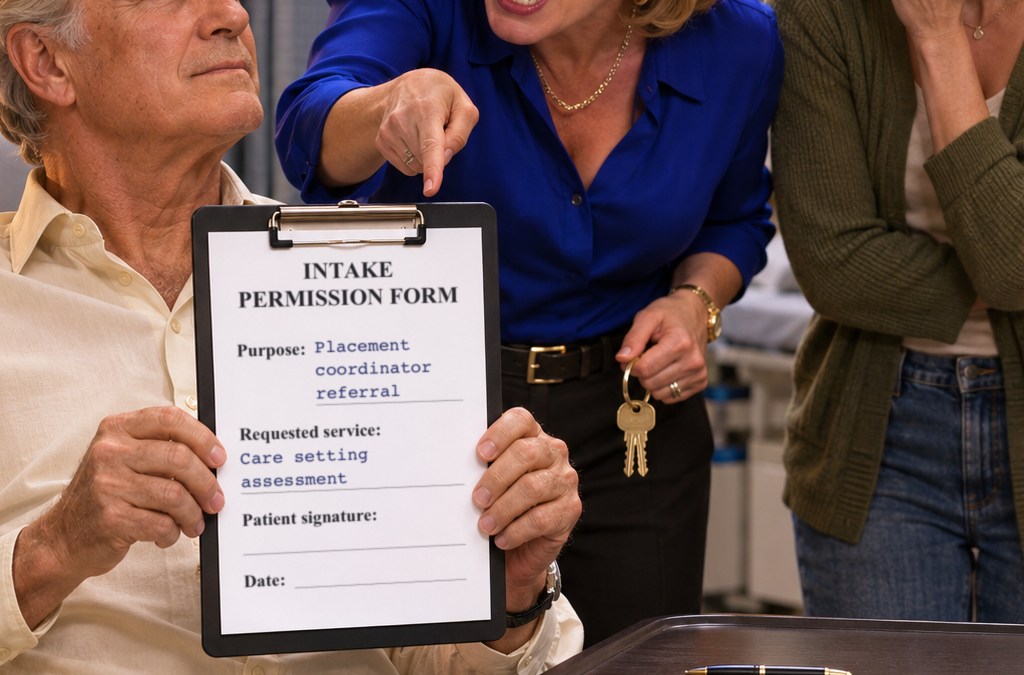
“This is an intake permission form. It lets a placement coordinator find an appropriate setting. Nobody’s putting you anywhere today.”
Emily said, “That sounds reasonable.”
There was a line for my signature.
I had thanked people by letting them decide for me. A ride became permission to choose my appointment. Help with groceries became permission to throw away what I liked.
I accepted the pen before reading the page.
“Right there,” Linda said. “Then we can get you comfortable.”
My name was printed beneath the blank line. I nearly signed it.
Instead, I put the pen down.
“What happens after this?”
“They look at your care needs.”
“Who asked them to?”
“I did the preliminary work. So you wouldn’t have to.”
Rachel stepped closer.
“He hasn’t agreed to placement.”
“Of course. That’s why I’m asking him now.”
Linda sounded patient. Emily looked embarrassed for her, which hurt worse than the crooked shirt.
“Helping me dress didn’t make my home yours.”
“Dad.”
“What?”
“You don’t have to say it like that.”
“How should I say it?”
Emily didn’t answer.
Linda’s position paid $3,600 for the month’s booked hours. I had expected meals, clean clothes, help getting through recovery. I hadn’t expected to ask whether I could enter my own front door.
Rachel asked, “Do you want to speak without anyone else here?”
“I want my daughter to hear me.”
“I’m listening,” Emily said.
“Then stop answering for me.”
Linda’s voice softened.
“A facility assessment isn’t a commitment. It gives everyone information. You may find they offer things I can’t provide.”
“I haven’t asked for that.”
“The discharge staff still have to consider safety. They can’t just send you back because you insist.”
Rachel turned from Linda to me.
“Where do you want to go when you’re ready to leave?”
“Home.”
“And who could help you there?”
Before I could answer, Emily said, “Linda knows what he needs. She’s been keeping track.”
“I asked him,” Rachel said.
“I need help bathing. Dressing. Meals. I know that.”
“And the drain?”
“A nurse showed us what to do.”
Linda said, “He sometimes minimizes how much support he requires.”
Rachel asked me, “Who has your house keys?”
“She does.”
“For safekeeping,” Linda said. “There’s been a lot going on.”
My scarred brass key was on that ring. I had used it for years, long before either child could reach the lock.
“Will you let me in?” I asked.
“We need a workable plan first.”
Emily watched the computer now, as though the answer might appear there.
Rachel moved through the discharge-planning screen.
Linda leaned toward her. “The family situation should already be documented.”
Rachel stopped scrolling and began reading the entry again.
“Who entered this?” she asked Linda.
The screen described me as having “no fixed residence.”
For a moment I could hear wheels rattling beyond the curtain.
“That’s wrong,” I said. “I own my home. I haven’t moved out.”
Linda said, “I told intake he couldn’t return without adequate care.”
“That’s different,” Rachel said. “I’ll correct the planning note.”
Emily brought my tablet from the bag beside my chair. Its screen showed a battery warning, a weather alert, and two stacked camera thumbnails.
The recordings remained in my automatic backup.
Before retiring, I had installed residential security systems and kept the same habits at home.
The angled dual-view doorbell covered my entrance and porch. Its microphone had been disabled from installation; it recorded silent video only.
Linda glanced toward the tablet.
“You should save your energy.”
“I can look at my own screen.”
Emily’s phone buzzed. She had been messaging my brother—no, my son. I was tired enough to stumble over the word, and Linda looked up when I corrected myself.
“My son,” I repeated. “Ask what he agreed to.”
“I already did,” Emily said.
Linda said, “We all want the same thing. A safe recovery.”
Emily began rereading the reply, her mouth opening.
“Eric says you never asked him.”
She read his words aloud.
“I never agreed to keep Dad out of his house.”
Linda waited until Emily finished.
“Then my care recommendation was misunderstood. I wasn’t claiming either of you had made a permanent decision.”
“You said we agreed,” Emily said.
“I should have been clearer.”
Rachel faced me again.
“Needing assistance doesn’t tell us where you live. Those are separate questions.”
She reviewed my discharge instructions from May 29. They restricted exertion and required help with personal care. My ER records would cover today’s assessment and treatment, not settle who could enter my house.
The physician, Mark Ellis, came behind the curtain.
“Your assessment doesn’t require an admission,” he told me. “We need a safe plan you agree to.”
“Can somebody here make her let me in?”
“We can’t settle access to a residence from the ER.”
Emily said, “You could stay with me tonight.”
“Can you help with the things on that sheet?” Rachel asked.
“Yes. I’ve got the spare room.”
“The bed with all those pillows?” I asked.
“I’ll leave you somewhere to sleep.”
I managed a small laugh.
“All right. Tonight.”
Linda showed Emily an apartment listing on her phone.
“Fifteen hundred fifty a month,” she said quietly. “I have nine hundred saved. I need some notice if everything’s changing.”
“We’re arranging tonight,” Emily said.
Rachel told us the hospital would report suspected neglect to Adult Protective Services. That wasn’t an order sending me anywhere.
When Linda stepped outside with Emily, I asked Rachel to stay.
“Don’t let her change this plan for me.”
“I’ll speak directly with you.”
“I still need help.”
“I know.”
“I just don’t want that confused with permission.”
My tablet sounded with a family-group message. Linda had sent it under my name for an appointment on Tuesday.
“His memory-care assessment is booked for 9:00 tomorrow.”
Chapter 2 of 7
On Tuesday, June 2, I called the assessment office before breakfast.
“The appointment was requested by your caregiver,” the woman said.
“Did a doctor refer me?”
“No. She supplied the information.”
“Has anyone there examined me?”
“No, sir. This would be the first assessment.”
“And nobody’s decided I belong there?”
“No placement decision has been made.”
I canceled the assessment.
The woman asked whether I wanted to reschedule. I said no, then waited until she confirmed it was off the calendar.
Emily stood in her kitchen doorway.
“I could’ve done that.”
“I know.”
She went back to the stove without asking for the phone.
She had made oatmeal in the pot she usually used for spaghetti. There was enough for six people.
“You expecting company?” I asked.
“I can’t get the amount right.”
“You start with less.”
“Thank you, Dad. Very technical.”
For a moment, she sounded like my daughter again.
At 9:30 a.m., Janet Ortiz arrived from Adult Protective Services. She asked whether we could speak privately.
Emily started explaining where everything was.
“The bathroom’s down there, and his medicines—”
“Your father can show me what he wants me to see.”
Emily looked at me.
“We’ll be all right,” I said.
Before she left, I asked her to fasten the back of my dressing. I couldn’t reach it without pulling across my abdomen. Then she helped me settle into the living-room chair.
Janet waited until Emily had gone outside.
“Is this where you want to stay today?”
“For today. I want my house back.”
“Tell me about the help you need.”
“I had abdominal surgery May twenty-first. Came home Friday. I can’t bend much. Bathing’s a problem. Buttons shouldn’t be this much work.”
“Meals?”
“I can eat them. Standing long enough to cook is another matter.”
She asked what had brought me to the ER. I told her about being outside my door, asking to come in, then asking a passerby to call for help.
“Did you want to leave your home?”
“No.”
“Do you want Linda caring for you now?”
“No.”
My discharge instructions lay beside me. Janet read them with my permission, then asked about the follow-up care I had arranged.
When I needed the bathroom, I tried getting up too quickly. Pain stopped me halfway.
“Give me a minute.”
“Would you like help?”
“Yes. At the elbow, please.”
She helped me stand. I hated needing it, but I needed it.
Back in the chair, I said, “That’s what I hired her for. Things like that.”
Janet nodded. She didn’t finish the sentence for me.
My phone rang while we were discussing meals. Eric’s name filled the screen.
“It’s my son. Is it all right?”
“Your visit,” she said.
Eric sounded as though he had stepped away from work.
“Dad, can I ask you something without you getting mad?”
“Depends on the question.”
“Linda wants me to talk to you about a short facility stay. She says it could prevent another wandering episode.”
“I went out my own front door.”
“That’s why I’m calling you.”
“I’ll accept physical help, Eric. I won’t accept a diagnosis somebody made up in a group chat.”
He didn’t answer right away.
“She says you’ve been refusing care.”
“I refused an appointment she booked without asking. I just let a woman I met this morning help me stand.”
“Okay.”
“You can ask me what happened.”
“I am asking.”
“Then keep doing that. Don’t tell people what I agreed to.”
“I won’t. I’ll tell her she has to ask you.”
After we hung up, Janet asked whether I wanted help finding temporary care. I said yes. I also asked her to write down a number I could call myself.
I brought up the camera app on my tablet. The ordinary export had finished downloading. It contained the main outward view from the doorbell, with the walkway and street beyond.
I opened the file, then closed it. Janet waited while I checked that it had saved.
“I want to keep a copy,” I said.
“That makes sense.”
“Can you make her let me into my house?”
“APS can help you plan and find support. I can’t settle access to the house or remove her.”
“So I could go there and still be standing outside.”
“I wouldn’t recommend going alone.”
I pictured waiting on the porch again, with nobody answering except through the door.
“I want to talk to a lawyer.”
Janet wrote down referral information. She asked whether I wanted Emily included in the rest of our conversation.
“After we’re done.”
When Emily came back inside, Janet was leaving. My daughter stayed near the doorway until I asked her to sit.
“How did you find Linda?”
“References. She’d been with her previous client seven years. The family said she handled everything.”
“Everything.”
“They were grateful, Dad.”
“Did you ask what she told them about me?”
Emily’s eyes went toward the discharge instructions.
“She said postoperative confusion happens. I believed her.”
“You could’ve called me.”
“I know.”
“And if you need to get something from my house?”
She hesitated.
“I gave her the spare access set. When she moved in.”
I couldn’t have gone home quietly, even with Emily driving.
My phone chimed before either of us spoke again.
Linda requested $275 for the facility assessment. Beneath the request was a screenshot of her message to the family: Daniel could no longer manage his own medication.
Chapter 3 of 7
“I’m not paying for an assessment I canceled,” I told Emily.
By Wednesday, June 3, Linda’s request still sat unanswered on my phone. At 6:20 p.m., I called Eric and asked him to read the family message aloud.
“‘Daniel is no longer managing his medication reliably. We’re working toward a more supervised setting. Please support the transition rather than upsetting him with conflicting advice.’”
“Who’s we?”
“She didn’t say.”
“Who answered?”
He paused.
“Two relatives offered to help clear the house. They think you agreed.”
I hadn’t authorized placement. Now people were volunteering to empty rooms I expected to use again.
“Tell them to wait,” I said.
“I already did. Dad, there’s another message.”
Linda had forwarded something I’d written after coming home from surgery.
Thank you for handling things. I don’t know what we’d do without you.
Underneath it, she had added, “I’ve been proceeding in good faith based on Daniel’s wishes. Sudden changes may make his recovery harder.”
I remembered thanking her. She had picked up groceries and straightened out a delivery. I’d been grateful enough to tell her twice.
Eric said, “What do you want me to say?”
“Nothing for me. I’ll answer.”
I sent one message to the group.
I have not agreed to placement or authorized anyone to clear my house. Please ask me directly before making plans involving me or my belongings.
A relative asked whether my medication had caused confusion.
I didn’t answer that. My medical care wasn’t going to become a family vote.
Emily stood beside the dining table, still in her work clothes.
“Couldn’t she stay there while we work this out?”
“And where would I stay?”
“Here. For now.”
“How long is now?”
“I don’t know, Dad. I’m trying.”
“So am I.”
She sat across from me. Her husband’s unopened mail occupied the place where I usually ate breakfast now.
“She’s worried about having nowhere to go,” Emily said. “If this turns into some public dispute—”
“She’s telling people to clear my house.”
“She didn’t ask them to. They offered.”
“And she let them think I was leaving.”
Emily looked toward the hallway.
“You always used to say we could work things out.”
“I used to pay whatever made it easier.”
“That’s not fair.”
“No. Sometimes you needed it. Sometimes I just didn’t want an argument.”
I had paid bills, changed plans, slept on couches. Usually somebody thanked me, and I called that working things out.
“I’m not living in your spare room so she can stay comfortable.”
“You make it sound like I want you gone.”
“I want to go home, Emily. Those aren’t the same.”
My clean clothes were still there. So was the walker attachment that let me carry a plate without trying to hold it and the walker together. The prescribed dressing supplies were in the bathroom cabinet.
Emily had asked Linda to gather them. Linda wanted a complete list, then wanted to know who had approved changing my care arrangements.
“I could drive you over,” Emily said.
“And do what when she won’t open the door?”
“We could talk.”
“I did that Monday.”
Emily didn’t offer again.
She went alone after dinner. Linda brought a grocery bag to the door and said the rest needed sorting.
The bag held two shirts, underwear, and the wrong slippers. There were enough dressing supplies for the next change, but no walker attachment.
“She said she couldn’t find it.”
“It’s clipped to the walker basket.”
“I told her.”
Emily’s face looked worn. I left it there.
She had brought a package of plain undershirts from a store, too. At home, I kept old ones for wearing under work shirts. These had stiff folds and a sticker promising softness after washing.
“I’ll wash them first,” she said.
“Don’t shrink them. I’ve got enough fitting problems.”
She laughed once, through her nose.
On Thursday, June 4, at 11:00 a.m., Sarah Collins met with me privately. Emily waited outside until I asked her to come in.
Sarah asked what I needed help doing, then what I wanted to happen.
“I want to recover at home without Linda deciding whether I’m allowed inside.”
“Do you want her caring for you?”
“No.”
“Are you willing to say that in court?”
“Yes.”
She read the medical papers and took down my account. They supported asking for a vulnerable-adult protection order; the camera files still needed preparation and someone who could establish what they were.
“Can I see what you have?” she asked.
I gave her the ordinary export. She watched without telling me what a judge would do.
“What happens meanwhile?” I asked.
“Don’t go argue at the door. Let’s get the request ready.”
Before we finished, another message arrived from Linda.
“For continuity of care, please confirm my work and accommodation for another month by Friday noon. Without that assurance, I’ll need to advise the discharge coordinator that home care is unavailable.”
I read it aloud.
Emily said, “Maybe she means she can’t keep working without a schedule.”
“She can ask about work,” I said. “She can’t make staying in my house the price of telling people I have help.”
Sarah asked, “Can you arrange somebody else?”
“I’ll pay for temporary help.”
Emily started to speak.
“I know you can help,” I told her. “You also have a job.”
I asked Sarah to prepare the protection petition. Then I asked for the temporary-care numbers Janet had given us.
Emily’s phone lit up before she found them.
She read the message without passing it to me at first.
“What now?” I asked.
She turned the screen toward me.
“I’ll be at the house Friday at noon to meet the care-placement representative.”
Chapter 4 of 7
On Friday, June 5, Sarah called before the placement representative’s scheduled visit.
“He canceled.”
“He spoke to Linda?”
“I spoke to him. You objected. He isn’t coming.”
“Can she send somebody else?”
“Nobody can place you or dispose of your belongings because she invited them over.”
Across Emily’s kitchen, the refrigerator motor clicked off. I could hear her neighbor mowing.
For once, something would not happen at my house without me.
“Thank you,” I said.
“Where do you want to stay while we do this?”
“Here. For now.”
That answer still cost me. My daughter’s spare room had a mattress too high for my feet to reach the floor comfortably. Getting up at night required planning.
But I wasn’t going back to wait outside my own door.
At 9:00 a.m., Sarah filed my petition with my declaration, medical support, and the camera export I had given her. I asked for temporary protection from contact while I stayed voluntarily with Emily.
The request to keep Linda out of the house would wait for a hearing where she could answer.
“I want her out,” I told Sarah.
“I know.”
“I don’t want that mistaken for saying she can stay.”
“It won’t be.”
My declaration included the things I had needed help with that morning. Emily had helped me wash and dress. I had eaten breakfast sitting down because standing through the preparation still hurt.
Seeing those needs in writing made me want to cross some out.
Sarah asked, “Is any of it inaccurate?”
“No.”
“Then leave it.”
Emily had made scrambled eggs with a little milk, the way my wife used to. Unfortunately, she had also added the cinnamon sitting beside the pepper.
We ate toast instead. Neither of us had mentioned the eggs since.
By afternoon, the temporary order had been issued. I kept expecting the telephone to ring with another demand from Linda.
At 3:40 p.m., she was served with the order, petition, and available exhibits.
Sarah called after receiving confirmation.
“She’s been served. She cannot contact you directly.”
“Has she left?”
“No. This order doesn’t remove her from the house.”
I looked toward Emily’s hallway. My overnight bag was still there, half unpacked.
“So tonight is the same.”
“For the house, yes.”
I didn’t like the answer. I was beginning to trust Sarah because she gave it anyway.
The served exhibits told Linda that the doorbell had been working. Through her attorney, she acknowledged the recording and disputed my account of what had happened.
Her explanation was no longer about an unexplained wandering episode.
“She describes a short porch exercise,” Sarah told me. “She says Emily approved getting you outside during recovery.”
“An exercise.”
“That’s her description.”
“I asked to come in.”
“That belongs in your testimony.”
Her attorney said Linda had tried to balance my wish for independence against the help I required. The porch, she said, had been part of an agreed effort to get me moving.
I could hear how it might sound to somebody who hadn’t been there.
That evening, Emily came home from work and found me in the living room.
“Did you discuss taking me outside with her?” I asked.
“Yes.”
“When?”
“Before Monday. We were talking about recovery.”
“Why didn’t you tell Sarah?”
“I didn’t think that was what she meant.”
“What did you say?”
Emily looked at the television, which wasn’t on.
“We talked about getting you out of the bedroom. Some fresh air.”
“Linda’s saying you approved what happened.”
“I didn’t see what happened.”
“That wasn’t my question.”
“I answered an email. Dad, I need to find it.”
I wanted to keep asking. She already looked ready to defend the conversation instead of telling me about it.
“Send the whole thing to Sarah,” I said.
At 4:30 p.m., I had authorized paid administrative leave through the hearing. Linda would not work for me during that period, and the scheduled pay would continue.
Paying someone I didn’t want near me felt backward.
“Does this end her job?” I asked.
“No,” Sarah said.
“All right. Send it.”
That afternoon, Sarah also retained Ben Foster to prepare the camera evidence. He received the full existing archive from my home storage, including files absent from my simple app export.
His work would cost $650.
I agreed to it, then checked my account myself. I could still do that without anyone standing behind my shoulder.
Monday, June 8, Sarah called at 2:15 p.m.
“Tuesday, June 16. 9:00 a.m. Pierce County Superior Court, Tacoma.”
I repeated it to make sure I had it right.
“Will Linda be there?”
“She’s contesting exclusion. Expect her and her attorney.”
“And Emily?”
“Yes. You, Emily, and Ben need to be prepared to testify. I’ll handle getting the medical evidence in with the proper foundation.”
“What do I need to practice?”
“Answering the question asked. Tell me if you need a break.”
I had spent years explaining alarm panels to homeowners who wanted one button for everything. Now I worried about answering a question about my own front porch.
Later, Sarah sent Linda’s newly filed declaration.
I read it at Emily’s dining table. Linda described helping me regain confidence outside and following a plan discussed with my daughter.
Then I reached the attachment.
It was Emily’s actual email: “Yes, a little fresh air might help.”
The declaration named her as the person who had authorized the porch exercise.
Chapter 5 of 7
On Monday, June 15, Emily read her email aloud at breakfast.
“‘Yes, a little fresh air might help.’”
She kept reading. There were questions about meals, walking, and whether I was sleeping.
“I meant sitting outside with somebody,” she said. “Company on the porch. I didn’t mean she should keep you out.”
“Then say that.”
“I will.”
“What else?”
Emily looked at the rest of the thread.
“She’s been asking me to keep the plan consistent.”
“What plan?”
“How we explain it. She says changing the account now makes everyone look unreliable.”
“Were you there?”
“No.”
“Then don’t explain what happened. Tell them what you actually said.”
“I’m trying to keep this from getting worse.”
“Tell the truth even if it embarrasses us both.”
She stayed at the table after I finished eating. Her toast had gone cold, with a square of butter still sitting in the middle.
At 11:30 a.m., Sarah called with a proposal from Linda’s attorney.
“She’ll leave for $7,200, provided you withdraw the protection petition.”
“Leave when?”
“They’re offering to arrange a departure date. We’d need definite terms.”
“And afterward?”
“No protection order if you withdraw.”
I could afford it. That bothered me more than I expected. I could pay, stop attending appointments about my own front door, and let everybody call it resolved.
“Would she agree not to contact me?”
“We could request that in an agreement.”
“But I’d be trusting another agreement.”
“Yes. Enforcement would be different.”
“I want distance she can’t decide to shorten.”
“Then we proceed.”
“You think I should?”
“It’s your choice. I can present the case. I can’t promise the ruling.”
I told her I would not accept the withdrawal condition.
“This stays between the attorneys,” she said. “It isn’t evidence for tomorrow.”
That afternoon, Emily and I went to Sarah’s office for a prehearing meeting. Linda and her attorney used another room. The temporary order stayed in place; there would be no direct conversation between us.
Eric joined our room by phone from Spokane.
“I can stay on until my shift starts,” he said.
Sarah asked him whether he had ever approved keeping me from the house.
“No. I thought we’d settled that.”
“We’re making sure everyone answers from what they know.”
Linda’s attorney came in after conferring with her. He spoke without the impatience I had expected.
“My client maintains this was a short, supervised exercise discussed with Emily. She understood the family wanted him encouraged to get outside.”
Emily stared at the speakerphone.
“She acknowledges the approach didn’t work,” he continued. “But she disputes that an unsuccessful care technique warrants losing both her work and her accommodation.”
“Was she calling it an exercise Monday?” Eric asked.
Sarah stopped him gently.
“You’ll have your opportunity to answer questions tomorrow.”
The attorney continued. Linda had worried about my walking alone. She had tried to establish a routine. My resistance, he said, had complicated an already difficult recovery.
He wasn’t claiming I hadn’t needed help. Neither was I.
“I needed somebody beside me,” I said. “I needed to be able to go back inside.”
“He says she was supervising,” Emily murmured.
“From where?”
She didn’t answer.
I spoke to the attorney.
“She could ask me to walk. She could offer her arm. Keeping my way back closed wasn’t helping me walk.”
He said he would convey that.
When he left, Eric asked, “Dad, you want me over there?”
“You have work.”
“I can ask.”
“Call me afterward tomorrow. Let me tell you what happened.”
“All right.”
Sarah spent the rest of the meeting checking who would be available and when. The medical support was arranged. Ben was expected. Emily had supplied the complete message thread instead of selected screenshots.
Nobody told me the hearing would be easy.
On the way out, Emily stopped near the elevator.
“Do you want me sitting with you?”
“Are you asking where to sit?”
“Dad.”
“I don’t need you choosing my side. I need you correcting what you got wrong.”
“I’ve told Sarah about the email.”
“Is that everything?”
She looked toward the closed elevator doors.
“I want to be there.”
“Then be there. But don’t leave me to explain what you told people.”
That evening, she packed snacks for the courthouse as though we were driving across three states.
“You’ve got enough crackers for the judge,” I said.
“They’re for you.”
“I’ll try to leave her some.”
She laughed, then checked whether I had my glasses. I let her check. That was help I could accept.
Tuesday morning, we arrived at Pierce County Superior Court in Tacoma with time to spare. I needed it. The walk from the entrance had left me tired before anything had begun.
At 8:45 a.m., Sarah received Ben’s completed supplemental export and report.
She checked the notification.
“Her attorney has them too. Same delivery.”
“Do we wait?”
“I’ll tell the judge when we go in. They need time to review it. If they need more time, we’ll deal with that.”
I nodded. Across the hall, Linda sat beside her attorney. He was reading his screen.
At 8:50 a.m., Sarah headed toward the hearing-room door. I started after her.
Emily stopped me before I reached it.
“Dad. There’s something I haven’t said.”
I waited.
“I told her you were confused. I hadn’t spoken to you.”
Chapter 6 of 7
“Tell the court why you kept his keys, Ms. Mercer.”
Judge Susan Bennett looked toward Linda, who had just been sworn in. It was 9:00 a.m. on June 16.
“Emily approved a supervised porch exercise,” Linda said. “He was supposed to come back inside. When he became confused and left, it turned into an emergency.”
Outside, Emily had finally given me the time: 7:42 a.m. on June 1. She had texted that I “seemed confused” because I hadn’t answered calls.
She hadn’t spoken to me. She had agreed to correct that under oath.
Linda continued, “I was trying to encourage movement without letting him walk off alone.”
Judge Bennett glanced toward Sarah.
“Would a badly executed exercise justify excluding her for a year?”
Linda’s attorney asked permission for her to answer.
“I provided useful care,” Linda said. “Meals, bathing, everything he couldn’t manage after surgery. I never intended to abandon him. Losing my work and lodging over an unsuccessful recovery activity seems disproportionate.”
Emily’s unopened packet of courthouse crackers sat beside me. She had packed the ones I liked, then sat across the aisle.
Before playback, Sarah disclosed when Ben’s completed material had arrived.
“Both attorneys received it at 8:45 this morning,” she said.
Linda’s attorney confirmed receipt but requested review time.
“You’ll have thirty minutes,” Judge Bennett said. “After that, I’ll hear whether you need additional time or a continuance.”
We waited in the hallway. Emily asked whether I needed anything.
“To sit.”
She found a chair without asking another question.
When we returned, Linda’s attorney said they had reviewed the supplemental recording and report.
“Do you need further time?” the judge asked. “A continuance remains available.”
He conferred briefly with Linda.
“We elect to proceed.”
Ben testified about receiving my archived files, preserving the originals, and checking the export against them.
“The integrity checks matched,” he said. “The paired recordings came from the same unit. There is no recorded audio.”
The judge admitted the authenticated export. My treatment records had also been admitted with their supporting foundation. They described assistance I needed after surgery, not whether Linda intended harm.
Then Sarah called me.
“That’s my entrance,” I said, looking at the screen. “That’s me in the doorway.”
The outward recording showed the walkway. I knew how that part looked: an old man eventually leaving the frame.
“Please play the second view.”
Ben selected it.
The lower thumbnail on my tablet had belonged to the same doorbell. Its angle covered the threshold and porch, below the outward picture.
The recording began before the door closed.
I watched Linda take my key ring. I watched myself reach toward it.
Then I was outside.
Nobody had to describe how slowly I moved. There I was, one foot carefully placed before the other, keeping close to the wall.
The door closed.
I tried the handle. Later, the door opened partway. Linda appeared inside. I moved toward her, and it closed again.
Linda’s attorney asked her about the keys.
“I secured them to prevent unsafe walking,” she said. “He wasn’t steady.”
Sarah asked me what I had been trying to do.
“Get inside.”
“Were you trying to leave?”
“No. Please let it keep playing.”
The sequence continued without a break for eleven minutes and forty-seven seconds.
I returned to the handle. I waited near the entrance. When Linda appeared again, I leaned toward the opening.
She did not come outside beside me.
Emily testified next. Her voice caught on the first answer.
“I approved sitting outside with company. Fresh air. I never approved keeping him out.”
“Your message about confusion?” Sarah asked.
“I guessed. He missed my calls. I hadn’t spoken to him.”
“Did you tell Linda that distinction?”
“No. I let her treat it like something I’d seen.”
Judge Bennett recalled Linda.
“Who was providing assistance while he repeatedly sought entry?”
“I was inside, monitoring him. I believed letting him settle would help.”
“Preventing a physically dependent patient from returning to shelter is not the supervised exercise you described.”
Linda looked toward her attorney.
“I’m granting the one-year vulnerable-adult protection order,” the judge said. “You are excluded from his residence, including the rent-free suite, through June 16, 2027. You may not provide caregiving contact.”
She signed the order in front of us.
Linda rose halfway.
“What about my clothes? Am I expected for my next shift?”
Her attorney spoke quietly, but I heard him.
“There’s supervised retrieval. We’ll arrange that under the order. Don’t go back on your own.”
Sarah asked permission to address employment separately. The judge allowed it without changing her ruling.
I looked at Linda.
“You won’t decide who enters my home again.”
Then I signed my written termination. Sarah delivered it to her attorney. The court had restricted contact and access; I ended the job and paid leave myself.
Her June schedule had booked $3,600 in work. There would be no next shift.
“Earned wages will go through payroll,” Sarah said.
Emily stood.
“I need to correct something else,” she said. “In the hospital, I stayed quiet when she said we agreed. Dad kept asking me to listen. I didn’t.”
Linda’s attorney passed her the house keys Linda had brought for surrender.
Emily carried them across the aisle. The scarred brass key hung below her fingers.
She gave me the ring without asking to keep a spare, then sat beside me.
I said, “You can have the crackers.”
She gave a wet, startled laugh.
Linda remained standing beside her attorney. He checked the retrieval provision, then looked back toward the judge.
“One remaining access issue, Your Honor. A gate remote and two additional access devices are still inside the house. They remain to be surrendered.”
Chapter 7 of 7
On Thursday, June 18, at 2:00 p.m., Linda returned the gate remote and both additional access devices during her court-authorized, supervised retrieval.
I stayed at Emily’s. Sarah confirmed the three items had been accounted for before Linda began carrying out her belongings.
“She’s asking whether there’s anything you want to discuss,” Sarah told me afterward.
“No.”
“I’ll leave it there.”
Linda collected her clothes, bedding, and the belongings from the sitting area. She left without a private conversation with me.
Only after the exclusion had been implemented did I arrange to have the access system reset. The returned devices would no longer operate it. The locks were serviced, too, preserving the familiar brass key I had chosen to keep.
I knew enough about security systems to check the work. This time, I paid someone else to crawl around doing it.
On Friday, June 19, payroll paid Linda $1,440 for forty-eight paid hours, including administrative leave.
I checked the statement at Emily’s dining table.
“That’s all going through?” she asked.
“Yes.”
“Even after—”
“She earned wages. We agreed to paid leave.”
Emily nodded.
I saved the statement with the employment records. The termination had ended future work; the payment finished what I owed.
There was no refund arriving to cover the days I had spent away from home. I still had the temporary help and evidence work to pay for. I checked those charges myself, too.
On Monday, June 22, I came home.
The replacement provider met us at the car. I had booked twenty hours weekly at $32 an hour, with nursing visits scheduled separately.
The distance from the passenger seat to my doorway looked shorter than it felt.
“Wait,” I said.
The provider stopped.
My feet were on the pavement, but the rest of me hadn’t agreed to follow. Pulling upright caught across my abdomen.
Emily leaned forward from beside the car.
“Let me—”
“He asked us to wait,” the provider said.
I counted the seams in the driveway until the pain eased.
“All right. Elbow.”
With assistance, I stood. Then came the walker, the uneven edge of pavement, and the small rise at the entrance.
By the time I reached the doorway, sweat had gathered under my collar.
“Chair’s ready inside,” Emily said.
“I’m coming.”
Nobody closed the door while I crossed it.
I sat in my own living room with my shoes still on. The provider asked whether I wanted lunch before washing up.
“Wash first.”
“What would you like afterward?”
“A sandwich. Whatever’s here.”
Emily said, “I bought turkey.”
“That’ll do.”
I hadn’t expected choosing the order of two ordinary things to tire me out.
On July 6, the payroll statement confirmed Linda’s June bookings were closed. No July hours were authorized.
I called Sarah to confirm she needed nothing further from me.
“Keep your copy of the order,” she said. “Call if there’s contact.”
The order remained in effect through June 16, 2027. It wasn’t a promise from Linda or a family arrangement somebody could quietly revise.
I put Sarah’s number beside the telephone and went back to the laundry I was folding badly.
Emily came that afternoon.
“I can keep track of everything,” she said. “Appointments, groceries, the care schedule. You shouldn’t have to.”
“I want to keep my appointments.”
“I could just handle the calls.”
“No.”
She looked down at the laundry.
“I’m trying to make up for it.”
“Can you receive groceries Wednesday afternoon? Two to four?”
“Here?”
“Yes. Check the cold things get put away. Leave the substitutions for me.”
“And the appointments?”
“I’ll call.”
She nodded, though she looked disappointed by the smallness of the job.
On Wednesday, she arrived before the delivery and asked where I wanted the peaches.
“The counter.”
“They’ll ripen faster in a bag.”
“Then we’ll have slow peaches.”
She laughed. I didn’t join her yet.
The drain came out at a routine appointment in July. I had expected a larger occasion. Instead, I went home with updated instructions and ate lunch.
Over the next weeks, my shirts hung differently. I could wash without planning every reach. One morning, I fastened all my own buttons and arrived at breakfast with the provider still waiting in the hallway.
“You need anything?”
“Toast.”
“Anything else?”
“More toast than that.”
In August, I walked past the end of my driveway. Later, I reached the corner and came back without needing to sit halfway.
The provider asked about moving a scheduled visit.
“Would Thursday morning work instead?”
“What time?”
“Nine.”
“I have an appointment. Ten-thirty?”
She checked, then agreed.
There had been no call to Emily to get permission. I mentioned that to my daughter when she came for groceries.
“That’s how it should’ve been,” she said.
“Yes.”
She waited, but I had nothing else ready for her.
Her visits became easier before they became easy. Some afternoons, I still heard her silence in the ER when she stood in my kitchen.
She stopped filling those pauses with explanations.
Once, she asked about a baseball game and stayed through my answer. Another time, she told me about a scheduling mess at the dental office, then said she wasn’t asking me to solve it.
“That’s good,” I said. “I don’t know anything about teeth.”
“You paid for enough of mine.”
“That makes me an investor.”
I laughed first that time.
We arranged a visit for Monday, September 21, at 4:30 p.m. Emily offered to bring takeout from the teriyaki place we both liked.
“Rice separate,” I told her.
“I remember.”
“And dinner, not enough food for the block.”
“I remember that, too.”
At 4:30, she stood outside with one paper bag. She rang once and waited.
I had set two places at the kitchen table. I could carry the plates myself now, though I still made two trips.
Through the glass, Emily lifted the bag.
“They put the rice separate.”
“Then they’re learning.”
“Can I come in?”
She didn’t reach for the door.
I had planned dinner with my daughter. There would be chicken, too much rice despite my warning, and an ordinary Monday evening at my table.
The scarred brass key was in my pocket. I took it out myself.
I turned my brass key and invited her inside.







