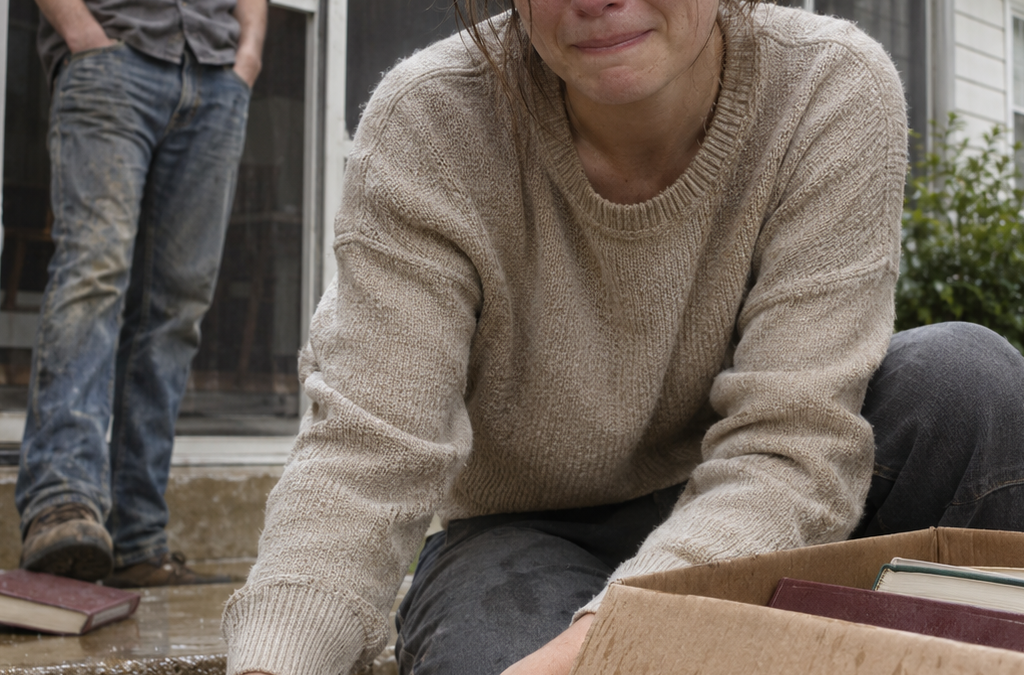
The morning after Grandpa’s funeral, my stepson shoved my nursing-school textbooks off our porch after my three years as Grandpa’s caregiver.
Chapter 1 of 7
“You inherited nothing. Get your boxes off.”
Ryan’s shoe caught the fundamentals book, sending it into the gravel. Rain had spotted its cover before dawn.
“Those are my books. Please leave them alone.”
Mark stood beside the screen door, still wearing yesterday’s dress pants. My cousin Beth smirked beside him. A glossy photograph of the house lay on Ryan’s moving cartons.
“Are you going to let him do this?” I asked Mark.
He looked toward the driveway.
“He’s only asking you to clear the porch,” Beth said.
The porch had room for all of us. Ryan had stepped around two empty chairs to reach my books. My face burned, but I wouldn’t cry while he watched.
At twenty-eight, I was Erin Cole, still using the name I’d kept when I married Mark four years earlier. Mark was forty-nine. His son was twenty-seven, an adult before I ever met him.
I’d paused nursing school to care for Grandpa here in Fort Worth, Texas. Three years later, my school timetable remained clipped behind a grocery list. Grandpa’s worn slippers still waited beside his bed.
Inside, Ryan’s washed work shirts sat folded on the dryer. He lived in the detached guesthouse, but somehow his laundry always reached my basket.
Paul Harris arrived carrying the battered metal box we’d arranged for him to deliver. Grandpa’s lawyer had called about it before the funeral. He placed it in my hands, bent latch facing up.
Grandpa’s tackle box was the one thing he had set aside for me.
Ryan stopped moving my carton when he noticed Paul. Then his elbow shifted toward the glossy picture, which showed our porch without a single chair.
Ryan slid the house photograph beneath his elbow.
I recognized the dent beside the handle. Grandpa had kept private essentials beneath the fishing tray, away from hooks and sinkers. The lid stayed closed against my forearm.
“Your grandfather wanted you to have that,” Paul said.
Ryan ignored him and dragged my packed school carton toward the steps. Its bottom scraped the concrete.
“You’re not sleeping in the main house tonight.”
“The funeral was yesterday, Ryan. Leave her books,” Paul said.
Beth’s expression changed when Paul addressed him, but only briefly.
“You can stay somewhere else for once,” she told me.
For once. As though I’d spent those years on vacation instead of washing bedsheets and counting pills. Mark knew how often I’d slept in a chair beside Grandpa’s bed.
And he still wouldn’t look at me.
“GET YOUR THINGS OFF MY PORCH!”
Ryan’s shout carried across the yard. My knees went weak, and I braced my heel against the bottom step.
“You’re putting me out before anyone checks his papers?”
“Yes, and Dad isn’t changing my mind.”
Mark opened his mouth. Nothing came out.
For years, he’d called this keeping the peace. When my mother died, his steadiness had been the thing I leaned on; now he stood close enough to help and watched Ryan decide.
There was a basket beside the door with Ryan’s shirts in it. I’d brought it out before the books hit the gravel. My first impulse was still to get everything safely inside.
“I’ll handle my own things.”
So I left the shirts where they were and stepped down. Paul stayed until my books were back in their carton, then asked me to call once I could speak privately.
At my car, I called him. Ryan was still talking on the porch, with Beth nodding beside him.
“Did you see those house pictures?” I asked.
“Yes. A prospective buyer contacted my office.”
My fingers went cold against the phone.
“Ryan offered the property with everyone moved out,” Paul said. “The buyer wanted to know who could sign.”
Until then, I’d thought Ryan wanted me gone because he disliked me. But somebody outside the family had already been invited into this, and Ryan hadn’t mentioned that part while he was throwing my books.
Paul asked me to stay nearby. I said I would.
Later that morning, Paul returned to the porch. Ryan greeted him with a polite voice I hadn’t heard used on me. Beth stood behind Ryan; Mark remained by the door.
Dana Price approached the front gate.
Dana opened the gate. “Ryan Bennett? These are for you.”
Ryan looked first at Paul, then at the papers in Dana’s hand. His smile stayed in place a moment too long.
“I’m Dana Price, a process server,” she said.
She handed him the filed petition and hearing notice. The papers asked the court to resolve the house dispute and protect against its being sold or anyone being forced out while that happened.
Dana didn’t order anybody off the property. She didn’t pronounce the house mine. She identified what she’d delivered and left through the same gate.
“This is just her trying to delay me,” Ryan said.
I stood beside Paul with the box against my ribs. There was gravel dust on my pants from kneeling over the books. Beth looked at the papers over Ryan’s shoulder.
“The will doesn’t give Erin anything,” Ryan told Paul, more carefully this time.
“The will isn’t the only paper your grandfather signed.”
Paul asked me to lift the tray. Beneath it lay a folded slip with a county recording reference. There were no grand instructions, just identifying numbers and the property address.
I read the address twice. It was the same one I’d written on nursing-school forms before leaving school.
Paul looked directly at me.
“Grandpa recorded a deed leaving this whole house to you.”
For a moment, I couldn’t answer him. I’d expected fishing things, perhaps a photograph. Behind Paul, the screen door needed the same repair I’d been asking Mark to make since spring.
Ryan gave a short laugh.
“An old arrangement isn’t a finished transfer. He talked about things.”
“It was recorded while he was alive,” Paul said. “I’ll retrieve the public record.”
Beth turned on me before I could speak.
“He’s barely buried, and you’re already being ungrateful.”
Those words hurt, even coming from her. I’d driven her home after the funeral because she hadn’t wanted to be alone. Now she was watching to see whether I’d apologize.
“Can everybody lower their voices?” Mark said.
“We weren’t shouting,” I told him.
He looked at Ryan instead of answering. I hated how relieved I’d been just to hear my husband speak.
The house Ryan had offered was priced at $392,000. Paul showed me the email on his phone, sent before the funeral. There were pictures of the kitchen, the bedrooms, and the guesthouse where Ryan had lived rent-free for six years.
My nursing books had been cropped out of the dining-room photograph.
I’d done everything quietly, and that had helped them treat my work as free. It hurt to admit my own part in making this look easy. But quietly caring for Grandpa hadn’t meant I agreed to disappear afterward.
Paul stepped closer so I could hear him without leaning forward.
“Your grandfather also left a message on my office phone. I’ve preserved the original.”
I wasn’t ready to ask what it said. His voice belonged to ordinary mornings, asking whether there was coffee left.
Ryan went inside and returned with a printed sheet.
“Here. This is what I’m trying to get done.”
He laid his private offer on the porch table.
Both the house and guesthouse were promised empty.
Chapter 2 of 7
The offer sheet had promised empty possession of both buildings. Two days later, those words still bothered me more than the price.
“Did somebody agree to this?” I asked Paul.
“No. Ryan sent photographs and proposed terms. Nobody accepted. No money changed hands.”
That photograph was an offer, not a sale. There wasn’t a buyer waiting for keys, or purchase money somebody had to return.
Ryan had meant to move out himself, at least long enough to sell. Whatever he expected from the money mattered more than keeping his own roof, too.
Paul met me at the county-records counter in Fort Worth. I’d brought my driver’s license and a folder from the kitchen, the same one I used for Grandpa’s prescription receipts.
It embarrassed me how badly I wanted Paul to sound certain. Back home, Ryan spoke as though confidence settled everything.
The county-certified copy arrived with Grandpa’s name above mine: Arthur Cole. Seeing his full name on an official page made his death feel fresh again.
“This is the recorded deed,” Paul said. “A transfer-on-death deed can pass a house outside the will. If Ryan challenges whether it’s valid, a judge will have to decide that.”
“So his copy of the will doesn’t settle it?”
“No.”
I read until the words blurred, then went back to the signature.
Grandpa’s capital A leaned harder than it once had. The last letters crowded together. I’d watched his handwriting get slower on birthday cards, until writing my name took longer than choosing the card.
“He had Parkinson’s,” I said. “His hand shook.”
“A shaky hand doesn’t answer whether he understood his decision.”
Paul let me keep looking. He didn’t hurry me toward a comforting conclusion.
Grandpa had needed help buttoning shirts. He’d also caught duplicate charges on grocery receipts. I hated having to assemble memories of him like a defense, when all I wanted was another ordinary morning with him.
Outside the records office, Paul mentioned Carol Dixon, the mobile notary whose name appeared on the deed.
“She used to work at a bank. She keeps handwritten appointment entries. She remembers your grandfather.”
“Has she talked to you?”
“Briefly. I’ll follow up. I also still have his original office voicemail.”
I nodded, but didn’t ask to hear it.
Across the street, a young woman carried a backpack with a hospital badge clipped to it. For a moment, I remembered my campus reentry appointment: the squeaking chair, the course list, my own handwriting beside classes I hoped I could manage.
I’d bought a parking pass that morning and worried I was getting ahead of myself.
By the time I reached home, Ryan had sent Mark and Beth pages from the will. Mark’s phone was open on the kitchen counter. Only the pages naming who received what were attached.
Beth was already there.
“He sent me the whole thing that matters,” she said.
“The whole thing that matters to him.”
“Grandchildren should be treated equally, Erin.”
I’d made soup before leaving that morning. Beth had taken a bowl and left the ladle across the burner, where Grandpa used to warn everybody it would get hot.
The sight made me miss him so much I nearly lost track of the argument.
“I’m asking what Grandpa actually arranged,” I said. “I’m not putting it to a family vote.”
“Ryan says you want your share and ours.”
“The will leaves me out. You know that.”
She looked toward Mark, waiting for help he hadn’t given me.
Ryan came through the back door before Mark answered. He didn’t ask about the county visit. Beth had apparently kept him informed.
“You got him to sign something. That doesn’t make this fair.”
“I didn’t bring anything for him to sign.”
“Then stop trying to take everything from us.”
He stood close to Mark while he said it. I was humiliated by how familiar that arrangement had become: Ryan accusing, Mark listening, me expected to explain myself until everybody else felt comfortable.
Paul had given me a copy to keep. I left it in my folder. I couldn’t make Ryan read it by offering it across the kitchen.
Mark followed me into the hall.
“There’s a motel near my next job,” he said. “We could stay there. Just a temporary compromise.”
“We?”
“I’d come after work.”
“And Ryan stays here.”
“You’re asking me to leave so he can act like this is settled.”
“He’s upset. Beth is, too.”
My husband looked tired. Once, that would have been enough to make me drop the subject and find him dinner.
This time, it hurt more than I could hide.
“You’re asking me to leave so he can act like this is settled.”
“That’s not what I said.”
“It’s what would happen.”
I wasn’t agreeing to disappear.
I stayed in the main house. Ryan stayed in the guesthouse. Nobody’s locks changed, and I didn’t pretend the county copy let me put his belongings outside.
That evening, I ate soup at the kitchen table. Grandpa had always crumbled so many saltines into his that Beth called it wet stuffing. Mine stayed thin, cooling while I tried to read the same paragraph twice.
Paul called before I finished.
“I received Ryan’s additional probate paperwork,” he said. “There’s a proposed inventory with it.”
“Does he have permission to sell now?”
“No. This is what he’s asking to handle.”
The attachment reached my phone while we were talking. I opened it, expecting bank accounts and furniture, the ordinary things Grandpa had left.
Ryan’s proposed estate inventory listed the $392,000 house as property he expected to administer.
Chapter 3 of 7
Paul filed our objection to including the house separately from Ryan’s appointment. By the time Ryan received his letters allowing him to handle the estate, the house dispute was still pending.
“He can handle the estate assets,” Paul told me. “That doesn’t mean the court has decided the house belongs among them.”
I understood the difference. Living with Ryan made it harder to remember. He kept a copy of those letters on the kitchen counter, where Grandpa used to leave coupons for cereal nobody liked.
My name was on the deed, but I couldn’t treat my certainty like a court order.
I had submitted receipts for supplies I’d bought during Grandpa’s last months. Mattress pads, skin cream, replacement bedding. The request covered purchases for him, not wages for the years I’d spent caring for him.
Ryan sent it back with a handwritten refusal.
Beth was in the kitchen when I found it. He told her he was being careful with the money.
“Everybody wants something now. I’m trying to conserve the estate.”
She nodded as though he’d caught me stealing.
I waited until she went outside before asking him about the receipts. It hurt to have those purchases treated as some greedy thing I’d invented after the funeral.
“You can see what they were for,” I said.
“You wanted to play nurse. That was your choice.”
For a second, all I could remember was kneeling beside Grandpa’s bed, trying to change a sheet without hurting his hip. Ryan had never stayed for that part.
“These were things he needed.”
“Then you should’ve asked him to pay you.”
Grandpa had thanked me every time I brought home supplies. I hadn’t wanted him worrying about whether clean bedding made him expensive to love.
Now I needed that money for my own expenses. Ryan knew I wasn’t working regularly yet. He left the rejected request beside the coffeepot.
Two mornings later, I came home from submitting a job application and found a hauling truck beside the house. Workers had opened the side storage area.
My school supplies were stacked near the truck.
That space held spare flowerpots, Grandpa’s folding lawn chairs, and the plastic bins I’d packed when I paused school. A contractor’s work sheet lay on top of a carton. It called for clearing the storage area for sale photographs.
I photographed the sheet and the bins where they stood. Then I carried my things inside. The workers waited without arguing; nobody tried to take anything from me.
That almost made it worse. They were doing an ordinary job someone had paid them to do. Ryan had made clearing away my belongings part of their workday.
One bin held practice supplies from my first nursing classes. Another had index cards sorted by subject. I was humiliated carrying them through my own back door as though I’d arrived too late for a yard sale.
Ryan appeared after the truck had gone.
“The space needed clearing. You saw the mess.”
“My things were in there.”
“Then put them somewhere that isn’t in the way.”
He said he was preserving the property’s value while everything got sorted out. He’d arranged clearing, photography, and preparation for a sale. Real work had been done, and the estate had paid $4,200 for it.
I sent Paul the photographs and asked him to obtain the bills.
Those were not estate sale expenses.
Mark came home while I was fitting the bins into the bedroom. He looked at the stack, then asked whether I’d eaten.
On ordinary workdays, he made what he called refrigerator burritos: whatever leftovers fit inside a tortilla. Once he’d put spaghetti in one. I’d laughed about that for a week.
That night, the offer of dinner made me want to cry.
“Did you tell Ryan I was leaving?” I asked.
Mark stayed in the doorway.
“I said you’d considered somewhere else. Just to get some rest.”
“I told you I couldn’t sleep here with everybody fighting.”
“I thought he might back off if he knew.”
Instead, Ryan had started clearing space.
I was angry enough that my voice shook. Mark looked past me toward the bins.
“You can’t carry our private conversations back to your son.”
“He asked how you were doing.”
“I’ve got $68,000 hanging over the business, Dad. I can’t keep waiting.”
“Then tell him to ask me.”
There were things I’d still been telling Mark automatically: worries about work, school, whether I could manage the house alone. I stopped. He noticed when I moved my job applications into my bag instead of leaving them on our dresser.
Later, I heard Ryan talking to him in the kitchen.
“I’ve got $68,000 hanging over the business, Dad. I can’t keep waiting.”
Mark asked whether selling equipment would help.
“You think I haven’t looked at that? Six years I helped him with bills and paperwork. She got to live here free.”
I stood at the end of the hall. Ryan saw me and kept going.
“I handled things too. You act like she did everything.”
I could have listed every night he’d slept through, every appointment I’d driven to. I was too tired to turn Grandpa’s care into a competition.
“Caring for him wasn’t permission to sell my home,” I said.
Ryan turned back to Mark, waiting for his father to answer me.
Mark said nothing.
Paul later sent the invoices and estate statement. After the spending, $20,400 remained. I read the balance while sitting beside my rescued school bins.
An email from Ryan arrived beneath Paul’s message. It said the photographer needed access to the house. He’d attached a written demand, as though the letters on our counter had made him entitled to every room.
Ryan’s written demand ordered me to surrender my house keys by the following afternoon.
Chapter 4 of 7
I didn’t surrender my keys. I told Ryan he didn’t have permission to photograph my bedroom or market the main house.
Paul sent the same answer in writing: the house’s ownership was disputed, and it wasn’t available for estate sale preparations. I forwarded Ryan’s demand to him instead of answering it again.
The photographer never came inside. Ryan stayed in the guesthouse, and his key still worked there.
For several days, we passed each other without speaking. I hated listening for his truck before stepping outside. Even taking the trash out had become something I planned.
Then Paul sent the certified county verification to Thomas Reed, the lawyer Ryan had hired.
It identified the whole parcel. The main house and the 620-square-foot guesthouse were covered by the same deed. Ryan’s building wasn’t a separate inheritance waiting behind mine.
Thomas went over the copy with Ryan. I knew because Ryan brought it into the kitchen afterward, with Beth following him.
“Your lawyer says this includes where I live.”
“Yes,” I said. “That’s what the record says.”
“He never told me that.”
I couldn’t answer for what Grandpa had told him. Ryan stared at the property description, then checked the page showing when it had been recorded.
For weeks, he’d treated the paper as something I still needed to finish. Now he understood that Grandpa had finished it himself, while he was alive. The house wasn’t waiting for Ryan’s approval.
Beth leaned toward the page.
“What about the will?”
Ryan didn’t answer her. He took the copy back to the guesthouse.
I should have been relieved. Instead, I sat at the kitchen table until my tea went cold. Knowing he finally understood didn’t make me feel safe around him.
The next thing Paul received wasn’t another demand for keys. Thomas had filed a challenge saying Grandpa hadn’t understood the transfer and that I had pressured him into it.
He changed his accusation.
Now I wasn’t misunderstanding Grandpa’s wishes. I was accused of making them for him.
At Paul’s office, I read the section describing my daily access to Grandpa. It made breakfast, bathing, and helping him into bed sound like opportunities I’d been waiting to use.
“They’re saying I wore him down.”
“That’s the claim,” Paul said.
“Because I was there?”
“Because you were there, and the deed benefits you. They still have to support it.”
I was angry, but mostly I felt sick with shame I hadn’t earned. Three years of work had become a reason to suspect me.
Paul waited before explaining the difference.
“The county record tells us what he signed and what was recorded. Independent recollection and his own recorded words can help answer whether this was his choice.”
He didn’t promise the paper would end it. He didn’t tell me a judge would understand just by looking at me.
On the drive home, I remembered the school appointment I’d nearly canceled. Grandpa had needed help getting dressed that morning, and leaving him always made me uneasy.
I’d gone back twice before reaching the car. Once to check his water, once because I couldn’t remember whether I’d left his glasses within reach.
At campus, I kept my phone faceup beside the course list. The appointment had been about returning to school, but I’d spent half of it afraid something would happen at home.
I didn’t know what that memory could settle. I only knew how far it was from the person Ryan was describing.
“You were alone with him all day. We know that.”
That evening, Beth and Mark were on the porch when Ryan stopped me at the steps.
“Stop pretending his last months made you special.”
“I’m not pretending anything.”
“You were alone with him all day. We know that.”
Mark looked up.
“She wasn’t keeping anybody away,” he said.
Ryan turned toward him. “You weren’t home all day either.”
Mark’s mouth stayed open for a moment. Then he looked down at his work boots.
It hurt to see him retreat again, especially after that small beginning.
Beth said Grandpa had been vulnerable. Ryan said somebody had to protect him, even now. They spoke in front of me as though I’d already admitted doing something wrong.
“He needed help eating,” Beth told Mark. “You can’t ignore that.”
“He needed his food cut up,” Mark said. “He knew what he wanted.”
Ryan shook his head, impatient with the distinction.
I went inside before Mark could ask us all to calm down. On the counter sat Grandpa’s old grocery pad. He’d always written bananas twice, once under fruit and once wherever he remembered them again.
I’d used to buy two bunches just to hear him accuse me of opening a monkey sanctuary.
Remembering that made me laugh once. Then I cried, standing beside the refrigerator.
Paul called with the hearing setting: Thursday, October 22, at 9:00 a.m., in Judge Helen Brooks’s Tarrant County probate courtroom. He expected me, Ryan, Thomas, Carol Dixon, Mark, and Beth to be there.
I wrote it on my calendar. Underneath, I added that I needed to ask about changing a work shift. There were still ordinary things I had to arrange.
Mark asked whether he should come.
“You know what happened in this house,” I said.
He nodded without asking what I wanted him to say. For once, I left the answer with him.
The next email from Paul arrived with a newly filed request attached. I read it at the porch table, where Ryan had once spread out his sale offer.
Thomas had asked the court to exclude Grandpa’s voicemail, claiming I’d supplied the words.
Chapter 5 of 7
“The judge hasn’t ruled on the message,” Paul told me. “I’ll offer the original with testimony identifying it. Thomas has the audio and the documents.”
I sat across from him without asking to hear it. The thought of Grandpa speaking, then somebody arguing over what he meant, hurt more than I’d expected.
Paul had kept the original file on his office system. He’d arranged for Carol Dixon to attend and told me where to meet him.
“Can they keep it out?” I asked.
“They can ask. I can’t promise what she’ll decide.”
That was all he promised me: he would bring what he had, and he would be there.
At home, Mark had washed his work clothes with a tissue in one pocket. White flecks covered every dark shirt. Before all this, I would have helped him shake them out.
He stood by the dryer while I packed lunch for my next shift.
“We could ride together Thursday.”
“I’m meeting Paul there.”
“I can drive you to meet him.”
“I’ll drive myself, Mark.”
He looked at the lunch container instead of me. I hated how easily a plain answer between us became another injury I was supposed to repair.
“I wasn’t trying to upset you.”
“I need my own way home.”
He nodded. There was no reason he couldn’t arrive alone and say what he knew. Sitting beside me in a car wouldn’t do that for him.
Ryan stopped me on the porch the following afternoon. Beth was there with Mark, eating the last of the peanut butter crackers Grandpa had bought by the case. He’d called them emergency food, though most emergencies involved missing lunch.
Ryan waited until I reached the table.
“We can still settle this without everybody getting dragged in.”
He sounded almost reasonable. That made me more wary than the shouting had.
“What are you offering?”
“Give me time to cover the $68,000. We work out the rest afterward.”
“I’ll stop pushing the concerns about the deed. You let me handle a sale.”
Beth brushed cracker crumbs from her lap.
“That sounds like a start,” she said.
Ryan kept his attention on me. “Give me time to cover the $68,000. We work out the rest afterward.”
He hadn’t offered to buy the house. He wanted me to turn it into money first, then trust him about what remained.
“Where would I live?”
“You’d have money left. Get an apartment.”
Mark shifted beside the door but said nothing. Ryan took his silence as room to continue.
“Nobody wants to stay mad at you, Erin. Just quit making this harder.”
For a moment, I wanted the offer to mean something kinder. I was lonely in a house where I knew everybody’s coffee preference and couldn’t trust anybody with my worries.
I wasn’t selling my home for family peace.
“No,” I said. “My house isn’t paying your business debt.”
Ryan’s reasonable voice disappeared.
“You think three years makes everything yours?”
“I’m not bargaining about those years.”
Beth said I could at least consider it. I looked at Mark, but he was watching his son.
Ryan turned toward them both.
“She picked who got to visit. Then she told him what to say.”
“You came over whenever you wanted,” I said.
“After you told us whether it was a good day.”
Grandpa had bad days. Some mornings, getting dressed exhausted him. I’d asked people to call first so he wouldn’t be asleep when they arrived.
Now that ordinary kindness was being used against me. I felt humiliated explaining it on the porch where I’d helped him sit in the sun.
“Did you personally see him sign the deed?”
Ryan looked annoyed by the question.
“No. I didn’t need to stand there.”
He had not been there.
“You can see the pattern,” he told Mark. “She had him practicing answers before anybody showed up.”
Mark rubbed at a white tissue fleck stuck to his sleeve. Beth stared at me as though waiting for a confession.
I went inside. Nobody followed.
By the hearing morning, I’d checked my bag so often that the corners of my folder had softened. I drove downtown alone and parked farther from the Tarrant County courthouse than I’d intended.
Walking those extra blocks gave me something useful to do with my legs.
Paul met me outside the hearing room. Ryan and Thomas Reed stood farther down the hall. Beth had saved a bench seat for Mark.
Thomas approached Paul while I was close enough to hear.
“We’re not disputing that it was recorded,” he said. “Acknowledging a signature isn’t a medical finding. The message doesn’t establish independent intent by itself.”
“Carol will testify,” Paul said.
“And I’ll question her.”
Thomas wasn’t sneering. That scared me more than Ryan’s certainty. He had a real argument, and Paul wasn’t pretending otherwise.
Ryan joined them, lowering his voice for the lawyers.
“She checked his identification. That doesn’t mean she knew what happened at home.”
A woman carrying a worn appointment book came around the corner. I recognized Carol before Paul introduced us.
Years earlier, she’d helped Grandpa at the bank when a statement confused him. I remembered her waiting while he found his reading glasses, never reaching over to do it for him.
“I remember you,” I said.
“I remember you too, Erin.”
Her familiar face nearly made me cry. She belonged to a part of Grandpa’s life that hadn’t depended on me.
Ryan barely glanced at her book. He’d already decided her part had been checking a license and watching a signature.
Inside, Carol sat where Paul directed her. I took my place, keeping my bag against my ankle.
She laid the old book on the table and opened it.
The entry heading read, “Private client conference.”
Chapter 6 of 7
Carol explained the entry before the probate judge, her appointment book open beside her.
“Arthur asked to speak with me alone before signing. This wasn’t just a signature pickup.”
Ryan watched her from the witness table. Behind him, Mark leaned forward beside Beth.
When Thomas called him, Ryan looked toward Judge Helen Brooks.
“Erin coached a failing man into giving her the house. She controlled his days. This property belongs in the estate.”
Hearing him say it under oath hurt. Grandpa’s empty chair at breakfast seemed more real than anything in that courtroom.
Paul asked whether Ryan had witnessed any coaching. Ryan admitted he hadn’t, then said he knew how things worked at home.
“Then why did he insist I wasn’t there?”
The question escaped me before Paul could stop it. Judge Brooks looked toward me.
Paul touched my sleeve. “You’ll have your chance.”
I lowered my voice. “Please. I want Grandpa’s voice played.”
Ryan turned around.
“She could’ve prepared him before she left.”
Thomas faced the judge. “Absence at signing doesn’t rule out prior pressure. A message can be rehearsed. And a notary cannot diagnose cognitive capacity.”
“I understand the limits,” Judge Brooks said. “Let’s hear what the witnesses actually observed.”
Paul first identified the certified deed. It named me and covered both buildings. Thomas didn’t dispute the recording or its wording; he disputed whether Grandpa had understood and freely chosen it.
Then Carol returned to the stand.
“How long were you alone with Arthur?” Paul asked.
“Twenty-eight minutes. I noted when we began and when we finished.”
“Where was Erin?”
“At her nursing-program reentry appointment. Arthur told me that, and she wasn’t in the house.”
I remembered worrying over the course list while checking my phone. All this time, I’d pictured Grandpa waiting for me to return.
Carol said he had given his address, described the property, and named the relatives affected. He knew the older will left its remainder to Ryan and Beth.
“He wanted the house handled separately,” she said. “He asked whether the paper accomplished that after his death.”
Thomas asked whether she had performed a medical examination.
“No. I’m describing our conversation.”
“Could you know what Erin had said to him beforehand?”
“Did he explain why he wanted this without anyone prompting him?”
“No.”
Her answer frightened me, though it was honest. I wanted someone to make the accusation impossible. Instead, Carol stayed with what she knew.
Judge Brooks leaned toward her.
“Did he explain why he wanted this without anyone prompting him?”
“Yes. Erin had stopped school to care for him. He wanted her to have somewhere to live when she returned. He said the other grandchildren could receive what remained under his will.”
Carol glanced at her entry.
“I referred to the guesthouse as Ryan’s place. Arthur corrected me. He said Ryan had permission to live there, but it was part of his property. He wanted Erin to receive all of it.”
Ryan looked down at Thomas’s papers.
Paul then identified the original message on his office system: Grandpa’s familiar voice, voluntarily left for him, preserved as received. After hearing the foundation and Thomas’s objection, Judge Brooks allowed it.
The first sound was Grandpa clearing his throat.
“Paul, Arthur Cole. I want to finish that deed we discussed. The house and the little house out back, to Erin when I’m gone. Separate from the will.”
His words came slowly. I knew the effort between them.
“She needs to get back to school. She mustn’t be made to choose between school and a roof. Call me here. She’s at her appointment.”
I cried without covering my face. He’d thought about my future while I was afraid to plan one.
After the message ended, Thomas renewed his argument about earlier influence. Paul answered with Carol’s private conversation, her notes, and Grandpa’s own specific instructions.
Judge Brooks reviewed the invoices and account statement, too.
“This decision doesn’t rest simply on hearing a frail man’s voice,” she said. “The deed and the independent evidence from that time show he understood the property and made his own choice.”
Her first ruling confirmed my ownership of the entire parcel.
Her second removed Ryan as executor for his conflict and misuse of estate money. James Foster would replace him and receive control of the remaining $20,400.
“Estate money cannot be spent preparing someone else’s house for sale,” she said.
Ryan had lost his executor’s authority in front of everyone he’d asked to believe him.
He stood so abruptly his chair scraped backward.
“Dad. Tell her what I handled for him.”
Mark rose from beside Beth. For a terrible second, I expected him to explain Ryan again.
Instead, he crossed the aisle and sat beside me.
“She cared for him. I should have stopped you.”
He said it to Ryan, without asking me to help soften it. I was relieved, and angry that relief still came so easily.
Ryan looked toward Beth. Earlier, she’d moved her bag to offer him the seat beside her. Now she put it back. She kept her eyes on the floor.
“So everybody’s just leaving me with this?” he asked.
I didn’t answer his debt question. It had never belonged to me.
“You don’t get to manage my home or my life.”
Mark stayed beside me, but I didn’t reach for him. One true sentence hadn’t repaired our marriage.
Paul gathered our documents. Grandpa’s tackle box rested in my bag, its bent latch catching against the folder. I carried both myself.
The house was mine. Recovering the guesthouse would still take a separate case; Judge Brooks hadn’t ordered Ryan out.
Near the courtroom door, Thomas stopped Paul. Ryan waited behind him, staring past me.
“Ryan will remain in the guesthouse unless Erin obtains a possession judgment.”
Chapter 7 of 7
The next morning, Paul delivered the written demand for Ryan to leave the guesthouse. I waited through the required notice period, then filed the separate case in justice court.
Owning the property and getting possession of an occupied building were different steps. I had won the first one; I still had to finish the second.
The locks stayed as they were. So did the water and electricity. Ryan’s truck still came up the driveway, but he no longer came into the main house.
Anything he wanted to say about the property or the estate went through counsel. That distance helped more than I expected. I could come home from work without rehearsing an answer before opening my door.
On November 19, I sat before Judge Susan Ward with Paul beside me. Thomas Reed appeared with Ryan.
Judge Ward reviewed the ownership ruling and the papers showing that Ryan’s permission to stay had ended. She wasn’t hearing the deed challenge again.
“The court awards possession to Erin Cole,” she said.
Paul explained afterward that Ryan still had time before any enforcement could happen. I went home without arranging a moving truck or touching his belongings.
Six days later, Ryan left on his own.
I stayed in the main house while he loaded the last of his things. From the kitchen, I could hear his truck door opening and closing. I hated that I was still listening so carefully.
His key came back through the lawyers. There was no goodbye at the porch.
When Paul confirmed he was out, I walked through the guesthouse. The rooms looked smaller without his furniture. There were pale rectangles on the walls and a line of dirt where the couch had stood.
For six years, somebody else had decided what happened in that little building. I stood in its empty kitchen, relieved enough to cry.
I didn’t decide what to do with it that day.
The main house and guesthouse stayed together. I wasn’t selling the property to divide up its value, and Ryan’s business debt remained his.
Two weeks after the possession hearing, James Foster confirmed that Ryan had restored the $4,200 to the estate following the accounting demand.
“That money is back in the estate account,” James said. “It isn’t a payment to you.”
“I understand.”
He was also handling the ordinary remaining expenses and reviewing the receipts I had submitted. I no longer had to ask Ryan whether Grandpa’s bedding had been worth buying.
“But you can’t use it to get me to make Ryan comfortable,”
That mattered to me almost as much as the returned money. I was tired of needing him to approve things he hadn’t stayed around to see.
Mark had moved into a rented room before the possession hearing. He returned his main-house key without asking me to reconsider.
I told him I would attend marriage counseling if he would go, too.
“But you can’t use it to get me to make Ryan comfortable,” I said.
“I know.”
“I need you to understand why I don’t trust you.”
He looked tired. This time, I let him be tired without fixing anything.
We went to counseling. Mark began answering questions without looking at me for the version that would hurt least. He admitted that keeping Ryan calm had usually meant asking me to give something up.
Hearing him say that hurt. It also made me less lonely.
One evening, he called before coming over.
“Would Sunday be all right? Just for a visit.”
“For an hour,” I said. “And Ryan doesn’t come with you.”
“I wasn’t going to ask.”
“I still need to say it.”
He came only when invited. He had no key. Some visits were easy enough that I missed him afterward; others left me grateful when his car pulled away.
I didn’t promise we would stay married. I didn’t promise we wouldn’t. His sentence in court had mattered, but I needed to see what he did on ordinary days.
Beth called while I was folding my work clothes.
“I was cruel to you,” she said. “On the porch. Afterward, too.”
I waited, expecting her to explain why.
“I’m sorry, Erin.”
“Thank you for saying it.”
She didn’t ask about money or what she might receive from the estate. We talked for a few minutes, then ended the call.
I accepted the apology. I didn’t offer to drive over, bring dinner, or make sure she felt better about herself. That took practice. My first impulse was still to help somebody else past an uncomfortable moment.
Three months after the funeral, my nursing-program reentry was confirmed.
The first-term budget came to $5,800. Between resumed paid work and ordinary student financing, I could manage it. I checked the figures twice, then stopped searching for some hidden reason I shouldn’t go.
At the preparatory skills refresher, I stood beside a practice bed with my hair pulled back. My hands remembered more than I expected. The classroom sequence took longer.
During the handwashing review, I caught myself humming the chorus Grandpa used to sing at the kitchen sink. He always stretched the last line because he forgot what came next.
I nearly laughed in the middle of counting.
Later, I practiced taking a blood pressure and had to try again. Nobody looked disappointed in me. I was rusty, and I was allowed to learn.
It hurt to realize how long I’d been waiting for permission to be a beginner again.
After class, I sat in my car with the course materials on the passenger seat. Nursing school was still ahead of me, with early mornings, exams, and bills I would have to plan for.
For once, those worries felt like mine.
At home, I chose the porch table for my schoolwork. It had good afternoon light, and I could see the driveway without needing to watch it.
Grandpa’s tackle box sat beside my folder. I had cleaned out the loose hooks and kept his old fishing tray. Beneath it were my pens, pencils, and highlighters, easy to carry inside when the weather changed.
There was soup warming in the kitchen and a work shirt waiting to be washed. I had reading to finish before bed.
I sat down in the chair Ryan had once stepped around to reach my books.
Being family did not make my future theirs to spend.
I opened the tackle box and took out my pen.







