The new hotel manager peeled my mother’s guest ribbon off her coat at the opening before 24 guests, without knowing who I was.
Chapter 1 of 7
Grant Mercer dropped it beside the reception trash, and I retrieved it before anyone stepped on it. Mom had spent 33 years cleaning hotels; now, at 76, Ruth Bennett stood holding her coat closed.
“Delivery people use the back.”
“We’re invited guests. Why did you touch her?” My voice stayed level.
Claire Foster stood behind the welcome desk. “Claire, are you going to let this happen?”
She looked away.
“The reception is for invited guests,” Paige Dalton said. Her tablet rested beside Claire’s blue-tabbed folder.
“You’re blocking the entrance for everyone else.”
Behind them, a folded sheet protruded from the folder, until Claire covered it with a list.
My face burned.
I was Nora Bennett, and I’d turned 45 that morning. I was this company’s largest shareholder.
Grant had never met me. He’d been running Alder House Hotel for six weeks. Apparently, my work jacket had told him everything he needed to know.
Bennett Commercial Laundry was stitched above its pocket. I’d come straight from helping ready the hotel’s linen rooms, wearing the same jacket Mom had mended at her kitchen table while I sorted laundry invoices beside her.
Mom smoothed that collar. We had a little time before my scheduled board meeting.
That morning, she’d packed my birthday breakfast in a cake carrier. Scrambled eggs deserved a proper entrance once a year.
The carrier was still in my truck, with a fork rattling inside and a square of buttered toast she’d wrapped separately so it wouldn’t get soggy on the drive.
I’d made a habit of smoothing things over before anyone apologized.
Beside Claire’s elbow, eighteen names had been crossed out in blue.
The list lay exposed again, showing people I’d invited from our Durham, North Carolina, neighborhood. Claire and I had checked the names together.
Now Grant stepped across the route into the reception.
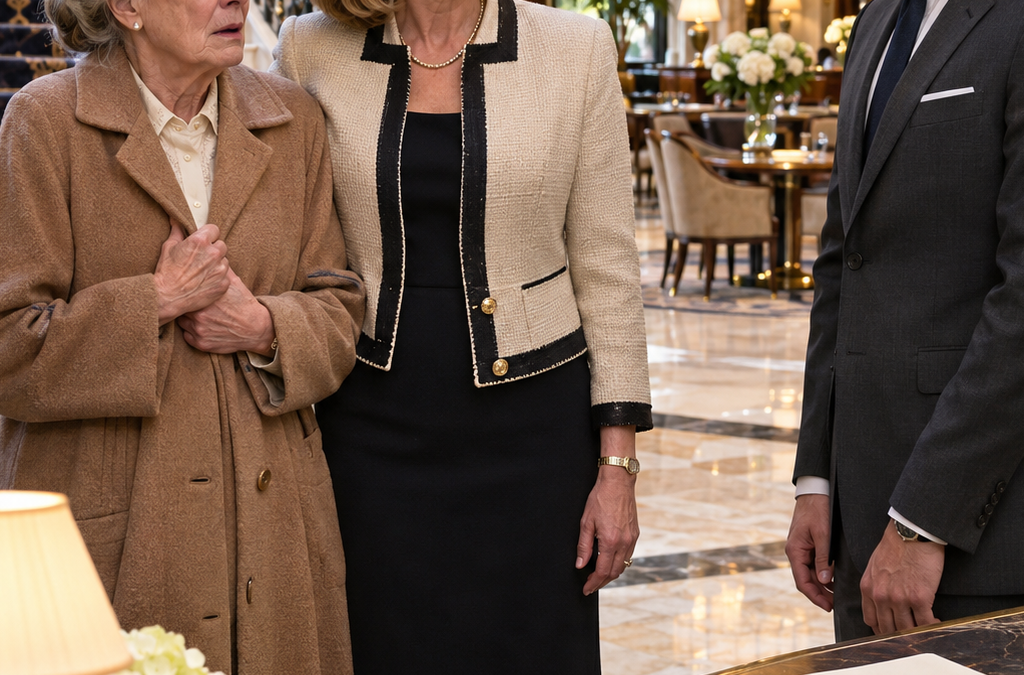
Beyond his shoulder, tables waited beneath low pendant lights. Mom’s coat was unbuttoned because we’d already been welcomed inside. Grant had intercepted us near the desk where Claire checked us in.
“There’s a service entrance around the building,” he said. “You can wait there until someone sorts you out.”
Paige shifted toward that corridor, expecting us to follow, but I stayed beside Mom.
Grant looked past me toward the staff near the dining room.
“TAKE HER THROUGH THE BACK!”
Mom flinched at the volume. That hurt worse than his guess about my jacket.
“You’re refusing the invitation Claire already checked?”
“Your group isn’t going into that reception.”
“Then leave my mother’s coat alone.”
And I stepped aside with her, away from the arriving guests but still inside the lobby. We stopped beside the window, in full view of the welcome desk.
We weren’t leaving.
Mom watched Claire, who had welcomed us warmly just minutes earlier. Claire kept her attention on the folder while Paige checked her tablet against the printed chart beneath it.
Neither looked toward us.
The guests nearest the desk had heard everything. Some were people Mom recognized from the neighborhood, dressed for a night they’d been looking forward to.
But nobody seemed sure where to go now.
I called Ellen Walsh, the board chair, and gave her our location.
“Stay there,” Ellen said. “I’ve just seen a replacement chart. Those eighteen neighborhood places went to luxury-event prospects. They weren’t misplaced, Nora. They were replaced.”
For a moment, I couldn’t answer.
Then I opened the picture Claire had taken on my phone. Mom and I stood just inside the entrance, smiling beneath the Alder House sign, before either of us knew there would be trouble.
The metal clasp in my palm read 14, matching the one visible in the photograph.
That proved we’d already been welcomed inside. It couldn’t explain who had changed the list.
Then Ellen came down the stairs toward us.
Grant straightened when he saw her approaching.
“Ms. Walsh, I’m managing arrivals,” he said.
Ellen stopped beside Mom rather than beside him.
“Ruth is my invited guest. She stays here.”
Paige stopped halfway toward the service corridor.
Grant’s welcoming expression held for another second.
Then his eyes moved to Claire’s folder.
Claire drew it closer against her body.
Ellen looked down at the crossed-out list.
Ellen turned to Grant. “Who crossed out those eighteen names?”
Grant didn’t answer her question. Instead, he explained that opening receptions required adjustments. Some guests had been assigned to a different area.
His tone had changed completely. He spoke to Ellen as though she’d arrived to help him manage a small inconvenience.
I stood beside Mom and listened.
“Nora’s done a lot for the neighborhood,” he added. “I appreciate that. But we can’t have sponsors bringing groups through without checking.”
Claire’s eyes finally met mine. She knew we’d checked.
“Keep Ruth and Nora here,” Ellen told Paige. “I want to see the lists you’re using.”
Paige stayed at the desk. She stopped pointing toward the service corridor, though she still watched Grant before answering Ellen.
Mom moved closer to me. I was humiliated, and I hated that she might mistake my embarrassment for embarrassment about her.
“Claire, start with the list you had when they arrived,” Ellen said.
Claire opened the folder. The folded sheet caught against its blue tab, and Grant spoke before she could lift it free.
“That’s a working note. The seating chart is current.”
Ellen kept looking at Claire.
Claire said the sheet had writing on both sides.
Grant moved closer to the welcome desk.
Ellen waited without reaching for the folder.
Claire’s fingers stopped against the folded edge.
Then she lifted it clear of the list.
Claire turned the sheet; my name was underlined twice.
The rest remained folded inward. There was no way to read it from where I stood, and Claire didn’t offer it to me.
Mom spoke near my ear.
“Should I have worn something else?”
Her good blouse showed beneath her coat. She’d ironed it that afternoon, including the parts nobody would see.
“No, Mom. Your clothes are fine.”
“I wasn’t asking about fine.” She glanced toward the dining room. “I mean, for this place.”
“You wore what you wanted. They checked your invitation. That was enough.”
She nodded, but she didn’t look convinced. I hated hearing her search for a mistake she could fix.
Mom had never apologized for cleaning rooms. When I was little, she’d told me exactly what she did, including the bathrooms, and expected me to understand it was work worth doing well.
Now she was wondering whether a different blouse would have protected us.
Grant lowered his voice toward Ellen, though we could still hear him.
“I’m trying to keep the reception moving. Paige has the actual table assignments.”
Ellen asked Paige to bring them over.
Claire held the folded sheet against her folder. She looked frightened now, but I couldn’t forget how easily she’d looked away when Mom needed her.
I wanted an explanation from her, too.
Paige brought the tablet first. Ellen asked for the printed chart underneath it, the one Paige had been checking when Grant shouted.
“There are different categories,” Paige said. “That’s why this looks confusing.”
Mom watched the paper approach. She stood upright beside me, no longer tugging at her coat.
I stayed where she could feel my shoulder against hers.
Paige laid down the replacement chart. “Ruth Bennett—crew.” Mom’s reception place had been reassigned.
Chapter 2 of 7
“Crew?” Mom looked at Paige. “I didn’t come here to work.”
There was no disgust in her voice. She’d said the same thing about a hotel calling after retirement. Her working years were finished, and she’d earned the right to come through a lobby without being handed a task.
“Why has a checked-in birthday guest become crew?” I asked.
Paige looked toward Grant before answering. The whole neighborhood group had been moved into a different category, she said. Nobody had accidentally left Mom off.
Ellen opened the approved copy on her phone beside Paige’s printed chart. The paper showed reception seats assigned to different people. She asked Paige whether this was the chart being used at the entrance.
“Yes. This is the current one.” Paige kept her voice brisk. “The neighborhood allocation was moved together.”
“Moved where?” Ellen asked.
Paige said there was space near the service dining area. She didn’t say who had decided that space was good enough for us.
I felt embarrassed all over again, standing there while strangers discussed where to put my mother. Mom had been looking forward to dinner. Now she was listening to an explanation of why her chair belonged to somebody else.
Grant stepped closer to Ellen, speaking softly enough to sound helpful.
“A quieter meal might suit Ruth better,” he said. “We can have someone take care of her away from this crowd.”
He hadn’t asked Mom whether crowds bothered her. She’d spent years taking church bus trips where everybody sang badly and nobody wanted to stop.
“Does she look like she needs to be removed?” I asked.
Grant turned toward me. His pleasant expression disappeared.
“Claire, were these eighteen names approved for the main reception?”
“Stop making your mother stand here for attention.”
“She can choose her table herself.”
Mom stayed beside me. Grant looked at Ellen again, as though my answer required correction from somebody he respected.
“Claire, were these eighteen names approved for the main reception?” Ellen asked.
Claire confirmed they were. She’d checked them against Ellen’s instructions before opening the doors, including Mom’s name. Her voice was quiet, but this time she finished what she started.
The list proved we were invited, not who had ordered the change.
Ellen told Paige that Ruth’s invitation still stood. The approved guests were entitled to remain in the reception area while the conflicting arrangements were sorted out.
That helped, but it didn’t undo what Mom had heard. Her gaze traveled through the dining room, searching past the flowers and glassware toward the tall windows.
“Somebody got right into those corners,” Mom said.
For a second, I didn’t understand. Then I saw her studying the clean edges of the window frames. She noticed work other people never saw.
A chair near us sat crooked against its table. Mom reached toward it, then stopped before touching the back.
It hurt to watch. She had started trying to make herself useful in a place where she was supposed to be welcomed.
There had been plenty of times when I would have taken her home. I knew how to make a graceful excuse, blame a long day, promise we’d get something better elsewhere. Afterward, I’d tell myself I’d protected her.
“Do you want to sit for a minute?” I asked.
Mom said she wanted to wait until she knew which seats were actually ours. She wasn’t asking to leave.
So I stayed beside her instead of reaching for that familiar excuse.
The $1,600,000 I’d invested in the company had come from eighteen years building Bennett Commercial Laundry. There had been early mornings loading vans myself and nights spent finding a way to cover a broken machine without missing payroll.
I was proud of that work. But Mom shouldn’t have needed my investment behind her to have her invitation honored.
Grant excused himself when another cluster of guests reached the desk. He greeted them personally, with a warmth he hadn’t managed for us.
“We’re developing our corporate-event calendar,” he told them. “I’d love to show you what we can offer.”
He described private dinners, meeting space, and future bookings. His opening plan, which I’d read before that evening, set a $240,000 prospective-event target during his ninety-day introductory period. These were the people he hoped would help him reach it.
I listened while he offered them places inside. Behind us, the neighborhood guests waited with invitations that had suddenly become complicated.
“Will you hear what he says happened?” I asked Ellen.
“The scheduled directors will hear both accounts,” she said. “I need to know why these arrangements changed.”
She promised no result. I couldn’t decide what happened to Grant’s job by standing in the lobby and demanding it.
I was still angry enough to want an answer immediately. Ellen’s restraint frustrated me, even though I knew she needed more than my account.
Claire remained near the desk, her folder against her side. I wanted her to look at Mom without waiting for Ellen to ask.
Instead, Paige came toward me with her tablet.
“There’s a staff message,” she said. “Grant already sent it.”
Her tone made me expect another seating instruction. I read the screen.
Grant had called us “an uninvited sponsor group disrupting arrivals.”
Chapter 3 of 7
“An uninvited sponsor group disrupting arrivals,” Claire read aloud to Ellen. She stopped, then added, “That’s what went to the reception staff.”
Paige said she had followed the message. Near the entrance, staff hesitated over the neighborhood invitations, checking the desk instead of directing their holders into the main room.
Mom heard every word. She looked from Claire to me, trying to understand how I’d become the problem at an opening I’d helped pay for.
Grant returned from greeting his prospects. He saw Ellen studying the message and stopped beside Paige, close enough to read over her shoulder.
“That was an instruction to keep arrivals moving,” he said. “We’ve got customers watching this. A public argument can cost everyone here business.”
He spoke to Ellen first. Then he turned toward me, and the courtesy disappeared.
“You can argue somewhere that paying guests can’t hear.”
“I’m staying here with my mother.”
My face was hot again. The staff had seen me helping with linen rooms earlier; now they were being told I’d brought an uninvited group through the front doors.
Nobody asked me about the difference. They waited for somebody with a title to settle it.
Grant indicated the corridor, but I stayed beside Mom. Going there would leave his message circulating while we disappeared from view.
Mom leaned closer. “We could go, Nora. I don’t want your birthday ruined.”
She hadn’t mentioned my birthday since we arrived. Hearing it now made me want to cry, which annoyed me almost as much as Grant did.
We’d planned dinner together before I came upstairs for the meeting. She’d asked whether the hotel served soup because restaurant portions were always too big, unless they were dessert.
A few minutes earlier, that had been our biggest concern.
“We haven’t even had dinner,” I told her. “Do you want to leave?”
She said she didn’t want to make things harder for me. That wasn’t the same answer, and we both knew it.
Usually, I would have offered to get the truck. We would have found somewhere else, and I would have worked hard to make her laugh before we got home.
Then this birthday would join the other occasions we remembered by what we avoided saying. I was tired of helping people hurt her quietly.
“Use the approved invitations,” Ellen told the reception staff. “The neighborhood guests belong in the main reception. The directors will hear the disagreement separately.”
Staff began directing the waiting guests inside. Paige stayed at the desk, checking the original names instead of sending people toward the service area.
It was a correction for the evening, not a decision about Grant. He remained beside Ellen, still explaining that arrangements had changed under pressure.
Mom watched the guests enter. Her shoulders eased a little, though she didn’t follow them yet.
“Claire, whose instruction changed your working list?” Ellen asked.
Claire looked at Grant. Her folder was still against her side, its blue tab visible above her wrist.
Grant answered before she did. There had been several versions, he said, and everyone had been working quickly. He called it an opening-night mix-up.
Claire finally said she had changed the working list herself. She didn’t explain the folded sheet or offer its complete wording.
“Did you choose the new categories?” I asked her.
“I made the changes at the desk,” she said.
It wasn’t an answer. Her voice had gone thin, and I could see how frightened she was. I was still angry with her.
“Or I can give the directors my written account of your disruption.”
She had known Mom’s name. She had taken our picture and welcomed us inside. Fear might explain why she’d looked away, but Mom had stood there without her help.
Ellen told Claire to keep the original materials together and be ready to explain what she had done. Claire nodded without looking at Grant.
He asked Ellen for a moment with me. She remained within hearing distance, and Mom stayed at my side.
“I can apologize privately before your meeting,” Grant said. “Or I can give the directors my written account of your disruption.”
He made the offer as though I ought to be grateful. His apology would happen out of sight; his accusation would go to people who worked with me.
I wanted him to admit what he’d done without making me purchase it by leaving. That hope embarrassed me. He was still waiting for me to become easier to manage.
“Put your account in your own words.”
Grant looked toward Mom, perhaps expecting her to talk me out of it. She said nothing. I was grateful she didn’t have to defend me on top of defending her own invitation.
He went behind the desk for paper. The reception continued around us, with guests moving past toward tables that should never have been in doubt.
Mom asked whether I was worried about the meeting. I told her I didn’t like being called a liar in front of people I knew.
She said she didn’t like it either.
That plain agreement helped more than reassurance would have. We stood together while Grant wrote, and I stopped trying to find a way to make the evening look normal.
Claire remained near Ellen, watching the page. Grant no longer asked her to confirm anything. He finished, signed beneath the last paragraph, and brought it over.
Ellen received Grant’s signed account and read its central claim aloud: Claire had supplied the replacement categories; he had merely approved a seating adjustment.
Chapter 4 of 7
“Claire supplied the replacement categories,” Claire read. Her eyes stayed on Grant’s signed page. “That’s what you’re saying I did?”
Grant told her they could discuss the details after arrivals settled down. He sounded impatient with her for asking.
She looked toward Ellen instead.
“I want to give my account to the directors. With the original instruction there, so everyone can see it.”
The folded sheet remained inside her folder. She didn’t open it or tell us what else it said. For the first time, she wasn’t waiting for Grant to finish before deciding whether she could speak.
Mom watched her closely. I wanted to be relieved, but I was still hurt. Claire had found her voice when her own name appeared on the page.
James Parker came down from the meeting rooms first. He stopped beside Mom and asked whether she had somewhere to sit. When she said she was waiting with me, he stayed standing too.
Linda Brooks joined us and looked past the desk at the guests still hesitating near the entrance. David Chen arrived behind her, leaving room for them to pass.
“Has Ruth had anything to eat?” Linda asked.
Mom said she hadn’t, but she wasn’t fainting. Linda accepted that without fuss. I could have hugged her for it.
Ellen told them there were conflicting accounts of changes to the approved guest allocation. Grant began explaining before she finished, describing Nora’s neighborhood group and an unfortunate disagreement.
“Nora is here as a director,” Ellen said. “She’s also the company’s largest shareholder, with forty-two percent of its shares.”
Grant looked at me, then back at Ellen.
His gaze dropped to the name stitched on my jacket. He’d already seen it several times. Now he seemed to read it.
Paige stood very still beside him.
“I understood Ms. Bennett was involved as a community sponsor,” Grant said.
I had never heard him call me Ms. Bennett before. It made the earlier orders worse somehow. He could manage courtesy; he’d simply decided we didn’t qualify.
Ellen opened the company share register on her tablet and confirmed the holding. Linda checked the entry beside her. Neither made a performance of it.
Grant watched them, his jaw working.
“Of course, a major shareholder isn’t the entire board,” he said. “Management still has to make commercial decisions.”
He had found firmer ground, and he knew it. His shoulders settled as he spoke about the authority he’d been hired to exercise.
“The board has to judge what happened,” I said. “I don’t get to decide it alone.”
“Those prospects could put us on track for the $240,000 event target.”
Ellen checked his appointment and employment documents in the meeting file. “This board appointed you, Grant, and it can end your employment; Nora cannot do that herself.”
She closed that part of the file. The question now was what he had instructed staff to do, not how much of the company I owned.
I was glad she moved on. Mom’s invitation had been valid before Grant knew anything about my shares.
“The opening was an opportunity we won’t get twice,” Grant said. He addressed James and David now. “Those prospects could put us on track for the $240,000 event target.”
He described the people he had seated, the companies they represented, the conversations he’d hoped to have before dinner. None of those bookings existed yet. But I could hear how real they had become to him.
He said the reception needed to produce business, and he’d expected the results to justify some adjustments.
“A sales target doesn’t explain calling my mother uninvited,” I said.
Grant glanced at Ruth. For a moment, I thought he might answer her directly.
Instead, he told Ellen he regretted that the situation had become personal.
It hurt to hear him call it that. He had touched Mom’s coat and shouted across the lobby. Now he wanted to discuss business while she stood there listening.
Mom asked me quietly whether there would be chairs in the meeting room. Her knees were bothering her. She’d waited until nobody else was speaking to mention it.
At home, she could claim the best chair before the weather forecast ended. Here, she was asking permission to sit.
“Yes,” I told her. “We’ll get you a comfortable one.”
Ellen said the existing Thursday meeting would begin at 7:15 p.m. in the Magnolia Room, adjoining the reception. The opening part would address what had happened at the entrance.
All five directors would attend. Grant, Claire, Paige, Mom, and the affected invited guests could hear that account; afterward, the directors would meet privately.
James went to check that the room was ready. Linda asked Mom if she wanted to walk over with her, but Mom chose to wait for me.
I was grateful she still wanted to stay close. I’d spent so much of the evening trying to protect her that I hadn’t asked whether she was worried about me too.
Grant asked Ellen whether he could first give a brief operational explanation. She told him he would have time to answer in the room.
He nodded politely.
Claire kept her folder against her side. Beyond her, staff began opening the Magnolia Room doors. Guests turned toward the movement, and Paige stepped away from the desk.
Grant went toward the small reception microphone before anyone called his name. He lifted it from its stand and faced the people he’d been courting all evening.
“Claire handled the guest-list changes.”
Chapter 5 of 7
Claire set her working folder on the welcome desk. Grant still held the microphone, waiting for her to support him.
“I’ll describe exactly what I was ordered to do,” she told Ellen.
She didn’t raise her voice to reach the reception guests. Ellen asked Grant to leave his complete explanation for the assembled session. He returned the microphone to its stand.
The Magnolia Room doors stayed open. From the entrance, I could see the reception tables and guests who had heard him blame Claire.
Mom paused beside a chair near the wall. It had a low back and a seat she’d struggle to get out of.
“Let’s find one with arms,” I said.
She looked toward the far corner, away from the doorway. I asked whether she wanted that spot or the upholstered chair closer to the table. She chose the upholstered one.
Linda made room for us without rearranging everybody around Mom. I was grateful for that. Mom needed a comfortable seat, not another reason for people to stare.
Ellen put the approved guest list on the table. Paige brought the replacement chart, and Claire kept the folded original with her folder. My phone was in my jacket pocket, where I could reach it.
“We’ll keep this opening part to what happened at reception,” Ellen said.
James sat where he could see the doorway. David took the chair beside Ellen. Staff gathered near the open doors, along with affected guests and several people Grant had been courting.
He greeted those customers with a small, apologetic nod. Then he stood near the table, leaving himself visible from the reception.
“There was a last-minute category problem,” Grant began. “Claire supplied a revision, and I approved what I understood to be a sensible seating adjustment.”
“The alternative arrangements were still hospitality. Nobody was being denied a meal.”
He sounded almost reasonable. He described a busy desk, competing demands, and people trying to open a hotel without disappointing anyone.
Listening hurt. He had found room in his explanation for everyone’s difficulties except Mom’s.
Nobody interrupted him. Claire watched the table while he explained that reception staff had needed clear directions and that he’d tried to provide them.
“My intention was to avoid confusion,” he said. “The alternative arrangements were still hospitality. Nobody was being denied a meal.”
Mom looked at me then. She hadn’t complained about the food. She hadn’t even seen it.
Grant moved past my chair as Paige came closer with her chart. He bent just enough for his next words to stay between us.
“Don’t turn a seating problem into your birthday performance.”
For a second, I wanted everyone to hear him. I wanted him to repeat it at the volume he’d used with Mom. Instead, he straightened and resumed his patient expression before I could answer.
There were things I could have said about my business and the money I’d put here. I could have told those customers how hard Mom had worked. I was tired of having to explain why we deserved ordinary courtesy.
“Do you want them to hear what happened?” I asked Mom.
“Yes,” she said. “I’d rather they heard it with me sitting here.”
I checked that she meant it. She gave me the look she used when I explained the television remote twice.
“I heard you the first time, Nora.”
That nearly made me laugh. The relief surprised me. She was still herself in that chair, even after everything Grant had done to make her uncertain.
Paige stood beside the chart. She said the opening had been busy and that changes were coming through quickly. Grant nodded as though she had confirmed his whole account.
“Did you hear Claire propose the change?” Ellen asked.
Paige looked down at the chart. She hadn’t heard that conversation, she said. She could confirm which version she had used at reception.
Grant started to explain how instructions passed between departments. Ellen told him she had noted his account and would ask him about it shortly.
I watched Paige leave a little space between herself and him. She hadn’t apologized, and she hadn’t corrected his description. Still, she hadn’t claimed to witness something she hadn’t seen.
“The chart I brought is the one I used,” Paige added.
Ellen thanked her and asked her to remain available. There was no lecture, just a limit on what her answer could establish.
Claire brought her folder toward the table. Grant noticed the folded sheet before she took it out.
His shoulders eased. He told Ellen there had been written notes throughout the opening preparations, including quick instructions that weren’t intended to describe every detail of an arrangement.
“I wrote a working instruction.”
Claire stopped beside an empty chair. He looked directly at her now, apparently expecting agreement.
He said it was a staffing note, nothing more. It had helped people move between assignments while the opening plan developed. He denied directing the deliberate exclusion I had described.
I was angry enough that my face felt hot. He could describe Mom’s removal as a staffing matter while she sat within a few feet of him.
Claire didn’t reassure him. She said she had kept the original, not a copy made after the disagreement.
Ellen cleared a space beside the approved list. The guests at the doorway stayed where they were, close enough to hear without crowding Mom’s chair.
Grant waited with his hands at his sides. Mom rested against the chair back and watched Claire.
Claire laid the sheet facedown before Ellen.
“He wrote on both sides.”
Chapter 6 of 7
“Grant, say it plainly. What happened to Ruth’s invitation?”
Ellen waited while he looked toward the open doors. The customers he’d brought into the reception could hear her.
“Nobody deliberately barred an approved guest,” Grant said. “We corrected categories in a hurry. That’s different from refusing the board’s direction.”
I put my phone beside the ribbon I’d retrieved from the lobby floor. The metal clasp numbered 14 faced Ellen.
“Mom was already inside. Claire took this before he stopped us.”
The photograph filled the screen: Mom smiling beside me, wearing the ribbon. Ellen checked Ruth’s entry on the approved list, and Claire confirmed taking the picture after welcoming us.
Mom studied our faces on the phone. Seeing how happy we’d been hurt more than I expected. She’d wanted one nice evening with me.
“An initial welcome doesn’t settle final seating,” Grant said. “Claire’s revised categories still had to be sorted out. Paige used the current chart.”
Paige confirmed that she had. She didn’t add anything about who had ordered it.
Grant nodded toward her, as though that settled the gap between being welcomed and being sent around back. James asked Claire whether those categories had been her idea.
“I changed the list because Grant told me to.”
Claire stood from the chair near Grant and crossed to the empty one beside me. She remained standing there while Ellen brought the original sheet closer.
Grant started to speak. Ellen asked him to let Claire finish.
Claire turned the sheet over. Ellen examined both sides, then angled it so Linda and James could read. David leaned forward from his chair.
The heading identified the eighteen names as board-approved reception guests. Below it, in Grant’s handwriting, was the instruction Claire read aloud.
“Replace Nora’s eighteen with prospects. Don’t admit the original group. I’ll answer to the board afterward.”
I looked at Mom. She was watching Grant now, not the paper. Her invitation hadn’t been misplaced or misunderstood.
“That was a preliminary business plan,” Grant said. “You’re reading a working instruction without the conversation around it.”
Ellen asked Claire whether she had told him those places were board-approved before he wrote it.
“Yes. I read your direction to him.” Claire’s voice shook. “He underlined Nora’s name. Twice. Then he wrote that and told me to change the desk list.”
She admitted she had obeyed. She had also checked us in from the approved list, then failed to challenge Grant when he stopped us.
I was still angry with her. But she stayed beside me while she said it, without asking me to make it easier.
“Is that your handwriting?” Ellen asked.
Grant said it was. He leaned toward the table, insisting that the prospects needed places and that successful bookings would have justified the change. He’d expected to explain it afterward, with results.
Ellen looked directly at him.
“That was a choice to ignore our guests, not an admission mistake.”
Grant sat back. For once, he didn’t have another version ready.
He offered to arrange a separate dinner and speak privately with us. I shook my head. Mom had chosen to hear this here; I wasn’t moving her out of sight now.
“My mother’s work was never a reason to turn her away.”
My voice caught on “mother.” Mom rested her hand against my arm, and I left it there.
I stayed out of the decision because I was the complainant. Ellen, James, Linda, and David withdrew to deliberate; I abstained and remained with Mom.
Nobody filled the wait with conversation. Grant sat apart from us, watching the doorway. Claire stayed in the chair beside mine.
“The board voted four to zero. Your employment as general manager ends now.”
Mom leaned close and whispered that she hoped dinner wasn’t one of those meals with three peas arranged around a pork chop.
A laugh escaped me, small and badly timed. She looked pleased anyway. I needed that glimpse of her more than I’d needed any reassurance.
When Ellen returned, the others took their seats behind her. She held the written record, with a separate notice for Grant.
“The board voted four to zero. Your employment as general manager ends now.”
Grant stared at her. Before the staff and customers he had gathered, he had lost his $112,800 job.
Ellen gave him his notice. She asked him to leave his hotel keys and access card with James and arrange the return of anything else belonging to the company.
Grant stood so abruptly that his chair scraped.
“Claire, stay here. I need you with me.”
Claire remained seated beside me. She told him she would answer any remaining questions from Ellen.
He waited, looking at the space beside his chair. Claire didn’t move.
I hadn’t realized how tense I’d been until my shoulders began to ache. Across the table, Mom watched him without lowering her eyes.
James waited while Grant separated the hotel keys from his own. There was no speech about it. Grant left the keys and card on the table, then glanced toward the reception.
The customers he’d greeted so warmly were still near the doorway. None approached him. David moved aside to let him pass, and Grant walked out without looking at Mom.
Paige turned toward Ellen rather than following him. After a brief exchange, she opened the route into the dining room and directed staff back to the approved arrangements.
Claire asked Mom whether she could check on the neighborhood guests. Mom nodded. I returned the ribbon to her, and she held it in her lap.
Through the open doors, our neighbors gathered near their tables. Claire spoke with them, listened, then came back to Mom’s chair.
“The other seventeen guests want you to lead them into dinner.”
Chapter 7 of 7
“I’d like dinner,” Mom told Claire. “We’ve waited long enough.”
She stood beside me at the dining room entrance, facing the seventeen neighbors gathered there. Then she smiled and welcomed them in.
“Come on. Let’s eat while it’s hot.”
We went through the same wide doorway everyone else used. Mom kept her arm through mine until we reached our table.
Nobody applauded. I was grateful for that. She needed dinner with people who wanted her there, not another audience watching what she would do.
Paige checked the restored seating arrangements, then stepped away. Claire stayed near the entrance until the last of our neighbors had found a place.
Mom settled into her chair and looked around.
“Well,” she said, “I’m sitting down now. Somebody else can worry about supper.”
For the first time that evening, I laughed without having to force it.
The food arrived while our neighbors talked across the table. Mom joined a conversation about a road repair that had somehow made everybody’s driveway harder to reach. Soon she was arguing about which detour was worse.
I hardly touched my food at first. I was still upset, listening for trouble after there was nothing left to settle.
Then Mom asked whether I planned to eat or inspect my plate. I picked up my fork.
She didn’t make a birthday speech. Halfway through dinner, she leaned toward me and said she was glad we’d stayed. I told her I was too.
Grant had left without another conversation with me. There had been no bargain at the door, no explanation I needed to accept before Mom could enjoy her meal.
I didn’t contact him afterward.
Ellen handled the company’s correspondence with him. When she sent me updates as a director, I read them in my office, not across Mom’s kitchen table.
That separation helped. I was relieved that Mom could tell me about her day without having to hear about his.
On June 12, his regular payday, Grant received all the wages he had earned. The company also reassigned his six pending event proposals to the remaining management team and removed him as their contact.
Ellen’s update was brief. The inquiries still needed answers, and the hotel still needed to operate.
“He gets paid for the work he did,” she told me. “The decision doesn’t change that.”
I agreed. I hadn’t wanted his wages withheld. I wanted him out of a job he had used to humiliate invited guests.
A week later, the directors declined his written request for reinstatement. There was no second confrontation.
“I heard you. I didn’t pretend not to hear afterward, but I did then.”
The employment record stated why he had been dismissed: he had knowingly displaced approved guests, mistreated them, and given a false account of the changes. Outside employment references stayed factual, limited to his position and employment dates.
That was the last update about him I needed.
Claire’s apology came separately, after the opening was behind us. She asked whether she could speak with Mom and me together, and we agreed.
“I looked away when you asked me for help,” she said. “I heard you. I didn’t pretend not to hear afterward, but I did then.”
Her eyes filled. She kept talking.
“And I changed the list. I knew those invitations were approved. I was afraid of losing my job, and I let that matter more.”
I had wanted those words for days. Hearing them still hurt. Mom had trusted Claire’s welcome, and I couldn’t forget how alone we’d been at that desk.
“You knew us,” I said. “That made it worse.”
Claire said she knew. She didn’t reach for an excuse or ask whether we understood the pressure.
Mom let her sit with that before answering.
“I believe you’re sorry. Next time somebody needs you, don’t wait so long.”
I accepted the apology too. I told her that didn’t mean I could act as though her silence had done no harm. She said she understood.
Claire remained deputy manager under the interim arrangement, accountable to Ellen and the directors. She had to report how guest-list changes were handled and make sure staff knew whose instructions to follow.
The hotel began an ordinary search for a new general manager. Applications came in, interviews took place, and people kept doing their jobs while a permanent hire was chosen.
I didn’t find myself trusting Claire all at once. Over time, she answered questions directly, including the uncomfortable ones. That helped more than another apology would have.
Three months later, Mom asked to go back for breakfast.
We were at her kitchen table when she suggested it. I’d stopped by before work, and she was reading the hotel’s menu on her phone.
“They do breakfast every day,” she said. “We could go before you get busy.”
“Are you sure you want to?”
She looked up over her glasses.
“Nora, I’m asking you to eat eggs. You don’t have to look so worried.”
I felt foolish, then relieved. I’d been treating the hotel as a place we might need to recover from forever. Mom wanted to try the breakfast.
We drove over on an ordinary work morning. I wore my laundry jacket because I had deliveries to check afterward. Mom wore a cardigan she liked, without asking me whether it was right for the place.
Outside the front entrance, she looked through the glass toward the dining room. Most of the tables were still empty.
“I want that one by the window,” she said. “We can see the street.”
She had picked a table plainly visible from the lobby. I was glad she hadn’t searched for somewhere out of the way.
Before we went inside, she opened her purse and took out the plum ribbon.
“I know I don’t need this anymore,” she said. “To get in, I mean.”
She held it against her cardigan, checking where it would sit.
“Then why bring it?”
“Because we stayed. I had a good dinner with my daughter. I’d like to keep that part.”
I couldn’t answer right away. She waited, patient with me, while people passed us on their way inside.
Nobody should have to hide their mother’s work to earn respect.
Mom fastened her ribbon and walked through the front doors.







