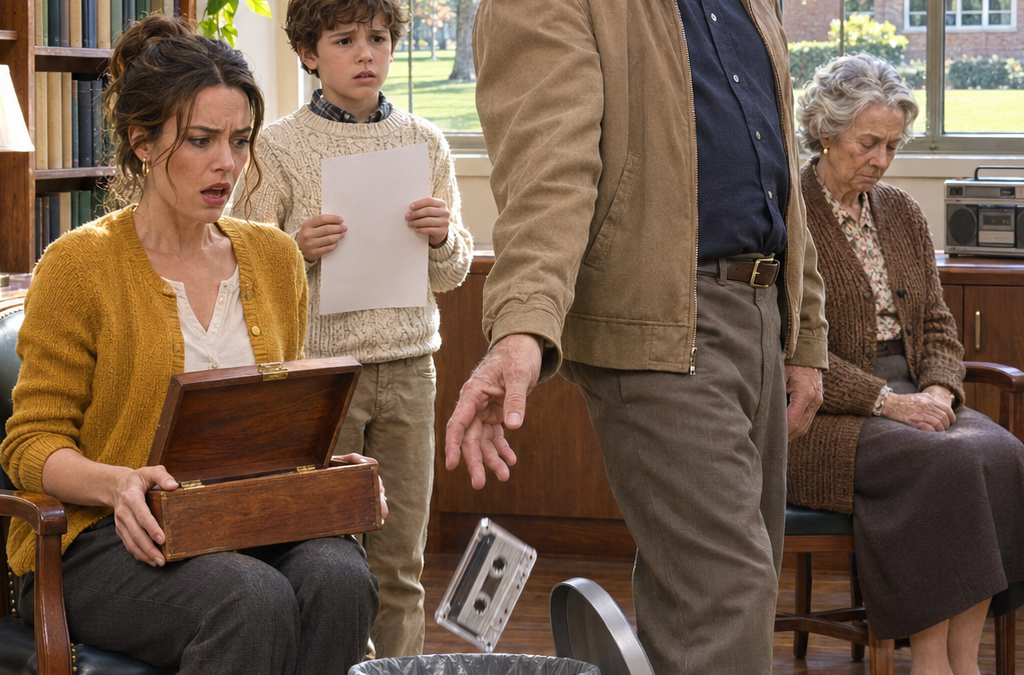
“Your father didn’t want you. Leave it.”—my stepfather dropped Dad’s cassette into the principal’s wastebasket before my son’s memorial reading.
Chapter 1 of 7
“Why would you throw away his voice?” My own voice stayed low, though my face burned.
My stepfather, Mark Collins, kept his foot against the wastebasket’s tipped lid. He had taken the cassette straight from my hand.
“Grandma Helen, are you going to let him destroy it?”
My grandmother, Helen Ward, looked down at the carpet instead of answering, while my son stood beside my chair with the tribute we had practiced together.
Mark’s sister, my step-aunt Linda Foster, leaned toward me. “Your mother wanted a peaceful afternoon. Leave that old business alone.”
Those words hurt more than his insults. Inside Mark’s open folder, two envelopes showed beneath a stack of papers. One had my name on it.
My name is Rachel Bennett. I’m thirty-one, a reading-intervention tutor, and I’d recently returned to Worcester, Massachusetts, from Columbus, Ohio, with my son.
Dad’s keepsake box belonged to me.
My former elementary teacher, Principal Karen Price, had handed it over before stepping out to check Owen’s place in the program. Dad had left it with her shortly before he died.
The wooden box rested across my knees, and beneath its open lid lay folded cards and old envelopes that I hadn’t yet had a chance to examine.
I had hemmed Linda’s black funeral pants on Mom’s sewing machine. Mark’s chicken-and-rice soup still sat in his refrigerator; he complained if anyone added celery. And Owen’s tribute had taken three evenings, mostly because he wanted every funny thing about his grandmother included.
Now Linda wanted me to keep the peace for them again.
My name was on the envelopes inside Mark’s folder.
Eight-year-old Owen stood beside my low chair, holding his reading page against his shirt. His thumb covered the sentence about Mom letting him sound out the lunch menu.
Helen was seventy-six, and the office’s only padded chair stood beside the cassette player. She remained there, studying her shoes.
“Put the box away and get him ready,” Mark said.
He spoke as though I’d brought the cassette to cause trouble. Until a moment earlier, I hadn’t even known what was recorded on it.
But I knew whose handwriting labeled the case.
When I leaned forward, Mark shifted across the narrow space between my chair and the wastebasket, leaving Owen pressed against the chair arm while his reading page bent.
“STOP UPSETTING YOUR SON!”
Owen flinched, and I hated that he had heard it.
“You’re throwing away the only voice he left me?”
“Yes, Rachel. Leave it where I put it.”
“Then move away from my chair.”
I stood with the box against my ribs. Then I stepped back toward Owen instead of reaching past Mark or apologizing.
Karen came through the doorway with the program in her hand. Her first act was to retrieve the cassette from the still-open wastebasket.
She put it in the school’s working cassette player, an old classroom listening-center machine still used for older literacy materials. Helen reached toward the volume knob.
The small office had Mom’s remembrance programs stacked beside the door, Owen’s coat hanging from my chair, and Dad’s rescued cassette waiting in a machine older than my son.
Nobody had missed the reading yet. There was still time to pretend this had been an unpleasant misunderstanding.
Mark tried first.
“That’s enough, Karen. We have somewhere to be.”
Karen stayed beside the player. “I’m not throwing away Rachel’s property.”
She pressed the button before he could answer.
“Rachel, come celebrate your fifteenth birthday with me.”
Dad sounded younger, almost cheerful, and terribly close.
“Mark says you don’t want messages, Rachel, but—”
A woman’s soft laugh came through the speaker.
“Please pause it, Karen. Just for a second.”
Karen’s finger moved toward the player’s pause button.
Mark’s mouth opened, but no words came.
Helen’s hand stopped on the volume knob when Dad said my name again.
My stepfather hid Dad’s invitations and told each of us the other wanted no contact.
That was what I understood standing there with Owen against my side. Dad hadn’t been recording a goodbye. He’d been asking me to come over.
For my fifteenth birthday, Mark had told me Dad was busy. I remembered pretending I didn’t care while Mom finished frosting a cake in the kitchen.
I had mistaken silence for proof.
Karen looked from the player to Mark. “You told me Rachel didn’t want this box, either.”
Mark said he’d never put it that way. His voice had changed for Karen, softer now, almost patient. He claimed there had been confusion after the funerals.
But Karen had reached me directly through Owen’s updated enrollment information. Until her call, I hadn’t known a box was waiting.
Owen looked up at me. “Did you miss your birthday?”
“Part of it,” I said. “We’ll talk later.”
He checked his tribute page, as though the answer might be there. The program still waited by the door, and he had practiced too hard for me to let Mark turn his reading into another thing we lost.
I looked at the folder again.
“Why do you have envelopes addressed to me?”
“Those are estate matters. I’m handling them.”
“Dad’s estate?”
Mark reached across the folder before I could read more. Karen told him that mail addressed to me should go to me.
The top envelope showed Dad’s name beneath mine.
Linda stopped talking halfway through telling me to sit down.
Mark closed his folder over the letters about Dad’s money.
“Apologize before Owen has to go out there,” Linda said.
“No. I’m not apologizing for asking.”
She stared at me, then looked toward Helen for help. Helen remained beside the player, her hand now resting in her lap.
I crouched beside Owen so he wouldn’t have to look up.
“The adults are having a disagreement. You didn’t cause it, and you don’t have to fix it.”
“Can I still say the part about Grandma’s pancakes?”
“Every word.”
He had written that Mom made pancakes shaped like states. Most were Massachusetts because they came out crooked and narrow. It was the one part he’d refused to shorten.
Karen took us to the reading, and I stayed where Owen could see me. My hands were still shaking when he began, but he found my face and got through the first sentence.
I laughed at the pancake part with everyone else. It hurt to hear him call Mom the person who always helped when words were difficult. She had helped him. I could let that be true without knowing yet what to do with the rest.
Back in Karen’s office afterward, I collected the box and cassette. Karen said Dad had asked her to give the closed box to me after his death.
“When I learned he’d died, I asked Mark to tell you it was here,” she said. “He said he would. I should have checked with you.”
“You could’ve called me,” Mark told me.
“I didn’t know there was anything to call about.”
Linda was already telling Owen to find his coat. I helped him into it myself.
Mark tucked the folder under his arm and said the estate envelopes were already handled. There was nothing for me to worry about.
“You’ve already received that mail, Rachel.”
A sealed envelope addressed to me slipped from his folder.
Chapter 2 of 7
“Give me that envelope, Mark. It has my name on it.”
He bent to retrieve it, but Karen was closer. She handed it to me while he complained that I was making another scene.
Inside was a notice concerning Dad’s estate. It had been sent to the house where I’d grown up, the address I hadn’t used since leaving Massachusetts.
“This says it came to your house. That doesn’t mean I received it.”
“You’re holding it now. What else do you want?”
I wanted to know how many others there were. Owen was waiting in his coat, though, and Karen had already stayed late. I took my mail and my son outside.
At Mom’s house that evening, Helen sat with me while I opened the remaining things in Dad’s box. Mark had gone upstairs. Owen was watching a movie in the living room.
There were birthday cards, school photographs, and invitations folded around handwritten directions. One invited me to dinner and said I could bring a friend. Dad had underlined that part.
“I was told you wouldn’t go,” Helen said. “Your mother said you didn’t want us pushing. I remember thinking we should give you a little time.”
“I didn’t refuse him.”
She looked at the invitation between us. I was angry enough to want her to argue, so I could finally answer someone.
But she only said she knew that now.
The papers preserved Dad’s attempts. They didn’t tell me who had handled every envelope or what Mom had known. I couldn’t turn each unanswered question into a fact just because I was hurt.
One card had a joke about my terrible bowling. I’d forgotten Dad called the gutter my preferred lane. I remembered laughing at that once, before I learned to act bored whenever someone mentioned him.
“Why didn’t anybody ask me?” I said. “I was right here. You all talked about what I wanted, and I was right here.”
Helen’s eyes filled. She said she should have asked, but she didn’t reach for me.
I was grateful for that much. I couldn’t have comforted her then.
By Monday, Mark had found another way to get at me.
Owen was eating toast before school when Mark told him grown-ups sometimes got upset over things they didn’t understand. Then he looked at me.
“Stop making the boy carry your troubles. He’s got enough going on.”
Linda had stopped by before work. She said Owen could leave Dad out of future family stories, at least until everyone settled down.
“He can talk about his grandfather. Please don’t tell him he can’t.”
Owen looked from Linda to me. His toast stayed halfway to his mouth, and I felt ashamed that breakfast had become another place he had to watch adults.
I didn’t ask what Mark had said when I wasn’t there. Owen didn’t need to become my witness.
Karen had offered him a place in a supervised after-school reading activity. I confirmed it that morning, giving him somewhere familiar to stay while I met an attorney.
“Do I have to talk about Grandma there?” Owen asked.
“You can’t walk into the bank and take over. We’ll get the file first.”
“No. You can read about dragons if you want.”
He wanted sharks. He said dragons weren’t real, as if that settled a serious mistake I’d made.
I met Daniel Brooks that afternoon. He was forty-three, with a small Worcester office and an appointment squeezed in between two others. I brought the notice and asked whether Mark could keep holding everything while refusing to tell me anything.
“The court appointed him,” Daniel said. “You can’t walk into the bank and take over. We’ll get the file first.”
“Dad named me, though.”
“Being named isn’t being paid.”
It embarrassed me to hear how much I hadn’t understood. I’d spent years helping children ask questions without feeling foolish. At thirty-one, I still wanted to apologize for asking my own.
Daniel obtained a copy of the probate file. The will was old, signed nineteen years earlier, when the adults still cooperated and Mark helped Dad with his books.
That explained why Dad had chosen him then. It didn’t explain what Mark was doing now.
The notices listed my former family-home address. Seeing it repeated made me furious. Mark knew I had been living in Ohio, and now I was sleeping under his roof while he claimed I’d received mail I’d never seen.
I looked through the appointment pages and the address entries. I couldn’t absorb the rest of the will yet. Daniel said we would go through it properly.
While waiting to collect Owen, I started a message to Mark.
I’m sorry this has become so upsetting.
The sentence came easily. That was the humiliating part.
I had kept smoothing over problems until Mark treated my silence as agreement. Even now, I was trying to make him comfortable before asking where my mail had gone.
“Please use this address to reach me directly,” I wrote to Daniel instead. “Don’t send anything through Mark. I need to know what’s happening myself.”
I deleted the apology and supplied my current mailing address. Then I went inside for Owen.
He showed me a shark book with a torn cover. We talked about its teeth all the way to the car, and for those few minutes I wasn’t thinking about Mark.
That evening, a family message appeared on my phone. Mark wrote that I had abandoned Dad and was now “taking things from the house.”
Underneath was a photograph of my keepsake box on my car seat. I hadn’t known anyone had photographed it. I felt exposed looking at my own belongings through his camera.
Linda forwarded Mark’s accusation with the same photograph of my box and the words, “She’s already started taking things.”
Chapter 3 of 7
“Taking things while the rest of us are grieving,” Linda added to the family message. “That tells you what her priorities are.”
Helen’s name stayed beneath the list of people who had read it. She wrote nothing.
I sent the brief confirmation Karen had given me: Dad had entrusted the box to her for me, and she had handed it to me herself. Then I turned off notifications.
I was humiliated. People who hadn’t called when Dad died were reading an accusation about me over breakfast.
Linda sent one separate message before I put the phone away. She wouldn’t help me move after all. I had asked her for two hours, not money, but now even that came with a condition.
By the time I came downstairs, Mark had stopped talking about stolen belongings.
“You moved here without a job lined up,” he said. “That’s what people are worried about. You’ve got a child to think about.”
I had tutoring experience and inquiries out, but no signed contract. That much was true. I hated that he could use one true thing to make everything else sound reasonable.
Owen was at school. I was glad he wasn’t there to hear Mark describe us as another problem somebody else had to solve.
“You couldn’t manage a week without somebody covering you.”
I wanted to remind him whose groceries I had bought since returning. Instead, I told him I had an apartment to see.
He asked who was paying for that. I left without answering.
The rental was in Worcester, close enough to Owen’s school that mornings wouldn’t become a long drive. Its second bedroom barely held a bed, but the door closed.
I signed the rental agreement that afternoon. The deposit and initial move-in costs came to $3,200, half my $6,400 savings.
“Is this where my books go?” Owen asked when I brought him through afterward. “Can they stay out, or do we have to pack them every night?”
“They can stay out. This is our place.”
He chose a wall for them before choosing where he would sleep. I felt relieved watching him claim a corner without asking whether Mark would mind.
Then I pictured our remaining savings and felt scared again. I needed steady work. I needed to stop buying small things because we were too tired to find the box they were packed in.
That evening, I went back for the family meeting about Mom’s belongings. Linda had arranged it around what she wanted from the kitchen. Helen sat near the doorway.
“We should settle the serving dishes first,” Linda said. “Your mother promised me the good ones. I don’t want this turning into another argument.”
“I’m here about Mom’s things. I’d like her cookbooks, if nobody else wants them.”
Mom’s good dishes were the ones nobody could put in the dishwasher. She had served holiday dinners on ordinary plates rather than wash twelve settings by hand.
I almost laughed, remembering her eating leftover pie straight from the pan afterward. Then I missed her so badly I couldn’t speak.
Linda began listing what she remembered being promised. Mark interrupted to ask whether I had signed anything for the apartment.
“I paid for it myself,” I said. “I’m here about Mom’s things. I’d like her cookbooks, if nobody else wants them.”
“You’ll get what we agree on. Don’t start dividing everything.”
I hadn’t touched anything. Helen watched him, but still didn’t speak.
Mark turned the conversation toward all the work he had done. For twelve years, he said, he had helped keep family money straight. People remembered birthdays and dinners, but nobody remembered who dealt with bills.
“I’ve carried plenty around here,” he said. “You think that roof paid for itself? Everybody expects me to keep going and never ask.”
He showed us his creditor statement. There was $14,600 still owed for repairs to his roof.
I understood why that worried him. It would have worried me, too. But the bill belonged to his house, and Dad hadn’t lived there.
Mark said he expected $18,000 from Dad’s estate for his work.
The amount frightened me. Until then, his talk about handling things had sounded like another way to keep me quiet. Now he had put a price on it.
“I’m not saying you never worked,” I said. “I know you’re grieving. But why didn’t I get my mail? Why did you keep using that address?”
He told me I was changing the subject.
I asked again. I wanted him to answer in front of the people who kept telling me to trust him.
Linda said this wasn’t the night for money. She hadn’t interrupted him when he named what he expected to receive.
“Further information comes through formal correspondence,” Mark said. “I’m done answering questions in my kitchen. Have your lawyer write if that’s what you want.”
I gave him my current mailing address anyway. He said he already knew it.
That made me furious. He had known how to find me for accusations, favors, and family meetings. Getting information to me had become difficult only when I asked about Dad.
I left the cookbooks where they were.
Daniel had requested the financial records. He told me payment for work had to be explained and accounted for; asking for compensation didn’t establish that Mark had earned it.
There was no instant change after I refused him. Mark still controlled Dad’s accounts and what he sent me. I still had half my savings and a move to finish.
That night, Daniel forwarded the statement he had obtained. I opened it sitting on the floor of our rental, beside Owen’s unopened book box.
The payment entry showed Mark had already paid himself $3,600.
Chapter 4 of 7
“The entry proves he paid himself,” Daniel told me. “It doesn’t mean everything is gone. We need to see what work he says he did.”
He said the court could review Mark’s conduct. Until then, I needed to keep the records, including anything Mark sent me.
I had wanted a simpler answer. Seeing that payment had scared me, and I wanted someone to say he couldn’t touch another dollar. Daniel wouldn’t promise that.
The next morning, I read Dad’s complete will at our kitchen table. Owen was at school. Nothing needed unpacking badly enough to let me avoid it again.
“The rest of his estate goes to you,” Daniel had explained. “After the bills and costs. Mark’s job is to handle it, not decide who gets it.”
I read that part several times. The whole remainder was mine.
Dad had signed it when I was twelve, before the birthday invitation I never received. Back then, Mom still sometimes called him about school, and Mark helped him with bookkeeping.
That explained why Dad had chosen Mark. It didn’t make the money Mark’s.
I cried over the page. I was grateful, but I wanted a Saturday with Dad more than I wanted to know what he’d saved.
Owen came home with a spelling list and complained about “Wednesday” having unnecessary letters. We ate grilled cheese with one pale side and one burned side. Our stove and I hadn’t worked things out yet.
For a little while, I helped him study instead of reading about everything I’d missed.
I returned to Mark’s house for an agreed pickup of Mom’s cookbooks and two boxes of photographs. Helen had sorted them with Linda. I had promised to take only what we’d discussed.
Mark was reading the request to remove him when I arrived. He had received it that afternoon.
“So you’ve decided I’m stealing from you,” he said. “Is that what you’re telling everybody now?”
“I asked for somebody else to handle Dad’s estate. I have the will, Mark. I know what he left me.”
He looked up then. Until that moment, he’d seemed more annoyed by my presence than worried about what I knew.
He asked whether Daniel had also obtained the financial records. I said yes.
“It’s yours eventually. That doesn’t mean you can run it.”
I had expected another denial. Instead, he spoke as though my inheritance were a difficult appliance only he knew how to operate.
“I’m offering to put this behind us. Take the cookbooks and think about it.”
He reminded me that I’d just spent half my savings moving. He knew exactly where to press. I was afraid about money, and hearing him use that fear made me furious.
“I can straighten out what people heard,” he said. “Linda will send a correction. You leave me in charge and stop fighting my fee.”
“You’ll tell them the box wasn’t stolen if I let you keep handling the money?”
“I’m offering to put this behind us. Take the cookbooks and think about it.”
Helen stood in the dining room doorway. I wished she would say that he owed me a correction anyway. She stayed there while Mark waited for my answer.
“I’m taking the cookbooks. I’m not agreeing to anything else.”
He told me I was making an expensive mistake. I carried Mom’s books out with their loose recipe pages still tucked inside.
I felt sick afterward. Refusing him hadn’t felt strong or satisfying. I sat in the parked car until I could drive without crying.
Daniel asked me to save Mark’s messages and write down the offer while I remembered it. The request was before the court; Mark still held his position while we waited.
There was no new permission for me to take over. I paid our bills from my own account and kept looking for tutoring work.
“Please don’t tell Owen I’m trying to take anything,” I told Linda when she called. “He needs to be left out of this.”
She said Mark had enough trouble without me accusing him of upsetting a child. I ended the call before I started defending myself again.
Karen supplied a short account of when Dad had left the closed box and how she had contacted Mark. She also confirmed that she had finally reached me through Owen’s school information.
A preserved copy of the recording and a written transcript were prepared. Both sides received them, including the faint woman’s passage after the place where I’d asked Karen to pause.
I didn’t keep playing it at home. Hearing Dad had already left me raw, and Owen deserved evenings that weren’t organized around my grief.
The mail records showed two separate stretches of missing information. The earlier notices had gone to my old address before Mark’s appointment; another packet had arrived after Mom died.
That distinction mattered. I was beginning to see how easily “the family mail” could swallow several different things.
The hearing was set for Friday, April 17, at 10 a.m., at Worcester Probate and Family Court. Mark and I would attend with our attorneys; Karen and Helen were expected too.
We weren’t going there to discover who inherited. We were asking the judge to review what Mark had done while in charge.
“Do you want me there early?” Helen asked when she visited our rental.
I said I wanted her to tell what she actually remembered. Asking even that made me sad. I used to assume she would.
Linda arrived before Helen left. She declined coffee and remained near the door, still wearing her coat.
“Mark needs you to tell the judge Susan handled the mail.”
Chapter 5 of 7
“Susan usually sorted the household mail,” Helen said. “I can say that. I can’t tell anyone what happened to letters I didn’t open.”
Linda remained by our apartment door. She said Mark only wanted Helen to explain how things worked at home.
“I won’t guess for him.”
Helen sounded tired, but she looked straight at Linda. I hadn’t heard her refuse anything so plainly in months.
Linda called Mark from the hallway. Her voice carried through the open door. She told him Helen would confirm that Susan handled the mail.
Apparently, he thought that was enough. Linda came back looking satisfied, while Helen stayed beside my table.
After Linda left, I asked why Helen hadn’t spoken that way at school. The question came out harder than I intended.
“Why did you look away when he threw Dad’s cassette in the wastebasket? I asked you to help me.”
“I know you did.”
She mentioned Owen’s reading, then stopped. From his bedroom came the scrape of a box across the floor. He was building a parking garage for cars he no longer admitted playing with.
Helen waited until the scraping stopped.
“I thought if we could get through the reading, we could talk afterward. He’d practiced so hard. I didn’t want him remembering a fight.”
“He saw a fight. He saw Mark shout at me.”
She said she hadn’t known what to do. That hurt almost as much as her silence had. I had needed one adult to say he couldn’t treat me that way.
“Your silence protected Mark,” I said. “Owen still had to stand there.”
Helen’s eyes filled, but this time I kept talking. I told her how often I’d waited for someone older to correct him, then accepted their silence as proof I was wrong.
She listened without defending Mom or asking me to lower my voice.
“I thought waiting would make it easier,” she said. “I kept doing that. You were already grown before I noticed how long I’d been waiting.”
I wanted to forgive her immediately. I also wanted her to leave. Both feelings embarrassed me.
We stayed at the table until Owen came out asking whether parking garages needed bathrooms. Helen told him every building needed one eventually.
He considered that a design problem worth solving.
The afternoon before the hearing, Daniel reviewed what I should expect. Our evidence was already shared: the will, Mark’s appointment, the notices, the account statement, and the verified recording copy.
He asked me to answer what I knew, without filling gaps. There was nothing hidden to spring on Mark, and Daniel promised no result.
“Will I have to look at him?”
“You can look at the judge.”
That small permission helped more than another explanation would have. I was frightened of getting upset and watching Mark use it against me.
Karen called after school. She could identify Dad’s box and describe the first playback, but she couldn’t identify the woman’s voice.
“I trusted Mark when he said he’d passed along my message,” she said. “I should have checked with you. I’m sorry, Rachel.”
I thanked her. She didn’t ask me to make her feel better about it.
“I’m not trading the truth about Dad for a cleaner story about Mom.”
Linda called while Owen and I were eating dinner. I let it go, then listened to her message after he went to bed.
“She loved that school,” Linda said. “Mark wants you to remember that. A public hearing will stain your mother’s memory. People will talk about her instead of what she did for those children.”
I called back because I wanted my answer clear. Mom had helped children read. Dad had tried to reach me. Neither truth needed to disappear for the other to survive.
“I’m not trading the truth about Dad for a cleaner story about Mom.”
Linda said nobody was asking me to lie. I told her the hearing would go ahead.
By morning, I felt worn out before leaving home. Owen went to school with a friend’s family, carrying his lunch and instructions to stop redesigning his garage during math.
At Worcester Probate and Family Court, I found Linda beside Mark. Helen sat on his other side, her coat still buttoned.
Mark was talking loudly enough for me to hear.
“She wants the money without the burden,” he said. “I’ve been the only responsible adult through all of this.”
I carried my own case of papers past them and took an empty chair. I felt lonely sitting there. Helen saw me, but she didn’t move.
Karen arrived and greeted me before finding a seat nearby. Daniel joined me shortly afterward. Nobody tried to start a family discussion.
Mark thanked a court employee for directions in a voice I barely recognized. He called her ma’am and apologized for being in the way.
Then he leaned toward me.
“Keep your grief out of my answers.”
I stared at him. He seemed to expect agreement, the way he once expected me to clear dinner while he was still eating.
I moved closer to Daniel instead.
When our case was called, Linda stood with Mark. Helen rose more slowly. I held my case against my leg and waited for them to go ahead.
“Your mother handled the mail.” Mark said it to me, then looked toward Helen. “That’s how the house worked. Don’t let her turn ordinary things into accusations.”
He straightened his jacket before entering. Linda followed him, and Helen stayed beside the doorway.
“I gave every notice to Susan.”
Chapter 6 of 7
“State your explanation.”
Judge Patricia Reed looked at Mark while I sat beside Daniel, afraid I would miss something.
“Yes, Your Honor. I gave Rachel’s notices to my wife, Susan, to forward. I never knowingly cut Rachel out.”
He sounded patient. Karen sat behind me, with Linda and Helen across the aisle. They could all hear him.
When I testified, I looked at the judge instead of Mark.
“How could Mom receive the later packet? It reached the house after she died.”
Saying it hurt. Mom had been dead only weeks, and he was making her answer for him.
Daniel showed me the copy already in the court’s records. I recognized the envelope from Mark’s folder. My name and Dad’s estate appeared on the front.
Mark didn’t dispute when it had arrived. He changed his explanation.
“That was a duplicate. Helen must have left it among Susan’s papers. I didn’t receive it from her.”
Helen sat very straight. Linda leaned toward her, but Helen kept watching the judge.
Mark also disputed what the birthday recording established. He said Dad had recorded an invitation, but that didn’t prove anyone had delivered one to him.
“The woman sounds like Susan,” he added. “She may have meant to arrange something. That doesn’t mean I ever got an invitation.”
I was furious hearing him use that careful voice. At home, he would have told me to leave it alone.
Karen had confirmed that Dad entrusted the closed box to her. She described retrieving the cassette at school and hearing the first passage. She didn’t claim to recognize the woman.
Judge Reed allowed the previously shared passage to be played. Mark had relied on the family’s mail arrangements; she would hear the testimony about them.
I supplied the original cassette to the employee handling playback. My fingers shook against its hard plastic case.
“Please play the passage after Dad’s birthday invitation.”
I stayed seated while Dad’s voice came through the speaker. He sounded hopeful again. For a moment, I wanted everyone else to leave so I could hear him without watching Mark.
Then the faint laugh came, followed by the words we hadn’t heard at school.
“I’ll bring Rachel, Tom. I’ve already handed Mark the invitation.”
Helen leaned forward.
“That’s my own voice.”
Mark turned toward her. He started to speak, but his attorney touched his sleeve.
Helen explained that she had arranged to bring me to Dad’s place. He had asked whether fifteen-year-olds still liked ice cream cake. She’d told him I would eat it for breakfast if allowed.
I remembered wanting that cake every year. The memory made me sad in a small, ordinary way I hadn’t expected.
“Did you hand Mr. Collins that packet, or leave it somewhere in the house?”
“Mark told me afterward Tom had canceled,” Helen said. “I believed him. I should have called Tom myself.”
Mark looked down at the table. His guess about Mom’s voice had left him facing someone who could answer.
Judge Reed brought Helen back to the later mail.
“Did you hand Mr. Collins that packet, or leave it somewhere in the house?”
“I put it in his hand. Susan was already gone. He said he would handle Rachel.”
Helen identified the packet by its envelope and return sender. She hadn’t opened it and didn’t pretend to know what every page said.
She remembered bringing it from the mailbox into the kitchen. Mark had been standing by the counter. There had been no pile of Mom’s papers between them.
I felt relieved, then angry that relief required this much. One plain account of what happened shouldn’t have been so hard to get.
Mark insisted the packet was only a duplicate. He said he had protected the estate and done work nobody else wanted.
Judge Reed looked directly at him.
“Duplicate or not, Rachel remained uninformed. You paid yourself while withholding information from her. Your explanation of who received these notices is contradicted by firsthand testimony.”
She said the old invitation did not decide his fitness by itself. His present conduct did. His advance and any final payment for work would still require review.
Then she removed him as personal representative and appointed Janet Ellis to take over the records and assets.
“With that removal, Mr. Collins, you lose control of the $271,000 estate.”
Mark stood so abruptly his chair scraped. His attorney spoke to him quietly, and he sat again.
I hadn’t expected to feel so tired. I had spent weeks trying to get him to answer me. Now the decision belonged to someone he couldn’t shout down.
After we were dismissed, Linda moved her bag onto the chair she had been saving for him. When Mark approached, she pointed toward another seat without looking up.
Helen crossed the aisle and sat beside me. She asked whether I wanted her there.
I said yes. It wasn’t forgiveness for everything, but I was glad she had asked.
Mark stopped in front of us.
“We need to settle this privately. You’ve made your point.”
“You don’t get to speak for me anymore.”
He glanced toward Daniel, then told me he was talking about family, not lawyers. He wanted us back in his kitchen, where he could decide when the conversation ended.
I felt scared refusing him even then.
“Anything about Dad’s estate goes through Janet. I’m not making a private agreement.”
Helen stayed beside me. She didn’t soften my answer or offer him another explanation.
Mark returned to the table where the remaining records were being gathered. He opened his folder and pulled out the packet he had kept.
He left it on the table for Janet, still unopened, with my notice facing up.
Chapter 7 of 7
Janet logged the packet Mark handed over and sent me copies. It contained the missed notices, including the one addressed to me. There was no additional gift inside, only information I should have received weeks earlier.
Mark remained out of the job. Checking Dad’s accounts and finishing the work would take months, but Janet sent updates directly to me.
“I got another envelope,” I told Helen when she visited our rental. “I actually knew what it was before I opened it.”
She said she was glad. Then she asked whether I wanted company or whether she had come at a bad time.
I told her to stay.
I was still angry with her sometimes. She understood that a visit didn’t mean everything was settled.
During the summer, I picked up regular tutoring students. I worked while Owen attended a day program, then brought home books children had spilled juice on.
Our rent came from my earnings and savings. Some weeks were close, but I stopped checking my balance before buying milk.
“Can I tell Mark you’re doing all right?” Helen asked one afternoon. “He asked me whether you needed anything.”
“You can tell him to ask me himself. You don’t have to bring his questions here.”
She looked embarrassed. I felt guilty for a moment, then let the answer stand.
Helen hadn’t become fearless after the hearing. She still sometimes began a sentence with what somebody else wanted. Now she caught herself, and I didn’t have to pretend I hadn’t heard.
Mark tried Owen next.
He called while we were sorting school clothes. I answered because I thought there might be a question about Mom’s remaining photographs.
“Put Owen on,” he said. “He can tell you what I’m asking without you turning it into a fight.”
I kept the phone in the kitchen. Owen was down the hall, arguing with a shirt that had become too small.
“No. If you have something to say to me, say it. Owen isn’t carrying messages between us.”
Mark called me difficult and hung up.
It hurt that I still wanted him to say something kind. I went back to Owen, helped him out of the shirt, and added it to the donation pile.
A few weeks later, Janet sent me the review of Mark’s advance. He couldn’t support the $3,600 against the services he had failed to perform. Rather than keep fighting the charge, he agreed to return it.
The confirmation arrived on September 18, 2026. His payment had cleared into Dad’s estate account.
“That doesn’t come to us today,” I told Owen, who had noticed me reading the message twice. “It goes back where it belonged while things get finished.”
“Then why are you happy?”
“Because he finally had to give it back.”
I felt relieved, though the money didn’t fix the years. I closed the message and helped Owen find the homework he had confidently declared wasn’t in his backpack.
Linda called after hearing about the repayment. She wanted to know how much would be left for me.
“That’s private,” I said. “I’m not giving you balances or telling you when money comes. Please don’t ask Owen, either.”
She said families shouldn’t have secrets.
I told her Owen had school in the morning and ended the call. She still sent occasional holiday greetings, but I gave her no financial information. I no longer explained the same answer until she approved of it.
Helen began calling before she came over. Sometimes I said yes. Sometimes we were tired, or I simply wanted an evening alone with my son.
“Would you like me to bring supper?” she asked once. “I’m asking you, Rachel. Nobody sent me.”
I laughed before I could help it. She laughed too, then admitted she had already made enough baked potatoes for six people.
We ate them for two nights.
Those visits helped. I could be glad to see her without forgiving every time she had looked away. She could hear that something hurt me without asking me to remember how hard it had been for everybody.
One evening, she asked whether I wished Dad had tried harder.
“Yes,” I said. “He should have called me himself. Kept trying directly. And I wish I’d asked sooner instead of believing what I was told.”
I cried saying it. Dad had made mistakes, and I had questions he could no longer answer. None of that excused Mark for manufacturing the rejection between us.
Helen stayed with me until I could talk about something else.
By winter, an approved $240,000 interim payment reached my account. Janet kept $12,500 for the remaining obligations and finishing the work.
I read the amount at our kitchen table, then checked that the rent was scheduled as usual.
“Are we moving again?” Owen asked. “I like my room. I finally know where everything goes.”
“We’re staying here. This means I don’t have to worry so much about paying for it.”
I was grateful enough to cry again, which annoyed him because he had asked a practical question. I assured him his room was safe.
“The birthday part. I want to hear him ask you again.”
I kept tutoring. I paid the bills, set most of the money aside, and replaced our unreliable car before it stranded us. Our home stayed rented, with the same narrow second bedroom and the same neighbors upstairs.
On Christmas morning, Owen woke me wearing one sock. He claimed the other had disappeared during the night, although I could see it beside his bed.
We ate cinnamon rolls from a tube. He always took the center one because it had no hard edge. That morning, he offered it to me.
“Can we hear Grandpa after presents?” he asked. “The birthday part. I want to hear him ask you again.”
“Yes. We can hear the whole thing.”
The cassette player sat on our living-room shelf. I had played Dad’s voice aloud there before, without checking who might be upset. Sometimes it made me cry. Owen knew he hadn’t done anything wrong when it did.
He sat beside me on the couch, his new book open across his knees. Outside, our upstairs neighbors were trying to carry something heavy down the steps.
I was happy in our small rented home. I still missed Mom and Dad.
Family love didn’t require me to surrender my voice.
I put the cassette back in the player.
I pressed play and let Dad finish.







