“A toddler could sew better than that,” my daughter-in-law mocked my quilt, then paid $1,630 to replace me—until a fire captain lifted its crooked corner, silencing her while the money stayed lost.
Complete story · 9 parts · about 35 minutes · ending included
Part 1 · Part 2 · Part 3 · Part 4 · Part 5 · Part 6 · Part 7 · Part 8 · Part 9
Part 1 of 9
“This looks like something you’d wipe down an engine with,” my daughter-in-law said, holding my quilt up to her phone while her friend filmed.
Kenzie Groff was my son Josh’s wife. She sat in the middle of their sofa in Lititz, the gift table in front of her.
Madison, a nail tech at Kenzie’s salon, stood facing her with Kenzie’s phone raised.
Twenty-five guests had come for the sip and see. I sat in the armchair by the fireplace, where I could see the gift box Kenzie had just emptied. The card was still pinned near the quilt’s top corner.
At the kitchen doorway, Josh held their newborn daughter, Ellie, against his shirt.
Kenzie shook the navy patchwork baby quilt until the binding fluttered.
A woman laughed into her napkin. Others joined in while Madison kept filming.
“Wait,” Kenzie said. “Get the corner.”
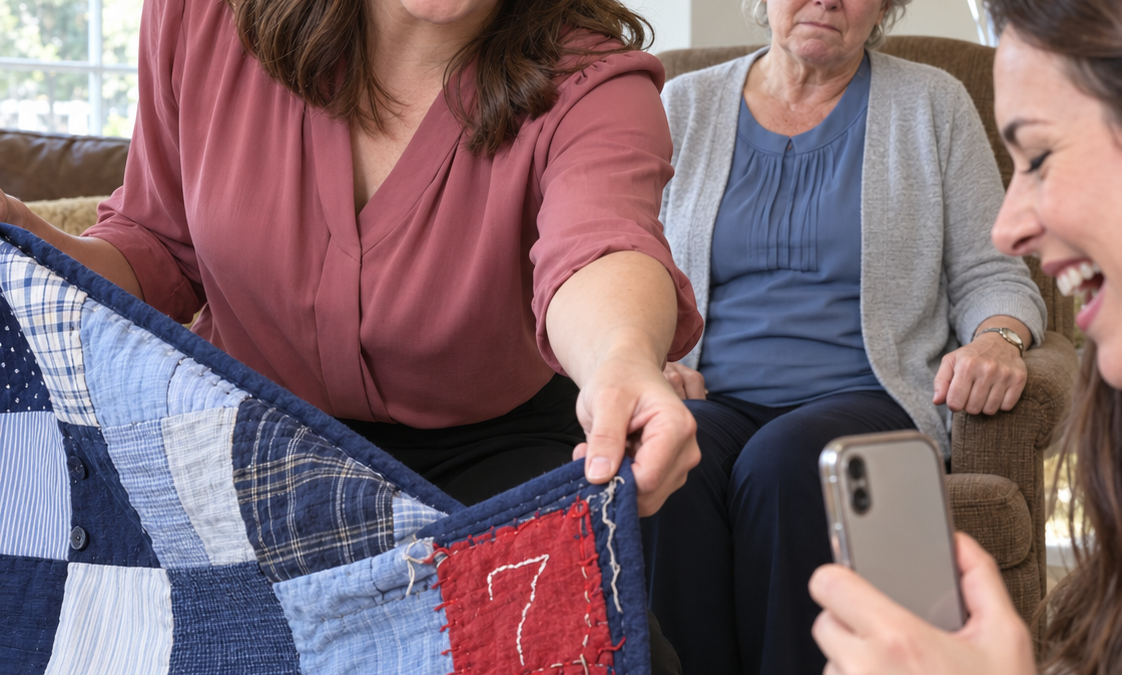
She brought the bottom right of the quilt toward the lens. The seven patch, a white 7 on red, filled the space in front of the phone. Old red stitches formed a crooked ring around it.
Kenzie never looked down. Her eyes moved between Madison’s screen and the guests watching her.
“Look at this corner. A toddler could sew better than that.”
She gave the edge a tug. The binding loosened beneath her thumb.
I noticed the gap. Bernice had prepared that edge so carefully herself. I knew where it should lie.
“Is that supposed to be a seven?” Madison asked from behind the phone.
“It’s supposed to be a baby present,” Kenzie said.
Laughter came again, louder near the sofa.
I kept my palms on the arms of the chair. I’d spent thirty-one years as a county court clerk, listening while people said things they expected everyone else to agree with. I kept quiet.
Kenzie reached for the card. She unpinned it, leaned toward the camera, and put on a sugary voice.
“‘For the wall, not the crib.’ Don’t worry, Laurie, it’s not going anywhere near her.”
This time the whole room laughed.
The rest of the card said, “Bare is best till she’s one. — Mom L.” I had written it so nobody would misunderstand. Ellie was too young for anything loose in her crib.
Josh lowered his face toward Ellie. He adjusted the baby against his shoulder and said nothing.
My own son.
I had retired a year early to watch Ellie on Mondays, Wednesdays, and Fridays when Kenzie returned to the salon. My babysitting days would start November 2.
He had opened the door for me and made room for my gift. Now he would not look across the living room.
Kenzie laid the card on the table.
“I mean, I love handmade things,” she said to the phone. “You know I do.”
Madison gave a short laugh. “Sure.”
“But you have to know your audience.”
Someone near the fireplace stopped laughing. A paper plate scraped against another.
Kenzie stood and carried the quilt over to me, letting one corner trail from her hand.
“Here, Laurie. You can have it back.”
I held out both hands. She passed it across without waiting for me to stand.
My thumb found the red stitches around the seven patch. The thread stood up in uneven ridges under my skin. That had been the last piece I sewed onto the quilt, on August 30.
I could still see Bernice Eshleman, Kenzie’s mother, in my kitchen on March 14.
She had set the bag on my table. It was cream cloth, full of fabric squares already cut to size, with the binding folded, ironed, and pinned.
“Old work shirts. Don’t ask. Put the seven in a corner. Leave the red stitches. It’s a family thing — don’t mention it to Kenzie. I’ll tell her myself.”
Bernice’s older brother Marvin had just closed his garage. I figured the squares came from his old work clothes. Bernice had not corrected me, and I did not press.
Her hands hurt too much with arthritis to sew. She could still manage the ironing and pins, and she had done those herself.
“These are ready,” she’d said, touching the binding. “You can do the rest.”
I had agreed.
Bernice couldn’t come to the sip and see. After her knee surgery, she was staying at Willow Lane Rehab. Not one person in that room had asked how she was doing, her daughter included.
Instead, Kenzie stood above my chair while Madison kept the phone aimed our way.
“Take it home, Laurie. We don’t have a wall that ugly.”
I smoothed the loose binding against the corner.
“I’ll keep it safe,” I said.
Kenzie smiled at the room, as though I’d given her permission to make another joke. But she turned back to the sofa when somebody lifted a different gift from the table.
Madison followed her, still holding the phone.
Josh, with Ellie resting on his shoulder, glanced toward me from the kitchen entrance. His mouth opened slightly, then closed. He shifted Ellie higher in his arms.
I could have called him over or read my note aloud myself. Neither would have stopped a single person from laughing.
With the seven patch turned to the inside, I folded the quilt in my lap and slid it into my canvas tote.
I stayed in my chair until the last guest left at four-thirty, the tote at my feet. I told no one what Bernice had asked of me. Whatever those red stitches meant, it was hers to tell.
Part 2 of 9
Lois Herr slid her phone across the sewing table and said, “Laurie, honey, is this your quilt?”
Lois was my friend, and in all our Thursdays at that table she had never once interrupted my stitching. She had set her scissors aside, points tucked under a scrap of cloth, before turning the screen toward me.
We were in the fellowship hall of our Lutheran church, four days after Ellie’s party. The tables were covered with fabric, pins, and the pieces everyone was working on. My needle stopped halfway through a seam.
“Where did you find that?” I asked.
“Kenzie posted it.”
My daughter-in-law’s name appeared above the video. Beneath it was a caption, written on Sunday night at 9:40.
“Ugliest gift of the year? 😂 My MIL made this for my newborn.”
I knew the quilt before I touched the play button. It was hanging from Kenzie’s hands, its navy squares stretched under the lights in her living room.
“Is that public?” I asked.
“Yes. It’s on her own Facebook page. And she shared it into Lititz Area Moms.”
“She’s a moderator there.”
“I know.”
Lois kept a finger beside the screen, careful not to cover the numbers. Three thousand shares, nearly every one with a laughing face. Hundreds more reactions sat beneath the video, and mocking comments on the reposts turned my handmade gift into a joke.
One said, “Grandma raided the thrift store rag bin.”
I rested my sewing hand on the tabletop.
“That many people?”
“That’s what it says.”
We watched Kenzie lift the quilt toward the phone Madison was holding. The guests from the sip and see laughed in the background. There I was in the armchair by the fireplace, my knees together, looking at the quilt I’d spent all spring and summer sewing.
I hadn’t known the phone caught me too.
“Do you want me to stop it?” Lois asked.
“Let it finish, please.”
My daughter-in-law pulled the seven patch toward the lens. Her mouth formed the words about a toddler sewing better. On the recording, I could see the binding stretch where her fingers tugged it.
The card came off next.
Kenzie read it in a sugary voice I’d never heard her use with me. Someone gave a little squeal of laughter. The camera caught Josh at the kitchen doorway, Ellie nestled against his shirt. He looked down.
Lois touched the edge of my sleeve.
“Did you know she’d put it online?”
“No.”
I rubbed the thread between my fingers until the needle lay straight again. Inside my sewing bag, I found the folded calendar page: Mondays, Wednesdays, and Fridays circled in pencil from November 2, the days I had left the county court a year early to keep.
“She knows why I wrote that card,” I said.
Lois nodded toward the comments. “There’s something farther down.”
Her finger moved slowly over the glass. She stopped at a reply with Kenzie’s name and picture beside it.
“She gave my newborn a suffocation hazard. That’s why she won’t be watching my baby.”
I closed my hand around a spool of thread until its rim bit into my palm. A loose end trailed between my knuckles.
“Did she write that herself?” I asked.
“She did.”
“Not someone repeating it?”
“No, Laurie.”
I took my hand away from the spool. There was a red ring in my palm where the rim had pressed.
“Can you leave that where I can see it?”
Lois held the phone steady.
I looked at the accusation again. Then I picked up my needle and guided it through the cloth. The stitch came out too long. I pulled it free and made it properly.
On Saturday, September 26, I drove to Lititz. By the time I stood at the kitchen island in Josh and Kenzie’s townhouse, the clock was near eleven.
Kenzie was by the sink. Her phone lay within reach, beside a dish towel. From the hallway, I could see part of Josh’s shirt. He didn’t enter.
“Kenzie, may I ask you something?” I said.
“Sure. What’s up?”
“Please take the video down.”
She turned away from the sink. “Why?”
“It’s hurtful. And what you wrote about Ellie isn’t true.”
Kenzie dried her fingertips on the towel.
“It’s my page. People think it’s funny.”
“I understand they laughed.”
“Then what’s the problem?”
“The comments say I gave Ellie something dangerous.”
“You gave us that quilt for a baby.”
“For the wall.”
She tipped her head. “Laurie, come on.”
“That card said the wall.”
“Nobody reads cards, Laurie.”
I placed my palms flat on the island, careful to keep my voice even.
“I wrote it for a reason.”
“Okay. You made your point.”
“Will you remove it?”
Kenzie looked toward the hallway.
“Josh?”
He remained out of the kitchen.
“Mom,” he said, “can we just leave this alone?”
“I’m asking her, Josh.”
She crossed her arms.
“People share things. They get a laugh. Soon they’ll have forgotten it.”
“I haven’t.”
She glanced at the phone beside the sink. Her expression tightened, then smoothed as she looked back at me.
“You’re making a lot out of a joke.”
“I would like my face taken off it.”
“And tell everyone what? That you came over because you couldn’t stand a little teasing?”
I ran one finger along the island’s straight edge. I could hear Josh shift his feet in the hall.
“Please,” I said. “Take it down.”
Kenzie put her hand over the phone.
“Say one word about this at church, or to my mother, and you won’t babysit. Not one day.”
Part 3 of 9
I picked out four inches of binding where Kenzie had yanked it, and the fold opened on letters I had never seen.
The clamp lamp lit a strip of navy fabric across my sewing table. Under the stitching, faded white print ran along the inside edge.
MILLCREEK F.C.
Beside those letters was a small printed 7.
I set down my thread snips. The metal tips touched the wood with a click, and I pressed my thumbnail over the printing to make sure it was part of the cloth.
On Sunday evening, September 27, the quilt covered most of the table in my Lancaster living room. I had spread it out to repair the place Kenzie had pulled loose at the sip and see.
Bernice had handed me the binding already folded, ironed, and pinned in March. I’d sewn along her crease without opening it. Her hands could still do that much, even when arthritis kept her from holding a needle.
Now I could see what her iron had pressed out of sight.
I shifted the lamp closer. The white ink had worn thin, but I could read every letter.
Bernice’s instruction came back to me: “Leave the red stitches.”
My fingers moved to the seven patch. Those crooked loops were still intact, though Kenzie’s tug had loosened the fabric beside them.
I stopped working. On the table, the printed mark and the hand-sewn number rested a few inches apart.
The next morning, I carried my tablet to the kitchen table and searched the words from the binding.
Millcreek Fire Company appeared in the results. It was a volunteer station fifteen minutes from my house.
I opened an old news article from 2005.
The first paragraph named Ray Eshleman, a firefighter with the company, who had died at thirty-eight in a barn fire. It said he rode Engine 7.
Ray was Kenzie’s father.
I knew he had died on a fire call when she was twelve. Nobody had ever told me which station he served or the number on the truck he rode.
I held the tablet near the kitchen window and enlarged the article, making sure I hadn’t mistaken the surname.
Eshleman.
When Bernice gave me the bag, I had assumed the squares came from her brother Marvin’s closed garage.
But there was the name of the fire company inside the cloth she’d prepared, and Ray’s engine number on the patch she had told me to put in a corner.
Old work shirts, Bernice had said.
I turned the tablet facedown. Then I went back to the living room and folded the quilt so the seven patch lay on top.
Bernice had asked me to leave that patch alone and say nothing to Kenzie. I had done both. She hadn’t said whose shirts they were, and I hadn’t asked.
I picked up my phone to call her. Kenzie’s words at the sink came back to me: or to my mother. I set the phone down.
On Tuesday, September 29, I put the quilt in the tote and drove to Millcreek Fire Company.
At four o’clock, the roll-up doors stood open. A new Engine 7 sat in the apparatus bay, its paint bright under the overhead lights. A tool bench lined the back wall.
Captain Steve Hoover stood beside it.
“Can I help you, ma’am?”
“My name is Laurie Groff. Do you have a minute?”
“Yes, ma’am.”
I lifted the tote slightly. “I have something I think belongs here. Or used to.”
He looked at the fabric showing above the handles.
“May I see it?”
“Please.”
Steve led me over to the truck. He opened a side compartment, and together we spread the quilt across its lid. He took care not to catch the binding on the metal edge.
“Where did you get this?” he asked.
“Bernice Eshleman brought me the pieces. I did the sewing.”
His eyes stayed on the bottom right corner.
“Do you recognize it?”
He rested his finger on the red stitches.
“That’s the old Engine 7 patch. We retired that design in 2008. Somebody hand-stitched this one on.”
I turned back the loosened binding and showed him the printing. He examined it, then laid the fold down again without trying to pull anything farther apart.
“Is that this company?”
“Yes, ma’am.”
“There’s something else,” I said.
From my phone, I opened Kenzie’s public Facebook page. The video was still there.
“This was filmed at my granddaughter’s sip and see.”
“May I?”
I gave him the phone.
Steve watched all of it. Kenzie held the quilt up, and her voice came thin and bright from the phone’s small speaker: “This looks like something you’d wipe down an engine with.” Steve did not look away. The video showed me sitting alone in the armchair.
When the video ended, he handed my phone back.
I put the phone in my pocket without looking at the screen.
“Did you know Ray?” I asked.
“I rode Engine 7 back then.”
“Nobody told me the shirts were his.”
“Bernice called me back in August. She asked me to keep something to myself until the memorial. You’ll have to ask her.”
I looked at the quilt still spread beside us.
“Is there anything you can tell me now?”
He shook his head.
“Then I’ll take it home.”
Steve lifted the quilt from the compartment lid and carried it across the bay to the bronze memorial plaque on the wall.
He raised the seven patch to the plaque and held it under one line:
FF RAYMOND ESHLEMAN — ENGINE 7 — OCTOBER 8, 2005
The stitched 7 sat an inch below the engraved one.
Steve said nothing. He kept holding the corner there.
Part 4 of 9
“What’d you bring her this time?” Kenzie said before I had my coat off. “Another suffocation hazard?”
I stood in the doorway of Josh and Kenzie’s townhouse with a pot of beef stew warm through the handles. It was Wednesday, September 30, at five-thirty, and Josh had just come home from work. He stood by the door with his keys still in his hand.
Kenzie sat on the sofa holding Ellie. Madison, who did nails at the same salon, sat in the armchair beside her with her feet tucked under her. She glanced toward me, then away.
“I brought supper,” I said.
“That’s nice. Set it wherever.”
I set the pot on the coffee table, took my wallet from my coat pocket, and drew out the card that had been pinned to the quilt.
“Josh, would you read this for me?”
He took it and tilted it toward the lamp.
“For the wall, not the crib. Bare is best till she’s one.”
He paused at my signature. I didn’t ask him to read that. Madison watched his face instead of mine.
She sat upright. “Kenz, you read that out loud in the video.”
“I only read the first part,” Kenzie said.
“You read the bit about the wall.”
Kenzie looked at the card in Josh’s hand. Red climbed her neck.
“I am holding a baby. Can we not do this?”
She carried Ellie into the bedroom and shut the door.
Josh handed back the card. I slipped it into my wallet while Madison began picking at a chipped fingernail. The stew sat untouched.
“You’re welcome to eat it while it’s hot,” I told Josh.
“Thanks, Mom.”
I kept my coat on and left.
At 9:15 that night, my phone lit up on the kitchen table in Lancaster. The quilt was folded on the chair beside it. I had left the loose binding unstitched since my visit to the station.
Kenzie had sent a text.
“Little Acorns starts November 2. I already paid $1,630. Your babysitting days are done. Josh agrees. And keep your quilt. Ellie doesn’t need another suffocation hazard.”
It was a daycare in Lititz, near the salon.
I looked at the words Josh agrees.
He had stood in the hallway when Kenzie first threatened to take away my days with Ellie. Now she had put his agreement in writing for him.
The three days a week with Ellie were gone. I had left the county court a year early for Mondays, Wednesdays, and Fridays with her. I’d emptied my desk in June for those mornings.
My eyes went from the screen to the quilt. I typed:
“I’ll keep it safe.”
I opened Facebook. Kenzie’s page no longer appeared when I searched her name. She had blocked me.
I set the phone faceup on the table.
No message came from Josh.
Kenzie had already taken the babysitting, so her warning about her mother had nothing left behind it. Bernice was the only one who could tell me what Steve was keeping. On Thursday, October 1, I dialed Bernice’s cell. The call rang out. I tried again from the same chair and got no answer.
Friday, October 2, at six in the evening, my screen showed Marvin’s name. Marvin was Bernice’s older brother. Back in March, I’d guessed those squares came from his garage.
“Laurie? It’s Marvin. My sister wanted me to call you.”
“How is she?”
“She saw your missed calls. Her knee incision got infected.”
I reached for the edge of the kitchen chair.
“They moved her out of Willow Lane Rehab this morning,” he said. “She’s at Conestoga Valley Hospital. They’re cleaning out the infection.”
“Can I visit?”
“She doesn’t want visitors right now. Won’t be on the phone till Tuesday, either.”
“Will you tell her I called?”
“I will.”
“Thank you, Marvin.”
He waited a beat. “Was it about something urgent?”
“No. Just tell her I’m thinking of her.”
That was all I said. I didn’t tell him about the quilt.
Sunday morning, October 4, I walked through the hallway at my Lutheran church with my coat over my arm. Two women from the sewing group fell quiet as I approached. One leaned toward the other’s ear. I heard my name, followed by the scrape of a shoe against the tile.
“Morning,” I said.
They answered with polite nods. I kept walking.
At home that evening, I settled with the quilt folded across my lap. The house was quiet enough to hear the refrigerator switch off.
I checked the binding where Kenzie had pulled it loose, then tucked that edge beneath the rest.
The red stitches disappeared inside the fold.
I left them there.
At eight-thirty, I stood to lock the front door. Something pale showed through the glass of the storm door.
An envelope had been wedged between it and the frame.
The front carried the name Millcreek Fire Company, but no stamp. Someone had brought it by hand.
I opened it standing there.
It was an invitation to the 21st annual memorial service on Saturday, October 10, at 2:00 PM, at the station.
Beneath the typed lines was a line in handwriting:
“Bernice asked me to make sure you come, and that you bring it. — S.H.”
Part 5 of 9
Bernice watched the whole video on my phone without blinking, and when it ended she said, “Play the part with the corner again.”
It was Tuesday, October 6, three in the afternoon, at Conestoga Valley Hospital, and an IV pole stood beside her bed. A bandage covered her knee. Her leg rested on a pillow, too stiff for her to shift without help.
I sat close while she worked the screen with a swollen knuckle. Lois had saved the video and sent it to me after Kenzie blocked me.
“There,” she said.
Kenzie pulled the quilt toward the camera. Her voice came out of the speaker, cheerful and sharp. Bernice kept her eyes on her daughter laughing at the stitching until the clip ran out. Then she handed my phone back.
“Those are Ray’s shirts.”
I kept the screen dark in my lap.
“I worked it out from the binding,” I said. “Why didn’t you tell me in March?”
“You would have looked at them differently.”
“You cut the squares?”
“Every one. At my kitchen table. So she’d never see a whole shirt.”
Bernice’s gaze moved to her bandaged leg. She reached for the call button, shifted it away from her elbow, and let go.
“The binding too?” I asked.
“Folded and ironed it myself. Pinned it for you. These hands can’t sew anymore.”
She flexed her knuckles as if the phone had left them aching.
“You did the hard part,” I said.
“You made something Ellie could have. That’s what I asked.”
“Kenzie said it was ugly.”
“I heard her.”
“And three thousand people have shared it.”
Bernice held out her hand for a sip of water. I passed her the cup, and she drank before answering.
“That doesn’t change whose clothes they were.”
I drew the chair closer without touching the bed.
“Steve knew about it?”
“I called him in August. Asked if we could lay the quilt on Ray’s chair at the memorial. Told him I wanted Kenzie to bring Ellie to her first one.”
“Did he agree?”
“He said he’d see it done.”
I looked at the IV line hanging beside her shoulder.
“Steve called me the night you went to him,” she said. “Told me you’d brought the quilt in, and that there was a video. Wouldn’t tell me what was on it.”
“I didn’t tell him much either. I just let him watch it.”
“Now I’ve seen it.”
A nurse knocked, stepped in to check the IV, and asked whether Bernice needed anything. Bernice shook her head. The nurse straightened the line and left us alone.
“He sent me an invitation,” I said. “There was a note at the bottom.”
“I asked him to get it to you.”
“Will you be there?”
“Not before Monday, October 12. That’s the earliest they’ll discharge me.”
She pulled the sheet away from the bandage, then covered it again.
“I meant to tell her myself. I can’t stand up yet, so Steve will.”
“What do you need me to do?”
“Lay it on his chair. Don’t tell her before. I want her to hear it there, with the men who carried him.”
“I promise,” I said.
Bernice looked toward the window. A strip of afternoon light crossed the foot of the bed.
“There’s a shoebox of his pictures in my hall closet. Some of them you should see.”
“When you’re home?”
She nodded, then turned back to me.
“If she sees it before Steve says his name, she’ll put it in the trash. She’d do it in front of everyone.”
I slipped the phone into my purse.
“Sit back where she won’t look. Keep it zipped till Steve calls you.”
On Thursday, October 8, at seven in the evening, I opened the tote on the table at home. The quilt was folded beside it, with the seven patch tucked out of sight.
My phone rang before I could pack it.
“Laurie Groff? Captain Steve Hoover. Have you spoken to Bernice?”
“Yes. On Tuesday.”
“Good. Your seat will be in the front row on the left, next to Ray’s chair.”
“The empty one?”
“Yes, ma’am. A folding chair with his helmet on it. We leave it for him.”
I looked down at the open tote.
“Bernice wanted me to sit back where Kenzie wouldn’t look.”
“I’ll call you when it’s time.”
“When will that be?”
“I’ll read Ray’s name first. Then I’ll call you up to bring the quilt.”
“All right, Captain.”
“Can you bring it without anyone seeing?”
“I can keep it in the tote.”
“Good. I’ll see you Saturday.”
After the call, I tucked the quilt inside and zipped it shut. I checked that the card was still in my wallet, then laid the invitation on top where I’d see it on my way out. I pressed the canvas once to feel the quilt under it.
At seven-thirty, I sent Josh a text.
“Steve Hoover invited me to the memorial Saturday.”
I set the phone beside my wallet. No reply came. Thirty-four years, and my son couldn’t spare me one word.
Before I left the hospital on Tuesday, Bernice had taken hold of my wrist. Her swollen fingers barely closed around it, but she didn’t let go until I faced her.
“She made me throw out every piece of him when she was fourteen. I told her I did. I kept six shirts for nineteen years, and she thinks her father went out with the trash.”
Part 6 of 9
Lois sent me a screenshot at 8:20 on Friday night, because Kenzie had blocked me and Lois had not been blocked by anyone in sixty-eight years.
The picture showed Ellie in a onesie printed “Pop-Pop’s Firehouse Girl.” Kenzie had put her daughter on display again, this time for a different audience.
Her caption said, “Taking Ellie to my dad’s firehouse memorial tomorrow. Some of us know how to honor family.”
I enlarged the picture enough to see Ellie’s face. She was awake, with her mouth slightly open. The words on her clothing sat straight across her little chest.
Lois had written beneath the screenshot, “Thought you ought to know.”
“Thank you,” I replied.
Another message appeared, this one from Josh.
“Maybe skip tomorrow, Mom. She’ll lose it.”
I read it standing at my living room window. The tote waited near the door with the quilt zipped inside. Steve’s invitation was beside it.
Josh knew I had been invited. He had not asked why I was going. He had only asked me to stay away.
“Bernice asked me.”
I sent the reply and turned off my phone.
On Saturday, October 10, I reached Millcreek Fire Company at 1:45. Both roll-up doors stood open, letting daylight fall across the concrete. The new Engine 7 was parked behind a podium fitted with a microphone.
The coffee was stronger near the folding chairs. Farther inside, I caught the faint diesel smell of the truck.
About eighty people were gathering: firefighters in uniform, families, neighbors who had known the men whose names were cast on the station wall. Some spoke quietly while others studied the program in their hands.
Ray’s chair stood empty in the middle of the front row, his helmet resting on it. Mine was the one to its left, close enough that I could have touched the helmet without rising.
I did not sit there.
Bernice had said to stay back where Kenzie wouldn’t look. I chose a chair in the second row on the left and set the zipped tote at my feet, its handles turned toward my shoes.
Pam Hoover, Steve’s wife, sat in the third row behind me. She looked at the empty seat up front and then at me.
“There’s a place saved for you, Laurie,” she said.
“I know. I’ll go when Steve calls.”
Pam gave a small nod and opened her program.
On the other side, two of Kenzie’s friends had settled into the row opposite mine. I recognized them from the sip and see. Neither looked my way for long.
At 1:55, Kenzie arrived with Josh and Ellie. My son held the baby in one arm and carried the diaper bag over his shoulder. He paused when he saw me sitting on the left.
“Mom,” he said.
“Hello, Josh.”
Kenzie followed his eyes. Her smile disappeared.
They cut through my row on the way to the front right. I drew my feet back to give them room. Josh turned sideways, but the diaper bag clipped one of the tote’s handles.
The canvas fell onto the concrete. Its zipper popped open, and the quilt slipped out just enough for the seven patch to touch the floor.
I bent at once, scooped the loose corner back inside, and pulled the zipper closed. The white number faced my shoe, not the aisle.
Kenzie’s eyes were on the navy cloth, not the corner.
“You brought that rag to my father’s memorial? You couldn’t give me one day?”
Her voice carried under the raised doors. Her friends giggled across the aisle. A few heads turned; someone in the front row lowered a printed program.
I did not answer.
I ran my thumbnail along the seam of my coat cuff, though it was already flat.
Even here.
Josh looked from the tote to Kenzie, then hitched the strap higher on his shoulder. He said nothing and followed his wife to their seats up front. Ellie made a small sound from his arms.
Kenzie sat down without another glance in my direction. One of her friends leaned forward from the row behind her, smiling, and whispered something I couldn’t hear.
At two o’clock, Captain Steve Hoover approached the podium. The room settled as he adjusted the microphone.
“Thank you for coming,” he said. “This is our twenty-first memorial. We’re here to remember the people who served this company and the families who have carried their names.”
He kept his opening short. I could see the bronze plaque over his shoulder and the engine parked behind him.
As names were read, people sat with their hands quiet in their laps. One firefighter bowed his head. I could hear the station’s open doors creak when the breeze moved through.
At 2:12, Steve looked down at the program, then raised his eyes.
“Firefighter Raymond Eshleman, Engine 7.”
The station bell rang once.
Nobody laughed.
Steve waited for the sound to fade, then leaned toward the microphone.
“Mrs. Groff, Bernice asked you to bring something. Would you bring it up?”
I stood from the second row, lifted the quilt out of the tote with the seven folded against my chest, and walked up the center aisle, past Kenzie’s seat, toward Ray’s chair.
Part 7 of 9
I laid the quilt over Ray’s chair, under his helmet, and Kenzie stood up and said, “Get that off my dad’s chair.”
Her voice reached the open doors. I stopped beside the empty folding chair, my hands resting on the navy binding. She was in the front row on the right, only a few steps from the podium. Josh stayed seated with Ellie against his shirt.
“That’s his chair,” Kenzie said. “Laurie, I mean it.”
The microphone gave a small click as Captain Steve Hoover removed it from the stand. He walked down from the podium and came alongside me.
“Leave it there, ma’am,” he said quietly.
He lifted the helmet just enough to free the bottom right corner, then set it back on the quilt. With the wireless microphone in his other hand, he turned the seven patch toward the rows of folding chairs.
“Engine 7.”
His words came through the speakers above us. Near the back, a man lowered his program. Nobody interrupted.
“These are Ray Eshleman’s station shirts,” Steve said. “Bernice kept them for nineteen years. In March, she cut them up herself. Laurie Groff sewed the pieces into a quilt for Ray’s granddaughter.”
Kenzie’s arms dropped to her sides.
“Bernice asked me to tell you here, Kenzie, with the men who rode with him.”
Steve angled the fabric so the front rows could see. Then he unfolded the loosened binding near the patch. The faded letters appeared on the inside of the strip.
“MILLCREEK F.C.,” he read.
The strip hung across his hand. Kenzie had pulled that very edge loose at the sip and see, but she had never stopped to look inside it. The letters faced her now, where she stood near the podium.
I watched a firefighter in the front row lean forward to see the printing. Another man nodded once at the cloth. Steve lowered the fold without pulling at the old stitches.
Kenzie took one step toward us.
“Nobody told me what it was! How was I supposed to know?”
My wallet was in my coat pocket. I took out the card that had once been pinned to the quilt. The crease from my wallet ran across my signature.
I held the writing high enough for Kenzie to recognize it.
“You read this out loud in your video. ‘For the wall, not the crib.’ Then you told three thousand people I gave her a suffocation hazard.”
My voice stayed level. I could hear the microphone picking up a chair leg scraping the concrete beside Steve.
“That’s not what I meant,” Kenzie said.
I held the card another moment before lowering it.
She glanced over her shoulder at the people sitting behind her. Several faces were already turned her way. A woman near the aisle stopped halfway through folding her program.
“It was a joke. It was just for my friends.”
From the third row on the left, Pam Hoover raised her own phone. The video was visible on its screen.
“It’s public, honey. My nephew sent it to me from Ohio.”
Kenzie stared at Pam, then looked toward the right-hand rows. The two friends who had giggled when she called the quilt a rag were sitting very still.
Steve brought the microphone closer to his mouth.
“Somebody in that video said, ‘A toddler could sew better than that.’ And that it looked like something you’d wipe down an engine with. This came off Engine 7.”
He gave the quilt’s corner a slight lift. The helmet stayed in place. Behind him, the new truck filled the bay with its polished grille and the number on its side.
Kenzie swallowed. Her eyes moved from the vehicle to the cloth beneath Steve’s hand.
A baby made a soft sound.
Josh stood with Ellie in his arms. He moved along the front row, around the end of the chairs, and stopped beside me at Ray’s chair.
“Mom wrote ‘for the wall.’ I was standing right there, Kenz. I should’ve said so.”
He looked at me when he finished. I returned the card to my wallet and closed my coat over it.
Twenty days late.
Josh shifted the baby higher as he waited for his wife to answer.
Kenzie crossed the short space to Ray’s chair. Steve stepped back, leaving the quilt spread beneath the helmet. She reached toward the seven patch, hesitated, then put one finger on the red stitches circling it.
Her face changed. The color left her cheeks, and her lips parted without a word.
On the right, one of her friends turned her phone face down in her lap. The other stared toward the roll-up doors.
I stayed beside Josh, close enough to see Kenzie’s fingertip resting on the crooked thread. She did not trace it. She only kept her hand there.
Those stitches had survived Kenzie’s tug at the party. She had laughed at them in front of everyone. Now she would not lift her finger.
My throat tightened around a reply I did not give.
Kenzie looked up at last, her finger still on the red stitches. Steve raised the wireless microphone again.
“Seven was your father’s engine, Kenzie.”
Part 8 of 9
By Monday morning, the women who had laughed at my quilt were reading about it on the fire company’s page.
On Sunday, October 11, Pam Hoover had posted about the memorial. Lois Herr, my friend from the church sewing group, sent me the link while I stood at my kitchen counter putting away a dish.
Pam had written Ray Eshleman’s name beneath a picture of the quilt draped over Ray’s chair. The seven patch showed below his helmet. Kenzie wasn’t in the shot.
By that night, someone had shared Pam’s post into Lititz Area Moms. The group had 6,400 members, and Kenzie was one of its moderators. She had put the video there herself.
Lois called.
“People are talking about the quilt,” she said.
“What are they saying?”
“Some are asking who sewed it. Others remember laughing at it.”
I hung the dish towel over the oven handle.
“Don’t read the comments to me, Lois.”
“All right.”
On Monday, October 12, she called again.
“The group owner removed Kenzie as a moderator,” Lois said. “And the video is gone.”
“Who took it down?”
“Kenzie deleted it herself. I checked her page.”
I couldn’t check. My daughter-in-law still had me blocked on Facebook. I could see the fire company’s post, but nothing she’d written under her own name.
At noon, Marvin, Bernice’s older brother, called.
“The hospital sent her home this morning,” he said. “Got her walker and she’s already telling me where to put everything.”
“How’s the knee?”
“She’ll tell you it works well enough. She’ll also tell you not to fuss.”
“I’ll call her. Thank you, Marvin.”
After I hung up, I took the folded calendar page out of my sewing bag. The pencil circles from November 2 had not faded.
On Tuesday, October 13, a text from Josh appeared while I was washing a cup.
“I took Ellie’s name off the list at Little Acorns.”
Another followed.
“The $1,630 Kenzie paid up front isn’t refundable under the contract.”
Then came the words I had stopped hoping to hear.
“You’re keeping her Mondays, Wednesdays and Fridays, like we said. Starting November 2.”
I dried the cup before answering.
“I’ll be there.”
I propped the calendar page against the sugar canister, where I’d see it every morning.
On Wednesday, October 14, Lois rang while I was eating at the kitchen table.
“Kenzie posted an apology,” she said.
“Where?”
“Her personal page. Right above the one that said some of us know how to honor family. Want me to read it?”
“Please.”
Lois gave me the sentence that stayed with her.
“I made fun of my father’s shirts and the woman who sewed them.”
The spoon in my hand rested against the rim of my bowl. I moved it onto the napkin before answering.
“Thank you for reading it.”
On Thursday, October 15, Bernice called from home.
“Can we have Sunday supper at your house from now on?” she asked.
We had always eaten at hers. I’d bring something, Josh would carry it in, and Bernice would make room at her table even when her hands hurt.
“Of course,” I said. “I’ll make room.”
“Some things you hand over, you don’t explain.”
She ended the call before I could ask whether she needed anything carried over.
On Sunday, October 18, Bernice sat at the head of my dining table, her new knee stretched out on a footstool. Josh came alone.
I’d set a plate for Kenzie. Her chair remained empty throughout supper, the silverware untouched.
Josh sat down, then nudged his chair nearer to Bernice, away from the setting at his elbow. I passed the food without saying anything about the missing guest.
The quilt rested folded on the chair beside the china cabinet. Nobody moved it.
Bernice looked along the table and nodded toward the extra space.
“Your table’s bigger, and you’re the one who sewed.”
“You can come every Sunday,” I said.
“That’s the arrangement.”
Josh passed her a serving dish. Then he asked whether she wanted more. She took a little and changed the subject to her knee.
Afterward, I left Kenzie’s plate where it was until the others had gone. I carried it to the sink without a scrape of silverware.
On Saturday, October 24, at two in the afternoon, the doorbell rang. Bernice stood on my front porch with her walker and the photo, a 4 x 6 print, in her free hand. Marvin waited in his car at the curb.
“You came out yourself,” I said.
“Marvin drove. I did the walking.”
She kept the photo turned toward herself and didn’t give it to me yet.
“Found this in the shoebox in my hall closet.”
I opened the door wider. Bernice stayed on the porch.
“Those red stitches are Kenzie’s. She sewed that seven on for Father’s Day. He wore it every shift until October.”
She handed me the photo.
Ray stood in his station shirt, the seven sewn on in big crooked red stitches. Beside him was Kenzie at twelve, smiling and holding a spool of red thread.
Part 9 of 9
Kenzie came alone on Sunday and stood on the bottom step like she wasn’t sure the porch would hold her.
It was October 25, four in the afternoon. I was in the doorway of my house in Lancaster, with the photo Bernice had given me the day before.
Kenzie kept her coat buttoned. She glanced at what I carried.
“Mom said she came over.”
“She did.”
“Did she leave something?”
I held out the photo.
Kenzie took it by the edges. Her eyes went to her father’s face, then dropped to the white seven on his shirt. She remained on the step while I held the screen door open.
She studied the picture for a long time.
“I said a toddler. I was twelve.”
I let the door rest against my shoulder. Kenzie tipped the photo toward the light.
“I remember the thread,” she said. “I don’t remember him keeping it on.”
“Bernice said he wore it every shift.”
Kenzie ran a hand over her mouth. She held the photo flat against her coat, taking care not to bend it.
“Can the quilt go on the wall in her room?”
“I’ll keep it safe till you’re ready.”
“I’m ready.”
I stepped aside, but she didn’t come up.
“Laurie? Would you teach me to sew?”
“Yes. I will.”
She looked down at her hands.
“I’m not very good at it.”
“You can learn.”
Kenzie waited while I fetched the quilt from the chair beside my china cabinet. The card was still in my wallet.
At six that evening, we were in Ellie’s room at the Lititz townhouse.
The crib stood bare in the far corner. Kenzie had cleared a space above the dresser for the quilt. Josh held the step stool steady while she climbed onto it.
“Is it straight?” she asked.
“A little higher on your side,” I said.
She adjusted the top edge. I reached up to help settle the navy binding, and together we hung the quilt flat against the wall, well away from the crib.
Kenzie came down and stood beside the dresser. Her gaze stopped at the seven patch.
“The red stitches are still crooked,” she said.
“They’ve held all this time.”
I took the card from my wallet and offered it to her. She found the pin and fastened it to the quilt’s edge herself.
“For the wall, not the crib,” she read aloud.
Josh watched without speaking. When she finished, she smoothed the card against the cloth.
“Leave it there,” she told him.
“I will,” Josh said.
On Sunday, November 1, we had supper at my dining table. Bernice took her place at the head, her new knee up on the footstool. Josh brought Ellie in her carrier. Kenzie followed him with a dish of scalloped potatoes.
This time, Kenzie’s chair was occupied.
“Put that closer,” Bernice told Josh, indicating the dish beyond her reach.
He moved it. Kenzie served her mother before sitting down, and Bernice accepted the help without comment.
Ellie blinked up at the ceiling light from her carrier.
“Is the quilt up?” Bernice asked.
“Above the dresser,” Kenzie said. “I pinned the card on it.”
“Good.”
That was all Bernice said about the quilt. She asked Josh about work instead.
After supper, I cleared a place at the table for sewing. Kenzie sat next to me while Josh kept Ellie nearby. Bernice stayed at the head, watching over her glasses.
I showed Kenzie how to bring the needle through her first fabric square without pulling the cloth tight. The thread knotted on the underside.
“Do I take it out?” she asked.
“Yes. Here.”
I guided her hands through the next stitch. Kenzie tried again, holding the fabric more loosely. When she reached the end, the row wandered off the line.
She lifted the square for her mother to see.
Bernice inspected the crooked stitches. Her mouth tightened, and for a moment I thought she’d found something to correct.
Then she laughed out loud, short and warm.
Kenzie looked at her. Josh kept quiet. No one joined in.
On Monday, November 2, at seven-thirty in the morning, I stood inside the front door of the townhouse. Kenzie had her things ready for her first day back at the salon.
She kissed Ellie and placed her in my arms.
“See you at five, Mom L.”
“Have a good day.”
The door shut behind her.
Not one day, she’d said in September. Here was the first.
I carried her upstairs. At about 7:45, we stood in front of the dresser. The quilt hung above it, across the room from the empty crib. The card stayed pinned near the top.
Her gaze drifted to the bottom right corner, where the white seven sat inside its crooked ring.
Ellie looked at the red stitches first, and nobody laughed.
THE END
More stories
My Ex-Husband Took Over My House With 2 Bowling Friends and Mocked My Librarian Job—Then the Door Log Helped Get Him Removed in Front of His GuestsMy Daughter Told Me to Say I Was Visiting My Sister and Leave a Camera Running, Then Four Days Later It Showed My Husband Putting My Mother’s Rings on His Ex-Wife.My brothers and I paid our sister Amber $1,100 each monthly for two years; she asked 40 relatives for an aide’s Christmas bonus—But Mom asked What aide? and we sued her for $79,200.My Husband Toasted Finally Our House at a Thanksgiving Table Set for 22—Then His Brother Read His Old Divorce Judgment Aloud, and I Canceled the Closing on My House.My Daughter’s Groom Planned to Sell 6 Acres of My Farm for $420,000—Until His Own Microphone Exposed Him Before 160 Wedding Guests, and My Daughter Refused to Marry HimMy son-in-law claimed he’d earn nothing from my $522,000 annuity before 32 retirement guests—But I revealed his $36,540 commission, and he later resigned as church treasurer.








