My Boyfriend’s Mother Handed Me Dirty Plates at His Resort Party, Then the General Manager Recognized Me at the Sink
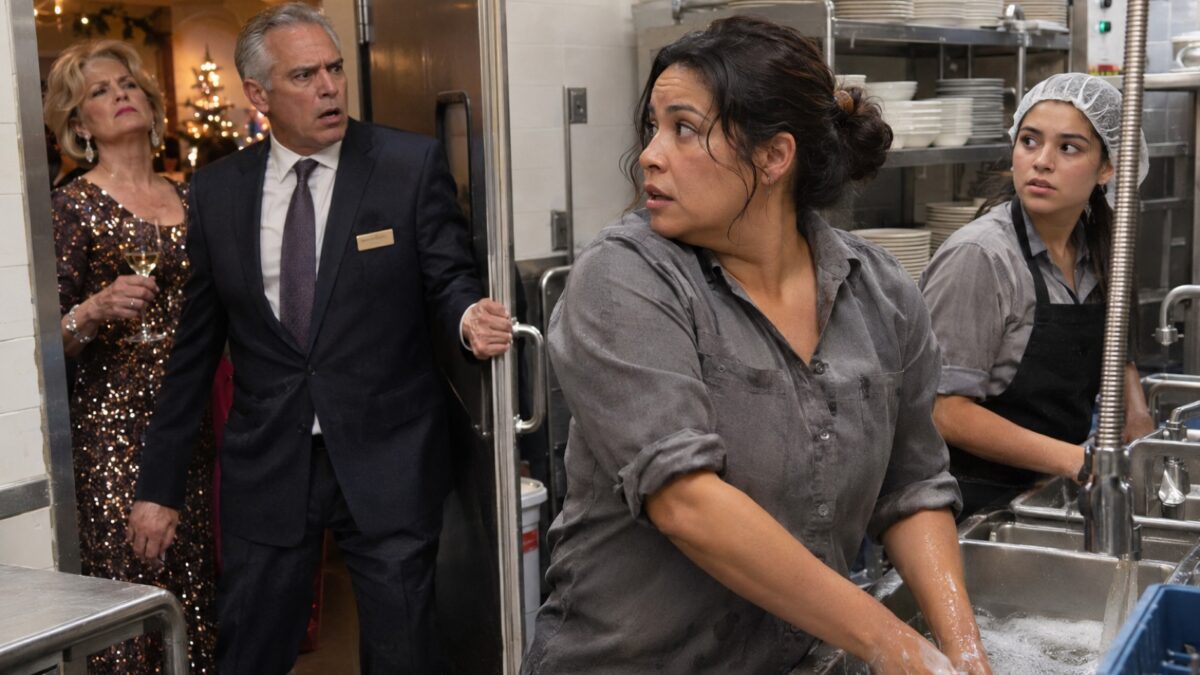
I turned off the faucet before I answered him.
Water dripped from my fingers into the steel basin.
“Helping Ana,” I said.
Robert looked at the plates, then at the blue shirt I had rolled above my elbows.
“Were you asked to work?”
Ana went still beside me.
She had been reaching for another rack, and now she held it halfway off the counter.
“I didn’t ask her,” she said quickly.
“I know,” I told her.
Robert stepped closer so the cooks at the prep table wouldn’t hear every word.
“Are you all right?”
It was such an ordinary question.
That almost undid me.
“I’m not hurt.”
“That wasn’t what I asked.”
I looked down at the water spotting the toes of my shoes.
For one foolish second, I wanted to tell him everything.
Not because he could fix it.
Because somebody had finally noticed there was something to ask.
His radio crackled before I could answer.
A voice reported a guest fall near the east terrace.
Robert pressed the button on his lapel.
“Is medical responding?”
Another burst of static followed.
He listened, his expression tightening.
“I need to check that,” he told me.
“Please stay here for a moment.”
“I’m not going anywhere.”
He looked at Ana.
“Could you get her some water?”
“I already did.”
She pointed at a paper cup on the shelf above the sink.
Robert nodded.
“Thank you.”
Then he went through the door at a fast walk.
Ana watched it swing shut.
“Do you know him?”
“Yes.”
“Like, actually know him?”
“We’ve worked together.”
She set the rack down carefully.
“I hope I didn’t get you in trouble.”
“You didn’t.”
“Because I thought you wanted to help.”
“I did.”
Both things were true.
I had wanted to help, and I had wanted to get away from a room where the people closest to me had made me feel disposable.
Ana handed me the paper cup.
The water was cold enough to hurt my teeth.
I drank half of it anyway.
Through the wall, the band began a Christmas song with a heavy bass line.
The plates on the drying rack trembled faintly with the beat.
My phone buzzed in my back pocket.
Daniel.
Where are you?
I stared at the screen.
He had watched me walk through that door.
I typed, Kitchen.
Three dots appeared, vanished, then appeared again.
Mom was joking.
I put the phone facedown on the shelf.
Ana pulled on a fresh pair of gloves.
“Bad party?”
“Parts of it.”
“My cousin had her wedding here.”
“Was it nice?”
“Beautiful.”
She scraped a plate.
“We’re still paying off the bridesmaid dresses.”
I laughed once, and it came out rough.
She didn’t stare.
She just pushed the next rack into place.
At the ballroom entrance, Linda had looked at my shirt and said Daniel should have told me there would be photographs.
Courtney had asked whether the van outside was mine, then laughed when I said yes.
When Linda handed me the dishes, Daniel had checked the room before he checked my face.
Three little memories.
Nothing anybody could photograph and call a disaster.
But together they made it difficult to breathe normally.
Ana nodded toward the phone.
“You can answer him.”
“I already did.”
“Oh.”
She knew enough not to ask more.
A cook in a black cap came over carrying a roasting pan.
“Behind you.”
We stepped aside.
He lowered the pan into the soaking sink and rubbed his wrist.
“Sorry,” he said.
“Long night.”
“What’s your name?” I asked.
“Luis.”
“Does that wrist need a break?”
“It needs January.”
Ana smiled.
“Luis has been here since ten.”
“So have you,” he said.
“I got here at eleven.”
“Practically a vacation.”
He went back to the line.
I picked up the sprayer again.
Ana reached over and turned the pressure down.
“That setting will soak you.”
“Thank you.”
“You really don’t have to keep doing this.”
“I know.”
I rinsed a platter while she loaded the rack.
She had a system.
Silverware went into a shallow tub before anything reached the machine.
Small plates fit in the back slots.
The chipped white bowl by the faucet held broken pieces until a supervisor could dispose of them safely.
I watched her hands and copied the order.
“What are you studying?” I asked.
“Accounting, if I can get the classes.”
“What’s getting in the way?”
“Work schedule.”
She checked the machine’s temperature display.
“And the classes that fill before my registration appointment.”
“Which college?”
“Phoenix College.”
“Do you like it?”
“I like knowing there’s an answer.”
“To accounting?”
“To the homework.”
She gave me a small smile.
“You do it right, the numbers match.”
I glanced toward the service door.
“That sounds nice tonight.”
My phone started ringing.
Daniel’s name filled the screen.
I let it stop.
A moment later, the door opened.
He came in holding a short glass with a lime wedge pressed against the ice.
“There you are.”
Ana moved toward the far end of the station.
I stayed where I was.
“You knew where I was.”
“I didn’t think you’d actually be washing dishes.”
“Your mother handed them to me.”
“She was trying to clear the table.”
“There were servers in the room.”
He glanced at Ana.
“Can we talk somewhere private?”
“You can talk here.”
“Marisol.”
He said my name the way people say careful when someone is carrying a full cup.
I dried my hands on a towel.
“What did you want to say?”
He shifted the glass from one hand to the other.
“Mom can be awkward.”
“No.”
“What?”
“She wasn’t awkward.”
He looked toward the door.
“Could we not turn this into a whole thing tonight?”
I folded the towel in half.
I had spent a year making room for his mother’s little comments.
When she asked whether my parents had gone to college, I had answered politely.
When she suggested Daniel needed somebody who could “keep up socially,” I had asked if she wanted more coffee.
Every time I let it go, she pushed a little further.
“What would you have said if someone handed Courtney those plates?” I asked.
“That’s different.”
“How?”
He opened his mouth.
Then he took a sip of his drink.
Ana closed the machine door harder than she needed to.
Daniel noticed.
“Look,” he said, lowering his voice.
“People heard Mom, and now people are noticing you’re gone.”
“Did anyone ask why?”
“Courtney said you might have gotten upset.”
“Did you tell her I had a reason?”
He rubbed the back of his neck.
“I’m trying to have a nice night with you.”
I looked at the glass in his hand.
He had come looking for me without even setting down his drink.
“I wanted that, too.”
“Then come back out.”
“Have you asked your mother to apologize?”
“She didn’t mean it the way you took it.”
“That wasn’t my question.”
His expression changed.
Not anger exactly.
Impatience.
He wasn’t used to reaching the end of my willingness to make things easier for him.
“You know how she is,” he said.
“Yes.”
For once, I let that be the entire answer.
A woman named Patrice pushed through with a tray, dropped a fresh apron at Ana’s station, asked whether I needed one, too, and called Ana over to the prep line.
She hesitated before leaving us.
I gave her a small nod.
Daniel leaned closer.
“Please don’t embarrass me at work.”
The kitchen kept moving around us.
A cart wheel squeaked.
A printer spat another order near the hot line.
I could hear water running at the handwashing sink.
“Go back to your party,” I said.
“You’re coming?”
“Not with you right now.”
He waited for me to soften it.
I didn’t.
Finally, he set his glass on a shelf beside a stack of clean bowls.
Ana returned just as he turned toward the door.
“Sir,” she said.
He stopped.
“Your glass can’t stay there.”
He looked at it as if he had never seen it before.
Then he picked it up.
When he was gone, Ana adjusted the bowls he had nudged out of place.
“I’m sorry,” I told her.
“For what?”
“Having that conversation at your station.”
She shrugged, but not carelessly.
“People have worse conversations back here.”
“That doesn’t make it fair to you.”
“No,” she said.
“It doesn’t.”
I liked her for that.
She didn’t rush to comfort me by pretending none of it mattered.
I lifted the towel and laid it across my shoulder.
The fabric was warm from the room.
Robert came back through the service door with his radio turned low.
“The guest is being checked by paramedics,” he said.
“Her husband is with her.”
“I hope she’s all right.”
“So do I.”
He glanced at the station, then at Ana.
“Thank you for looking after our guest.”
“She helped me,” Ana said.
“I noticed.”
I reached for my phone.
There were two new messages.
One from Daniel.
One from a number I recognized from work.
I opened the work message first.
Everything on our end was ready.
Of course it was.
People had done their jobs while I stood there hoping my boyfriend would do the simplest part of his.
Robert checked his watch.
“Do you need a few minutes to change?”
“I didn’t bring anything else.”
“That’s perfectly fine.”
He said it without looking at the stain on my cuff.
“Would you prefer a quiet room first?”
I thought about sitting alone under a fluorescent light, waiting until my face looked agreeable again.
“No.”
“Are you sure?”
“I need to wash my hands.”
He stepped aside.
I used the handwashing sink, worked the soap between my fingers, and rinsed until the water ran clear.
Ana held out paper towels.
“Your sleeve,” she said.
I had missed a damp fold near my elbow.
She helped me straighten it.
Such a small thing.
It steadied me more than anything Daniel had said.
Robert waited until I had dried my hands.
Then he looked toward the ballroom door.
“That’s actually why I came back here looking for you, Ms. Vega,” he said.
“The contract renewal is being signed onstage at nine.”
For a moment, I smelled hot cotton instead of dish soap.
I was eight again, standing on an overturned milk crate at the laundromat on McDowell Road.
My mother had given me the pillowcases.
They were the only things I could fold without dragging a corner across the floor.
“Match the seams, Marisol.”
I pulled the fabric straight.
“Like this?”
“Exactly like that.”
The dryers made the windows sweat during the monsoon season.
In winter, customers stood near them to warm their hands.
My mother knew who needed quarters for the parking meter and who would come back Friday with the rest of the money.
She also knew who kept leaving lipstick in shirt pockets.
Those people got a firm reminder.
Kindness never meant she stopped keeping track.
After school, I did homework at the little laminate table beside the change machine.
When I finished, I helped.
Sheets were harder than pillowcases.
My mother took one end, and I took the other.
We walked toward each other until the corners met.
“Don’t fight it,” she would say when I twisted the fabric.
“Find the edge first.”
At fourteen, I could fold a fitted sheet neatly enough that customers asked which of us had done it.
At seventeen, I knew why a machine could be busy all day and still lose money.
Water cost money.
Gas cost money.
Repairs cost money.
A dryer sitting empty with a broken belt cost money every hour somebody waited for a part.
I didn’t learn business from a family friend with an office.
I learned it from my mother’s penciled figures and the laundromat owner arguing with the repairman beside an open machine.
I went to work in commercial laundry after high school.
Hotels sent their sheets out in enormous wheeled carts.
Restaurants sent aprons stiff with grease.
Medical offices sent uniforms that needed more than a quick wash and a hopeful look.
I learned the routes first.
Then scheduling.
Then purchasing.
I learned to read a maintenance invoice before approving it.
I learned which promises a plant could keep and which ones would leave the night shift carrying somebody else’s mistake.
At twenty-six, I found a small industrial laundry whose owner wanted to retire.
The roof needed work.
Two machines were older than I was.
The customer list was worth saving.
I applied for an SBA-backed loan.
The lender wanted tax returns, projections, purchase documents, and explanations for numbers I had already explained twice.
I brought another binder.
Then another corrected page.
I used my savings for the down payment.
My mother offered the money she had put aside for a replacement car.
I told her no.
She brought dinner instead.
The loan closed on a Thursday.
On Friday morning, I unlocked my first plant before sunrise.
I stood inside with the lights still off and listened.
One dripping faucet.
Traffic outside.
A building full of equipment that was now my responsibility.
My mother arrived carrying breakfast burritos in foil.
“Are you scared?” she asked.
“Yes.”
“Good.”
I looked at her.
“It means you read the papers.”
I laughed so hard I had to put down my keys.
Desert Bloom Linen & Uniform grew slowly at first.
I kept customers by answering the phone and fixing problems before making excuses.
When we could afford another route, we added one.
When a second plant became possible, I read every inspection report.
By thirty-four, I owned six industrial laundries.
They washed every sheet, towel, and uniform for the Sonoran Crest Resort group.
I still drove a work van.
Sometimes I delivered an emergency order myself.
Sometimes I worked beside a maintenance technician until we found the reason a line kept stopping.
None of that had seemed like a secret I was keeping from Daniel.
He knew I ran a laundry, though he had never once asked which hotels we served.
He knew my hours.
He knew I signed checks and took calls when trucks were late.
He called it “your laundry job.”
I had stopped correcting the phrase because I thought he understood the work mattered to me.
Standing in the resort kitchen, I finally wondered what he had understood at all.
“Onstage?” I asked Robert.
“The program has a short presentation before the signing.”
“I thought we were handling the paperwork after dinner.”
“That was the original arrangement.”
He frowned slightly.
“My office sent the revised schedule Tuesday.”
“I was covering an equipment failure Tuesday.”
“We should have confirmed with you directly.”
He didn’t blame an assistant.
I appreciated that.
“How much time do we have?”
“Enough.”
Ana looked between us.
She wasn’t pretending not to listen now.
“You have to go onstage?”
“Apparently.”
“With the towel?”
I reached for my shoulder.
“Oh.”
She smiled.
For the first time that evening, I smiled without having to work at it.
“I’ll bring it back,” I said.
“We have more.”
“I know.”
I left it where it was.
I wasn’t making a statement.
I simply needed something familiar against my shoulder while I walked back into that room.
Robert held the service door.
Before I followed him, I turned to Ana.
“Will you still be here later?”
“Until midnight.”
“Then I’ll see you.”
She nodded, and I stepped into the corridor.
The sound changed immediately.
The kitchen noise dropped behind us.
Ahead, I heard laughter, glassware, and an announcer testing a microphone.
A server passed carrying a tray of empty champagne flutes.
Robert moved aside to give her room.
“Do you want to tell me what happened?” he asked.
“Not before your program.”
“If a member of my staff treated you badly—”
“They didn’t.”
I stopped walking long enough to make sure he heard that.
“Your kitchen staff were kind to me.”
“All right.”
“I’d like that understood.”
“It is.”
We continued past a storage alcove stacked with folding tables.
At the end of the corridor, a brass-framed mirror hung beside the ballroom entrance.
My hair had loosened around my face.
There was a pale mark on my cheek where I had wiped it with a damp hand.
I rubbed it away.
Robert waited without checking his watch.
That courtesy nearly made me angry again.
A busy man responsible for an entire resort could give me thirty seconds.
My boyfriend had wanted me to hurry up and stop being upset.
“Ready?” Robert asked.
“Yes.”
He opened the ballroom door.
Cold air touched my forearms.
A singer near the dance floor was finishing a song.
Beyond her, white lights covered the windows overlooking the dark golf course.
I recognized our table immediately.
Linda sat with one ankle crossed over the other.
Courtney leaned toward her, phone in hand.
Daniel stood behind an empty chair.
My empty chair.
Linda saw us first.
Her eyes moved from me to Robert.
Then to the towel.
She rose just enough to catch his attention.
“Oh, Mr. Hale.”
Robert stopped.
“Mrs. Whitaker.”
“I hope there hasn’t been a problem.”
“There hasn’t.”
Linda gave me a practiced little smile.
“Good.”
Then she lowered her voice without lowering it enough.
“I’m sure she didn’t realize guests couldn’t wander around the service areas.”
I watched Robert’s expression settle.
“Ms. Vega was with our staff.”
“Of course.”
Linda touched the back of her chair.
“If you need to escort her somewhere, please don’t let us hold things up.”
Courtney looked down at her phone.
Her shoulders moved with a small laugh.
Daniel took a step toward me.
“Marisol, I’ve been trying to reach you.”
“I saw.”
“What’s going on?”
“Mr. Hale and I have something to take care of.”
He looked at Robert.
Daniel looked from Robert to me, plainly unsure which of us he needed to please.
“Is this about what happened earlier?”
Robert glanced at me.
I answered before he could.
“Not everything tonight is about your mother.”
Linda’s smile disappeared.
I hadn’t raised my voice.
There was nothing for her to call a scene.
Robert gestured toward the far side of the ballroom.
“We have a place ready for you.”
I followed him.
Behind us, Linda said something too softly for me to hear.
I didn’t turn around to catch it.
Near the stage, a woman wearing a headset stood beside a small table.
A leather document folder lay open beneath a reading lamp.
“This is Elise from our events team,” Robert said.
She shook my hand.
“Thank you for being flexible, Ms. Vega.”
“I’m catching up.”
“That’s our fault.”
She checked a printed schedule.
“We’ll keep the introduction brief.”
An attorney I knew from earlier meetings came over and handed me a marked copy of the signature pages.
“We have the final version,” he said.
“No changes from the approved draft.”
I checked anyway.
The names were right.
The dates were right.
The attachments were listed correctly.
A room full of people could wait two more minutes.
“Take your time,” he said.
I found the provision I had asked them to clarify during negotiations.
It was there.
Then I checked the service requirements one more time.
Six plants would have to keep those promises.
So would I.
Across the room, Daniel had started toward us.
Linda caught his sleeve.
He stopped beside her chair.
I looked back at the paperwork.
“Everything appears in order,” I said.
The attorney nodded and took the review copy.
Elise offered to hold my towel.
I slid it from my shoulder and folded it once before handing it over.
“Thank you.”
“Of course.”
Robert leaned closer.
“There’s still time to move the signing offstage if you’d prefer.”
I looked at the ballroom.
The servers were clearing the last appetizer plates.
Someone at a nearby table was showing a photograph of a new grandbaby.
A man in a red tie was carefully cutting a roll for his wife, whose hand was in a brace.
There were good people in that room.
I wasn’t going to let one table chase me back into the kitchen.
“We can do it as planned,” I said.
Robert gave a small nod.
The band finished.
Applause moved across the room.
Elise touched her headset and listened.
Then she guided me to a spot just beside the stage steps.
From there, I could see Linda’s table.
I kept my eyes on the microphone instead.
The master of ceremonies stepped into the light with a folded card.
He thanked the kitchen and banquet teams.
I clapped.
Robert did, too.
Then the man at the microphone glanced down at his card.
“Our next guest has been an important part of keeping Sonoran Crest ready for every arrival, every banquet, and every busy season.”
A spotlight shifted across the floor.
I rested my hand on the stair rail.
“Please welcome the owner of Desert Bloom Linen & Uniform.”
The light landed on me.
The first thing I saw was Daniel’s hand falling away from the back of his mother’s chair.
Linda stayed seated.
Her mouth opened slightly, as if somebody had called the wrong name and she was waiting for the correction.
Courtney’s phone lowered into her lap.
Neither of them was laughing now.
Robert stepped forward and offered his hand at the bottom of the stairs.
I didn’t need help climbing them.
I took it anyway.
The stage had three steps, a small table, and two chairs angled toward the ballroom.
Nothing about it should have frightened me.
I had sat across from lenders who could decide whether I got to keep a building.
I had answered calls about broken water mains before sunrise.
Still, my fingers tightened around the railing.
People could see me now.
Not the version of me Linda had introduced.
Me.
The master of ceremonies moved aside.
Robert adjusted the microphone.
“Most of our guests never see the work that gets a room ready,” he said.
“They see a clean bed, fresh towels, and a uniform pressed for the next shift.”
He glanced toward me.
“Our partnership with Desert Bloom makes that possible.”
I looked past the lights.
Daniel was coming toward the stage.
He moved quickly between two tables, smiling now.
That smile hurt more than his silence had.
He had found a reason to be pleased with me.
Unfortunately, I could see exactly when it happened.
Robert continued.
“Tonight, we’re renewing that partnership for another five years.”
The attorney placed the folder in front of me.
I sat.
The clock above the ballroom doors read nine.
My name was printed beneath the signature line.
Marisol Vega.
Owner.
I had seen those words on hundreds of documents.
That night, I let myself look at them for an extra second.
Robert sat beside me.
“For a total contract value of nine point two million dollars,” he said.
Applause started near the front.
Then it spread.
I saw Linda put both hands flat on the table.
Courtney turned toward her.
Whatever she said didn’t reach the stage.
Linda didn’t answer.
Linda’s face had gone the color of the tablecloth, and Courtney slowly set her wineglass down without drinking. At the next table, a woman who had watched Linda hand me those plates turned in her chair and looked straight at her.
I uncapped the pen.
The number mattered.
It meant work we could schedule.
Equipment we could maintain properly instead of patching until the next billing cycle.
It meant that when my employees asked whether we expected steady hours, I could answer honestly.
It wasn’t nine million dollars going into my checking account.
It was five years of promises with my name beneath them.
I signed.
Robert signed after me.
The attorney checked both pages before turning the folder for a photograph.
I appreciated him more for doing that than for anything ceremonial.
A photographer asked us to hold still.
I smiled.
For the first time all evening, nobody had to tell me how.
Robert rose and offered me the microphone.
“We’d love a few words.”
I stood with the pen still in my hand.
“Thank you for trusting us with another five years.”
My voice sounded steadier through the speakers than it felt inside my chest.
“Desert Bloom has six plants, and every one of them depends on people who notice things.”
I looked at the kitchen doors.
“A loose button.”
“A stain that needs another treatment.”
“A delivery count that doesn’t match the order.”
I set the pen on the table.
“Those things matter to the person who opens the package.”
A few people nodded.
“I also wanted to thank some people working here tonight.”
Robert turned slightly toward me.
“Ana, at the dish station.”
“Luis, on the line.”
“And Patrice, who has been moving hot trays through those doors without stopping.”
I had read Patrice’s name tag when she brought Ana a fresh apron.
She had asked whether I needed one, too.
No fuss.
No judgment.
Just another person she thought might need something.
“They made room for me tonight,” I said.
“I appreciated it.”
Robert started clapping.
This time, the applause reached the kitchen doors before it reached Linda’s table.
One of the servers smiled at me.
Then the photographer asked for another picture, and the program moved on.
That was the strange part.
Something enormous had happened inside me.
Outside, somebody still needed to announce dessert.
At the bottom of the stairs, Elise handed back my folded towel.
“I can send this to the kitchen,” she said.
“I’ll take it.”
Daniel reached us before I could move away.
“Marisol.”
His smile was too wide.
He opened his arms.
“There’s my girl.”
I stepped back.
Not far.
Far enough.
His hands hung in the space between us.
Then he lowered them.
“Come on,” he said softly.
“People are looking.”
“They were looking earlier.”
His eyes flicked toward Elise.
She checked her headset and gave us a little room.
“I didn’t know,” he said.
“I can see that.”
“You own the whole company?”
“Yes.”
“All six locations?”
“Yes.”
He looked toward the signed folder the attorney was carrying away.
“Nine point two million.”
“Over five years.”
“Still.”
I waited.
He seemed to be searching for the right expression.
Pride.
Amazement.
Something that would make us look like the couple he wanted everyone to think we were.
“You’re incredible,” he said.
“I worked fourteen hours today.”
“I know.”
“You told me not to turn this into a whole thing.”
“That’s not what I meant.”
Before he could explain what he had meant, Linda arrived.
Courtney stayed half a step behind her.
“Marisol,” Linda said.
There was a new care in the way she pronounced my name.
“Why didn’t you say something?”
“About what?”
“Well.”
She glanced at the stage.
“All this.”
“Robert handled the introduction.”
Courtney made a small sound that might have been a laugh if anyone had joined her.
Nobody did.
Linda clasped her hands.
“You must think we’re all terribly surprised.”
“You look surprised.”
“Daniel told us so little.”
I looked at him.
He studied the towel in my hands.
Linda reached toward my arm.
I moved the towel before she could touch me.
“We should get a photograph,” she said.
“The whole family.”
“I need to return this.”
“Surely someone can take a towel for you.”
“I told Ana I’d come back.”
Her expression tightened.
Only for a second.
But I knew that expression.
It was the one she wore when a server brought the wrong sparkling water.
“Well, don’t disappear again.”
I let the sentence sit between us.
Then I walked away.
Nobody followed me through the service door.
Ana was emptying the silverware tub when I came in.
She looked up.
“Nine million?”
“Not tonight.”
She laughed.
Then she covered her mouth with her wrist.
“Sorry.”
“Don’t be.”
I handed her the towel.
“You brought it back.”
“I said I would.”
Luis leaned around the end of the prep table.
“You said my name.”
“I hope that was all right.”
“My wife’s out there.”
“Then I’m glad I did.”
He nodded once and returned to his station.
Ana wiped her hands.
“So you’re not getting fired from your laundry job?”
“Probably not.”
“That’s good.”
Her face stayed serious for half a second before we both laughed.
It felt different from the laughter at Linda’s table.
There was room for both of us in it.
“Did I make things awkward by mentioning you?” I asked.
“No.”
“Tell me if I did.”
She leaned closer.
“The banquet captain said good job.”
“You were doing a good job before anybody said it.”
“I know.”
I liked that answer.
Robert appeared in the doorway.
“Ana, your supervisor will cover your station for ten minutes.”
She looked alarmed.
“Why?”
“So you can eat something while it’s still hot.”
“Oh.”
He nodded toward the employee meal area.
“Luis, too, when the line can spare him.”
He wasn’t offering her a prize for being kind to an important person.
He was giving a tired employee a break.
Ana untied her apron before he could change his mind.
I thanked them again and went into the corridor.
Daniel waited near the brass-framed mirror.
He had finally put down his drink.
“Can we talk now?”
I glanced toward the ballroom.
“I’m not going back to the table.”
“Fine.”
We walked toward a small sitting area near the conference rooms.
Two armchairs faced a display of resort brochures.
A holiday centerpiece stood between them with a price card still tucked under its base.
Neither of us sat.
“My mother wants to apologize,” he said.
“She had a chance.”
“She was caught off guard.”
“So was I when she handed me dirty plates.”
He exhaled.
“I know tonight wasn’t great.”
“Tonight was very clear.”
“Can you stop doing that?”
“Doing what?”
“Making everything I say sound worse.”
“I’m repeating what happened.”
He rubbed both hands over his face.
For a moment, he looked tired enough that I remembered why I had loved him.
The Saturday he had driven across Phoenix to bring me cold medicine.
The way he remembered how I took my coffee.
Those things had happened, too.
They didn’t disappear because he had failed me.
That made the conversation harder.
Not easier.
“I’m trying to understand,” he said.
“Then ask me something that isn’t about the company.”
He looked at me.
I waited.
The hallway speakers played a soft instrumental version of a Christmas song.
Somewhere behind us, a door latch clicked.
“Were you embarrassed?” he asked finally.
“Yes.”
He swallowed.
“Because of Mom?”
“Because you watched.”
His eyes dropped.
“I didn’t think you wanted a scene.”
“I wanted you to stand beside me.”
“I would have.”
“You didn’t.”
He looked toward the ballroom, where his mother was waiting.
Then he looked back at me.
“You should have told me who you were.”
“You should have known who I was.”
He didn’t answer me that night.
He reached for my hand instead.
I kept it at my side.
“Let me drive you home,” he said.
“My van’s here.”
“I can follow you.”
“No.”
He nodded as if I had asked him to give me the evening.
I hadn’t decided what I was asking for yet.
Outside, the Scottsdale air felt cold against my damp cuff.
I sat in the van without starting it.
There was a delivery receipt on the passenger seat.
A pair of work gloves lay beneath it.
I moved both to the floor and put my purse down.
Then I called my mother.
“Are you home?” I asked.
“Almost.”
“From where?”
“The store.”
“At this hour?”
“Eggs were cheaper.”
I closed my eyes.
She waited.
“How was the party?”
“I signed the renewal.”
“That’s good, mija.”
Then she asked the question nobody in Daniel’s family had thought to ask.
“Did you eat?”
I laughed, and that turned into something else.
My mother stayed on the phone until I could speak again.
By Monday morning, Linda had found my business email.
The subject line was A Little Misunderstanding.
I opened it at my desk with a maintenance report beside my keyboard.
She wrote that the ballroom had been loud.
She wrote that she had assumed I was helping the banquet staff because I was carrying plates.
She wrote that she would never intentionally make a guest feel unwelcome.
The message did not mention who had put the plates in my hands.
It ended with an invitation to brunch.
Just us girls.
I read it twice.
Then I went back to the maintenance report.
A dryer bearing wasn’t going to improve because I was upset.
At ten, our plant manager, Everett, brought in the weekly overtime sheet.
“You all right?” he asked.
“Yes.”
He waited.
“Personal problem.”
“Anything we need to know?”
“No.”
“All right.”
He set down the sheet.
“Line three needs the service appointment moved up.”
We talked about that instead.
It helped.
There were problems I could solve by approving a purchase order.
That week, Daniel sent flowers to the main plant.
The arrangement came in a glass vase too large for the reception counter.
Our office coordinator, Nessa, carried it into my office with both arms.
“Do you want these up front?”
“Let’s put them in the break room.”
She read my face, not the card.
“Okay.”
The card said he was proud of me.
I put it in a drawer.
That evening, I called him.
“Please don’t send anything else to work.”
“I was trying to do something nice.”
“I know.”
“Did you like them?”
“They were beautiful.”
“But?”
“I asked for time, Daniel.”
“I’m giving you time.”
“Then let it be time.”
For three days, he did.
Linda was less patient.
She left a voicemail saying she hated the thought of awkwardness between us.
Then she invited me to a restaurant near Fashion Square where brunch cost more than my mother spent on a week of groceries.
I declined.
She suggested another Sunday.
I declined that one, too.
On Thursday, Courtney sent me a connection request through a business networking site.
I left it unanswered.
That afternoon, Linda called while I was reviewing a uniform inventory shortage.
I let it go to voicemail.
Her message began brightly.
“Just checking on you, sweetheart.”
Then it moved to Courtney.
She was ready for a change.
She had wonderful people skills.
Linda wondered whether a growing company might need someone in client relations.
“No pressure, of course,” she said.
I listened to the message once.
Then I forwarded our careers page to Linda with one sentence.
All open positions and application requirements are listed here.
She replied within four minutes.
I meant something you could discuss personally.
I didn’t answer.
The next morning, Nessa asked whether we were expecting an applicant named Courtney Whitaker.
“No.”
“She called asking who handles executive placements.”
“We don’t have an opening.”
“That’s what I told her.”
“Thank you.”
Nessa shifted the folder against her chest.
“Is there anything special we should do if she calls again?”
“Treat her like anybody else.”
She nodded.
That mattered to me.
Nessa had enough to do without my love life landing on her desk.
Daniel came to see me the following Saturday.
Not at the plant.
I agreed to meet him at a coffee shop halfway between our homes.
He arrived early.
There were two cups on the table.
Mine had the right amount of cream.
For a second, that small kindness nearly made everything more confusing.
He stood when I approached.
“Thank you for coming.”
I sat across from him.
He didn’t try to kiss me.
“I talked to Mom.”
“What did you say?”
“That what she did was wrong.”
“And?”
“She said she thought you understood her sense of humor.”
I looked down at my coffee.
“I told her that wasn’t an apology,” he added.
That surprised me.
He saw it.
“I can say things to her.”
“You can.”
“I just don’t always.”
Outside the window, a father lifted a little boy out of a pickup.
The boy’s jacket caught on the seat belt.
His father stopped and freed it before setting him down.
I watched until the boy’s sneakers touched the pavement.
Daniel followed my gaze, then looked back at me.
“I was afraid of her,” he said.
I let him finish.
“It sounds ridiculous.”
“It sounds unfinished.”
He pressed his thumbs against the cardboard sleeve around his cup.
“If I disagreed with her, she made everything miserable.”
“How?”
“Calls.”
“Comments.”
“She’d tell Courtney I was choosing someone else over the family.”
“And Courtney would call you.”
He nodded.
“So you learned to let the other person absorb it.”
His face tightened.
“I never thought about it that way.”
“I was the other person.”
“I know that now.”
I believed he was beginning to.
That wasn’t the same as knowing what he would do the next time.
“I can’t go back and change it,” he said.
“No.”
“But I can do better.”
“You have to mean that even if I’m not standing there.”
He looked at me for a long time.
Finally, he nodded.
We finished our coffee.
He asked whether he could call during the week.
I told him one call was fine.
It was not a promise about anything beyond that.
A few days later, I returned to the resort for a scheduled operations meeting.
We reviewed delivery windows, storage counts, and holiday occupancy projections.
Daniel’s name appeared on an event-sales forecast.
I discussed the numbers exactly as I would have before the party.
Afterward, Robert walked me toward the lobby.
“Everything going smoothly on your end?”
“With the service, yes.”
He accepted the boundary.
At the service corridor, I stopped.
“Is Ana working today?”
“I can check.”
“I don’t want her pulled off the clock for a personal favor.”
He nodded toward the employee dining room.
“Afternoon break should be starting.”
I found her at a table with a sandwich wrapped in foil and a textbook beside her tray.
She looked up and smiled.
“No towel today?”
“Not yet.”
“Sit down.”
I asked whether she had managed to get her accounting classes.
“One.”
“What happened to the other?”
“Lab fee, mostly.”
She said it quickly, then took a bite of her sandwich.
“How much?”
“More than I had after the battery in my car died.”
I didn’t take out my wallet.
Something about the speed of her answer told me that would have ended the conversation.
“What do you want to do when you’re finished?”
“Payroll, maybe.”
“Why payroll?”
“My mom used to bring her checks home and count the hours twice.”
“Where did she work?”
“A laundry near the airport.”
I looked at her.
“She worked there?”
“Until her shoulder got bad.”
Ana brushed crumbs into her sandwich wrapper.
“She still checks my pay stubs.”
“Good.”
“You sound like her.”
“I’d probably like her.”
“You would.”
We talked about classes.
About the late bus she took when her car was in the shop.
About how hard it was to accept extra shifts and still be awake enough to study.
I asked whether I could contact her if I had questions about something I was considering for workers’ families.
“What kind of something?”
“Nothing ready to announce.”
She studied me.
Then she wrote her number on the back of an unused receipt.
“Just don’t call during an exam.”
“I won’t.”
On the drive back to the plant, I called our accountant.
I asked questions.
Then I asked for the name of an attorney who handled charitable programs.
I wasn’t ready to promise anything.
I wanted to know what doing it properly would require.
Friday came with a water-pressure problem at one plant and a truck tire that needed replacing at another.
By three, I had forgotten my lunch in the office refrigerator.
My mother called to remind me we were having dinner Sunday.
“Six o’clock,” she said.
“I know.”
“You said that last time.”
“I was twenty minutes late.”
“Your food was twenty minutes older.”
I smiled.
“I’ll be there.”
After we hung up, I went out to the folding floor.
A conveyor sensor had been stopping the line.
Everett wanted me to see the replacement before he approved a second order.
I had just crouched beside the housing when Nessa appeared at the yellow safety line.
She didn’t step onto the floor without her hearing protection.
I stood and walked over.
“Everything okay?”
“There’s someone at reception.”
“Do they have an appointment?”
“No.”
Nessa glanced toward the office windows.
Through the glass, I could see pale pink wrapping and the curved handle of a large basket.
Then Linda stepped into view beside it.
She wore a cream-colored jacket.
A gold bow rested against several jars, a bottle, and a package of crackers.
Her smile appeared the moment she spotted me.
Linda had come to my main plant uninvited, carrying a gift basket.
I stayed on my side of the safety line.
What, exactly, did she think that basket was going to buy?
“Could you tell her I’m on the floor?” I asked.
Nessa nodded.
“Do you want me to ask her to come back?”
“No.”
I looked down at my work shirt.
There was machine grease near the hem.
“Tell her I’ll be ten minutes.”
The replacement sensor still needed checking.
Everett held the flashlight while I looked at the mounting bracket.
We tested the line twice.
Both times, the conveyor stopped where it should.
“Order the second one,” I said.
Only then did I wash my hands and go to reception.
Linda stood when I entered.
“There you are.”
“Hello, Linda.”
“I hope this isn’t a terrible time.”
“I was working.”
She glanced at the basket.
“Just a few things I thought you might enjoy.”
“Thank you, but I can’t accept it.”
Her hand settled on the handle.
“It’s only food.”
“I understand.”
Nessa kept her eyes on her computer.
Linda lowered her voice.
“Could we speak privately?”
“Yes.”
I opened the visitor cabinet.
“First, I’d like to show you where I work.”
“Oh, I don’t need the whole tour.”
“I think it would help.”
She looked through the glass at the moving linen.
Then she put the basket down.
“All right.”
I handed her the visitor sheet.
She signed beside the arrival time.
I gave her hearing protection and a high-visibility vest.
“Stay inside the yellow walkways.”
“I won’t be in anybody’s way.”
“If you need to stop, tell me.”
She struggled with the vest zipper.
I waited.
At the first station, damp sheets rose toward the feeder.
The heat reached us before we got through the door.
Linda stopped.
“Is it always this warm?”
“Warmer in August.”
I introduced her to Everett.
“Our plant manager.”
He nodded politely.
Then I introduced her to Noreen, who had been checking hems when we approached.
Noreen had trained me on a feeder years before I owned one.
“This is Daniel’s mother,” I said.
“Nice to meet you,” Noreen told her.
Linda smiled.
“Marisol speaks so highly of everyone.”
Noreen looked at me.
“She tells us when something’s wrong, too.”
“That’s true,” I said.
We kept walking.
At each station, I waited until there was a safe moment.
I introduced Linda to every person working that shift.
Rosa at the feeder.
Wes beside the ironer.
Janelle checking the folded stacks.
Andre logging the carts.
Malik and June in dispatch.
I gave Linda their names and told her what each person did.
I didn’t tell them why she was there.
They hadn’t come to work to be part of my argument.
By the third introduction, Linda had stopped trying to hurry.
By dispatch, she was using both hands to hold her purse.
An outgoing cart carried wrapped bundles for Sonoran Crest.
“That’s ours,” she said.
“The resort’s,” I said.
“Yes.”
She studied the label.
Sonoran Crest had printed beautifully on the white paper.
Under it were counts somebody had checked by hand.
We stopped beside the office door.
Through the window, I could see Nessa answering the phone.
Linda removed her hearing protection.
“Your employees seem very loyal.”
“We try to give them reasons to stay.”
“I’m sure you do.”
She smoothed the front of her vest.
“I had no idea you had built something like this.”
“You didn’t need to know.”
Her fingers stopped moving.
“You needed to know Daniel had brought someone he cared about.”
“I know the party got off to a bad start.”
“Linda.”
She looked at me.
“You handed me dirty dishes.”
“I thought—”
“You knew I was Daniel’s guest.”
Her mouth tightened.
For a few seconds, the machines did all the talking.
Then she said, “I shouldn’t have done that.”
“No.”
“And Courtney shouldn’t have laughed.”
“You can answer for yourself.”
She looked through the window again.
“I suppose you think we’re terrible people.”
“I think you expected me to accept it.”
“I’ve been trying to make things right.”
“With brunch.”
“I didn’t know what else to do.”
“You could have apologized without explaining why it wasn’t your fault.”
She lowered her eyes.
I let her have the silence.
Finally, she said, “I’m sorry I humiliated you.”
That was the first apology I could recognize.
“Thank you.”
She exhaled.
Then she made the mistake of reaching for familiar ground.
“I only ever wanted Daniel to have someone from a good family.”
I glanced toward the floor.
Rosa lifted a hand to Janelle, asking her to check a corner that had folded under.
Janelle stepped over.
“These are my good family.”
Linda followed my gaze.
“My mother worked in a laundromat,” I said.
“I was proud of her before I owned anything.”
“I didn’t mean your mother.”
“You didn’t ask about her.”
She had no answer for that.
We went into my office.
Linda sat across from me without taking off the vest.
“About Courtney,” she began.
“There isn’t an opening for her.”
“She has experience dealing with people.”
“Our applications go through the same review.”
“Of course.”
“And please ask Courtney not to call Nessa about executive placements again.”
Her cheeks reddened.
“She was only asking.”
“I’m answering.”
She looked at the folder on my desk.
The signed renewal sat inside it, beside the delivery schedule.
“Will this affect Daniel at the resort?”
“No.”
She looked up quickly.
“His job has nothing to do with this conversation.”
“And the contract?”
“We signed it.”
I closed the folder.
“We’ll do the work.”
She sat back.
I hadn’t realized until then how much she had expected me to behave like her.
At reception, she picked up the basket.
I held the door while she carried it to her car.
She didn’t invite me to brunch again.
The next evening, I met Daniel at the same coffee shop.
This time, he waited for me before ordering.
“Mom called,” he said.
“I thought she might.”
“She said you showed her the plant.”
“Yes.”
“She also said you were very direct.”
“I was.”
He almost smiled.
Then he saw that I wasn’t going to.
“Marisol, I’ve been trying.”
“I know.”
“I told her she can’t come to your workplace again.”
“Thank you.”
He leaned forward.
“Could we start with dinner?”
I had practiced an answer in the van.
It still hurt to say it.
“No, Daniel.”
He sat still.
“I love things about you,” I said.
“I’m going to miss them.”
“Then why can’t we work on this?”
“Because I don’t want to spend another year finding out whether you’ll stand beside me.”
“I would now.”
“Keep working on that.”
“With you.”
“No.”
He looked down at his hands.
I waited while he understood.
After a while, he asked, “Is there anything at my place?”
“My blue sweater.”
“I’ll bring it over.”
“Mail it, please.”
He nodded.
“I’m sorry I left you alone that night.”
“I know.”
I touched his hand once before I stood.
Then I left without giving him another possibility to wait for.
The sweater arrived Tuesday.
Inside was a short note.
No request.
No explanation about his mother.
I put it in the drawer with the flower card.
Courtney eventually sent her own apology.
She named the van joke and the laughing.
I thanked her.
I didn’t accept the lunch invitation that followed.
There was no job offer.
There was no call to Robert about Daniel, either.
At our next operations meeting, we discussed cart shortages and delivery times.
Daniel’s sales forecast stayed in the packet.
So did the work.
The scholarship took longer than the breakup.
There were forms.
There was an attorney’s bill.
Our accountant explained why I couldn’t simply write tuition checks from whichever account had money in it.
We set it up through a local community foundation.
I funded it with $25,000 from my personal savings.
The five-year contract helped me plan.
It wasn’t a scholarship fund.
It was payroll, utilities, maintenance, and trucks that needed tires whether I felt generous or not.
The program covered tuition, required fees, books, and approved transportation costs for children of laundry and kitchen workers.
An independent committee reviewed applications.
Recipients didn’t have to work for Desert Bloom.
They didn’t have to promise they ever would.
I called Ana when the forms were ready.
“Is this the thing you were asking about?”
“Yes.”
“Do I qualify if my mom doesn’t work there anymore?”
“Yes.”
“Do I get it because I helped you?”
“No.”
There was a pause.
“You’ll need your transcript,” I said.
“And documentation of your mother’s employment.”
“Oh, good.”
“What?”
“I can do paperwork.”
She was the first person to apply.
Six weeks later, the committee made her the first recipient.
Her award was $3,240.
The foundation paid Phoenix College directly for tuition and fees.
Books and an approved transportation allowance were handled separately.
Ana called me from the campus parking lot.
“I got both classes.”
“That’s wonderful.”
“And I’m not picking up every Sunday anymore.”
I sat down.
I had to hold the phone away from my face for a second.
At the resort, Robert made sure she could keep a consistent schedule around those classes.
Luis finally got the January time off he had been talking about.
His wrist improved with rest and treatment.
Patrice sent me a photograph of the kitchen crew beside a small thank-you card Ana had taped near the break-room notice board.
I printed it for my office.
My mother came to the plant the afternoon the scholarship plaque arrived.
It wasn’t large.
Just the program name: the Carmen Vega Scholarship for Laundry and Kitchen Families.
She read it twice.
“You could have warned me.”
“You would have said not to spend the money.”
“I’m still saying it.”
But she touched the lettering before I hung it up.
Later, we stopped at a table where a small stack of clean sheets needed refolding.
A cart had caught one corner of the wrapping.
My mother set down her purse.
“We can fix these.”
“We have people for that.”
“I know.”
She took one end.
I took the other.
Around us, the afternoon shift kept moving.
Noreen called good night from the doorway.
I called it back.
My mother shook out the sheet, and we stepped toward each other.
The corners met.
Her thumbnail pressed a small, neat crease into the cotton.
THE END








