My daughter-in-law accepted $3,000 to demolish my late husband’s kitchen, then ordered me to sign at her launch—But the proof I carried stopped her deal, and I ended her lease.
Complete story · 9 parts · about 36 minutes · ending included
Part 1 · Part 2 · Part 3 · Part 4 · Part 5 · Part 6 · Part 7 · Part 8 · Part 9
Part 1 of 9
“Tell my followers how long you’ve been making this,” my daughter-in-law said, and pointed her phone at my face.
The clock above the cooler read 3:40 p.m. Wednesday, October 1. Lindsey Neumeyer stood on the customer side of the display case at Neumeyer’s Bake Shop, her camera held level with her eyes.
Between us sat a tray of samples from our butter pound cake, made from my mother’s recipe.
“Forty years,” I said.
“Hear that, guys?” Lindsey turned the camera toward herself. “Forty years. We’re doing an honest taste test today.”
She pinched a square from the tray, held it beside her cheek for the picture, then took a bite. I watched her chew. Lindsey’s eyes narrowed as though she’d found something gritty.
“It tastes like drywall.”
She gave the lens a bright little smile.
“Forty years of family recipe, guys. Drywall.”
I didn’t answer. Forty years, and she’d needed one bite.
Instead I reached beneath the counter, pulled out the receipt book, and uncapped my pen. It was the first of the month.
A customer paused over the cinnamon rolls, watching Lindsey’s phone. I kept my eyes on the page.
Marcy Haas, who’d worked beside me since 2001, looked over from the register.
“Darla, honey,” she said, “you want me to bring out the pickup order?”
“Please. It’s on the back shelf.”
Marcy raised her eyebrows at the filming but stayed at the register.
Lindsey crouched beside Harper, my six-year-old granddaughter. Harper had been studying the samples.
“Come here, baby,” Lindsey said softly.
Then she leaned close to Harper’s ear and whispered. Marcy glanced up from the register as Lindsey cupped a hand beside her mouth. With the mixer running, neither of us heard the words.
Harper looked at me. Her mouth pressed into a line.
“Go on,” Lindsey said, louder now. “Try it for everybody.”
My granddaughter took a small bite. She chewed once, glanced at her mother, and spat the cake into a paper napkin.
Lindsey aimed the lens down until the damp crumbs filled the screen.
“Oh, Harper!” She laughed. “Kids have zero filter, you guys.”
Marcy slipped into the back and returned with the loaves, setting them beside me.
“Fresh out of the oven this morning,” she said.
“That’s why we do honest reviews,” Lindsey replied, still smiling at the camera. “People trust us.”
Harper rubbed both palms against her jeans. I reached for an empty box and slid a sheet of waxed paper into the bottom. My fingers flattened it twice before I could make them leave it alone.
“You can sit by the window, sweetheart,” I told her.
At the small table, Harper opened her sketchbook and grabbed an orange crayon from the cup I’d left for children.
While I packed the order, she drew a pumpkin on the flap of a white envelope. I saw her bend over another page, tear something free, and make a few small folds. Her shoulders hid most of the table. By the time I glanced over again, she was pressing the envelope shut with both thumbs.
Lindsey edited her video, dragging one nail across the screen. She tilted the phone away from the overhead lights to check her face.
“Grandma, do pumpkins have teeth?” Harper called.
“This one does,” I said.
She added a crooked stem.
At a few minutes past four, Lindsey plucked the envelope off Harper’s table, crossed to the register, and held it out between two fingers.
“Here’s your little check, Darla.”
Picking up where the Facebook post left off
The pumpkin’s grin had one tooth higher than the others. I placed the envelope on the counter beside the cash drawer.
“Thank you.”
Taking a butter knife from the utensil cup, I slit one top corner, as I did each month to protect Harper’s drawings, and slid out the check.
$900. The memo read “Rent — Oct” in Lindsey’s handwriting, and her signature sat at the bottom.
“Paid in full,” I said.
I entered the date and amount in the receipt book, tore off the top copy, and placed it beside the envelope. The yellow carbon stayed attached beneath it. Lindsey was already reaching for Harper’s coat.
“We’re going, honey. Say bye.”
“Your receipt,” I said.
“Just keep it, Darla. You love paperwork.”
She didn’t look back as the doorbell rattled.
Harper lagged behind. Before her mother pulled her through the doorway, she pressed one palm against the glass of the cake case and moved her lips toward me. I couldn’t make out a word.
Then she was gone.
Marcy waited until the door closed.
“That kid barely chewed,” she said.
“I saw.”
“And her mother had to film it.”
I tucked the October check into the bank deposit pouch beneath the register, then set the unused receipt back between the pages of the book. The pumpkin envelope went into the inside pocket of my tote, where nothing sticky could touch it. I returned the receipt book to its place under the counter.
“That’s thirty-nine receipts she’s never taken,” I told Marcy.
“And you keep writing them.”
“Every month.”
Marcy eyed the samples.
“Leave them,” I said. “Someone might want one.”
By closing, the last box had been collected and the tray on the counter was empty. I counted the drawer, wiped the case, and climbed upstairs to my apartment at nearly nine. Streetlights glowed along 22nd Avenue.
At my desk, I took the October envelope from my tote and held it beneath the lamp. Beyond the little opening I’d made, a folded sheet lay against the back. Orange crayon marks showed backward through the thin paper. No matter how I angled it, I couldn’t read them.
The sheet was wider than the slit. Getting it out would mean slitting her envelope wide open, and Harper hadn’t said a word to me about a note.
I left the pumpkin whole, the way I’d kept every one she drew. Gary’s metal tin came down from the shelf, and I laid the October envelope on top of the others, crayon side up.
Whatever Harper had folded inside stayed unread.
Part 2 of 9
Before I unlocked the bakery, I slid the lease out from under Gary’s cabinet drawings: one page, both sides, and Lindsey’s name alone on the tenant line.
It was Thursday morning. Gary’s tin sat open on my kitchen table, with the October envelope on top. Harper’s orange pumpkin faced the ceiling. Under it lay thirty-eight older rent envelopes, stacked by month, and beneath those, the drawings Gary had kept folded in half.
Yesterday Lindsey had held a phone inches from my face, insulted my mother’s pound cake, and called her rent payment my “little check.”
This morning I wanted to see the words she’d signed.
In the corner of one drawing, Gary had written “for D.” in pencil. His carpenter’s lettering was so square I could still picture his thumb braced against the ruler.
In 2004 he’d built the maple cabinets for our kitchen on Birch Road, measuring each door himself. After he died in 2021, I couldn’t stand to see his coffee mug beside an empty chair. When I moved into the apartment above the bakery in summer 2022, I left the three-bedroom house for Seth’s family.
I turned the lease over.
August 1, 2022. Month to month. Nine hundred dollars a month.
Lindsey Neumeyer had signed as tenant. My name appeared on the landlord line. Seth, my son, had been away on a long-haul delivery route that week, so she had handled the paperwork herself.
On the reverse, clause 9 read: “no alterations without Landlord’s written consent.”
I rested a finger beneath that line until the paper stopped curling.
Then I tucked the lease under the cabinet drawings, laid the thirty-eight envelopes back over them, and returned the October envelope to its place above the stack. The lid snapped shut. I carried Gary’s tin to the shelf before heading downstairs.
At seven, Seth stood at the bakery counter with a paper cup of coffee. His delivery jacket was zipped to his throat, and he kept studying the lid as if it might give him an answer.
“Morning,” I said.
He took a swallow.
“Linds is building something, Mom. Don’t make it weird.”
“The bakery’s open. What am I making weird?”
“She has followers. She’s worked hard for them.”
“I know she has a phone.”
“Please don’t start.”
I set a fresh tray of rolls in the case. Seth moved aside for it, still avoiding my face.
“If her followers come into the bakery,” he said, “you’ll just smile, okay?”
“Customers get a smile.”
“You know what I mean.”
“Tell me.”
He rubbed his thumb around the cardboard rim.
“Can you please do this for me, Mom?”
Beside me, Marcy reached for the price tags.
“Do what, exactly?” she asked.
Seth finally glanced up, then toward the door.
“I have to get to work.”
He dropped the cup, still half full, in the trash and went out without taking a roll.
Marcy watched the glass swing shut.
“Well, that was a warm visit.”
“He had an early route.”
“Darla, honey, I didn’t ask about his route.”
She set the tags down and went to lift the next baking sheet. I straightened the paper beneath the rolls, though it was already lying flat.
Friday at 7:10 p.m., my phone buzzed on the table upstairs.
Lindsey had sent a message.
“I’m thinking of redoing the kitchen. those cabinets are so dated.”
A little photograph of Harper was beside her name. My granddaughter wore a paper crown she’d made at school, its points leaning sideways.
I typed: “Not Gary’s cabinets. The lease says ask first, and I’m saying no.”
Three dots appeared. Vanished. Came back.
Lindsey replied: “Fine, landlord.”
I saved the exchange and set the phone beside my supper plate. The kitchen across town had Gary’s work in every drawer and hinge. Lindsey could dislike its color. She couldn’t take a saw to it.
Saturday morning, I was kneading dough in the bakery’s back kitchen when my phone rang against a flour sack.
Lindsey.
I wiped one hand on my apron and answered.
“Hello.”
“Stay out of my content, Darla, or you’ll be in it.”
“Lindsey, what content?”
The call ended.
For a moment the dough sat under my other palm, warm and springy. I covered it with a towel before washing my hands.
Later, a woman who bought a slice of the pound cake most Saturdays approached the counter. She kept her purse tucked close against her coat.
“Is it true about the cake?” she asked quietly.
“What about it?”
“Oh.” She studied the display. “Never mind. I’ll take the bread today.”
“Did someone tell you something?”
“Don’t worry about it, Darla.”
She chose a loaf and left without looking at the pound cake.
Another regular came in before lunch, a man who usually took a piece home with his coffee. He lowered his voice when he reached me.
“Is it true about the cake?”
“I’d like to know what you’ve heard.”
He shook his head.
“Just a loaf of bread, please.”
I wrapped it and passed him the bag. He paid, thanked me, and hurried out.
I had no social media account. Lindsey had filmed in front of me Wednesday, but I hadn’t seen anything afterward. Neither customer would say where the question came from.
Marcy stood at the end of the counter, holding the knife she’d used to slice the bread.
“That was strange,” she said.
“Both of them.”
“You want me to ask around?”
“No. Let them shop.”
On Monday, October 6, at six in the evening, I picked up my phone and texted Lindsey.
“I’ll be at the house tomorrow at 10 to change the furnace filter, like every October.”
Her answer came back: “k.”
Then another message lit the screen.
“Don’t touch anything in MY kitchen.”
Part 3 of 9
There was blue painter’s tape on every one of Gary’s cabinets, and every strip said DEMO in black marker.
At ten Tuesday morning, Lindsey stood between the stove and sink at the house on Birch Road, holding her phone at face level.
“Okay, guys, welcome to the before tour,” she said. “You can see what we’re working with, and this sad little kitchen is about to be gone.”
She swept the camera past the maple doors Gary had fitted by hand. Blue strips crossed their grain like somebody had started measuring for a demolition crew.
On the counter sat a box labeled Larkmoor Home. Sample packets stuck out of the open top.
Lindsey caught sight of me in the doorway and lowered her phone.
“It’s our house. Our call.”
“The filter’s in the hallway furnace,” I said.
“I know where it is, Darla.”
“I brought a replacement.”
“Then do what you came for. I’m filming.”
She started recording again before I reached the hall.
The furnace panel was low enough that I had to kneel on the runner to open it. The old filter came free with a gray fringe of dust around the edges. I checked the arrow on the new one, slid it into the slot, and secured the cover.
A little dirt had fallen onto the floor. I slipped the used one into the cardboard sleeve the replacement had come in and leaned it against the wall.
The cleaning bucket was beneath the kitchen sink, where it had always been.
Lindsey was filming the stove when I came back. She spoke in the cheerful voice she used for strangers.
“Just imagine it all bright and clean. Nothing like this.”
I crouched and opened the cabinet under the sink.
Inside the door, just above the hinge, were pencil marks I hadn’t seen in years.
G.N. 2004 — for D.
Gary’s note.
It matched the “for D.” in the corner of Gary’s drawing, the one I’d looked at Thursday morning. He’d marked the doors after he hung them, while I was still using a folding chair to reach the upper shelves.
My finger rested over the last letter.
“Are you finished?” Lindsey asked.
I pulled the bucket free and stood.
“The cabinets stay.”
She lifted her eyebrows. “Darla, I’m in the middle of something.”
I ran an inch of water into it, wiped the dust from the hallway floor, then emptied it and put it back where it belonged. The blue tape remained exactly where she’d stuck it.
On my way out, the sleeve with the dirty filter went into the outdoor trash bin. I carried my cleaning cloth back to the car and drove to the bakery.
At two that afternoon, Marcy brought her phone to the small table behind the counter.
“My niece sent me a link this morning,” she said. “She asked if this was our shop.”
I sat opposite her. “What did you tell her?”
“That I’d look.”
She tapped the glass and turned it toward me.
There was my display case. There was Lindsey’s face, smiling at forty thousand followers on @lindseymakeshome. Under her name, the posting date said October 2.
For the first time, I watched what she’d recorded.
“It tastes like drywall.”
Lindsey laughed into the camera.
“Forty years of family recipe, guys. Drywall.”
My granddaughter took a bite of the pound cake, glanced at her mother, and spat into a napkin. Then the shot moved close enough to show every wet crumb.
After that it cut to a few seconds of Gary’s kitchen, morning light across the cabinets, and ended before I could see Harper’s face again.
“Did you know she put that online?” Marcy asked.
“She filmed it Wednesday. I didn’t know what she posted.”
“Look underneath.”
Hundreds of comments filled the page. One person had written, “Even the kid knows!” Another had added a row of laughing faces. More appeared as Marcy moved her thumb.
Six years old. And she’d made her the punchline.
“Those people who asked about the cake Saturday,” I said. “They must have seen this.”
“Probably.” Marcy stopped scrolling. “Darla, honey, a house like that on Birch Road rents for about $1,750. And you charge her nine hundred.”
“You’ve seen the envelope.”
“Every month since she moved in. I’ve never understood why you make it so easy for her.”
I pinched the edge of my apron beneath the table until the fabric creased.
Marcy went to the top of Lindsey’s account.
“Now look at what she’s pinned.”
On the screen, above a bright picture of a tidy room, were the words: “Big news Nov 2: a brand is helping us make our first home OURS.”
Marcy tapped the table. “What’s she planning to do in that kitchen?”
“She asked Friday about changing it.”
“And?”
“I said no. The lease has clause nine. No alterations without Landlord’s written consent.”
“Both of them signed?”
“Only Lindsey. Seth was out on a long-haul route the week we did the paperwork.”
Marcy sat back. The pinned post glowed on the table between us.
“Then you’ve got paper, honey. Use it.”
She went back to the drywall video and scrolled past the comments until the caption came into view. She read the words aloud.
“Anyway, here’s the house we bought ourselves.”
Marcy looked at me.
“Darla, whose name is on that deed?”
Part 4 of 9
“We need Gary’s original plans for the crew,” Lindsey said, and the man beside her held up a clipboard with a furniture company’s logo on it.
Larkmoor Home was printed across the top of the clipboard. It was Tuesday, October 14, a little after eleven. Lindsey stood in front of my display case wearing the smile she used when her phone was recording, though today it was tucked into her purse.
The man offered his hand.
“Hector Salas. Site lead for Larkmoor Home.”
“Darla Neumeyer.”
“We’re trying to locate the original cabinet drawings,” he said. “The water lines run behind those units. My crew needs to know where they are before anyone starts work.”
“I know where the drawings are.”
Lindsey leaned closer. “See? I told you she’d have them.”
Marcy was at the register, tying a bakery bag shut. She stopped pulling the string.
“Could you bring them here?” Hector asked.
“What work are you planning?”
“Kitchen renovation,” Lindsey answered before he could. “Darla, please. We have a professional standing here.”
“Do you have approval to remove anything?” I asked.
“It’s our place,” she said. “I don’t need to run every little decision past you.”
Hector shifted his clipboard against his hip.
“Those plans belong to the owner of the house,” I said.
“Which is us.”
“Then you won’t need mine.”
For once, Lindsey had no quick reply. Her smile stayed, but she pressed her lips together behind it.
Hector glanced at her, made a note on his clipboard, and clicked his pen closed.
“All right,” he said. “We’ll need to sort that out before we go further.”
Lindsey headed for the exit empty-handed. The bell sounded behind both of them.
Marcy finished knotting the bag and set it aside.
“She thought bringing a witness would make you hand them over.”
“She brought somebody who asked a question.”
Upstairs, the cabinet drawings were still folded inside Gary’s tin. I left them there.
On Friday, October 17, Marcy put her phone on the counter.
“She’s made another one,” she said.
A new video showed Lindsey looking wounded instead of cheerful.
“My mother-in-law is gatekeeping our own house plans,” she told her followers. “Yes, the same woman who serves that drywall cake.”
Marcy turned off the screen.
“Don’t watch the comments,” she said.
“I wasn’t going to.”
By Saturday afternoon, thirty-eight new one-star reviews had appeared on the bakery’s business listing. Marcy counted them on her phone while I filled the bread shelves. Some mentioned the pound cake. Others had no words at all.
At three, the shop phone rang in the back kitchen.
“This is Joan Brekke,” the caller said. She ran the St. Mark’s fall bazaar, where I’d promised to deliver forty pound cakes on November 8.
“Hello, Joan. Is there a change to the delivery?”
“I need to cancel the order.”
“All forty?”
“I’m sorry. I just can’t have people talking at the bazaar, Darla.”
“The cakes are for the dessert table.”
“I know what they’re for.”
I held the receiver against my ear. The order sheet was pinned beside the shop calendar, with forty written in Marcy’s block lettering.
“I’ll take it off the board,” I said.
Joan thanked me twice before hanging up. I drew one line through the order and left the sheet on its hook.
Sunday, October 19, Seth came to the bakery at nine in the morning. He was alone on the sidewalk outside the glass door.
Usually Harper spent Sunday mornings beside me, with flour on her sleeves and an apron tied around her waist. Lindsey had kept her home October 5 and October 12 because she was “shooting content.”
I opened the door a few inches.
“Where’s Harper?”
“At home.”
“Is she sick?”
“No.” Seth looked past me at the unlit display case. “Linds says Harper needs a break from you. Just till after the launch.”
“A break?”
“Just let her have this, Mom.”
“Did Harper ask for one?”
He shifted his keys from one hand to the other.
“Please don’t make this harder.”
My fingers gripped the metal doorframe.
My own son had delivered the ban.
“All right, Seth.”
He stayed outside until I eased the door closed. Harper’s small apron lay on the chair I’d set out for her. I hung it back on its hook.
Thursday, October 23, at four-thirty, Hector Salas returned without Lindsey.
“One whole pound cake, please,” he said.
I placed it in a bakery box and tied the string. He paid as I rang up the purchase, then rested both hands on either side of the box.
“May I ask you something?”
“You can ask.”
“My crew can’t open a wall without a signed property owner consent. Our legal people are strict. Who signs it, ma’am?”
The box sat between his hands. Through the front glass I could see long shadows stretching across the parking spaces.
I said nothing.
He didn’t press. Instead he drew a business card from his wallet.
“Hector Salas, Site Lead,” he said. “That’s my direct number.”
On the back he wrote, in dark block letters, “call before Nov 2.”
He slid it to me, took his cake, and walked out.
I stood Hector’s card against the register, with his handwriting facing me. November 2 was ten days away.
Part 5 of 9
The invitation came in a cream envelope with my name spelled right and my title spelled wrong: Proud Mother-in-Law.
Friday morning, October 24, I found it in the bakery mailbox between a flour invoice and a grocery circular. A small company logo was printed on the back. I carried it inside and slit the envelope at the counter.
Our First Home. Sunday, November 2, 2:00 p.m. Larkmoor Home showroom, Pleasant Prairie.
The invitation promised “an afternoon with sixty of our favorite customers and creators” to “celebrate Lindsey and Seth’s first home.”
Beneath that, in larger letters, was the premiere: “Episode 1: Goodbye, Old Kitchen.”
I pictured the strips of blue tape across Gary’s cabinets, each marked DEMO. I’d told Lindsey those doors were staying. Someone had already given their removal a cheerful title.
Marcy read over my shoulder.
“Proud Mother-in-Law?” she said. “That’s a new one.”
At the bottom, somebody had written in blue ink: “Lindsey says you’re the heart of the family. Please come!” It was signed Monica Feld.
“Do you know Monica?” Marcy asked.
“Never met her.”
“She seems to know an awful lot about you.”
I slid the invitation into its envelope and left it next to the cash drawer. Orders were waiting, and the morning customers had begun arriving for bread.
At three that afternoon, I took it into the bakery’s back kitchen. The office number was printed below the showroom address. I dialed it on the wall phone while the last tray cooled on its rack.
“Larkmoor Home,” a woman answered.
“May I speak with Monica Feld, please?”
“She’s traveling until the launch. Can I help?”
“I need to discuss the kitchen project with her.”
“Are you one of the participating creators?”
“No. I need Monica herself.”
“Well, the homeowner can raise anything at the signing. That’s when we handle final questions.”
Homeowner.
“Thank you,” I said, and replaced the receiver. I didn’t tell her who owned the house. That was for Monica, face to face, not for someone who couldn’t decide anything about Gary’s kitchen. The invitation went into my tote beneath the counter.
Saturday at closing, Marcy wiped the display case while I counted the till. The last customer had gone, and the street beyond the bakery windows was wet from an afternoon shower.
“I’ve been thinking about the launch,” she said.
“So have I.”
“She’ll have sixty people and a camera. If you raise your voice, you’re the crazy mother-in-law in episode one, and Seth picks her.”
I finished counting the bills and closed the drawer.
“Then I won’t raise my voice.”
Marcy folded her cloth. “I’m coming too.”
“All right.”
“Don’t say it like I’m asking permission.”
“You weren’t.”
She gave a short laugh, but her eyes stayed on me. I carried my tote upstairs after we locked the bakery.
On Sunday night, I opened Gary’s tin on my kitchen table. The October envelope lay where I’d left it, Harper’s orange pumpkin looking up from the flap. I’d slit only one top corner, just enough for the check. The folded sheet inside was still beyond reach.
I set it beside the tin without opening it further.
Beneath the older rent envelopes sat the cabinet drawings, Gary’s careful measurements still in pencil. I lifted them and took out the lease, dated August 1, 2022. Lindsey’s signature stood alone on the tenant line. On the reverse, clause 9 required written consent for alterations.
The lease went into the inside compartment of my purse. I returned the drawings and the older envelopes to Gary’s tin, placed the October envelope above them, and shut the lid. My purse stayed on the chair by the door.
I wouldn’t sign away his work, and I wouldn’t post a word online. I’d put the lease in front of the one person who could stop the crew.
Monday, October 27, at eight, I took Hector’s card from beside the register and carried it to the back kitchen. The oven was already warm. Marcy stood next to it, checking the baking trays.
“You’re calling him?”
“Yes.”
I dialed his direct number.
“Salas.”
“Hector, this is Darla Neumeyer from the bakery. I own that house. She rents it from me.”
He said nothing for a moment.
“I remember you, ma’am. Let me get the project folder.”
Paper rustled over the line. Marcy stopped checking the trays.
“My crew tears out the kitchen Monday morning, November third,” he said. “That’s if the consent form gets signed at Sunday’s launch. They want the signing for the cameras.”
“Who is supposed to sign?”
“Your name’s on that form, ma’am, not hers. Legal printed the owner off the county record. She told Monica the title just hasn’t transferred yet.”
“I haven’t sold it,” I said. “The house is mine.”
“Understood. Monica only stops a shoot on paper. Bring whatever you’ve got in writing on Sunday. If you’re not there, she’ll tell Monica you’re sick, take the form home for you to sign, and hand it back Monday before my crew. Nobody at Larkmoor knows your handwriting.”
She’d kept Harper away from me. Now she meant to sign my name for me.
I gripped the receiver and looked at Marcy, who was watching my face.
“I’ll bring the lease,” I said.
“Good. And there’s one more thing.”
I waited.
“She signed our contract as homeowner, ma’am. Larkmoor paid her three thousand dollars last Tuesday.”
Part 6 of 9
Harper came through the bakery door in a cupcake headband left over from Halloween, holding an envelope with a crayon turkey on it.
It was ten o’clock on Saturday, November 1, thirteen days after Seth told me Harper needed a break from me. Seth followed her inside, keeping one hand on her shoulder. Through the front window, I could see Lindsey sitting in her car at the curb, her phone raised against the glass.
“Grandma!” Harper called.
I came around the display case.
“Mom, Linds wants a quick clip for tomorrow. Harper gives Grandma her turkey card. That’s all.”
My granddaughter held out the November envelope with both hands. A brown turkey covered the flap, its tail feathers shaped like crooked fingers.
“For you,” she said.
“Thank you, sweetheart.”
I took it. Harper reached up and hugged my waist.
Out at the curb, Lindsey lowered her phone.
Apparently, Harper could visit if somebody needed the footage.
At the counter, I used the butter knife to open a small corner of the November envelope without cutting the turkey. Inside was the November check.
Nine hundred dollars, signed Lindsey Neumeyer. The memo line said “Rent — Nov” in the same round handwriting.
I put it in my wallet. The bakery’s deposits went to the bank on Monday, so it would stay there until then. I slipped the envelope into my tote beneath the counter.
Harper tugged my sleeve.
“Grandma?”
“Yes, baby?”
She leaned close enough that her headband brushed my cheek.
“Did you read it?”
“Read what, sweetheart?”
Before she could answer, Seth stepped forward.
“Come on, Harper. Mommy’s waiting.”
He lifted her into his arms. Harper looked back over his shoulder as he carried her toward the door.
“Bye, Grandma.”
“Bye, sweetheart. I love you.”
Seth stopped with one hand on the handle.
“Linds wants you to say a few words tomorrow. How proud you are.”
“Of what?”
“The house. Everything she’s doing.”
I met his eyes.
“Tell her I’ll be there.”
He nodded and carried Harper outside. I watched him buckle her into the back seat. Lindsey didn’t look toward the bakery again.
Saturday evening, Marcy brought her phone behind the counter.
“She’s advertising the launch.”
Lindsey’s latest post filled the screen.
“Tomorrow: the BIG reveal. Our home, our rules.”
Late that night, I brought my tote upstairs and set the November envelope on my kitchen table. The street below had gone quiet.
Harper’s turkey faced me from the flap.
Did you read it?
I took a paring knife from the drawer and slit the remaining top edge, careful not to touch her drawing.
I’d already taken out the check. There wasn’t another piece of paper.
Gary’s tin sat at the other end of the table. I lifted the lid. The October envelope was still on top of the older ones, its orange pumpkin grinning up at me.
I took it out.
Through the paper, I could see the folded sheet Harper had tucked inside a month earlier. Crayon marks showed backward against the light, but the words wouldn’t come clear.
Whatever she’d folded in there was hers to hand me, not mine to dig out.
“I’ll open it with her,” I said.
The empty November envelope went into Gary’s tin with the other rent envelopes. I laid Harper’s pumpkin back on top and closed the lid.
My purse hung from the chair by the door. The lease hadn’t left it since Sunday.
Sunday, November 2, Marcy and I arrived at the Larkmoor Home showroom in Pleasant Prairie shortly before two.
Sixty folding chairs stood in six rows facing a low stage. A camera on a tripod stood at the end of the center aisle. Behind it, a screen displayed a photograph of Gary’s kitchen.
Blue painter’s tape crossed every cabinet door.
At the bottom were the words: “Episode 1: Goodbye, Old Kitchen.”
We took seats in row four. Seth and Harper sat at the left end of the first row. My granddaughter had traded her cupcake headband for a little pink bow.
Hector Salas stood by the door at the back of the room.
Right at two, Lindsey climbed onstage beside a woman whose name tag read MONICA FELD, PARTNERSHIPS. Monica held a clipboard against her side. Lindsey wore a cream sweater and carried her phone like an old friend.
“Okay, guys! Welcome to our big day!”
The guests applauded.
“Our mortgage is killing us, so thank God for Larkmoor.”
People laughed. Her rent check was tucked in my wallet, in her own handwriting.
Marcy’s hand closed around my wrist.
Lindsey gestured toward the screen.
“We’re going to show you where we started. And please don’t judge me for the kitchen!”
The picture changed to my bakery counter.
Lindsey took a bite of the pound cake and made a face.
“It tastes like drywall.”
The audience laughed.
Then Harper appeared, biting her piece, glancing toward her mother, and spitting into a napkin.
A woman two rows ahead covered her mouth.
In the front row, Harper slid down in her chair until only the pink bow showed above the seat back.
I kept my hands in my lap.
Lindsey returned to the microphone.
“My mother-in-law’s here!” she announced, pointing toward our row. “Her pound cake? Drywall. But she raised the man who helped me buy our dream home.”
Marcy’s hand was still on my wrist. Under my other arm rested my purse, the lease in one pocket and my wallet in the other.
Lindsey went on describing the kitchen makeover.
At 2:25, Monica stepped forward.
“Before we roll episode one, we just need the homeowner’s signature on the property owner consent.”
She raised the clipboard.
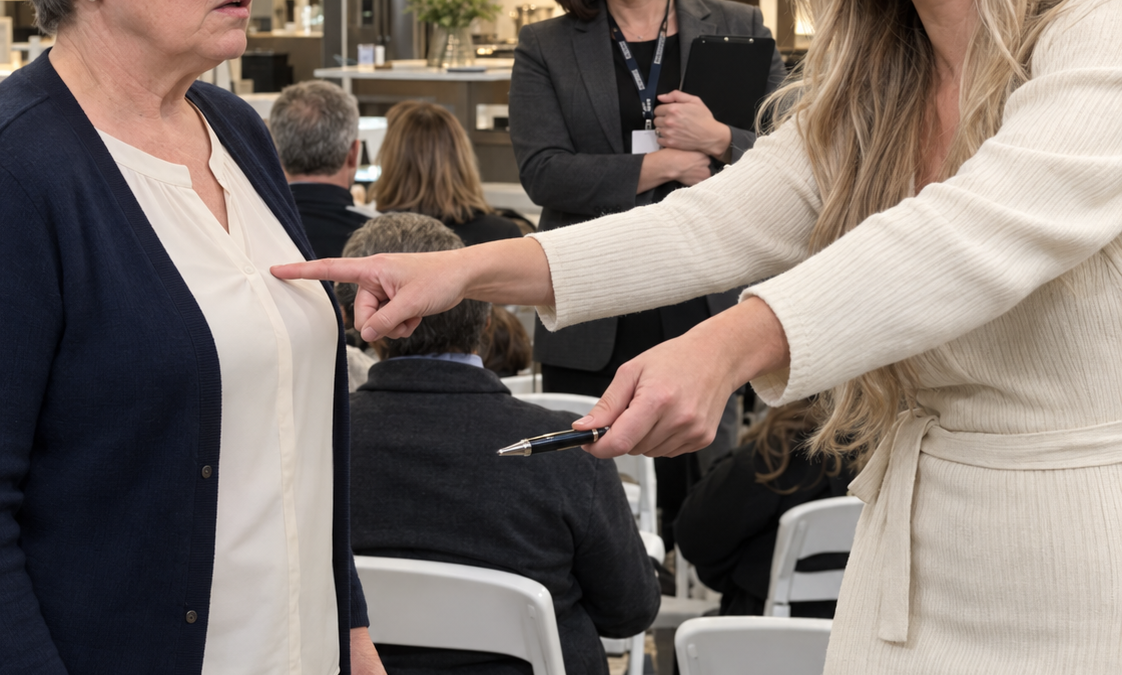
Lindsey paused for the camera, then pointed directly at me.
“Darla, sign it.” She smiled at the audience. “The paperwork’s still in her name. It’s a family thing.”
Every head in the first three rows turned toward me.
I stood, tucked my purse under my arm, and stepped into the aisle between the chairs.
Part 7 of 9
“I’m not signing that,” I said, and behind me the folding chairs creaked.
I kept walking until I reached the foot of the low stage. Monica Feld stood above me with the consent form on her clipboard. Lindsey was beside the big screen, phone raised, waiting for the part where I played along.
“I’m the owner of the house, and I don’t consent,” I said.
A murmur ran through the room. The camera on the tripod at the end of the aisle was still pointed toward us.
Lindsey gave the audience a patient smile.
“She’s being dramatic. We’ve lived there three years. It’s basically ours.”
“Basically isn’t on a deed,” I said.
The smile left her face.
I opened my purse. The lease was folded into its inside pocket, where I’d put it the previous Sunday. I drew it out by one corner and offered it to Monica.
“Would you read this, please?”
She kept the clipboard tucked against her left side and accepted the page with her free hand.
“Is this the rental agreement?”
“August first, 2022. Both sides.”
She glanced toward Lindsey, who had begun shaking her head.
“That was just something we did when we moved in,” my daughter-in-law said. “Everybody knows how families handle things.”
Monica read the top portion into the microphone on its stand.
“Tenant: Lindsey Neumeyer.” She paused. “Landlord: Darla Neumeyer.”
Her eyes moved down the page. She flipped it over, using the edge of the clipboard to support it.
“And clause nine says, ‘no alterations without Landlord’s written consent.'”
The microphone picked up the rustle of paper.
“Where’s the owner’s consent?” I asked.
Monica looked down at the form clipped to her board.
“This is what we’re asking you to sign.”
“And I’m refusing.”
Lindsey stepped toward the front of the stage.
“Seth, tell them. Tell them she gave us that house.”
My son rose from his seat on the left side of the front row. Harper remained beside his empty chair, her pink bow barely reaching the seat back.
He rubbed one hand across his mouth. For an instant I thought he’d sit down again.
“She didn’t give us anything, Linds. We pay her nine hundred dollars a month. You write the checks.”
Lindsey stared at him.
“Seth. Seriously?”
He held her gaze.
“I let you have this. That was the problem.”
I had wanted my son to say those words across a kitchen table, with nobody watching. Instead, a room full of strangers heard them at the same moment I did.
I reached into the other pocket of my purse and took out my wallet. Saturday’s payment was tucked inside, apart from the bakery cash.
“The November check,” I said.
I unfolded it carefully, holding it high enough for the first row to see. Lindsey’s signature lay below the amount.
“‘Rent — Nov.’ She wrote it. Her daughter handed it to me yesterday.”
Somewhere behind me, a woman said, “I thought she said mortgage.”
“You don’t have to do this publicly,” Lindsey said.
“You brought us here.”
She took a step back. The slide of Gary’s kitchen was up again, blue tape marked DEMO across every door.
I slid the check into my wallet again, closed it, and tucked it back into my purse.
“Monica, there’s another thing I can show you.”
I took out my phone. It was 2:33. I opened Lindsey’s text from October third and held the screen up to Monica.
“Please read her answer.”
Monica tucked the lease under her clipboard and took the phone. She studied the message.
“‘Fine, landlord,'” she read.
One man in the second row stopped taking notes. The woman beside him lowered her program.
“That was a joke,” Lindsey said.
Monica said nothing. She compared the text with the tenant name on the page she was holding, then studied the blank consent form.
“That’s from Lindsey’s number?” she asked.
“Yes. She sent it to me.”
At 2:35, Monica gave my phone back. I returned it to my purse and kept the bag against my hip.
One lease, one check marked “Rent.” Three years of keeping paper, and Lindsey had signed every page that mattered.
Monica leaned toward the microphone.
“Larkmoor can’t film inside a home without the owner’s consent, and we can’t tell forty thousand people something that isn’t true. We’re pausing the series.”
Hector’s voice came from the back of the room, near the door.
“I’ll call off Monday’s crew.”
He didn’t come forward. There was no reason for him to. The consent form sat on the clipboard, unsigned, and Monica had the lease in her other hand.
Lindsey lowered herself onto the edge of the stage. Her phone lay faceup beside her shoes, its recording timer ticking on. She kept her hands on her knees and stared at the floor.
Harper watched me without moving from her chair. Not her mother.
Marcy remained in the fourth row, both hands resting on the purse in her lap.
I took one step toward Lindsey.
“‘It tastes like drywall,’ you told them.”
Her eyes rose to mine.
“The drywall’s mine too, Lindsey. So is the house.”
Part 8 of 9
Monica Feld’s email came at 8:12 the next morning, and Lindsey forwarded it to me with one word: Happy?
My phone lay on the flour-dusted table in the bakery’s back kitchen. The first batch of bread was in the oven. I wiped my fingers before opening what she’d sent.
Monica had written that the partnership was terminated, effective immediately. Lindsey would lose the “Larkmoor Home Ambassador” title, and the pinned announcement about their first home was to come down. Under the contract’s “accurate representations” clause, she had thirty days to return the $3,000 advance.
It was addressed to Lindsey, with two people at Larkmoor copied. Nothing in it asked for an answer from me.
I locked my phone and left it on the table. Then I went back to the dough.
At five-thirty that evening, I stood on the front step of the house on Birch Road with a written notice in my hand.
Lindsey opened the door. Her hair was pulled into a knot, and the hallway beyond the doorway was dim. Seth stood behind her, one shoulder against the wall.
The paper was addressed to Lindsey Neumeyer, Tenant. I’d put the date at the top and signed my own name at the bottom.
“This is for you,” I said.
She took it by the edge. Her eyes moved from the heading to my signature.
“The tenancy ends December thirty-first. I’m selling the house.”
Seth shifted away from the wall. For a second he seemed ready to speak, but his wife folded the notice once and held it against her side.
Nobody asked me inside. I didn’t ask to come in.
I walked down the steps and back to my car. In the rearview mirror, the porch light came on before I’d turned the corner.
Tuesday morning, Seth arrived at the bakery while Marcy was working the register. I was boxing rolls a few feet away.
“She’s kicking us out,” he said.
“She gave you until the end of December,” Marcy answered.
“You think that’s a long time to find another place with a kid?”
“She should’ve done it in 2022.”
Seth faced me past her shoulder. “Mom, Harper grew up in that house.”
I lined the next box with paper and placed the rolls inside. The one nearest my hand had a split down its crust. I gave him no answer.
“I’m not saying Lindsey was right,” he said. “I’m saying Harper didn’t do any of this.”
Marcy set the change on the counter for a waiting customer. “Neither did Darla.”
He left without arguing further.
That afternoon, Marcy brought me her phone. Under the drywall video, the laughing comments had begun to change.
“wait, you RENT from her?” one said.
Another asked why somebody would call a house theirs when their mother-in-law collected the rent. Marcy scrolled past a few more, then put her phone away.
“That’s enough of those,” she said.
On Thursday, November 6, she told me Lindsey had locked her account. I hadn’t checked it myself. I was carrying a tray to the cooling rack when the shop phone rang.
Joan Brekke was calling about the St. Mark’s fall bazaar.
“My daughter was at that launch,” she said. “I’d like all forty of the pound cakes after all, if you can manage them.”
I leaned against the counter. “For Saturday?”
“Yes. I’m sorry I canceled.”
“Marcy and I can have them ready.”
Friday, we baked and packed the order. By closing, the boxes filled the back shelf, stacked beside the delivery trays.
Saturday at eleven, our table stood in the St. Mark’s churchyard beneath a canvas canopy. The pound cake was cut into neat slices for shoppers, and the rest sat in boxes for Joan’s booth beside ours. She was counting change when Seth came through the crowd with Harper.
It was the first time I’d seen my granddaughter since the launch.
She walked straight to me, reached for my sleeve, and tugged.
“Did you read my letter, Grandma? It’s inside the pumpkin one. You can open it, Grandma.”
I bent toward her. “The one you drew for October?”
She nodded hard enough to loosen the ribbon in her hair.
I’d held the envelope to the lamp in October and again last week, and both times I’d put it back uncut, waiting for her.
“I saved it,” I told her.
“Good,” she said.
Seth met my eyes and nodded once. Then he took her hand and led her to Joan’s booth, where she began studying the jars of apple butter lined up by the cashbox.
That night, just before nine, I set Gary’s tin on my apartment kitchen table. The October envelope was on top, exactly where I’d left it. Harper’s pumpkin had a crooked grin and a stem that leaned right.
I carried a box cutter over from the drawer and drew its blade out a fraction. Starting at the untouched side seam, I cut along three edges, keeping the pumpkin flap whole. The paper spread apart like a cover.
Behind the place where the rent check had rested was a small sheet torn from Harper’s drawing pad, folded in four.
I eased it free and opened the first fold, then the second. Orange crayon covered the page in uneven capitals.
MOMMY SED SPIT IT FOR THE VIDEO. I LIK YOUR CAK. SORY.
Part 9 of 9
Seth sat down on a fifty-pound sack of flour with the envelope and Harper’s letter on his knee and didn’t say anything for a long time.
It was Sunday morning, November 9. The bakery’s back oven was warming, and Harper’s small apron hung on its hook by the door.
My son held the sheet close enough to study every crooked orange letter.
“She wrote this herself?”
“She told me where to find it yesterday.”
He touched the word SORY with his thumb.
“Linds told me Harper hated the cake.”
I checked the oven temperature.
“Your daughter told me something different.”
Seth lowered his head. His delivery jacket creaked as he leaned forward, elbows on his knees.
“She used our little girl.”
I let him sit with that.
Finally, he raised his face.
“Harper doesn’t go on camera again. Not one more video.”
“Have you told Lindsey?”
“Not yet. I’m telling her tonight, before she can argue me out of it.”
He glanced toward the little apron.
“Can Harper come here every Saturday from now on?”
“Does she want to?”
“She asked me at breakfast.”
I crossed to the hook, lifted the apron free, and handed it to him. The neck strap was faded from years of washing.
“Tell her I’ll have dough ready.”
Seth folded it over his arm.
“We’re out by the thirty-first. The new lease has both our names.”
“Good.”
“Lindsey says, ‘Who puts family on paper, Seth? That’s cold.'”
“Wanting your name on the thing you paid for isn’t being cold, honey. It’s just being the one who paid.”
He rubbed his jaw.
“She’s paying Larkmoor back from her own savings. All three thousand. She said she’ll send it before December third.”
“That’s between her and Larkmoor.”
“I know.”
Seth stood and brushed flour off his jeans. He gave back the October envelope and Harper’s letter, holding them separately so the crayon wouldn’t rub.
“Mom, I should’ve said something months ago.”
“You said something last Sunday.”
“After you did.”
I accepted the papers. My fingers caught on the torn edge of the sketchbook sheet.
“Harper needs you to keep saying it.”
He nodded, tucked the apron into his jacket, and went out through the back door.
Afterward, I carried the two papers upstairs and placed them together in Gary’s tin.
That afternoon, I called the real estate agent about listing the house.
“There’s one condition,” I told her. “I’ll sell only to somebody who promises to keep Gary’s kitchen.”
“Those cabinets are older,” she said.
“I know when they were built.”
“That might narrow your buyers.”
“Then we’ll have fewer showings.”
She agreed to tell anyone interested before scheduling a visit.
On Monday, December 1, I met Nicole and Cal Vandermolen at the house on Birch Road. I’d texted the tenants at nine the previous night, twelve hours ahead of the showing, as always.
Moving boxes stood against the living room wall.
Nicole was a nurse, and Cal was an electrician. They were buying their first home.
The three of us walked into Gary’s kitchen.
Cal stopped in the doorway.
“These are solid maple?”
“Yes. My husband made them.”
“Did he do the joinery himself?”
“Every door.”
Nicole examined a drawer, then crouched beside the sink.
“Can I open this?”
“Go ahead.”
She pulled the cabinet door toward her. Inside, just above the hinge, Gary’s note remained in pencil.
G.N. 2004 — for D.
“Who’s D?” she asked.
“Me.”
Nicole leaned closer.
“That’s sweet.”
“He built them for me in 2004. I asked your agent to tell you I’d like them kept.”
Cal came over and ran a fingertip along the edge of a door.
“We’re not planning to tear these out.”
Nicole stood.
“I’d rather keep what a man made with his own hands.”
“Even if the color goes out of fashion?”
She smiled.
“Then it goes out of fashion. They’re staying.”
I waited beside her while she opened another drawer to see how Gary had fitted the runners.
On Saturday, December 6, Seth brought Harper to the bakery. As she hurried toward the back kitchen, he stopped beside me.
“Larkmoor got the money,” he said. “Lindsey paid it back.”
“All of it?”
“Every dollar.”
I thanked him for telling me and went to help my granddaughter tie her apron.
On Wednesday, December 31, Seth and Lindsey moved out on time. Their new apartment was on 60th Street. He returned the house keys after the last boxes were loaded, and Harper showed me which window would be hers at the new place.
Friday, January 9, 2026, the sale closed. The Vandermolens took possession of the house, with Gary’s kitchen exactly as he’d built it.
The next morning, Saturday, January 10, at nine, Harper stood on a step stool behind the bakery’s glass display case.
Her small apron reached almost to her shoes.
Marcy worked the register while my granddaughter offered samples of the pound cake to customers.
“Would you like to try some?” she asked a woman in a red winter coat.
“Did you make it?”
“I helped Grandma mix it.”
The customer tasted a piece.
“That’s very good.”
Harper beamed.
Beside the register sat a small frame. Inside were the October envelope, its orange pumpkin visible, and Harper’s letter, the uneven crayon capitals in her own hand.
When the morning rush slowed, my granddaughter picked up the cake knife.
“Can I have a piece too?”
“Of course.”
She cut herself a slice, set it on a little paper plate, and reached into her pocket.
A quarter landed on the counter.
“That’s for mine.”
The woman in the red coat was finishing her coffee nearby.
Harper held up her plate.
“It doesn’t taste like drywall. It tastes like Saturday.”
Marcy smiled from the register.
I reached beneath the counter for the receipt book and uncapped my pen.
I wrote her a receipt for it anyway: one slice, paid in full.
THE END
More stories
My fiancé shamed me for working nights before 80 hockey parents while my son sat beside me—then the rink owner arrived, and his perfect speech began unraveling.My brother’s wife carried Mom’s clothes from her bedroom 14 days before Dad’s knee surgery—Until Dad’s case manager stepped in, and the room she called hers stopped being hers.On Thanksgiving, my daughter told 31 relatives I was too confused to handle money and had filed for guardianship. In June she’d had me co-sign her $38,000 car loan.My Stepmother Demanded My Guest Cottage, So I Locked The Gate And Let Her Story UnravelMy Son Told 19 Relatives I “Live Off Him” at Thanksgiving—Then I Set My Bank App Beside the TurkeyGrandpa Left Me a Falling-Down Bee Shed and My Uncle Laughed and Offered $200—Then the County Clerk Called About the Ground Under It








