My Daughter-in-Law Locked Me Out of My $310,000 House After Hip Surgery, but She Didn’t Know What I Had Kept.
Chapter 1 of 7
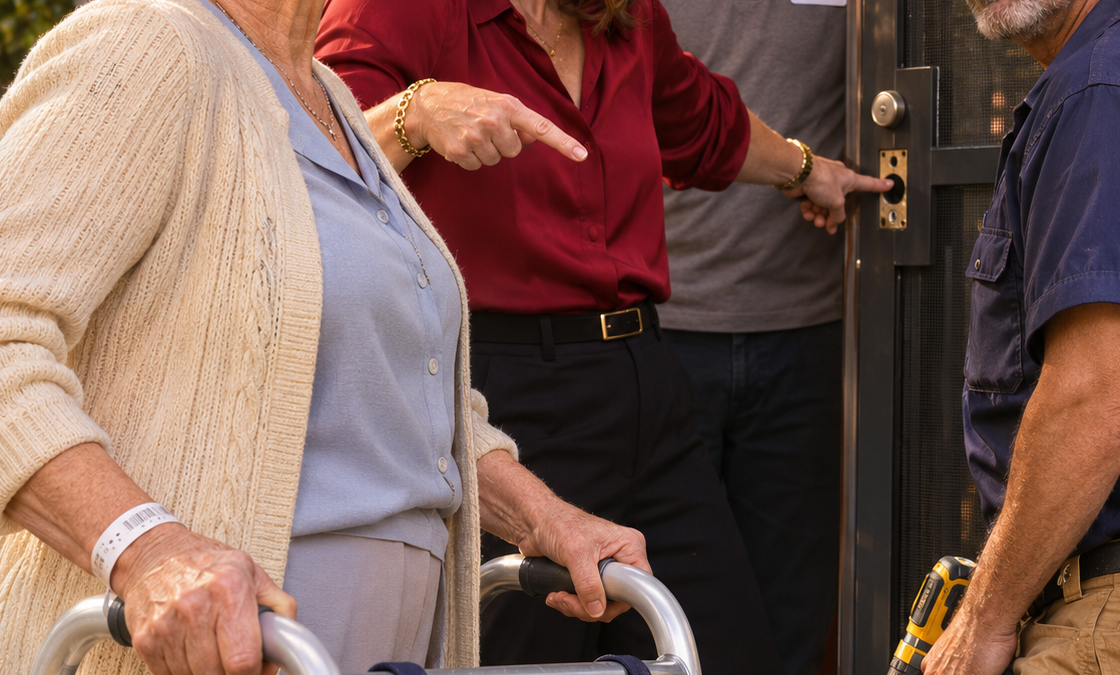
Friday, June 12, 2026, at 11:20 a.m., my hospital wristband scraped my walker. A locksmith was drilling at my front door.
I had bought that house. I owned it outright.
Ben stood behind the screen, holding my welcome-home balloon.
“Grandma needs a facility, not a key.”
Megan said it while pointing the locksmith toward the deadbolt. Daniel stood beside her, still wearing the visitor sticker from picking me up.
He said nothing.
“Move back, honey,” Megan told Ben. “Let him finish.”
My worn brass key was in my sweater pocket. I had pictured using it, then sitting down.
Instead, I stood on the porch with discharge instructions beneath my arm.
“What are you doing to my door?”
“Making things manageable,” Megan said. “You weren’t supposed to come straight here.”
“You watched him bring me up the walk.”
“We need to talk before you go inside.”
Across the street, my neighbor stood at her gate. She had come out smiling. Now she stayed where she was.
The locksmith stopped drilling.
“Ma’am, are you the customer?”
“I live here,” I said.
“I arranged the work,” Megan told him. “I’m the household contact.”
“I need everybody clear of the door.”
“Then let me through it.”
Megan remained in the opening.
“You can barely stand, Helen. Please don’t make this harder.”
My walker’s back legs rested against the porch seam. I could feel the unevenness through both palms.
“Daniel.”
He looked at my shoes.
“Mom, maybe sit in the car while we figure—”
“I came home.”
Ben’s balloon brushed the screen. It had a smiling hippo wearing a nurse’s cap. We had always called the hospital the hippo hospital, ever since he was little.
Nobody laughed at it now.
Megan lowered her voice.
“We’ve been taking care of everything. Meals, laundry, appointments. There has to be a sensible arrangement.”
“I’ll hire help.”
“That doesn’t cover the rest of the day.”
“Then we’ll discuss the rest.”
“We tried discussing things before surgery. You kept saying you would see.”
“I said I would see how I felt.”
“And this is how you feel. You’re shaking.”
The locksmith looked toward Daniel.
“Who’s responsible for the invoice?”
My hand went toward my purse before anybody answered.
That was how these things usually ended. I paid the bill, somebody stopped being upset, and supper happened.
I had paid to keep the peace until peace meant my absence.
This time, I left my purse shut.
“Megan ordered the work,” I said. “She can pay for it.”
Daniel finally looked at me.
Megan’s mouth stayed pleasant.
“We’re all under pressure. You know what we’re trying to pay down.”
I knew. Her debt balance was $24,600. Living with me rent-free was supposed to help them get ahead.
It had become a reason I should stand outside.
“Helping me did not make this house yours.”
“Please keep your voice down. Ben’s right here.”
“So am I.”
She turned toward the locksmith.
“Finish what’s safe to finish. We’ll handle the family part.”
“No,” I said. “Don’t change anything else on my say-so. You don’t have my permission.”
He set his drill against his thigh.
“I’ve got conflicting instructions now.”
“You have mine,” Megan said. “I booked you.”
My son moved closer to the threshold, but he didn’t cross it.
“Let me help you back down, Mom.”
“Will you take me inside?”
He looked past me toward the driveway.
I said nothing at all.
The locksmith asked whether I had identification. Megan said my purse was probably packed under my medicine, as though finding it would exhaust me.
“It’s here,” I said.
I had spent years finding things while bus drivers waited at my office window. A wallet wasn’t beyond me.
The locksmith held out his work authorization beside my license. Megan leaned closer.
“Her name is different from Daniel’s,” she said.
“He’s my son.”
“I didn’t say he wasn’t.”
“Then let the man read.”
The locksmith began lowering the drill.
“You listed yourself as—?”
“Owner,” Megan said. “I handle the house. That’s what the booking form asked.”
“I can’t accept that authorization over her objection.”
“You’ve already started.”
“I’ll leave the hardware secure. But I won’t put you down as owner or give you every replacement key.”
“Can you let me in?” I asked.
“I can’t settle who gets possession, ma’am.”
By 11:45, his drill was packed. Megan still blocked the doorway.
His receipt identified him as Jack Wilson. He gave me his number before leaving.
My neighbor crossed the street then. Ruth Miller was sixty-eight and walked faster than anybody had advised me to walk.
“You need a chair, Helen.”
“I need my house.”
“I know. You also need a chair.”
The recovery tote hanging from my walker held my complete duplicate of our temporary occupancy agreement. Megan, Daniel, and I had signed it in March.
I had kept transportation records for the school district before retiring. Keeping a complete copy was a habit.
Bathroom rails, the downstairs bedroom, which hallway cupboard held towels—we had written down ordinary household things.
The folder stayed in my tote.
Daniel rubbed his jaw.
“Mom, nobody’s saying it isn’t your house.”
“Then why am I out here?”
Megan answered him instead.
“Show her what we’re dealing with. I sent you the picture.”
His phone sounded.
“Look at it before we keep going,” she said. “There wasn’t a safe path through there.”
Daniel opened the photograph and started lifting his hand toward it.
His hand stopped above the screen.
“Megan, where is Mom’s bed?”
“The frame was a hazard around the equipment.”
“Where is it?”
“In pieces in the garage. Nothing’s been thrown away.”
My hip ached down into my thigh.
“You took my bed apart?”
“We needed room to work. You cannot get a walker through clutter.”
“My bed wasn’t clutter.”
“The whole recovery-room setup needed changing,” she said. “You haven’t even seen the photograph.”
“Because I’m standing outside.”
Daniel looked toward the hallway.
“I could put it back.”
“Today?” Megan asked. “With her waiting on the porch? And who stays awake tonight if she falls?”
Ruth moved beside my walker.
“I have a place she can sit.”
Megan nodded quickly.
“Good. Thank you. That gives us time to talk about somewhere properly equipped.”
“I’m not agreeing to move,” I said.
“I’m asking you to consider professional care.”
“You told my grandson I needed a facility.”
“Because he asked why the locks were being changed.”
Ben was still behind the screen. The balloon string had twisted around his wrist.
“Did Grandma do something?” he asked.
“No, sweetheart,” I said. “This is grown-up business. You didn’t do anything either.”
Daniel stepped inside, toward him.
Megan stayed at the door.
“If I send you the intake information, will you at least approve starting? We can’t keep going without a plan.”
“Send information. I’m not signing admission consent.”
“It isn’t a punishment, Helen.”
“Neither is coming home.”
Ruth waited until I looked at her.
“My guest room is ready. We can argue from a chair.”
I couldn’t safely stand there any longer. My shirt had stuck to my back, and my operated leg trembled whenever I shifted.
“I’m leaving to rest,” I told Megan. “I am not giving you my home.”
Daniel came out to help me down the step. His father’s surname, Carter, was on his work badge. I had kept Brooks after my second husband died; we had been explaining the difference for years.
He didn’t need my license to know who belonged there.
At Ruth’s house across the street in Round Rock, Texas, my phone chimed before I reached her guest bed.
Megan had attached a newly submitted facility inquiry.
My name was at the top.
The proposed monthly charge was $4,800.
Chapter 2 of 7
At 9:10 Saturday morning, June 13, I called the facility from Ruth’s guest room.
“I’m Helen Brooks. Someone submitted an inquiry under my name. I didn’t authorize placement.”
The woman checked before answering.
“It’s only an inquiry, Mrs. Brooks. You haven’t been admitted.”
“Have I agreed to pay anything?”
“No. There’s no signed contract.”
“Please note that I make my own decisions. Call me directly.”
She read back my number. I stayed on the line until she finished.
Ruth stood in the hallway with toast on a plate.
“Any trouble?”
“Apparently I’m allowed to remain a person.”
“Well, good. I only made enough toast for two.”
She had cut mine diagonally. The toast rack was an old taco holder, which she insisted worked better than anything sold for breakfast.
I ate sitting high on pillows, with my operated leg positioned as instructed. Across the hall, her guest bathroom had a tub.
I had tried approaching it that morning. There was nowhere safe to put my weight while getting over the side.
“I can wash at the sink,” I said.
“For today,” Ruth said. “Don’t start planning your whole recovery around my plumbing.”
“I’m staying here temporarily, if that’s still all right.”
“It is. But we need somebody who knows what to do.”
She meant a lawyer, not somebody to bathe me.
Ruth helped me contact Susan Grant, a civil-litigation attorney. Susan called back that morning and asked first where I had slept.
“At my neighbor’s. Across the street.”
“Can you recover safely there?”
“I can sleep. I can’t use the tub with these restrictions.”
“What’s available at your house?”
“My room’s downstairs. The bathroom has rails and a walk-in shower. We arranged it before surgery.”
“Keep the discharge instructions. I need to see those.”
“I own the house outright.”
“The recorded deed establishes ownership. It doesn’t let you throw established occupants out.”
“I wasn’t planning to throw anybody.”
“You asked about having the locks changed back.”
I had. In fact, I had asked before giving her my address.
“They live there with your permission,” she said. “We need to address your access without doing to them what you say they did to you.”
“How long does that take?”
“I can’t promise a date today. Send me what you signed.”
I sent her a copy of the complete agreement and kept my duplicate. She arranged to obtain a certified deed copy from the Williamson County clerk.
While that was being handled, I wrote a list: medication, clean underwear, loose pants, the walker pouch, the attachment that kept things within reach.
For years, a missing form had been the worst thing on my desk. Now I needed professional help to get my own underwear.
Before lunch, Megan sent a family message.
Helen has kindly offered us some stability while she focuses on getting well. We’re grateful she’s putting recovery first. Daniel, please help her finish the transition so we don’t keep confusing Ben.
Ruth’s phone sounded a moment after mine.
“She included you,” I said.
“I can see that.”
“Don’t answer yet.”
“I wasn’t going to discuss your business with everybody on a phone list.”
Daniel called shortly afterward.
“Mom, can we keep this between us?”
“Your wife just sent it around.”
“She’s trying to explain.”
“Then she can explain why I’m sleeping across the street.”
He went quiet long enough that I could hear warehouse machinery behind him.
“I’ll come over when I get off.”
“Bring my list inside first. I need those things today.”
“I’ll talk to her.”
“I asked you to get my clothes, Daniel.”
“All right.”
When he arrived, Ruth left us in the living room. His work shirt had a dark crescent under the collar.
“Megan did help,” he said.
“Yes. She brought meals. She drove me to appointments. I’ve never said she didn’t.”
“She cut her hours.”
“I know that too.”
“You make it sound like she showed up and took over.”
“She helped me. Then she kept me outside. Both happened.”
He leaned back against the sofa.
“We can’t afford another place on what I make alone.”
“I didn’t ask you to find one this afternoon.”
“If this turns into us living separately, I won’t see Ben every day.”
There it was. He had brought his fear across the street and set it between us.
“I’m not asking you to choose whether you’re his father.”
“That isn’t what I meant.”
“I need a safe place to recover. I’m hiring help at twenty-eight dollars an hour. Three hours a day initially.”
“Megan could do those things.”
“She already did some. I’m grateful. I’m still hiring someone I choose.”
He looked toward Ruth’s kitchen.
“Mom, she thinks there was an understanding.”
“About what?”
He showed me the full message thread on his phone. I had the same thread on mine.
There were reminders about taking the bins out, an expected delivery, and letting a helper inside. Among them was my message: “Take care of the house until I’m steady.”
I read above it and below it.
“I was going into surgery,” I said.
“I know.”
“Do you?”
“She says you wanted us to handle everything.”
“Handling a delivery isn’t deciding where I live.”
“I’m showing you what she’s talking about.”
“Send Susan the whole conversation. Don’t crop it.”
He agreed. I didn’t ask him to declare what the messages proved.
We had arranged a short collection of my things that afternoon. Daniel would walk with me, and I would avoid the step into the house until he was beside me.
I had put on shoes and made it as far as Ruth’s front room when his phone sounded.
He read the message.
“She put the bag on the porch.”
“I need to check what’s in it.”
“I’ll bring it here.”
“We agreed I could collect things.”
“Let me just get the bag.”
He crossed the street without me.
From Ruth’s window, I watched my son carry a grocery sack down my front walk. Megan never came outside.
The medication was there. So were two shirts, one pair of pants, and socks I couldn’t put on without help.
“No walker pouch,” I said.
“I’ll go back.”
“And underwear.”
His face reddened.
“I didn’t pack it.”
“I know who didn’t pack it.”
He stood there awaiting another instruction. Every ordinary thing I needed now had to pass through him.
At 5:40 p.m., Megan sent another message.
For clarity, please approve the attached residential transition statement. This reflects the arrangement we discussed and will help everyone give consistent answers.
She attached my text beneath it.
Ruth asked whether I wanted supper in the living room.
“In a minute.”
The new statement described my home as the Carters’ “exclusive household during recovery.”
Chapter 3 of 7
“I’m not approving that statement,” I told Megan. “I never agreed to an exclusive household.”
She hadn’t merely suggested that I avoid stairs anymore. She was claiming we had made another arrangement.
On Sunday, June 14, at 2:30 p.m., she brought the facility estimate to Ruth’s house.
“This is preliminary,” she said. “Nobody’s admitting you against your will.”
“I already called them.”
“Then you know it’s an option.”
She wore her dental-office cardigan despite the heat. I had seen her wear it when she needed patients to accept a rescheduled appointment.
Ruth stayed near the kitchen doorway.
“Would you like some water?”
“No, thank you. I can’t stay.”
Megan put the estimate beside my discharge instructions. The quoted base rate was $4,800 monthly, before any additional services.
“That’s a lot of money,” I said.
“It covers more than a person coming by for a few hours.”
“It also covers a place I don’t want to live.”
“For recovery, Helen. We’re talking about recovery.”
“Then help me recover at home.”
Her eyes moved toward Ruth.
“I need you to hear this without making me the bad person. I can’t supervise your recovery if you insist on directing everything in the household.”
“Which things?”
“Meals. Who comes in. What gets moved. You want my help, but every decision becomes a discussion.”
“It’s my supper. My visitors.”
“And I’m the one expected to make it all work.”
She sounded tired. There were shadows beneath her eyes, and I remembered the meals she had brought before surgery. She had labeled the containers because I always forgot what I had frozen.
“I know you’ve done work,” I said.
“Then please stop acting as if none of it counts.”
“It counts. It doesn’t give you my decisions.”
Megan looked at the discharge instructions again.
“I won’t have Ben listening to adults argue every time somebody needs to get you to the bathroom. He needs his home to feel settled.”
“He doesn’t need to hear it. We agree on that.”
“Then you’ll need somebody else responsible for your care.”
“All right.”
She waited.
“I’m arranging paid assistance,” I said. “You don’t have to supervise me.”
“Three hours isn’t a day.”
“I’ll ask the service what I need. And my medical team.”
“You’re making this more expensive than it has to be.”
“Yes,” I said. “It will cost me.”
She left the estimate. I didn’t follow her to the door.
Afterward, Ruth brought lunch on the tray she used for eating in front of baseball games. A faded sticker on its edge said NO COACHING FROM THIS SEAT.
“My husband put that there,” she said. “Apparently I had useful advice too often.”
I laughed, then had to brace myself before shifting higher in the chair.
“Don’t tell me laughing’s forbidden too.”
“Only if you’re funny again.”
We ate without discussing Megan.
Later, I called the home-assistance service. I arranged three hours daily initially, at $28 an hour, and explained that I was temporarily staying across the street from my own house.
The woman asked about bathing.
“There’s a tub here,” I said. “I can’t get over the side safely.”
She made a note for the assessment. Hiring help gave me someone to call. It didn’t give me access to my adapted bathroom.
I checked my bank balance after we hung up. Then I checked it again, though the numbers hadn’t changed.
Daniel drove me to the pharmacy that afternoon. I needed a prescription picked up, and Ruth needed groceries.
We sat on the bench by the pharmacy counter while the prescription was finished. He watched the display that kept promising a vaccination appointment.
“Did Megan come over?” he asked.
“Yes.”
“She told me she couldn’t keep doing the care.”
“I’ve arranged help.”
He rubbed his heel against the floor.
“That’s going to add up.”
“So does assisted living.”
“I know.”
“Do you think I should pay for that?”
“I think everybody’s looking at numbers they can’t manage.”
A cart rattled past us with a squeaking wheel.
“How much is still owed?” I asked.
“On her cards?”
“Yes.”
“$24,600.”
He said it quietly, though nobody nearby knew us.
“Even with no rent?”
“We’ve paid things down. Then there were other expenses.”
“I’m not asking for every purchase.”
“It sounds like you are.”
“I’m asking why my recovery depends on your budget.”
He stared at the pharmacy display.
“If we rent somewhere, most of what’s left goes there. With her hours reduced, I can’t carry it alone.”
“You told me yesterday.”
“And if she takes Ben somewhere she can afford—”
“Daniel.”
“I’m trying to keep us together.”
“I know you are. But I didn’t agree to leave so that you could.”
He leaned forward, elbows on his knees.
“I thought we could get through the surgery first. Figure everything else out later.”
“You let her tell people I had already agreed.”
“I didn’t send that message.”
“You didn’t correct it.”
He stayed bent over. I watched a woman compare two bottles of children’s medicine.
Finally, I asked, “What happened to my room?”
He looked up.
“The bed’s in the garage.”
“All of it?”
“The mattress is covered. The frame’s taken apart. Nothing was sold.”
“And the rest?”
“Dresser’s still there. Your clothes are there.”
“Can you get into it?”
“Yes.”
“Is it locked?”
“Since she moved the equipment in. I still have the separate bedroom key.”
“Why didn’t you tell me?”
“You hadn’t asked.”
He winced before I answered.
“That sounded bad.”
“It was bad.”
The pharmacy called my name. He stood, but I told him I would answer their questions myself.
On the ride back, he asked whether I needed anything else collected.
“My house shoes. The ones with backs.”
“I’ll bring them.”
He brought them that evening. He left them beside Ruth’s guest-room door without asking me to thank Megan.
Before supper, Megan sent a message.
To avoid another misunderstanding, please confirm by Monday at noon that the stored bedroom furniture can be removed. We need the garage space for therapy equipment and a clear working area. I’ve arranged pickup so Daniel won’t have to handle it after work.
I read it twice.
Then I answered: I do not authorize removal of my bedroom furniture. Leave it where it is.
I sent the exchange to Susan and asked her to seek help getting me home. I didn’t ask Daniel to block a truck or put the bed together while Megan was out.
Ruth found me looking across the street.
“Want me to close the curtain?”
“Please.”
At 6:15 p.m., Daniel forwarded Megan’s reply to him: “Your mother gave us the entire house for the recovery period.”
The attached removal booking listed a 12:30 p.m. pickup.
Chapter 4 of 7
At 10:30 Monday morning, June 15, Susan called. The furniture pickup was canceled, and she had filed our request.
“The mover won’t collect disputed belongings,” she said. “Your bed stays where it is.”
“In pieces.”
“For now.”
A washcloth hung over Ruth’s bathroom faucet. I had washed at the sink again, leaving water down the front of my nightgown.
“Thank you,” I said. “But I still can’t get into a shower.”
“That’s in your sworn statement. I included your discharge restrictions and the bathroom photographs.”
Ruth had photographed her tub, then asked Daniel for pictures of my adapted bathroom. He had sent them without comment.
“What exactly are we asking the judge to do?”
“Restore your own living space and shared access. Not remove them. Access can be protected while a separate possession case remains unresolved.”
“Will somebody actually have to let me inside?”
“That’s what I’m requesting. The judge decides.”
The truck wouldn’t take my furniture. I would still sleep across the street from it.
Before lunch, Daniel asked to meet me alone. Ruth drove me to a nearby park, where a bench stood close to the parking lot.
“I’ll stay in the car,” she said. “Don’t let him turn this into a walking meeting.”
Daniel waited beneath a live oak. He wore his warehouse shirt and kept watching the parking lot entrance.
“How long have you got?” I asked.
“Lunch break. Are you okay sitting here?”
“For a little while.”
He waited until Ruth was back in her car.
“Mom, can you hold off until my next paycheck?”
“What happens then?”
“I’ll have some room. We could work something out.”
“What?”
“I don’t have every answer yet.”
A groundskeeper drove past on a cart. Daniel watched him instead of me.
“I can’t use Ruth’s tub,” I said. “She’s arranging her day around helping me.”
“There are places with accessible showers.”
“You mean a hotel.”
“Temporarily.”
“Who pays?”
His jaw moved, but nothing came out.
“I’m paying for help,” I said. “And a lawyer. You want me to pay for another place while you decide whether I can use mine.”
“I’m trying to get us through this.”
“I know you are. I’m still not waiting until payday.”
“Megan thinks this is how you start getting us out.”
“Read what Susan sent.”
“She’s scared, Mom.”
“I believe that.”
He looked at me then.
“She can be scared with me inside the house.”
A little boy rode past on a bicycle, his training wheels rattling. Daniel watched until he disappeared around the bend.
“Ben asked why you haven’t come back.”
“What did you tell him?”
“That we’re figuring out the safest arrangement.”
“Don’t tell him I chose to leave.”
“All right.”
“And he doesn’t need to know about this meeting.”
“I’m not putting him in the middle.”
“Good.”
He checked the time on his phone.
“I need to get back.”
“So do I.”
He looked toward Ruth’s car. I stayed seated until she came to help me up.
On the ride back, Ruth complained that the park had removed the bench nearest the duck pond.
“Probably because people kept feeding them bread,” I said.
“They could have removed the people.”
“You’d have run a strict park.”
“I ran a grocery store. Ducks would’ve been a promotion.”
I laughed once, carefully. She drove around a pothole without mentioning it.
Back in her guest room, I called Susan. My account was verified, and the complete agreement, message thread, and recovery records had gone with the filing.
“I asked the judge to shorten hearing notice because of your recovery needs,” she said. “That isn’t the usual schedule.”
“Will Megan get everything?”
“Both of them will. The application, evidence, and hearing notice.”
“I don’t want Daniel saying he didn’t know what this was.”
“Service will be documented.”
Later that afternoon, Susan called with the setting. The judge had shortened notice because of the documented recovery urgency.
Tuesday, June 16, at 4:00 p.m., at the Williamson County district courthouse. Susan and I would attend, and Megan and Daniel were notified to appear.
“This hearing concerns temporary access,” Susan said. “It isn’t the final trial.”
“What should I bring?”
“Your discharge instructions. And tell me about any difficulty you haven’t already described.”
I told her about the wet nightgown. About standing at Ruth’s sink because sitting low was difficult. About asking for clean clothing one bag at a time.
She asked questions without making sympathetic noises. That helped more than I expected.
At 4:20, Megan called.
“I’ve received the papers,” she said. “Daniel has his too.”
“Then you’ve seen what I’m asking.”
“I’ve seen that you kept the March agreement.”
“I kept my copy.”
“I’m not denying my signature, Helen. But March wasn’t the last conversation we had.”
I could hear the dishwasher running in my kitchen.
“You went into surgery, then rehabilitation,” she continued. “You told us to take care of the house. There was a key handoff. We made arrangements around all of that.”
“I expected to come home.”
“That wasn’t clear to us.”
“Daniel brought me there.”
“And nothing had been coordinated. Which is why we need something workable now.”
My supper would be arriving on Ruth’s baseball tray. Megan was standing somewhere near my dishwasher, explaining what was workable.
“Tell the judge what you understood,” I said.
“I’d prefer we stopped spending money on this.”
“So would I.”
“Then hear the proposal first.”
I waited.
“Sign an exclusive-use arrangement for six months. We’ll contribute a fixed monthly amount toward somewhere accessible for you. Daniel and I would have time to get stable.”
“Where would the contribution come from?”
“We’d adjust our debt payments.”
“And afterward?”
“We’d review things before the end date.”
“I’m not leaving my return for another review.”
“This would be written down.”
“I’m not signing it.”
“You haven’t heard the figures.”
“Send them to Susan. My answer about six months is no.”
Megan stopped speaking. The dishwasher kept running.
“We’re trying to offer something reasonable,” she said.
“I’ve heard the offer.”
“We’ll be at the hearing.”
Afterward, I called Susan.
“Send me anything she puts in writing,” she said. “No more negotiating tonight.”
“Tuesday at four.”
“Yes. Rest before then.”
Ruth heated supper while I sat with my leg supported. Across the street, Daniel’s car was in my driveway.
I wanted to ask what he would tell the judge.
His message arrived before I called.
“I gave her your outside key. She says that proves you turned the house over.”
Chapter 5 of 7
Tuesday morning, June 16, Daniel called before I finished breakfast.
“I gave Megan the key to let the home-care helper in,” he said. “That’s why I had it.”
“Did you tell her that?”
“Yes. At first.”
“And when she said it meant something else?”
“I didn’t correct her.”
Ruth’s kitchen clock clicked through several seconds.
“There’s more,” he said. “I’ve been forwarding her your plans.”
“What plans?”
“When you were collecting things. When you were talking to Susan. She asks, and if I don’t tell her, it looks like I’m taking sides.”
“You could have told me.”
“I’m telling you now.”
Ruth’s toast had gone cold beside my eggs.
“From now on, scheduling comes directly to me, in writing,” I said. “Copy Susan when it concerns getting into the house.”
“Mom, I can still help.”
“Then stop making me guess who else is listening.”
He didn’t answer that.
Before noon, he sent a photograph of my bed frame back in my room. The mattress stood upright beside it.
I called him.
“Did you put it together?”
“Not yet. I brought everything in from the garage. I’ve arranged for somebody to help after my shift.”
“You’re working today?”
“I swapped hours. I’ll have to cover them later.”
The quilt lay over my dresser. He had folded it wrong, with the underside showing. I had complained about that when he was a boy.
“Thank you for bringing it back.”
“Does this help us get back to—”
“Daniel.”
“I mean living there. Working things out.”
“The bed needed to go back regardless.”
“Right.”
I wanted to make his disappointment easier. I could almost hear myself offering another month, another payment, another promise.
Instead, I asked him to send the reassembly time directly.
Megan’s proposal arrived shortly afterward.
She and Daniel would remain until January. They would coordinate every visitor, including paid helpers, so nobody interrupted medication, exercise, or rest.
The message included suggested visiting hours for me.
I called Susan.
“She’s given me visiting hours in my own house.”
“Send it.”
“Should I answer?”
“Briefly.”
I wrote: I am asking to live at home, not visit. I will coordinate my care directly.
Then I put the phone where I couldn’t watch it.
Ruth drove me to the courthouse early. She had packed a cushion and a sandwich wrapped in wax paper.
“Eat something before we go in.”
“I’m not hungry.”
“It’s egg salad. You can’t leave it in my car in June.”
I ate half in the parking lot. She ate the other half without asking.
Inside, the courthouse air felt cold against my damp collar. I was seventy-one, wearing elastic-waist pants, and worried about whether I could stand quickly enough when told.
Susan met us near the hearing room.
“Tell the truth. Ask for a break if you need one.”
“Will I have to stand?”
“We’ll make sure you’re accommodated.”
Megan and Daniel arrived together. She carried the same exhibits Susan had sent. Daniel’s shirt was clean, but his work boots had dust around the soles.
Megan stopped beside Ruth.
“I appreciate you helping while we sort this out.”
“Helen needed somewhere to sleep,” Ruth said.
“Yes. We all want her safe.”
Then Megan looked at me.
“You handed over the key and asked us to take the whole household over. We arranged our lives around that.”
“For deliveries and help,” I said.
“That’s how you’re describing it now. You left, Helen. You told us to handle the house while you recovered. There wasn’t a date when you would take things back.”
Daniel stared toward the hearing-room door.
Megan continued, evenly.
“I’m not saying the house belongs to me. I’m saying we made a later arrangement, and now we’re being treated as if March was the only conversation.”
Susan spoke before I could.
“The judge has the complete record. We’ll address it inside.”
Megan nodded.
“That’s what I’m here for.”
At 4:00 p.m., Judge Patricia Ellis took up our request.
She confirmed that Megan and Daniel had received the application, hearing notice, and exhibits. Neither asked for more preparation time.
“This concerns temporary access,” she said. “We are not deciding every dispute between you today.”
Under oath, I gave my name and explained where I had slept since Friday.
“Can you use the bathroom there safely?” the judge asked.
“The sink. Not the tub. My instructions say I can’t move that way yet.”
“And at your house?”
“A walk-in shower. Rails. We had it ready before surgery.”
Susan asked what I wanted.
“My room. To come through my own front door. Shared use of the house.”
“Are you asking that anyone be removed today?”
“No.”
Megan described the meals, the reduced work hours, and the arrangements she had made. I didn’t dispute those things.
She explained the departure, the transferred key, and my text. Her voice stayed steady.
“We believed we were responsible for the household during recovery,” she told the judge. “Not simply waiting there for instructions that could change every day.”
Daniel confirmed why he had transferred the key. He also admitted that he hadn’t challenged Megan’s broader interpretation.
I watched a scuff on the table while he answered.
The judge asked about the bed, the paid assistance, and my discharge restrictions. She reviewed the complete messages without reading them aloud to us.
“I’m taking the request under advisement,” she said.
There was no answer to carry home yet.
Outside, Megan asked Daniel whether he could drive her back before returning to work.
“Yes,” he said. “But I need to say this here.”
She glanced toward Susan.
“What?”
“If somebody asks me why I handed you that key, I’m answering. Same with Mom’s room. I’m not leaving parts out anymore.”
“I haven’t asked you to lie.”
“I’ve been trying not to upset anybody. That’s been—” He stopped. “I’m answering the questions.”
Megan looked at me.
“While this is pending, we can arrange collection of personal effects. Clothes, toiletries, whatever you need. Directly, in writing.”
“Send it to Susan,” I said.
Ruth drove me back to her guest room.
That evening, Daniel sent a photograph of the assembled bed. I enlarged it enough to see that the legs were level.
I didn’t send him a promise.
Wednesday morning, June 17, Susan called at 8:35.
“We have a written ruling.”
I sat upright against Ruth’s pillows.
“Tell me what happens next.”
“I’m handling the required bond and issuance with the clerk. You’ll receive the actual papers. I’ve already coordinated with the constable’s office; the visit is set for ten.”
“Should I call Daniel?”
“No. We’re arranging delivery to both of them.”
Later, she confirmed the clerk had approved the bond and issued the injunction. Service was being documented.
Ruth had gone across the street to check the driveway when my phone sounded again. She had sent two pictures together, the second taken through the open front door.
Her photograph showed a new sliding bolt on my bedroom door, with Jack’s van in the driveway.
Chapter 6 of 7
The standby began Wednesday, June 17, at 10:00 a.m., on my front porch.
“The bolt keeps Ben away from the equipment,” Megan said. “It wasn’t put there to hurt anyone.”
Deputy Laura Hayes checked her verified copy against the papers delivered that morning.
“The access directive covers physical obstacles too. I’m here to carry out those terms, not decide ownership or remove residents.”
Deputy Paul Reed stood near the porch steps. Jack waited inside the open doorway, his tool bag beside his boots.
Ruth had brought my prescribed walking aid across the street. Daniel stood beside Megan.
Everyone who had watched me leave was there to watch what happened next.
Megan held her papers against her dental-office cardigan.
“I’ve read it. But could we begin by collecting what Helen needs? Her clothes, medication. That would let us arrange the rest without people standing around.”
“I’m here to stay,” I said.
“We haven’t coordinated overnight care.”
“I have.”
“Three hours a day, Helen. What happens the other twenty-one?”
Her question sounded sensible on that porch. My leg hurt already. Ruth had helped me dress, and Daniel had needed to steady me on the step.
Megan looked toward Hayes.
“She gave us the outside key. She told us to take care of the house until she was steady. We took responsibility while she was gone.”
Jack watched from inside. Daniel’s eyes stayed on the floor.
Megan continued without raising her voice.
“I’m not claiming her property. I’m saying the household arrangement changed after March. We can’t pretend the surgery and everything afterward didn’t happen.”
My complete duplicate lay open on the walker tray. I found the inventory page, between the bathroom fittings and the cupboard list.
“This part,” I said.
Megan looked down.
“I know what we signed.”
I placed my finger beneath the line.
“‘Helen Brooks retains her downstairs bedroom for her own residence, with shared entry and household access.’”
Ruth stood close enough to read over my shoulder.
“Where did I give this room up?” I asked.
Megan’s answer came quickly.
“Afterward. That’s what I’ve been saying. The text was afterward. You left afterward. Daniel handed over the exterior key so we could manage things.”
“The court addressed that,” Hayes said.
“I know. But there wasn’t a date in her message. We were supposed to take over until she was steady. She still needs someone beside her on the steps.”
Hayes glanced at the issued papers.
Hayes read the finding without looking toward me for agreement.
“The court provisionally finds that the subsequent message and exterior-key transfer did not relinquish the separately reserved living space or shared access.”
Megan’s papers bowed against her cardigan.
She wasn’t deciding whether Megan sounded reasonable. Judge Ellis had heard us, considered the evidence, and signed the direction Hayes carried.
Megan looked at Daniel.
He stepped away from her and came beside my walker.
“I gave you the outside key for the helper,” he said. “To let somebody in.”
“I heard you at the hearing.”
“I never saw Mom give up her room.”
“You didn’t object when we moved things.”
“No. I didn’t.”
He didn’t try to improve that answer.
Hayes read the operative requirement.
“Mrs. Brooks is to have access now to her downstairs bedroom and shared entry, without the added obstruction.”
Megan looked through the doorway toward the hall.
“All right,” she said. “We’ll comply.”
Daniel addressed Jack.
“Please take the extra bolt off. We’ll pay for the work.”
Jack waited until Megan nodded, then carried his tools down the hall.
On the small console inside the door lay the exterior-key packet. Megan reached toward it.
Hayes spoke once more.
“Mrs. Brooks receives her exterior key directly, as ordered.”
Megan stopped.
Jack had matched the exterior cylinder to my worn brass key after receiving my authorization through Susan. Daniel brought the labeled packet to me. I checked that my old key was inside.
From the hallway came the brief whine of Jack’s driver.
Megan’s exclusive control ended with witnesses standing on my porch.
She could no longer decide, alone, whether I entered that $310,000 house, reached my room, or used the common hallway. Her own place to sleep remained upstairs. Nobody was carrying her belongings out.
“Daniel, come inside with me,” she said.
“In a minute.”
“We need to talk.”
“I’m getting Mom to her room.”
He stayed beside me while Ruth crossed the threshold with my walking aid. She didn’t ask Megan where she was allowed to put it.
Jack returned from the hall.
“Bolt’s off. The original bedroom lock is untouched.”
Daniel showed me the separate bedroom key I had asked him about at the pharmacy.
“I’ve still got it.”
He unlocked the door, gave me the key, and pushed the door open himself.
My bed stood where it belonged. The quilt was still upside down.
For several seconds, I could look only at the space beneath it. Nothing blocked the path to the bathroom.
Megan followed us as far as the kitchen.
“I can make coffee. We could sit down and get a schedule worked out before this becomes another misunderstanding.”
“I needed help, Megan. I did not give you my home.”
“I was helping.”
“Yes. You were. Then I couldn’t get inside.”
She looked toward the deputies, still near the front entrance.
“We don’t need to do this in front of everyone.”
“I’m not having coffee.”
Daniel started to say something, then stopped.
“My helper’s assessment is this afternoon,” I said. “I’ll send the arrival time directly. I’ve hired the service myself.”
“Does she need anything moved?” Megan asked.
“They’ll tell me.”
I went into my room. Ruth followed, leaving the door open behind us.
The top dresser drawer held my nightgowns. My shoes were beneath the chair. I could reach the bathroom without asking Daniel to carry a bag across the street.
Ruth checked the height of the mattress.
“Looks right.”
“He put the quilt on backward.”
“I wasn’t going to mention it.”
“Leave it. I’m getting in anyway.”
She laughed softly and helped me settle without bending past my restrictions. Outside, Jack’s van door closed. The deputies finished documenting the civil standby and left.
Daniel remained in the hallway.
“Do you need anything?”
“Water. Then I need to rest.”
“Okay, Mom.”
He brought it. He didn’t ask whether fixing the bed had fixed us.
Later, with the helper’s arrival confirmed, I read Susan’s message.
“Ending their occupancy requires separate notice and, if they remain, a separate case. I can arrange service of the written termination and notice to vacate on June 18.”
Chapter 7 of 7
On Thursday, June 18, the notices were personally delivered to Megan and Daniel, separately. Susan kept proof of both deliveries, with certified-mail records as additional proof.
The deadline was July 19, more than thirty days away.
They still lived there. I left the utilities alone and didn’t touch their belongings.
Megan read her notice in the kitchen.
“So this is happening even though we let you back in.”
“I’m ending the arrangement.”
“We could have worked something out.”
“I’m not offering another arrangement.”
She went upstairs. I stayed downstairs, where my helper was waiting to help me shower.
We used written schedules for the kitchen and shared spaces. Helper visits went directly to both adults, with arrival times and the space needed.
I kept my exercises on the refrigerator beside Ben’s school calendar. He drew sneakers on the little figures demonstrating ankle movements.
“Those feet looked cold,” he told me.
“They did.”
He wasn’t asked to deliver messages or explain what anyone upstairs was doing.
One afternoon during the notice period, my physical therapist needed entry while my helper was off duty. I couldn’t safely reach the front door quickly enough.
Megan answered the scheduling message.
I have work calls. Please arrange someone else to coordinate.
Daniel was scheduled for overtime at the warehouse.
“Could she leave the door unlocked?” he asked me.
“I’m not asking her again. Can you be here?”
He let out a long breath.
“Yes.”
He came in his work clothes and waited by the door. The appointment ran late, and he missed the entire overtime block.
When the therapist left, he stayed near my bedroom doorway.
“I told my supervisor I couldn’t cover.”
“Thank you.”
“Megan’s upset about the money.”
I waited.
“I’m not asking you to fix that,” he added.
“Good.”
He helped clear the hallway, then went upstairs. I didn’t offer to replace his lost wages.
Susan’s invoice for restoring access came to $2,400. I paid it from my account. The bond had been separate, and neither was money the court ordered Megan to repay.
By July 19, their belongings remained upstairs.
On Monday, July 20, Susan filed the possession case in the correct precinct’s Justice Court. Both were served well before the August 3 hearing.
Megan and Daniel appeared. They had their chance to contest the request, and I answered the questions put to me.
The possession judgment was entered for me that Monday. It didn’t bring officers to the house that afternoon. There was no appeal or stay, and they arranged their move before any physical removal under a writ became necessary.
They signed a rental agreement for $1,650 monthly.
Daniel told me the amount while I was eating lunch.
“The deposit’s the difficult part.”
I stopped chewing.
He looked down at his plate.
“I know. I’m not supposed to ask.”
“You can ask. I’m saying no.”
“We’re going to have to move some payments around.”
“That’s between you and Megan.”
He finished his lunch. Two days later, he sent the moving date without another request for money.
On August 14, they carried boxes out through the front door. Megan’s dental-office cardigan hung over the passenger seat of their car. Ben’s bicycle went into the truck last.
They were taking their things normally, not watching strangers put them on the curb. They were also leaving the $310,000 house where they had paid no rent.
I stayed in the living room while the upstairs rooms emptied.
Megan stopped beside my chair.
“We have everything out of the bathroom. Daniel’s checking the closets.”
“Thank you.”
“I hope you know I was trying to keep things manageable.”
I looked toward the hallway.
“I heard you.”
She waited, then went outside to check the truck.
Daniel repaired the bolt holes before he left. The patched places needed paint, and he arranged a time to return with the right color.
At the kitchen table, he returned every household key, including the bedroom key I had allowed him to use during recovery.
“Check the ring,” I said.
He did.
“That’s all of them.”
I counted them against the list we had made.
After the surrender, Susan filed our written settlement and dismissal. The court dissolved the interim relief and canceled the August 31 trial setting.
That evening, I used my kitchen without a schedule. Ruth came over with supper, and we ate at the table.
Later, my paid helper assisted with my exercises. I could pay for what I needed without wondering whether supper obligated me to leave.
Daniel completed six consecutive scheduled rides to follow-up care. He arrived when agreed, waited through the appointments, and brought me home.
At the last one, he asked whether he should hold a spare again.
“No. Ring the bell.”
He nodded.
He could drive me. He could visit by arrangement. He no longer managed my house, and there was no invitation to move back.
By November, Megan’s messages were civil.
Ben is available Saturday. Daniel can handle transportation. Please confirm lunch plans.
There was no full apology tucked beneath the arrangements. I stopped looking for one and answered the questions she actually asked.
Saturday worked. Daniel would bring Ben. I would confirm the pickup time.
On November 14, I woke before the alarm and dressed without needing help. My hip still complained on cold mornings, but I could stand at the counter and make breakfast.
I had planned lunch at home. Then I saw the library book on my table, due back soon.
I sent Daniel a message.
Library before lunch. Bring Ben here first. We’ll go together.
He answered that he would.
When they arrived, Ben came inside to tell me about his school project. He needed information about local birds and had already rejected two pictures because the beaks looked wrong.
“Can we look at the big books?” he asked.
“That’s why we’re going.”
“Dad said you might want to rest.”
“I’ll rest after lunch.”
Daniel waited beside his car while Ben checked that I had my library card. Nobody asked him to carry an apology between houses.
I checked the stove and picked up my bag. At the door, Ben was still explaining why a grackle wasn’t the same as a crow.
Outside, I locked my door with the brass key.








