My ex-husband erased my work shifts at Sunday dinner to make me the babysitter; he didn’t know what I would finally stop doing.
Chapter 1 of 7
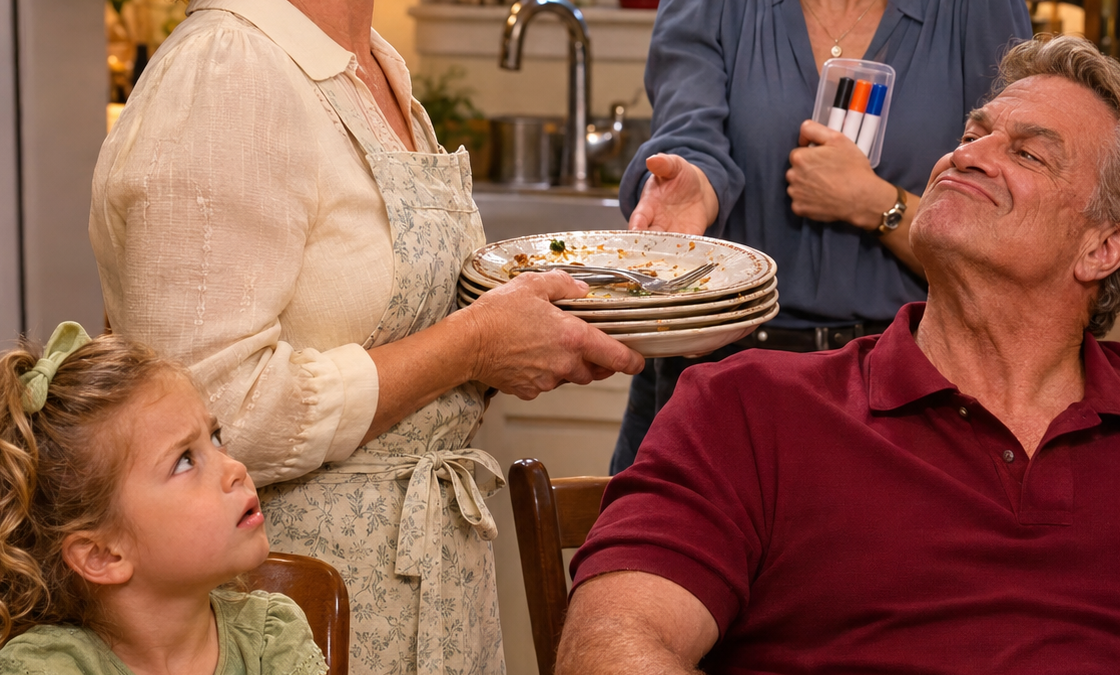
The chicken cooled while Russell rubbed his thumb across Brynn’s reusable calendar. My orange work blocks disappeared beneath a gray streak.
“Why are you taking Grandma’s colors off?” Willa asked.
Russell wrote GRANDMA across the weekday spaces.
“You stop cars. She has a career.”
Brynn stood beside him holding the marker box. She watched him fill the last space without saying anything.
“Well,” I said, “good thing I didn’t bring my résumé.”
Nobody laughed. Willa dragged a fork through her mashed potatoes.
“The orange ones were mine,” I told Russell.
“We can use another color.”
“I wasn’t talking about the color.”
He looked toward Brynn, whose mouth had gone small and straight. The marker cap fit loosely, clicking without catching.
“Let’s get everybody fed,” he said. “Then we can work this out.”
“You’ve already written it.”
“It wipes off, Nell.”
“So did my job, apparently.”
Brynn lowered the box against her hip. “Mom. Please.”
Outside her rental, somebody’s mower started, then stalled. It was Sunday, August 17, and the kitchen was still hot from the oven. I had brought the chicken because Brynn said Sunday dinner was easier when I handled the main thing.
I usually handled the main thing.
“My last summer day is August 29,” I said. “I go back September 2.”
“I know both dates.”
“You were sitting right here when we agreed.”
“I’m not saying you changed the dates.” Russell kept his voice level. “The cost changed what we can manage.”
“Then ask me.”
“We’re talking now.”
“No. You’re writing.”
Willa looked between us. “Am I going somewhere?”
“You’re staying right here tonight, honey,” Brynn said.
Russell bent close enough to see Willa’s plate. “Eat some chicken, too. Potatoes aren’t the whole dinner.”
“I know.”
“You’ve got a whole potato mountain there.”
She inspected it, then ate a bite of chicken. He waited until she swallowed before turning back.
“Brynn’s trying to get settled at work. She can’t spend every morning wondering whether somebody’s going to call.”
“Somebody being me?”
“I’m talking about a new arrangement. New people. You already know what Willa needs.”
Brynn stared at the chicken skin on her plate.
“Dad means I’m still learning,” she said. “There’s a lot coming at once.”
“I know you are.”
“And they’ve been patient. I don’t want to be the person who always needs—”
“You haven’t been,” I said.
“Yet.”
Russell nodded toward her. He didn’t have to repeat his remark about my work. She had supplied a quieter way to say it.
I picked up his empty plate, then Brynn’s. My own chicken sat almost untouched, but I stacked the plates anyway.
“Being available wasn’t the same as being asked.”
Brynn glanced at the dishes against my apron. “I would’ve gotten those.”
I stood there holding them.
“Then take them.”
She did, awkwardly, with the marker box still trapped beneath one arm.
Russell waited until she reached the sink. “Nobody’s saying you haven’t helped.”
“That isn’t what I asked you to say.”
“What would you like me to say?”
“That I’m going back.”
He looked at the spaces he had filled. “And then what happens here?”
The question landed where it always landed: between Willa’s chair and my place at the table.
Brynn ran water over the dishes. “I’ve called places, Mom.”
“I know.”
“Some don’t open early enough.”
“I know that, too.”
“And she cries when we visit.”
Willa looked up. “I didn’t cry at the fish one.”
“No,” Brynn said. “You didn’t.”
I nearly said that visiting wasn’t the same as being left there. The words were ready, familiar and useful. I swallowed them with a mouthful of cold water.
Russell watched me.
“You really want somebody else getting her breakfast? Getting her through all that?”
My knee pressed against Willa’s chair. She leaned over to examine a freckle on my wrist.
“You’re asking whether I’d let somebody else take care of her,” I said.
“I’m asking if you’ve thought about what that looks like.”
I answered him.
Russell stopped turning the marker cap. “You’d really let me—?”
“Yes. Even if that somebody is you.”
Brynn shut off the faucet.
Russell’s eyebrows drew together. “I work.”
“So do I.”
“I didn’t say you didn’t.”
“You just erased it.”
He looked away first, toward the stove. “There’s an afternoon shift I could ask about. Asking isn’t getting.”
“I haven’t said you have to get it.”
“You’re making it sound simple.”
“It isn’t simple. I still get to say when I’m available.”
Willa pushed her chair back. “Can I be done?”
“Yes,” Brynn said. “Plate stays here.”
I almost reached for it. Instead, I let her carry it to the counter herself.
“I’m talking about my own hours,” I said. “You can’t put them down before I offer.”
Russell pulled his chair closer to the table.
“You make nineteen an hour. Three paid hours. That’s two hundred eighty-five for a full week.”
“I know what I make.”
“The five-day place is three twenty-five.”
He was right. Paying for care cost more than my five-day gross pay. There wasn’t a clever answer tucked underneath that arithmetic.
Brynn dried her hands on a dish towel. “The woman I visited said she’d message me if anything opened.”
“Then let’s see what she says,” I said.
“And if there’s nothing?” Russell asked.
Brynn’s phone buzzed beside her plate. She checked the screen before I could answer him.
Brynn read the message twice. “She can hold three days, not five.”
“Which three?” Russell asked.
“She’s sending the details.”
Willa came back carrying a plastic horse without its tail.
“Grandma, bath?”
Brynn’s eyes stayed on the phone. “Could you stay through bath time? Just tonight. I need to answer this and get tomorrow ready.”
I had already stayed through dinner cleanup without eating my dinner. My purse was on the chair nearest the door.
“All right,” I said.
The answer came out before I considered whether I wanted to.
Upstairs, Willa insisted the horse needed a bath before she did. It floated sideways while she accused it of drinking her water.
“Horses don’t drink bathwater,” I told her.
“This one does.”
I laughed, though I was still angry. Downstairs, Russell and Brynn talked too quietly for me to make out the words.
Willa wanted her hair rinsed with the little cup, never the big one. I knew that. I knew which towel she wanted and how to keep water out of her ears.
I wanted them to miss knowing those things. The thought embarrassed me enough that I rinsed her hair twice.
“Done, Grandma.”
“Right. Sorry, sweetheart.”
Brynn appeared with pajamas tucked under her elbow.
“Thank you. I can take over.”
“You’ve got tomorrow ready?”
“Mostly.”
“Your lunch?”
“Mom, I’ve got it.”
I heard how quickly I had started checking.
She leaned against the doorframe. “I do have that one discretionary leave day approved. I’m hoping to save it.”
“For what?”
“I don’t know yet. Something I can’t work around.”
I wanted to ask whether my work counted as something she could work around. Willa was waiting with both feet planted on the bath mat, so I helped her into her pajamas instead.
Downstairs, my chicken was still on its plate. I covered it to take home.
Brynn’s work phone lit beside it: September 2 — first solo dispatch opening.
Chapter 2 of 7
“She means without my trainer,” Brynn said Monday morning. “I’ll open dispatch by myself.”
She called from her driveway before leaving for work. Willa was still asleep in my spare room.
“Do you know how to do it?” I asked.
“Mostly. It’s different when there’s nobody sitting beside you.”
Russell was there, too. His voice came through farther from the phone.
“That’s why I said just until your first review.”
“Dad.”
“Let me finish. Your mother keeps her return date. We ask whether she can move it. There’s a difference.”
“I heard you,” I said.
Brynn said nothing.
“When is the review?”
“I don’t have a date yet.”
“Then that isn’t a few extra days.”
Russell came closer to the phone. “Nell, she’s worried about making a mistake.”
“I know she is.”
“I can do the opening,” Brynn said. “I just don’t want to mess it up.”
I remembered her calling before her first driving test. I had wanted to sit beside her then, too.
“I’m coming this morning,” I said. “Like we planned. But August 29 is still my last day.”
“All right,” Brynn said.
Russell started another sentence. She ended the call before he finished it.
On Wednesday, August 20, I met Elaine Porter at the equipment check. She was sixty-three and had worked crossings longer than I had.
“Velcro’s catching lint again,” she said, inspecting her reflective vest. “By November I’ll be wearing half the dryer.”
My vest had a pale coffee spot near the bottom. I had washed it twice. Elaine said nobody approaching in a car would grade my laundry.
I checked the handle on my STOP paddle and walked with her to the intersection by my assigned elementary school.
Four years into the job, I still watched the same driveway twice. A hedge hid the first few feet of it. A car could appear between one glance and the next.
Elaine stood where a child would wait.
“Ready?” she asked.
“Wait a second.”
A driver had slowed at the corner, then started turning before I had moved out. I stayed back and kept Elaine beside me. The driver noticed us, braked, and waved.
We waited for the car to finish.
“Happens there,” I said.
“Which is why we’re standing here.”
We walked the crossing, checked the view around a parked van, and walked it again. By the third pass, sweat had collected under my collar.
There was no audience. Most of doing the job well was watching until it was time to move, then watching some more.
“I’m back September 2,” I told Elaine.
“Good. They’ve got the earlier days covered.”
“I confirmed it Monday.”
“Then quit telling me like you’re asking permission.”
She said it kindly, which made my face hotter.
On Friday, August 22, Brynn asked me to come on her second visit to Maple Steps. She had arranged a time with Dana Price after work.
“You’ve got questions I won’t think of,” she said.
That pleased me more than it should have.
Dana’s home daycare was in Cedar Rapids, a short drive from Brynn’s rental. Willa remembered the basket of toy animals near the door. She selected a giraffe and stood close to Brynn’s leg.
Dana was forty-six, with reading glasses hanging from a cord. A small sock lay beneath a child-sized chair.
“Somebody always goes home with one less,” she said when Willa spotted it.
“Whose is it?”
“I’m still investigating.”
Brynn asked about drop-off before anything else.
“You’re sure five-fifteen works?”
“Wednesday, Thursday, and Friday. Those are the days I can offer.”
“And breakfast?”
“Here. You don’t need to feed her before you come.”
Brynn asked about lunch, naps, and where Willa would be while the older children ate. Dana answered without pretending that every child settled in immediately.
“She may be upset when you leave,” she said. “We’ll talk about what helps.”
Willa pressed the giraffe against her cheek.
“The full week was $325?” Brynn asked.
“Yes. Three days would be $195.”
“And pickup around two-fifty-five?”
“That works for me.”
Brynn had brought the rate sheet from her first visit. She kept looking at it, though the prices hadn’t changed.
“What if she won’t eat?” I asked.
“We offer the meal. We don’t make it a fight.”
“She sometimes says she’s finished when she’s barely started.”
“We see that.”
“She needs somebody who knows when she’s just saying it.”
Dana waited.
“You can’t know her the way I do,” I said.
Brynn’s face changed. I tried to soften it.
“I only mean she’s used to me.”
“I’m sure she is,” Dana said.
Willa had begun arranging animals beneath the chair. Brynn told her we would be right outside, where she could see us through the screen door.
On the porch, my daughter spoke quietly.
“Why did you come?”
“You asked me.”
“To help.”
“I was explaining what she needs.”
“You made it sound like nobody else could feed her lunch.”
“That isn’t what I said.”
“It’s what you kept getting around to.”
A lawn sprinkler ticked across the yard next door. Through the screen, Willa asked Dana whether giraffes slept standing up.
“You want me to find someone,” Brynn said. “Then you talk like leaving her here would be neglect.”
“I didn’t use that word.”
“Mom.”
I looked at the porch steps. There was a worn place in the paint where people stood waiting.
“I made that harder.”
“Yes.”
“I’m sorry. You were doing fine.”
“I need to find out if this works. I can’t spend the whole visit defending why I’m here.”
We went back inside. Willa had found a second giraffe.
“I’m sorry, Dana,” I said. “I talked as if you couldn’t learn what Willa needs.”
“We’d have some learning to do,” she said.
I nearly supplied another detail about lunch.
Instead, I asked, “What would you like Brynn to send for nap time?”
“A familiar blanket is helpful. Nothing irreplaceable, if possible.”
Brynn asked how to reserve the place.
“A $65 payment holds the three days,” Dana said. “It’s credited toward the first $195 invoice.”
“I’m going to check the rest of my week before I pay.”
“That’s fine. Let me know.”
Outside, Brynn said she wanted to call Dana herself with any remaining questions.
“All right.”
“Without you making a list.”
“I said all right.”
She looked tired. I was tired of hearing myself sound injured.
At the car, Willa asked whether the giraffes would still be there next time. Brynn told her we would ask.
My phone buzzed before we left. Russell had sent a message.
I’ll keep Willa Saturday, August 23. 5:20 a.m. until 3:05 p.m. You make plans, Nell. Not in the house.
Chapter 3 of 7
Russell arrived at Brynn’s at 5:20 Saturday morning, wearing an old sweatshirt Willa liked because it had a pocket big enough for her horse.
“She wants toast cut straight across,” I told him. “Not triangles.”
“I want cereal,” Willa said.
“She wanted toast a minute ago.”
Russell looked at her. “Cereal it is. Where’s your mother keep your rain jacket?”
“Hooks by the back door,” Brynn said.
He checked there, then asked which shoes could get wet. I had expected questions about breakfast, the bathroom, what to do if she cried. He wanted shoes.
Brynn was taking the trial day for errands she usually squeezed around Willa. I had arranged breakfast with Elaine, followed by a quilt shop in Marion.
My purse strap had caught beneath my coat.
“You’ve got your phone?” Russell asked.
“Yes.”
“All right. See you this afternoon.”
Willa wanted a kiss, then wanted me to see the horse disappear into his pocket. I stayed through the demonstration.
At the door, I started to mention her snack.
Brynn said, “Bye, Mom.”
I left.
Elaine met me at a diner at six. She ordered eggs over easy and told the waitress she meant easy, not frightened.
“You’re checking that thing again,” she said.
My phone lay beside the menu.
“I’m checking the weather.”
“Rain.”
“I can see that.”
“Then we’ve settled it.”
I put the phone in my purse. That was the one deliberate act I managed without turning it into a production.
We ate slowly. Elaine complained about a seam in her sock. I told her about a cabinet door that wouldn’t stay shut. For almost twenty minutes, nobody needed me to explain a child.
The quilt shop opened later. We spent the gap browsing a thrift store, where Elaine considered a lamp shaped like a duck.
“Don’t,” I said.
“You haven’t seen my living room.”
“I’ve seen enough.”
By the time we reached the fabric bolts, rain was bouncing off the sidewalk. My phone had no missed calls.
I wanted that to feel better than it did.
Russell called after lunch.
“She says she needs the hall light,” he said. “You leave it on for her nap?”
“Yes. Door cracked, light on.”
“Okay.”
“Did she eat?”
“Most of her sandwich. Some pear.”
“And—”
“She’s safe, Nell. I’m asking about the light.”
“I know. Leave it on.”
I almost said I could come back if she wouldn’t settle. Elaine was halfway down an aisle, studying fabric covered in tiny red barns.
Russell waited.
I said nothing at all.
“All right,” he said. “See you at three-oh-five.”
Afterward, I bought enough blue cotton to repair a cushion cover. I didn’t need new fabric. I needed to finish the outing I had chosen.
We returned at 3:05. Brynn’s car pulled in behind mine.
Willa came to the door rubbing one eye. Her hair had flattened on one side.
“Grandma!”
She wrapped herself around my legs, then turned toward Russell.
“Tell her the tunnel.”
“You tell her.”
“We made a tunnel, but he couldn’t fit.”
“He” was right there, with a strip of paper taped to his sock.
Rain had kept them inside. Two dining chairs and a blanket had become a tunnel, then a veterinary office. They had fed lunch to the stuffed animals before eating their own.
“She got mad about snack,” Russell said.
“You forgot my crackers,” Willa told him.
“I offered you crackers.”
“The round ones.”
He had offered square ones. Her usual snack had come late, and the nap had followed late, too. She was cranky when Brynn said it was time to put the blanket away.
“I wasn’t done.”
“You can leave it for a little while,” Brynn said.
Russell said, “We said we’d clean it up.”
Willa cried. He waited beside her until she could help.
I searched for something I needed to fix. There was a sticky place on the table and a damp sleeve near the sink. Willa had eaten, slept, played, and gotten irritated. She kissed Russell’s cheek before asking me to carry her.
Nobody had won anything she could name.
On Sunday, August 24, we met again at Brynn’s. I brought the repaired cushion cover because she had asked for it weeks earlier.
Russell was there when I arrived.
“Yesterday ought to take some worry out of it,” he said.
“It went fine.”
“Better than fine. She and I can manage.”
“I saw that.”
“So we’ve got some room to work with. My time, some paid days, yours while Brynn gets settled.”
There it was again, my time brought in before I offered it.
“I said August 29.”
“I heard you. I’m asking you to look at the whole thing.”
“You’ve never organized your life around anybody else. It’s easy to tell me—”
“Mom,” Brynn said.
Russell’s mouth opened, then closed.
Brynn stood near the couch, still wearing the shoes she had gone out in.
“My knee.”
“That was different.”
“What was different?”
“You were hurt.”
“And Dad took me.”
“I took you plenty of times.”
“I didn’t say you didn’t.”
Russell looked toward the window. He wasn’t helping her make the case. That made it harder to brush aside.
Brynn said, “The six early appointments. Before school. He changed things at work.”
Physical therapy. She had been a teenager, furious about crutches and missing things her friends did. Russell had driven her while I opened at my job.
I remembered those mornings. I remembered being glad he had handled them.
Somewhere after our divorce, I had stopped including them when I told our history.
“You picked her up, too,” I said.
“When she needed it,” Russell said.
“You did show up.”
He nodded once.
“I shouldn’t have said never.”
“No.”
Brynn sat down. She looked relieved, but wary, as if an apology might require her to choose a side next.
I had done that to her before. Asked who remembered the birthday cake, who bought the coat, who stayed home. Even now, with her own child nearby, I had reached for the old score.
“I left things out,” I told her. “Things your dad did.”
“You both did things.”
“Yes.”
Russell said, “I appreciate you saying it.”
Then he waited. I knew that waiting, too.
“My return date stays the same,” I said.
“I wasn’t trading.”
“I know. I needed to say it anyway.”
On Monday, he called while I was getting Willa’s breakfast. His supervisor had sent a notice about the offered shift.
He read the last line aloud.
“Selection has to be in by 10:00 a.m. Thursday, August 28.”
Chapter 4 of 7
“The offer is four in the afternoon until two-thirty in the morning,” Russell said. “Tuesday through Friday. I could cover Monday and Tuesday, but I’d be off those six scheduled Saturday maintenance jobs.”
It was still Monday, August 25. Willa was eating breakfast while he explained it over the phone.
“Forty base hours,” he added. “Same hourly pay. I wouldn’t lose that.”
“But the Saturdays.”
“Four hours each. A hundred ninety-two dollars a Saturday.”
Willa asked for more milk. I told her I’d get it.
“I’m sixty-one, Nell. I’ve got eighteen thousand four hundred left on that consolidation loan. Four-ten every month. I’m trying to have it gone before I retire.”
“I know you are.”
“Then you know why I’m not jumping at this.”
“I haven’t asked you to jump.”
He paused. “Brynn got a deadline from Dana, too. We need to sit down.”
We met Wednesday evening, August 27, at Brynn’s kitchen table.
She had made scrambled eggs for supper. Willa called them supper eggs and wanted to know whether breakfast eggs were a different kind.
“Same eggs,” Brynn said.
“Then why don’t we have toast?”
“We do have toast.”
“Okay.”
For a few minutes, that settled the largest problem in the kitchen.
After Willa went into the living room, Brynn showed us her pay statement.
“About seven-ten coming home in an ordinary week,” she said. “Not eight-sixty. That’s before everything comes out.”
Russell nodded. “We use what actually lands.”
“Daycare is $195 a week. Wednesday, Thursday, Friday.”
“And the car?” he asked.
“Two-forty.”
“Does it have to happen now?”
“The shop said it’s safe to drive. It can wait until October twenty-fourth.”
Her car had already waited through other expenses. I wanted to tell her I would pay for the repair. I hadn’t come intending to, but there it was, another way to make myself necessary.
She continued before I could speak.
“That leaves five-fifteen before groceries and everything else. I know it isn’t all spare money.”
“No one thinks it is,” Russell said.
He looked at me.
“Five days with Dana would be three twenty-five. Your full week is two eighty-five before deductions.”
“Yes.”
“So we’re spending more than you earn to have you work.”
“That part is true.”
Brynn looked up. “Mom?”
“The five-day price is more than my gross pay. He’s right about that.”
Russell leaned back. “Thank you.”
“I wasn’t arguing with the numbers.”
“Then let’s do something that helps everybody. Brynn pays you what you’d lose. You stay with Willa. She’s still ahead compared with buying five days.”
Brynn’s eyes moved between us.
“You’d take two eighty-five?” she asked.
“I haven’t said I would.”
“Less than that, maybe,” Russell said. “Once you account for what she actually brings home. We can work out something fair.”
“What hours would that buy?”
“The hours Willa needs care.”
“Five-twenty until three-oh-five?”
“Yes.”
“Every weekday?”
“That’s the need, Nell.”
“And when does it stop?”
“Once things ease up.”
Brynn rubbed at a tired patch beneath one eye.
“Could we pick a date?” she asked.
“We picked August twenty-ninth,” I said.
Russell’s voice stayed even. “That was free help. I’m suggesting you get paid.”
“I know what you’re suggesting.”
“You’d be home with your granddaughter instead of standing outside this winter.”
“I like standing outside.”
“You like February?”
“No. I own a coat.”
Brynn gave a small laugh, then looked down again.
Russell didn’t laugh. “You’d rather have less money coming into the family?”
“I’d rather keep my job.”
“Even with somebody replacing the money?”
“Yes.”
He studied me for a moment.
At fifty-nine, I still found it hard to leave a kitchen where my daughter looked worried. My crossing hours occupied only part of the day. I could hear every empty hour being counted against me.
“I don’t want to sell you the rest of my weekdays,” I said.
“That makes it sound ugly.”
“I’m trying to answer the offer.”
Brynn said, “I wouldn’t want you trapped.”
“But when I wanted to stop, we’d be back here. You’d still need care.”
Neither of them answered that.
From the living room, Willa asked whether someone could fix her horse’s blanket. Brynn called back that she would come in a minute.
Russell said, “If I do this, I need you not checking everything I do.”
“I can do that.”
“Saturday you asked about lunch before I’d finished asking about the light.”
“I did.”
“I’m not doing two days a week with you coming by to see whether I’ve used the right crackers.”
I could have defended the question about lunch. It had been ordinary enough. The wish underneath it wasn’t.
“I won’t inspect you,” I said. “And I won’t make a list of what went wrong so I can say you need me.”
Brynn looked directly at me then.
“I’m keeping my return date,” I added. “I’m not taking replacement wages.”
Russell waited.
Usually I filled that wait. I offered an extra week, a morning, anything that let us leave without looking disappointed in each other.
Brynn went to help with the blanket.
“You’re really leaving it there?” he asked.
“Yes.”
He watched the doorway where she had gone.
“All right. I need to think.”
On Thursday morning, August 28, Brynn called Dana herself. I was at the house for my promised childcare hours, listening from the kitchen while Willa hunted for a missing shoe.
“Yes, the three days,” Brynn said. “Starting Wednesday, September third.”
She paid the $65 reservation credit. The receipt showed $130 remaining on the first $195 invoice.
“I can forward this to you,” she told me afterward.
“You don’t need to.”
“I mean, so you know it’s done.”
“I believe you.”
She read it once more anyway. Then she called Willa over to find the shoe together.
Russell submitted his request before the ten o’clock deadline. He called Brynn, who put him on speaker.
“This is a six-week experiment,” he said. “I’m not agreeing to every Monday and Tuesday from now on.”
“Okay,” she said.
“We review it after six weeks. All of us.”
“Yes, Dad.”
“I’ll be there five-twenty. You’re back three-oh-five. I leave at three-twenty-five for work.”
His drive took twenty-five minutes, leaving ten minutes before his shift. Monday and Tuesday care would follow nights he wasn’t working.
Brynn said, “I’ll be home.”
Later, Russell sent her the approval. It changed his work schedule, not what anyone owed him at her house. He could still decline the care before it began.
He sent me the message, too.
The final line removed his name from the Saturday maintenance roster beginning September 6.
Chapter 5 of 7
“That message is real,” Russell said when he called Friday morning. “They approved it.”
“I saw.”
“I want us to reconsider before Tuesday.”
Willa was at my kitchen table, pressing raisins into a piece of toast. It was August 29, my last promised summer day.
“Can you change it back?” I asked.
“I can ask. Somebody has to approve a reversal. I can’t just show up on the old shift.”
“All right.”
“That doesn’t mean I’m saying I won’t help.”
“I heard you.”
He paused, perhaps waiting for more. Willa held up her toast.
“It’s a face.”
“It needs a nose,” I told her.
Russell said he would talk to Brynn.
The day went mostly as our summer days had gone. Willa needed help getting one sock on, though she had managed the other. We walked to the corner and back because she wanted to look for a feather.
At lunch, she asked for noodles without sauce, then dipped each noodle in mine.
“You could have had sauce.”
“I’m dipping.”
There was no answer worth making to that.
After her nap, I brought out the bag Brynn had sent for her things. We packed the small blanket, the stuffed dog with one flattened ear, and the spare clothes from my bottom drawer.
Willa pulled the dog out again.
“He can’t breathe.”
“Leave his head out, then.”
“Is tomorrow another Grandma day?”
“Tomorrow’s Saturday. You’ll be with your mom.”
“Then after?”
“Sunday, then Monday. Tuesday I go to my crossing.”
“Do I go?”
“No, honey. The plan is Grandpa here with you Tuesday. Your mom and Grandpa are still working out that morning. Wednesday you go to Dana’s.”
“With the giraffes.”
“Yes.”
“Does Grandpa know my cup?”
“He can find your cup.”
She considered that, then tucked the dog beneath the blanket with his head showing.
I wanted to explain more. I wanted her to ask about my work, so I could give her an answer that sounded cheerful and certain. She wanted to know whether the bag had room for her slippers.
It did.
Brynn arrived at 3:05. She looked into the bag before she looked at me.
“All of it?”
“Just her everyday nap things. There’s still a toothbrush here.”
“Right.”
She had the first daycare invoice on her phone. The reservation credit had been applied; $130 remained.
“I’ll pay the balance tonight,” she said. “Then it’s the full weekly amount after that.”
“Did you call about the car?”
“October twenty-fourth. They put me down.”
“And they’re still saying—”
“It’s safe, Mom. It can wait.”
I stopped there.
Willa insisted on carrying the bag herself. It bumped each porch step behind her. Brynn offered to help twice before Willa let her take one strap.
I watched them get into the car, then went upstairs to put away the sheet from the spare bed.
Her room sounded different.
Without the blanket and dog, the dryer turning downstairs seemed louder. I left the clean sheet folded on the mattress.
At supper, I cooked too many noodles. I ate some standing at the counter before getting myself a plate.
By Labor Day, September 1, I had washed my work clothes and checked the forecast three times. I woke early anyway.
Brynn asked me over that afternoon while she got Tuesday ready. Willa was matching socks in the living room, accepting only pairs whose toes pointed in the same direction.
Russell arrived while Brynn was packing her lunch.
“I’ve been thinking,” he said.
Brynn kept working. “About tomorrow?”
“About not making tomorrow the point where everything has to change at once.”
I stood by the doorway.
“If you use the day you’ve got,” he told her, “I can ask about going back to my old shift. We get a little room to look at a longer bridge.”
Brynn looked up. “A bridge with who?”
“That’s what we’d work out.”
“Dana starts Wednesday.”
“I’m not saying cancel Dana.”
“What are you saying?”
“Keep what you’ve booked. Give me Tuesday to talk to work. Then we look again instead of charging into something we’re already worried about.”
He turned toward me.
“I’m asking us to consider it, Nell.”
“Does going back depend on somebody else taking your new shift?”
“It depends on what they can arrange. I don’t have an answer yet.”
Brynn shut the refrigerator.
“And if they say no?”
“Then we know.”
Her lunch was packed. Her shoes were beside the door. Everything looked ready except the three adults standing in her kitchen.
“My approved leave is still there,” she said. “I checked.”
Russell nodded. “So there’s a way to handle tomorrow.”
“There’s a way for me to stay home tomorrow.”
“Yes.”
“That’s all I’ve confirmed.”
He waited for her to continue.
“I have to call before 5:15 a.m. They’ll arrange coverage for dispatch.”
“You’re allowed to take it.”
“I know.”
I had been watching a damp place darken her shirt where she’d leaned against the counter. She was thirty-seven, with a lunch packed for a job she wanted to keep. I could still hear her at twelve, asking whether I could drive her somewhere because everyone else was going.
I nearly offered the morning.
Only until she had opened dispatch. Only until Russell had spoken to his supervisor. I could hear how easily the offer would come out.
Instead, I said, “I’ll be leaving for work in time for my seven o’clock assignment.”
Brynn looked at me.
“I know, Mom.”
She hadn’t asked me to take her place. I had been ready to answer a request she hadn’t made.
From the living room, Willa called, “These aren’t the same blue.”
“They’re close enough,” Brynn called back.
“They aren’t.”
Russell went to look. He agreed they weren’t, then helped her find the other one.
I left before supper. At home, I checked my alarm and tried to watch a show I had already seen. I missed enough of it to lose track of who had the missing car.
Brynn sent the Tuesday details that evening. She needed to leave at 5:20 if she went in. I was to come before then. Russell would be there, too.
She added that Willa’s breakfast was ready to heat.
I answered that I would be there.
At 9:18 p.m., Brynn texted again: Dad will come at 5:05 with his work lunch. He hasn’t committed to staying.
Chapter 6 of 7
Before anybody volunteered me, I met Russell at Brynn’s door at 5:05 a.m. He had his work lunch tucked under one arm.
“Give me five minutes,” he said.
Brynn stood behind me, dressed for dispatch. The kitchen light made the windows look black.
On the wall, GRANDMA still filled the spaces where my orange work blocks had been.
“One day of leave,” Russell said. “That’s all I’m asking you to consider this morning.”
Brynn went to stand beside him.
“You take today,” he told her. “I talk to work about reversing the shift. We keep the daycare reservation while we figure out something that doesn’t eat up this much money.”
“And tomorrow?” she asked.
“Dana tomorrow. That’s paid for.”
“Not the whole week after that.”
“I know. That’s why we should give ourselves some room.”
He looked at me.
“Your summer agreement ended Friday. You said September second, and here we are. I’m not disputing any of that.”
I sat at the table. My work bag rested against my ankle.
“But there’s nothing wrong with looking again,” he said. “Not when we’re spending more for care than your job brings in.”
“That calculation hasn’t changed.”
“Exactly.”
“Neither has what I said.”
“Nell, nobody’s asking you to stay today. Brynn has leave.”
“And after you change your shift back?”
“We’d discuss it.”
“With my weekdays waiting there.”
“We haven’t agreed on anything.”
“You wrote it on the wall.”
He glanced at the calendar.
Brynn watched him, then looked down at her shoes.
“Every bridge ends up at my mornings,” I said. “Even this one. You go back to your old hours, and then we discuss when I’ll stop working.”
“There could be a combination.”
“There can be. Without holding my hours open.”
I put on my reflective vest. One side caught against the back of the chair.
“I’m going to work. Please decide without spending my morning.”
Russell’s eyes stayed on the vest.
“Brynn pays for that decision,” he said. “You know she does.”
“Yes.”
“Money she needs. And now she might call out the first morning they trust her to open alone.”
Brynn spoke before I could.
“Are you taking the trial, Dad?”
“I’m trying to keep you from having to—”
“Or should I use my approved leave?”
He looked at her.
“It’s five-eleven,” she said. “I need an answer.”
She came around the table and sat in the chair beside mine. Her phone went on her side, with the number she needed already on the screen.
“Mom, I’m sorry I held that box.”
I could see her standing there again, letting him write.
“I should’ve said something,” she added. “I kept thinking you’d stay anyway.”
I wanted to tell her she had good reason to think that. Instead, I waited.
“If Dad says no, I’ll make the call,” she said. “I’m not asking you again.”
Russell looked between us.
“And the three days are actually held? Not somebody telling you she’ll try?”
“Wednesday, Thursday, Friday. Five-fifteen drop-off. I paid the first invoice.”
“All three days, through the afternoon?”
“I pick her up around two-fifty-five. Home by three-oh-five.”
“And Monday?”
“You and Tuesday, if you want to do it. You said six weeks. We review it after that.”
He looked toward the hall. Willa’s door was still closed.
“I’ve got forty hours on that shift,” he said. “Those don’t change.”
“I know.”
“The Saturdays do.”
“I know that, too, Dad.”
He stood there long enough that Brynn checked the time again.
“All right. I’ll take the two mornings.”
“Six weeks?” she asked.
“Six weeks.”
He looked at me when he said the rest.
“That’s six Saturday overtime slots. Eleven hundred fifty-two dollars gross.”
Brynn didn’t turn toward me.
“Yes,” she said. “I heard you.”
“I’m not going to pretend I won’t miss it.”
“I’m not asking you to.”
He put his lunch in the refrigerator.
“Where’s the breakfast you said was ready?”
“Front shelf. Blue lid. Eggs and potatoes.”
“She’ll eat potatoes this early?”
“Usually. There’s cereal if she doesn’t.”
“I can manage breakfast. I’m asking what you left.”
“Right. Sorry.”
Neither sounded relieved.
He asked where Brynn kept the number for dispatch, in case she was late getting home.
“I’ll answer my cell.”
“And if you can’t?”
She told him the number. He repeated the last four digits.
Willa called from the hall then, cross about being awake.
“Why’s everybody talking?”
Russell went to her. “Because we forgot to whisper.”
“You woke my dog.”
“Sorry about your dog.”
She appeared carrying him by one leg. When she saw my vest, she stopped.
“You’re going now?”
“Yes, sweetheart.”
Brynn needed to leave. I needed to stop standing there making it harder.
“Have a good morning,” I told her.
“You, too, Mom.”
She looked as if she wanted to say more. Then she went out to her car.
I followed, but Willa called me back for one more goodbye. I kissed her warm forehead while Russell waited beside her.
“Grandpa’s doing breakfast,” I said.
“I know.”
She sounded impatient with the explanation. I was the one who needed it.
I went home first. There was time before my seven o’clock assignment, too much time to picture their kitchen without me.
At the crossing, a boy dropped a folder and chased a worksheet along the sidewalk. His mother caught it against a fence.
“Rough start,” she said.
“Still got it,” I told her.
I worked until eight-thirty, then returned for the afternoon assignment, two-forty-five to four-fifteen. Cars turned. Children stopped to retie shoes. One girl told me about a loose tooth without opening her mouth enough to show it.
At 3:05, while I was watching the intersection, Brynn got home to Willa and Russell. Nobody needed to call me.
Wednesday’s daycare drop-off involved tears. Brynn told me afterward, not during.
“She ate breakfast once I left,” she said.
I asked how opening dispatch had gone.
“I had to check one thing. Otherwise, okay.”
The following Tuesday, Russell called me after his long stretch of care and work.
“Left her place at three-twenty-five. Made it with ten minutes.”
“You sound tired.”
“I am tired.”
I nearly offered next Tuesday. He hadn’t asked.
“That’s a long day,” I said.
“Yep.”
On Thursday, Brynn asked whether Willa could visit me Friday after daycare.
“Until five-thirty. I need groceries without her.”
“I’d like that. Five-thirty pickup.”
“Five-thirty.”
On September 12, Willa and I made biscuit pizzas. She counted each piece of pepperoni before eating it separately.
Brynn arrived on time. Two weeks of daycare had been paid. Russell had missed September 6 overtime; the next slot was the following morning.
After they left, Brynn sent a list for their September 21 review.
The last item read: Dad can’t cover Tuesday, October 14, if we continue.
Chapter 7 of 7
“I’ve asked Dana about October fourteenth,” Brynn said at our September 21 review. “A separate paid day. I’m waiting for her to confirm.”
We were at her kitchen table. Willa was in the living room, telling her stuffed dog to stop interrupting.
“If she has room, I’ll pay for it,” Brynn added.
I almost praised her. The words sounded wrong before I said them, as if she had brought home a good report card.
Instead, I asked, “When will you hear?”
“This week.”
Russell said, “I won’t be available that Tuesday. Even if we keep going.”
“I put it on the list, Dad.”
“I’m making sure.”
“I heard you.”
The first three weeks had cost Brynn $585 in daycare invoices. The $65 reservation was part of that total, not another charge.
Russell had passed up September 6, 13, and 20: $576 gross he hadn’t earned.
He mentioned the loan payment. Brynn mentioned groceries. Nobody looked at me as if I had another column to add.
“I need an extra paid day next week, too,” she said. “Dad’s got an appointment Monday.”
“Did Dana have it?”
“She does. I booked it.”
I had been free that Monday after my morning crossing. I let the booking stand.
Willa appeared in the doorway.
“Are you done with the talking?”
“Nearly,” Brynn said.
“You said that already.”
“She gets that from you,” Russell told me.
“She gets the clock-watching from you.”
Brynn laughed before she could stop herself.
It wasn’t much, but I stayed for coffee.
By October 10, the sixth workweek was finished. Willa knew which hook was hers at Dana’s. She still complained about leaving some mornings. Other afternoons, Brynn had to wait while she finished playing.
Russell completed his mornings without my inspection. Sometimes he told me what they had done. Sometimes I heard nothing.
The sixth Saturday maintenance opportunity passed on October 11. His total forgone overtime came to $1,152 gross.
At our October 12 review, he looked tired.
“I can keep the two mornings for now,” he said. “I can’t make this my permanent answer without checking again.”
Brynn nodded.
“Tuesday is a long stretch,” he continued. “Care all day, then work until two-thirty. And four evenings a week, I’m gone.”
“You get Monday night,” Brynn said, then stopped. “Sorry. That didn’t help.”
“No.”
I knew the answer I once would have given. I had worked tired. I had missed evenings. As if his complaint could erase anything I had done.
Instead, I asked, “What do you want to agree to?”
“Through November. Same mornings. Then we talk before December.”
“Except this Tuesday,” Brynn said.
“Except this Tuesday.”
“Dana confirmed it. Sixty-five dollars. Already paid.”
He looked relieved, though he only said, “Good.”
Brynn could keep paying for Wednesday through Friday. Russell could give the two mornings he had named. My crossing schedule stayed mine.
“And if you can’t do another morning?” she asked him.
“Tell you as soon as I know.”
“I’ll ask Dana first. If she can’t, I’ll have to look for other paid care or use leave.”
“You can ask me, too,” I said.
Both of them looked up.
“Ask,” I repeated. “I might say yes. Don’t build the plan on it.”
Brynn nodded. “Okay.”
October 14 came and went with Willa at Dana’s. Russell kept his own plans. I worked both crossings.
Nobody called to check whether I was really busy.
Brynn had the $240 repair done on October 24. The car came home safe, as it had gone in, with one postponed expense finally crossed off.
She called me from the shop while she waited.
“Do you need a ride?” I asked.
“No. They’re almost done.”
“Oh.”
“I was just calling.”
We had lost some of that. For weeks, our calls had concerned a handoff, an invoice, a date somebody needed confirmed.
I asked whether she had eaten lunch.
“Yes, Mom.”
“Right.”
Then she told me about a dispatcher who kept calling every missing shipment “our little adventure.” She did the voice badly enough to make me laugh.
We talked until they called her name.
On November 16, we ate Sunday dinner at Brynn’s. I brought a bag of rolls because she had asked, not the main dish.
She made a pot roast. One carrot stayed hard no matter how long she cooked it.
“That one’s decorative,” Russell said.
Willa tried to bite it.
“Don’t eat the decorations,” he told her.
After dinner, Brynn asked about a Saturday visit.
“Not for errands,” she said. “She wants to go somewhere with you.”
“The library,” Willa said. “And get a muffin.”
“That sounds like two places,” I said.
“It is.”
“I could do one Saturday visit a month,” I told Brynn. “If you ask me ahead. We’ll choose the date.”
“Okay.”
“Not a standing emergency day.”
“I know what you’re offering, Mom.”
I stopped explaining.
Russell was sitting across from me. He had agreed to keep his two mornings through December, with another conversation before January.
He looked toward the kitchen wall.
“I shouldn’t have erased your hours.”
I waited, but he didn’t add anything about daycare prices or winter weather.
“No,” I said. “You shouldn’t have.”
“I’ll ask next time.”
“All right.”
Brynn brought over the reusable calendar. She wrote my work hours first, beside Willa’s daycare days and the mornings Russell had accepted.
“What are the orange squares?” Willa asked through a mouthful of roll.
“My crossing hours,” I said.
“All of them?”
“The ones I’m working.”
Brynn checked a weekday afternoon.
“I’ve got an appointment there. I haven’t figured that one out.”
Russell shook his head. “I can’t take the afternoon.”
I had no crossing then, but I hadn’t decided what I wanted to do. Brynn left the square blank.
“We can come back to it,” she said.
Willa wanted to choose our Saturday. Brynn checked the date, and I agreed to pick her up at ten and bring her home at two.
“With the muffin,” Willa reminded me.
“We’ll write library. I’ll remember the muffin.”
She asked me to draw a small book in our square. Brynn gave me the marker, and I drew one with crooked pages.
The unclaimed afternoon remained empty.
I capped the marker and passed it back.








