My father used his Citizen of the Year speech to blame me, after owing me $12,000—But a school custodian stood up, and the plaque was taken back that night.
Complete story · 9 parts · about 35 minutes · ending included
Part 1 · Part 2 · Part 3 · Part 4 · Part 5 · Part 6 · Part 7 · Part 8 · Part 9
Part 1 of 9
My father pointed at me in my scrubs before 140 people and blamed me for being unreachable when my daughter needed me. I didn’t argue. Seconds later, the school custodian stood up with his own award in his hand. Three weeks before that, at 7:04 p.m. on October 16 last year, the ICU desk phone rang, and Beth Aho’s first words were, “Ruthie is safe.”
I gripped the receiver tighter.
“Safe where?”
“At Hillcrest. She’s with me.”
Beth was Hillcrest Elementary’s assistant principal. Ruthie was nine, in fourth grade there, and at that hour she was supposed to be with my father.
I looked through the glass toward my patients’ rooms.
“What happened?”
“A man found her walking on the road in the sleet.”
My pen stopped over the chart in front of me.
“Walking where?”
“Toward home.”
“Why?”
“We’re still sorting that out.”
My phone was in my locker. That was where it stayed during a shift unless I was on break. I had started at 7 a.m. and was scheduled until 11 p.m., a double I had agreed to because my father had promised to pick Ruthie up from reading club.
At the side door.
At 4:00.
He had said, “I’ve got her. Go save lives.”
I pressed the receiver against my ear.
“Where is my father?”
Beth paused.
“He was picking Ruthie up at four.”
“I know.”
“Where is he?”
“That’s what I need to talk to you about.”
My eyes went to the clock above the ICU desk.
Beth said, “Ruthie is cold and scared, but she is not hurt. I want you to hear that clearly.”
“I heard you.”
“She was found and brought back here. We tried your cell earlier.”
“It’s in my locker.”
“We tried the other number we had too.”
My fingers tightened around the cord.
“My father’s?”
“Yes.”
“What happened when you called him?”
Another pause.
“I think Principal Lindahl is going to want that conversation handled through his office.”
That was a sentence from a school office, and I was a mother holding a phone.
“Beth, did my father come to get her?”
“I can tell you he is not here now.”
I looked across the unit.
Another nurse had already seen my face. She came around the desk and held out her hand for the patient sheet.
“Go,” she said.
“I’m in the middle of a double.”
“I know.”
“I have patients.”
“I have them.”
She took the sheet from my free hand.
Beth heard enough through the receiver to say, “We’ll stay with Ruthie until you get here.”
“I’m coming.”
I hung up, got my phone from the locker, and found the missed school call and voicemail from 4:40.
I did not play it.
Beth had already told me the only part that mattered first.
Ruthie was safe.
Outside, the sleet had turned the parking lot slick and silver. Duluth hills were bad enough in weather without a child walking them alone.
I kept both hands on the wheel.
At each stop, I saw the same picture I had not actually seen: Ruthie’s backpack, her coat, the road.
I cut it off every time.
Facts first.
Safe at school.
Found walking.
Cold.
Scared.
Not hurt.
I reached Hillcrest at about 7:30.
The front office lights were still on. Beth met me inside and led me down the quiet hall toward the nurse’s room.
Ruthie sat on the edge of the cot wearing a lost-and-found sweatshirt that came past her wrists.
Her hair was still damp around her ears.
“Mom.”
I crossed the room and crouched in front of her.
“Show me your hands.”
She held them out.
Cold fingers. No cuts.
“Feet?”
“Fine.”
“Head?”
“I’m okay.”
Only then did I put my arms around her.
She tucked her face against my shoulder.
Beth stood near the doorway.
“She’s had time to warm up,” Beth said. “We’ve been keeping an eye on her.”
“How did she get back here?”
“A man from the school found her.”
A slow voice came from the hallway.
“That was me, ma’am.”
The man who stepped in was Odell Tate, Hillcrest’s custodian. I knew his face from school events, but Beth gave me his name before I had to ask.
“Odell’s been here thirty years,” she said.
Odell was still in work clothes. He carried Ruthie’s backpack by the top loop in one hand.
“I was driving to get ice melt,” he said. “Saw her on the road.”
“You stopped?”
“Yes, ma’am.”
Ruthie looked down at the sleeves covering her hands.
“I was going home.”
I turned toward her.
“From where?”
“Hadley’s.”
Beth said, “We can go through that when she’s ready.”
Odell held the backpack toward me.
“The pack got pretty wet.”
I took it with one hand.
“It’s dry now?”
“Mostly. I set it where it could dry.”
Beth looked at Ruthie.
“Do you want to tell your mom what the office told you?”
Ruthie picked at the sweatshirt cuff.
“They said change of plans, you’re walking to Hadley’s.”
“Who said that?”
“The office.”
“Who changed the plan?”
She shook her head.
“They didn’t tell me.”
Hadley Hokanson lived two blocks from Hillcrest. I knew that much.
I also knew my father was on Ruthie’s pickup list.
That was why the school could release her to him without calling me every time.
I looked at Beth.
“Did someone authorize her to walk?”
“A dismissal change was made,” Beth said carefully. “Principal Lindahl will need to address the details.”
“Tonight?”
“He isn’t here.”
Odell glanced at the backpack.
“There was some paper in there got wet.”
I opened the top just enough to look inside.
A pink sheet lay against the dry fabric. The ink had bled into soft blue-gray streaks.
I could make out Hillcrest Elementary at the top.
Below it, OFFICE NOTICE.
I assumed it was some late notice from reading club that had gotten soaked.
Odell pointed once, then lowered his hand.
“Keep that pink paper, ma’am. Keep it dry.”
I zipped the backpack, slung it on my shoulder, took Ruthie’s hand, and pulled out my phone.
Then I dialed my father. The call connected. “Jode?”
Part 2 of 9
“Dad, where were you?”
A short pause.
“I’ve been trying to figure out what happened over there.”
“Ruthie was found walking home.”
“I know. I just heard.”
“How?”
“The school.”
He sounded tired.
Then he said, “I got there at four and they said she’d already gone. The school let her go. Nobody told me a thing.”
I stood in the hall outside the nurse’s room with Ruthie’s backpack on my shoulder.
“You went to the side door?”
“Yes.”
“And she was already gone?”
“That’s what they told me.”
I was thirty-eight, and I believed him.
That was the part that bothered me later.
At the time, my father was Russ Sandvik, sixty-six, retired from his hardware store, a school board member for fourteen years, and the man who had shown up when I needed somebody to get his granddaughter after reading club.
He was also my father.
I had no reason yet to put his words under a bright light.
“What did the school say happened?” he asked.
“They’re reviewing it.”
“They better.”
“Dad.”
“What?”
“Ruthie could have been out there a lot longer.”
“I know.”
His voice softened.
“Is she all right?”
“She’s safe.”
“Good. That’s the important thing.”
I ended the call and drove Ruthie home. By nine she was in pajamas, standing in the kitchen doorway.
“Can I have some water?”
I got her a glass.
She held it with both hands.
“Tell me what happened after reading club.”
Ruthie stared into the water.
“They told me, ‘Change of plans, you’re walking to Hadley’s.’”
“Who told you?”
“The lady in the office.”
“Did she say Grandpa called?”
“No.”
“Did she say I called?”
“No.”
“Did you ask?”
Ruthie shook her head.
“I thought you knew.”
I pulled out the chair beside me.
She sat.
“What happened at Hadley’s?”
“Nobody was home.”
“Did you knock?”
“Yes.”
“And then?”
“I waited on the porch.”
“For how long?”
“I don’t know.”
That answer was honest enough.
“What happened when the sleet started?”
“It got hard.”
She rubbed one thumb across the other.
“I thought maybe Hadley’s mom was coming.”
“But she didn’t.”
“No.”
“So you started home.”
Ruthie nodded.
The route from the Hokansons’ house to ours was 1.4 miles of hill.
An adult could call it a walk.
A wet nine-year-old in sleet had another word for it.
“Why didn’t you go back to school?”
“I thought it was closed.”
I kept my voice level.
“Okay.”
“Am I in trouble?”
“No.”
Her eyes lifted.
“Not even for leaving the porch?”
“No.”
That was enough questioning for one night.
I put the pink slip from her backpack on the refrigerator under a magnet. The ink was so badly run that I could make out the school name and OFFICE NOTICE, not much else.
Then I got Ruthie into bed. I played the 4:40 voicemail. Beth, asking me to call the school about Ruthie right away.
By Sunday, October 19, my father had turned the whole thing into a school failure.
We were at his house for dinner with my brother Neil, Neil’s wife Deb, and their son Brody.
Brody had just won a college scholarship, and Russ kept steering the talk back to him.
“That’s work paying off,” Dad said.
Brody gave a small smile.
Neil said, “He’s worked for it.”
Deb reached for her water.
Then Russ looked at me.
“School give you anything useful yet?”
“No.”
“They’re circling.”
“Maybe.”
Russ leaned back.
“I’ve been on that board fourteen years. I know how these things go.”
Neil looked at me.
“Jo. How is she really?”
“She’s fine.”
“That’s not what I asked.”
I glanced toward the other room, where Ruthie sat alone with a book.
“She’s quieter.”
Russ folded his napkin.
“That girl should never have been sent out.”
“No.”
“They had a pickup plan.”
“Yes.”
“And they ignored it.”
I watched him.
He met my eyes with the same reasonable expression he used at board meetings.
Then he said, “A girl needs a mother who is home by four.”
Neil’s fork stopped.
Deb looked down at her plate.
Russ gave me a small, regretful smile.
“It’s nobody’s fault you work like you do, Jode.”
My jaw tightened once.
There were sick people who had needed me that day.
My daughter had needed the adult who promised to get her.
I said, “You told me you had her.”
“I did have her. The school sent her somewhere else before I got there.”
Neil cleared his throat.
“Dad.”
Russ lifted one hand.
“I’m not criticizing. Jodie knows that.”
I did not answer.
He had a talent for saying a cruel thing gently enough that anybody objecting sounded louder than he did.
After dinner, I took Ruthie home.
My kitchen was dark except for the light over the stove.
The pink slip still sat under the magnet on the refrigerator.
I opened the drawer below the counter to put away a pen.
Under a stack of household papers was a one-page promissory note.
In 2023, I had lent my father $12,000 from savings I had meant for Ruthie’s college.
His roof needed redoing.
He had signed the note at my kitchen table.
Russ had put the new roof on his house.
He had paid me nothing, and the next spring he bought a fishing boat.
I slid the drawer shut on his signature.
Part 3 of 9
Principal Arne Lindahl folded his hands on his desk and said, “A dismissal change was processed. We’re reviewing it. I’d ask you to put your request in writing.”
I sat across from him at Hillcrest.
“Who processed it?”
“We’re reviewing the sequence.”
“Who requested it?”
“That would be part of the same review.”
“Was my father here?”
Principal Lindahl’s face did not change.
“I don’t want to speculate before we’ve completed the internal process.”
“I’m not asking you to speculate.”
He adjusted a paper on his desk.
“I understand.”
“Russ Sandvik was on Ruthie’s pickup list.”
“Yes.”
“So somebody could accept a change from him.”
“The office follows the authorized pickup information it has on file.”
That was as close as he came to answering.
I looked at him.
“What exactly does that mean?”
“It means the office can act on instructions from an authorized adult.”
I said, “So whoever called mattered.”
Principal Lindahl glanced toward the closed office door.
“Put your request in writing, Ms. Sandvik.”
My father sat on the board above Lindahl’s job.
Neither of us said that part.
I left with nothing in my hands.
At home, Ruthie had started asking for the hall light.
The first night, I thought she had forgotten to turn it off.
I stood in her doorway.
“Want me to get that?”
“No.”
“You want it on?”
“Yes.”
Her blankets were pulled to her chin.
“Okay.”
I left it on.
The next night was the same.
Then the next.
She never said she was afraid of the dark.
She did not have to.
The pink slip stayed on the refrigerator under the magnet.
Its surface had dried stiff after being soaked in Ruthie’s backpack. Most of the writing looked washed away.
Hillcrest Elementary.
OFFICE NOTICE.
That was what I could read.
I took it for a late notice from the end of reading club, something sent home after the office had already let her go.
I had seen plenty of school paper.
Permission forms.
Lunch notices.
Reading reminders.
Pink did not mean anything to me yet.
My nurse’s penlight hung from my badge every shift.
I used it to check pupils, find dropped tubing behind a bed, and see where a line disappeared under a blanket.
At home, it stayed clipped to the badge when I hung my scrubs up.
Russ did not wait for the school review.
He started talking.
Neil called me after church.
“Jo, Dad’s telling people Hillcrest dropped the ball.”
I stood at the kitchen counter with my phone against my ear.
“What exactly is he saying?”
“That they sent Ruthie out without telling him.”
“That’s what he told me too.”
“He says he’s looking into it through the board.”
I looked at the pink paper on the refrigerator.
“Did he say anything about me?”
Neil hesitated.
That was enough to make me close my eyes.
“What?”
“He said you were working a double.”
“So?”
“He said that made it harder to reach you.”
“My phone was in my locker because I was working.”
“I know.”
“The school had the ICU desk number.”
“I know, Jo.”
I rubbed my thumb along the edge of the counter.
Neil lowered his voice.
“I’m not taking sides.”
“I didn’t ask you to.”
“Dad thinks he’s fixing it.”
“Dad usually does.”
Neil went quiet.
A minute later we ended the call.
Russ called that evening.
“Jode, Neil says you’re upset.”
“I’m not discussing Neil.”
“Fine.”
“What are you telling people at church?”
“The truth.”
“Which part?”
“That the school released Ruthie when you and I had a pickup plan.”
“You told me you went there at four.”
“I did.”
“And they told you she was already gone.”
“Yes.”
I waited.
Russ filled the space.
“I’m trying to help you here.”
“How?”
“I know those people.”
“You’re on their board.”
“Exactly.”
I looked down the hallway.
The light outside Ruthie’s room was on.
Russ said, “I can get answers without turning this into some fight.”
“I asked Lindahl who changed her dismissal.”
“What did he say?”
“To put it in writing.”
A small sound came through the phone. Russ had a way of making disapproval sound like patience.
“See, that’s bureaucracy.”
“It’s a written request.”
“You don’t need to start building a file.”
I looked toward the kitchen drawer.
Inside it was another piece of paper with his signature on it.
“I asked a question.”
“And I’m telling you I’ll get it answered.”
“I want the school’s answer.”
“You’ll get the school’s answer.”
“When?”
“When they finish looking into it.”
“That’s what Lindahl said.”
“Because that’s how these things work.”
His voice stayed mild.
Warm.
Civic.
He still sounded like the man everybody asked to chair a committee or unlock a hall.
“I’ve been on that board fourteen years, Jode. Let me handle people I know.”
Down the hall, Ruthie called, “Mom?”
“I’m here.”
Russ heard her.
His tone softened further.
“Go take care of your girl.”
I looked at the hall light burning outside her room.
Then my father said, “I’ll handle the school.”
Part 4 of 9
A few days after Sunday dinner, I found Deb’s post from October 16.
I was standing in my kitchen with my phone in one hand when Brody’s face stopped my thumb.
He was sitting at a steakhouse table, grinning down at a check.
My father sat beside him.
Deb’s caption celebrated Brody’s scholarship. The post carried the time.
4:15 p.m.
I enlarged the photo.
Brody was holding a $5,000 check from Russ.
Neil sat at the table. Deb had taken the picture.
My father looked pleased with himself.
Nothing in the photograph looked rushed.
Nothing looked like a man who had just driven away from Hillcrest after finding his granddaughter missing.
I took a screenshot while the post was still on the page.
Then I set my phone on the counter and got a pen.
At work, I charted what I could prove.
I did the same thing at home.
4:00. Russ said he arrived at the Hillcrest side door.
4:15. Russ photographed at the steakhouse.
The steakhouse was twenty-five minutes from the school.
I stared at the times.
A patient could tell me he had taken his medication, but if the blood work said otherwise, I charted the blood work.
Numbers did not care who somebody’s father was.
Russ could not have been at the side door at 4:00 and sitting beside Brody at that steakhouse at 4:15.
I checked the screenshot again.
The time had not changed.
Neither had his face.
Ruthie walked into the kitchen.
“Can I get something to drink?”
“Yes.”
I turned my phone facedown.
She filled a glass and glanced toward the refrigerator.
The pink slip still sat under the magnet.
“You working tomorrow?”
“Yes.”
“Double?”
“No.”
Her shoulders loosened slightly.
I noticed.
I hated that I noticed.
I waited until I had dropped Ruthie at school the next morning before I called Russ.
Then I stopped.
A phone call could turn into another version of what somebody had said.
I wanted to look at him when I asked.
I went to his house.
Russ opened the door in a sweater and stepped aside.
“Jode. Everything okay?”
“I need to ask you something.”
“Sure.”
He led me toward the kitchen.
I stayed standing.
Russ noticed that too.
“What’s going on?”
“October 16.”
His expression remained open.
“What about it?”
“You told me you got to Hillcrest at four.”
“I told you what happened.”
“I want you to tell me again.”
He leaned one hip against the counter.
“All right.”
“What happened at four?”
Russ frowned slightly, as if I were making the question harder than it was.
“I called ahead and they told me she’d left. I never said I drove there.”
I looked at him.
He looked right back.
He corrected me as if I had copied the wrong number.
“You told me, ‘I got there at four and they said she’d already gone.’”
“Jode.”
“That is what you said.”
“You were upset.”
“I remember it.”
“So do I.”
“Apparently differently.”
Russ gave me the small patient smile he used when he thought somebody needed help getting back to reasonable ground.
“You had just picked up a frightened kid after a hospital shift. You were exhausted.”
“I was awake.”
“I didn’t say you weren’t.”
“You said you got there.”
“What I meant was I had handled the pickup.”
“That isn’t what you said.”
He folded his arms.
“What is this about?”
I took out my phone and opened the screenshot.
Then I held it where he could see.
Brody.
The check.
Russ.
4:15.
His eyes stayed on the screen for a second.
Then he looked at me.
“So?”
“The steakhouse is twenty-five minutes from Hillcrest.”
“Yes.”
“You were here at 4:15.”
“At dinner.”
“You could not have been at Hillcrest at four.”
Russ straightened.
“Which is why I’m telling you I called.”
“You were celebrating with Neil and Deb.”
“With Brody. He earned a scholarship.”
“You gave him five thousand dollars.”
His mouth tightened.
“What does that have to do with Ruthie?”
“It puts you here.”
“It puts me at dinner.”
“At 4:15.”
“Yes.”
“And you told me you were at Hillcrest at four.”
Russ shook his head once.
“No. You heard what you expected to hear.”
I kept the phone between us.
“I asked if you went to the side door.”
“You were asking ten things at once.”
“I asked, ‘You went to the side door?’”
He looked toward the window.
“I was trying to explain that the school had already sent her away.”
“And you said yes.”
“Jodie, you are making this into a courtroom.”
“No.”
I lowered the phone.
“I’m making it into a timeline.”
That took the smile off his face.
Only for a second.
Then Russ softened again.
“Fine. Timeline. I was supposed to get her. I called ahead. They told me she had already left. I went to dinner because there was nothing for me to pick up.”
“Why didn’t you call me?”
“You were working.”
“You knew that when you agreed to get her.”
“And I thought the school had handled it.”
“The school sent her to an empty house.”
“Which is why I’m looking into the school.”
I slipped my phone into my pocket.
Russ watched me.
“Don’t turn one bad sentence into something bigger than it was.”
“It was not one bad sentence.”
“What do you want from me?”
“The truth.”
His jaw moved once.
Then the reasonable expression came back.
“I gave you the truth, Jode.”
I opened the door.
Behind me, he said it again, calm enough to sound almost helpful.
“I called ahead and they told me she’d left. I never said I drove there.”
Part 5 of 9
I put my request in writing.
Principal Lindahl had asked for that.
So I asked to see Ruthie’s records connected to the dismissal change on October 16.
I kept the wording plain.
I asked only for the record of what had happened to my daughter.
The district answered by letter.
It could take up to 45 days.
I checked the calendar.
The deadline could run past November 8.
Past the Northland Civic League banquet my father had already been talking about.
I folded the district letter and put it with my papers.
Then I called Hillcrest.
Joanne Pelto, the school secretary, answered.
“I need to change Ruthie’s pickup list.”
“All right.”
“Remove Russ Sandvik.”
There was a pause.
“Her grandfather?”
“Yes.”
Joanne’s voice stayed professional.
“I’ll make the change.”
“What does that mean from now on?”
“He will no longer be authorized through that list.”
“So the office should not act on pickup instructions from him.”
“That’s correct.”
“Were you the one who took the call on the sixteenth?”
“That would go through Principal Lindahl, Ms. Sandvik.”
“Thank you.”
Later, the office called back to confirm the change had been entered.
I wrote down that it had been done.
Russ called before the day was over.
“Jode, did you take me off Ruthie’s list?”
“Yes.”
“Why?”
“You know why.”
“No, I know you’re upset. That is different.”
“I need the school to call me.”
“They tried to call you.”
“At my cell.”
“You were working.”
“I’m aware.”
He exhaled slowly.
“You’re embarrassing me in front of my own district. Family doesn’t do paperwork.”
My eyes went toward the kitchen drawer.
The one-page promissory note was still inside.
His signature.
My $12,000.
Nothing paid.
He was talking about the school request.
He was also talking about that drawer.
I said, “Family signs paperwork too.”
Russ went quiet.
Then his voice warmed again.
“You don’t need to make everything formal.”
“I asked for Ruthie’s records.”
“And took her grandfather off the list.”
“Yes.”
“I have picked that child up plenty of times.”
“This time she ended up walking in sleet.”
“That was the school.”
“You changed your story.”
“I clarified it.”
“I have to go.”
“Jode.”
I ended the call.
A few days later, I brought Odell Tate a thank-you card.
I found him at Hillcrest while Ruthie was still in class.
He was near the office hallway when I approached.
“Mr. Tate?”
He turned.
“Yes, ma’am?”
“I wanted to give you this.”
I held out the card.
“For finding Ruthie.”
Odell took it.
His eyes dropped to the envelope, then came back to me.
“You didn’t need to do that.”
“I did.”
“She doing all right?”
“She’s sleeping with the hall light on.”
Odell’s mouth pressed into a line.
“She was cold when I saw her.”
“I know.”
“I called Mrs. Aho before I brought her back. Kept her on speaker.”
“Thank you.”
He nodded.
I waited.
There were questions I wanted to ask him.
He must have seen that.
Odell looked toward the office.
“I’ve been told if anybody has questions about that day, I’m to send them to the office.”
“Principal Lindahl?”
Odell did not answer that.
He looked back at me.
“I’ve got a year to my pension, ma’am.”
That was all he said about it.
I understood enough.
“I’m not asking you to risk your job.”
“No, ma’am.”
I turned to leave.
Odell spoke behind me.
“How’s that pink paper?”
I stopped.
“The one from Ruthie’s backpack?”
“Yes, ma’am.”
“It’s on my refrigerator.”
“Still dry?”
“Yes.”
He nodded once.
“Good.”
I looked at him.
“Why?”
Odell’s eyes went toward the office again.
“I’d send that question through there.”
I almost asked again.
I didn’t.
He had already told me where the fence was.
“Thank you for helping her.”
“Yes, ma’am.”
I walked out with more questions than I had brought in.
Russ called that week in a better mood.
“I’ve got something I want you at.”
“What?”
“The Civic League dinner.”
I leaned against the kitchen counter.
“November 8?”
“Yes.”
He sounded pleased that I remembered.
“You know they’re giving Odell his service award.”
“I heard.”
“And they’re giving me Citizen of the Year.”
I said nothing.
Russ continued.
“It matters to me, Jode.”
“I know.”
“I’ve spent a lot of years doing things around this town.”
“That’s true.”
“I want my family at the table.”
“Neil and Deb will be there.”
“I want you there. Bring Ruthie.”
“I’m working.”
“Come after.”
“I’ll be in scrubs.”
“So be in scrubs.”
His laugh was soft.
“People know what you do.”
I looked toward Ruthie’s room.
“She won’t be coming.”
“Why not?”
“I’ll arrange for her to stay with a friend from work.”
Russ was quiet for a beat.
“All right. But you come.”
“Why is it so important?”
“Because my family should be there when I accept it.”
His voice took on that public warmth I knew so well.
“Come clap for your old man.”
I looked at the district letter on my counter.
Up to 45 days.
The banquet would come first.
Russ said, “Whatever you’re doing with the school, don’t bring it into that room.”
Part 6 of 9
On November 7, Ruthie’s teacher mentioned the color without knowing she had just answered a question I had been carrying for weeks.
We were at the parent-teacher conference.
Ruthie sat beside me while her teacher went through her work.
Reading was good.
Math was steady.
Then her teacher shuffled a few school papers and glanced at one.
“I’m glad the office got the dismissal issue sorted out.”
I looked up.
“What do you mean?”
“The change that day.”
“What change?”
Her teacher stopped.
“I only knew Ruthie had a pink slip.”
I sat straighter.
“Does pink mean something?”
“Yes. Pink is a dismissal change.”
“Always?”
“At Hillcrest, yes.”
“What about a late notice?”
“Those are yellow.”
My fingers went still on my knee.
Ruthie looked between us.
“Mom?”
“I’m fine.”
Her teacher’s face tightened.
“I thought you knew.”
“I thought the paper in her backpack was a late notice.”
“No. A pink slip comes from the office when dismissal changes.”
That was enough.
I did not ask Ruthie anything in the car.
She had told me exactly what she knew weeks earlier.
Change of plans, you’re walking to Hadley’s.
She did not know who had made the change.
Neither did I.
That night, it was near midnight when I stood alone in my kitchen.
Ruthie was asleep.
The hall light was on outside her room.
The refrigerator hummed.
The pink slip sat where it had been since October 16, held flat under the magnet.
I took it down.
The paper had dried with faint ripples in it. The ink on the surface had run badly enough that most of the handwriting was still unreadable.
Hillcrest Elementary.
OFFICE NOTICE.
I turned it toward the kitchen light.
Nothing.
I tilted it.
The stains changed shape, but the words did not come back.
Then I thought about Odell.
How’s that pink paper?
Still dry?
Good.
I looked at the sheet more closely.
A carbon slip.
Someone had written on the original hard enough to leave pressure behind.
My badge was hanging with my scrubs.
I took my nurse’s penlight from it.
Then I turned off the kitchen light.
The house went dark except for the hall light down the corridor.
I laid the pink slip flat on the counter.
My hand was steady when I placed the penlight against the paper.
Then the pressed marks appeared.
I moved the beam slowly from the top.
Indented strokes caught the side light.
I leaned closer.
3:40 PM.
My mouth went dry.
I shifted the penlight.
More marks rose from the paper.
Grandfather R. Sandvik by phone.
My fingers locked around the light.
I stopped moving.
The refrigerator motor clicked off.
From down the hall came the faint sound of Ruthie turning in bed.
I looked toward her doorway.
The hall light made a narrow strip across the floor.
I turned back to the slip.
One line remained.
I moved the beam lower.
Walk to Hokanson.
My wrist dropped to the counter.
For several seconds I could hear my own pulse.
My father had not called Hillcrest after discovering Ruthie was gone.
He had called before she left.
At 3:40.
He had told the school to send her walking to the Hokansons’.
At 4:00, she had gone out carrying the pink copy in her own backpack.
Then Russ had told me he arrived at the school and found her gone.
Later he had changed that to a phone call.
I put the light down.
My hand shook once when I reached for the edge of the counter.
I tightened my fingers until it stopped.
Numbers first.
3:40 PM.
Grandfather R. Sandvik by phone.
Walk to Hokanson.
I turned the kitchen light back on.
The writing disappeared again beneath the water stains.
But the pressed marks were still there.
They had been there every day on my refrigerator.
I thought of Odell drying the backpack.
Keep that pink paper, ma’am. Keep it dry.
He had seen it before the ink finished running.
That was why he had asked about it.
I clipped the penlight back onto my badge.
Then I folded the slip carefully.
Once.
Again.
I slid it into the badge holder behind my work identification.
The banquet was the next day.
Russ had told me not to bring the school matter into that room.
I had not planned to.
He was my father.
Brody would be there.
Neil and Deb would be there.
Odell would be receiving his service award.
I did not want a public scene.
I opened the kitchen drawer.
The one-page promissory note lay beneath the household papers.
Russ had signed it in 2023 after I lent him the $12,000 meant for Ruthie’s college.
He had never paid anything back.
Family doesn’t do paperwork.
I rested my fingertips on the drawer edge, then closed it.
I would go to the banquet straight from my shift in scrubs.
Ruthie would stay with my friend from work.
After dinner, when the speeches were over, I would take Russ aside privately.
I would show him the pink slip.
I would ask why he sent Ruthie out.
Then I would tell him I wanted the signed note paid.
No audience.
No board.
No Civic League.
Just the paper in my badge holder and the question he had avoided since October 16.
Tomorrow night, after he accepted his award, my father was going to answer me.
Part 7 of 9
By the time I walked into the veterans’ hall on Saturday, November 8, the chicken dinner had already been served to most of the 140 people in the room.
I had come straight from my shift.
Blue scrubs.
Badge still clipped on.
My penlight was on it.
The pink slip was folded behind my work identification.
Russ spotted me before I reached our table.
“There’s my nurse.”
He smiled and touched my shoulder with one hand.
“You made it, Jode.”
“I said I would.”
“I know you did.”
His voice was warm enough that anyone nearby would have heard a proud father.
Neil stood to let me into the table.
“Hey, Jo.”
Deb smiled.
Brody gave me a small wave from beside her.
Ruthie was with my friend from work.
Russ had asked about her once when I arrived.
I said, “She’s staying with a friend tonight.”
He nodded and did not push it.
At the front of the hall, a podium stood beside a table where the awards were waiting.
Round tables filled the room.
People Russ knew kept stopping on their way past.
A retired store owner shook his hand.
A woman from the Civic League leaned down to congratulate him.
Russ thanked each person like the evening belonged to all of them.
He was good at that.
He remembered spouses.
He remembered whose kid had graduated.
He asked after knees and roofs and volunteer drives.
Watching him, I understood again why people trusted him.
I had too.
Neil glanced at my plate.
“You going to eat?”
“I ate at work.”
“You sure?”
“Yes.”
Russ sat beside Brody and said, “Your aunt lives on coffee.”
“I heard that,” I said.
He grinned.
“There she is.”
For several minutes, we could have been any family at any banquet.
Then the program started.
Odell Tate’s service award came before Russ’s.
The Civic League officer at the microphone talked about thirty years at Hillcrest.
Odell stood from the school’s table.
He wore a dark jacket and moved slowly toward the front.
Applause followed him.
Russ rose too.
As a school board member, he was the one who handed Odell the award.
The plaque was already in Russ’s hands when Odell reached the podium.
“Thirty years,” Russ said into the microphone. “That’s service.”
Odell accepted it with both hands.
“Thank you.”
Russ held out his right hand.
Odell shifted the plaque into his left and shook it.
They faced the camera.
The flash went off.
Russ smiled broadly.
Odell did not.
He returned to his table carrying the award against his side.
I watched him sit.
His eyes met mine for a moment.
Then he looked away.
Dinner plates were being cleared when Russ’s name was announced.
Citizen of the Year.
The room rose in pockets before most people followed.
Neil stood.
Deb stood.
Brody stood.
I did too.
Russ walked toward the podium with his chin slightly lowered, accepting the applause as if he wished people would not make such a fuss.
I knew that walk.
He had used it when somebody thanked him at church.
He had used it at school events.
He had used it whenever being noticed required him to look modest about being noticed.
A Civic League officer handed him the plaque.
Russ took it and shook the officer’s hand.
Another camera flash.
Then he set the plaque on the podium.
He started by thanking the League.
He thanked people who volunteered.
He thanked the school district.
He talked about owning the hardware store and how people had come in needing more than nails or furnace filters.
“They came in because they knew somebody would listen,” he said.
People nodded.
Russ looked comfortable.
Then he began talking about family.
He mentioned Neil.
Deb.
Brody and the scholarship.
His eyes found me.
I felt the folded pink slip behind my badge.
My plan had not changed.
Let him finish.
Take him aside afterward.
Ask him privately.
Then Russ said, “We’ve all got to look out for the kids around here.”
My fingers tightened around my napkin.
He continued.
“We’ve seen what happens when people get too busy and systems stop doing what they’re supposed to do.”
Neil turned his head toward him.
Russ rested both hands on the edges of the podium.
Then he told the room about October 16.
“When that sleet came in last month my first call was to that school. And I’ll tell you, my daughter’s a fine nurse, but they couldn’t reach her for going on three hours. That’s what’s wrong with how we raise kids now.”
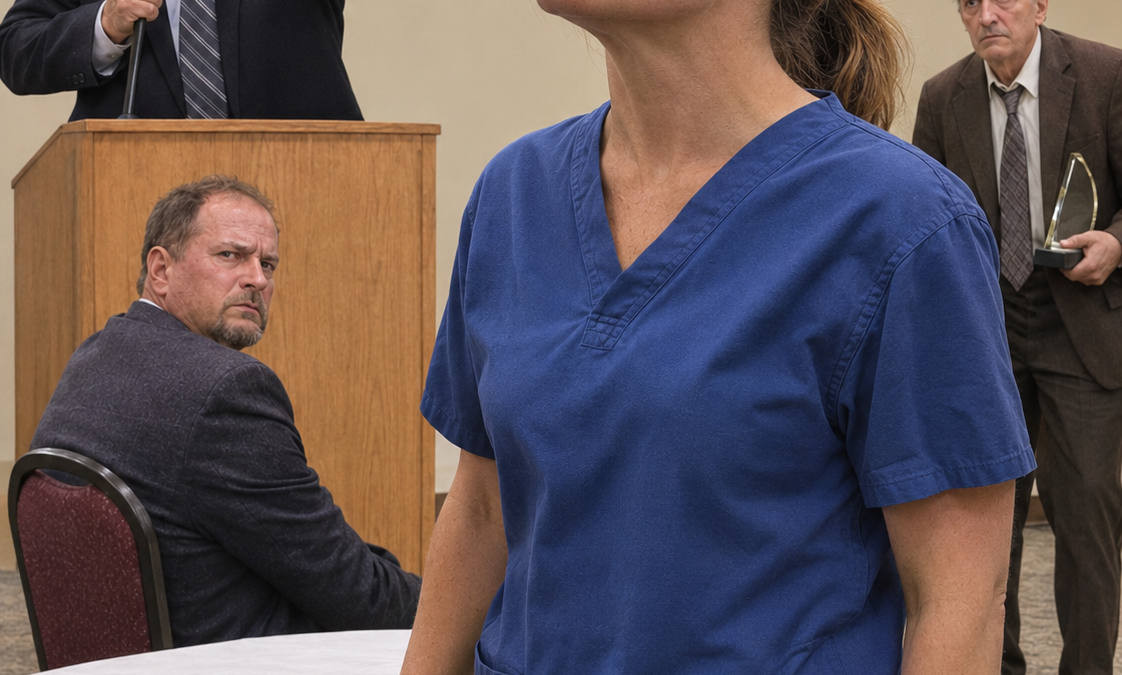
He pointed at me.
Heads turned.
A lot of them.
I sat in blue scrubs beneath the hall lights while strangers looked from the Citizen of the Year to the daughter who had apparently been too busy saving other people to answer for her own child.
Deb’s face changed.
Neil stared at Russ.
Brody looked down at the table.
My father smiled gently.
Like he had protected me by calling me a fine nurse before he blamed me.
He had sent Ruthie walking into sleet.
Now he had put me on display for it.
My hand moved toward my badge.
Then stopped.
Across the hall, a chair scraped.
Odell Tate stood.
His service award was in his left hand.
The room quieted as he faced the podium.
“Mr. Sandvik,” Odell said, “I’ve got one question.”
Part 8 of 9
“Who called the office at 3:40?”
Nobody moved.
Russ looked at Odell from behind the podium.
His smile stayed in place.
“I’m sorry?”
Odell held his service award against his side.
“You just told this room your first call was when the sleet came in.”
Russ gave a small nod.
“That’s right.”
Odell spoke slowly.
“Then who called the school office at 3:40 and had that child sent walking to the Hokansons’?”
A chair shifted behind me.
Russ’s fingers curled around the podium.
Odell continued.
“That girl was sent out alone on one phone call. Nobody was home where she was sent. I found her on the road in that sleet and brought her back.”
Someone near the school table whispered something.
Odell did not look away from Russ.
“Her mother has the pink copy.”
Every face that had turned toward me during Russ’s speech turned again.
This time I stood.
My knees felt solid until I reached the aisle.
Then one gave a small tremor.
I kept walking.
Russ watched me approach.
“Jode.”
I did not answer.
I unclipped my badge holder.
I drew out the pink slip.
I unfolded it at the podium and set it flat in front of him.
Russ looked down.
I said, “3:40 PM. Grandfather R. Sandvik by phone. Walk to Hokanson.”
That was all.
No speech.
No explanation.
The paper had already done enough.
Russ stared at it.
Then he looked up at the room.
“I was told the Hokanson girl’s mother was home. It was a miscommunication. I called back as soon as I could.”
Odell nodded once.
“You did. Ask Mrs. Aho what you said at 5:20.”
My head turned.
Beth Aho was sitting at the school’s table.
She looked tired even from across the room.
For one second she stayed seated.
Then she stood.
Russ said, “Beth, I don’t think we need to turn this into—”
Beth cut him off.
“At 5:20, you called the school back.”
Russ’s face tightened.
Beth kept both hands at her sides.
“I told you Ruthie had been found and was safe at school.”
I looked at her.
She looked at me.
Then she repeated the words I had never heard.
“You said, ‘Don’t pull her mother off the floor, those are sick people. I’m on my way. I’ll handle it.’”
My fingers went cold.
Beth swallowed.
“You never came.”
I heard a sound from Neil’s chair.
Beth continued.
“We had tried Jodie’s cell earlier. We had tried your cell too. After you called back and said you were coming, I waited.”
My eyes stayed on her.
“I called the hospital at 6:50 and was left on hold. They put me through to the ICU desk at 7:04.”
Going on three hours.
That was what Russ had told the room.
He left out the part where, for ninety minutes of it, he knew exactly where Ruthie was and told them not to pull me off the floor.
I had believed the school simply could not reach me.
Beth looked toward the podium.
“I took your call myself, and I have lived with it for twenty-three days.”
Russ lifted one hand.
“Beth, I was trying to keep a hospital from being disrupted.”
“My daughter was missing,” I said.
The words came out flat.
Russ looked at me.
“She had been found.”
“And you did not tell me.”
“I was coming to get her.”
“You didn’t.”
The room stayed still.
Odell spoke again.
“There’s one more piece.”
Principal Lindahl was sitting at the school table.
His eyes went toward Odell.
Odell looked at him.
“The next morning I told Principal Lindahl what I had read on that pink slip when I dried it.”
Lindahl’s mouth tightened.
Odell said, “He told me to refer any question to his office. Said I had a year to my pension and a service award coming.”
The award in Odell’s hand caught the hall light.
Nobody needed him to explain the warning.
Russ turned toward Lindahl.
Neil stood.
“Dad.”
Russ looked at him.
Neil’s face had gone pale.
“Where were you at four?”
Russ opened his mouth.
Brody stared at his grandfather without speaking.
Deb put one hand flat on the table.
Neil asked again.
“You were at that table with us by 4:15. Where were you at four?”
Russ glanced toward me.
He knew I had the photo.
I watched him understand that.
A Civic League officer approached the podium.
The same officer who had handed Russ his plaque minutes earlier.
“Mr. Sandvik.”
Russ looked at her.
She held out her hand.
“We need the plaque back while the League reviews this.”
Russ did not move.
The officer waited.
People watched.
Finally, Russ lifted the Citizen of the Year plaque from the podium.
For the first time that evening, his hand was not steady.
He gave it to her.
She carried it away.
I looked down at the pink slip between us.
Then I picked it up.
Part 9 of 9
The Northland Civic League put it in writing.
The Citizen of the Year award was rescinded.
The letter arrived without ceremony.
I stood at my kitchen counter, read the page, and put it with the district papers.
Russ called that evening.
I watched his name on my phone until the screen went dark.
The school board consequence came next.
He left after fourteen years.
The board filled the vacant seat.
Russ was already off Ruthie’s pickup list, and he stayed off it.
Principal Lindahl did not stay in the principal’s office after the district reviewed what happened.
I learned that through the school.
Nobody asked me to celebrate any of it.
I did not.
Neil came to my house without Russ.
Deb was with him.
Ruthie was in her room.
Neil stood in my kitchen and would not sit.
“Jo, I should have pushed him harder that Sunday.”
“You didn’t know.”
“I defended him.”
“You believed him.”
Deb looked at the refrigerator.
The pink slip was no longer under the magnet.
“I posted that picture,” she said.
“I know.”
“I didn’t even think about the time.”
“You were celebrating Brody.”
Her mouth tightened.
“He gave our son that check while Ruthie was out there.”
Neil looked down.
Neither of them defended Russ again.
They also did not ask me to forgive him.
That helped more than an apology from either one would have.
Russ wanted a different conversation.
He called until I answered.
“Jode, we need to sit down.”
“What for?”
“To straighten this out.”
“The school straightened it out.”
“That isn’t what I mean.”
I waited.
Russ said, “You made me look like I abandoned my granddaughter.”
“I put a pink slip on a podium.”
“You know what I mean.”
“Yes.”
“I made a bad decision.”
“Yes.”
“I was trying to keep you at work because you had sick people depending on you.”
“You told the school you were coming.”
“I intended to.”
“You didn’t.”
His breath came through the phone.
“We’re family.”
I looked toward the kitchen drawer.
“What do you want?”
“I want us to talk like father and daughter.”
“We are.”
“No. You’re talking to me like I’m one of your patients.”
“My patients get accurate charts.”
He went quiet.
I did not fill it for him.
Finally Russ said, “Do you want an apology?”
“No.”
That seemed to surprise him.
“What do you want?”
“The note paid.”
Silence.
“The roof money?”
“Yes.”
“Jode.”
“You signed it.”
“That money was between us.”
“It was Ruthie’s college savings.”
“I know where it came from.”
“Then pay it.”
He wanted the apology scene.
The one where he could tell me what he had meant, I could tell him how much he had hurt me, and we could walk away saying family had survived something.
I did not give him that room.
I had done enough of that.
Russ sold his fishing boat.
Then the full $12,000 from the note went into a college savings account in Ruthie’s name.
I checked the amount.
I kept the paperwork.
The kitchen drawer no longer had to hold his debt.
Odell’s job stayed safe.
He finished his last year and retired with his full pension.
I saw him at Hillcrest before then.
Ruthie was with me.
She carried a thank-you card this time.
When Odell came down the hallway, Ruthie stopped beside me.
He smiled.
“Well, hello there.”
“Hi.”
Ruthie held out the card.
“This is for you.”
Odell accepted it.
“You already thanked me once.”
“That was Mom.”
He looked at me.
I said, “This one’s hers.”
Odell looked back at Ruthie.
“Well, thank you, ma’am.”
Ruthie smiled at that.
Then she said, “Thank you for finding me.”
Odell’s face changed slightly.
He looked down at the card in his hand.
“I’m glad I came along when I did.”
“So am I.”
He nodded toward me.
“Your mom kept that pink paper dry.”
Ruthie glanced up.
“She keeps everything.”
“That sounds about right.”
I smiled.
Odell had stood up in a room full of people when staying seated would have been easier.
He had risked the thing Principal Lindahl had reminded him he could lose.
Thirty years of work had taught him where every door in that school led.
It had not taught him to keep quiet when a child had been sent out alone.
We said goodbye and left.
That night, Ruthie got ready for bed.
I checked on her from the doorway.
Her blankets were pulled up, but not to her chin anymore.
“You good?”
“Yes.”
I pointed toward the hall.
“Light?”
Ruthie looked past me.
Then back at her pillow.
“You can turn it off.”
My hand rested on the switch.
“Sure?”
“Yeah.”
I turned off the hall light.
THE END
More stories
My Ex-Wife’s Rich Father Took My Son From School and Called Me the Gate Guy, Then I Stood at the Gate I Built With a Judge’s Order During His Fundraiser.I sat in my apron while my daughter-in-law promised my upstairs to her parents for $2,500—until her father came to my table and my son returned their money.My daughter’s future father-in-law ordered four bottles of champagne, then sent me the $3,600 bill—But the manager walked in and contradicted him where his relatives could hear.My Son Dropped His Daughter at My Bus Depot With One Duffel Bag and Moved to Tampa, Then Sued Me for Custody Three Years Later, Until the Judge Asked Who Braids Her Hair.At 58, I was the “grease monkey” my daughter’s fiancé mocked at his company picnic — Until his boss approached me beside coach 14 and his grin disappeared.My Son Photographed the Rent on My Tax Return and Demanded My Duplex, Until the Head of School Read One Name at My Granddaughter’s Fall Gala.








