My Fiancé Told Everyone I Couldn’t Keep Working—Then His Caregiver Application Asked Me to Verify That I Needed His Daily Care
Complete story · 8 parts · about 38 minutes · ending included
Part 1 · Part 2 · Part 3 · Part 4 · Part 5 · Part 6 · Part 7 · Part 8
Part 1 of 8
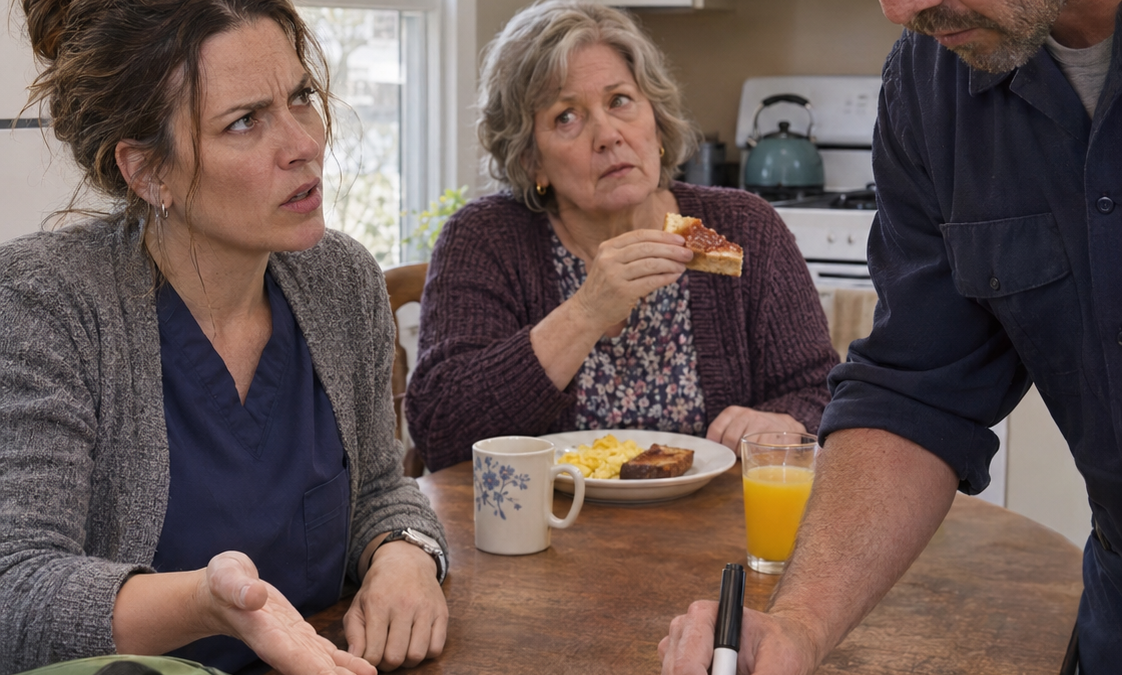
On Wednesday, October 1, 2025, Damon drew a black line through three of my work shifts while my mother watched him do it.
He stood at the end of our kitchen table with the wedding-planning calendar flattened under one hand. October was crowded with my handwriting—dress fitting, final head count, menu tasting, dentist appointment, Mom airport pickup—and, in green ink, the days I was scheduled at the dental office in St. Paul.
Damon uncapped the marker again.
“October twentieth,” he said.
He crossed out HYGIENE 7:30–5.
“Damon.”
“And the twenty-first.”
Another line.
My mother, Gail, stopped buttering her toast.
I was already wearing navy scrubs beneath a gray cardigan. My green zippered lunch bag sat by my chair with my September timecard tucked into the outside pocket because I had planned to scan it at work.
“What are you doing?” I asked.
“Cleaning this up.”
He smiled like he had solved something for me.
Our wedding was scheduled for November 8. We had been living together for ten months, long enough that the rental townhouse had stopped looking like two households pushed together. His heavy work boots lived beside my sneakers. My coffee filters sat above his protein powder. The refrigerator held both the meal-prep containers he took to the warehouse and the yogurt cups I grabbed between patients.
Damon tapped the calendar.
“You won’t need all this after the wedding.”
“All what?”
He pointed at my shifts.
Mom looked from him to me.
Damon was dressed for his own job, steel-toe boots and a dark blue work shirt from the packaging company where he supervised shipping. He had told me more than once how short-staffed his dock had been lately.
I said, “I work those days.”
“For now.”
The phrase came easily.
He had been using versions of it for weeks.
After the wedding, you can slow down.
After the wedding, you won’t have to keep proving anything.
After the wedding, we’ll finally have a normal schedule.
Usually I had answered with something light because I thought he meant he wished we had more evenings together.
That morning he had put ink through my actual workdays.
I took the marker from his hand.
“Don’t cross out my shifts.”
“Lin, come on.”
“I have patients today, and I have patients those days too.”
Mom set her knife beside her plate.
Damon laughed once through his nose.
“No one’s saying you can’t go in today.”
“You just crossed out three days.”
“Because you’re not going to keep doing this forever.”
“Doing what?”
He looked at my scrubs.
“Pushing yourself.”
There it was.
I had heard him say it at his sister’s cookout in August when somebody asked whether I planned to stay full-time after we married.
Lindsay pushes herself too hard.
At the time, I had rolled my eyes and told them I liked my job.
A month later, at dinner with his cousin Melissa, Damon had answered a question directed at me.
She’s going to cut back. She needs to.
I had corrected him then too.
That Wednesday morning, with my mother three feet away, the words landed differently.
Mom asked, “Is Lindsay cutting back?”
“No,” I said.
Damon said, “We’ve talked about it.”
“We’ve talked about you wanting me to.”
“Same conversation.”
“No, it isn’t.”
The toaster clicked behind him.
For a few seconds nobody moved.
Then Damon gave Mom the patient smile he used when somebody at a restaurant had misunderstood an order.
“She gets wiped out,” he said. “She comes home and crashes.”
“I come home and change clothes.”
“You know what I mean.”
“I know you’re making my ordinary workday sound like a medical event.”
His smile disappeared.
“Don’t make this ugly.”
Mom picked up her coffee.
I looked at Damon.
“Then don’t tell people I can’t handle my job.”
“I didn’t say can’t.”
“You said I won’t need my shifts after the wedding.”
“Because I’ll take care of you.”
That sounded generous until I heard the part beneath it.
I put the marker on the counter.
“I don’t need you to take care of me instead of letting me work.”
His jaw tightened.
“You always do this.”
“Do what?”
“Turn help into an insult.”
My phone showed 6:48.
I needed to leave by seven.
I slid the calendar toward me and rewrote HYGIENE beside each line he had made.
Damon watched me.
Then he said, quietly, “You don’t know when to stop.”
The sentence hurt more than the others because he said it like a diagnosis.
I zipped my lunch bag.
“I know when to go to work.”
Mom stood too.
She had come over early because we were supposed to look at centerpiece photos before my shift. Instead she gathered the printouts from the table and tucked them into her purse.
“I’ll call you tonight,” she told me.
Damon turned toward the sink.
I left with my green bag against my hip and the calendar still open behind me.
Picking up where the Facebook post left off
At the office, Wednesday moved at its normal pace.
I reviewed charts, cleaned rooms between appointments, finished my notes, and ate half a turkey sandwich during lunch. Nothing about the day felt heroic. That was the point. It was work I had been doing full-time for years.
At 4:52, I carried my bag into the staff room and pulled out my September timecard.
One hundred sixty-eight hours.
I stared at the total longer than I needed to.
That morning Damon had spoken in front of my mother as if my job were something we had already agreed to end.
I took a photo of the timecard before submitting it for payroll.
Not because I thought I would need proof of my own life.
I just suddenly disliked how confidently somebody else was describing it.
When I got home, Damon had erased the black lines from the calendar as well as he could.
Gray shadows remained over the green ink.
He was chopping onions at the counter.
“I fixed it,” he said.
I put my lunch bag in the refrigerator.
“You erased marker.”
“Isn’t that what you wanted?”
“I wanted you not to do it.”
He kept chopping.
“You want to fight all night?”
“No.”
“Good.”
He tipped the onions into a skillet.
I stood there long enough for him to look at me.
“I need you to stop telling people I’m going to quit or cut back,” I said.
“I don’t tell people you’re quitting.”
“You told Mom.”
“I said after the wedding we can make some changes.”
“You crossed out my workdays.”
He sighed.
“Lindsay, your mother knows how hard you work.”
“So does everyone else.”
“That’s not always a compliment.”
I waited.
He set the knife down.
“You come home exhausted. Your shoulders hurt. You’re on your feet all day.”
“Those things don’t mean I’m unable to work.”
“I never said unable.”
“Then don’t talk like I am.”
He picked up the knife again.
“Fine.”
It wasn’t an apology, but I let the conversation end because I needed one evening where our wedding wasn’t another argument.
Two days later, an email arrived that used the exact word he had denied.
Unable.
Part 2 of 8
Thursday morning began with Damon apologizing by bringing coffee to the bathroom while I dried my hair.
He leaned against the doorframe and held out my travel mug.
“I was a jerk yesterday.”
It was October 2, and the apology was close enough to what I had wanted that I stopped with the dryer in my hand.
“You were.”
“I know.”
I took the mug.
He kissed my forehead.
“No more calendar crimes.”
“That isn’t really the problem.”
“I know.”
He said it again, softer.
For most of that day, I believed we had reset something.
Then my aunt called during my lunch break.
I was sitting in my car with the driver’s window cracked, eating yogurt with a plastic spoon.
“Your mom said you’re still working right up to the wedding,” Aunt Cheryl said.
“Yes.”
“Well, good for you.”
I frowned.
“What does that mean?”
“Nothing bad. Damon just made it sound like you were barely hanging on.”
My spoon stopped halfway to my mouth.
“When did he tell you that?”
“Sunday, I think. He called about the rehearsal dinner.”
“He called you?”
“He wanted to know whether I could help with flowers because you weren’t supposed to be doing much.”
I put the yogurt in the cup holder.
“What exactly did he say?”
There was a pause.
“You know how people paraphrase.”
“Cheryl.”
“He said you’ve had some health trouble and he’s trying to get you through the wedding without you overdoing it.”
I looked through the windshield at the brick wall behind the clinic.
“I haven’t had health trouble.”
“I didn’t think you had.”
“He told you I had?”
“He didn’t give me a diagnosis or anything.”
“Because there isn’t one.”
“All right.”
Her voice changed.
“Lindsay, I wasn’t trying to get in the middle.”
“I know.”
“He also said you might have more time after the wedding and could help me sort Grandma’s Christmas boxes.”
I closed my eyes.
“I work full-time.”
“I know that.”
“Apparently he doesn’t.”
When I hung up, I called Mom.
She answered on the second ring.
“I was about to call you.”
“Has Damon been telling people I’m sick?”
Silence.
“Mom.”
“He hasn’t used that word with me.”
“What has he used?”
“He told your uncle on Sunday that you’re having a hard time keeping up.”
I pressed two fingers against my forehead.
“And?”
“And that once you’re married, he’s hoping you’ll stop working for a while.”
“That isn’t happening.”
“I told him that.”
I sat straighter.
“You did?”
“Yes. He laughed and said you’d come around.”
I looked at the clock on the dashboard.
I had nine minutes left in my break.
“Why didn’t you tell me?”
“Because I thought it was wedding-managing nonsense. After yesterday, I wasn’t so sure.”
I let out a breath.
Mom said, “Are you okay?”
“Yes.”
“I mean with him.”
“I don’t know.”
It was the first time I had said that aloud.
That evening Damon was cheerful.
He had picked up Thai food and laid two venue invoices beside my plate.
“The florist added a hundred eighty dollars,” he said.
“For what?”
“Delivery window.”
I opened the invoice.
The wedding had become a pile of numbers lately. Chair rental. Linen upgrade. Cake delivery. Photography balance. We were paying from a joint wedding account we had opened in March, although I had contributed more during the summer after my hourly rate increased.
I had gotten a two-dollar-an-hour raise in August.
Damon had celebrated by taking me to dinner.
Now he was telling relatives I was about to stop earning it.
“My aunt says you called her,” I said.
He looked up from his noodles.
“Cheryl?”
“You told her I was having health trouble.”
“I did not.”
“She said you told her I was having a hard time and shouldn’t do much before the wedding.”
“That isn’t health trouble.”
“You told her I could help with Grandma’s Christmas boxes after we’re married.”
He shrugged.
“You’ll have more time.”
“No, I won’t.”
“Here we go.”
“Don’t say that.”
He pushed his carton away.
“You asked for help with wedding stuff. I’m delegating.”
“You’re volunteering my time based on a schedule I never agreed to.”
“Sorting Christmas boxes with your aunt isn’t exactly manual labor.”
“That’s not the point.”
He rubbed his mouth.
I said, “Did you tell Uncle Ray I’m going to stop working?”
“I said we’re looking at options.”
“We are not looking at options.”
“You won’t even consider it.”
“Because I don’t want to stop working.”
“You’re thirty-eight, Lindsay. You’re not twenty-two.”
I stared at him.
“What does that have to do with anything?”
“Your back hurts.”
“Sometimes.”
“You get headaches.”
“Sometimes.”
“You fall asleep on the couch.”
“So do you.”
“Not at eight-thirty.”
“After a ten-hour day, sometimes I do.”
He leaned back.
“This is what I mean. You don’t know when to stop.”
The same sentence.
This time I didn’t let it pass.
“No. You don’t get to keep saying that like you know my body better than I do.”
His eyes narrowed.
“I’m trying to make your life easier.”
“By telling people I can’t manage it?”
“I have never said you can’t manage.”
“You keep building a story where everybody else reaches that conclusion for you.”
He stood and carried his food to the counter.
“You’re hearing what you want to hear.”
I stayed at the table.
“Did you tell anyone I need you to take care of me?”
He turned around.
The question changed his face for half a second.
Not guilt exactly.
Calculation.
Then he said, “Everybody in a marriage takes care of each other.”
“That wasn’t my question.”
“No, Lindsay, I have not gone around telling people you’re an invalid.”
I hated the word immediately.
“I didn’t say that.”
“You’re acting like I did.”
He rinsed his carton.
Conversation over, according to Damon.
I opened the florist invoice again, but the numbers blurred.
The next morning, Friday, October 3, I was between my first and second patients when our front desk coordinator waved me over.
“You have a minute before nine?”
“Barely.”
She handed me a printout from our internal scheduling system.
“Your requested vacation day on the seventeenth is approved.”
I had requested that Friday because of wedding errands before the tasting on Saturday.
“Thanks.”
“And congratulations on surviving October.”
“Ask me again November ninth.”
She laughed.
I folded the sheet and tucked it into my locker.
At 10:36, during a gap caused by a canceled appointment, I checked my personal email from my phone.
The subject line read:
CARE RECIPIENT ATTESTATION REQUIRED — RESIDENT CAREGIVER SUPPORT STIPEND
I almost deleted it as spam.
Then I saw Damon’s employer named in the sender information.
The company name was familiar from his pay stubs and benefits enrollment packets. Beneath it was a note that the message had been generated because I had been identified as the proposed care recipient in an employee application.
I read that sentence twice.
Then I opened the email.
The first paragraph described an employer-funded taxable stipend for employees providing qualifying care to a resident domestic partner or family member.
Four hundred dollars per month.
Four thousand eight hundred dollars per year.
Payment required the care recipient’s separate attestation and appropriate functional documentation.
Nothing would be approved until verification was complete.
My mouth went dry.
A link opened a secure verification page.
My name was already there.
Lindsay Marrow.
Resident domestic partner of Damon Sedgewick.
Below it were the statements I was being asked to verify.
I am permanently unable to work because of a functional condition.
I require daily hands-on assistance from Damon Sedgewick with routine personal activities.
Damon Sedgewick provides this care on an ongoing basis.
I stared at the screen until it dimmed.
Then I tapped it awake.
The words did not change.
Part 3 of 8
I did not sign anything.
At 10:42 on Friday morning, I stepped into the staff room, shut the door, and read the verification request from the beginning.
The plan description was linked at the bottom.
I opened that too.
It was not government assistance, insurance, leave pay, or a tax credit. The document described an employer-funded taxable caregiver stipend available under that company’s internal benefits program.
Maximum amount: four hundred dollars a month.
Maximum annual amount: four thousand eight hundred.
A resident domestic partner could qualify as the care recipient.
The employee’s statement alone was not enough.
The named recipient had to separately attest to the claimed need for care, and the application required appropriate functional documentation before any stipend could be approved.
I scrolled back to the statements attached to my name.
Permanently unable to work.
Daily hands-on assistance.
I looked down at my navy scrub pants.
My green zippered lunch bag sat under the table.
Inside its front pocket was the copy of my September timecard.
One hundred sixty-eight hours.
The number did not establish everything about my health. It did establish something very specific: I had worked a full-time schedule during the same period Damon was now describing me, on an employer benefit application, as permanently unable to work.
I opened my email again.
The verification message included a benefits contact.
JOELLE PASK — BENEFITS COORDINATOR.
There was an office number beneath her name.
I checked the clock.
10:49.
My next patient was due at eleven.
I called.
A woman answered, “Benefits, this is Joelle.”
“My name is Lindsay Marrow. I received a care recipient verification request this morning connected to an application from Damon Sedgewick.”
Her voice became more formal.
“All right. Before we discuss the request, I need to confirm a few pieces of information from the verification record.”
She confirmed my name and the email address the request had been sent to.
Then she asked for the verification reference number.
I read it from the screen.
“Thank you,” she said. “I can explain the statements you’re being asked to attest to and record your response. I can’t discuss unrelated employment or medical information.”
“That’s fine.”
I heard keyboard clicks.
“The application identifies you as the resident domestic partner and proposed recipient of daily caregiver support. You are being asked to confirm the functional statements shown in the request.”
“They’re false.”
There was a short pause.
“All of them?”
“The part saying I’m permanently unable to work is false. I work full-time.”
“All right.”
“And I do not need Damon to give me daily hands-on help with routine personal activities.”
“All right.”
“He does not provide that kind of care for me.”
More typing.
Joelle said, “To be clear, are you declining to attest to the statements as written?”
“Yes.”
“And are you asking that your correction be recorded in this application?”
“Yes.”
“All right. I’ll record that the named care recipient disputes the eligibility statements and declines attestation.”
I gripped the edge of the table.
“Does that stop it?”
“The application cannot be approved without the required recipient attestation and truthful supporting eligibility information.”
“Has anything been paid?”
“I can tell you this application has not been approved for payment.”
I let out a breath I had not realized I was holding.
“Good.”
She continued, “You’ll receive a confirmation of your response. If you want to provide material concerning the statements about you, the confirmation will explain how.”
“I have my timecard.”
“You may provide records you believe are relevant, but a work schedule by itself doesn’t determine every possible functional issue.”
“I understand.”
I appreciated that she said it.
I was not trying to prove that anyone with a disability could not work, or that employment settled every medical question. I was correcting Damon’s specific statement that I was permanently unable to work.
Joelle said, “Do you currently have documentation from your own provider or occupational clinic regarding work restrictions?”
“Yes.”
Then I corrected myself.
“I think so. I had an occupational-clinic evaluation for work last spring.”
“If it’s your record and you choose to provide it, you can submit it using the instructions in the confirmation email. We don’t need unrelated records.”
“Okay.”
Another pause.
Then I asked, “Can you tell me what Damon wrote?”
“I can explain the statements in the portion naming you because your attestation is being requested for those statements. I can’t open up unrelated parts of his employee file.”
“That’s all I need.”
She read the three claims back to me.
They were exactly what I had seen.
Permanent inability to work.
Daily hands-on care.
Ongoing care provided by Damon.
I closed my eyes.
“Thank you.”
“I’m sending your confirmation now.”
The email arrived while we were still on the phone.
Joelle waited until I saw it.
“Your correction is recorded as of October third,” she said. “Do not sign the original attestation if it is inaccurate.”
“I won’t.”
When the call ended, I had four minutes before eleven.
I sat alone in the staff room with my phone in my hand.
I wanted to call Damon immediately.
Instead, I saved the verification email and the plan description into a folder in my personal account.
Then I photographed the September timecard again, this time making sure the total was clear.
168 HOURS.
I put the paper back in my green lunch bag and returned to work.
At 12:17, during lunch, I called the occupational clinic I had visited in April after a strained shoulder.
The strain had improved with ordinary treatment and time. The clinic had cleared me to return to my regular duties without current work restrictions.
I asked whether I could obtain a copy of my own clearance letter.
The records clerk verified my information.
“Yes,” she said. “We can release that to you through the patient portal.”
“I need the existing letter, not a new evaluation.”
“That’s what you’ll receive.”
“Thank you.”
By 12:31, the April letter was in my portal.
It stated that, as of that evaluation, I had no current work restrictions.
I read it carefully.
It did not say I had never had an injury.
It did not say I could never develop another condition.
It did not declare me universally healthy.
It said what I needed it to say: at the time of that occupational evaluation, I had been cleared for my regular work without current restrictions.
I submitted the letter through the secure instructions Joelle had sent, along with my correction.
Then I went back to my afternoon schedule.
Damon texted at 2:08.
Pizza tonight?
I looked at the message while standing beside the supply cabinet.
For several seconds I considered answering with a screenshot of the attestation.
Instead I typed:
We need to talk when I get home.
The typing bubbles appeared.
Disappeared.
Appeared again.
About what?
I put my phone away.
At 5:22, I pulled into our townhouse lot.
Damon’s truck was already there.
He was sitting at the kitchen table when I walked in.
The wedding calendar was still open to October.
The gray shadows from his erased marker crossed three of my workdays.
He looked at my face and said, “What happened?”
I set my green lunch bag on the table.
“This came to my email today.”
I turned my phone toward him.
He glanced at the screen.
His shoulders dropped slightly.
Not surprise.
Recognition.
That was the first real answer.
“You applied for this,” I said.
He leaned back.
“It’s not what you’re making it sound like.”
“I haven’t made it sound like anything yet.”
“It’s a caregiver program through work.”
“I read the plan.”
“Then you know.”
“I know it’s four hundred dollars a month.”
“Before taxes.”
“I know.”
He folded his arms.
“And I know you told them I’m permanently unable to work.”
His eyes moved away from mine.
“That wording is stupid.”
“You checked it.”
“It’s form language.”
“You also said I need your daily hands-on care.”
“Again, form language.”
“No. A form gave you choices. You chose those answers.”
He rubbed the back of his neck.
“Nothing was approved.”
“Because they needed me to verify it.”
He looked at me again.
“You didn’t sign?”
“No.”
His mouth opened.
Then closed.
I pulled out the chair across from him but did not sit.
“I called the benefits coordinator.”
His face changed.
“You called Joelle?”
“Yes.”
“Jesus, Lindsay.”
“I corrected the statements about me.”
“You called my employer?”
“I called the contact listed on a verification request sent to me.”
“You could have talked to me first.”
“You submitted claims about my ability to work without talking to me first.”
“I have talked to you.”
“About me quitting my job. Not about telling your employer I’m permanently unable to have one.”
He stood.
“Would you stop saying it like that?”
“That’s what the application says.”
“You think I wrote the program.”
“You selected the answer.”
“It was the closest category.”
“To what?”
“To our situation.”
I laughed once because I could not help it.
“Our situation is that I’m a dental hygienist with a full schedule.”
“You come home hurting.”
“I have sore shoulders sometimes.”
“You need help.”
“With what daily personal activity?”
He stared at me.
I waited.
“Exactly,” I said.
“That’s not fair.”
“What do you do for me every day that counts as hands-on care?”
“I cook.”
“So do I.”
“I drive when you’re tired.”
“I drive myself to work five days a week.”
“I pick things up. I handle errands. I make sure you don’t overdo it.”
“There it is.”
He looked confused.
“You don’t know when to stop,” I said.
His expression hardened.
“Don’t twist my words.”
“I’m not twisting them. I’m finally answering them.”
He stepped away from the table.
“This could have helped us.”
“By lying about me.”
“By bringing in forty-eight hundred dollars a year.”
“Taxable.”
“Fine. Less than that.”
“For care you don’t provide.”
He slapped one palm lightly against the back of a chair.
“Why are you acting like I stole something? They hadn’t paid a dime.”
“I know they hadn’t.”
“So there’s no damage.”
“The damage is that you believed I should sign it.”
“I figured you’d understand what it was.”
“I understand exactly what it was.”
“No, you see one phrase and make it personal.”
“My name is on it, Damon. It’s personal.”
He started pacing toward the living room, then turned back.
“We have a wedding in five weeks. We have deposits due. We have a thousand little expenses. I found a program that could help.”
“You found a program for employees who actually provide qualifying care.”
He looked away.
“You always need everything to be technically perfect.”
“Truthful is not technically perfect.”
He exhaled hard.
“You got your raise. Good for you. But your schedule is brutal, and after we’re married, if you cut back, I would be supporting more of the household anyway.”
“So you applied based on a future you invented.”
“I was planning ahead.”
“You checked permanently unable to work.”
“Because there wasn’t a box for ‘shouldn’t be working this much.’”
I stared at him.
He apparently heard himself, because his voice dropped.
“That’s what I mean. You’re running yourself into the ground.”
“No.”
“Lindsay—”
“No. You don’t know when to stop.”
That silenced him.
I opened my lunch bag and took out the September timecard.
I laid it on the table.
“One hundred sixty-eight hours last month.”
He looked at it but did not touch it.
Then I opened the occupational-clinic letter on my phone.
“And this is my existing work-clearance letter from April. No current restrictions at that evaluation.”
“So now you’re building a case against me?”
“No. I’m correcting a case you built about me.”
His face flushed.
“I did this for us.”
“You did it without me.”
“I thought you’d be grateful.”
There it was.
Not sorry.
Grateful.
My phone buzzed on the table.
An email from Joelle Pask.
I opened it.
The message confirmed that my correction and refusal to attest had been recorded. The application could not proceed on the submitted claims without truthful required eligibility information.
A second line stated that the current caregiver stipend application had been closed.
I read it twice.
Then I turned the screen toward Damon.
He looked down.
His jaw went tight.
“What did you do?”
“I told the truth.”
The kitchen became very quiet.
For the first time since the email arrived, the problem was no longer four hundred dollars a month or a benefits form.
Damon looked at me as if I had taken something away from him.
And I understood that he had expected my signature all along.
Part 4 of 8
Damon slept in the guest room Friday night.
He didn’t announce it. He carried his pillow down the hall at 10:15 while I sat at the kitchen table with the verification request open beside Joelle’s confirmation.
Before bed, I forwarded the occupational-clinic clearance letter, the stipend plan description, and the application-closure email to my personal backup address.
The April letter had come from my own records because I requested it. It said I had no current work restrictions at that evaluation. I wasn’t treating it as proof that a person with a disability couldn’t work. Plenty could. I was documenting something narrower: Damon’s claims about me were not true.
The plan description mattered for the same reason.
Four hundred dollars a month.
Taxable.
Separate recipient attestation required.
Appropriate functional documentation required.
No approval without those steps.
And according to Joelle’s email, no payment had been issued.
At 10:31, Damon came back into the kitchen.
“You’re still doing this?”
I looked up.
“Doing what?”
“Saving everything.”
“Yes.”
He rested one hand on the back of a chair.
“You called benefits. They closed it. It’s over.”
“The application is over.”
“What else is there?”
I turned my phone facedown.
“Us.”
His mouth tightened.
“Right.”
“You lied about me to your employer.”
“I filled out a benefit form badly.”
“You selected three false statements.”
“I already told you the wording was stupid.”
“And I told you the wording was specific.”
He pulled out the chair but stayed standing behind it.
“We’re getting married in five weeks.”
“I know.”
“So what are you saying?”
“I don’t know yet.”
He stared at me.
“You don’t know if you’re marrying me?”
“I know I can’t pretend this didn’t happen.”
“You’re really going to blow up a wedding because I tried to get us four hundred bucks a month?”
“No. I’m trying to understand why you needed me to be incapable before you could call what you were doing ‘help.’”
“That is not what happened.”
“You’ve been telling my family I’m barely managing. You crossed out my work shifts. Then you put in writing that I’m permanently unable to work and need your hands on me every day to function.”
“That makes it sound disgusting.”
“It makes it sound like the application.”
He pushed the chair back into place.
“Fine. Stay mad.”
“I am not asking permission.”
His face went blank in the way it did when he had decided further conversation would only hurt him.
He left.
Saturday morning, October 4, Gail came over with two coffees and a grocery bag containing blueberry muffins.
She didn’t ask where Damon was until she saw his truck gone.
“He working?”
“Warehouse inventory.”
She set the bag on the counter.
“You sleep?”
“Some.”
I showed her the verification request.
Mom read more slowly than I expected.
When she reached the statements about daily hands-on care, she looked up.
“He said this?”
“He checked it on an application.”
“And you corrected it?”
“Friday morning.”
“Good.”
“I also gave them my existing work-clearance letter.”
She handed the phone back.
“What happens to him?”
“I don’t know.”
“Did you ask?”
“No. Joelle wouldn’t discuss anything unrelated to the part involving me.”
Mom nodded once.
“That sounds appropriate.”
I pulled a muffin apart.
“The application was closed. No money was paid.”
“So the money isn’t the problem.”
“No.”
She knew me well enough not to finish the sentence for me.
After a minute she said, “What are you doing about the wedding?”
The question made my stomach tighten.
“We have the menu tasting on the eighteenth.”
“That isn’t what I asked.”
“I know.”
We had paid a venue deposit in June and another installment in September. The contract was in both our names. Cancellation charges increased as the event got closer.
“I need to read the contract again,” I said.
“You don’t have to decide everything today.”
“No. But I do have to stop letting decisions happen around me.”
Mom looked toward the calendar.
The erased black marks were still visible.
I closed it.
On Monday, October 6, Damon texted me before lunch.
We need to figure out what we’re telling people.
I answered during my break.
Tell them the truth: we’re having a private problem and the wedding plans are unresolved.
His reply came immediately.
That’s humiliating.
I typed:
So was being described as unable to work.
He didn’t answer.
That evening, he was sitting on the couch with the venue contract printed in his lap.
“I called them,” he said.
My purse was still on my shoulder.
“You called the venue?”
“I asked about the tasting.”
“What about it?”
“They need the final dinner selections whether we have twenty-six people at the tasting or not.”
“We already knew that.”
“They also said if we cancel this close, we lose part of the deposit.”
“How much?”
He handed me the contract.
The cancellation schedule was highlighted.
There was no miraculous escape clause. If we canceled before the next deadline, we would lose the initial reservation payment and part of the second installment. Waiting longer would cost more.
I sat across from him.
“So we need to make a decision before the next deadline.”
“We need to stop acting like we’re canceling.”
“I didn’t say we were.”
“You told your mother we’re unresolved.”
“We are.”
He looked down at the pages.
“We’ve already spent thousands.”
“That isn’t a reason to marry you.”
He flinched.
For once, he didn’t argue.
Part 5 of 8
The next week cost us in smaller ways.
Not money at first.
Space.
Damon stayed in the guest room.
We stopped buying groceries together. I cooked on Tuesday; he brought takeout Wednesday and ate it in front of the television. Thursday morning, I found the coffee maker empty because he had made only enough for himself.
None of it was dramatic enough to tell anybody.
That almost made it worse.
At work, my schedule remained full.
I kept the October calendar on my phone and the September timecard in my green lunch bag until payroll confirmed it had been processed. Then I moved the paper copy into a folder at home with my clearance letter and Joelle’s emails.
On Wednesday, October 8, Joelle called during my lunch break.
“I wanted to confirm that the application involving you remains closed,” she said.
“Okay.”
“There was no approved stipend and no payment.”
“Thank you.”
She continued carefully.
“The closure reflects the lack of the required truthful recipient attestation and supporting eligibility for the submitted claims. It isn’t a general medical determination about you.”
“I understand.”
I appreciated hearing it stated that plainly.
“I also wanted to confirm that your correction is attached to the closed application record.”
“That’s what I cared about most.”
“It is.”
After the call, I ate my sandwich in my car and watched leaves scrape across the parking lot.
I felt better knowing my name was no longer sitting beside Damon’s statements without my answer attached.
At home that evening, he was opening mail at the kitchen counter.
“Joelle called me,” I said.
He stopped tearing an envelope.
“Why?”
“To confirm the application is closed and my correction is on record.”
He laughed once without humor.
“You really need that record clean.”
“Yes.”
“I didn’t accuse you of a crime.”
“No. You described me as unable to work and dependent on your daily care.”
“You know what I meant.”
“I still don’t.”
He dropped the envelope on the counter.
“I meant I do things for you.”
“Then why didn’t you write that?”
“Because ‘I pick up groceries and tell my fiancée to rest’ doesn’t qualify for the stipend.”
The sentence hung between us.
I looked at him.
He realized too late what he had admitted.
“So you knew our actual situation didn’t qualify.”
“I knew they had categories.”
“You knew the truth wouldn’t get the money.”
“Don’t turn this into some confession.”
“You just said it.”
He rubbed both hands over his face.
“We’re drowning in wedding bills.”
“We are not drowning.”
“We’ve got the photographer balance, the venue, your dress alterations—”
“My raise covered my share of those.”
“Our share.”
“Yes. Our share. Which is why you didn’t need to invent a caregiver income stream.”
He looked toward the hallway.
“You act like every dollar I bring in belongs under a microscope.”
“No. Only the ones attached to false statements about me.”
Friday night, Gail called while I was putting laundry away.
“Your cousin Marissa asked if you’re still doing the tasting.”
“Apparently.”
“Apparently?”
“We haven’t canceled the venue. And the tasting is part of the contract.”
“Do you want me there?”
“You were already invited.”
“I mean do you want me there now.”
I sat on the edge of the bed.
“Yes.”
“Then I’ll be there.”
I lowered my voice even though Damon was downstairs.
“I’ve told him this doesn’t mean we’re fine.”
“Good.”
“He thinks attending means we’re moving forward.”
“Then tell him again.”
So I did.
Saturday morning, October 11, I found Damon in the garage checking tire pressure.
“The tasting next week,” I said.
He glanced up.
“What about it?”
“I’ll attend because it’s already booked, people were invited, and we need to deal honestly with the venue commitments.”
“Okay.”
“It does not mean the relationship is resolved.”
He straightened.
“Do we need a disclaimer at the door?”
“I’m telling you because I don’t want you pretending later that I agreed everything was normal.”
He screwed the valve cap back on.
“You love making things sound official now.”
“I’ve learned wording matters.”
That landed.
He stood.
“Twenty-six people are coming, Lindsay. Family. Wedding party. They’re expecting us to act like adults.”
“I am.”
“And you’re going to sit there looking like you’re at a deposition?”
“No. I’m going to taste food and answer venue questions.”
He shook his head.
“You know, people are worried about you.”
I went still.
“Who?”
“My sister. Melissa. Your aunt.”
“Why are they worried?”
He hesitated.
“Because you’ve been under a lot.”
“Did you tell them I’m having health problems again?”
“I said you’ve been pushing too hard.”
I stared at him.
After everything, he had kept the story alive.
“Stop telling people that.”
“I didn’t say you’re sick.”
“Stop telling people I can’t handle my life.”
He looked down at the tire gauge.
“I said you’re exhausted.”
“That’s not your story to build.”
He didn’t answer.
Part 6 of 8
On Saturday, October 18, the tasting room smelled like roasted garlic and fresh bread.
Twenty-six relatives and attendants filled three long tables inside the venue’s private dining room. Menu cards sat at each place. Water glasses caught the afternoon light from the windows.
I had arrived with Gail.
Damon came separately.
That was not the original plan.
The venue coordinator, Tessa, met us near the entrance with a clipboard.
“I just need one of you to confirm the contact number for final selections.”
“Use mine,” I said.
Damon looked at me.
Tessa glanced between us but only nodded.
“Lindsay’s number. Got it.”
We had agreed before arriving that we would not make announcements about the relationship. We were there because the tasting was booked, the contract still existed, and canceling the event required decisions neither of us had finished making.
I had also told Damon twice that week that we were unresolved.
Nothing about being in that room changed it.
Gail sat beside me.
Across the room, Damon’s sister waved like everything was normal.
I waved back.
The first course came out in small tasting portions. People compared the chicken to the pork, passed bread baskets, and argued cheerfully about potatoes.
For twenty minutes, the afternoon almost felt ordinary.
Then Damon’s cousin Melissa asked me, “Are you taking some time off before the wedding?”
I set down my fork.
“Just the days already scheduled.”
She smiled sympathetically.
“You’re still working full-time?”
“Yes.”
Her eyes moved toward Damon.
“I thought you were cutting way back.”
“I haven’t planned to.”
Damon, two seats away, said, “We’re still figuring out what’s best.”
I turned toward him.
“For who?”
A few conversations nearby quieted.
He smiled.
“For us.”
I kept my voice even.
“My work schedule isn’t being figured out.”
Melissa looked down at her plate.
Damon gave me a warning look.
I picked up my water.
The coordinator returned with the second entrée and the room loosened again.
For another half hour, I let the tasting be a tasting.
We compared sauces.
Gail preferred the green beans.
Damon’s mother voted for the roasted carrots.
Tessa explained the head-count deadline and reminded us that changes after it could affect cost.
I wrote the date in my notebook.
Then Damon’s sister raised her glass.
“I know this isn’t the rehearsal dinner yet, but I want to say something.”
My stomach tightened.
Damon smiled at her.
She looked at him.
“I’ve watched my brother step up this year, and I know marriage means taking care of somebody when life gets hard.”
Damon’s expression softened.
I looked at him.
He could have stopped it there.
Instead he reached for his glass.
“That’s what I’m trying to do.”
Several people smiled.
He continued.
“Lindsay doesn’t always know when to stop.”
The sentence crossed the table and found me exactly where it had the first time.
Only now I knew what he had written when nobody in the family was listening.
Damon looked around the room.
“She works herself into the ground. After we’re married, I want her to know she doesn’t have to prove she can keep doing everything. If she can’t work the way she used to, I’m going to take care of my wife.”
Gail’s chair shifted beside me.
Nobody laughed.
I looked at Damon across the plates, glasses, and twenty-six place settings.
He knew the application had been closed.
He knew I had corrected it.
He knew I had worked one hundred sixty-eight hours in September.
He knew I had told him the relationship was unresolved.
And in front of our families, he had chosen the same story again.
This time, I didn’t let him finish it for me.
Part 7 of 8
“I can keep working the way I work now,” I said.
Damon’s hand stopped halfway to his glass.
The room had gone quiet enough that I could hear silverware being collected near the service station.
He looked at me.
“Lin, that’s not what I meant.”
“It is what you said.”
His sister lowered her glass.
Across the table, Melissa stared at her plate.
Damon gave the small laugh he used when he wanted other people to believe a disagreement was harmless.
“She takes everything literally when she’s stressed.”
Gail turned toward me but said nothing.
I had asked her before we came not to step in for me.
I reached into my tote beside my chair.
Damon saw the folder.
His face changed.
“Lindsay.”
I took out two pages.
The first was the verification request sent to my email on October 3.
The second was Joelle’s confirmation that I had refused the false attestation and that the caregiver stipend application had been closed.
I laid them beside my place setting.
“I am taking something literally,” I said. “I’m taking literally what Damon submitted to his employer.”
Nobody moved.
Damon leaned toward me.
“This is not the place.”
“You made it the place when you told twenty-six people I might not be able to work and that you’ll take care of me.”
“I was making a toast.”
“No. Your sister made a toast. You repeated a story I’ve asked you to stop telling.”
His mother looked between us.
“What application?”
Damon answered before I could.
“It’s nothing. A work benefit.”
I slid the verification request toward the center of the table.
“It was a taxable caregiver stipend through his employer. Four hundred dollars a month. Forty-eight hundred a year if the application qualified.”
Damon pushed his chair back slightly.
“Jesus Christ.”
“No payment was ever approved,” I said. “None was paid.”
His mother looked at him.
“What did you apply for?”
He rubbed his forehead.
“It was a caregiver program. The wording was broad.”
That was the first evasion.
I turned the page so the printed statements faced him.
“The wording wasn’t broad.”
I read only the claims attached to my name.
“Permanently unable to work because of a functional condition. Daily hands-on assistance with routine personal activities. Ongoing care provided by Damon.”
Melissa’s eyes lifted.
Damon said, “Those were boxes on a form. I didn’t sit there and write some story about you.”
“You selected them.”
“It was the closest option.”
“To what?”
He didn’t answer.
I continued.
“You told me there wasn’t a box for ‘shouldn’t be working this much.’”
His sister frowned.
Damon looked around the table.
“She’s leaving out that she comes home exhausted all the time.”
“I come home after working.”
“You’ve had shoulder problems.”
“I had a shoulder strain.”
“And headaches.”
“Sometimes.”
He spread his hands.
“So I’m a monster because I noticed?”
“No.”
I kept my voice level.
“The problem isn’t that you noticed I was tired. The problem is that you turned ordinary things about my life into claims I never made about myself.”
I pulled another sheet from the folder.
My September timecard.
“One hundred sixty-eight hours in September.”
Damon looked at it.
“That doesn’t prove you’re not disabled.”
“No, it doesn’t.”
The answer came easily because Joelle had already been careful about that distinction with me.
“Disabled people can work. A timecard doesn’t decide anybody’s disability status. That’s not what I’m saying.”
I pointed to the verification request.
“I’m saying these particular claims about me were false. I had not reported that I was permanently unable to work. I did not need your daily hands-on care. And you did not provide it.”
Nobody at the table spoke.
Damon stared at me.
“You’re making this sound like fraud.”
“I am describing what happened.”
“You called my employer behind my back.”
That was the second evasion.
I put Joelle’s email beside the request.
“The verification was sent to my email because I was the named care recipient. The plan required my separate attestation.”
He looked at the page.
“I called the benefits contact listed on the material sent directly to me. I corrected the statements about me the same morning.”
“You could have talked to me first.”
“You could have talked to me before applying.”
“You would’ve said no.”
“Yes.”
His face tightened.
“That doesn’t make you right.”
“It makes my refusal mine.”
I slid the closure confirmation forward.
“The application was closed because I would not attest to false eligibility claims and because truthful supporting eligibility for those claims wasn’t there. No stipend was paid.”
His mother whispered his name.
He ignored her.
“Do you know what this could do at work?”
“No.”
“Exactly.”
“I don’t know what your employer will decide about you, and I’m not claiming I do. Joelle didn’t discuss that with me.”
“Because you didn’t care.”
“I cared enough not to lie for you.”
He leaned back as if I had struck him.
The room felt suddenly too warm.
Tessa, the venue coordinator, stood near the service door with another staff member. She had stopped approaching our table.
I closed the folder.
Damon said, quieter now, “I was trying to help us.”
“With money we weren’t eligible for.”
“We have bills.”
“So do millions of people.”
“We have a wedding in three weeks.”
I looked around the room.
The menu cards.
The half-eaten plates.
The relatives and attendants who had expected an afternoon of chicken, pork, sauces, and seating questions.
Then I looked back at him.
“We had a wedding in three weeks.”
His face went still.
Gail’s hand tightened around her water glass.
Damon said, “Don’t do this because you’re angry.”
“I am angry.”
“Then don’t make a permanent decision in front of everybody.”
“I didn’t make it this afternoon.”
That was true.
The decision had been forming every time he chose the story again after I corrected him.
I had wanted the tasting to tell me whether Damon understood what he had done.
Instead, he had stood in front of our families and done it again.
“I told you the relationship was unresolved,” I said. “I told you attending today did not mean everything was fixed.”
His voice dropped.
“Lindsay.”
“I am ending the engagement.”
Nobody made a sound.
Damon looked at me for several seconds.
Then he looked down at the two documents between us.
“This is insane.”
“No.”
I put the pages back into my folder.
“This is my decision.”
Gail stood when I did.
I touched her arm.
“I need five minutes with Tessa first.”
Damon stared at me.
“You’re dealing with the venue right now?”
“We’re both on the contract.”
That stopped him.
I walked toward Tessa with the folder against my side.
Behind me, twenty-six chairs remained around three long tables.
The tasting had not become the celebration everybody expected.
But for the first time in weeks, nobody else was deciding what my life meant.
Part 8 of 8
The venue did not give us our money back.
On Monday, October 20, Damon and I sat across from Tessa in her office and reviewed the cancellation section we had already highlighted at home.
The initial reservation payment was nonrefundable.
Part of the second installment was also retained because we had canceled inside the contracted window.
The remaining scheduled payments were stopped before the next deadline.
It hurt.
There was no satisfying way to lose money on a wedding that would not happen.
Damon signed the cancellation acknowledgment first.
Then I signed.
Outside, he stood beside his truck while I folded my copy into my bag.
“We could’ve avoided this,” he said.
I looked at him.
He shook his head.
“Not the application. All of it.”
“By doing what?”
“Talking without an audience.”
“We talked privately.”
“You never really gave me a chance after Friday.”
“I gave you two weeks.”
He looked toward the parking lot.
“I apologized for the form.”
“No. You called it harmless.”
“I said I was sorry it upset you.”
“That isn’t the same thing.”
He looked tired.
So did I.
For once, neither of us tried to win the last sentence.
We drove home separately.
The townhouse lease was in both our names, so neither of us ordered the other out.
That night, we sat at the kitchen table with a yellow legal pad and divided what was actually ours.
Damon had owned the living-room television before we moved in together.
I had bought the dining table.
The gray couch had been purchased jointly, so he offered to take it and reimburse me half of what we could reasonably sell it for used.
We split the cookware without argument until we reached the cast-iron skillet.
“You hate that thing,” he said.
“I hate cleaning it.”
“So I get it.”
“Take it.”
For the first time all evening, we almost smiled.
The joint wedding account was simpler.
We left enough money to cover the venue loss and the few vendor balances we could not cancel without fees. After those cleared, we divided what remained according to what each of us had contributed.
My checking and savings accounts stayed mine.
His stayed his.
The following weekend, Damon moved into his brother’s apartment temporarily.
We agreed in writing with the landlord that I would keep the townhouse through the current lease term and take over the monthly rent myself starting in November.
No one changed locks on anyone.
No one dumped belongings onto a sidewalk.
Damon packed his clothes, his tools, the television, two boxes of kitchen things, and the cast-iron skillet.
On his last trip to the truck, he stopped beside the refrigerator.
The wedding calendar was still there.
October had my green work shifts, the tasting date, and the faint gray marks where he had crossed through my schedule on the first morning.
He looked at it for a long time.
Then he said, “I really did think I was helping.”
I stood by the counter.
“I know you thought that.”
His eyes met mine.
“That doesn’t count for anything?”
“It counts as something you believed.”
He nodded slowly.
Not agreement.
Maybe only acceptance that I was no longer going to translate his intentions into permission.
He left the townhouse key on the table because we had already agreed he would.
I heard the truck start a minute later.
On Monday, October 27, my alarm went off at 5:42.
For a few seconds I lay still and listened to the furnace click on.
Then I got up.
I showered, pulled on burgundy scrubs, packed yogurt, an apple, and leftover pasta into my green zippered lunch bag.
On the refrigerator, I had replaced the wedding-planning calendar with a plain monthly one.
No dress fitting.
No rehearsal dinner.
No head-count deadline.
Monday had one line in green ink.
WORK 7:30–5.
I zipped the bag and carried it to the door.
At the dental office, the first hour was ordinary.
I stocked my room.
I checked the day’s schedule.
I drank coffee that had already cooled too much.
At 9:40, during a short opening, my phone buzzed in my locker.
A text from Gail.
Dinner tonight? I made too much chili.
I smiled.
Yes. I’ll bring bread.
Then I put the phone away.
There was another patient due in five minutes.
I washed my hands, tied back my hair, and checked the room.
My shoulders were a little stiff.
I rolled them once.
Then I went to work.
THE END
More stories
My Sister-in-Law Put My Late Mother’s Quilt Under Her Grandmother’s Name and Took the $300 Prize, but My Stitches Helped the Guild Correct the Credit.
My Office Manager Called My House a Thanksgiving Venue for 34 Coworkers While I Cared for My Husband, until Her Own Records Forced a Public Correction.
At Thanksgiving, My Son Told 27 Relatives His Wife Stole My House Key—Then He Asked Me to Support a Story I Knew Was False
My Fiancé Promised to File a Police Report After My Husband's Guitar Vanished, but Never Gave Me a Number—Until His Own Paperwork Exposed Him at a Public Performance.
My Boss's Daughter Fired Me by Text After 26 Years and Changed the Locks—Then 10 Tax Envelopes Proved I Owned Part of the Diner She Tried to Sell
My Daughter Told Me to Say I Was Visiting My Sister and Leave a Camera Running, Then Four Days Later It Showed My Husband Putting My Mother's Rings on His Ex-Wife.








