My HOA president sent two men with shovels into my late husband’s memorial garden and fined me $2,400—Then her own financial records cost her the presidency.
Complete story · 13 parts · about 54 minutes · ending included
Part 1 · Part 2 · Part 3 · Part 4 · Part 5 · Part 6 · Part 7 · Part 8 · Part 9 · Part 10 · Part 11 · Part 12 · Part 13
Part 1 of 13
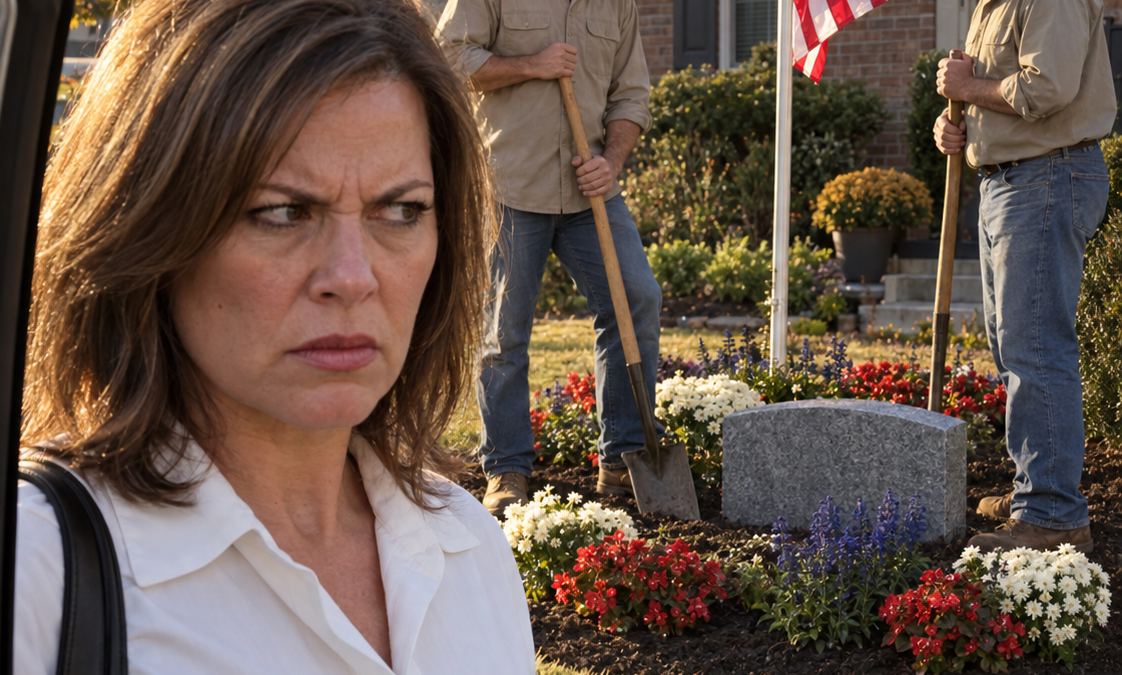
Two men with shovels were standing in my dead husband’s memorial garden when I pulled into the driveway.
One had planted his boot inches from Russ’s name.
Darlene Pruitt, president of our HOA for nine years, sat at my curb in a white golf cart, a clipboard balanced across her knees.
“Kimberly, honey. Perfect timing.”
I’m a CPA. I’d spent twelve hours on tax-extension returns at Hollister & Grant.
SFC RUSSELL DOYLE
U.S. ARMY
Red begonias, white chrysanthemums, and blue salvia surrounded the granite marker. The six-foot flagpole stood behind it.
I put the car in park and got out.
“Please step out of the bed,” I said.
The older worker glanced toward Darlene. The younger man adjusted his grip on his shovel.
“Oh, don’t be alarmed, sweetheart,” she said. “The crew is just tidying up.”
She sounded as though she’d brought a casserole.
I shut my car door. It was 6:18 p.m. on October 3. Low evening sun flashed on the shovel blades. Across the street, the Hendersons slowed their walk. Their beagle stopped at a mailbox. Neither called it along.
“Whose crew?” I asked.
“An HOA-approved vendor. We take pride in keeping Hawthorne Ridge attractive.”
The younger man was Travis Pruitt, Darlene’s son. His crew had mowed our common areas since 2018. He chewed gum.
“That’s an unapproved landscape modification,” Darlene said. “Our architectural standards apply to everyone.”
“Even on my property?”
“Especially on a corner lot. You’re right across from the clubhouse entrance. Think of the example.”
I’d seen a bass boat sitting on blocks for six weeks and Christmas decorations still plugged in at Easter. Those never got a shovel.
I stopped at the edge of the mulch.
“Article IX,” I said.
Darlene’s pen froze over the clipboard.
“Excuse me?”
“Article IX of our bylaws. Nothing on a private lot can be removed without written notice, a hearing, and thirty days to correct it.”
“Kimberly, I’m quite familiar with our rules.”
“Then you know I haven’t had a hearing.”
“We can address procedural details afterward. I’m trying to spare you a more unpleasant situation.”
“By digging up my husband’s garden?”
“By maintaining standards for all two hundred and twelve families who live here.”
I looked toward the flag.
“The Freedom to Display the American Flag Act covers that flag. You can set reasonable rules about the pole. You can’t ban the flag.”
“I never said we were banning the flag.”
“Good. Then nobody needs to touch it.”
The older worker lowered his shovel, setting its blade flat on my driveway. The younger one followed a second later.
“Travis,” she said. Softly. As if he’d forgotten his manners at church.
He snapped his gum.
“Ma, she knows the book. We’ll come back.”
He turned toward a truck parked beyond the golf cart.
A magnetic sign on the truck door read RIDGELINE GROUNDS. The HOA’s paid crew called its president “Ma,” which wasn’t a column in our budget. Apparently they did memorial gardens now, too.
“Next time we won’t knock,” he said.
Nobody had knocked tonight.
Darlene climbed out of the cart and straightened her blouse.
“I know this time of year is hard for your family, Kimberly.” Her smile didn’t move. “And I understand the sentimental value. But buyers driving past the clubhouse deserve something nicer to look at, sweetheart.”
She slid a sheet out from under the clip.
“Your formal violation notice. I thought you’d appreciate receiving it personally.”
I took it, then looked down.
The amount at the bottom was in bold type.
$2,400.00.
I kept my eyes on the figure and said nothing.
“Accrued fines. One hundred dollars a day.”
“For flowers?”
“For noncompliance. Words matter, Kimberly.”
Mrs. Henderson bent to fuss with the beagle’s collar. Her husband stood beside her, both hands wrapped around the leash.
Darlene lowered her voice, though not enough to keep it from carrying.
“Russ sat on this board, honey. He’d be the first to tell you. Rules are rules.”
The corner of the paper bent under my thumb.
Russ had kept the association’s accounts for years. He brought his calculator to meetings and stayed afterward to stack chairs. Darlene knew that.
“Then you’ll have no objection to following Article IX,” I said.
She watched me for a moment, waiting for something louder.
“Well,” she said, “we’ll let the board sort that out.”
She climbed into the golf cart and drove toward the clubhouse.
The Hendersons started walking again. Mr. Henderson lifted two fingers toward me, then lowered them when his wife touched his sleeve.
I checked the garden before going inside.
The edge of a shovel had nicked the border. One red begonia leaned sideways, its roots exposed. I knelt and pressed damp dirt around them until the stem stood upright.
I’d planted the bed on September 14, Russ’s birthday.
Our son, Jake, had set the pole himself. He’d borrowed Russ’s old level from the garage and checked it three times, even after the concrete started to harden. He’d wiped the level clean before putting it back.
Jake was still out with the team.
Inside, the house smelled faintly of coffee from that morning. I set my keys on the entry table and passed the hall closet.
Russ’s Army footlocker had sat there since 2019, with the same strips of packing tape across the lid.
I kept walking.
Jake’s cleats were gone from the mat. I put Darlene’s notice facedown beside the microwave.
I wouldn’t tell him yet. He would walk out on his team, and Darlene would get the argument she wanted.
I reheated spaghetti and left most of it.
Then I turned the paper over.
I went through the notice as I would a tax return I was about to sign.
Violation start date: September 9.
I dug the first hole on September 14.
Someone had started charging me for Russ’s garden five days before it existed.
I opened the laptop on the counter and searched my sent mail for September 2.
Part 2 of 13
“We never received it. Spam folder, maybe. Not my problem.”
Darlene Pruitt pushed my September 2 receipt back across the folding table with one fingertip, unread.
Rain streaked the Hawthorne Ridge clubhouse windows on October 6, the night of my violation hearing. About twenty residents watched from metal chairs. Two buckets on the floor were already catching drips from the leaking roof.
I had brought three sets of the same documents: my architectural review application, the sent email, and its automatic confirmation. I’d slid one set to Darlene, handed another to Gene Kowalski, and kept the third in front of me.
“Your system acknowledged it,” I said.
“Those automated messages can be so confusing, sweetheart.” Darlene smiled at the residents. “What we need is an approval. You don’t have one.”
I hadn’t claimed I did.
“Please have the minutes show I submitted the receipt,” I said.
Vince Albright, the secretary, glanced at her.
“Vince, write down that Mrs. Doyle brought a printout.”
He wrote slowly, as though he were recording a suspicious object found at the scene.
On my copy of the violation notice, I had circled 9/9 and written 9/14 beside it. I didn’t mention either date.
Vince kept the minutes. I kept mine.
Tonya Reese leaned forward, her badge hanging from her navy scrubs.
“Did somebody check the inbox? Not guess. Check.”
“Tonya, dear, I appreciate how thoroughly you do things at the hospital,” Darlene said. “Here we have an established review process.”
“This isn’t a hospital, I know,” Tonya said. “Good thing. Your bedside manner would get you written up.”
A couple of residents gave short, nervous laughs.
“I work in an ER. When we lose a chart, we don’t charge the patient extra while we look for it.”
A woman near the back murmured, “Exactly.”
Darlene adjusted her reading glasses.
“The garden is there without approval. We can’t pretend otherwise just because the paperwork is unfortunate.”
“Then find the paperwork,” Tonya said.
The rain struck the windows harder. Gene studied the pages I’d given him, running one blunt finger down the confirmation email. Harold Benning sat beside Vince, squaring the edges of a blank agenda. He had delivered mail in this neighborhood for thirty-one years. I had never seen him so determined not to look up.
Darlene made a motion for a continuing-violation fine: fifty dollars more per day. Vince seconded immediately.
“Hold on,” Tonya said. “We’re increasing a fine while nobody’s answered whether the application got through?”
“We can’t hold the whole neighborhood hostage over one missing email,” Darlene said.
I drew a line under the motion on my yellow legal pad. The existing penalty was $100 a day. Add $50, and the new rate was $150 a day.
$1,050 a week.
Darlene called for the vote.
She raised her hand. Vince raised his.
Tonya voted no.
Gene set the papers aside and turned to Darlene.
“I haven’t seen enough. Abstain.”
Harold kept his eyes on the table until Darlene said his name.
Then he raised one hand without lifting his head.
Three yes. One no. One abstention.
I wrote 7:26 p.m. beside the tally.
Darlene folded her hands, as pleased as a hostess whose guests had finally agreed on dessert.
“We do sympathize. But we can’t have every widow on the street building a shrine.”
A man in the third row laughed once. His wife looked toward the floor. The sound ended there.
“Grief isn’t a variance, Kimberly.”
I wrote those exact words beneath the vote, followed by the time: 7:27 p.m.
Tonya pushed her palms against the table.
“That was unnecessary.”
“Oh, Tonya. I would never mean to hurt anyone. I’m only trying to help Kimberly understand the difference between personal wishes and community responsibilities.”
I capped my pen.
The meeting moved to parking complaints and a request for new clubhouse furniture. When it ended, residents began stacking chairs. One woman paused beside me, opened her mouth, and then carried her chair away.
Darlene waited until the room had thinned before approaching.
“There’s no shame in selling, honey. That’s a lot of house for one woman.”
“It’s paid for,” I said.
Her smile tightened.
At home, Jake was waiting in the kitchen, his sweatshirt still damp from the rain.
“Why didn’t you tell me?”
I set my keys down.
“Tonya’s son Eli saw it in the Hawthorne Ridge Neighbors Facebook group. They tried to dig up Dad’s garden?”
“They didn’t touch the marker.”
“That’s not what I asked.”
“I stopped them.”
“And tonight you just sat there? It’s all over the group.”
“I gave the board the documents.”
“You let them do it.”
“They voted, Jake.”
“Call me next time.”
“You were out with the team.”
“So?”
He looked past me toward the dark front yard.
“That’s Dad’s name out there.”
“I know.”
He pulled a flashlight from the junk drawer and went outside. Its beam moved over the flower bed, then stopped at the pole’s concrete footing.
The small solar spotlight at the base was aimed too low. Jake crouched, turned it upward, and watched until the flag caught its light. He checked the pole with one hand before coming inside.
He went upstairs without speaking.
I left his wet footprints on the mat.
The next morning, a plain envelope was tucked into my storm door. No stamp. Hand-delivered.
Bluff Road Holdings LLC offered $289,000 cash for my house, as-is. Comparable sales put mine at about $350,000. Their offer came in sixty-one thousand dollars low.
The letter was dated October 5.
It offered to buy the property “to relieve you of your outstanding HOA obligations,” specifically “$2,400.00 in accrued fines as of October 3, currently accruing at $150 per day.”
The $2,400.00 matched the notice Darlene had handed me on October 3.
The board hadn’t voted on that extra fifty dollars until 7:26 last night.
Part 3 of 13
The man whose crew had planted a boot inches from Russ’s name wanted to buy the ground it stood on. The state’s summary page for Bluff Road Holdings LLC listed one manager: Travis Pruitt.
It was a little after seven on the morning of October 7, and his offer was still lying beside my coffee on the kitchen counter.
I ran his lawn company next. Ridgeline Grounds LLC listed Travis as manager, a commercial registered agent, and a P.O. box for mail. No surprise there. Everybody knew whose crew had mowed our common areas since 2018.
On the Montgomery County property site, I searched the owner name Bluff Road. Three parcels came back, all inside Hawthorne Ridge. I copied the house numbers onto a legal pad. One was Grace Okafor’s old house. I had assumed Grace sold it to move in with her daughter in Nashville. I didn’t know the other two.
My desk at Hollister & Grant held a stack of extension returns due October 15. I slid my notes into my briefcase and drove to the office.
That evening I built workpaper folders, the way I would for any audit.
W/P-1 held the Bluff Road letter, my yellow-pad note of the 7:26 p.m. vote, and the three house numbers.
Knew the vote early. Source unknown.
W/P-2 got the September 2 application email and its automatic confirmation.
Sent and received. Not yet: who opened it.
October 8 broke cold and gray. I walked down to the retention pond behind the clubhouse. Dew beaded on the stone bench. I pulled a tissue from my pocket and wiped the left half of the seat dry. The right half stayed wet, the way it had for seven years.
I opened the camera on my phone. The screen framed the same view I had shot every morning since the morning after Russ’s funeral: dark water, the broken fountain, three big oaks on the far bank.
I took one photo.
It went into my iCloud library with the date and time, after more than 2,500 others. Jake knew about my morning walks. He didn’t know about the pictures. Nobody did.
Something splashed behind me, and I turned. Farther down the bank, well out of the frame, Harold Benning was feeding the ducks. Our HOA treasurer had on his old canvas barn coat. A plastic bread wrapper crackled in his fist. He kept tapping its open edge against his thigh, squaring it over and over, the way he used to even up a bundle of envelopes on my porch.
I stood up. My boots slid on the clay.
“You voted for the extra fifty,” I said.
Harold stopped tapping the bag. He looked at his shoes.
“Leave it alone, Kim. Please.”
He didn’t explain, just shook the last crumbs onto the water and hurried off toward the street.
That night I drafted an inspection request on my laptop. Tennessee law lets an owner inspect association records with five business days’ written notice. I listed financial statements, check registers, vendor contracts, and meeting minutes.
My second paragraph stated the purpose exactly. “To verify the reserve balance and the basis of the fines assessed against 401.”
I emailed it to all five board members, then printed a copy and signed it in blue ink.
Across the street, the clubhouse was dark and locked. The glass case by the door still showed only the October 6 agenda. I pushed the envelope through the brass mail slot and heard it hit the tile inside.
Back home, Jake had a box of cold pizza open in front of him and his eyes on his phone. His gym bag lay where he’d dropped it by the back door.
“Dad would’ve done something,” he said.
I pulled out the chair opposite him. In June he would ship out for basic training, and he still slammed doors like he was fourteen.
“I am doing something. It’s just boring.”
Jake stared at the cardboard box. The cheese had gone stiff and pale. He nudged the last slice toward me. It was the piece with extra pepperoni he always saved for himself.
“Eat,” he said.
On October 10, at 6:42 p.m., someone knocked while I had a client’s ledger spread across the table. The sharp rap rattled the storm door frame.
I walked over and twisted the deadbolt. Darlene stood on my porch in a tailored blazer, holding out a single sheet of paper.
The page she handed me was on HOA letterhead, dated October 10. My request had been “denied as harassment of volunteers.”
I uncapped a pen and wrote W/P-3 in the top right corner.
“One signature. No board vote cited,” I said.
Darlene tilted her head and gave me the smile she used at open houses.
“We all respect Russ, Kimberly. We simply can’t be asked to look at your grief every morning.”
I looked down at the letter’s last line. “The board will take up a lien at the annual meeting.”
A lien would sit on my deed until I paid or sold. Bluff Road had left its offer in my storm door three days earlier.
“Thank you for putting that in writing.”
Part 4 of 13
“Kim, I’m in the parking lot at my cardiologist’s office.”
Harold Benning sounded as though he’d run up the clubhouse steps. It was October 12. I had payroll figures open at Hollister & Grant.
“Are you all right?”
“Doctor told me in August to give up anything stressful.” A car door thumped somewhere on his end of the line. “I should’ve listened sooner.”
I moved my pencil off the spreadsheet.
“What happened?”
“At five on the 10th, Darlene emailed the other four board members. Subject said ‘FYI – handled.’ She attached what she gave you. Even the part about putting a lien on your house.”
“She called that handled?”
“Nobody voted to deny your request.” Harold took a shallow breath. “I called Tonya that night. We sent notice to the whole board for a special meeting on the 13th. Put a copy on the clubhouse door, too.”
“Four days ago you told me to leave it alone.”
“I told Darlene in August I was stepping down this fall,” he said. “Somebody who can read a balance sheet needs to see those books before the annual meeting.”
The treasurer’s seat was going to open this fall. Darlene had known since August.
“Will you take my seat, Kim? For what’s left of my term?”
Extension returns due October 15 crowded the tray beside my keyboard. I turned one client’s checklist facedown.
“If the board appoints me, I’ll serve.”
“Thank you.” His voice went thin. “I can bring the binder.”
He hung up without explaining the binder.
On October 13, a plastic bucket sat below the clubhouse ceiling leak. Water dripped from a brown stain over the soda machine. My folding chair rocked on uneven tile.
Darlene had taken the chair nearest the door, a Cumberland Crest Realty pen laid across her agenda. Vince opened the minutes book to a clean page. Gene Kowalski had a work jacket over his arm. Tonya came straight from the hospital in navy scrubs and set a paper cup beside her phone.
Harold stood with a sheet in both hands. He pressed its folded edge flat with his thumb.
“I resign my position as director and treasurer, effective when my successor takes office. My term runs until November of next year. I appreciate the opportunity to serve Hawthorne Ridge.”
He sat down slowly. Until the vacancy was filled, he still had a vote.
“I’d like to move that we appoint Kimberly Doyle to the remainder of Harold’s term and elect her treasurer,” Tonya said.
“Second,” Gene said.
Darlene rested her hands on the table.
“Is this really appropriate? Kimberly has an outstanding violation.”
“My $780 annual dues are paid,” I said.
“The bylaws disqualify an owner behind on dues,” Tonya said. “They don’t say an owner accused of a garden violation can’t serve.”
Vince turned a page in the minutes book, then turned it back.
Darlene let the silence run and didn’t call the question.
“Then I will,” Gene said. “All in favor.”
Harold raised his hand first. Tonya and Gene followed. Darlene and Vince voted against.
Three to two.
Darlene’s smile held while Vince recorded the result. A drop hit the bucket, then another.
I took Harold’s place at the table.
The board considered a second resolution, authorizing me to sign for the association at Riverbend Community Bank in Harold’s place. Vince entered it in the minutes. Gene asked for a show of hands.
It passed, three to two, with my hand up where Harold’s used to be.
Harold lifted a thick blue binder from the empty chair next to him. Metal rings had dented its scuffed spine. He slid it across the table until it stopped against my legal pad.
“These are the treasurer’s records,” he said. “I’m sorry I didn’t bring them to you sooner.”
“Thank you, Harold.”
He emailed Red River Community Management, the firm that collects our dues, from his phone, asking that Kimberly Doyle be added to its portal as treasurer, effective October 13. He showed me the sent message.
Darlene adjusted the cuff of her blazer.
“Congratulations, Kimberly. That doesn’t make your flower bed legal, sweetheart.”
I wrote “flower bed” on my legal pad and underlined it once.
Vince lifted his pen. “I’d also like to request that the treasurer’s report be limited to five minutes at the annual meeting.”
Tonya looked at him. “She hasn’t even opened the binder.”
“It’s a matter of keeping things orderly,” Vince said.
Gene asked him to put the request in the minutes. The bucket ticked through the rest of the meeting.
At 9:17 that night, Red River emailed my portal login. The account was active.
Jake was upstairs finishing homework. His Army enlistment paperwork lay under a math worksheet beside the breadbox. Across the street, the clubhouse went dark. I moved his papers clear, set Harold’s binder by the laptop unopened, and signed in.
The dashboard showed dues collected, maintenance tickets, and a tab marked Violations. Red River ran the online fine ledger. I selected the previous two years, then sorted the fines from highest to lowest.
Three closed owner accounts exceeded $5,000. I opened their histories one at a time. Under every notice date ran a column of daily charges. Each account had a place for a hearing date and disposition.
Those fields were blank.
The attachments held fine notices and final payoff statements, but nothing from a hearing.
One belonged to Grace Okafor, a seventy-one-year-old widow now living with her daughter in Nashville. Her fines totaled $7,850. The account had closed with a sale nineteen days after her last fine notice.
I opened the county search I had saved on October 7 and set the two windows side by side on the screen.
Grace’s old house was one of the three parcels from that search. On that row, the buyer column read BLUFF ROAD HOLDINGS LLC.
The second fined account matched another one.
So did the third.
The fines weren’t punishment. They were a sales pitch.
Part 5 of 13
“Well, hell,” Tonya said. “Not one of them got a hearing?”
She stood on my porch on October 14 with two coffees and her hospital badge clipped to her jacket. My laptop sat between us on the small wicker table.
Tonya pointed at the buyer column. “All three went to the same company?”
“County records say so.”
“In triage, we at least let people talk before we send them a bill.”
I turned the screen toward her. Anyone could look those deeds up online. My new treasurer login showed blank hearing-date fields in their violation histories.
Tonya took out her phone. “I still have Grace Okafor’s number.”
Grace answered on the fourth ring. Tonya introduced me and asked permission to use speakerphone.
“I remember Kim,” Grace said. “Russ used to bring my newspaper up from the curb when I was sick.”
The paper cup warmed my hands. I hadn’t known that.
“Grace, can I ask about the fines on your old house?” Tonya said.
“They kept sending notices. I asked for a meeting, and nobody called back.” Grace stopped to clear her throat. “Then the buyer came along. They said I’d lose the house to a lien anyway.”
A sob came through the speaker, then a muffled apology.
“I’m at my daughter’s,” Grace said. “I don’t have my files here.”
“You don’t have to find them today,” Tonya said. “Thank you for answering.”
After the call, Tonya held her coffee without drinking it. A delivery truck rolled past my corner lot. Neither of us moved until it was gone.
At ten, I went to the clubhouse office for the bank paperwork.
Darlene stood by the filing cabinet, arms loosely folded. Vince had the secretary’s certificate on the desk and a pen uncapped beside it.
“The appointment won’t stand,” Darlene said pleasantly. “We may need to reconsider it once everyone has calmed down.”
“Three directors voted in favor,” I said.
“I question the procedure, Kimberly.”
Vince looked from her to the bank form. For a moment he seemed interested in a speck on the paper.
Then he signed.
“It’s a recorded vote, Darlene. I’m the secretary.”
The pen left a blue stroke under his printed name. Vince handed me the certificate without meeting Darlene’s eyes.
At Riverbend Community Bank, a woman behind a glass-topped desk checked the board resolution and my driver’s license. She brought out a new signature card for the reserve account. Association checks from that fund required two signatures, the president’s and the treasurer’s.
I signed in the box marked Authorized Signer.
“I’d like to see the statements,” I said.
“We need to finish the signer update first,” the banker said. “Online access usually takes eight to ten business days.”
Red River, our management company, only ran the dues portal, the everyday operating account, and the fine ledger. The reserve fund itself sat here, at Riverbend. I put the bank’s receipt for my paperwork in W/P-4 and went back to work.
That evening Jake sat at the kitchen table with his phone propped against the salt shaker.
“Mom, Mrs. Pruitt put Dad’s garden on Facebook.”
The Hawthorne Ridge Neighbors group showed a photograph taken from the street. Russ’s granite marker was visible below the flag.
Darlene’s caption read: “Some residents think grief means special rules. Tacky shrines hurt ALL our property values.”
Jake scrolled through the comments. A neighbor wrote that the flowers looked respectful. Another wanted the board to enforce the rules consistently. Someone with a profile picture of a golden retriever suggested we should move the memorial to a cemetery.
“Listen to this,” Jake said. “‘The HOA shouldn’t make exceptions just because somebody served.’ Who says that?”
His thumb moved faster. More replies appeared beneath the post.
“And this one says you think you’re better than everybody because Dad was in the Army.”
I took the phone from his hand and set it facedown beside the salt shaker.
“Give it back.”
“Finish your dinner.”
Jake pushed his plate away. The peas slid into his mashed potatoes.
“You’re going to let her talk about him like that?”
I opened the post on my own phone and saved a screenshot. Jake watched me do it, arms crossed, and didn’t touch his fork.
On October 20, after work, I stopped at the clubhouse to look for the posted meeting minutes. Darlene caught me in the parking lot as I reached my car.
“I thought you might want to see this,” she said.
The photocopy was the 2018 Ridgeline Grounds mowing contract. The annual price was $9,800. At the bottom, under Treasurer, was Russ’s signature.
Darlene smoothed a corner of the sheet against my car door.
“Before you go digging, sweetheart, the first name you’ll find is your husband’s.”
“May I keep it?”
“I made that copy for you.”
Home was across the street, but I took the long way around, with the contract on the passenger seat and the radio off. At the first red light, the page slid toward the seat belt buckle. I reached over to keep its corner from folding.
That night I called Tonya.
“Darlene gave me Russ’s signed 2018 mowing contract. She said his name would be the first one I found.”
“Chart it,” Tonya said. “Time, place, her exact words. If it isn’t written down, it didn’t happen.”
At 6:40 a.m. on October 21, I pulled on my walking shoes and went out toward the pond. The streetlights were still on, and the sky behind the clubhouse was gray. Sunrise was almost twenty minutes away.
The solar spotlight at the corner of my front garden shone against the flagpole. Something pale had been taped around the metal, just above Jake’s concrete base.
I stopped and peeled away a folded notice. The date at the top was October 21.
“Unapproved structure removed per Article IX.”
Below the flag, Russ’s granite marker was gone. Only a clean rectangle of bare dirt remained where it had stood.
Part 6 of 13
When I turned from the flagpole, Jake was standing over the empty spot in his socks and Army PT shirt. His car keys were already in his fist.
“Where does Travis live?”
The sun hadn’t cleared the houses. Dew from the grass had soaked through to his heels, and he didn’t seem to notice.
“You’re not going over there,” I said.
“He took Dad’s name.”
“We don’t know who took it.”
Jake headed for the car. I crossed the driveway and planted myself between him and the driver’s door.
“Move, Mom.”
“No.”
He looked past my shoulder toward the street. Seventeen years old, already taller than Russ had been, with the same stubborn set to his jaw.
“Look at the camera,” I said.
Without moving from the car, I opened the doorbell app on my phone. The video began at 3:12 a.m. Headlights washed over the railing. A dark utility trailer passed through the far edge of the frame. Then the recording ended.
The driver and license plate stayed out of view.
Jake pinched the screen larger.
“Look at the rear fender.”
I could barely make out its shape.
“It’s dented,” Jake said. “Like the trailer Ridgeline parks behind the clubhouse.”
“Like it,” I said.
He handed back my phone. His keys stayed in his fist.
I called the Clarksville police nonemergency number and reported the missing stone. The dispatcher asked for my address, what was taken, and whether I knew who had removed it.
“I don’t,” I said.
A patrol officer arrived after seven. He parked at the curb instead of blocking our driveway and listened while I explained that the granite marker had carried my husband’s name.
I handed him the folded notice I’d peeled off at dawn and showed him the strip of tape still stuck to the flagpole. He unfolded it.
“Unapproved structure removed per Article IX,” he said.
“That’s a section of our HOA bylaws,” I said.
He looked from the page to the disturbed flower bed.
“This appears to be a civil dispute with the association, ma’am. I can document what you’re reporting, but I can’t tell you who removed it.”
“Please document it.”
He wrote down the description and the 3:12 time stamp from my doorbell video, then gave me an incident number. Before leaving, he suggested I speak with the board or an attorney about the notice.
After his patrol car pulled away, I opened my yellow legal pad on the porch rail.
“October 6,” I told the flagpole. “Even if they count that meeting as a hearing, Article IX gives me thirty days to cure. Earliest removal is November 5.”
I wrote both dates beneath the officer’s number and drew a box around them.
The notice itself broke the rule.
Across the lawn, the flowers still made a neat border around the space where Russ’s name had been. The flag moved above it. Nothing else did.
Jake came out carrying his backpack. He’d changed his wet socks, but left his car keys on the kitchen counter.
“Are you going to do anything besides write stuff down?”
“I filed a report.”
“They stole Dad’s stone, and you got a number.”
“It’s where I start.”
Jake gripped the strap across his chest.
“Dad would’ve fought.”
“Your dad would’ve won.”
He went inside and slammed the door hard enough to rattle the glass in the storm door.
On October 24, I carried Darlene’s photocopy into the garage after supper. The work light over Russ’s bench put a bright circle around his signature at the bottom of the 2018 mowing contract.
The ink had the same long tail on the R as his notes on the calendar. He used to circle Jake’s games in blue and write the departure time beside them, allowing fifteen minutes for traffic even when the field was six minutes away.
I moved the page closer to the bulb.
Darlene had chosen that signature carefully. If there was something wrong in the records, I might be the one who carried Russ’s name into it. Jake had already watched strangers on Facebook use his father against me. I pictured him seeing the handwriting from his birthday cards on a screen, attached to something I couldn’t explain.
The laptop was open at the end of the bench. I drafted an email to the board.
Subject: Resignation as Treasurer
Please accept my resignation from the position of treasurer, effective immediately.
I stared at the cursor after the period. Then I closed the draft without sending it.
The checkbook was in the kitchen drawer. I fetched it, wrote October 24 on the next check, and filled in Hawthorne Ridge HOA as payee.
$5,500.00.
That covered the charges through the 24th, including the increase to $150 a day. In the memo line I wrote “Fine assessment, 401.”
I signed my name.
For a minute, the check lay across the contract, covering Russ’s. I separated the pages and slid the check under the old coffee can full of screws.
Before bed, I stopped at the hall closet. Russ’s Army footlocker sat on the floor beneath the coats, where he’d set it the week he shipped out. The brown packing tape still crossed the lid, dull with dust at the edges.
I laid my palm flat on the tape.
From the kitchen, the refrigerator motor started up. I shut the closet door and switched off the hall light.
The clock above the stove said 10:04 p.m. when someone knocked.
Harold stood on the porch in his old postal jacket, a banker’s box pressed against his chest. Its cardboard handles had bowed under the weight.
“Tonya told me what Darlene showed you.”
He shifted the box higher, his fingers tightening along its bottom seam.
“Russ signed one contract, Kim. Mowing. Nine thousand eight hundred a year. Lowest of three bids, and Darlene didn’t vote on it. Everything after that, I signed. And I kept copies. Because he told me to.”
Part 7 of 13
The first check copy Harold laid on my kitchen table was dated a month after we buried Russ.
Harold came back at eight on October 25, and within an hour his banker’s box had emptied into stacks of invoices, check copies, and meeting minutes. My laptop occupied one corner. A pot of coffee sat between the folders. Harold had poured half a mug and barely touched it.
A postal cap rested in his lap. Harold rubbed the frayed edge of its brim with one thumb.
“I took over the treasurer’s binder in March,” he said. “Russ handed it to me himself. All he said was, ‘Keep a copy of everything you sign.'”
I placed a blank legal pad under the first document. Harold squared the check copy against the edge of my placemat. His fingertips stayed on the page after it was straight.
“In November, Darlene brought me this.” Harold touched a Ridgeline Grounds invoice for $14,000. “Storm cleanup. Dated January. She said it was still sitting unpaid in Russ’s binder.”
“What did she say about approval?”
“That Russ had approved it before he left the board.”
Harold stared at his knuckles. I kept my pen moving so he wouldn’t see it stall on Russ’s name.
“We’d just buried him, Kim. She put it right in front of me. I signed the check.”
The coffee maker clicked as its warming plate switched off.
“And the later payments?” I asked.
“The next time I questioned her, she said, ‘You signed the first one on my say-so, Harold. Who’s going to believe you didn’t know?'”
He pressed the brim flat against his knees. One of the check copies had his signature slightly crooked over the printed line.
I wrote his account in my notes, with the date and his exact words. Riverbend still hadn’t activated my online access. Until it did, Harold’s copies showed what he had signed, not what the bank had paid.
He nodded at the stack nearest my elbow.
“There’s a copy for each one.”
I slid a clean folder underneath them. On the cover I wrote W/P-5.
On October 26, eight business days after I signed the card, Riverbend emailed that my signer access was active. As a signer, I could see the account’s full online history. I downloaded every reserve statement the portal kept, seven years of them, month by month.
The calculation began with the January 2018 opening balance from the year-end report in the treasurer’s binder. I added the reserve contributions in every approved budget from that point through the current year, then subtracted documented, legitimate expenses.
The balance should have been $227,200.
Riverbend showed $41,200.
I checked the formulas, traced the transfers back to their statements, and tried the reconciliation again. The difference remained $186,000.
A separate tab held columns for check number, payee, posting date, and amount. Each withdrawal needed a cleared bank entry, not merely a vendor invoice. I matched the numbers against the copies Harold had saved.
The first cleared check was dated November 2019: $14,000 to Ridgeline Grounds LLC for a storm-cleanup invoice marked January 2019.
A May 2021 entry showed $48,000 for pond dredging. August 2023 brought $61,500 for drainage work.
Another payment, dated April 2024, was $38,200 for removing three oaks. The September 2025 check was $24,300 for an irrigation overhaul.
Each amount matched a withdrawal on the statements. Together, those five checks accounted for the missing $186,000 exactly.
Two signatures appeared on every check copy, Harold’s and Darlene’s, as Riverbend required.
The 2023 reserve study marked the clubhouse roof for urgent repair. I’d watched water fall into a plastic bucket while the board discussed limiting my treasurer’s report to five minutes.
At the bottom of the storm-cleanup invoice was a printed instruction: REMIT TO 114 LAUREL COURT.
I opened the next bill, then the others. All five gave that same street address.
Darlene lived at 114 Laurel Court.
Ridgeline’s state business summary listed Travis as manager and gave a Clarksville post office box for mail. I searched his name in the county property records. His own house purchase was recorded in February 2021.
But the four later invoices still sent the association’s checks to his mother’s mailbox.
On October 7, I’d stopped at that summary page. It identified the manager, not whoever had signed the company’s original filing.
I went to the Tennessee Secretary of State’s website and ordered Ridgeline’s articles of organization. A purchase confirmation appeared in my inbox. I saved it with the other workpapers.
That night I called Tonya. She answered over the sound of a microwave door closing.
“One hundred eighty-six thousand?” she said.
“Five cleared checks. Every invoice has Darlene’s home address.”
“I’m calling the police.”
“Not until every number has a document behind it.”
“Kim, at the hospital we’d call that an emergency.”
“I have the bank records. I’m waiting on a state filing.”
The microwave beeped. Tonya let it beep again.
“Call me when it arrives.”
On October 29, the Secretary of State’s email arrived as I finished a client’s quarterly payroll reconciliation. I downloaded the attached 2017 articles of organization and sent the pages to my printer.
The organizer line carried a handwritten name: Darlene Pruitt.
I took the October 3 violation notice from my briefcase and laid it next to the state filing. Darlene had signed that notice beneath the fine amount.
Both signatures had the same tall loop in the capital D and the same sharp crossbar on the final t. I aligned the pages at their bottom edges.
The president had been paying herself out of the money meant to fix the roof over our heads.
Part 8 of 13
By November 2, my address was sitting in all 212 Hawthorne Ridge mailboxes, printed on the annual-meeting agenda mailed October 23. Tonya had just helped Vince log the proxies neighbors had already returned to the clubhouse drop box.
“People are voting before they know what they’re voting on,” Tonya said.
My own packet lay open on the kitchen counter. Page one listed my house the way it might list a clogged storm drain.
Item 4: Enforcement, 401 Hawthorne Ridge Dr.
Item 5: Treasurer’s report (5 minutes).
Item 6: Election of directors.
Two board seats were up. One belonged to Darlene. The other belonged to Gene, who wasn’t running again.
On the ballot, the choices were Darlene Pruitt and Sheila Marsh. Sheila was Vince’s friend. The proxy listed the same two names, without a line for other nominations.
“That’s convenient,” I said.
Tonya checked her note. “Twenty-three. Darlene is collecting more herself.”
My phone buzzed against the counter.
“Five minutes. Don’t embarrass yourself,” Darlene wrote.
I answered, “Thank you for putting that in writing.”
Tonya looked at the screen. “Does that woman ever take a day off?”
“Apparently not in November.”
By afternoon, Darlene was working her way down Hawthorne Ridge Drive with foil-wrapped loaves of pound cake. From my corner lot I watched her stop at two porches. At the second, the homeowner stood listening for nearly ten minutes.
A neighborhood Facebook post urged everyone to support “experienced leadership.” Darlene had liked it.
After dark, Tonya came up my walk in house slippers and a fleece jacket, on her first day off in a week. She stopped beside the empty place in the flower bed where Russ’s granite marker had stood.
“She’s telling people you’re not well since Russ,” Tonya said.
“Which people?”
“Anybody who opens a door. I heard her at the Hendersons’. Their kitchen window was up. I could hear her from next door.”
Tonya put her hand on my porch railing.
“Darlene said, ‘She does people’s tax returns, honey. A reserve fund is a little different.’ Word for word.”
I looked toward the clubhouse. The light above its entrance was on, though nobody had repaired the roof.
“How many?” I asked.
“We logged twenty-three. There were thirty-one when I checked again after supper. Who knows how many she’s keeping until the meeting.”
Tonya took a folded copy of the ballot from her pocket and tapped both printed names.
“If Darlene and Sheila get those seats, we’re two against three. You and me on one side. Darlene, Vince, and Sheila on the other.”
“I can count.”
“Then count what they can do. The board meets right after the election. They can approve a lien on your house and vote you out as treasurer.”
“I still give my report before the election.”
“Five minutes, Kim. Five minutes before they move on and nobody has even looked at the ledger.”
A moth struck the porch light. Tonya folded the ballot, then smoothed it open.
“You have a week,” Tonya said. “Tell me that’s enough.”
“I have the records.”
“That’s an inventory, Kim.”
I didn’t answer. Tonya tucked the paper into her jacket pocket and went home.
Inside, I opened the reserve reconciliation beside the folder of sunrise photographs.
The $48,000 invoice called the work pond dredging. I started with April 2021 and moved through June, one dated morning at a time. The view held steady. The broken fountain remained in the same patch of water.
An excavator should have left something along the bank. A dredging crew would have needed access, fencing to hold back silt, somewhere to put the mud. My pictures showed no machinery, no silt fence, no tire ruts. The same ducks crossed near the concrete outlet after the May invoice was issued.
I checked the weeks on either side. The bare spot in the grass beside the pond kept its exact shape. The water never showed the disturbed shoreline I would have expected after a $48,000 job.
Then I opened the April 2024 invoice.
Its description said “removal of three oaks” and charged $38,200.
I pulled up the photographs from the month before the billed work. Three large oaks stood behind the pond, their trunks spaced along the slope. One leaned toward the fence. Another had a fork low on its left side.
I advanced to the month after.
The leaning trunk was still there. So was the fork. Every tree stood in its original place, with fresh leaves across the same branches. I went forward another month, then back to the week of the invoice. All three stood in every frame.
For years I’d sat on that bench before the neighborhood woke. The camera had kept each date.
I sat with my hands around a glass of water until the ice had melted.
I indexed the relevant images without changing their original files, marking those before and after each invoice.
On November 8, forty-eight hours before the annual meeting, I wrote to Stuart Haskins, the association’s attorney. He represented Hawthorne Ridge, not Darlene personally, and I addressed him in my capacity as its treasurer.
I attached the reconciliation, the fine ledger pages for 401 and for the three sold houses, their recorded deeds to Bluff Road, and copies of every Ridgeline invoice. My cover note listed each bank withdrawal by check number. I made no accusations. The documents had dates, signatures, and amounts.
One by one, I matched each attachment to the list on my legal pad. Then I clicked Send.
At 11:48 p.m., my phone lit up with Haskins’s reply.
“Mrs. Doyle, I’ll be there. Bring the originals. And please don’t discuss this with the president before Tuesday.”
Part 9 of 13
On November 10, Jake caught me in the hallway with my coat over one arm.
“Can I borrow Dad’s beret for the city’s Veterans Day ceremony tomorrow?”
He stood in front of the hall closet, still wearing the T-shirt he’d slept in.
“I won’t wear it,” he said. “I just want to carry it.”
Behind the closet door sat Russ’s Army footlocker, packed and taped before his last deployment. I looked at the knob.
“After the meeting,” I said.
Jake rubbed the back of his neck.
“You’re going to be there all night, aren’t you?”
“There are six items.”
“That wasn’t my question.”
He moved aside to let me pass, but he didn’t follow me to the door.
By 6:35 p.m., rain had turned the clubhouse parking lot into a sheet of reflected headlights. Cars lined both curbs past the retention pond. Three neighbors I’d never seen at a board meeting were hurrying toward the entrance.
Inside, about ninety residents filled the clubhouse. Rows of folding chairs stood close enough that knees touched the backs in front. Wet umbrellas leaned against the wall.
Three plastic buckets caught water from the leaking roof. One had been set near the refreshments, beneath a ceiling tile stained the color of weak tea.
Darlene waited at the entrance in a navy suit, handing out agendas. She had arranged the room herself.
“Glad you could make it, Kimberly,” she said.
Four name cards in white plastic holders lined the board table. Mine wasn’t among them.
Darlene had followed me up the aisle. She pointed to the front row.
A folded tent card on the chair read KIM DOYLE. Beneath the name, in smaller print, she’d added: until Item 5.
The place beside it was empty.
I sat down without a word. Jake, in the blue button-down he’d worn the day he signed his enlistment papers, lowered himself next to me. His knees barely fit.
“You’re the treasurer,” he whispered.
“That’s what the minutes say.”
“Then why are you down here?”
I tucked my laptop bag under my chair.
Tonya noticed the card on her way to the board table. Her hospital badge was clipped to her jacket. She pressed her lips flat and took her seat beside Gene.
Stuart Haskins, the association’s attorney, sat alone at the far end. A narrow leather folder rested in front of him. He didn’t speak.
Darlene called the meeting to order at 7:00 p.m. sharp.
“I want to recognize nine years of standards under my leadership,” she said. “Nine years of protecting property values and insisting on the same rules for every household.”
Vince started clapping. Several people joined him.
Darlene smiled at the back rows.
“Some years, that means making unpopular decisions. That’s what leadership is.”
The projector lit up behind her. Vince slid pages of meeting notes across to Darlene while she cleared the first three agenda items. No hands went up. Rain rattled the windows.
When she reached Item 4, the screen displayed my address.
401 Hawthorne Ridge Drive.
“This is an enforcement report,” Darlene said. “The members aren’t being asked to vote on an individual lot tonight. That responsibility belongs to your elected board.”
A photograph appeared. My flower bed in September, with its red, white, and blue blooms, Russ’s granite marker, and the six-foot flagpole Jake had set himself.
I felt my son’s chair move closer to mine.
“Most of you know we’ve worked very hard to resolve this privately,” Darlene said. “We respect military families here. Our concern is compliance.”
She clicked to the next image.
The picture had been cropped tightly around the bare rectangle where the stone had stood. None of the flowers on either side were visible. From the back of the room, it might have looked as though the whole bed had been cleared.
“Unfortunately, the violation remains unresolved.”
A man two rows behind us murmured, “Then why’d they take the marker?”
His wife put a hand on his knee.
“At the regular board meeting immediately after tonight’s election, your directors will vote on recording a lien against 401 Hawthorne Ridge Drive for unpaid fines.”
A few neighbors nodded. Someone near the coffee urn said, “Rules have to mean something.”
Jake pushed his feet against the floor. The metal chair legs grated.
I kept my eyes on the front table. My annual dues were paid. The penalties were disputed. On the screen, my house number stayed large enough to read from the last row.
Darlene turned back to the crowd.
“And before our treasurer lectures anyone about finances, her late husband personally hired the contractor she’s about to smear.”
She lifted a stapled copy to shoulder height and held it there. From my folding chair I recognized the cover page of Russ’s signed mowing contract.
Murmurs traveled toward the back wall. A woman near the aisle looked straight at Jake. Two men behind her turned to find me.
“Dad didn’t hire somebody to steal from us,” Jake said.
He began to rise.
I put my hand on his arm. He stopped, breathing through his nose, and slowly settled back.
Darlene kept the contract in her hand. The corners of her mouth stayed lifted.
“Item 5. Treasurer’s report. Five minutes, Kimberly.”
I stood, walked to the front, and plugged my laptop into the projector.
“I’ll only need four,” I said.
Then I set a four-minute timer on my phone and laid it face up on the podium, where Darlene could see it.
Part 10 of 13
The first slide was a bank reconciliation.
Under HAWTHORNE RIDGE RESERVE FUND sat two numbers that should have matched.
The ledger called for $227,200. Riverbend Community Bank showed $41,200.
Behind me, a bucket caught another drop from the ceiling.
“That’s why there are buckets in this room,” I said.
Near the coffee urn, someone set down a fork.
Darlene leaned toward the microphone. “Every HOA in Tennessee is underfunded. Kimberly doesn’t understand how HOAs work.”
“Underfunded means the money wasn’t collected,” I said. “Our dues were. The missing $186,000 left this account in five checks to one company.”
I clicked once.
Five cleared checks appeared, each signed by the president and treasurer. Every payee line read Ridgeline Grounds LLC.
“Russ hired Ridgeline,” Darlene said. “I showed you his contract.”
“For mowing. Nine thousand eight hundred dollars a year.”
On the next slide, Russ’s agreement sat beside five more invoices. One billed $14,000 for storm cleanup. The others charged $48,000 for pond dredging, $61,500 for drainage, $38,200 for removing three oaks, and $24,300 for an irrigation overhaul.
“Here’s the pond on the dates Ridgeline billed for dredging.”
Sunrise photographs dated May 2021 showed the broken fountain in shallow water. No dredging equipment appeared.
I advanced to April 2024. The three oaks stood behind the water. More images followed from after the $38,200 tree-removal invoice.
All three trunks remained.
A phone lowered in the second row.
“She’s a grieving woman who takes pictures of a pond,” Darlene said. “Those could be from any year.”
“Each file retains its date and time,” I said. “I have more than 2,500, unaltered. The paper originals Mr. Haskins asked for are in the box by this podium.”
Stuart Haskins opened his leather folder. Darlene watched him instead of the screen.
I brought up the invoices again and enlarged the payment instructions.
REMIT TO 114 LAUREL COURT.
The address appeared five times, beside five different dates.
“That’s your house, Mrs. Pruitt,” someone said from the back.
The following slide was the filed articles of organization for Ridgeline Grounds LLC. Beneath the 2017 filing date was the organizer’s signature.
Darlene Pruitt.
“That’s Travis’s company,” Darlene said. “I filled out his paperwork when he was twenty-five.”
“Travis moved out in 2021. Why did the checks keep coming to your mailbox?”
Her microphone gave a small squeal when she pushed it away.
Jake sat in the front row, hands flat on his knees.
The next document was the offer tucked into my storm door. Bluff Road Holdings LLC had offered $289,000 on October 5, already citing fines of $150 per day.
Beside it I projected my yellow pad from the October 6 hearing.
7:26 p.m., October 6. Board votes $150/day.
“Your son’s company knew the vote a day before your board did,” I said.
Vince looked down at the agenda in front of him. “She called me on the fifth about the extra fifty,” he said quietly. “Asked me to second it.”
Next, I put up the fine notice Darlene had signed. Its start date was September 9.
“I planted those flowers on September 14,” I said. “The only way you knew about my garden on September 9 was my September 2 application.”
I placed the email receipt next to her signature.
Then the October 21 removal notice appeared beside Article IX, with its requirement for a hearing and thirty days to cure. She had dated it fifteen days before that period ran out.
Darlene reached for the 2018 mowing contract again. The edge bent under her thumb.
A chair scraped in the third row.
Harold Benning got to his feet, one hand braced on the seat ahead of him.
“Russ signed one mowing contract,” he said. “The first invoice was sitting unpaid in his binder. She told me he’d approved it. I signed. And I signed four more, because by then my name was on the first one.”
My phone vibrated against the podium. Four minutes were up. Nobody asked me to sit down.
Harold sat. Across the aisle, a neighbor moved her purse aside.
Haskins stood.
“Before Item 6 proceeds, the association has an election problem,” he said. “The mailed ballots and proxies listed only Mrs. Pruitt and Ms. Marsh. Owners were given no place to nominate another candidate. Nominations must be reopened with proper notice.”
A woman in a raincoat raised her hand. “I move to postpone the election until we can nominate somebody.”
Another resident seconded. Haskins explained that both expiring seats would go to a special election in December. Until successors were elected, Gene and Darlene remained directors.
Hands rose across nearly every row. Vince counted them and announced that the motion passed.
Darlene’s face had lost its color. She struck the gavel once.
“The annual meeting is adjourned.”
Every chair stayed full.
Under the bylaws, the board’s regular meeting followed at once, at the same table, with no separate notice. Darlene called it to order. A bead of rainwater struck the bottom of a bucket near her chair.
“The association should suspend the president’s bank signing authority tonight and refer these records to law enforcement,” Haskins said. “Mrs. Pruitt, please yield the chair to the secretary for any motion concerning you.”
Darlene looked at Vince. He pulled the microphone toward him.
“Go ahead, Tonya.”
“Motion to remove Darlene Pruitt as president and suspend her signing authority, effective immediately.”
“Second,” Gene said.
Vince called the roll. Tonya answered yes before he finished her name, and Gene and I followed. Darlene said no without looking up. Vince abstained.
“Three to one, one abstention,” Vince said. “A majority of the full board. Motion carries.”
Darlene held Russ’s contract in both hands. Her knuckles pressed white against the paper.
“You humiliated me in front of my neighbors.”
I looked at the signature at the bottom of the page.
“He’d be the first to tell you, Darlene. Rules are rules.”
Part 11 of 13
Darlene still sat in the president’s chair as if the vote hadn’t happened. Gene leaned toward his microphone.
“We need somebody to chair the rest of this meeting.”
Vince set the roll sheet down. Russ’s mowing contract still lay bent between Darlene’s hands.
“The office is vacant,” Haskins said. “Mrs. Pruitt remains a director. The board can elect an acting president now.”
“I nominate Tonya,” Gene said.
“Seconded,” Vince said.
Darlene turned toward him. “Vincent.”
He kept his eyes on the minutes.
Four voted to make Tonya acting president. Darlene voted against.
Tonya drew the microphone closer. She unclipped her hospital badge from her jacket and laid it face down by the gavel.
“Let’s protect what money we have left,” she said.
Gene moved to freeze further Ridgeline payments, send the evidence file to the Clarksville Police Department, and open a claim under the association’s fidelity insurance.
“You’re going to stop mowing for 212 families because you’re mad at my son?” Darlene asked.
“We’re stopping checks,” Tonya said. “You can worry about the grass tomorrow.”
Vince’s pen scratched across the page. The motion carried, four to one. Under the table, Darlene’s thumb moved fast across her phone screen. Russ’s marker was still missing.
Haskins wrote the result into his leather folder. The room hadn’t emptied. Owners stood two deep along the clubhouse wall.
“Next, enforcement against 401 Hawthorne Ridge Drive,” Tonya said.
That meant the disputed fines and the lien. I slid my chair away from the table.
“I won’t vote on my own case,” I said.
Tonya moved to void the charges and drop the lien. Gene seconded.
“Rules can’t disappear whenever Kimberly brings a slideshow,” Darlene said.
“They didn’t disappear,” Tonya said. “We just heard what happened when you ignored them.”
Tonya, Gene, and Vince voted yes. Darlene voted no. I did not cast a vote.
Vince drew a line through the proposed lien motion on his agenda.
Haskins took the microphone. “No lien vote will proceed on this property. I’ll prepare the written confirmation.”
My legal pad still had 7:26 p.m., October 6, in the margin. I tucked it into my bag.
Before I reached the door, Haskins stopped me beside the folding chairs.
“I’ll write to the three families who sold to Bluff Road,” he said. “Their fines were levied without hearings. They should hear that from the association, not from a neighbor.”
“Thank you,” I said.
“Keep your originals. We’ll need a proper record of what we turn over.”
Outside, rain blew under the clubhouse awning. Jake carried the file box against his chest as we crossed to my car.
Darlene stood beside her car with her keys in one hand. Neighbors passed within a few feet of her. One shook out an umbrella at the door of a pickup. Another pulled her daughter beneath a hood.
Nobody spoke to Darlene.
At home, Jake left his shoes on the porch. I spread the damp workpapers across the kitchen counter, with a dish towel under the corners.
At 11:51 p.m., I opened the neighborhood Facebook group. Darlene’s post about “tacky shrines” was gone.
I put the phone on its charger.
The next morning, Jake came downstairs in a pressed blue shirt.
“The ceremony downtown starts at eleven,” he said. “You said after the meeting. I’ll carry Dad’s beret, not wear it.”
The hall closet had a narrow space between the vacuum cleaner and the coats. Russ’s olive-green footlocker sat there with the same strips of packing tape he’d pressed across its lid before he deployed.
I brought it into the living room. Jake knelt at one end while I steadied the other.
From the kitchen drawer, I took the box cutter and handed it to him.
“You do it,” I said.
Jake eased the blade through the old adhesive. It made a dry ripping sound. He flipped the metal clasps back and raised the lid.
Russ’s dress uniform lay inside, jacket folded over trousers, the brass buttons covered by a piece of tissue paper. The crease in one sleeve was still sharp.
A black beret rested beside the collar. Jake picked it up by the edge and brushed lint from the insignia with his thumb.
Under the uniform was a manila folder thick with receipts. I turned back the cover.
On top lay a Ridgeline Grounds invoice for $14,000, dated January 2019. Across the amount, in Russ’s square handwriting, were the words:
REFUSED: no work done. R.D.
I held the sheet by its corners. Harold had signed the check for it a month after the funeral, because Darlene told him Russ had approved the work. This original had been in our closet the whole time.
Beneath that sheet was a sealed envelope. My name was written in the same block letters Russ used on our Christmas cards.
KIM: HOA. READ IF.
I carried it to the kitchen table, pulled my copy of Russ’s signed mowing contract from last night’s workpapers, and set the envelope on top. A small crease crossed the flap where his thumb had pressed it shut.
Jake stood beside the empty chair with the beret in both hands.
I opened the envelope. The letter was dated February 26, 2019, eleven days before his deployment.
Kim,
Ridgeline billed $14,000 for storm cleanup nobody on our street ever saw. I refused to pay it and told Darlene I’d take it to the members at the annual meeting when I got home.
I took the bill home and marked it, so nobody can pay it while I’m gone. Until I had proof, I didn’t want to put this on Harold. I told him to keep copies of everything.
You always know which papers to save. I hope I can explain all this across the table instead of making you find a letter in my things.
If I don’t make it home, finish it for me.
Part 12 of 13
Jake held his father’s black beret against his blue shirt and waited for the speaker to reach the D’s.
His hair had the careful part Russ wore on inspection mornings. When the bugler raised his trumpet, Jake lowered his chin and kept both hands around the rim.
The speaker read Russ’s name from a sheet that kept lifting at the corners. A veteran beside us stood with one knee locked straight. His wife slipped an arm beneath his elbow. Small flags snapped against their wooden sticks.
At the final salute, Jake drew the beret closer to his chest. He carried it to the car. Nobody asked whose it was.
At home on November 11, Russ’s letter lay beside two coffee mugs at the kitchen table. Jake sat opposite me, the folded black wool between us.
“You did finish it,” he said.
I looked at the words Russ had written before he deployed, and at the invoice he’d marked REFUSED.
Darlene had never feared the garden. She’d feared the widow of the only man who had ever caught her.
“Your dad started it,” I said.
Jake ran a finger over the beret’s edge. “He knew you’d find the papers.”
“He knew I’d keep them.”
On November 16, a Clarksville detective came to Hollister & Grant with an evidence case and an inventory. I had labeled the originals, the photos, and the downloaded statements.
He checked the labels before sealing the files. I signed the three-page receipt and kept the pink carbon sheet beneath my legal pad.
“Mr. Benning came to the station on his own,” the detective said. “Before anybody contacted him.”
I looked up.
“He gave us a statement on every check he signed. Dates, amounts, who brought him the bills.”
“All five?”
“All five.”
I slid the final folder across the desk. It held Russ’s original refusal and the letter he had left in the footlocker.
He put them in separate sleeves. “We’ll be in touch about the property.”
Eight days later, the detective called from Ridgeline’s equipment yard. Harold’s statement and the association’s records had gotten him a search warrant for the company’s files and equipment. My doorbell video had never shown a plate or a driver, only a dark trailer with a dented rear fender. A worker told him Travis had moved that trailer behind the shed the morning after the annual meeting. The granite marker was inside, wrapped in an old moving blanket under a coil of hose.
After police photographed and logged it, I signed for its release and drove it home in the back of my car.
Jake met me in the driveway. We lowered the stone onto cardboard beside the flower bed. The letters were intact. Mud streaked the line that read U.S. ARMY.
“Should we put it back?” Jake asked.
“We will. The base needs checking first.”
Travis’s trucks stopped coming. Grass around the retention pond reached my shoetops. Tonya asked another crew for a temporary mowing quote, payable only from the operating account.
Cumberland Crest Realty posted a short notice that it had “parted ways” with Darlene Pruitt. Outside 114 Laurel Court, the frame for her YOUR NEIGHBOR IN REAL ESTATE sign stood empty. Its two bare chains swung in the wind. Soon the stakes vanished too.
Grace Okafor called while I was sorting mail. Her daughter had hired a lawyer and wanted the hearing records for all three families.
At Harold’s house, his reading glasses lay beside the newspaper on the coffee table. His old postal jacket hung on the hook by the door.
I gave him copies of the refused bill and Russ’s February 26 letter.
He held both pages near the lamp.
“Darlene told me it was in the binder because Russ had approved it,” Harold said. “That first one.”
His thumb rested under REFUSED.
“After Russ took the original home, Darlene printed another and put it where you’d find it,” I said.
Harold lowered the pages. His shoulders shook. He covered his face with a handkerchief.
“He told me to keep copies. I kept copies. I just didn’t have the spine to use them.”
“You used them.”
“After five checks.”
“And you went to the police before anybody asked you to.”
Harold folded the cloth into a square and reached for the letter.
At the office, the fidelity insurance form wanted the amount of loss, the bank records supporting it, and the names of every person authorized to sign a reserve check. I attached the five canceled checks and the board minutes freezing payments.
The loss was $186,000. The policy covered $150,000, subject to review. I filed the claim and sent Haskins a schedule for the other $36,000.
Haskins prepared a restitution demand to Darlene. I checked the addition and signed as treasurer. The insurance money had not arrived. The clubhouse roof still leaked.
At the December special election, rainwater stains marked the ceiling above the folding chairs. This time Tonya placed a clean bucket under the worst spot before anyone arrived.
Two neighbors were nominated from the floor: Judy Prather of Birch Lane, a retired county clerk, and Paul Everett from Laurel Court.
Darlene remained seated at the front with Sheila Marsh. Vince distributed paper ballots. Owners dropped them into the box from the clubhouse office. Haskins watched the count at the card table by the door.
Judy received 83 votes, Paul 79, Darlene 24, and Sheila 17. The two newcomers would replace Gene and Darlene.
Darlene tucked her campaign cards into her purse, catching one corner in the zipper. Gene shook Paul’s hand, picked up his old coat, and left his place at the board table.
When the residents went home, the new board stayed behind for the officer election. Tonya straightened the microphone and looked toward me.
“I nominate Kim for president,” she said.
“I’d like to stay treasurer,” I said.
Tonya waited.
“It was his seat. I just kept it warm.”
Part 13 of 13
At our first spring board meeting, Tonya set the old blue bucket beneath the ceiling stain.
Rain worked against the new shingles for two hours. When we stacked the folding chairs, the bucket was empty.
“Put that in the minutes,” Tonya said.
Judy Prather looked up from her notebook. “That the roof passed inspection?”
“That we can retire the bucket.”
I filed the roofer’s invoice with photographs of the new flashing and a copy of the warranty.
By May, the grass around the retention pond had been cut. A contractor with a clipboard came to pour a concrete base in our front garden, where Russ’s marker had stood before Travis took it.
“I can set it,” Jake told me after the truck left.
“The base needs to be sound.”
“He said it was.”
“You heard him?”
“I asked him twice.”
A week later, when the concrete had cured, Jake brought Russ’s carpenter’s level out of the garage. He had wiped the dust off the yellow frame, but the letters R.D., scratched near one end, still held a thin line of dirt.
We lifted the granite marker from its padded place in the garage and settled it on the new base. Jake crouched until his eyes were even with the stone.
“Hold it there, Mom.”
I braced the edge while he worked the mortar beneath it.
He laid the level across the top. The bubble rested against the left mark.
“Another little bit,” he said.
I did as he asked. He checked it from the side, then lifted the tool and started over.
“You got that from your dad.”
“The level?”
“The part where one measurement never counts.”
“It was off.”
By the time Jake stood, the bubble sat between the two lines. He rubbed a streak of dust from the letters U.S. ARMY.
The brass plate had been approved by the board without an objection. Jake fastened it to the base beneath the granite.
“SFC Russell Doyle, HOA Treasurer, 2016–2019. He kept the receipts.”
A screwdriver lay in the flower bed beside his knee. Jake tightened the final screw and moved his hand so I could see the inscription.
Near the end of May, a letter from the district attorney’s office said Darlene’s criminal case would go to trial in August. I filed it with the other correspondence.
Bluff Road settled with Grace Okafor. She mailed me a pound cake and a card that said, “This one comes without a campaign speech.”
Early in June, the morning before Jake left for basic training, I heard him moving around upstairs at 5:18.
His duffel stood zipped beside the front door. The recruiter’s instructions were tucked into its outside pocket. Russ would have approved of the packing.
Jake came down in an old gray T-shirt.
“Are you going out?” he asked.
“I was.”
“Can I come?”
I took the house key off its hook. He held the door while I stepped onto the porch.
We passed the garden. The flag shifted on its line, and the brass caught a little light. Jake stopped to straighten one white flower that had tipped against the granite.
“Does it look right?” he asked.
“It’s level.”
“That’s not what I meant.”
I looked at his name and at the last line.
“Yes,” I said. “It looks right.”
The road through Hawthorne Ridge was empty except for a newspaper lying across a driveway. We passed the clubhouse and followed the path to the pond.
Jake walked a little ahead. He waited for me to get around a broken patch of sidewalk.
The fountain ran in the middle of the water. The crew had switched on the new motor in April, and its steady hiss covered the traffic from the main road.
At the bench, I pulled a tissue from my jacket pocket and wiped the dew from my usual place on the left. Then I took out a second tissue and dried the right half, too.
Jake sat down beside me.
“You carry tissues?”
“Every morning.”
“Two of them?”
“Not usually.”
He looked at the clear stretch of stone between us and rested his elbows on his knees.
“So these are the pictures.”
“You saw them at the meeting.”
“On a screen. I never knew where you sat.”
I took out my phone, scrolled back to the first picture, and handed it to him. October 19, 2019. Gray water, a dead fountain, the far bank. Jake looked at it until the screen dimmed, then gave the phone back. The horizon behind the oaks was turning pale.
A duck cut a line through the ripples.
“You’ll still come down here when I’m gone?”
“Yes.”
“Even with everything settled?”
“Not everything.”
He glanced toward me, then back at the fountain.
I’d spent every spring meeting other people’s deadlines, and missing Russ had never come with one. I folded the damp tissues into my pocket.
“Your dad would’ve checked that plate himself,” I said.
“Then he’d have made me do it again.”
“Twice.”
Jake smiled at the water.
When the sun cleared the oaks, I stood and stepped back toward the path. Jake stayed near the bench, one hand resting on the stone where I had wiped it dry.
“Stay there,” I said.
He turned. “Like this?”
“A little to your left.”
He moved until the spray rose behind his shoulder. His T-shirt collar sat crooked. I left it alone.
I raised the phone and took the day’s photograph.
The fountain was running, and for the first time, the picture had someone in it.
THE END








