My husband excluded me from our daughter’s six-day Maine vacation, and he had no idea what I would finally tell her.
Chapter 1 of 7
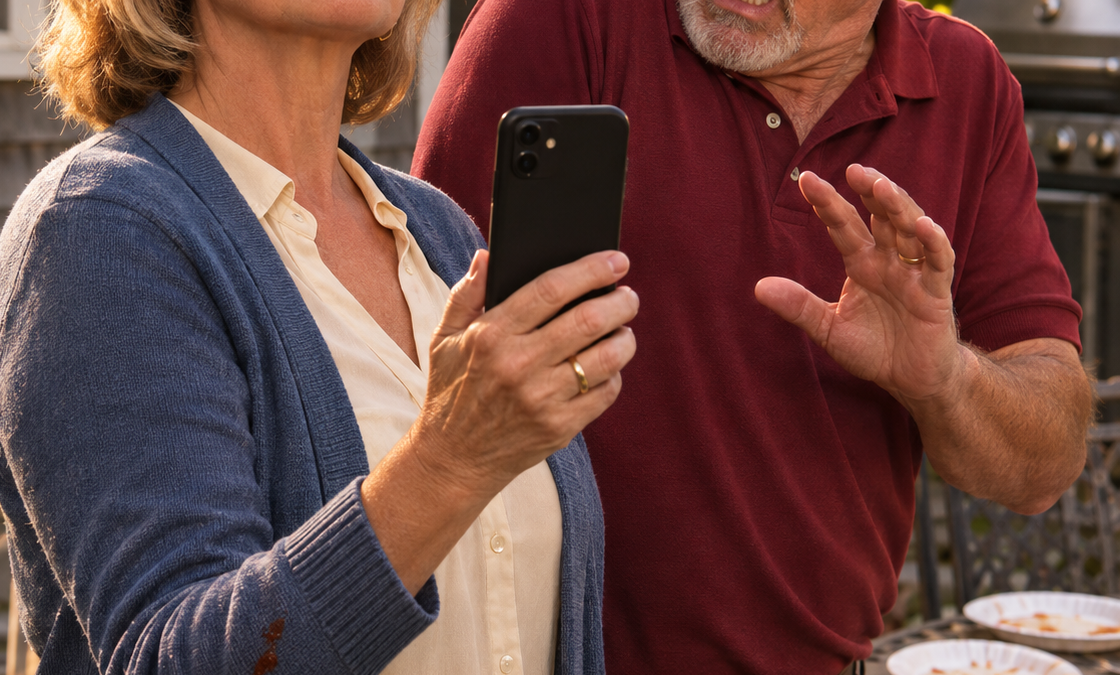
I had everyone’s used plates against my blue cardigan when Grant described tomorrow’s drive to Freeport.
“What about the evenings?” I asked. “I could come after work. Have supper with you.”
He looked across our patio table at Hannah.
“We wanted a vacation, not another performance review.”
Our daughter said nothing. Beside her, Audrey stopped eating.
The paper plate on top had ketchup underneath. I could feel it soaking through my sleeve.
It was Wednesday, September 3, and the cookout had started at five thirty. Our South Portland yard still held the afternoon heat. Nobody had finished the corn.
“I was asking about dinner,” I said.
“Celia, honey. You’re asking now. Then it’s where we eat, whether we’ve booked, why we didn’t check the parking.”
One of our guests looked toward the driveway. Another studied the mustard bottle.
“Hannah leaves for Japan this month,” I said. “I’d like to see her.”
“And she’s sitting right here.”
Hannah’s knees were turned away from the table. She had come straight from an errand, and her car keys were still clipped to her belt.
“I’m here, Mom,” she said. “Can we just have tonight?”
“I was hoping we could still have some evenings together.”
Grant leaned back.
“Remember the spring outing? The jacket?”
“That jacket wasn’t waterproof.”
“She’s thirty-five. She can get rained on.”
Hannah looked down at the corn silk stuck to her plate.
“You made her go all the way back to the car,” he continued. “Then the place she picked for lunch wasn’t good enough.”
“I said it was expensive for sandwiches.”
“You said, ‘Apparently we’re paying for the privilege of finding our own table.’”
I had said that. I had also watched Hannah’s face afterward and pretended I hadn’t.
“You can dislike my company without speaking for me.”
Grant’s voice softened. That made it carry farther.
“Nobody said we disliked your company. You wanted to work. We made plans around that.”
“I went back on the schedule because—”
“Please,” Hannah said.
She didn’t say it loudly. Audrey’s chair was close enough that their shoulders touched.
“I don’t want to spend tonight sorting out which one of you said what. We still have to get to the cottage.”
I had saved seven workdays for her visit. She had six consecutive vacation days, and I had pictured more than this table, these plates, her keys waiting against her hip.
“I’m not asking you to sort us out.”
“Then don’t make me answer for Dad.”
A guest asked whether the trash went in the bin beside the garage. I said yes, though that was the recycling, and let it go.
Grant started talking about the cottage kitchen. There was a coffeemaker. He had checked. Hannah wouldn’t have to hunt for coffee before they went out.
“Your dad considers that wilderness survival,” Audrey said.
Hannah gave a small laugh. I wanted to join it. My mouth wouldn’t cooperate.
At our cookouts, Grant always bought hot-dog buns for hamburgers. He called them convertible buns. That evening, three burgers sat folded in half along the platter, and nobody made the usual joke.
The guests began saying goodbye. Hannah offered to help clean up.
“Leave it,” Grant told her. “You’ve got driving to do.”
“I can carry things in,” she said.
“I’ve got it,” I told her.
The words came out automatically. She was already standing, and I had just dismissed the few minutes she’d offered me.
Audrey thanked me for supper. Hannah asked where she’d left her sweatshirt. Grant knew: over the porch rail, under his cap.
He knew which coffee she wanted tomorrow. He knew where her sweatshirt was.
I was still trying to find out whether I could eat with my daughter.
My phone was in my cardigan pocket. I opened Hannah’s messages and typed one question. Grant came close enough to see her name above it.
“Celia. What are you doing?”
I turned the screen toward him.
Grant read my screen twice. “You haven’t sent that, have you?”
“Did you invite both of us?”
The question sat unsent beneath our last exchange about hamburger rolls.
“I’m asking you first,” I said.
“Put that away until they’ve gone.”
“Then stay out here with me.”
Hannah called from the driveway that she’d found her sweatshirt. I hugged her beside the gate. She smelled like sunscreen and the laundry soap she’d used since college.
“We’ll talk,” she said.
I couldn’t tell whether that was a promise or a request to stop.
Their car left a little after seven. The last guest had gone. Grant stood by the grill, watching the spot where Hannah had parked.
“Did she invite both of us?” I asked.
“She asked about you.”
“What did you tell her?”
“That you weren’t coming.”
“Before you asked me?”
“We’d already talked about walking. You said you weren’t spending your time trying to keep up with everybody.”
“So you declined for me.”
“I knew what you’d say.”
Four weeks earlier, he had answered our daughter’s invitation. I had been in the same house.
“Did you say I couldn’t manage it?”
“I said you had work.”
“You told me she wanted father-daughter time.”
“She does.”
“Those aren’t the same thing.”
He looked tired, the way he used to look when a repair needed doing twice.
“I was trying to avoid exactly this.”
On my phone, the leave calendar showed the days I’d put back on the work schedule. I had canceled them after Grant told me Hannah’s wishes. I hadn’t been too busy when she called.
My unsent question was still there when the notification arrived.
Grant saw Hannah’s name.
“Don’t pull her into this tonight.”
Hannah’s message appeared beneath it.
“Dad said you were relieved we weren’t asking you to come.”
I read it aloud. Grant looked toward the house.
“Relieved about the walking,” he said. “That’s what I was talking about.”
“She said relieved you weren’t asking me.”
“People shorten things in texts.”
“Did you tell her that?”
“I told her you weren’t looking for six days of being dragged around.”
“You told me she didn’t want me there.”
“I never used those words.”
He was right about that. He had said she wanted time with her father, just the two of them on their walks. I had supplied the rest, then carried it around for weeks.
“What exactly did she ask?”
“Celia, I don’t have every word stored away.”
“But you had my answer.”
He exhaled through his nose.
“You’ve complained about these outings for years. I thought I was making it easier for everybody.”
On the Wednesday of that call, I had passed through the kitchen with a damp dish towel while Grant stood near the refrigerator. I heard “let her answer” from the phone, then went back to wiping the stove.
“Easier for who?” I asked.
“For you, too. You hate being hurried. She wants to get outside before she starts that job.”
“I know what she wants to get away from. I’m asking what she offered.”
“I told you. I don’t remember the whole conversation.”
I left Hannah’s message unanswered. There were questions I couldn’t answer yet, including why I’d let her go without asking one plain thing.
Grant went inside. Through the screen door, I heard a closet open.
I stayed beside the table. The ketchup had dried on my sleeve. For once, I let the dishes wait.
He came back carrying the empty overnight bag I usually packed for him.
Grant put it beside me.
“Seven fifteen. I’ll need that ready.”
Chapter 2 of 7
I left the bag where Grant had put it.
On Thursday morning, he found it empty beside the patio table. He brought it inside while I was eating toast.
“You could have told me you weren’t doing it.”
“You could have asked.”
“I did ask.”
I looked at him.
“All right,” he said. “I need to get moving.”
He packed while I dressed for my restored library shift. From the bedroom came the sound of drawers opening, then a question about his gray socks.
“In your drawer.”
“Which one?”
“The one where you keep socks.”
That came out sharper than it needed to. I heard him stop moving, then resume.
At seven fifteen, he appeared in the kitchen with the bag.
“I’ll let you know how things are going.”
“Tell Hannah I hope she has a good day.”
“You can tell her yourself.”
“Yes,” I said. “I can.”
He waited, perhaps expecting another sentence. Then he left.
I watched his car pass the kitchen window. My work shoes were by the back door, where I had put them the night before. Until August, I had expected to spend this morning choosing clothes for Freeport.
Instead, I wrapped half a sandwich and checked that I had my library badge.
I could have driven there.
There was gas in my car. I knew where the cottage was; Hannah had sent us the directions before any of this. Nobody had barred me from the rental or told me I couldn’t visit Freeport.
I could finish work, drive up, and knock.
For several minutes, that was what I intended to do.
I pictured Hannah opening the door. I would say I was only stopping by. Then I would wait for her to invite me inside, offer me supper, find me a chair.
Even in my imagined version, she had to make room for the hurt I brought.
I went to work without deciding.
At the circulation desk, the returns cart had a wheel that complained every few feet. Someone had taped a note above it: YES, WE KNOW.
By midmorning, I had checked in a stack of gardening books and explained that a library card couldn’t be renewed with a grocery rewards card.
The woman who offered it laughed before I did.
“Well, they both live in the same pocket.”
My phone buzzed during my break.
Grant had sent a photograph of a walking map spread across the cottage table. A coffee cup held down one corner. Beyond it, I could see the sleeve of Hannah’s sweatshirt.
His message sounded almost cheerful.
“Looks like we picked a good day. Hannah seems settled. I know you’re upset, but an unexpected arrival could make her feel responsible for everybody. Let’s give her some breathing room.”
I enlarged the picture before I could stop myself.
There was no reason to. It was a map, a cup, part of my daughter’s arm. I wouldn’t find out whether she missed me by looking harder.
I typed, “Did she say she doesn’t want me there?”
Then I erased it.
I wanted an answer from Hannah. Another answer from Grant would leave me exactly where I was.
Back at the desk, an older woman and a man approached together. He put a paperback in front of me.
“She needs another one like this.”
The woman frowned.
“Not necessarily.”
“She liked it,” he told me. “Something short. Nothing depressing.”
“Was there something particular you liked?” I asked her.
“The print.”
He glanced at her. “You said it was good.”
“It was good. I couldn’t read the last one you brought me.”
I asked whether she wanted large print, then whether she preferred another mystery.
“Maybe a biography,” she said. “If it’s somebody interesting.”
“We’ve got a few people who qualify.”
She laughed. Her companion looked relieved to have the request settled.
I showed her where to start. She chose for herself, reading the backs of three books while he waited near the desk.
When they left, he carried the books. She carried her card.
The next patron needed a hold found. Then the receipt printer ran out of paper. Work kept offering me small questions with answers I could check.
During lunch, I ate my sandwich over a napkin and looked at Grant’s photograph again.
He wasn’t wrong about every trip.
Once, Hannah and Audrey had planned an afternoon alone after we met for lunch. I knew that before we left the house. Still, I insisted on a place farther along the coast because the closer restaurant had uneven reviews.
“There’s parking,” I had said. “And you can actually hear yourselves talk.”
There had been parking. There had also been a wait.
By the time we finished, they had lost most of the afternoon they had set aside. Audrey said they could do their thing another time. Hannah paid the check without ordering dessert.
I had complained about the slow service on the drive home.
Grant said, “You picked it.”
“And apparently I should have cooked, too.”
That was how I remembered ending the conversation.
I had wanted to give them a good lunch. I also wanted to be the person who knew the better place, the easier route, the thing everyone would be sorry they hadn’t brought.
Being useful had become a way to keep my place. I had made it difficult to turn down my help.
But I had still been entitled to hear the invitation.
I finished my sandwich and sent Hannah a message.
“Could we have a private phone call when you have a little time? Just you and me.”
I didn’t mention the cottage. I didn’t tell her how long I had been looking forward to this week.
Her answer came later, while I was shelving holds.
“Tomorrow might work. Not sure when yet.”
“Okay. Let me know.”
I read my reply once, resisting the urge to add anything.
After work, I drove home.
The house was warm upstairs. I opened the bedroom window and found one of Grant’s rejected shirts on the bed. I left it there.
For supper, I made an egg sandwich and ate it standing at the kitchen counter. Grant always put pickle relish on his and said that made it supper instead of breakfast. I took the jar out, then put it back unopened.
At a little after eight, my phone sounded.
For a moment, I expected Hannah to say she could call now.
It was Grant. He had forwarded a message, with a line of his own above it.
“I’m not trying to keep you apart. This is what she sent me.”
Underneath was Hannah’s message.
“Mom told me not to rearrange anything. Please don’t restart it tonight.”
Chapter 3 of 7
“Don’t rearrange anything for me. I can keep myself occupied.”
I had said that to Hannah on Sunday, August 10. By Friday morning, September 5, I could hear the exact tone again.
Light. Busy. As if she had called while I was doing something more important.
I had wanted her to protest. To say she wanted me there, that her father had misunderstood. Instead, she had asked whether I was sure.
“Of course,” I had told her.
I had made her ask twice, then resented her for believing me.
Grant’s forwarded message was still on my phone. I read it beside my untouched breakfast.
“Please don’t restart it tonight.”
Hannah had written that to him, not me. I had no way to hear her voice in it. Tired, irritated, worried about another argument—I could supply whichever version hurt most.
I put my phone in my purse and left for work.
At the library, a colleague was covering the desk while I signed in.
“I thought you were off this week,” she said. “How’s the visit going?”
“Oh, beautifully. Apparently the best way to enjoy my company is—”
She looked up from the returns bin.
I stopped. There was nowhere useful for that sentence to go.
“Hannah’s in Freeport with Audrey and Grant,” I said. “I’m here. We haven’t sorted out when I’ll see her.”
“Oh. Well, I hope you get some time.”
“Me too.”
“Could you cover while I take these upstairs?”
“Yes.”
She rolled the cart away. I logged in and helped a man find the book he had requested. Nobody congratulated me for leaving a cutting remark unfinished. My colleague had work to do, and so did I.
By noon, I had answered the phone often enough that my voice sounded pleasant without effort. At home, pleasant usually took more planning.
Grant’s photograph arrived during my break.
It was in our existing family thread, the one we used for birthday plans and questions about whose charger had been left behind. The cottage table was set for breakfast. Hannah sat sideways in a chair, laughing at something outside the picture. Audrey’s toast was visible at the edge.
Underneath, Grant had written:
“Good start to another easy day. Thanks to Celia for generously choosing to keep things simple this week. We know the library appreciates her, too.”
I read it twice.
He had made my absence sound generous. Anyone challenging that description would have to spoil the pleasant morning first.
For a moment, I wanted to leave it alone.
I could accept the thanks. I could tell myself he was offering a way out of the cookout, a nicer account we could all use. Hannah would remember that her mother had been accommodating before she left for Japan.
My thumb hovered over the little heart beneath the photograph.
Then I opened the reply box.
“I didn’t choose this. You told Hannah I wanted to work, and you told me she wanted time without me.”
The words crowded the small screen. I added another sentence about his thanking me for a decision he had made himself.
I imagined Hannah reading it over breakfast, with Grant close enough to watch her face.
She still hadn’t heard me say plainly what I had been told. She had heard my telephone performance and seen us at the cookout. Now I was about to give her an accusation in a group thread and expect her to sort that out, too.
I deleted the reply.
I left the photograph without a heart.
At the end of my break, I checked our separate messages. Hannah hadn’t answered about a time to call. “Tomorrow might work” had never been a promise.
I went back to the desk.
That evening, I opened the bedroom closet to put away clothes I had set aside for the visit.
There were two tops that traveled well, a pair of comfortable pants, and a rain jacket I had bought in the spring. I had tried them together before canceling my leave. They had stayed on the closet chair afterward, as if someone might still need them.
I began putting everything back.
The rain jacket went on its hook. One top went into a drawer. I stood there holding the other, a striped cotton shirt Hannah had once said suited me.
I was packing the week away before I had spoken to her.
It was easier to be finished. Finished let me stay home and be injured without risking an answer I didn’t want.
I put the shirt on a hanger instead.
My small overnight bag was on the closet shelf, behind a box of winter scarves. I brought it down and left it beside the dresser.
I didn’t pack it. Hannah hadn’t invited me anywhere. I could leave a bag where I could reach it without turning that into another expectation for her to meet.
For supper, I heated soup and made the toast we called garlic bread. Our family version involved garlic powder and whatever sliced bread was left. Grant always objected that proper garlic bread needed a loaf, then ate three pieces.
I made two.
My phone stayed on the table through supper. Once it buzzed with a store coupon. I was annoyed with the store for several seconds before laughing at myself.
I checked Hannah’s messages before bed. Nothing new.
On Saturday, September 6, I worked from ten until two.
This was the additional shift I had agreed to after Grant told me about the father-daughter plans. It hadn’t been part of my regular week. When the opening came up, I had said yes quickly, grateful to have somewhere respectable to be.
The children’s area was busy that morning. A boy brought back a book with a cracker tucked between its pages.
“I was saving my place,” he explained.
His mother closed her eyes.
“Next time, try paper,” I said.
“Can I still eat it?”
“I’d ask your mom.”
She said no before he finished turning toward her.
A little later, I helped someone print a boarding pass and found a missing hold on the wrong shelf. At one fifty, a patron needed help with a password. I stayed until she reached the page she wanted, then passed the desk to the next person.
Outside, I sat in my car with the windows open. I had brought a grocery list, but I didn’t start the engine. I wanted to check my phone without watching the road.
At 2:12 p.m., Hannah’s name appeared.
I expected an apology for missing Friday, or a suggestion for when we could talk.
“Did you ask Dad not to invite you again?”
Chapter 4 of 7
“No. I need to tell you what I did say.”
I sent that from the library parking lot on Saturday. Hannah replied that she could call during their laundry stop Sunday. She wanted time when nobody was waiting to go somewhere.
At 11:40 a.m. on September 7, my phone rang.
“I didn’t ask Dad to stop inviting me,” I said.
“Okay. Hi, Mom.”
“Hi. Sorry.”
A dryer thumped behind her. She was at a self-service laundromat in Freeport, waiting for a machine to finish.
“Then what did you say?”
“On our August call, I told you not to rearrange anything. I made it sound like I didn’t care.”
“You said you could keep yourself occupied.”
“I wanted you to argue.”
“With what?”
“With me. Say you wanted me there.”
“Mom.”
“I know. You asked whether I was sure. I said yes.”
I was sitting at our kitchen table. The Sunday crossword lay beside me, blank except for a wrong answer I had written in ink.
“Why didn’t you just tell me?” she asked.
“Because I wanted you to ask without my having to tell you.”
She didn’t answer.
“It sounds worse when I say it out loud.”
“It wasn’t very nice on the phone, either.”
“No.”
A machine beeped near her.
“Dad said you wanted extra shifts,” she said. “That you’d rather work than spend your days walking around with us.”
“He told me you wanted father-daughter time. On August seventh. I canceled five leave days the next day. Then I took yesterday’s extra shift.”
“So you weren’t already working?”
“I had seven workdays approved. I kept Monday and Tuesday. The rest went back on the schedule.”
“I thought you’d picked work.”
“I picked it after he told me what he said you wanted.”
She asked me to wait. I heard coins falling, then a door slam.
“I offered shorter walks,” she said when she returned. “We didn’t all have to do the same thing every day. I said we could meet up for supper.”
I pressed my bare feet against the floor.
“He didn’t tell me that.”
“Any of it?”
“No.”
“I wasn’t asking you to keep up with Dad. He’s got more energy for this than either of us.”
“I would have liked supper.”
“You could have said that when we talked.”
“I thought I’d be asking you to undo a plan you wanted.”
“So you told me everything was fine.”
“Yes.”
It took a little effort to leave that answer alone.
Hannah said Audrey was there and wanted to say something. The phone changed hands.
“Celia? I heard the options Hannah offered. Shorter walks, doing different things, evenings together. That was part of the invitation.”
“Thank you.”
“But I also remember when she first mentioned walking. You asked if this was supposed to be a vacation or an endurance test.”
I remembered saying it from this same kitchen.
“I did.”
“It didn’t sound like you were interested.”
“I was interested in seeing her. I didn’t say that part.”
“No, you didn’t.”
Audrey’s voice stayed ordinary. She wasn’t going to smooth it over for me.
“I need to sort our laundry,” she said. “I’m giving you back to Hannah.”
My daughter came on again.
“I’m not saying Dad handled this right.”
“He told me Wednesday that he turned it down for me.”
“He said he knew you wouldn’t enjoy it.”
“He knew I’d complain. Those aren’t quite the same.”
“You do complain, Mom.”
“I made you go back for that jacket in the spring. Then I criticized your lunch choice.”
“I remember.”
“And the other lunch. When you and Audrey had plans afterward, and I insisted on the place farther away.”
“We barely had an afternoon left.”
“I called it better planning.”
“You were still explaining why it was better while we were waiting.”
The refrigerator motor stopped. I could hear her dryers more clearly than anything in my own house.
“I wanted to be asked honestly,” I said. “You didn’t have to agree with me. Neither did Dad.”
“Would you have come?”
“I don’t know what I would have agreed to. I never got that far.”
She was quiet long enough that I checked the screen.
“We’ve had a good time,” she said. “These four days with Dad. We have.”
“I’m glad.”
“Are you?”
“I’m trying not to make a face you can hear.”
She gave a short laugh, then stopped.
“We’ve talked. We’ve gone places. He hasn’t made everything about Japan. I needed some of that.”
“I’m not asking you to say it was awful.”
“Because it wasn’t. What he told us doesn’t make those days fake.”
“All right.”
“I need to think about what I want to do with the time left.”
I wanted to mention the two days I still had off. She knew already.
“Call when you’re ready,” I said.
After we hung up, I made lunch. Sunday lunch in our house was usually leftovers declared a buffet. I ate cold chicken from a plate rather than making the joke to an empty kitchen.
Grant called that afternoon.
“Hannah says you two talked.”
“We did.”
“She’s upset.”
“She asked me a question. I answered it.”
“I’m not saying you shouldn’t have.”
“Then what are you saying?”
“That we need to stop putting her between us.”
I watched a delivery truck turn around across the street.
“She told me about the shorter walks,” I said. “And meeting for supper.”
“Celia, you were already unhappy with the walking idea.”
“You could have told me the rest.”
“I thought I was sparing us six days of negotiations.”
“You told her I wanted work.”
“You took the shifts.”
“After you told me.”
“All right. The order matters to you. I hear that.”
“It changes what happened.”
He paused.
“Can we call this crossed signals? You were hurt. I made assumptions. She’s got two days left, and I don’t want her spending them refereeing.”
“I won’t ask her to referee.”
“That’s what I’m asking.”
“I’m also not calling it crossed signals.”
“What would you like me to do?”
“Tell her what you told each of us. Without making my work schedule the reason.”
“And then?”
“Then she decides what she wants.”
He said he would talk to me later.
The afternoon went slowly. I watered the porch plants and got a wet shoe from the watering can’s crooked spout. Usually I blamed Grant for leaving it that way. I had been using it crooked for years.
At 6:05 p.m., Hannah called again.
“Mom, I want to ask you something before we get into details.”
“Okay.”
“Would you spend Monday and Tuesday with me? One overnight. We’d have to work out where.”
I sat on the bottom stair.
“I mean those two days,” she continued. “I can’t give you the four back. Would you want to come, even if that’s all I can offer?”
Chapter 5 of 7
“Yes,” I said. “I’d like that.”
I stayed on the bottom stair, with the phone against my ear.
“Okay,” Hannah said. “We still need to figure out—”
“What would you enjoy?”
“Well, I don’t need a big thing.”
“I wasn’t asking how big.”
“I know. Sorry. I’ve been trying to work out what everybody needs.”
For a moment, I wanted to tell her she didn’t have to worry about me. That would have been another lie she might reasonably believe.
“I’d like some time with you,” I said. “The rest can be ordinary.”
“Could you come to the cottage at eight thirty tomorrow? We could pick a short outing. See how we feel.”
“Yes.”
“And stay somewhere overnight?”
“I can book a room. Two beds?”
“That would be good.”
I could hear voices near her, then a door closing.
“I’ll tell Dad what this changes,” she said.
“Have you talked to him yet?”
“Some. I need to finish.”
I almost asked what he had said. Instead, I asked whether she wanted me to send her a motel option.
“Just somewhere clean,” she said. “We’re going to sleep there.”
“Your standards have fallen since you were twelve.”
“At twelve I thought every hotel had a pool.”
“And you thought we were withholding them from you.”
“You were suspiciously good at finding the ones without pools.”
We laughed. It lasted only a few seconds, but I stopped pressing my heel into the stair.
Before we hung up, she said, “Mom?”
“Yes?”
“Thanks for saying yes.”
I sat there after the call ended. Then I went upstairs to get my bag.
The striped shirt was still hanging where I had left it Friday. I had Monday and Tuesday off. For the first time since I’d canceled the other days, I needed to decide what to wear somewhere besides work.
I searched for a motel in Freeport. One had a room with two beds, and the quoted total was $168, including the applicable charges.
I checked the date and the number of adults. Then I checked them again.
The confirmation arrived while I was still on the page. I sent Hannah the name and location.
“Booked. Two beds.”
Her reply came a few minutes later.
“Thank you. That works.”
There was no reason to keep searching, though I had already opened another listing. I closed it.
Downstairs, the kitchen still needed attention. I had left the Sunday crossword beside my lunch plate. I washed what was in the sink and opened the freezer.
Grant and I kept bread heels in there because each of us believed the other ate them. I found four in one bag. I toasted two and had them with cheese.
I was halfway through supper when Grant called.
“Hannah says you’re coming up.”
“Tomorrow morning.”
“Good. I’m glad you two worked something out.”
“So am I.”
“I suggested we could all have the evenings together. You and Hannah could do whatever you like during the day.”
I looked at the second piece of toast.
“She and I haven’t finished making plans.”
“That’s why I mentioned it now. Before everyone gets attached to separate arrangements.”
“I’ve booked a motel.”
“Yes, she told me. I’m not asking you to cancel it.”
He sounded careful, almost formal.
“Celia, I don’t want anybody made to choose sides. She can spend time with you without feeling she’s doing something to me.”
“She hasn’t said that’s how she feels.”
“I’m trying to prevent it.”
I could hear water running at his end. He waited until it stopped.
“We could have supper. Be civil. Let her leave Maine with us sitting at the same table.”
“We sat at the same table Wednesday.”
“I know. That wasn’t good.”
I waited.
“I’d like tomorrow to go better,” he said.
“So would I.”
“Then perhaps we could start by telling her there was mutual confusion. We both contributed. You’ve said yourself that phone call didn’t help.”
“I’ll tell her what I did. I already have.”
“Then we’re not far apart.”
“Grant, you told me something she hadn’t said. That’s still part of this.”
“I’m not asking you to pretend you weren’t hurt.”
“You’re asking me to call it something else.”
He was quiet for a few seconds.
“What arrangement would satisfy you?”
“She asked me to come. I said yes.”
“Would you prefer that I stay away?”
There it was, offered politely enough that either answer could become the plan I had imposed.
“I’m not asking you to do that.”
“Then supper shouldn’t be a problem.”
“I’m also not promising supper for her.”
“I’m talking to you.”
“About her time.”
He let out a tired breath.
“I’ll hear the plan from Hannah.”
“She shouldn’t have to deliver instructions to her parents.”
“She said she wanted to tell you herself.”
“All right,” he said. “I hope you’ll come willing to make this easier.”
“I’m coming to see her.”
After we hung up, I finished the cold toast. I wanted to call Hannah and explain the conversation before Grant did. I wanted her to know I hadn’t requested that he stay away.
My phone showed the motel message I had already sent. I left it at that.
Upstairs, I packed underwear, socks, the striped shirt, and something warmer for the evening. My small bag had a zippered pocket I always forgot to check. Inside was a shower cap from a hotel I couldn’t place.
I put it back. It weighed nothing.
The printed directions were on the dresser. I had gathered them in August: routes, parking suggestions, places we might eat. Some pages were doubled because I’d disliked the first print size.
I added them to the bag, then found they crowded the top.
Hannah had said we could choose a short outing together. I took the stack out and left it on the dresser. My phone could get me to the cottage.
I didn’t pack walking snacks for both of us. I had no idea what she had already bought.
At bedtime, Hannah sent another message.
“Eight thirty at the cottage still good? Audrey will be here in the morning. She’s keeping her afternoon with friends in Brunswick.”
“Eight thirty is good. Looking forward to it.”
I read that once before sending. It was what I wanted to say.
I set my alarm with enough time for coffee and the drive. The bag stood beside my shoes. Tomorrow, I would go because Hannah had asked me, and I had answered her.
My phone lit up again.
Grant had sent a text.
“I’ve told her breakfast can be our reset. No separate discussion needed.”
Chapter 6 of 7
“These next two days are going to be different,” Hannah said.
It was eight thirty on Monday, September 8. I had barely sat down on the cottage porch. Grant’s walking map lay between the coffee cups.
“I hoped breakfast could be a start,” he said.
“We can eat. But I need to say this first.”
Audrey sat near the screen door. Hannah was beside her father.
Grant looked at me, then back at Hannah.
“Your mother said the walking sounded like an endurance test. Later, she told you not to rearrange anything. I took those things together. I wasn’t trying to keep her from you.”
“You told me she wanted to work.”
“I thought she’d prefer it to arguing over every plan. And when you called her, she sounded settled.”
I knew how I had sounded. Hannah had described it accurately enough.
“I wanted you to protest,” I said. “That was unfair.”
Grant nodded.
“That’s what I’m saying. We both heard things that—”
“You never brought me the invitation she actually offered.”
He looked at the map.
“Shorter walks,” I said. “Separate things during the day. Supper together. I didn’t hear those choices.”
“I thought asking again would prolong the same argument.”
Hannah’s foot had been moving under the table. It stopped.
“I can see why that phone call sounded like confirmation,” she said. “Mom told me she was sure.”
“She did,” Grant said. “I’m not asking anyone to forget what happened. Shared evenings would keep one bad exchange from taking over the whole visit.”
“When I offered those other choices,” Hannah asked, “did you ask her afterward?”
“I considered her position settled.”
“But I asked to hear her own answer.”
Audrey spoke from beside the door.
“You said you’d ask her after supper. I heard that part.”
For a moment, I could smell the damp dish towel from that August evening. Grant near the refrigerator. The phone saying, “let her answer.”
Hannah watched him.
“Then you knew there was still an answer to ask for.”
“I thought I knew her answer,” he said.
“You’d told me you would ask.”
She moved to the empty chair beside me.
“At the cookout,” she said, looking at me, “I should have asked you what you meant. I let Dad answer, and then I wanted everybody to stop.”
“I helped make stopping look easier,” I said.
She turned toward him again.
“I’m spending Monday and Tuesday with Mom. Without you. We’re not doing the breakfast reset and then meeting for dinner.”
Grant folded the map along its worn creases. His proposed shared schedule no longer contained two days with Hannah.
“Dinner too?” he asked.
“Yes. And the overnight.”
“I thought the room was just so she wouldn’t drive back.”
“It’s for us to stay together.”
He looked toward the driveway.
“All right. I’ll find something to do.”
“You can still stay here,” Hannah said.
“I know.”
“And walk wherever you planned.”
“I know that, Hannah.”
She stayed beside me. I wanted to tell him he should have thought of this earlier. The words were ready, with the familiar little bite attached.
Audrey asked whether anyone wanted the remaining toast.
“I do,” Hannah said. “I haven’t had breakfast.”
“I put too much cinnamon on it,” Audrey warned.
“You say that like there’s a limit.”
Grant took a piece too. For a few minutes, we ate toast that shed sugar onto our knees. He asked Audrey when she was leaving for Brunswick.
“After lunch. I’m still seeing my friends.”
“Good,” he said. “Don’t change that.”
“I’m not planning to.”
Hannah asked whether he wanted anything brought back from Portland tomorrow.
“No. Thank you.”
His voice was flat, but he answered her. She didn’t try to cheer him up.
“I’ll answer my own invitations now,” I said.
Grant looked at me.
“All right.”
Hannah asked if I was ready to leave.
“Whenever you are.”
“I’d like to finish this first.”
“Okay.”
I waited while she ate.
At Wolfe’s Neck Woods State Park, Hannah chose a short waterside walk. Other paths continued farther, with more climbing than I wanted that morning.
“This enough?” she asked.
“Yes.”
She walked slowly beneath the trees. I followed her pace instead of trying to decide whether she was slowing down for me.
Near the water, she stopped to watch a bird. Her sweatshirt was tied around her waist. I nearly told her she would want it when we stopped moving.
She was standing beside me. She could feel the air.
We watched until the bird disappeared.
“Want to go farther?” she asked.
“Do you?”
“Actually, I’d like to sit.”
We found somewhere to rest and talked about nothing that needed resolving. She told me about a grocery-store self-checkout that had accused Audrey of stealing parsley.
“Was she?” I asked.
“Only in spirit.”
Later, we bought food without comparing every nearby option. By the time we reached the motel, I was tired enough to be grateful for an ordinary room.
The receipt showed $168 total. I checked it, then left it with my things.
My blue cardigan hung over the chair between the beds. Hannah lay on top of her covers and watched a television show she said was terrible.
“Should I change it?” she asked.
“No. I want to see whether that man ever finds his kitchen.”
“He’s been in that house three times.”
“Then he deserves what he gets.”
She laughed into her pillow.
On Tuesday, September 9, we went to the Portland waterfront. We walked a little, sat a little, and stopped looking for somewhere better when Hannah found a lunch place she liked.
She paid the $34 total.
“Thank you,” I said.
“You’re welcome.”
After lunch, we sat where we could watch people passing.
“Can I say something without wrecking this?” she asked.
I wanted to promise she couldn’t wreck it. Instead, I said, “Go ahead.”
“The advice wears me out. Clothes, meals, what to pack for Japan. Sometimes being with you feels like an inspection.”
A gull stood near an abandoned wrapper. I watched it while she continued.
“I tell you I bought a coat, and you ask if it’s warm enough. I tell you where we ate, and you ask what it cost.”
“Which habit should I stop first?”
She looked at me.
“The questions that are really corrections.”
“All right.”
“And if I say we have something handled, please let that be the answer.”
“I can try that.”
“I don’t need you never to help.”
“I’ll probably need reminding.”
“I can remind you. I don’t want a whole argument afterward.”
I nodded. There was plenty I could have said about being worried, about distance. She had heard most of it before.
“I liked those days with Dad,” she said later.
“I know.”
“I liked yesterday too.”
“So did I.”
Four days had already been spent without me. Sitting there with her did not return them. I asked whether she wanted another walk or more time on the bench.
“Bench,” she said.
We stayed.
That evening, after our outing ended and I was home, Grant sent a text.
“Could we talk tomorrow at seven? I need to say exactly what I did.”
Chapter 7 of 7
At seven on Wednesday, September 10, Grant sat across from me at the kitchen table.
“I told you Hannah wanted time with just me,” he said. “I told her you preferred working.”
I had come home from the library twenty minutes earlier. My shoes were still on.
“Neither of you got what the other one actually said.”
“No,” I said.
“And you took that Saturday shift after I told you. You hadn’t picked it instead of coming.”
He looked tired. I had spent thirty-eight years responding to that look with food, a suggestion, an easier question.
I waited.
“I wanted a few days without the commentary,” he said. “Without knowing we’d hear about every bad choice before we’d even made it.”
“You could have told me that.”
“I didn’t want the argument.”
“So you gave me a different one.”
“Yes.”
Outside, a truck backed into a neighbor’s driveway. We listened to its warning beeps.
“I thought you’d be angry if I asked for time without you,” he said. “And if I brought you the whole invitation, you might say yes.”
“I might have.”
“That’s what I didn’t want to risk.”
He had said it plainly. There was nothing for me to help him explain.
“That’s what happened,” I said.
“I’m sorry, Celia.”
“I believe you’re sorry.”
He glanced up.
“I’m still angry.”
“I know.”
“I’m not going to tell Hannah we’ve fixed this.”
“I haven’t asked you to.”
“You’ve asked me to make things easier before.”
He nodded once.
“Yes.”
I could hear the refrigerator rattling against the cabinet. Grant usually stopped it with a folded piece of cardboard. Neither of us got up.
“My sarcasm has been mean,” I said. “Sometimes I know that before I open my mouth. I’m going to work on stopping.”
“I’d appreciate that.”
“But you could have had an honest argument with me. Even a bad one.”
“I could have.”
We stayed at the table a little longer. He asked whether I had eaten.
“Not yet.”
“There’s chicken.”
“I’ll have some.”
We ate together. He didn’t ask whether that meant anything.
On Friday, September 12, I spent twenty minutes with my supervisor going over the library schedule.
The five days I had canceled were September 4, 5, 10, 11, and 12. I had worked them, including the shift I would finish that afternoon.
“And you used the eighth and ninth,” she said.
“Yes.”
She checked the calendar against her notes.
“Then those five are still available. That’s how we arranged it when you came back on.”
“I wanted to be sure.”
“Do you have dates in mind?”
“No. Not yet.”
“Let me know when you do.”
I returned to the circulation desk with five days still mine to request. I had no trip to put in their place.
A patron was waiting with a cookbook that smelled faintly of onions. She apologized before I said anything.
“I actually used it,” she said.
“That does happen.”
We checked for damage together. There wasn’t any.
At home that evening, Grant asked about the scheduling meeting.
“The days are still there,” I told him.
“Good.”
“Yes.”
He didn’t suggest where I should spend them.
By Monday, September 15, we had managed several ordinary meals and one disagreement about whether either of us had bought milk. That disagreement had stayed about milk.
After supper, we agreed to try a different arrangement for four weeks.
“If someone invites us somewhere,” I said, “we each answer.”
“What if it’s one call?”
“Then you can say you’ll ask me. And actually ask.”
“The same goes for you.”
“Yes.”
That was harder to say than it should have been. I had accepted invitations for him because I knew he would enjoy himself once he got there.
“And neither of us offers the other one’s time,” he said.
“No promising I’ll help set up. Or bake something.”
“No saying I can drive somebody.”
“Agreed.”
We chose Wednesday evenings to talk, after supper, even if the week had gone reasonably well.
“And we don’t send Hannah a report afterward,” I said.
Grant leaned back.
“She’ll ask how we are.”
“We can answer. She doesn’t need minutes.”
“No. She doesn’t.”
I had already wanted to tell her about his apology. I wanted her to know he had finally said it properly. I also wanted her to tell me I had handled it well.
I kept that conversation at home.
Hannah and Audrey were finishing their remaining time in Maine. Their six vacation days were over; there was no extra mother-daughter week waiting to be arranged.
We exchanged a few ordinary messages. Hannah asked whether she had left a charger at our house. She hadn’t. Audrey sent a photograph of it beside their bags before I could offer to look again.
I typed, “Make sure you—”
Then I erased that much and wrote, “Glad it turned up.”
On Thursday, September 18, they left Maine for their onward journey to Japan.
That morning I sent one message.
“Love you both. I loved our time together, Hannah. Wishing you a good journey.”
I read it without adding a question.
There were things I wanted to know. Whether she was nervous. Whether she had slept. Whether she would miss me before she was too busy to notice.
I left her phone free of those questions.
That evening, I took my tea onto the porch. I wore my blue cardigan over the shirt I had worn to work.
The air had cooled enough that the railing felt cold against my arm. Across the street, someone was dragging an empty trash bin over gravel.
Grant came to the screen door.
“Would you like company?”
I looked at the empty chair. He stayed inside.
“Yes,” I said. “Tonight, I would.”
He came out carrying his own mug.
One of the porch chairs still had its cushion backward. The ties dangled over the front, where he had left them after bringing everything in from the rain. I could have mentioned it before he sat.
He sat anyway. The chair held him just fine.
After a while, he asked whether I was cold.
“A little.”
“Want to go in?”
“Not yet.”
He settled farther into his chair. Our tea cooled while a neighbor’s porch light came on.
I buttoned my blue cardigan and stayed outside.








