My Husband Made Me Take Our Granddaughter’s $720 After His Fish-Fry Fire, but He Didn’t Know What I Would Finally Refuse.
Chapter 1 of 7
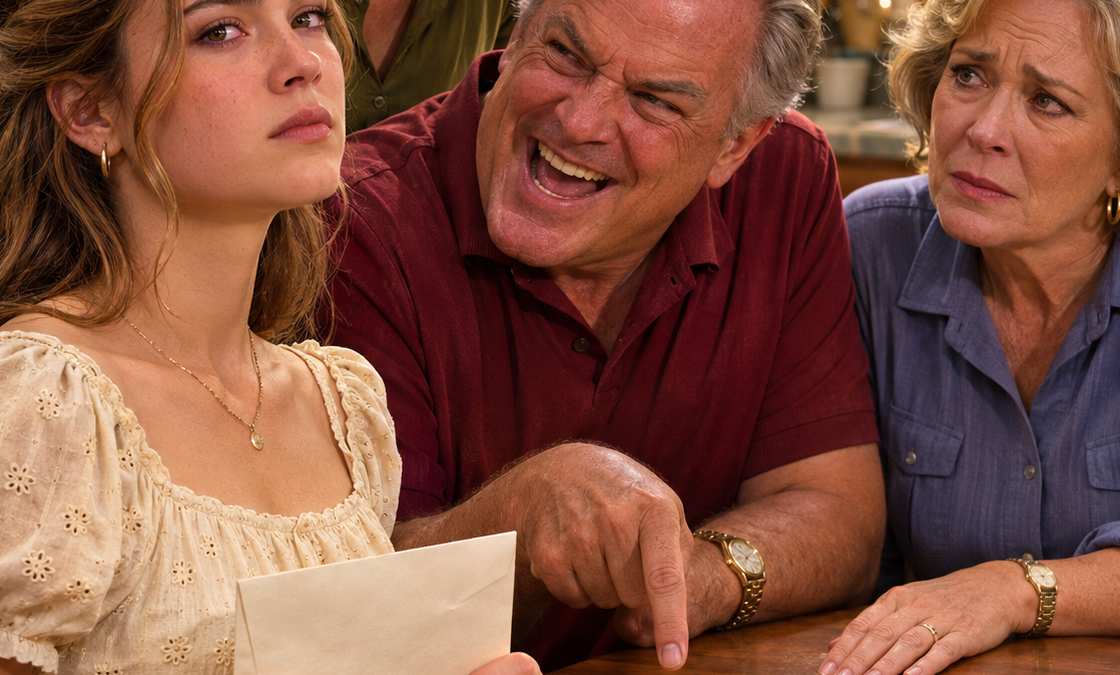
At 6:15 that Wednesday evening, Paige counted her savings on my kitchen table. Ray watched from the chair beside hers.
“She can earn it back. I can’t earn back respect.”
Colleen stood behind our granddaughter. My daughter said nothing to that.
Paige kept counting.
It was July 8, 2026. Outside our kitchen window in Briar Creek, Missouri, somebody’s mower kept catching and dying.
“This is part of taking responsibility,” Colleen finally said.
Paige separated a ten from two twenties stuck together. Some bills had soft corners. Others were flat, fresh from somebody paying her for pet care or yard work.
“That’s seven hundred,” she said. “And twenty.”
Ray looked at me.
“Linda. Take it.”
The envelope lay beside Paige’s drawing-course brochure. She had written “August class” on it in plain pencil.
I gathered the money instead of pushing it back.
Paige watched me count what she had already counted.
“That was all of it?” Colleen asked.
“Yes.”
“I mean, you didn’t leave some at home?”
“No, Mom.”
“Okay. I needed to ask.”
A supply list lay beneath the brochure. Paige had circled two kinds of pencils and written a question beside an eraser.
Ray glanced at it.
“What’s all that?”
“The class.”
“You can put that away now.”
“It was in with the money.”
“Well, we’re talking about what happened Saturday.”
Paige’s face had gone blotchy around her nose. She wasn’t crying. Her voice had the flat sound she used when she was trying not to.
“I didn’t touch it.”
Colleen closed her eyes.
“Paige.”
“I didn’t.”
“You’re making this harder than it needs to be.”
The kitchen smelled of the chicken I had cooked before they came. Nobody had asked about supper. Four plates waited on the counter, with a fifth underneath because I always miscounted when company was family.
Paige stared at the brochure.
“I wanted to learn perspective,” she said.
Colleen answered before I could.
“There’ll be other classes.”
“The chairs I draw look broken. Like somebody sat on them.”
On Saturday, she had told me the same thing while tearing crooked foil squares. I had laughed and told her our dining chairs looked that way in person.
Now I said, “You’ve been practicing a lot.”
Ray leaned back.
“Practice is fine. So is learning to own a mistake.”
Paige looked toward the back door. Through its glass, we could see the bare patch where the borrowed canopy had stood.
“I wasn’t out there.”
“That’s enough,” Colleen said.
Ray spoke more quietly.
“She needs to write apologies, too.”
“To who?” Paige asked.
“Your grandmother. Your great-aunt. And me.”
“I already said I was sorry stuff burned.”
“That isn’t the same thing.”
Colleen’s mouth moved before any sound came.
“Your grandfather means a proper apology.”
“What makes it proper?”
“Don’t do that,” she said. “You know.”
I could hear the refrigerator fan rattling. Ray had said he would fix it after the holiday.
“We can talk when everybody settles,” I said.
Paige turned toward me.
“I’m sitting here.”
“I know, honey.”
“I’m not yelling.”
“No one said you were,” Colleen told her.
Ray nodded toward the money in front of me.
“Your grandmother has had enough upset. Let’s get this done so she can have her evening.”
He made it sound like something he was doing for me.
Paige’s knee pressed against the underside of the table. The saltshaker trembled, and she pulled her leg back.
“What do I have to write?”
“I’ll send your mother something,” Ray said. “Then there won’t be any confusion.”
“She can write her own,” I said.
“She’s had several days to find the words, Linda.”
Colleen said, “A starting point might help.”
Paige looked from one adult to the next. Then she looked at the bills I had gathered.
“Does Grandma have to keep that while I write?”
“That’s reimbursement,” Colleen said. “It isn’t being held until you finish.”
I said, “Being family should make it safer to tell the truth.”
Paige waited. I could feel Ray looking at me.
Then she said something to her mother, too softly for me to catch. Colleen bent toward her.
Colleen’s fingers stopped on the last bill.
She looked from Paige to me. “What did you just ask me?”
“The corn tray,” Paige said. “Do you remember carrying it outside?”
Colleen’s eyes stayed on mine.
“You and Grandma were doing the corn.”
Paige nodded.
I remembered the foil catching on the cardboard teeth. She had pulled it sideways, making triangles instead of squares. Butter had softened in a dish between us, and she kept forgetting which ears she had salted.
That was when she had talked about drawing a chair.
We had been wrapping corn together around 4:10. She had stayed beside me until Ray shouted, about ten minutes later.
I had that whole stretch of time in my head.
Colleen said, “I remember taking a tray. I was going in and out.”
“I wasn’t,” Paige said.
Ray answered gently.
“Sweetheart, nobody’s asking you to remember every minute. Things were busy.”
I looked at the empty butter dish drying beside the sink.
“Linda?” Colleen said.
“The corn took a while.”
Ray said, “And I was getting everything ready outside. We all had jobs.”
Paige’s lips parted. She looked at me again, waiting.
Colleen’s phone chimed.
“That’ll be what I mentioned,” Ray said. “Read it first.”
Colleen started reading the message a second time.
Then she looked at Ray. “You want that sentence in all three?”
“The part about not telling the truth, yes.”
Paige stared at her mother’s phone.
“So I have to say I lied.”
“You have to acknowledge why we’re still talking about this,” Colleen said.
“I know why. Because you don’t believe me.”
“Because you keep arguing after we’ve made a decision.”
Ray said, “It doesn’t need to be long. Nobody wants an essay.”
The cash lay between my forearms. I slid it back into the original envelope, keeping every bill together.
Paige watched until I finished.
“You know I was with you, right?”
Her voice was ordinary now. She might have been asking whether I had seen her sweatshirt.
“Paige, I don’t want to make this worse.”
She waited through the rest of the sentence I didn’t say.
Colleen said, “Don’t put Grandma in the middle.”
“She was there.”
“Your grandmother has already dealt with enough.”
I had supervised a summer-meals cafeteria shift that morning. When a child said his lunch had been taken, I had stopped the line and asked who had seen it.
Here, I could see Paige’s bare feet under my table. One heel was pressed hard against the other.
“I’m tired,” I said.
“I can take her home,” Colleen answered.
Ray looked toward the stove.
“Your mother made supper.”
“I’m not hungry,” Paige said.
“There’s chicken,” I told her, as though she hadn’t heard me.
She gathered the brochure and supply list. One corner caught under her elbow, leaving a white crease across the photograph of a classroom.
I had already paid $2,180 on Monday to replace my sister’s damaged canopy and three folding tables. The receipt was still in my work bag.
I had paid it from my wage savings. Paige had not owed me the money I had just accepted.
“Can I go wait in the car?” she asked.
Colleen looked at Ray before answering.
“In a minute. There’s something else.”
Paige stopped beside her chair.
“I canceled your Saturday ride to the supply store.”
Chapter 2 of 7
Thursday morning, Paige called to ask whether she had left her supply list.
“It was with your brochure when you left,” I said.
“Okay. I’ll check my bag again.”
“Was Saturday when you were supposed to buy everything?”
“No. My friend’s mom was taking us to compare prices.”
“So you hadn’t signed up yet.”
“No, Grandma. We were going to look at pencils.”
I stood in the school kitchen, still wearing my purse.
“I’m sorry about the ride.”
“I can still compare prices online.”
“I know you can.”
“I have to go feed a dog.”
She hung up before I could find another question.
It was July 9. The cafeteria windows faced the empty playground. We served summer meals while school was out, and some children arrived early enough to watch us finish setting up.
That morning, the delivery was short two cases of peaches.
The driver said everything on his truck had been unloaded.
“Then we need somebody to bring the rest,” I said.
“Could be at the other building.”
“Call them. We open at eleven.”
He checked his sheet again.
A coworker asked whether we should start dividing the fruit into smaller portions.
“No. We’ve got enough pears in storage if we need them.”
By ten-thirty, the missing peaches were on their way. Nobody had needed to apologize for noticing they were missing.
I checked the milk cooler and the lunch count. One little boy at the door asked if we were having the square pizza.
“Tomorrow,” I told him.
“You said that yesterday.”
“Yesterday I said Friday.”
He considered that.
“Okay. But tomorrow.”
I had worked around children long enough to know that an adult’s promise could require checking.
Before we opened, a coworker asked about our holiday fish fry.
“Did you get rained out?”
“We had a fire.”
“Oh, Linda. Was anybody hurt?”
“No. Some borrowed equipment burned.”
“That’s awful. What happened?”
I could have given her Ray’s account. He had made it easy to repeat.
“I was inside when it started,” I said.
She asked whether we needed anything. I said we were all right, and then the first children came through.
I portioned chicken onto trays. The answer stayed with me through lunch. I had said where I was, but left out who had been beside me.
After my shift, I drove to Colleen’s house instead of going home. She had finished work early. Her dental-office shoes stood beside the front door, each stuffed with a folded sock.
Paige was at the dining table with a notebook.
Colleen met me in the hallway.
“If you’re here about the ride, she’s already asked twice.”
“She didn’t ask me to come.”
“Okay. I’m just saying, we can’t keep changing things because she’s unhappy.”
From the dining room, Paige said, “I asked once.”
“You asked if you could go, then you asked if you could pay for gas.”
“That was the same conversation.”
Colleen looked tired. I used that as a reason to speak softly.
“Maybe everybody misunderstood what happened Saturday.”
“What part?”
“The timing. Where people were.”
“Mom, we’ve been over this.”
“Have we?”
She glanced toward the dining room.
“She’s sixteen. Lately everything is a negotiation. Where she goes, when she comes home.”
“I came home eight minutes late,” Paige said.
“I’m talking to Grandma.”
“I can hear you.”
Colleen lowered her voice further.
“She says what she thinks will get her out of trouble. That doesn’t make her a bad kid.”
“No,” I said.
I had answered the easiest part.
Colleen went into the dining room, and I followed. Paige’s notebook lay open beside a glass of water. There were more crossed-out lines than uncrossed ones.
“I’m trying to teach responsibility,” Colleen said. “Dad says she needs to finish this before it gets any bigger.”
“Bigger how?”
“Other people lost things, Mom.”
I remembered standing inside our kitchen on Saturday. Paige had been beside me with the corn. Ray had called from outside, sharp enough that we both stopped talking.
By the time I reached the back door, people were moving away from the cooker. Adults called emergency services and kept everyone back. Nobody was hurt.
Afterward, I saw the ruined canopy and the tables. I had never seen Paige touch the burner.
Colleen had already accepted Ray’s account. Now she was waiting for me to help her get Paige to accept it, too.
“What have you written?” I asked.
Colleen was holding a loose sheet. Paige nodded toward it.
“That’s the new one. The notebook’s the bad one.”
“Paige,” her mother said.
“What? It is.”
Colleen gave her the sheet, and Paige pushed the notebook toward me instead.
“I don’t know which parts I’m allowed to say.”
The first line read, I’m sorry the cookout got ruined.
She had crossed out cookout and written afternoon above it.
Below that was, I wish nobody had brought the cooker.
That whole sentence had been struck through.
Farther down, between an apology for upsetting me and one for the damaged tables, she had written:
I turned up the burner while Grandpa went for the platter.
The letters were pressed hard into the paper.
“Your father supplied that wording,” Colleen said. “She was having trouble getting started.”
Paige looked at the loose sheet.
“Am I supposed to say ‘Dear Grandpa’ or just ‘Grandpa’?”
“Either is fine.”
“Because you crossed out ‘Hi.’”
“It’s an apology, honey.”
I read the page again without moving it closer.
“Could she leave this until tomorrow?”
“She’s had all day.”
“She fed dogs this morning,” I said.
“And she’s been home since.”
Paige’s eyes moved toward me, then back to the page.
I wanted to tell her I had come because I was worried. I wanted her to look relieved that I was there. She had already watched me take her money.
Colleen said, “All three are getting delivered. We need to be consistent.”
“What does that mean?”
“It means relatives shouldn’t get a mixed message. Dad hears one thing, you tell someone something different, and suddenly everybody’s calling.”
“I haven’t told anyone anything.”
“I know. I’m asking you not to undermine this.”
From the table, Paige said, “Can you two talk somewhere else?”
Colleen started to answer, but I said, “Yes.”
I went back to the hallway. My work shoes had left a small gray mark on the floor by the door.
Colleen followed me.
“I don’t enjoy this,” she said.
“I know.”
“She’ll be fine, Mom.”
I looked past her. Paige had bent over the notebook again. I didn’t call her over or ask for a hug.
“I’m going home,” I said.
Colleen opened the door.
“Ruth will get Paige’s apology tomorrow morning.”
Chapter 3 of 7
I called Ruth on Saturday morning, July 11, while Ray was out buying a cabinet hinge.
“Paige brought your note yesterday?” I asked.
“Colleen dropped it off before work. I appreciated Paige finally admitting it.”
“She’s had a hard week.”
“Well, she should have told us the truth Saturday. Would’ve saved everybody some trouble.”
I stood beside the kitchen window. The grass beneath the missing canopy was still yellow.
“About what she wrote—”
“It was a nice apology, Linda. You don’t have to worry about that.”
“I wasn’t worried whether it was nice.”
“Then what?”
I could have told her. Ruth was listening.
“I don’t think we’ve handled everything very well.”
“She’s sixteen. There’s still time to straighten things out.”
Ruth asked whether the replacement tables had arrived. I said they had, and we discussed where she wanted them stored.
By the time I hung up, we had settled everything except why I had called.
Ray came through the back door carrying a small hardware-store bag.
“They had the right one,” he said. “For once.”
“Which cabinet?”
“The one by the stove. Colleen asked me to fix it before it dropped on your foot.”
Our daughter had noticed it Wednesday. I had been lifting the door slightly each time I closed it.
“You don’t have to do it now.”
“It’ll take ten minutes.”
He had spent years repairing appliances in other people’s kitchens. Even retired, he noticed a bad motor by its sound and knew which replacement parts weren’t worth buying.
I had once watched him talk a young mother out of replacing a washer. He fixed it for the price of a hose and refused the cookies she tried to send home.
That morning, he brought a folded towel for his knees.
“Leave that bottom shelf alone,” he told me.
“I was going to clear it.”
“I can reach around it. Your knee was bothering you last night.”
He had noticed that, too.
I sat at the table while he worked. A door that had hung crooked for months closed evenly when he finished.
“There,” he said. “Try it.”
It opened without scraping. He looked pleased, and I thanked him.
“Your car’s due for an oil change next week,” he said. “I can take it Tuesday.”
“I can do it.”
“I know you can. I’m offering.”
For forty years, there had been offers like that. He remembered the tire pressure when the weather changed. He picked up prescriptions when I worked late. When I had the flu, he knew I wanted toast cut across, never corner to corner.
I would miss those things if they stopped. I could already feel myself using them against what Paige had said.
Ray went to wash up. I stayed at the table, remembering Colleen at fourteen, wearing a blouse she had bought with babysitting money. Ray had made a remark about it looking like something from a motel curtain.
She had gone upstairs without eating.
I had followed her and said he was embarrassed about a mistake at work. Let it go, I’d told her. He’d had a rough day.
She had worn a sweatshirt over the blouse the next morning.
I made his embarrassment everybody else’s job.
When Ray came back, I asked whether he wanted lunch.
“Whatever’s easy.”
We ate tomato sandwiches over the sink because he insisted that was the only sensible way. His dripped onto his shirt anyway.
“System needs work,” I said.
He laughed and dabbed at the spot with a dishcloth.
Afterward, we went through the household errands. A bill needed mailing. The porch light needed a bulb. Our anniversary confirmation was in the folder with the mail.
Ray asked me to check the arrival time.
The Hermann booking covered July 24 through July 26. We had prepaid $1,880 for the fortieth-anniversary package, with each of us named separately at $940. The written terms allowed no refunds after July 1.
“Three o’clock,” I said.
“We could leave after breakfast. Have lunch down there.”
“Maybe.”
“You wanted to stop at that place with the sandwiches.”
“I remember.”
He talked about taking the back roads. I tried to picture the two of us in the car, choosing lunch, asking whether the other needed a rest stop.
Paige’s apology kept interrupting the picture.
“Ray, when did she touch the burner?”
He stopped talking about the road.
“What?”
“On Saturday. When are you saying she did it?”
“We’ve gone over this.”
“You said it was when you went for the platter.”
“That’s what I remember.”
“Was that before you called out?”
“Obviously it was before.”
“I mean right before. A few minutes?”
He looked toward the window.
“Linda, you had people coming through. You were getting food ready.”
“I know what I was doing.”
“You were distracted. We all were.”
“Paige was beside me.”
“You’ve said that.”
“I haven’t said it clearly enough.”
He pulled out the chair across from mine.
“Sit a minute. You’re making your knee worse.”
“I’m all right.”
“Then sit because I’m asking.”
I stayed where I was.
He rubbed at the dried spot on his shirt.
“Maybe she touched it earlier. Before you two got started in there.”
“That isn’t what you told us.”
“I’m trying to account for what you’re saying.”
“You said you went for the platter and she turned it up while you were gone. Now you’re saying it happened before that?”
“I’m saying nobody was watching every second.”
“But you gave us a particular time. You didn’t say you were guessing.”
He looked past me toward the repaired cabinet.
“Do you know how many times I’ve used that cooker?”
“Yes.”
“Nothing like this has ever happened.”
“That doesn’t tell us what Paige did.”
“It tells you I know how to run the thing.”
I said nothing. His voice had risen, but he lowered it.
“Those were Ruth’s things. She trusted us with them.”
“I paid her.”
“Out of your savings. I know that, Linda.”
He looked tired then. At sixty-four, he still did most of the repairs our relatives needed. People called him before they called anyone else. He liked being able to say he would come by.
“I’m the one who was supposed to have everything under control,” he said.
“So we need to know what happened.”
“We had a fire in our yard. It could have been worse. And now we’ve got Colleen trying to teach her daughter something, with you questioning the whole thing.”
“Because Paige was with me.”
“We can disagree about a few minutes without pulling the floor out from under Colleen.”
“She’s punishing her for those minutes.”
“She’s punishing her for refusing to take responsibility.”
The repaired cabinet door stood square behind him. I had thanked him for it. I still meant the thanks.
“Did you actually see Paige touch the cooker?”
He looked at me for a long moment.
Then he said, “I’ll tell Colleen you’re encouraging Paige to disregard her mother.”
Chapter 4 of 7
On Tuesday, July 14, I called Colleen from the school parking lot.
“Has your father talked to you?”
“About you letting Paige go around me? Yes.”
“That isn’t what I’m doing.”
“Then please talk to me before you tell her something different.”
“I haven’t told her anything different. That’s part of the trouble.”
A car door slammed near her phone. She said she had ten minutes before she needed to be back at the dental office.
“I’m not asking you to take my side,” I said. “I need you to hear what I remember.”
“Mom, if this is another maybe—”
“It isn’t.”
“Then why didn’t you say it last week?”
I watched a little girl skip beside her mother toward the cafeteria entrance.
“I should have.”
Colleen waited.
“I’ll call you later,” I said.
“That’s what I mean. You start something, and then I’m supposed to figure out what you want.”
She was right about that, too.
When I got home, Ray had washed the kitchen floor. The chairs were still against the wall, their seats stacked with the little rugs from the sink and back door.
“Careful,” he said. “Might still be slick by the refrigerator.”
“Thank you.”
“Tracked something in yesterday. Figured I might as well do the whole thing.”
He had opened the windows. Our house smelled of floor cleaner and the hot grass outside.
I stayed in the doorway until he asked what was wrong.
“I talked to Colleen.”
“I thought she’d call you.”
“I called her.”
“Well, you two can work that out.”
“This is about Saturday. The fire.”
He glanced toward the clock.
“Can we eat first?”
“No.”
“I haven’t had lunch either.”
“There’s food in the refrigerator. I’m not stopping you.”
He stayed where he was.
For years, I had waited for a better time. After supper. After his headache passed. After company left, when there was nobody to hear and less reason to bother.
Ray said, “I don’t want another argument.”
“Neither do I. Did you see Paige touch the burner?”
“You know what I said.”
“I’m asking what you saw.”
“We had people everywhere. I was trying to get food cooked.”
“And you told us she turned it up when you went for the platter.”
He looked out the open window.
I could hear a lawn sprinkler ticking next door. Ray had repaired its connection in June. The neighbor had brought us zucchini afterward, enough that I had put it in almost everything for a week.
“Ray.”
“What?”
“I’m going to tell Colleen and Ruth where Paige was.”
“You told Ruth already?”
“No. I let her talk about that apology, and I said almost nothing.”
“Then leave it alone.”
“I’m going to tell them she was beside me, wrapping corn together, until you shouted. And I’m going to tell them I knew that when I took her money.”
His eyes came back to mine.
“Linda, listen to what you’re saying.”
“I know what I’m saying.”
“You’d have them think you took money you knew she didn’t owe?”
“I did take it.”
He stared at the clean floor between us.
“I won’t say I was confused,” I said. “I wasn’t.”
“What do you want from me?”
“What happened when you left the cooker?”
He stood there long enough that I nearly filled the space for him.
Then he said, “I left it heating.”
“To get the platter?”
“There was an argument by the fence. About where somebody had parked. I went over to get it settled.”
“How long?”
“I don’t know. I wasn’t looking at a clock.”
“And Paige?”
He rubbed his lips together.
“I knew she hadn’t touched it.”
The sprinkler caught again outside.
“You knew,” I said.
“Yes.”
“Before Wednesday?”
“Linda.”
“Before I took her money?”
“Yes.”
I had wanted him to answer me. Now he had, and I could hear the refrigerator running behind him.
“Why her?”
“I didn’t plan it.”
“You kept saying it.”
“I know.”
“She told you she didn’t.”
“I know what she said.”
He looked older standing against the white cabinets. His work shirts used to have his name stitched above the pocket. Since retirement, he still dressed by seven, even on days nobody needed him anywhere.
“Everybody calls me when something breaks,” he said. “That’s what I do.”
“I know.”
“I had Ruth’s stuff out there. My cooker. My yard. Then everybody’s standing around looking at it.”
“They would have been upset.”
“They’d have seen some old fool who couldn’t keep track of his own equipment.”
“So you gave them Paige.”
He flinched at that, but he didn’t deny it.
“I was scared,” he said.
I believed him. I also remembered Paige asking whether I knew she had been with me.
Ray looked toward the refrigerator.
“Give her the money back. All of it. We’ll call it an accident and stop picking at it.”
For a moment, I could see that evening clearly. Supper warmed up. Chairs back around the table. Ray asking whether I wanted to watch something.
I almost said yes.
“Who tells Ruth Paige wasn’t lying?”
“We don’t need to go through every word.”
“She wrote an apology.”
“Then we tell her she doesn’t owe us anything else.”
“That still leaves her as the girl who did it.”
He said my name softly, the way he did when my knee hurt.
I went to change out of my work clothes.
On Wednesday, July 15, I asked Colleen whether I could come by. She said Paige was home and knew I was coming.
Paige sat at the dining table with her laptop open. A grocery bag of empty containers waited beside the door. Colleen had washed them for me.
“I brought back your lids,” she said from the kitchen.
“Thank you.”
Paige closed the laptop halfway.
I sat across from her.
“I need to tell you I should have spoken up.”
“Okay.”
“Your grandpa and I have been married forty years. When you’ve been with someone that long, you get afraid of—”
“You were there, Grandma.”
“Yes.”
“With me.”
“Yes.”
“So why are we talking about how long you’ve been married?”
The refrigerator in Colleen’s kitchen started making ice. I waited until the cubes stopped falling.
“Because I was trying to explain myself.”
“Mom does that too.”
I looked at her.
“She tells me why Grandpa’s upset. Or why you’re tired. I still have to do whatever you say.”
“You shouldn’t have had to pay.”
“I know.”
“I knew you were with me.”
Her face changed then. She opened the laptop again, though she didn’t look at it.
“You could’ve said that.”
“Yes.”
I didn’t tell her about Ray’s admission. She had been telling us the truth all along.
“Do you need me to say anything?” she asked.
“No, honey.”
“Because I don’t have anything.”
“I’ll go.”
Colleen gave me the bag at the door. I left without asking Paige to get up.
At home, I put the containers in the cabinet Ray had repaired. My phone chimed before I finished.
Colleen’s message said Paige had asked that I stop being listed as her backup ride.
Chapter 5 of 7
Thursday morning, July 16, I called Colleen before work.
“About the backup ride,” I said. “Does she have somebody else?”
“She wants another adult she can count on for now.”
“All right.”
“Mom, she’s still upset.”
“I’m not asking you to change her mind. When can I return something that belongs to her?”
“What something?”
“Her money.”
Colleen didn’t answer immediately.
“After five,” she said. “We’ll be home.”
I worked my shift and drove over in the same clothes. There was dried dishwater across the front of my shirt. I noticed it on their porch and left it alone.
Paige came to the door.
“Mom’s on the phone.”
“I can wait.”
“She said you were bringing my money.”
“Yes.”
She let me in and went to the dining table. I followed her.
The original envelope still held the bills in the order I had put them away. Nothing had been spent or deposited. I returned it across the table.
“It’s all seven hundred and twenty.”
Paige looked inside.
“Mom said you were giving it back.”
“Returning it. It was never a gift.”
She counted every bill. I stayed seated while she counted again.
“It’s right,” she said.
“Yes.”
Colleen came from the kitchen with her phone against her shoulder. She finished her call, then looked between us.
“Good,” she said. “That’s one thing settled.”
Paige tucked the money away.
I stood without knowing what came next. Paige stayed on her side of the table.
“I don’t want a hug,” she said.
“Okay.”
“I’m not saying thank you, either.”
“You don’t owe me that.”
She went upstairs. A minute later, I heard a drawer open.
Colleen sat where Paige had been.
“I wish she hadn’t said it like that.”
“Like what?”
“About the hug. You didn’t even ask.”
“She wanted to be sure.”
Colleen looked toward the stairs, then back at me.
“Did you and Dad decide to return it?”
“I decided. There’s more I need to tell you.”
“Of course there is.”
“Paige was beside me from when we started the corn until your father shouted. She didn’t go outside during that time.”
“Why couldn’t you say that Wednesday?”
“Because I didn’t want to contradict him.”
“You let me stand there.”
“Yes.”
“And now I’m supposed to tell her I was wrong.”
“Yes.”
Colleen’s eyes filled, but her voice got sharper.
“I made her write those letters. I canceled her plans. Do you know how foolish I look?”
“She counted her savings in front of us while we told her she was lying.”
“I know what happened, Mom.”
“She asked me a direct question. I wouldn’t answer it. You told her not to put me in the middle.”
Colleen looked away.
“Your father told me Tuesday that he left the oil heating. He said he knew Paige hadn’t touched the cooker.”
“He said that?”
“To me. We were alone.”
“Then why didn’t he call me?”
“You’ll have to ask him.”
“I’ve been telling her she needs to earn our trust.”
Upstairs, something rolled across the floor and stopped. Colleen listened until it stopped moving.
“Did you tell her what Dad said?”
“No.”
“What am I supposed to do?”
“Start by telling her you believe her.”
Colleen wiped beneath one eye with the heel of her hand.
“I need a minute.”
I gave her one. Then I went home.
Friday morning, July 17, I called Ruth. I had her number open before breakfast and waited until nine. Waiting had become so familiar I could dress it up as consideration.
“Is this about the tables?” she asked.
“No. It’s about Paige.”
“She all right?”
“She didn’t turn up the burner. She was in the kitchen with me during the time Ray said she did.”
Ruth didn’t speak.
“I knew that when we took her money,” I said. “I returned it yesterday.”
“You took money from her?”
“Seven hundred and twenty dollars. Her summer earnings.”
“I thought you paid for my things.”
“I did. That was already paid.”
“Then why—”
“I accepted it because Ray wanted it, and because I didn’t want the argument.”
Her breathing sounded rough against the phone.
“Why did you let her write to me?”
“I kept hoping we could get past it without my having to say he was wrong.”
“She apologized for lying.”
“I know.”
“You let me believe her own words.”
“Yes.”
Ruth stayed on the line. I could hear a television somewhere behind her.
“You should have told me when you called Saturday.”
“I should have told you before then.”
“I’m going to need to speak to her.”
“Ask Colleen first. Paige might not want another conversation yet.”
“Don’t manage this for me, Linda.”
“All right.”
She ended the call without asking how I was.
I called one other relative who had heard Ray’s account. She asked whether Paige had talked me into changing my mind.
“No. I remember where she was.”
“Then why are we hearing this now?”
“Because I didn’t say it when I should have.”
She wanted to see what Paige had written.
“I’m not sending her letters around.”
“Well, it’s hard to know what to think.”
“I can tell you what I saw. She was beside me. I shouldn’t have let you hear otherwise.”
She said she hoped we could all settle down.
By lunch, Ray had heard from Ruth.
He found me in the kitchen, where I was eating leftover green beans straight from a bowl. We usually argued over whether they needed vinegar. That day, he didn’t mention it.
“Ruth called,” he said.
“I spoke to her this morning.”
“She asked me whether I had anything to tell her.”
“Did you?”
“I said we were working it out.”
I waited.
“Linda, the money’s back where it belongs.”
“Yes.”
“And I’m glad. I am. But an accident doesn’t have to destroy forty years.”
“The fire didn’t make you accuse her.”
“I know that.”
He sat across from me.
“I can talk to Colleen. We can stop the punishment. Nobody needs to lose anything else over this.”
“Paige already lost things we can’t put back.”
“I’m not saying we pretend nothing happened. I’m saying leave us something to work with.”
His voice sounded tired rather than angry.
“We’ve had bad weeks before,” he said. “We still went on.”
I remembered some of those weeks. We had gone on partly because I had stopped talking.
“Keep the Hermann trip,” he said. “Come with me. We could get away from the phone for a couple days.”
I looked at him across the table.
“I can’t tell you yes.”
“You don’t have to decide this minute.”
He sounded relieved by an answer I hadn’t given.
Colleen and Paige were already due Saturday at six. They were collecting the small cooler and travel bag Colleen had borrowed for us, and discussing the house checks for our weekend away.
Ray asked whether they were still coming.
“As far as I know.”
“Good. We can talk then.”
I didn’t call anybody else over.
Later that afternoon, Colleen texted, “Paige wants the apology letters back.”
Chapter 6 of 7
“She doesn’t want those letters kept as a confession,” Colleen said.
It was six o’clock Saturday evening, July 18. She sat beside Ray at our kitchen table. Paige stayed near the doorway, beside the cooler they had come to collect.
“I’ll ask for them back,” I said. “Even if we can’t get every copy, I’ll tell everyone they weren’t true.”
Ray nodded.
“That’s reasonable. We should get the house checks settled, too. Linda, afterward, you and I can talk about putting this behind us.”
“Say it here.”
He looked toward Paige.
“I don’t want to put her through another evening.”
“She’s already here.”
Paige stayed by the door.
Ray spoke to Colleen first.
“We responded to what we understood at the time. Your mother remembers it differently. The money’s been returned. We can correct things without letting uncertainty ruin this family.”
“It wasn’t uncertainty,” I said.
“Linda, we were all there. There was a fire. People were frightened. Paige wrote an apology herself. It wasn’t just me saying something nobody else believed.”
Colleen looked toward her daughter.
“Paige was beside me during the time that apology describes,” I said. “From when we started the corn until you shouted. I knew that when I took her money.”
Paige’s eyes stayed on me.
“I knew it while she was being punished. I didn’t speak because I didn’t want to contradict you.”
Ray waited before answering.
“I’m not saying you’re making that up. But you remember doing the corn. That doesn’t tell you everything that happened before it.”
“You said it happened while you got the platter.”
“Then perhaps I got the order wrong. That doesn’t mean I set out to hurt her. You’re taking a confused afternoon and making it into a deliberate thing.”
Colleen leaned forward.
“Everyone was upset. I don’t think any of us—”
“Who chose that exact time?”
“What?” she asked.
“The sentence. ‘I turned up the burner while Grandpa went for the platter.’ Who chose those words?”
Ray answered.
“I helped her get started. We’ve never hidden that.”
“Colleen?”
She looked down at the table.
“Dad sent them.”
“Did Paige tell you they were true?”
Paige’s shoe squeaked against the floor. Colleen looked at her.
“No.”
“Did she agree afterward?”
“No. She kept saying she hadn’t done it.”
Ray’s voice stayed level.
“We thought she was having trouble admitting it.”
Colleen stood.
“She wasn’t having trouble writing. She was telling me it wasn’t true.”
She moved around the table and stopped beside Paige.
“I told her she couldn’t cross that part out. I said the letters weren’t finished without it.”
“You were trying to follow through,” Ray said.
“I made her copy it.”
The dictated sentence had been treated as Paige’s own account. Colleen had required it, and I had read it without stopping her.
Colleen turned to her daughter.
“The punishment is over. You weren’t being dishonest. I’m sorry I kept calling it that.”
Paige looked at the cooler.
“I want the letters.”
“I’ll ask everyone,” Colleen said. “And I’ll tell them why.”
Ray looked back at me.
“Is this what you wanted?”
“No. I wanted not to have done my part.”
“Then we’re all sorry. Can we start there?”
“Tuesday, you told me you left the oil heating. You told me you knew Paige hadn’t touched it.”
He looked toward Colleen, then back at me.
“That was a private conversation.”
“Yes. Nobody else heard it. I’m telling them what you said to me.”
“You know what those days were like.”
“Will you tell Paige now that you knew she hadn’t done it?”
He faced her. For a moment, I thought he might answer.
“Things got confused,” he said. “I wish we’d handled it differently.”
Paige didn’t move closer.
“That doesn’t answer her,” I said. “You told us she did something. She kept telling us she hadn’t. Saying things got confused leaves her denial sitting there like it was part of the problem.”
“What else do you want me to say?”
“The truth you told me.”
He looked at the empty chair across from him.
I had spent years helping him finish conversations without having to answer.
“I won’t go on the anniversary trip. Your booking is yours.”
His eyes came up.
“Linda.”
“My share will go unused. I know that.”
Nine hundred forty dollars would stay spent. He could still go to Hermann. I wasn’t canceling his weekend or asking anybody to stop him.
He was losing one anniversary traveling companion. I was the one who could decide that.
“I won’t make her carry this so we can feel married.”
Ray pushed his chair back. Its legs caught briefly on the floor.
“You’re really going to abandon our weekend?”
“I’m not going.”
“Forty years, Linda. We were going to have three days.”
I remembered looking forward to those days. I had chosen clothes that wouldn’t need ironing. I had wanted breakfast with him somewhere neither of us had to cook.
“I know.”
He turned to Colleen.
“Tell your mother we can still—”
“Dad, don’t ask me.”
“I’m asking you to help.”
“I’m not going to tell her to go.”
Paige pulled the cooler away from the wall.
“I don’t want another adult discussion about how I should feel.”
“You don’t have to stay,” Colleen said.
“Or have one about me after I leave.”
I nodded.
“We’ll handle our own plans.”
They took the cooler and travel bag. Nobody discussed checking the house. At the door, Colleen asked whether I needed her to call later.
“Not tonight.”
Paige went ahead of her to the car. I didn’t follow.
After they left, Ray stayed in the kitchen.
“Where does this leave us?”
“I need somewhere else to sleep.”
“You don’t have to leave the house.”
“I know. I’m choosing to.”
That evening I called Ellen Foster. I had known her since she worked in the school office. She had mentioned her furnished spare room earlier that summer.
“Is it still available?” I asked.
“Yes. For you?”
“Yes.”
“For how long?”
“I don’t know yet.”
She told me the rent was $625 a month, utilities included, with a $300 deposit.
“Nine twenty-five to start,” she said. “I’ll write it down. We should both have a copy.”
“I can pay that.”
“Come see it tomorrow before you promise anything.”
The room had a twin bed, a dresser, and one window overlooking her driveway. Ellen said the bathroom was shared and asked whether I minded her getting up early.
“I’m up early, too.”
We signed a simple month-to-month agreement. On Monday, July 20, I paid the rent and deposit and kept my receipt.
I took work clothes, toiletries, medicine, and enough ordinary things to avoid returning every morning. Ray watched me carry them to my car.
“Call when you get there,” he said.
I did. I told him I had arrived, then hung up before either of us found something else to ask.
Monday evening, I was putting my cafeteria shirts in Ellen’s dresser when Ray’s message arrived.
“I’m keeping your place at breakfast Friday.”
Chapter 7 of 7
“I won’t be there Friday,” I wrote back. “Please don’t wait for me.”
Ray answered the next morning.
“All right.”
On Friday, July 24, I worked the summer-meals shift, then bought groceries for my shelf at Ellen’s. Ray drove to Hermann alone. He texted that he had arrived, and I told him to have a safe weekend.
I stayed in Briar Creek through Sunday, July 26.
Ellen made enough spaghetti for both of us Saturday. She cut hers with kitchen scissors before adding sauce.
“I’m sixty-eight,” she said. “I’m finished chasing supper around a plate.”
I laughed. Then I nearly said, Ray would have something to say about that.
Instead, I asked where she kept the colander.
Monday, July 27, he sent a photograph from the weekend. A sparrow stood beside a fallen piece of toast on an outdoor table.
“Wouldn’t even wait until I left,” he wrote.
He had always sent me things like that. A crooked sign. A dog asleep behind a store counter. Once, a tomato shaped enough like a duck that he brought it home instead of eating it.
I enlarged the photograph. His sleeve showed at the edge.
Then another message arrived.
“When are you coming home?”
“I don’t have a return date,” I answered.
I missed having him to tell things to. At school, a child had asked whether green beans grew green or got painted. Ray would have asked which answer cost us less.
I ate supper with Ellen, then went upstairs before eight.
My room had enough space for the bed and dresser, but I had to turn sideways to pass the chair. Some nights I wanted our wider bed, Ray’s breathing, and somebody who knew why I wouldn’t watch a certain movie again.
I stayed where I was.
At the little desk, I worked out August on the back of a grocery list.
My usual take-home pay was about $2,150. The room took $625 a month, including utilities. I still needed groceries, gas, medicine, and money put aside for the car.
The $300 deposit might come back under our agreement. It wasn’t rent I could spend again.
The $2,180 I had paid for Ruth’s equipment was gone from my savings. So was my unused $940 share of the anniversary weekend. Ray hadn’t repaid the equipment expense, and I hadn’t asked Ellen to reduce the rent because I was having a difficult month.
I crossed out a clothing purchase and kept the oil change.
On Monday, August 3, Colleen called while Paige was beside her.
“She’s ready to register,” Colleen said. “The drawing course.”
“Is that what you want, Paige?”
“Yes. That’s why we’re doing it.”
“Right. Sorry.”
“It’s two-forty,” Paige said. “And I’m keeping supplies under eighty.”
“That leaves four hundred.”
“I already did that part.”
Colleen completed the community-center registration as her parent. Paige chose the course and kept the remaining money. Nobody assigned it another job.
Later, she sent me two supply links and asked which pencils matched the list.
I checked the descriptions and answered. Then I suggested a spiral sketchbook I had seen.
“The rings get in the way,” she wrote.
“I hadn’t thought of that.”
“I want the bound one.”
“Then get that one.”
She sent back, “Okay.”
I left the conversation there.
On Wednesday, August 5, Colleen stopped at Ellen’s after work. We sat downstairs because my room had only one chair.
“I called all three people about the letters,” she said. “And I told Paige again that the punishment’s withdrawn.”
“What did you tell them?”
“That she denied it the whole time. That I made her use Dad’s sentence anyway.”
I waited.
“I told her her denials weren’t defiance,” Colleen added. “She said she’d been trying to tell me that.”
“What did you say?”
“That she had.”
Colleen looked worn out. I wanted to tell her she was a good mother. The words came close enough that I pressed my lips together.
“Ruth gave hers back,” she said. “She apologized to Paige herself. I’ve asked the others to return theirs, too.”
“Good.”
“Doesn’t feel like enough.”
“I don’t have anything that makes it enough.”
Before leaving, she asked whether I was eating properly. I showed her the leftover spaghetti in Ellen’s refrigerator.
Ray and I spoke twice that week. He needed to know where I kept the warranty information for the dishwasher. I needed a cardigan I had left in our closet.
He brought it to Ellen’s porch.
“You could come get your own things,” he said.
“I know. Thank you for bringing it.”
“We ought to sit down sometime. Without everybody misunderstanding each other.”
“I’ll talk about what happened. I won’t call it everybody misunderstanding.”
He looked toward my car.
“I don’t know what else to say.”
“Then we can stop for today.”
We remained separated. I didn’t give him a date, and he still hadn’t given Paige the correction she had asked for.
On Wednesday, August 12, five weeks after the kitchen table, Paige texted me.
“Can you take me to drawing? Mom’s working late. Starts at 5:30.”
“Yes. What time do you want me there?”
“Five.”
I arrived at four-fifty-five and waited in the car. At five, she came out carrying a canvas bag.
“Hi,” she said.
“Hi. Seat belt.”
“I’m doing it.”
She had bought the sketchbook she wanted. Its black cover stuck out of the bag.
On the drive, she asked whether the community center had vending machines.
“I think so.”
“Mom said eat first. I ate. I’m asking for later.”
“I wasn’t going to check.”
“Okay.”
We reached the classroom with ten minutes to spare. I walked beside her to carry a box of supplies, then returned it at the open door.
Inside, folding tables held plain white paper. A wooden stool stood beneath a lamp.
“I’ll be back when class ends,” I said.
Paige looked inside, then at me.
“You can come in, if you want.”
“Just for a minute?”
“Yeah. Look at the stool. Those legs are going to be awful.”
I followed her in after she stepped aside.
She chose a place near the window. From her bag came the original envelope, still marked “August class” in pencil. It held charcoal pencils now. She checked their points and lined them beside her sketchbook.
“I’ll see you afterward,” I said.
“Okay, Grandma.”
She slid the pencils into the envelope.








