My Son-in-Law Called Me Dead Weight and Demanded My House, but He Hadn’t Counted on the Ledger I Set Beside His Agreement
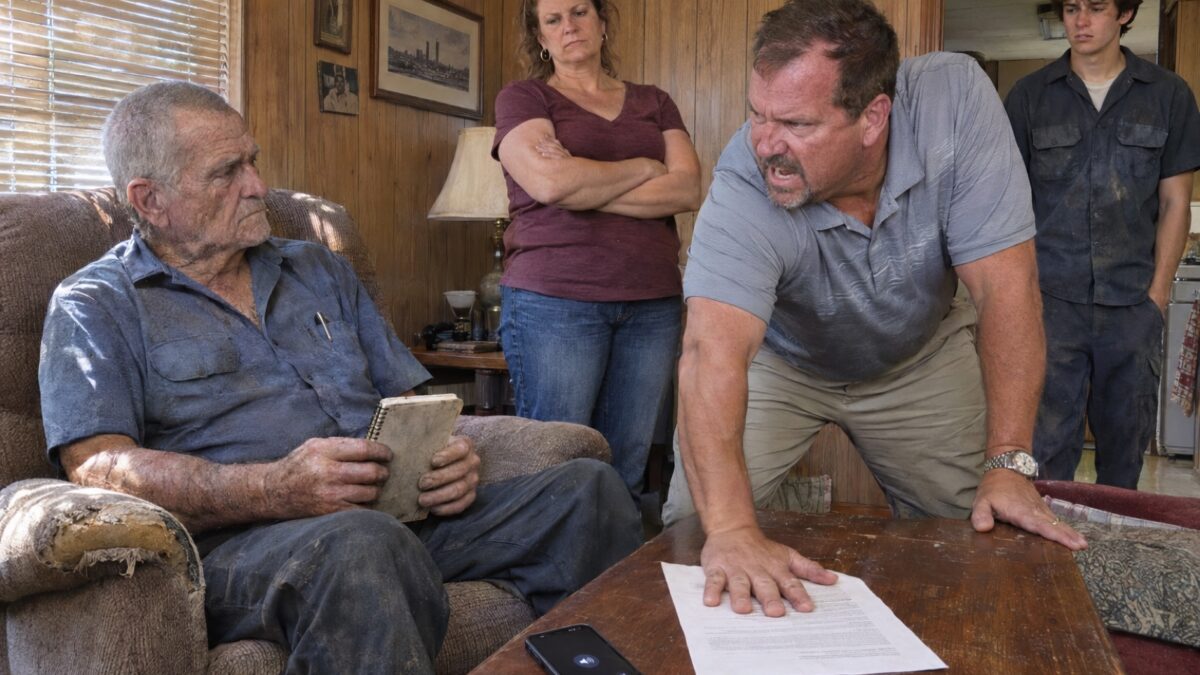
Rick looked at the phone, then at me.
“Who the hell is Hank?”
“A friend.”
“Then this doesn’t concern him.”
“You made it concern him.”
My hand stayed beside the phone.
There was a dark crescent under my thumbnail that the kitchen soap hadn’t touched.
Rick stared at it instead of looking me in the eye.
“Turn that off,” he said.
“No.”
Brenda reached toward the coffee table.
I moved the phone closer to my knee.
“Don’t.”
“Dad, we don’t need an audience.”
“Then you shouldn’t mind saying it again.”
Tyler was still halfway out of his chair.
I lowered my hand, and he sat.
His face had gone red above the collar of his shop shirt.
He looked older than nineteen just then.
Not because he was young.
Because he was waiting for one of his parents to do something he could respect.
Rick leaned back in June’s chair.
“Fine.”
But he didn’t repeat himself.
The refrigerator stopped running.
Somewhere outside, a truck backed up with three sharp beeps.
I could hear somebody breathing through the phone.
Hank knew how to wait.
Rick put two fingers on the agreement and pushed it toward me.
“We’re offering help.”
“I heard the offer.”
“You’re twisting it.”
“House to Brenda.”
She folded her arms.
“Truck to you.”
Rick’s jaw moved.
“My check under your control.”
“For expenses,” he said.
“And if I don’t agree, you stop coming.”
Brenda looked toward Tyler.
“Your father didn’t mean it that way.”
I waited for her to say what other way there was.
She straightened the cake box on the dining table instead.
Rick tapped the top page.
“Read the whole thing before you start making accusations.”
“I did.”
Earlier, I had read their three pages while Rick explained that putting my house in Brenda’s name was “family continuity.”
The signature lines said OWNER, CAREGIVER, and WITNESS, but nothing in those pages promised me heat, a bathroom, or even the right to stay.
I had brought the ledger in from the Ford when I saw his manila envelope, and before I came back from the kitchen, I had called Hank and left the line open in my shirt pocket.
Now Rick looked down at the little book.
“What’s that supposed to be?”
“Mine.”
“I can see that.”
“Then we agree on something.”
He held out his hand.
I didn’t give it to him.
The rubber band lay beside my phone.
A bit of blue paper had stuck to it.
Twenty years in an Oklahoma glovebox had curled the cover and faded the edges.
The pages inside were still readable.
That was all I needed.
Brenda watched my thumb settle over the wire binding.
“Dad, please.”
“For what?”
“Can we have one normal conversation?”
“We were having one until your husband threatened me.”
Rick sat forward.
“Nobody threatened you.”
I looked at the phone.
He did, too.
For the first time since he had come through my door, he seemed to consider the exact words he had used.
“I said we can’t keep doing this,” he corrected.
“Doing what?”
“Checking on you.”
Tyler looked up.
“When?”
Rick turned.
“What?”
“When did we check on him?”
“Stay out of it.”
Tyler pressed his palms against his knees.
“I drove over Tuesday.”
“We know.”
“You didn’t send me.”
Brenda shook her head a little.
Not enough to tell him he was wrong.
Just enough to ask him to stop.
He swallowed.
“I needed help with that charging problem on the Civic.”
“Then that wasn’t checking on him,” Rick said.
“No,” Tyler answered.
“It wasn’t.”
I looked at the boy.
He kept his eyes on his father.
“I came because Grandpa knew something I didn’t.”
Rick gave a short laugh.
“We all know Walter can fix a car.”
“Then let that be one thing you don’t have to manage,” I said.
Brenda sat down on the edge of the couch.
“Can everybody lower their voices?”
Mine hadn’t risen.
Neither had Tyler’s.
Rick picked up his tea, found it empty, and set it down too hard.
“We have bills, Walter.”
“I expect you do.”
“A mortgage.”
“So did I.”
“Insurance has gone through the roof.”
“I pay insurance.”
“And you’re sitting here in a paid-off house by yourself.”
There it was.
He had said it without dressing it up.
Brenda rubbed both hands over her knees.
I looked at her.
“Is that the trouble?”
“No, Dad.”
“Too much house for one person?”
“We worry.”
“That wasn’t what he said.”
She glanced at Rick.
He looked annoyed with her now, as if she had misplaced something they needed.
I knew that look.
I had seen it at the parts counter when a man brought the wrong brake pads back and wanted somebody else to apologize.
“Tell him about the stairs,” Rick said.
Brenda stared at him.
“What stairs?”
“At our place.”
She looked back at me.
“We could put another handrail in.”
“Up to the garage room.”
“Yes.”
“Does a handrail warm it?”
Tyler put his cap on the floor beside his boots.
“Mom, it was forty-one degrees up there when I got the Christmas bins.”
Rick pointed at him.
“That is enough.”
I leaned forward.
“You can talk to him without pointing.”
“He’s my son.”
“He’s sitting in my house.”
Rick lowered his hand.
Slowly.
Brenda picked at a loose thread on her sleeve.
“We could make the room nice.”
“You could.”
“Then why won’t you even consider it?”
“Because I said I didn’t want it.”
She looked almost offended by how little explanation that took.
I was seventy-four.
There were things I needed help with.
The porch gutter was one.
Reading the tiny numbers on a new thermostat was another.
Neither required giving somebody my deed.
I lifted the agreement by one corner.
“Who wrote this?”
Rick reached for it.
I kept hold of the page.
“Who?”
“We put it together.”
“Did a lawyer look at it?”
“It’s a family agreement.”
“That wasn’t my question.”
Brenda said, “We didn’t think we needed to spend money on a lawyer just to talk.”
“You brought signature lines.”
“We brought a starting point.”
Rick pulled the page from my fingers.
“A practical starting point.”
The bottom corner tore about half an inch.
He looked down at it.
Then he smoothed it flat, as if that little tear had been my doing.
I rested my hands on my knees.
They were big hands.
The knuckles had thickened, and my wedding ring no longer came off without dish soap.
June used to turn that ring around while we watched television.
I caught myself turning it now.
Brenda noticed.
For a second, she looked away from the papers.
“Dad.”
I waited.
Her mouth opened.
Then Rick said, “We should go.”
She shut it.
He gathered the agreement, but he didn’t put it in the envelope.
Not yet.
He wanted me to stop him.
I had stopped a lot of bad decisions from costing that family more than they could afford.
A tow bill.
A late charge.
An engine somebody kept driving after the temperature needle climbed.
This time I stayed in my chair.
Rick looked toward the phone again.
“Your friend still there?”
“Yes,” Hank said.
One word.
Calm.
Rick’s shoulders tightened.
“Then he ought to understand there are two sides to this.”
Hank didn’t answer.
Rick glanced at me.
“You call somebody and make us sound like we’re stealing from you.”
“I asked you to repeat yourself.”
“That’s not what I’m talking about.”
“It’s what I’m talking about.”
Tyler bent to pick up his cap.
He held it between both hands again, turning the bill with his thumbs.
“Grandpa didn’t ask for any of this,” he said.
Brenda’s eyes filled.
“Tyler, we’re trying.”
He looked at her for a long time.
Then he said, “I know you are, Mom.”
He didn’t say it kindly or cruelly.
He sounded tired.
That hurt her more.
Rick squared the pages against the coffee table.
“Let’s go.”
Brenda stayed seated.
I watched her look at June’s lamp, then at the ledger.
“What did you write down?”
I laid my palm over the cover.
“Things I didn’t want to forget.”
She nodded once, though I wasn’t sure she understood.
Rick stood.
“Great.”
He laid the envelope on top of the agreement and kept his hand there.
“Keep your little book.”
I said nothing.
“And next time something breaks around here, call Hank.”
My phone made a soft scraping sound.
A chair moving at the other end.
Rick stopped beside the coffee table.
He looked down at the screen, ready for one more argument with a stranger.
Then Hank spoke.
“Rick, this is Hank Doyle.”
“You and I have met.”
“You applied to manage my Route 66 location last spring.”
Rick’s hand stopped above the agreement.
For the first time that afternoon, he didn’t have something ready to say.
Brenda looked at him.
“You applied where?”
“It was an interview.”
“You told me you were meeting a supplier.”
Rick ignored her.
“Hank, right.”
His voice had changed.
I had heard men make that change at the repair shop when they discovered the fellow sweeping the bay owned the building.
“Didn’t realize you knew Walter.”
“Long time,” Hank said.
Rick adjusted the papers.
“Well, you’re hearing something out of context.”
“I heard what Walter asked you to repeat.”
“We’re discussing elder care.”
“Then you’d better let him discuss it, too.”
I watched Rick press his lips together.
Hank had always known when to stop talking.
It was one reason I trusted him.
The other reasons went back forty years.
He had brought an old Chevrolet into my shop with a water pump leaking badly enough to leave a trail across the lot.
He didn’t ask me to make it cheap.
He asked me to make it right.
We got along after that.
In 2012, he called me about a pump again.
Different kind that time.
But before that call, there had been a Tuesday morning at a QuikTrip in Tulsa.
I remembered the red pump number.
I remembered paying for coffee and putting forty dollars in the Ford.
I remembered a man ahead of me arguing about a cigarette price while I stood there with a breakfast sandwich going cold in my hand.
There were scratch-off tickets under the glass.
I bought one.
Twenty dollars.
A foolish amount for a piece of cardboard.
I wasn’t a regular player.
Some months I never bought a ticket at all.
That morning, I had a twenty folded behind my driver’s license and no good reason not to keep it there.
I bought the ticket anyway.
I scratched it in the truck with a quarter from the ashtray.
Then I cleaned my glasses.
Then I checked the numbers again.
The prize was $410,000.
I sat in the QuikTrip parking lot until the coffee quit steaming.
A delivery truck blocked half my view.
Somebody honked behind it.
The world kept doing its regular work while I held that ticket flat against the steering wheel.
I did not call Brenda.
I did not call anybody from the shop.
I went home, signed the back, and put it in an envelope.
That evening, I read the claiming instructions twice.
The next morning, I called the Oklahoma Lottery office and asked what documents I needed.
The woman told me to bring identification and the original ticket.
I asked about taxes.
She explained withholding and told me I should speak with a tax professional.
That sounded like good advice.
So I did.
The amount on a winning ticket was not the amount a man got to keep.
I kept enough back to settle what was owed.
I paid the accountant.
I put the rest somewhere safe while I thought.
Nobody in my family heard about the ticket.
Not Brenda.
Not Rick.
Not even June.
Keeping that from her was the part I had never felt easy about.
We had shared a bed, a mortgage, two bad furnaces, and nearly every worry we ever had.
But money had already made trouble around our daughter.
Whenever I helped once, Rick started planning around the next time.
June knew it.
She just hoped he would grow out of it.
A few weeks before I bought that ticket, we had sat at our kitchen table after Brenda left.
There had been an overdue bill beneath the sugar bowl.
June had covered my hand with hers.
“Help them if you can, Walt.”
“I do.”
“I know.”
She looked toward the driveway, where their taillights had just disappeared.
“But never let money change the kids.”
At the time, I thought she meant not letting them struggle too hard.
Later, I understood she meant something more difficult.
I had not yet figured out how to do it.
Hank’s call came about two months after the QuikTrip.
He wanted me to look at some equipment.
Three small car washes along Route 66 were for sale together.
Run-down places.
Faded price boards.
Coin boxes that stuck.
One had a bay customers avoided because the hose swung like it wanted a fight.
Hank had managed service businesses for years.
He knew payroll and suppliers.
I knew pumps, motors, and how long a man could postpone maintenance before it started charging interest.
We drove out on a Wednesday.
At the first wash, I knelt beside a motor housing while Hank held a flashlight.
The concrete was wet under one knee.
A hose dripped into a five-gallon bucket.
“What do you think?” he asked.
“I think the last owner liked collecting quarters more than changing bearings.”
“Can we fix it?”
“Most of it.”
“What can’t we fix?”
“Where they built it.”
He laughed.
That mattered.
The locations were good.
The equipment was tired, but the traffic was there.
People were still pulling in with Oklahoma dust on their cars.
We looked at utility bills.
Tax returns.
Repair records, such as they were.
We counted cars on a Saturday and again on a weekday after rain.
Hank did not ask me to buy a dream.
He brought me numbers.
I had money available, I told him.
Enough to be part of it.
He did not ask where it came from.
We each put money in, and a bank financed the balance.
A lawyer wrote the agreement.
An accountant explained what I needed to keep.
We called it Kessler & Doyle Wash Co.
For a while, the name sounded too grand for three places with peeling paint.
Then we got to work.
I kept my regular job and spent evenings fixing things.
Hank handled the daily operation.
We replaced broken equipment before buying new signs.
We cleaned drains.
We kept the lights working.
When somebody lost money in a machine, we answered the posted phone number.
There were months when nearly everything stayed in the business.
There were winters when frozen lines made me question my judgment.
There were also Saturdays when the bays stayed full from breakfast until dark.
Over fourteen years, those three worn-out washes became something worth owning.
Equipment improved.
Loans got paid down.
The land became more valuable.
By the time Rick sat in my living room calling me dead weight, my share was worth about $3.8 million, according to the most recent valuation.
It was not all cash sitting in a bank.
It was buildings, land, equipment, contracts, and years of work.
But it was mine.
My name was on proper papers.
No one in my living room knew that except the man speaking through my phone.
I had never dressed like it.
The Ford still ran.
My house still suited me.
June’s good dishes were still in the cabinet because buying new ones would not have improved supper.
I had told her once that Hank and I had invested in some wash properties.
She had nodded and asked whether the paperwork was sound.
I told her it was.
She never asked what I had put in.
I never found the nerve to tell her about the ticket.
Three years after losing her, that omission could still wake me in the night.
“Walter?”
Hank’s voice brought me back to the room.
“I’m here.”
“You want me to come over?”
“No.”
Rick’s eyes moved toward me.
I could almost see him sorting through what Hank might know.
Brenda stood beside the cake box again.
Her arms were folded.
“Nobody needs to come over,” she said.
“This has gotten blown out of proportion.”
I looked at her.
“You brought papers for my house.”
“We brought an idea.”
“An idea doesn’t need a witness signature.”
Rick gathered the agreement.
“We can revise it.”
“I didn’t ask you to.”
“Fine.”
He shoved the pages into the envelope, bending one corner.
Hank stayed quiet.
Rick looked at the phone.
“This is family business, Hank.”
“Walter’s my friend.”
“Then you should want him looked after.”
“I do.”
It was a small answer.
Rick could not find a handle on it.
He stood and smoothed the front of his shirt.
Brenda picked up her purse, then put it down to pick up the cake, then left the cake where it was.
“Dad, you embarrassed us.”
I looked at Tyler.
He had stayed beside his chair, his cap held tight in both hands.
“Not all of you,” I said.
Brenda’s eyes filled, but she blinked it back.
“We came because we care.”
“Come next time without an envelope.”
Rick made a noise through his nose.
“Don’t expect us to keep dropping everything.”
“I haven’t asked you to drop anything today.”
He headed for the door.
Brenda followed.
Tyler stayed behind long enough to touch my shoulder.
His hand was warm and rough from work.
“You need anything, Grandpa?”
“Put some ointment on that wrist.”
He glanced at the little burn.
“Yes, sir.”
“And don’t let your foreman catch you holding an extension by the socket end.”
That brought back his half smile.
“I only did that once.”
“Once is plenty.”
He leaned down and hugged me awkwardly around the shoulders.
I held on a second longer than usual.
Rick called from the porch.
“Tyler.”
The boy let go.
Brenda stopped in the doorway.
For a moment, she looked like she wanted to come back.
Then Rick’s car unlocked with two sharp chirps, and she went out.
Through the screen, I heard him speaking low.
“He’s got his old buddy backing him up, that’s all.”
I waited until their car pulled away.
Hank was still on the phone.
“You all right?”
“I’m sitting in my own chair.”
“That wasn’t what I asked.”
I rubbed my eyes.
“I know.”
He let me have a little quiet.
Then he said, “Call me tonight.”
“I will.”
“Walter.”
“What?”
“Eat something.”
After we hung up, I took the cake into the kitchen.
I put it in the refrigerator beside the stew.
There was no reason to waste it.
Back in the living room, the coffee table had a damp ring where Rick’s glass had stood.
I wiped it off with a dish towel.
Then I sat down with the ledger.
The rubber band lay beside it.
I turned back the worn blue cover and saw my own handwriting from a time when I still expected summer to settle things.
I read the first line to myself.
“March 2005, Brenda, $1,200, new transmission. Will pay back by summer.”
“Your daughter said you couldn’t remember whether you’d eaten.”
The woman on my porch held an identification badge where I could read it.
Oklahoma Human Services.
Adult Protective Services.
Her name was Denise Mercer.
I had a bowl of oatmeal in one hand.
A spoon in the other.
Behind me, the kitchen timer was going off because I had put two eggs on to boil.
“I remember breakfast,” I said.
“Come in before my eggs crack.”
She followed me to the kitchen.
I turned off the burner and moved the pot.
Ms. Mercer waited until I set the bowl down.
“I understand this may be upsetting.”
“What did she tell you?”
“I’d rather hear how things have been going for you.”
I pulled out a chair.
“Then you might want to sit.”
She did.
I stayed standing long enough to rinse my spoon.
Brenda had called twice the day after the meeting.
I hadn’t answered the first time because I was mowing.
The second time, I had answered with the mower still running.
She asked whether I was ready to be reasonable.
I told her I was ready for a shower.
Now there was a state employee at my kitchen table.
“Do you have food in the house?” Ms. Mercer asked.
I opened the refrigerator.
She glanced inside without getting up.
Stew.
Milk.
Apples.
Half a sheet cake.
“Are you taking any medications?”
“One for blood pressure.”
“Any trouble keeping track?”
I showed her the seven-day pillbox beside the coffeepot.
She asked about my doctor.
My bills.
Whether anybody had access to my checking account.
When I told her about the proposed room above the garage, her pen stopped.
“Is that where you want to live?”
“No.”
“Has anybody threatened you?”
I looked at the empty chair across from her.
“Depends what you call a threat.”
I told her what Rick had said.
Not louder.
Not better than he had said it.
Just the words.
She wrote them down.
“Do you have the agreement?”
“They took it.”
“Did you sign anything?”
“No.”
She nodded.
I showed her the paid property-tax receipt in my file drawer.
My electric bill was clipped behind it.
She didn’t ask me to prove every ordinary thing I did.
That helped.
Before leaving, she gave me a card.
“A report doesn’t mean somebody else gets to make your decisions.”
“I figured.”
“Sometimes family members misunderstand what our office does.”
“And sometimes?”
She put the cap on her pen.
“Keep my number, Mr. Kessler.”
After her car left, I stood at the sink peeling an egg.
I broke it cleanly in half.
Then I put both halves on a plate and sat down.
It bothered me more than I wanted it to.
Not the visit.
The time Brenda had spent describing me to a stranger.
She knew where I kept the bills.
She had eaten at that table three weeks earlier.
She had watched me take my own medicine.
I ate my eggs before I called her.
“A woman came by,” I said.
Brenda went quiet.
Then she said, “We were worried.”
“What did you say I couldn’t remember?”
“Dad, don’t interrogate me.”
“I’m asking.”
“You’ve been different.”
“Since I said no?”
“That’s not fair.”
Through the phone, I heard Rick ask who it was.
Brenda covered the receiver.
She didn’t cover it well enough.
“Tell him somebody had to do something,” he said.
I waited.
Brenda came back.
“We didn’t know what else to do.”
“You could have asked whether I wanted company for supper.”
She said my name.
I hung up before she could turn it into another discussion about my judgment.
Thursday morning, a tow truck stopped beside the Ford.
I was in the side yard coiling the hose.
The driver wore orange gloves and carried a clipboard.
He checked the plate.
Then he bent to look underneath the front bumper.
“Something wrong?” I asked.
“Vehicle pickup.”
“Not from me.”
He straightened.
“Rick Sorensen?”
“No.”
He looked at his clipboard again.
“Said his father-in-law’s truck wouldn’t run.”
I walked over.
The Ford had started fine when I moved it an hour earlier.
“Where were you taking it?”
He gave me the name of a repair shop south of town.
I knew it.
Rick played softball with the owner.
“Was it supposed to come back?”
The driver looked uncomfortable.
“Sir, I just do the pickup.”
“I understand.”
I showed him my license and registration.
He called his dispatcher.
I stood beside him while he explained.
No shouting.
No performance.
Just a man trying to keep somebody else’s family from ruining his morning.
When he hung up, he tore the top sheet off his clipboard.
“Canceled.”
“Any charge?”
“Not to you.”
I thanked him.
He drove off without unfolding the lift.
I checked the Ford’s doors.
Locked.
My spare key was still in the kitchen drawer.
I moved it somewhere else.
That afternoon, Rick called.
“Could’ve saved you a trip to the shop.”
“The truck didn’t need a trip.”
“It’s old.”
“So am I.”
“We were trying to help.”
“You didn’t call.”
“You don’t answer.”
“I answered now.”
He said nothing for a few seconds.
Then he asked whether I had talked to Brenda.
“That depends what you mean.”
“She’s upset.”
“She sent somebody to inspect my refrigerator.”
“She cares about you.”
“Then leave my truck where I put it.”
He ended the call.
I sat on the porch until the school bus went past.
There were two little girls in the last row waving at somebody.
I waved back before I realized they weren’t looking at me.
On Saturday, Brenda came alone.
At least she came to the door alone.
Rick stayed in the car with the engine running.
She carried no cake this time.
“Can we talk?”
I stepped aside.
She remained near the doorway.
That told me it wasn’t going to take long.
“We’re behind,” she said.
“On what?”
“A few things.”
I waited.
“The house payment.”
“How far?”
“Enough that I’m scared.”
Her face looked tired.
Not the pinched look she wore when she wanted her way.
Tired.
There were little white marks along one thumbnail where she had picked off the polish.
“How much?”
“Four thousand.”
I looked through the screen at Rick.
He was watching us.
“Why isn’t he asking?”
“He will.”
“Then let him.”
She stepped onto the porch and spoke to him.
He came up slowly.
“Temporary problem,” he said.
“Show me the notice.”
“It’s online.”
“Pull it up.”
He patted his pocket.
“Phone’s about dead.”
I had fixed enough cars to know the sound of a man describing a noise he didn’t want me to find.
Brenda looked down.
That was what got me.
Not Rick.
My daughter standing on my porch with her shoulders folded inward.
“Is the house payment late?” I asked her.
“Yes.”
“For Tyler and Maddie,” Rick said.
“Keeping things steady for the kids.”
Maddie was fifteen.
She had braces and a habit of apologizing before she asked for anything.
I had not seen her since Easter.
“Is this a loan?” I asked.
“Of course.”
“Then say when.”
“Sixty days.”
I held his eyes.
“Write it down.”
His mouth moved before any words came.
Then he said, “Sure.”
At the kitchen table, he signed a plain receipt.
Four thousand dollars.
Loan.
Repayment due in sixty days.
I kept the original.
He took a picture.
At the bank, I asked for a cashier’s check payable to Brenda.
I paid the eight-dollar fee.
She thanked me in the parking lot.
Rick said he’d get us square.
That evening, I entered the amount in the ledger.
The new total was $61,300.
I checked the addition twice.
Then I put the book in the fireproof box in my closet.
I didn’t like having it beside my chair anymore.
On Tuesday, Tyler pulled into the driveway after work.
He sat in his Civic a full minute before getting out.
I was replacing a porch-light bulb.
“Hold this ladder,” I said.
He held it.
I screwed in the bulb and climbed down.
“You eat?”
“Not yet.”
“There’s meat loaf.”
He followed me inside.
He ate one slice without talking.
Then he put down his fork.
“Grandpa, I need you not to call Dad while I’m here.”
I set my glass down.
“All right.”
“He owes somebody money.”
“I know about the mortgage.”
“No.”
Tyler pushed his plate away.
“There’s other money.”
He told me about a casino outside Tulsa.
About Rick borrowing against a credit card.
About a man calling the house after ten at night.
“How much?”
“I don’t know.”
“What do you know?”
“Dad said your four thousand bought him time.”
I looked at the empty chair where Brenda had sat.
“Time for what?”
“He didn’t say.”
“Did your mother hear?”
“She was upstairs.”
I rubbed a crumb off the table with my thumb.
Tyler watched me do it.
“I should’ve told you before.”
“You’re nineteen.”
“I knew enough.”
“You came now.”
His jaw worked.
For a second, he looked young enough that I wanted to put another slice on his plate and send him home with clean laundry.
Instead, I asked what else had happened.
He didn’t answer right away.
Then he took an envelope from his work bag.
“This came to our house.”
It was addressed to me.
Brenda’s street address was printed under my name.
A credit-card company’s return address sat in the corner.
“It was open when I found it,” he said.
“Dad left it by the printer.”
Inside was a statement.
My name.
A card number I didn’t recognize.
Charges at a cash-access service.
A balance of $6,842.19.
The account had been opened online in March, with Brenda’s house listed as the mailing address.
Tyler swallowed.
“He told Mom the bank mixed up the mail.”
I looked again at the account-opening date.
March was when Rick first started calling my bills “a lot for one man to track.”
What had he told that bank I had agreed to?
“If you sign their paper, you may spend the rest of your life trying to get your own house back.”
Marcy Gaines said it without raising her voice.
She sat across from me in a second-floor office near downtown Tulsa.
Her reading glasses hung from a cord.
There was a yellow legal pad in front of her and a coffee stain on the bottom corner.
I liked that better than a spotless desk.
It looked like somebody worked there.
“I haven’t signed it,” I said.
“Good.”
Hank sat beside me.
He had brought a folder thick enough to need a rubber band.
Mine was an old parts envelope.
Marcy pulled the credit-card statement closer.
“Did you apply for this account?”
“No.”
“Give Rick permission to apply?”
“No.”
“Let him use your information for any account?”
“No.”
She wrote down each answer separately.
“Has he ever had access to your Social Security number?”
“Tax papers, maybe.”
“Medicare paperwork?”
“Brenda helped sort things after June died.”
Marcy nodded.
“Access isn’t permission.”
“I know.”
“I want that clear before anybody starts calling this a family misunderstanding.”
Hank moved his chair back an inch.
That was all.
He had been quiet since we arrived.
I had called him the morning after Tyler brought the statement.
He had given me Marcy’s number.
Then he had asked whether I wanted him there.
“Yes,” I’d said.
No explanation.
He hadn’t asked for one.
Marcy turned to the copy of the loan receipt.
“This is the recent four thousand?”
“Yes.”
“And you believe the explanation was false?”
“My grandson heard something different.”
“Let’s keep what you know separate from what you suspect.”
She drew a line down her pad.
I appreciated that.
A good mechanic didn’t order a transmission because somebody said the car felt funny.
We went through it piece by piece.
The family meeting.
The agreement.
The visit from Adult Protective Services.
The canceled tow.
The loan.
The statement.
Marcy asked for dates.
When I couldn’t remember one, she waited while I checked my phone.
She didn’t finish my sentences.
When we got to Ms. Mercer, she asked whether I had kept the card.
I put it on her desk.
“May I contact her?”
“Yes.”
“And Tyler is willing to tell me how he obtained this statement?”
“He said he would.”
“I’ll speak with him directly.”
I looked at Hank.
He gave me a small nod.
Nobody was asking me to put on a show.
We were making a record.
Marcy leaned back.
“What do you want, Walter?”
“My house.”
“You already own it.”
“I want that to stay simple.”
“We can work on that.”
“My check stays where it is.”
“Yes.”
“My truck stays in my driveway.”
“That, too.”
I looked down at my hands.
There was a fresh nick across one knuckle.
Mrs. Talley’s water pump bracket had taken a small piece of me that morning.
“I don’t want Brenda standing at a grocery register with no money because he’s emptied something.”
Marcy let that sit.
Then she said, “Protecting yourself doesn’t require leaving your daughter helpless.”
“It doesn’t require paying him again, either,” Hank said.
“No,” she said.
“It does not.”
I looked at the envelope on her desk.
“I’d like that part understood.”
She turned to a clean page.
We spent another hour there.
Not all of it concerned Rick.
Marcy asked about the papers June and I had signed years earlier.
Who could make medical decisions if I couldn’t.
Who was named on accounts.
Who had keys.
That last question irritated me.
Not because she asked it.
Because I had to think.
Brenda had a house key.
She’d had it since June’s treatments started.
I had never thought of asking for it back.
“Changing a lock isn’t an accusation,” Marcy said.
“It’s a lock.”
I almost smiled.
Hank finally opened his folder.
Out came valuations.
Company documents.
Property information.
Marcy checked the names on the first page against something on her screen.
I watched her eyebrows lift slightly.
Then she looked at me, not Hank.
“You understand the value involved?”
“About three point eight million for my share.”
“And you understand that value isn’t the same thing as available cash?”
“I helped fix the pumps.”
She smiled once.
“All right.”
Hank slid another page toward her.
They discussed restrictions and lender requirements.
I asked questions when I needed to.
Neither of them hurried me.
There was one arrangement I had been thinking about since Tyler held my porch ladder.
I told Marcy what I wanted.
She asked me why.
I gave her the plain answer.
Then she asked whether anybody had promised me care in exchange.
“No.”
“Asked you to do this?”
“No.”
“Would you still want it if Brenda apologized tomorrow?”
I sat with that.
“Yes.”
She wrote something down.
“Then we’ll prepare it properly.”
Before I left, she handed me a short list.
Things to bring.
Numbers to verify.
Pages that needed original signatures.
Nothing happened just because I was angry.
That was fine with me.
The next morning, I called the number printed on the credit-card company’s official website.
Not the one in a text.
Not one Rick supplied.
I asked for the fraud department.
The woman who answered took me through identity questions.
Then she asked whether I had authorized the account.
“No.”
“Have you received or used the card?”
“No.”
“Do you recognize the person you believe opened it?”
I looked at the notes Marcy had helped me make.
“Yes.”
I gave the facts.
The woman explained that the bank would investigate.
She gave me a reference number.
I wrote it on the statement.
She didn’t promise an arrest.
She didn’t erase the balance while I waited.
There were forms.
There would be follow-up.
I could handle forms.
I placed security freezes with the three credit bureaus.
One website locked me out.
I called instead.
The man on the phone spoke too fast until I asked him to slow down.
Then we got through it.
I put every confirmation in a new folder.
After lunch, a locksmith changed the deadbolts.
He charged $186, including two extra keys.
I tested each one before he left.
I gave one to Hank.
The other stayed in my pocket.
Brenda called that evening.
“Tyler says he saw you.”
“He did.”
“He’s acting strange.”
“He works all day.”
“That isn’t what I meant.”
I waited.
“Did he say something to you?”
“He ate meat loaf.”
“Dad.”
“Ask your son what he wants to tell you.”
She went quiet.
I could hear dishes being moved.
“Rick thinks you’re trying to turn him against us.”
“Tyler can think.”
“He’s still young.”
“So were you when you married.”
I regretted that as soon as I said it.
Not because it was untrue.
Because it gave her something else to defend.
“I didn’t call to argue,” she said.
“Neither did I.”
We ended there.
For the next few days, I followed Marcy’s list.
I found the old will in the fireproof box.
I brought the originals she requested.
I checked figures with Hank.
At the second meeting, Marcy went through a draft with me, one paragraph at a time.
If she used a word I didn’t like, I asked what it meant.
If it didn’t say what I meant, she changed it.
Some pages required witnesses.
Some required acknowledgment before a notary.
One needed an attachment Hank’s accountant was still checking.
“Can it be ready by Sunday?” I asked.
“It can.”
“I don’t want anything missing.”
“Neither do I.”
That Friday, I took the ledger out of the fireproof box.
I sat at the kitchen table with a clean towel under it.
There were old stains on the cover.
Coffee, probably.
One corner had softened from years of summer heat.
I checked each entry against what I could find in my records.
Some amounts had bank statements behind them.
Some had nothing but my handwriting and a date.
School shoes.
A water heater.
An insurance deductible.
Money that had mattered more when I lent it than it did sitting in a column.
I didn’t tear out a page.
I put the rubber band back around it.
Then I called Brenda.
“Come for Sunday dinner.”
She didn’t answer at first.
“What kind of dinner?”
“Pot roast.”
“No, I mean why?”
I looked at the stack Marcy had sent home in a sealed folder.
“To sign the agreement.”
Her breath caught.
“Really?”
“I’m ready to sit down with everybody.”
“Rick, too?”
“Everybody.”
“Dad, I’m glad.”
I couldn’t tell whether she meant glad to see me or glad I had finally become manageable.
I said four o’clock.
After we hung up, I called Tyler.
“Sunday dinner.”
“I’ve got a shift until two.”
“Four’s fine.”
“Grandpa?”
“Yes.”
“Are you sure about this?”
“I’m sure about supper.”
He gave a short laugh.
It sounded like relief trying not to get ahead of itself.
I bought a chuck roast, potatoes, carrots, and the rolls June used to warm in a brown paper bag.
At the store, I stood too long in front of the dessert case.
Then I bought a peach pie.
June would have made one.
I wasn’t June.
Sunday morning, I peeled potatoes over the sink.
I set the table for everyone coming.
I put June’s dishes out.
Not because it was a special occasion.
Because they were dishes, and people were going to eat.
Hank called at noon.
“Need anything?”
“Bring yourself.”
“Marcy’s bringing the final folder.”
“All right.”
“You doing okay?”
I looked toward the driveway.
The Ford sat where I had parked it.
“Yes.”
At three fifteen, the doorbell rang.
Too early for Hank.
Too early for anybody.
Through the screen, I saw Rick holding his envelope.
Beside him stood a woman with a handbag and a small black stamp case.
“Brought a notary,” he said.
“Figured we’d get the signatures handled before everybody showed up.”
The woman looked past him at me.
Rick was already smiling.
He had brought someone to witness my signature, but had he asked what she would be witnessing?
“Let me see what you brought before anybody opens a stamp.”
I held the screen door.
The woman beside Rick looked at him.
“You said he’d already reviewed it.”
“He has,” Rick said.
“I read one version,” I said.
“Then I’d like to speak with you privately first,” she told me.
Rick’s smile loosened.
She introduced herself as Elaine Porter.
She was a notary, not his lawyer.
She made that clear before she stepped inside.
Rick started toward June’s chair.
“You can use the dining chair,” I said.
He stopped.
Elaine waited while he went into the kitchen.
“Are you signing voluntarily?” she asked.
“I’m signing something voluntarily.”
“His document?”
“No.”
She closed her handbag.
“Then I won’t be notarizing it.”
“That’s what I figured.”
Rick came back carrying a glass of water nobody had offered him.
“We ready?”
“Not yet.”
He put his envelope on the coffee table.
“Walter, we’ve been through this.”
“Then waiting another half hour won’t hurt.”
Brenda arrived with Maddie a few minutes before four.
My granddaughter held a grocery-store bouquet wrapped in cloudy plastic.
“Mom said you were cooking.”
“Somebody had to.”
She smiled and handed me the flowers.
I found June’s plain glass pitcher.
Tyler came next.
Then Hank and Marcy walked up together.
Rick watched Marcy set her briefcase beside the dining table.
“What’s she doing here?”
“Making sure I understand my paperwork,” I said.
“I brought a notary.”
“And I brought my lawyer.”
Brenda lowered her purse onto a chair.
“Dad?”
“Dinner’s nearly ready.”
“Can we handle the agreement first?” Rick asked.
“For once, we agree.”
I asked Tyler to take Maddie into the kitchen and warm the rolls.
I didn’t want her sitting beside her father while he discovered what was happening.
Marcy took the chair beside me.
Hank stayed standing until Brenda sat down.
Rick spread his three pages across the table.
He had added yellow arrows where he wanted my signature.
I read the first page.
The room above the garage was now called a private family suite.
There was still no heat promised.
The house would still go to Brenda.
The truck would still go to Rick.
My monthly benefit would still enter an account he controlled.
I pushed the pages back.
“No.”
Rick looked at Marcy.
“Did you tell him to say that?”
“Walter gives me instructions,” she said.
“Not the other way around.”
“He invited us here to sign.”
“I did,” I said.
Marcy opened her folder.
“But not that.”
For a moment, nobody moved.
Then Rick laughed once.
“What is this?”
I put both hands on the table.
“My house stays mine.”
Brenda opened her mouth.
I kept going.
“My truck stays mine.”
“Dad, nobody’s stealing your truck.”
“Then that should be easy to accept.”
Her eyes went to Rick.
“My Social Security stays in my account.”
Rick gathered his agreement.
“You could’ve said all that on the phone.”
“I wanted you to hear the rest.”
Hank set a property schedule beside Marcy’s folder.
Rick recognized the company name before Brenda did.
His finger stopped against the edge of his envelope.
“Kessler and Doyle?” he said. “I figured that was some other Kessler.”
“That’s us,” Hank said.
Brenda looked at me.
“You own part of Hank’s business?”
“Half.”
“The wash you interviewed at is one of three,” Hank told Rick.
“Walter helped buy them.”
Rick stared at him.
“You told me you couldn’t afford another manager.”
“I told you we weren’t hiring you.”
Hank’s voice stayed level.
“I wasn’t discussing our finances.”
Brenda turned back to me.
“How much are we talking about?”
I disliked the question.
I answered it anyway.
“My share was valued around three point eight million.”
The dining room went quiet.
Tyler had stopped in the doorway.
Maddie stood behind him holding the butter dish.
I nodded toward the counter.
She set it down carefully.
Rick leaned back.
“All this time.”
“Yes.”
“And you let us struggle?”
I looked at him.
“You asked me for four thousand dollars last week.”
“Exactly.”
“I gave it to you. Not bad for dead weight.”
Brenda’s face changed before his did.
Marcy placed a copy of the signed loan receipt on the table.
Beside it, she put the credit-card statement.
Rick reached for that one.
She kept her hand on it.
“This is Walter’s copy.”
“What’s that?” Brenda asked.
“A card in my name,” I said.
“One I didn’t open.”
Rick looked toward Tyler.
“Whatever he told you—”
“He brought me my mail.”
“It came to our house by mistake.”
“The bank is investigating,” Marcy said.
“Walter has disputed the account.”
Rick’s face reddened.
“Over a mailing error?”
“Over an account I didn’t authorize,” I said.
Brenda picked up the statement.
She read the balance twice.
“Rick.”
“I can explain.”
“Then explain.”
He glanced at Elaine.
She had moved her handbag onto her lap.
“I think I should go,” she said.
Rick stood.
“We’re not finished.”
“I am.”
She gave me a small nod on her way out.
Nobody followed her.
Marcy waited until the screen door shut.
“Walter has frozen his credit,” she said.
“The bank has the documents he was asked to provide.”
“This is family business,” Rick said.
“The account is bank business,” I told him.
“And my name is mine.”
He looked at Brenda.
“You going to sit there and let him do this?”
She was still holding the statement.
“Was the mortgage money for the mortgage?”
“We were behind.”
“That wasn’t my question.”
He rubbed the back of his neck.
“There were several things.”
“The casino?” she asked.
His eyes flicked toward Tyler again.
“Leave the boy out of it,” I said.
“He didn’t make your choices.”
Rick pushed his chair back hard.
“Well, congratulations.”
Nobody answered.
“You’ve got everybody lined up.”
“No,” Marcy said.
“Walter has protected his property and reported an unauthorized account.”
Rick waited for Brenda to stand.
She didn’t.
Finally, he picked up his envelope.
“Come on.”
Brenda set the statement down.
“I’m staying for dinner.”
He looked at Maddie.
She moved closer to Tyler.
Rick left without his water.
I heard his car start.
Then I heard it go.
We sat awhile before Marcy brought out the next pages.
“This is what Walter asked me to prepare,” she said.
I motioned Tyler over.
He took the empty chair beside me.
Marcy explained it without dressing it up.
The company had approved transferring my interest in one wash property into a trust.
The title work and required consents were complete.
Hank would keep operating the location under the company agreement.
The trust would receive my portion of the income.
It would support Tyler’s training and, when he was ready, help him establish a repair shop.
There would be books to keep.
A business plan.
Independent review before any large amount went out.
It wasn’t a pile of money somebody could talk him out of.
Tyler looked at the deed.
“Grandpa, I haven’t even finished my apprenticeship.”
“I know.”
“What if I’m not ready?”
“Then you keep learning.”
“What if I mess up?”
“Hank and I replaced the same pump twice one winter.”
“Three times,” Hank said.
I looked at him.
“Didn’t need that correction.”
Tyler laughed, then covered his mouth.
His eyes were wet.
“You don’t owe me a shop.”
“No.”
I picked up the pen.
“That’s why this is a gift.”
Marcy asked her questions.
I answered them.
Hank signed for the company and witnessed the trust papers where required.
Marcy, who kept her own notary commission, checked my identification and completed the acknowledgment on the deed.
Then I signed my name.
Walter Kessler.
The same name Rick had tried to put on his paper.
Only this time, I knew exactly what it gave away.
Brenda watched Marcy gather the originals for recording.
“Why didn’t you tell me?” she asked.
“About the money?”
“Any of it.”
“In 2012, I won a scratch-off.”
She stared.
“Four hundred ten thousand dollars before taxes.”
I told her about buying the washes with Hank.
Not every repair.
Not every winter.
Enough.
“Did Mom know?”
“She knew about the investment.”
“But not the ticket.”
“No.”
That answer hurt to give.
“I should have told her.”
Brenda rubbed her forehead.
“She used to worry about you working so much.”
“I liked fixing things.”
“I know.”
For once, she said it like she remembered.
I took the ledger from the sideboard.
The rubber band left a pale line across its cover.
“This is yours.”
She opened it.
Her eyes moved down the first page.
Then the next.
“Dad.”
“Sixty-one thousand three hundred.”
“I can’t pay that.”
“Turn to the back.”
She did.
I had printed the last line slowly that morning.
PAID IN FULL. Love, Dad.
Brenda covered her mouth.
Marcy slid a separate signed release beside the book.
I wasn’t leaving the meaning open to argument.
No collection.
No claim against Brenda’s share of my estate someday.
The old loans, including the four thousand, were finished.
“That doesn’t include the credit card,” I said.
“I never borrowed that money.”
Brenda nodded through her tears.
I let her cry.
I didn’t tell her it was all right.
It wasn’t all right yet.
After a while, she asked whether she could help with dinner.
“The gravy needs stirring.”
She went into the kitchen.
I heard her open the correct drawer for a spoon.
We ate before the potatoes got cold.
Maddie took a second roll.
Hank asked Tyler about his apprenticeship.
Brenda passed me the carrots without making me ask.
It was not a repaired family.
It was supper.
That was enough for one evening.
The next weeks involved more envelopes.
The deed was recorded.
The bank removed the fraudulent account from my responsibility after its investigation.
It did not remove Rick’s name from the information I had supplied.
A detective interviewed me.
I answered what I knew and left the rest alone.
Rick hired a lawyer.
His lawyer did not call mine asking for my house.
Brenda stayed with him another month.
Then she rented a small duplex near Maddie’s school.
She showed me the lease before signing, but she didn’t ask me to pay it.
She had taken more hours at work.
Tyler helped move the beds.
I brought my hand truck.
She began coming by on Wednesdays.
Sometimes we talked about June.
Sometimes we talked about nothing much.
Once, she started to explain Rick.
Then she stopped.
“I should have stood up,” she said.
“Yes.”
She nodded.
The following Wednesday, she came back.
By summer, Tyler had a binder labeled SHOP PLAN.
Hank made him explain every number.
Marcy kept the trust records.
I kept driving the Ford.
One Saturday morning, Tyler and I stood under its raised hood.
He checked the belt tension while I held the light.
“Like that?” he asked.
“Little less.”
He adjusted it.
I nodded.
On the toolbox beside us, June’s coffee mug held two warm bolts.
THE END








