My Son’s Grandfather Took Him From School at 2:50 and Kept Him Behind the Gate Before 60 Guests at His $250-a-Plate Fundraiser—But My Ex-Wife Arrived, and Two of His Biggest Donors Walked Out
Complete story · 8 parts · about 33 minutes · ending included
Part 1 · Part 2 · Part 3 · Part 4 · Part 5 · Part 6 · Part 7 · Part 8
Part 1 of 8
“The boy should grow up where the money is, not with the guy who fixes the gate.”
My son’s grandfather, Lyall Fairbairn, sent it with a photo of Milo standing on a pier.
At 3:05 p.m. on Friday, November 14, I sat in my work truck in the school pickup line with my phone in my right hand and the steering wheel under my left. The line had started moving, but Milo had not come through the side doors.
In the photo, Milo wore the same navy coat I had zipped for him that morning. His backpack hung from a shoulder. He was smiling toward whoever held the camera, with gray water behind him and empty dock posts along the shore.
The boats were already out for winter.
My thumb rested under the last line.
That morning, Milo, who was eight, had sat at the kitchen table while I poured milk into his glass. He watched the level rise and said, “That’s enough,” before it reached the rim.
“I know how much you drink.”
“You always put too much.”
“I always drink what you leave.”
“That doesn’t make it right.”
He grinned at me over the table.
The swap agreement hung under a plain magnet on the refrigerator. Kara’s signature and the date October 3, 2025, showed near the bottom.
Milo climbed onto a chair and pushed the agreement higher under the magnet so he could reach the cereal box on top of the refrigerator. The bottom edge folded against his wrist.
“Careful,” I said.
“I am careful.”
“You are holding it backward.”
He turned the box around, then smoothed the agreement flat again with the side of his hand.
I set the milk in the refrigerator and pressed the magnet down. Milo carried the cereal to the table against his chest.
“You picking me up?” he asked.
“At the usual door.”
“Even if you get a gate call?”
“I’ll be there.”
He poured too fast. Cereal bounced onto the table, and he gathered it with a fingertip.
“My class is doing reading partners.”
“You told me.”
“I got the same partner.”
“You told me that too.”
“I’m reminding you.”
I packed his lunch while he ate. I zipped the work bag and set it beside my boots.
At the school, Milo climbed out with his backpack settled squarely. He shut the truck door, opened it again, and leaned in.
“Usual door,” he said.
“The usual door.”
Then he ran toward the entrance.
That afternoon, the pickup line had shortened. A teacher in a bright vest walked along the curb calling names. She looked into my passenger seat, checked her clipboard, and kept going.
My phone buzzed.
Lyall’s text filled the screen. The photo sat above it.
I set the phone in the cup holder, pulled out of line, and parked near the front office. Then I took it with me across the sidewalk.
Mrs. Lund sat behind the counter with reading glasses low on her nose. A row of late slips rested beside her keyboard. She looked up and smiled before she saw my face.
“Beau?”
“Where’s Milo?”
Her smile left.
“He isn’t outside?”
“No.”
Mrs. Lund turned to her screen and typed. “Let me check.”
“He was signed out,” she said.
“By who?”
She leaned closer to the monitor. “His grandfather.”
“What time?”
“Two-fifty.”
“Lyall Fairbairn?”
“Yes.”
I set my phone on the counter with the photo facing up. Mrs. Lund looked at Milo on the pier, then at the message beneath it.
“I didn’t know there was a problem,” she said.
“Why was he allowed to take him?”
Mrs. Lund opened a binder and ran her finger down the pickup list.
“Mr. Fairbairn is approved.”
“By Kara?”
“He is on the list.”
“From this school year?”
Her finger stopped.
Mrs. Lund faced the computer again, clicked to another page, and pressed her lips together.
“His name is still on the list from last year,” she said.
“Who carried it over?”
“The list stayed active unless a parent changed it.”
“I am his parent.”
“You are.”
“Did anyone call me?”
“No.”
“Did Milo say I was picking him up?”
Mrs. Lund looked down at the binder. “He said you were coming. Mr. Fairbairn told him there had been a change.”
“What change?”
“The aide didn’t write that down.”
“Which aide?”
“The one who brought him from class.”
I picked up my phone.
Mrs. Lund stood. “I can call Mr. Fairbairn.”
“He already contacted me.”
She looked at the message again. “Do you want me to call the sheriff’s office?”
“I want the sign-out page.”
“A copy is no problem.”
“And the pickup list.”
Her hand stayed on the binder. “I need approval for that.”
“Then get it.”
She walked through the staff door, carrying the binder against her side.
I remained in the front office with my phone and the sound of children leaving through the hall. On the screen, Milo’s smile was small enough to cover with my thumb.
I enlarged the photo.
The pier had a square white cap on the last post. Beyond Milo’s shoulder stood a stone retaining wall and a line of bare maples. At the top edge of the picture, part of a dark roof showed above the slope.
I knew that roof. That slope confirmed the place.
The pier was at Lyall Fairbairn’s estate on Geneva Lake.
Part 2 of 8
I drove from the school to Lyall’s estate with the photo open on my phone beside me.
The road along Geneva Lake was quiet. Boat lifts stood empty near the shore, and the trees had dropped enough leaves to show houses that summer usually hid. My work truck smelled like rubber seals and cold coffee.
I called Lyall through the truck speaker.
He let it ring until the call ended. When I tried again, he declined it.
Milo’s face remained on the screen after the call disappeared. I closed the photo before I reached the estate and left the phone in the cup holder.
The sliding gate crossed the drive between stone posts. I had installed it two years earlier for Lakeshore Gate & Access. Its steel frame looked heavy, but I had balanced it well enough to move with a low, even hum.
My signed service sticker was still fixed to the inside of the right post.
BEAU DUNMORE was written across the bottom in my own block printing.
The keypad stood outside the drive where a driver could reach it through an open window. I knew the entry code. It was in the company file because technicians needed access for service calls.
I stopped short of the reader and lowered my window.
A guard stepped out from the gatehouse.
“I’m here for Milo Dunmore,” I said.
“Mr. Fairbairn isn’t receiving visitors.”
“Milo is my son.”
The guard glanced toward the house. “I understand.”
“Open the gate.”
“I can’t do that.”
“Did you see Milo come in?”
“I can’t discuss anyone on the property.”
“You just told me he was here.”
“I said I understood.”
The guard kept his hands at his sides. He did not reach for the controls.
I parked on the shoulder, moved the phone to my jacket pocket, and got out. The gate track ran straight across the drive. No leaves had packed into the rollers. The safety edge sat clean against the leading frame.
Every weld I had checked still held.
I walked to the call box and pressed the button.
The speaker clicked.
“Fairbairn residence,” the guard said from inside the drive.
“I can see you.”
“That is the procedure.”
“Call Lyall.”
The guard touched the radio near his collar and spoke too quietly for me to hear.
Lyall came down the drive carrying a white coffee cup. He wore a dark coat open at the front and walked as if he had expected me.
“Beau,” he said. “You found us.”
“Send Milo out.”
“He’s inside warming up.”
“You signed him out of school.”
“I collected my grandson.”
“You had no permission from me.”
Lyall stopped on the other side of the gate. He lifted the cup, took a small drink, and looked past me at my truck.
“You came straight from work.”
“Send Milo out.”
“He’s comfortable.”
“Kara left him with me.”
“She is working,” Lyall said. “You know how demanding those contracts can be.”
“That doesn’t answer me.”
“I’m trying to keep this pleasant.”
“You took him from school before I got there.”
“I picked him up from an approved list.”
“That list was from last year.”
“Then your complaint is with the school.”
“My complaint is standing in front of me.”
Lyall’s mouth curved, though his eyes did not. “Milo shouldn’t have to stand at a curb while adults sort out old paperwork.”
“Open the gate and let him walk out.”
“He doesn’t want to leave yet.”
“Bring him down and let him tell me.”
Lyall looked back toward the house. “He is having a fine afternoon.”
I stepped toward the keypad.
The guard stepped toward the controls.
My right hand stopped near the metal cover. I could have lifted it and entered the code without asking either man. The operator would have engaged. That steel frame would have rolled open along the track I aligned.
Lyall watched my hand.
“You do know your way in,” he said.
“I know the equipment.”
“That isn’t the same as being invited.”
I lowered my hand.
The service sticker caught the last light on the post. My signature sat inches from the gate Lyall was using to keep me out.
I took my phone from my pocket and called the Walworth County Sheriff’s Office.
Lyall sipped his coffee while I gave the dispatcher my name, Milo’s name, and the address. I said my son had been taken from school by someone left on an old pickup list and was inside, where the property owner would not release him.
The dispatcher asked whether Milo was in danger.
“I don’t believe he is being hurt,” I said. “He is being kept from me.”
“Do you have a custody order?”
“Yes.”
“Is it with you?”
“On my phone.”
“Stay outside the gate. A deputy will speak with both parties.”
“I’ll stay here.”
I ended the call and returned the phone to my pocket.
Lyall held the cup near his chest. “You could save everyone the trouble.”
“Send him out.”
“I meant you could go home.”
The guard looked away.
I stood beside the keypad without touching it. From there, I could see the upper windows of the house through bare branches. No face appeared.
Lyall finished his coffee and handed the empty cup to the guard beside him. With his hands free, he buttoned his coat.
“You’ve made your point,” he said.
“I haven’t.”
“Calling the sheriff says otherwise.”
“It was a phone call.”
A patrol car turned off the lake road and slowed behind my truck. The siren stayed off. Its tires pressed damp leaves against the pavement.
The deputy parked, opened his door, and stepped out.
Lyall moved closer to the gate with an easy smile.
“Tom,” he called. “Good to see you.”
Part 3 of 8
Deputy Tom Haas looked from Lyall to me, with the closed gate between us.
He was broad through the shoulders, with a dark-brown deputy jacket and a notebook in his left hand. Lyall stayed inside the drive. I stayed beside the keypad.
“Evening, Tom,” Lyall said.
“Lyall.”
Haas turned to me. “Beau Dunmore?”
“Yes.”
“Your son is inside?”
“Yes.”
“Start at the school.”
I told him about the pickup line, the text, the photo, and Mrs. Lund’s sign-out record. I kept my phone in my right hand and showed him Lyall’s message.
Haas studied the screen.
Lyall spoke through the bars. “My daughter asked me to watch the boy.”
Haas looked up. “Kara asked you?”
“She did.”
“When?”
“Recently.”
“Today?”
Lyall smiled as if Haas had asked for a dinner receipt. “Kara works nights in Arizona. Her schedule is difficult. We talk when we can.”
I said, “She signed Milo over to me before she left.”
Lyall’s eyes moved to mine. “That is not what the court order says.”
“It’s what Kara wrote.”
“Do you have it?” Haas asked.
I opened a photo of the swap agreement on my phone.
Kara’s handwriting filled the screen. The line placing Milo with me through January 2, 2026, was clear above her signature and the date.
Haas held out his free hand. I placed the phone in it.
He read without speaking.
Lyall rested a hand on a gate bar. “Tom, you know how informal family arrangements can become when people are under pressure.”
Haas returned my phone. “Original?”
“On my refrigerator.”
“Filed with the court?”
“No.”
Lyall gave a small nod, as though I had confirmed something for him.
Haas asked, “Who has the court schedule?”
“I do.”
“So do I,” Lyall said.
I pulled up the order and held the phone where Haas could see it. He scrolled with a fingertip while I kept my hand under the phone.
The deputy looked at the date, then at the gate.
“This is Kara’s week on the court schedule, and the swap agreement was never filed,” Haas said. “It’s civil, Beau. Get a judge.”
“What does that mean tonight?” I asked.
“It means I’m not taking Milo out of that house.”
Lyall’s expression stayed mild. “Thank you.”
“I didn’t say you were right,” Haas said.
“Nor did I ask you to.”
“Can I speak to Milo?” I asked.
Lyall glanced toward the house. “He’s settled in.”
“I asked the deputy.”
Haas put the notebook away. “Bring the boy down, Lyall.”
“I won’t pull him into an adult disagreement.”
“Let me see him.”
Movement crossed an upstairs window before Lyall answered.
Milo stood behind the glass in a light-colored sweater. Someone had combed his hair flat. He lifted his hand and waved when he saw me near the road.
I raised mine.
His smile widened. He pointed toward the lake, moved his arm like he was casting a fishing line, and looked warm, fed, and pleased with his surprise visit.
My son had no idea I had not agreed to it.
Haas watched the window.
“You see he’s fine,” Lyall said.
“I see him,” Haas answered.
Milo waved again and disappeared from view.
I stepped toward the gate. “Milo.”
No one came back to the window.
The guard stood near the controls with Lyall’s coffee cup still in his hand. Haas shifted between me and the keypad without making a show of it.
“Beau,” Haas said.
“I’m outside the gate.”
“Stay there.”
Lyall buttoned the top of his coat. “Let the man go home, Tom.”
The words came softly. That made them worse.
Haas looked at Lyall. “Keep this calm.”
“I have been calm all afternoon.”
The deputy turned to me. “Call your lawyer.”
“I will.”
Lyall stepped back from the bars. “Milo has everything he needs.”
“Then send him home.”
“He is with family.”
“So am I.”
Lyall’s smile thinned. “That seems to be the question.”
Haas walked to his patrol car and stood beside it, waiting to see whether I would leave.
I moved to my truck but did not get in. The keypad remained at my shoulder, close enough to reach without taking a step.
I called Renee Ostrowski.
She answered. “Talk.”
I started with the school, then covered the old pickup list, Lyall’s text, the estate, the swap agreement, and Haas’s decision.
“Did you touch the keypad?” Renee asked.
“No.”
“Do you know the code?”
“Yes.”
“Does Lyall know you know it?”
“He watched my hand.”
“Listen to me. Enter that code and you lose everything.”
“That would let me bring Milo out.”
“Using it would put you on private property after the owner refused you. Then Lyall stops being the man who took a child from school and you become the man who forced a gate.”
“I installed it.”
“That helps him, not you.”
I looked at my service sticker on the post. My name was visible under the estate lights.
“What do I do?” I asked.
“Photograph the gate, your sticker, and your truck outside the property. Do not cross the line.”
I took the pictures while she stayed on the call.
“Get the school sign-out record,” Renee said.
“Mrs. Lund is making a copy.”
“Back up the text.”
“I will.”
“Has Kara answered?”
“I haven’t reached her yet.”
“Start now. I need her in writing.”
Lyall was returning to the house along the drive. The guard carried the empty cup behind him.
Renee stopped asking about the gate.
“Who else knows about Sunday?”
I looked at the dark drive beyond it.
“What is Sunday?”
Part 4 of 8
Friday night, Renee sat across from me at the kitchen table with her phone beside the swap agreement.
“This is Sunday,” she said.
A cream invitation filled her screen. Lyall stood in the photograph with the lake behind him and the roofline above his shoulder.
“Sunday at 2:00,” Renee said. “60 guests. $250 a plate.”
She pushed it toward me.
The bottom line read, “Meet the candidate and his family.”
“He means Milo,” I said.
“That’s how Lyall plans to use him.”
The invitation named Fairbairn Marine, the county board race, and a reception on the terrace. Part of the drive showed along the edge. The gate was outside the frame.
“Lyall sent me the pier picture this afternoon,” I said. “Now he wants Milo beside him Sunday.”
Renee locked her screen. “It gets worse.”
A colleague at the county bar had told her that Lyall’s lawyer drafted a grandparent visitation petition using photos of Milo at the lake.
“With what claim?” I asked.
“That Milo spends time there and the relationship should continue.”
“Lyall took Milo there today.”
“Pictures can make an afternoon look routine,” Renee said.
I looked at the handwritten agreement between us. Its lower corner still held the bend Milo had made while reaching for cereal.
“Kara gave Milo to me through January 2,” I said.
“Then Kara needs to confirm that in writing.”
“I left messages.”
“Leave another.”
I tried Kara again. Voicemail picked up almost immediately.
“This is Beau. Your dad took Milo from school. He has him at the estate. Call me or Renee as soon as you hear this.”
I hung up and put the phone on the table.
Renee tapped the paper with a fingertip. “I can file an emergency motion in the morning. Her email would tell the judge the agreement is real and Lyall lied to Haas.”
“And without it?”
“We file what we have.”
“Will that get Milo home?”
“It gives us a lawful way to try.”
I picked up my phone and called the hospital unit in Tucson.
After a recorded menu routed the call, a woman answered in the clipped voice of someone working while she spoke.
“My name is Beau Dunmore,” I said. “I’m trying to reach Kara Fairbairn. It’s about our son.”
“She’s working.”
“I know. Her father took Milo from school in Wisconsin and won’t release him.”
The line went quiet except for a cart rolling near the receiver.
“Is the child safe?” the woman asked.
“He’s safe. But he is not where Kara left him.”
“What do you need me to tell her?”
“Tell her to call me and Renee Ostrowski because it cannot wait until morning.”
“I’m the nurse in charge, and I’ll make sure she gets the message on break.”
“Thank you.”
“Keep your phone on.”
I ended the call.
Renee reached toward the agreement, then stopped. “May I?”
I slid it across the table.
She picked up her phone, photographed the front and the signature, and laid it flat again.
“If Kara emails tonight, I add it before the motion goes in,” she said.
“And if Lyall files his petition before we do?”
“That does not make him right.”
“It gives him something to file.”
“Then we bring better paper.”
Renee put her phone in her bag and stood.
“Do not drive back to that gate tonight.”
“I know.”
“Knowing the code is the danger now.”
“I didn’t use it.”
“Keep not using it.”
After she left, I locked the front door and returned the agreement to the refrigerator. The magnet covered the same corner. It hung straight.
I carried my phone down the hall.
Milo’s bedroom door stood open. His blanket had slipped toward the floor that morning. I laid it across the bed and marked his place in the library book with a scrap from his desk. Then I set my phone on his nightstand.
The refrigerator motor started in the kitchen. A truck passed on the road. The screen stayed dark.
I tried Kara again.
No answer.
I carried it back and set it beside the sink.
The gate code sat in my head with the clean order of a wiring diagram. My fingers knew the spacing on Lyall’s keypad. I could see the cover lifting and hear the opening tone before the operator pulled the steel frame clear.
Then I saw Haas standing between me and the drive.
Enter that code and you lose everything.
I put my hands under the cold kitchen faucet until the thought stopped feeling like a plan.
The phone rang well after midnight.
I answered at once.
“Beau?”
Kara sounded tired enough that each word came alone.
“Where are you?”
“Break room. It’s 2 a.m. here. The charge nurse found me.”
“Your dad has Milo.”
“I know.”
“How?”
“I called him.”
“What did he say?”
“He said Milo was asleep and I was overreacting.”
“Then what?”
“He hung up.”
“Renee needs an email from you,” I said, leaning against the counter.
“I sent it.”
“Already?”
“I signed it. Tell your lawyer to check her email.”
Without ending the call, I opened Renee’s contact and sent a message.
Renee replied: Received.
“She has it,” I said.
“Good.”
“Can you leave work?”
“I’m booking a flight now.”
Tapping came through the phone, followed by the low murmur of someone entering the break room. Kara covered the phone for a moment.
“It’s booked,” she said. “I’m coming back.”
“Why are you so sure your dad can’t have Milo?”
Kara did not answer.
“You signed Milo to me before Tucson,” I said. “Why did you leave your dad off?”
“Kara.”
Her voice dropped.
“Not him. Anybody but him.”
Part 5 of 8
Saturday morning, Renee met me at the Elkhorn courthouse with Kara’s email printed behind the emergency motion.
A deputy let us in through the side entrance, and our steps carried down the quiet hall. Renee had her bag over her shoulder and the papers held against her coat. I held the original swap agreement in a clear sleeve.
She stopped before we reached the clerk’s window.
“Let me do the talking.”
“I planned to.”
“You say that now.”
At the counter, Renee handed over the motion and its attachments.
The on-call judge’s clerk started with Kara’s email.
I could see the lines upside down through the glass. Kara confirmed that she had signed on October 3, that Milo was supposed to remain with me through January 2, and that she had not asked Lyall to collect him from school.
The clerk looked at the original in my hand.
“May I see that?”
I passed the sleeve through the opening.
Renee said, “The child is at his grandfather’s lake property. Lyall refused to release him Friday evening.”
“Law enforcement responded?”
“Deputy Haas did.”
“Was the child safe?”
“Yes,” I said.
Renee glanced at me, but she let the answer stand.
“Where is the mother now?” the clerk asked.
“Coming back from Tucson,” Renee said.
“Arrival?”
“She booked the flight. I don’t have more than that.”
The clerk returned the original to me and gathered the motion, Kara’s email, the copy of the agreement, and Lyall’s text.
“I’ll send this to the on-call judge,” she said.
“When will we know?” I asked.
“Tomorrow morning.”
Renee touched my sleeve and guided me away from the window before I asked anything else.
Outside, the sky over Elkhorn had the flat gray color that comes before cold rain. I held the clear sleeve under my coat.
“That means Milo stays there tonight,” I said.
“It does.”
“And Lyall gets another day.”
“He gets hours. We use them better than he does.”
“What else do you need?”
“The sign-out record when Mrs. Lund releases it. The pickup list too.”
“She said she needed approval.”
“Then I’ll ask for it.”
We stood beside the truck.
Renee held out her hand for the original. “I’m keeping this until the judge rules.”
I gave it to her.
“Go home,” she said.
“I’m not going near the estate.”
“Good.”
“I didn’t say I was sleeping.”
“That wasn’t my instruction.”
I drove back to Lake Geneva with my phone on the seat and the volume high. Kara sent a message.
Flight confirmed. I work tonight, then fly straight out Sunday morning. Milo okay?
I answered.
He was safe when I saw him. Renee filed. Call when you land.
No reply came before the screen went dark.
I spent Saturday with my work bag open on the kitchen floor. A gate remote needed a new case. The loop detector had a loose wire at the terminal. I fixed both without turning on the radio. At four, Lyall sent me a photo of Milo in a new blue blazer on the terrace steps with the message, “He looks like he belongs here.” I put the phone face down and went back to the wire.
Milo’s cereal box was back on top of the refrigerator, where I had returned it. The empty place under the magnet showed where the swap agreement had hung.
Sunday morning, Renee called.
“Come to my office.”
“Signed?”
“Come get it.”
She was waiting inside with the temporary order on her desk. The judge’s signature crossed the bottom in dark ink.
Renee placed her palm over the order before I could take it.
“This orders Milo returned to you pending the next hearing,” she said. “Give it to Haas and stay outside the gate.”
“I know where the line is.”
“Knowing has not been your problem.”
She lifted her hand.
I picked it up and slid it into a plain folder.
“Keep it clean,” Renee said. “Don’t fold it, spill coffee on it, or prove a point with it.”
“Did you call Haas?”
“Yes. He’ll meet you at the gate.”
“Are you coming?”
“Yes. Separately.”
“Kara?”
“I can’t reach her. She may be in the air.”
My phone rang while I stood beside the desk, and my boss’s name showed on the screen.
His voice came through as soon as I answered.
“I need you on a service job,” he said. “Customer’s operator won’t move.”
“No.”
The word came out before he finished.
A pause followed.
“You never say no.”
“My son needs me.”
“Take care of your boy.”
The call ended.
Renee pointed to the folder. “That is the only tool you use today.”
I put it under my arm and left.
An hour before the fundraiser, I parked my work truck near Lyall’s estate. The order lay flat on the seat beside me, with the signature visible through the open folder.
The sliding gate I had installed stayed closed between arriving vehicles.
A catering van stopped at the keypad. The driver entered a code, and the operator drew the steel frame along the track with the low, even sound I remembered from installation.
The van passed my service sticker.
Another vehicle followed before the gate closed. Boxes showed through its rear windows. A caterer in the passenger seat looked at my truck and waved as if I had been sent to keep everything working.
I raised a hand without smiling.
The gate shut again.
From the shoulder, I could see heaters standing on the terrace above the lake. Staff carried covered trays toward the house. Lyall had built the afternoon around a view, and the drive gave every guest the same entrance.
The keypad stood within walking distance.
I ran the code once in my head.
My hand stayed on the steering wheel.
I looked at the temporary order until the judge’s signature was the only mark I followed. Then I put the sequence away.
More guests arrived. The gate opened for each car and closed behind it. Nobody stopped beside my truck.
Near 2:00, a patrol car turned onto the road.
Deputy Haas pulled in behind me as music came over the wall.
Part 6 of 8
At 2:00 p.m., Deputy Haas pulled around my truck and parked near the closed gate.
He stepped out and studied the terrace.
Renee’s car sat farther down the shoulder. She stood beside her car with the original swap agreement in its clear sleeve. I left the temporary order open on my passenger seat until Haas reached me.
“Still outside,” he said.
“I haven’t crossed the track.”
Music carried from the terrace above the lake. Through the bare trees, I could see people in coats gathered around the heaters. Servers moved among them with trays. Milo was not in sight.
I lifted the folder from the seat and held it out.
Haas took it with both hands. He read the first page, checked the signature, then turned to the next.
“This came through this morning?” he asked.
“Yes.”
“Mother confirmed the agreement?”
“Her email is attached.”
Renee walked over and stopped on the road side of the track.
“I have the original,” she said.
Haas glanced at the paper in her sleeve, then returned to the order.
A sensor chirped inside the gatehouse. The guard leaned toward his radio.
Lyall appeared at the top of the drive with a wine glass in one hand. He did not hurry. By the time he reached the lower curve, several guests had moved to the terrace rail to watch.
He came to the gate smiling.
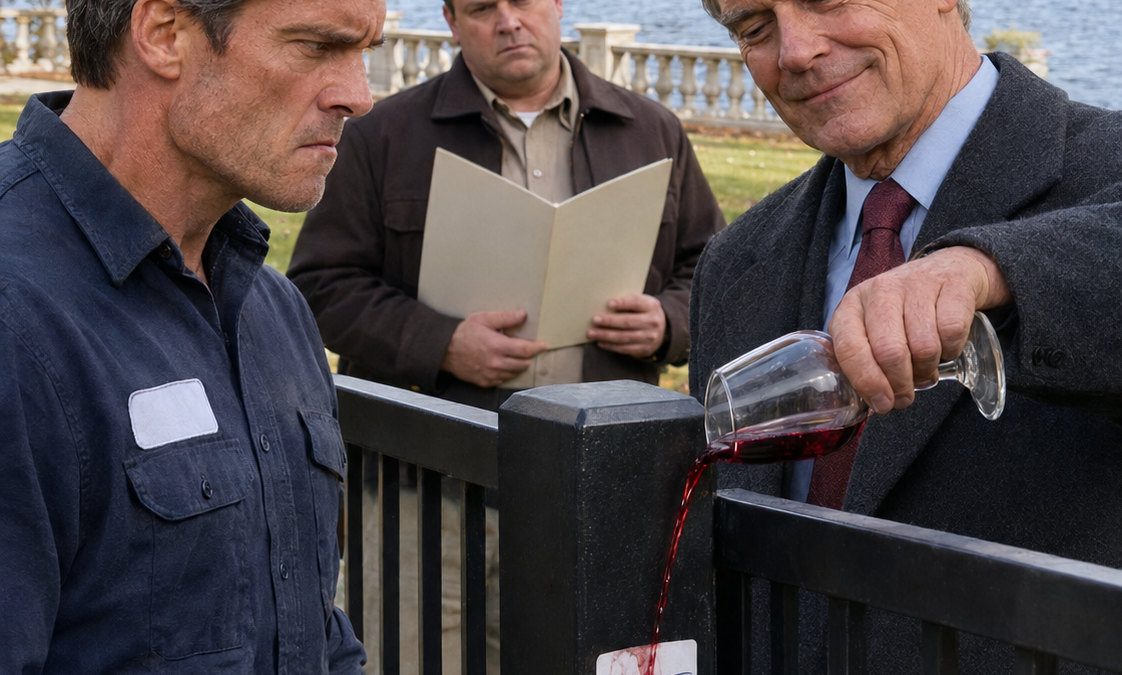
“Gate guy,” he said. “You here to fix something?” He tipped a little wine from his glass onto the white service sticker I had signed on the gatepost while I stayed behind the track. Then he raised his voice for the guests: “My grandson stays here. Not with the guy who fixes the gate.”
My hand stayed empty at my side.
Haas folded the pages together and held them where Lyall could see the judge’s signature.
“I have an order directing Milo’s return to Beau,” Haas said.
Lyall looked at the paper instead of me.
“My daughter asked me to keep the boy,” he said. “This is her week.”
“The judge reviewed that.”
“Then the court did not have all the information.”
Renee raised the clear sleeve. “The filing included Kara’s email and the agreement she signed.”
Lyall’s eyes moved to the signature at the bottom.
“Handwritten notes are easy to misunderstand,” he said. “Families make temporary arrangements all the time.”
“This one has dates,” Renee said.
“I am speaking with Tom.”
Haas kept the order in his hand. “It says release him.”
Lyall took a drink. Behind him, the guard had left the gatehouse and stood near the controls.
“I have sixty people here,” Lyall said. “Milo is dressed and ready to join us. Removing him now would upset him and accomplish nothing.”
“It would comply with the order,” Haas said.
Lyall turned slightly, enough for the guests above to see his profile.
“This is an unfortunate disagreement between divorced parents,” he said. “I stepped in because my daughter needed help.”
I looked at the terrace.
A man near the heater leaned toward a woman beside him. Another guest lowered a plate without taking a bite. The music kept playing, but the people at the rail had stopped talking.
Lyall had wanted Milo in front of them.
He had brought the audience to the gate himself.
“Call Kara,” Haas said.
“I have already spoken with her.”
“Call her again.”
“She is working.”
“You said she asked you to keep him.”
“She did.”
Renee held up her phone. “Her email says she did not.”
Lyall’s smile stayed in place.
“My daughter is tired,” he said. “She works nights. Beau reached her in the middle of a shift and pressured her into sending something before she understood what was happening.”
I said nothing.
The order did the talking better than I could.
Haas looked toward the house. “Bring Milo down.”
Lyall’s fingers tightened around the stem of the glass.
“You are asking me to interrupt a family event based on a rushed filing.”
“I’m telling you what the judge ordered.”
Lyall glanced at the terrace again. More guests had gathered near the rail. Someone lowered the music, and the voices from the road carried farther.
He softened his tone.
“Tom, you have known my family a long time. Milo is safe. He is happy. Let his mother sort this out when her contract ends.”
“When does her contract end?” Haas asked.
Lyall did not answer.
Renee put her phone in her coat pocket, then slid the agreement from its sleeve just far enough to expose Kara’s signature.
“She already sorted it out,” she said.
Lyall looked at the page, then at Haas.
“You know what Beau does for a living,” he said. “He knows that code. He could have entered this property at any time if he truly believed there was danger.”
The keypad stood a few feet from my shoulder.
“I did not touch it,” I said.
Lyall gave me the same patient smile he had used Friday.
“Because you knew you had no right to come in.”
“I knew you wanted me to.”
His eyes narrowed briefly.
Haas stepped nearer the track.
“Release the child, Lyall.”
The guard waited beside the controls.
Lyall lifted the wine glass toward the terrace, almost a toast.
“Kara asked me to protect her son during her week,” he said. “I will challenge the order through counsel.”
Haas unfolded the paper fully.
“Do that after you comply.”
An airport cab slowed behind my truck.
Its roof light showed the word CAB as it stopped. The rear door opened.
Part 7 of 8
Kara stepped out of the cab in navy scrubs with a carry-on in one hand.
Her hair was pulled back badly, as if she had done it without a mirror. A hospital badge still hung from her top. She looked at me, then at the gate, and left the bag beside the open cab door.
Lyall’s smile changed before his feet moved.
“Kara,” he said. “You should have let me know. I would have sent a car.”
“I called you.”
“You were at work and upset.”
“Then you hung up.”
Several faces turned along the terrace rail.
Lyall kept his voice gentle for them.
“Come inside. You’ve had no sleep, and this has become larger than it needed to be.”
Kara walked past my truck and stopped beside Renee. The original swap agreement was still in Renee’s clear sleeve. Kara pointed to her signature.
“I signed him to Beau. You had no right.”
Lyall looked toward the people above us.
“This is her week,” he said to Haas. “Kara asked me to help while she was away.”
“No,” Kara said. “I told you Milo was staying with Beau while I worked.”
“You told me you were worried about the arrangement.”
“I told you I missed my son.”
“Which is why I collected him.”
“You took him from school without calling either parent.”
Lyall lowered his glass.
“I was on the approved list.”
“From last year.”
“The front office released him to me.”
Kara tapped the sleeve with one finger.
“That is my signature. The email Renee filed is mine. I never told you to pick him up. I told you on the phone to send him home, and you hung up.”
No one on the terrace moved.
Lyall tried once more.
“You were exhausted. I believed you would thank me when you had rested.”
“Then why was Milo’s picture in your visitation petition?”
His eyes went to Renee, who said, “We know about the draft.”
“That draft was a precaution,” Lyall said. “Milo deserves stability.”
Kara looked at the temporary order in Haas’s hand.
“The judge answered that.”
Haas faced the guard. “Open the gate and bring Milo out.”
The guard turned to Lyall.
Lyall stood with the wine glass near his coat, his thumb pressed against the stem.
“Sir?” the guard asked.
The question carried up the drive.
Lyall gave a small nod.
The guard spoke once into his radio, then returned to the controls. With the same low hum I had listened for after installing it, the operator started. The steel frame rolled across the track.
I stayed where the shoulder met the drive.
Haas watched me, then the opening.
The front door of the house swung wide.
Milo came down the drive in his navy coat. At first he walked. Then he saw me beyond the gate and ran.
“Dad!”
He crossed the track.
His weight hit my chest, and his shoes knocked my shins. I caught him as his arms locked around my neck.
“I thought you knew,” he said.
“Now I do.”
“Grandpa said Sunday was part of the change.”
“It wasn’t.”
Milo pulled back enough to look at Kara.
“Mom?”
She put both arms around him. Her badge pressed between them. Milo held one of us with each hand as if he could keep the road from separating us again.
Lyall remained inside the open gate.
“Kara,” he said. “You have your son. Don’t make the rest of this public.”
She looked past him at the terrace.
“It was public when you put his picture in a court petition.”
“The petition was never filed.”
“You planned to.”
“I planned to protect my relationship with my grandson.”
Kara moved in front of Milo without letting go of his hand.
“In 1994, I was eight years old,” she said.
The music had stopped completely.
“I read the old custody file this summer.”
Lyall’s face went still.
“Kara,” he said.
“You brought me to this same house for the weekend.”
“That is enough.”
“You told my mother it was only the weekend.”
A server stood near the terrace doors with a tray held against his waist. The guests at the rail watched Kara.
She raised her voice just enough to reach them.
“My mother’s name was Dianne.”
Lyall set his wine glass on the stone post inside the gate.
“Your mother is not here to answer for her choices.”
“I was eight. Nobody asked me to answer anything.”
He took a step toward Kara, then stopped when Haas shifted between the open track and the road.
Kara continued.
“After you kept me here, you told the court I had settled in. You used the time you kept me as proof that I belonged with you.”
Lyall’s jaw tightened.
“That file does not contain the whole family history.”
“It contains what you told the court.”
Kara’s hand closed around Milo’s.
“Dianne lost custody.”
I looked at the house beyond Lyall.
The drive and lake were the same. So was the polite claim that a child was already settled. Milo was eight too.
I had never heard any of it. Kara had signed Milo to me because she knew what her father could make out of one weekend.
Lyall looked up at the terrace, searching for the audience he had controlled a few minutes earlier.
One guest lifted a wine glass from the rail, carried it to the nearest table, and set it down untouched.
Part 8 of 8
Deputy Haas spread the temporary order across the hood of his patrol car and started his report.
He wrote with the folder pinned under one forearm. Once Milo was outside, the gate slid shut behind Haas. Milo sat in my truck with Kara, eating crackers a caterer had brought down in a paper cup.
Renee stood by the front fender.
“Where does that report go?” I asked.
“District attorney,” Haas said.
Lyall heard him from inside the drive.
“Tom, that is unnecessary.”
Haas kept writing.
“You signed the boy out of school, refused the father, told me the mother asked you, and did not release him until a judge ordered it and your daughter arrived.”
“I followed the court schedule in effect.”
“You can put that in your statement.”
Lyall looked up.
Two guests at the terrace rail stood together. The man had already put down his wine glass. The woman placed hers beside it, and they started down the drive.
Renee leaned closer to me.
“Those are two of his biggest donors,” she said.
Lyall stepped away from the stone post.
“You don’t need to leave over a private disagreement,” he said.
The woman buttoned her coat.
“You put the boy in the invitation,” she said.
“We were celebrating family.”
“You were using him.”
Beside her, the man opened the passenger door of their car. Lyall stayed by the drive while the guard went to the controls.
The sliding gate rolled open.
Their car passed my service sticker, crossed the track, and turned toward the lake road. The guard had to stand there while it left and close the entrance behind it.
Haas tore a page from his notebook and handed it to Lyall.
“Contact information for your statement.”
Lyall took it between two fingers.
“You have known me for years.”
“I know what happened today.”
Haas went back to the hood and wrote the last lines.
Within the week, Lyall filed the grandparent visitation petition his lawyer had drafted.
A copy lay on Renee’s desk beside Kara’s printed email, the school sign-out record, and a copied page from the 1994 custody file. Kara sat next to me with a cup of coffee between her hands.
Renee put Lyall on speaker.
“I will not withdraw a petition simply because Kara made a scene at my home,” he said.
“You used photos from the weekend you took Milo,” Renee said.
“Those pictures show a close relationship.”
“They show he was on property you refused to let his father enter.”
“This is about Milo’s welfare.”
Kara set down the cup and slid the old court page toward the phone.
“Then we use this,” she said.
Lyall went quiet.
Renee continued. “We will also attach Haas’s report, your text to Beau, Kara’s agreement, and the school record. Kara will answer every claim under oath.”
“That would drag Dianne’s name into a public filing before April.”
Kara looked at the speaker.
“You dragged her name into court in 1994.”
“That was a different matter.”
“It was the same house and the same move.”
Lyall’s voice sharpened without rising.
“Milo needs a relationship with his grandfather.”
“Not one built from keeping him,” Kara said.
Another pause came through the speaker.
“I will not have that old file opened during my election.”
Renee picked up her pen.
“Then withdraw it.”
“Send the paper to my lawyer.”
The call ended.
Two days later, Renee’s printer fed out the signed withdrawal. She placed it over the petition and drew a line across the top page.
“That part is done,” she said.
The school corrected its part that afternoon.
Mrs. Lund laid the pickup list on the front counter. Lyall Fairbairn’s name still sat where it had been carried over from last year.
Kara stood beside me.
Mrs. Lund uncapped a black pen.
“This should not have stayed active,” she said.
She drew a firm line through Lyall’s name.
Then she wrote next to the entry, closed the binder, and kept the pen in her hand.
“He cannot sign Milo out again,” she said.
In the parking lot, Kara stopped at my truck.
“Do you think you were a fool not to use the code Friday?” she asked.
“I thought about it.”
“That wasn’t my question.”
“No. I wasn’t a fool.”
“Good.”
Renee joined us with the clear sleeve under her arm.
“The district attorney’s office wants the school sign-out record Monday,” Renee said.
Kara nodded. “I’ll be there.”
Milo came through the doors and took my hand.
At the end of the week, my boss met me at Lyall’s gate for the winter service. The guard opened the entrance for the appointment. My boss held the company’s code file while I stood beside the post.
My signed service sticker had curled at one corner.
I worked a fingernail under it and peeled slowly until it came away intact. The post showed a clean rectangle where my name had been.
My boss passed me the file.
“You want me to assign this to somebody else?”
I took it, looked at the written code, and handed it back.
I’d been called plenty for not making a bad thing worse.
“Take my name off that account,” I said.
“What should I tell Lyall if he asks who fixes his gate?” my boss asked.
“Tell him the guy who fixes the gate is picking up his own son at the usual door.”
THE END
More stories
My daughter’s future father-in-law ordered four bottles of champagne, then sent me the $3,600 bill—But the manager walked in and contradicted him where his relatives could hear.“You Drive a Bus, Ma. You Don’t Get to Keep My Daughter,” My Son Told Me at 55—Then a Court-Appointed Woman Entered the Fight He Thought Was Simple“Who let you in?” my daughter-in-law asked at the gala after my son demanded my $21,600-a-year rental property—then the head of school called me forward, and she resigned as treasurer.At 58, I was the “grease monkey” my daughter’s fiancé mocked at his company picnic — Until his boss approached me beside coach 14 and his grin disappeared.“Dad’s confused,” my son claimed in court, certain his $85 plan would stay hidden from me—until testimony he hadn’t counted on exposed his lies and left him without an ally.My father accused me of stealing $9,000 at Grandma’s 90th birthday while holding the microphone—then Grandma raised her hand, and even he had to listen to her.








