The Chair Beside Ruth
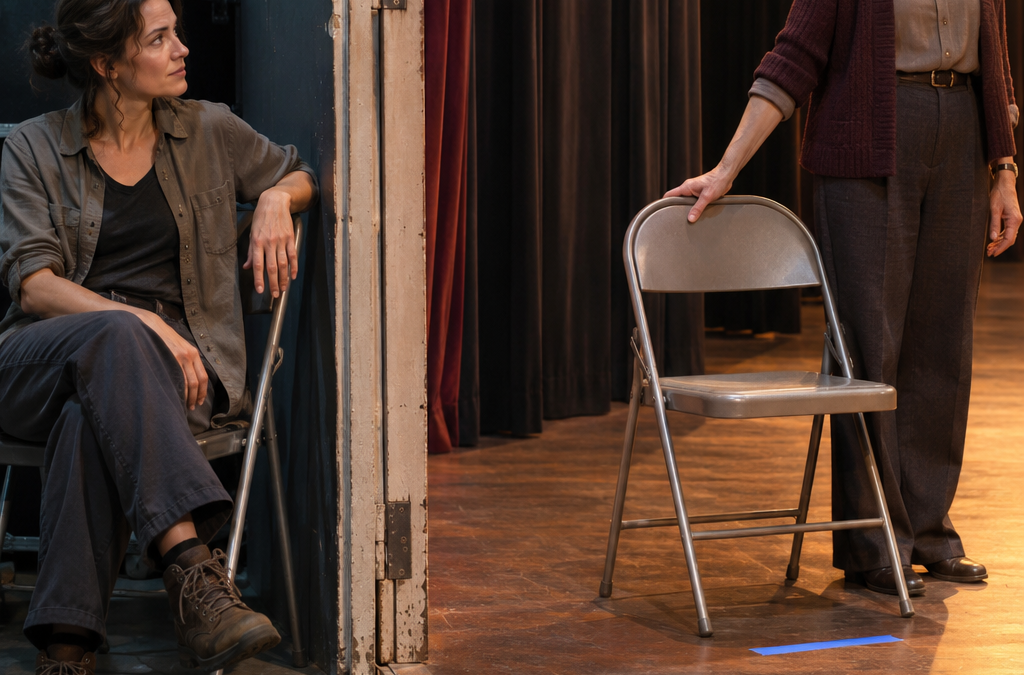
My aunt Ruth put a folded chair into my hands and pointed to the strip of blue tape beside hers.
“Right here, Nora. Turn a little toward me when you sit.”
Beyond the backstage doorway, a photographer was moving a light out of the orchestra’s way. Two women from Ruth’s volunteer costume crew stood beside a rack of wool coats, waiting to be told whether they belonged in the picture. Onstage, somebody was trying to flatten a corner of the painted winter sky.
I had come to discuss a job. Apparently, I had also come to be evidence of a happy family.
“Is this for the fundraising announcement?” I asked.
“The anniversary appeal,” Ruth said. “Lena has the wording.”
She tugged my collar flat, a gesture so familiar that I almost let her arrange the rest of me.
At sixty-four, Ruth still threaded a needle without glasses if the light was good. She had taught me to sew, fed me through high school, and once stayed up until two in the morning helping me finish a skirt I had foolishly promised a friend. None of those things had stopped her from closing a door I had spent months trying to reach.
I was thirty-seven now. I knew how to walk into a workroom without asking whether I belonged there. But I could still feel seventeen rise in me when Ruth said my name in that brisk, affectionate voice.
Lena Ortiz, the theater manager, came through the doorway with a sheet of paper.
“Before we start, could you both check this? Especially the description of the costume work.”
I balanced the chair against my leg and read.
The proposed caption described Ruth Ellis and her niece, Nora, as the partnership behind the theater’s costumes since its 2006 production of The Long Way Home. Twenty years of shared craft, it said. Together again for the winter revival.
“Not together again,” I said.
Lena looked up.
Ruth smiled toward the photographer. “She means we never really stopped talking sewing.”
That was true in the way a thimble and a bucket were both containers.
We had talked at family dinners. Ruth had occasionally called to ask where I bought lining. For twenty years, I had done my paid work elsewhere.
On the worktable behind Lena sat a thick green binder with THE LONG WAY HOME—2006 printed along its spine. Its lower corner was whitened where the covering had worn away. I recognized Margo Chen’s square handwriting on the label.
“You found the old production book,” I said.
“Margo brought it in yesterday,” Lena said. “Inventory, pattern pieces, her wardrobe notes. We’re hoping it saves us rebuilding things we already own.”
Ruth reached for the caption. “We can change a word or two.”
Twenty years earlier, she had held another piece of paper with my name on it. An introduction to a costume-shop owner who had agreed to let me spend a workday there. After a costume was found torn, Ruth blamed me and returned that introduction before I could use it. I had asked her to check Margo’s notes first.
She had said there wasn’t time.
Now there was time to move a lamp six inches, straighten my collar, and make twenty years look continuous.
“The work I’m proposing is mine,” I said. “It isn’t an extension of Ruth’s shop.”
One of the volunteers lowered the coat she was holding.
Lena glanced toward the stage. “The proposed agreement credits you as the alterations lead. This is just the fundraising copy.”
“I understand. But people will read it.”
I needed that agreement. I had left room in my winter schedule for it, turning down small jobs that would have filled the same weeks. The fee would carry a meaningful part of the quiet season. Lena still needed a workable plan within three days, and the plan we had discussed depended on Ruth’s volunteers.
Ruth rested her hand on the back of her marked chair.
“We’re not asking you to sign your life away. Come sit beside me.”
For a moment, I wanted to. Not for the photograph. I wanted the easy thing she was offering to be real.
I carried the chair into the wide recess beside the backstage doorway, clear of the passage. I opened it and sat on the other side of the threshold.
“I’ll work here under my own name, but I won’t sit for a picture that says I spent twenty years working beside you.”
Lena set the caption on the worktable and drew a line through the joint introduction. “We can remove this. Then we need to discuss which crew is actually coming for the revival.”
“Please pause the picture,” I said.
She asked the photographer to wait. Ruth took her hand off her chair, and I stayed where I was.
In October 2006, I was seventeen, and a pair of sewing shears had taken me eight weeks to buy.
I worked after school sorting donations and tidying the sales floor of a secondhand furniture store. On Saturdays I wiped fingerprints from glass tabletops that would be covered again before noon. I put part of every pay envelope into an empty tea tin and counted it after Ruth and my cousin Cal went to bed.
When I finally bought the shears, I cut through a folded scrap of cotton just to hear the sound.
“Don’t waste good fabric making confetti,” Ruth said.
“It’s from the scrap bag.”
“Then cut something useful.”
She gave me two narrow strips and showed me how to turn their edges together so the raw allowance disappeared inside the seam. I did it three times. On the fourth try, the line was straight enough that she held it up to the kitchen window.
“There,” she said. “That’s worth looking at.”
I kept that little strip in my sewing box longer than I admitted.
Ruth had raised me from middle school on. By then, she knew which foods I disliked, how I went quiet when I was hurt, and exactly how hard I would work for a small sign that she thought I might be good at something.
That evening, an envelope lay beneath her appointment book. NORA ELLIS was written across the front.
“Is that from the costume shop?”
She looked at it before answering. “From Elaine. Yes.”
Elaine owned a small costume business about forty minutes away. Ruth had done occasional overflow work for her and had asked whether I could come in for a day.
“What does it say?”
“That you can spend October twenty-first with them. Watch some fittings, do what they give you. It’s an introduction, Nora, not a job offer.”
“I know.”
“I don’t want you building it into something it isn’t.”
But it was something. There was a date. There was a place where people did the work I wanted to learn, and someone there had agreed that I could come through the door.
“Can I read it?”
Ruth slid it out far enough for me to see the sheet inside. The shop’s name was printed at the top, and there was a short note confirming the workday.
Then she put it back.
“I’m taking the packet over with the fabric samples next week. Keep it all together.”
“Shouldn’t I have the address?”
“I’m driving you.”
I nodded. I didn’t want to spoil her good mood by seeming ungrateful.
Cal came in carrying his rehearsal shoes. He was eighteen, a year older than I was, and had an audition workshop in another town that weekend.
“Did you get the travel money?” he asked.
Ruth opened her purse and counted bills onto the table. “That’s gas and lunch. Keep the receipt if you have to pay to park.”
I watched her add another ten.
“Could I go with you when you take the samples?” I asked. “So I could meet her before the workday?”
“You have your shift.”
“I could ask to switch.”
“Don’t start rearranging everything. Elaine’s busy.”
Cal tucked the money into his wallet. He had been allowed to leave the dishes that week because he needed to practice. Mine waited in the sink until I got home from work.
He noticed the envelope. “You got your sewing day?”
“I think so.”
“Good.”
He meant it, I thought. He grinned at me, then spread his pages over the table and asked Ruth to read the other character’s lines.
She moved my practice seam out of the way.
I took my new shears and washed the dishes. From the kitchen, I could hear Ruth stopping him, suggesting where to breathe, telling him not to rush a line just because he was nervous.
Later, she came to my room with a stage coat over her arm.
“For The Long Way Home,” she said. “The front hook needs replacing. Do that cleanly and we’ll put it with the things you can show Elaine.”
I laid the coat across my bed. It was dark green, lined in brown, with a broad front panel that overlapped at the chest.
Ruth pinned a paper assignment tag to the hanger and wrote my name on it.
I liked seeing it there.
On the afternoon of October 19, 2006, I carried the finished coat to the theater.
I had replaced the hook, reinforced the small patch beneath it, and checked that the front closed without pulling. Margo Chen was sorting gloves at the wardrobe table.
“Let’s see what you’ve got,” she said.
We laid the coat flat. She fastened the new hook, opened it again, and smoothed the front panel with her palm.
“Looks good.”
I stood a little straighter.
Margo made a short note in her green binder, then hung the coat on the ready rack. I put away the thread and spent the next hour helping match buttons to three old vests.
When I came back from carrying a box upstairs, Ruth was holding the coat under the workroom light.
A rip ran through the front panel below the hook. Not a loose stitch. The fabric itself had torn, leaving a narrow flap hanging away.
“What happened?” I asked.
“That’s what I’d like you to tell me.”
Cal stood near the doorway in his rehearsal clothes. He was rubbing a dark mark on the edge of one shoe with his thumb.
“It wasn’t like that when I brought it in.”
Ruth turned the hanger so the paper tag faced me.
My name swung beneath her hand.
“You worked on it.”
“On the hook. That’s lower down.”
“You may have caught it while you were pulling it through the machine.”
“I sewed the hook by hand.”
She looked at the tear again. Her eyes moved briefly toward Cal, then back to me.
I noticed the glance. I didn’t know what to make of it.
“Margo saw it,” I said. “We put it flat on the table.”
“Margo has enough to do.”
“She wrote it down. Ask her. Or look in the binder.”
The binder lay at the other end of the worktable beneath a bag of brass buttons. I could have crossed the room in five steps.
Ruth put the coat down between us.
“We’re not holding a committee meeting over every mistake.”
“It wasn’t torn when I gave it to her.”
“You keep saying that.”
“Because that’s when I last had it.”
Cal stopped rubbing his shoe.
No one asked who had taken the coat off the ready rack.
Even then, I understood that was the next question. It seemed so simple that I waited for Ruth to say it. She asked actors where they had left hats, asked volunteers who had moved a box, asked me what I had done with her good pins. Things changed hands in that room all day.
But this time she kept looking at the tag.
“Please,” I said. “Just check what Margo wrote.”
Ruth lowered her voice. “I have vouched for you. Do you understand that? I’ve told Elaine you take care with other people’s things.”
“I do.”
“Then take responsibility instead of making this harder.”
Cal shifted toward the doorway. Ruth glanced at him again.
“Stay a minute,” she told him.
I thought she might finally ask him something useful. Instead, she turned back to me.
“Go get the matching thread.”
I didn’t move.
“Nora.”
It was the voice that ended arguments at home. I was living in her house, waiting for her to drive me to the shop, depending on her to say I was ready. All those dependencies seemed to gather around that one word.
I got the thread.
Cal remained beside the door while Ruth examined the torn edges. He didn’t join the accusation, and he didn’t object to it. At seventeen, I counted that as a small kindness. I know better now than to decide what somebody else’s silence means without asking.
“Can it be fixed?” he said at last.
“It can be made usable,” Ruth said.
I held out the spool.
She took it without looking at me.
We worked on the coat until the front lay reasonably flat again. Ruth directed me to cut a backing piece while she handled the damaged panel. Once, she brushed loose threads from my sleeve, almost gently.
I wanted that touch to mean she had changed her mind.
Before we left, I looked toward the binder. Margo had gone to find a missing prop, and the bag of buttons still lay on top of it.
“Tomorrow,” I said. “We could ask her tomorrow.”
Ruth zipped her sewing bag.
“We’re done with this tonight.”
The next morning, October 20, I found the introduction envelope sticking out of Ruth’s purse.
My name was facing me.
I had put my shears in their sleeve and packed a notebook for the workday. There was a clean blouse hanging from my bedroom door, something plain that would not catch on a machine or trail across a table.
“What time are we leaving tomorrow?” I asked.
Ruth kept rinsing her cup.
“We aren’t.”
I waited for the rest. A car problem. A change at the shop.
“I’m taking this back to Elaine today.”
“Why?”
“I can’t send you in under my recommendation after last night.”
“Then don’t recommend me. Let me go and tell her what happened myself.”
“That isn’t how I arranged it.”
“Give me her number.”
Ruth shut off the faucet. “You are not going to call her and pull her into an argument.”
“I want to ask whether I can still come.”
“She trusted my judgment in offering you the day.”
“And now you’re telling her I shouldn’t have it?”
“I’m telling her you need more time.”
I could hear Cal moving in the hallway. He appeared at the kitchen door, took one look at us, and opened the bread drawer.
“Tell her what?” he asked.
“The shop,” Ruth said.
He took out two slices.
I turned toward him, though I didn’t know what I expected. He had been there when I asked about the binder. He could at least say that much.
He pressed the toaster lever down.
“Ruth, let me come with you,” I said. “I won’t argue. I’ll just ask her myself.”
“No.”
I had never been to Elaine’s shop. I knew its name from the letterhead and roughly where it was, but I had not copied the address or spoken to anyone there. Everything had come through Ruth. Getting there on my own would have meant finding a ride and arriving at a business that might already have been told not to expect me.
I could imagine doing it. I couldn’t yet make myself do it.
Ruth took the envelope from her purse and checked that the introduction was inside. Then she left.
When she came home that afternoon, I asked if Elaine had read it.
“I returned it,” she said. “We agreed not to go ahead.”
I didn’t know what she had said beyond that. For years, I filled the gap with the worst version I could imagine, then scolded myself for imagining it.
On October 21, I stayed home.
I unpacked my notebook. I put the blouse back in the closet. The shears went into my sewing box, still mine, still sharp, of no help with the thing I had needed most.
For several weeks, Ruth offered me small jobs around the house as though we had simply gone back to the previous arrangement. A hem. A loose button. I did them, but stopped bringing her things I had made just to watch her examine them.
In November, I went into June Walker’s alterations shop after work.
There was a handwritten notice in the window asking for help sorting garments and keeping the fitting rooms in order. I walked past it twice before I opened the door.
June was pinning a pair of trousers.
“I can come back,” I said.
“You can wait.”
So I did.
When she finished, I told her my hours and what I could do. I said I could sew a hook neatly, shorten a plain hem, and follow directions. I didn’t say I was supposed to be somewhere better.
She gave me a basket of tangled hangers.
“Start with those. I pay for the time, not how impressive the job sounds.”
I worked two evenings that first week. The next week she let me mark intake tickets. Later, she watched me baste a hem and made me take out half of it.
It was not a secret route to instant success. I spent months doing work nobody would put in a portfolio. I made mistakes June could point to, learned how to correct them, and was paid for hours I could count.
Over the years, that became a trade. I worked in other shops, took theater calls, learned which promises I could keep and which jobs to refuse. June remained someone I could call when a problem had beaten me.
I built a working life. That did not make October 21 a day I had never lost.
In October 2026, sitting in the backstage recess, I could see the green binder from my chair.
Ruth had gone to speak to her volunteers. The photographer was packing one of his lights, and Lena was making a note on the back of the proposed caption.
“May I ask Margo about something in that book?” I said.
“Of course. She’s coming back this afternoon to go through the inventory.”
“It’s an old entry. October nineteenth, 2006. The green coat.”
Lena set down her pen.
“The incident you mentioned?”
“Yes. I remember what I handed over. I’d like to know what was written down before I say anything more.”
Lena called Margo and asked whether she could come a little early. She didn’t ask her to settle an argument.
I stayed for the inventory discussion. It would have been easier to leave, but I still needed to know which coats could be let out and whether the brown uniforms were worth using. Lena and I laid three garments on the table, measuring the work in front of us instead of discussing people who weren’t there.
Ruth left before Margo arrived. She said she would call Lena about the crew.
Margo came in carrying reading glasses and a cloth shopping bag.
“I wondered when someone would need this monster again,” she said, patting the binder.
“You kept everything?”
“Not everything. Enough that I wouldn’t have to make the same pattern twice.”
She showed Lena the inventory first: garment numbers, fabric scraps, sketches of pieces that had been borrowed or made. Several pages had pencil notes added in later years. This was not an archive assembled for my benefit. It was a working book someone had found useful enough not to throw away.
When I asked for October 19, Margo turned to a section headed WARDROBE.
I recognized the coat number before I saw my name.
Oct. 19, 4:10. C7. Nora returned—hook replaced. Laid flat, front panel intact. Ready rack.
Below it, in the same small handwriting:
6:35. C7 back at table. Rip visible in lower front panel. Ruth repairing.
I read them twice.
The room seemed to get quieter, though Lena was still turning a coat sleeve right side out beside me.
“You wrote both?”
“Yes.”
“Do you remember why you noted the front panel?”
Margo touched the margin with one finger.
“I noted visible damage and finished repairs so I’d know what still needed doing. That coat had the closure problem, so we laid it down to check it. I saw the front then. Later I saw the rip.”
She paused.
“I didn’t inspect every seam, Nora. And I didn’t watch the rack all afternoon.”
“I understand.”
“I don’t know who took it down. That isn’t in here.”
I let her finish. Part of me wanted to seize the binder and carry it straight to Ruth, but Margo was telling me what she could stand behind. It mattered that I hear the limit along with the relief.
“Do you remember me asking Ruth to look?” I said.
“No. I wasn’t there for that.”
I nodded.
Margo looked at me more closely. “I knew you were blamed. Ruth said you’d caught the fabric doing the alteration.”
“Did she ask you about the entry?”
“Not that I remember.”
Lena moved the coat aside.
“This supports what you said about the handoff,” she told me. “It doesn’t tell us what happened afterward.”
“No,” I said. “It doesn’t.”
My hands were lying flat on the table. I lifted them and found faint damp marks beneath my palms.
For twenty years, I had carried the possibility that I had missed something—that I had handed over a damaged coat without noticing, that confidence had made me careless. Here was a small, ordinary note from someone who had stood beside me and seen what I saw.
It had been five steps away.
Margo asked whether I wanted a copy of the page. I said yes. Lena photographed it with Margo’s permission and sent it to me, then asked Margo to keep the binder available with the revival materials.
“I can explain those entries to anyone who needs me to,” Margo said. “Only those.”
“Thank you.”
I wasn’t thanking her for clearing my whole life. She hadn’t. I was thanking her for not adding anything she couldn’t know.
The two times remained on my phone screen: 4:10 and 6:35.
I remembered Cal by the doorway, rubbing at his shoe. That memory proved nothing about the coat. But he had been there when it was found, and he still helped the theater with its ticket mailings. I had seen his name on Lena’s current volunteer list that morning.
I had his number. We exchanged birthday messages and occasional questions about Ruth. Until then, I had never asked him directly about that evening.
I opened our messages and typed, Can we talk tomorrow? I want to ask what you remember about the green coat after I put it on the ready rack.
This time I knew which question came next.
Cal met me in the theater lobby the next morning. He had a carton of mailing envelopes under one arm, and for a moment we stood looking at each other as though one of us had arrived for the wrong appointment.
“Can we sit somewhere?” I asked.
He put the carton behind the ticket counter and followed me to a bench beneath the coming-attractions board. There was no audience, no Ruth, no reason to choose words that would carry to someone else.
I opened the photograph of Margo’s page.
“She recorded the coat intact at four-ten,” I said. “At six-thirty-five, the front was ripped. Do you know where it went between those times?”
Cal looked at the screen without taking the phone.
“Yes.”
I waited.
“I took it off the rack. I wanted to practice the turn in the second scene with it on. I went into the side rehearsal room.”
He rubbed his palms against his jeans.
“There was a piece sticking out of the old scenery flat. I caught the front on it when I turned. I pulled away before I realized what had happened.”
“You tore it.”
“Yes.”
“And put it back?”
“I brought it out and left it on the end of the wardrobe table. I thought maybe Mom could fix it before anybody asked.”
I put the phone facedown on my knee.
“You were standing there when she said I’d done it.”
“I know.”
“You heard me ask her to look in the book.”
“Yes.”
He was looking at me now. That made it harder in a way I hadn’t expected. I had prepared for evasions. I had not prepared for the plainness of his answers.
“When did you tell her?”
“After you left that night. In the parking lot. I told her I’d borrowed it and caught it on the flat. I told her the rip was mine.”
“October nineteenth?”
“Yes.”
“Before she took my introduction back.”
“Yes.”
A car went past outside, its tires hissing on wet pavement.
“What did she say?”
“She said she’d handle it. I asked whether she was still taking me to rehearsal that weekend, and she said yes.”
That was what he had asked. Not whether she would tell me.
Cal bent forward, elbows on his knees.
“I was afraid she’d stop paying for the trips. Afraid she’d tell the director and I’d lose the part. It sounds small now.”
“It wasn’t small to you. That was the point.”
“No.” He swallowed. “It mattered more to me than what was happening to you.”
I looked at his hands. At eighteen he had worried the edge of his thumbnail until it bled. At thirty-eight, he was still doing it.
“Did you know about the workday?”
“I knew you were supposed to go somewhere that Saturday. I didn’t know all of it. Not then.”
“Did you ask afterward?”
“No.”
I stood and walked to the glass doors. Across the street, someone was unlocking the bakery. Ordinary business continued while I tried to fit a deliberate silence into a memory I had spent years calling confusion.
Cal did not follow me.
When I came back, he said, “I should have told you long before you asked.”
“Yes.”
“I’m sorry, Nora.”
I believed he was. I did not feel better.
“Will you tell Lena what you told me? Your part. What you did, and when you told Ruth. Not what you think she meant.”
“I will.”
“And if she needs you to say it in front of the people who heard me blamed?”
His eyes moved toward the workroom door.
Then he nodded.
I picked up my phone. “I’m going to speak to your mother myself.”
“Do you want me there?”
“No.”
He accepted that, too. It was the first useful thing my cousin had given me that morning that did not concern the past.
***
Lena had spread the proposed costume schedule across her desk when I went in. I told her what Cal had said and that he was willing to speak for himself.
She listened, then turned the draft fundraising caption over.
“This version is finished,” she said. “Whatever else happens, I’m not using the claim that you’ve worked as a team for twenty years.”
“What about the picture?”
“I’ve told the photographer not to return for it while we settle this.”
Before I could answer, Ruth appeared in the open doorway.
“Lena asked me to come at eleven,” she said.
“I did,” Lena said. “We need to know who’s doing the work.”
Ruth stayed standing. She looked at the paper on Lena’s desk, not at me.
“I’m not coming in here to be made an example of.”
“Nobody’s asked you to,” Lena said.
“If this becomes a discussion in front of the crew about something that happened twenty years ago, I won’t be working on the show. And I’ll ask the women to leave with me.”
My stomach tightened. I knew most of those women by the work they could do: the one who could organize a rack so a hurried actor could find everything, the one who would stay to replace a whole row of closures without being asked twice.
“They decide for themselves,” Lena said.
“Of course they do.”
Ruth’s voice had that smoothness I remembered from difficult conversations at the kitchen table. It made disagreement sound like bad manners.
I held the edge of the schedule still with one finger.
“I don’t want anybody punished for knowing you,” I said. “I want the people who heard the old accusation to stop hearing it as the truth.”
“We can discuss that privately,” Ruth said.
“Yes. We can.”
She looked at me then, perhaps surprised that I had agreed.
“But I’m not buying a job by leaving it uncorrected.”
Lena leaned back.
“The crew plan is due tomorrow,” she said. “That hasn’t changed. If Ruth withdraws, I need a plan I can actually put in front of the theater. Not a promise that you’ll somehow manage.”
“I understand.”
“I can’t pay one person to do all the work we planned for a crew.”
“I’m not offering that.”
Ruth took her handbag from the chair beside the door.
“I’ll speak to my people.”
After she left, Lena turned the schedule toward me. The proposed job included alterations, new decorative pieces, a fresh set of cuffs and collars, and finishing work for costumes that could already be worn.
I crossed out nothing yet.
“Give me until tomorrow afternoon,” I said. “I’ll separate what the actors need from what we wanted.”
Outside, I called June.
“I can’t take a theater job on,” she said before I had finished explaining. “I’ve got three weeks of work hanging over my head.”
“I know. I’m asking for an hour to look at a list with me. And whether there’s one session you could spare, paid. If there isn’t, tell me.”
She was quiet long enough that I heard her set something down.
“Bring the list after closing. I can give you tonight to look at it and one evening next month. That is all, Nora.”
“I’ll plan for all, then. Not more.”
I made that note at the top of the page.
Then I called Ruth and asked her to meet me alone the next morning.
***
She chose her kitchen.
I arrived at nine. She had put out two mugs and the small plate she used for store-bought cookies when she didn’t want the package on the table.
For years, that kitchen had been where I waited for her decisions. Now I pulled out my own chair.
“Cal talked to you,” she said.
“Yes.”
“He called me yesterday.”
I put my phone beside my mug but did not open the photograph yet.
“Margo recorded the front intact when I handed it over. Cal told me he borrowed it and tore it. He said he told you that night, after I left.”
Ruth pushed the plate a little closer to me.
“Is that true?” I asked.
“Yes.”
“Both parts? That he borrowed it, and that he tore it?”
“Yes, Nora.”
“And you took my introduction back the next day.”
She folded her hands.
“I did.”
There it was. No missing page remained between those two things.
I had thought I might need to make her look at the entry. I had imagined turning the screen toward her, pointing to the times until she could not refuse to read them. Instead, the phone lay dark on the table.
“What did you tell the woman at the shop?”
Ruth looked down.
“That you weren’t ready for the workday. That you needed more time before I could recommend you.”
“Did you tell her I’d damaged a costume?”
“I said you’d been careless with an assignment.”
“You knew I hadn’t.”
“Yes.”
I stood. The chair legs scraped the floor, and she flinched at the sound.
I went to the counter, where a clean dish towel hung through the oven handle. I had folded towels there after school. I had waited there for Cal to come home so we could eat. It was possible to know every cupboard in a room and still have nowhere to put your hands.
“Why?” I asked.
“He had finally found something he was good at.”
“So had I.”
“I know that.”
“You knew it then.”
She pressed her lips together.
“He was struggling. If he lost the part—”
“He might have had to earn another one.”
“You weren’t his mother.”
“No. I was the other child in your house.”
Ruth looked up sharply. I had not raised my voice. That seemed to trouble her more.
“I took care of you,” she said.
“You did.”
“I taught you.”
“Yes.”
“I didn’t do all that because I wanted you to fail.”
I returned to the table, but I did not sit.
“I’m not asking whether every year I lived here was a lie. I’m asking why you let me miss that Saturday when you knew.”
Her eyes filled. She wiped beneath one with her finger, impatiently.
“Because correcting it would have meant saying I’d blamed you without checking. And it would have meant telling people what Cal had done after I’d been asking them to give him a chance.”
“So you told someone not to give me one.”
She nodded once.
I sat down.
For a while neither of us spoke. The refrigerator motor stopped, leaving the room so quiet I could hear her ring touch the side of her mug.
“I thought you’d find something else,” she said.
“I did.”
“You were always better at getting on with things.”
I looked at her until she dropped her eyes.
“That wasn’t permission.”
“No.”
The word was barely audible.
I took a breath that caught halfway in.
“I had my shears packed. Do you remember that?”
“I remember.”
“I kept thinking if you’d just let me go, I could explain. Even if I had done something wrong, I could have shown them what I could do. You wouldn’t let me speak to her.”
“I was ashamed.”
“Not of me.”
“No.”
I had wanted that answer for twenty years. Hearing it did not give me back the morning I had spent sitting on my bed with a bag I no longer needed to carry.
Ruth reached across the table. I moved my hand to my lap before hers arrived.
She stopped.
“What do you want me to do?” she asked.
“Tell the people at the theater who heard it that you were wrong. Cal can tell them what he did. You don’t have to tell them everything we’ve said here.”
“And the announcement?”
“Accurate credit. Your work was yours. Mine is mine. We didn’t have a twenty-year partnership.”
She looked toward the window.
“Will that be enough?”
“For the announcement.”
She turned back to me, understanding the distinction.
“I can’t tell you what we’ll be after that,” I said. “And I’m not asking you to work on the revival. That has to be your decision, not something I accept in place of this.”
“I don’t think I can come in every day with everyone knowing.”
“I came in when everyone thought it was me.”
She closed her eyes.
I let the silence stand. I had spent enough of my life finding something easier for her to hear.
When I left, the cookies were untouched. Ruth walked me to the door but did not try to hug me.
“I’ll call Lena,” she said.
“All right.”
I stepped onto the porch. She stayed inside, and I went down the steps alone.
***
By the crew-plan deadline that afternoon, I had a page with three columns: essential, optional, not included.
June had gone over it with me the evening before, drawing a line through the new cuffs.
“Those old ones can go onstage,” she’d said.
“They’ll look old.”
“It’s a revival. Are they falling apart?”
“No.”
“Then don’t sell time you haven’t got.”
Now Lena examined the page while I stood on the other side of her desk.
The revised plan kept the fittings, the failed closures, the weak hems, and alterations needed for the current cast. It dropped the new decorative pieces and most of the refinishing. I proposed nine paid workdays spread across the coming weeks instead of the twelve in the original offer.
Lena tapped the difference.
“That’s a quarter of your fee.”
“I know.”
The missing money had already become things in my head: the shop rent, the car repair I could postpone but not forget, the weeks after the holidays when customers called less often.
“I’m not cutting your rate,” Lena said.
“No. We’re buying less work.”
She studied the rack list again.
“I can take this forward if the two volunteers who’ve offered to stay handle the wardrobe sorting and the straightforward handwork you assign them. If that changes, tell me before you make up the difference yourself.”
“I will.”
By then, Ruth had spoken to her crew. Two wanted to stay. Others had already counted on working only with her and chose not to join this production. I did not phone them to plead my case.
Before the remaining volunteers began sorting, Lena asked us to gather by the worktable. Margo stood beside the binder. Cal came from the lobby without his carton.
“I need to correct something,” he said. “In 2006, I borrowed the green coat after Nora handed it in. I tore it during rehearsal. She didn’t.”
Ruth stood near the end of the table.
“I blamed Nora,” she said. “Cal told me afterward what had happened, and I didn’t correct it. I should have.”
One of the women looked at me, then at Ruth.
“Thank you for telling us,” Lena said. “We’ll use the correct account from now on.”
That was all. No one applauded. Margo opened the binder to the current inventory, and the room began to move again.
Ruth took her sewing basket with her. She did not leave it as a promise that she would return.
Later, Lena showed me the revised fundraising announcement. The joint photograph was canceled, not merely postponed; she had chosen an image of the theater’s restored entrance instead.
Ruth’s years of volunteer costume work were credited in a short paragraph about the theater’s history. Under the revival of *The Long Way Home*, the line read: “Costume alterations: Nora Ellis,” followed by the names of the people contributing to the present work.
I read it once more before I said yes.
The next day, after the revised agreement had been approved, I signed for nine workdays. Then I went back to my calendar and opened the three days I had expected the larger job to fill.
***
The work did not become easier because the argument was over.
At the first fitting, a pair of trousers split along an old repair when the actor sat down. One of the coats fit across the shoulders and nowhere else. The two volunteers who stayed had different hours, and I learned to leave each of them a separate tray instead of a vague list on the table.
June arrived for her promised evening with her own thimble and a sandwich wrapped in waxed paper.
“Show me the worst,” she said.
I showed her the trousers.
At the end of the session she packed up. There was still work on the rack, and for a moment I wanted to ask for another night.
Instead I said, “I’ll put your payment through with this week’s hours.”
“And you’ll eat something.”
“I will.”
I ate the sandwich she had brought for me after she left, sitting at the worktable with the fitting notes.
Lena came in the following week carrying a strip of braid she had found in a supply drawer.
“Could we use this along the edges? Just to freshen them up?”
I held it against a coat. It would have looked good.
“Not within the work we agreed,” I said. “I can give you an estimate for later, or we can leave the coats as they are.”
She looked at the marked fitting dates, then put the braid back in the drawer.
“Leave them.”
I did not secretly add it after she went home.
Tessa came on a Saturday to help label the finished garments. She was nineteen, worked shifts at a grocery store, and had asked me twice whether repair work could become something more than fixing her family’s clothes.
That afternoon she brought a jacket of her own with a neatly replaced zipper.
“Would this count as a sample?” she asked.
“For what?”
She took out her phone. She had saved a notice for a paid introductory work trial at a small independent costume shop called Marlow Workshop.
“I saw it, too,” I said. “I was going to give you the information.”
“I don’t want to quit my job for something that’s only a few days.”
“You shouldn’t have to guess. The contact person’s listed there. Ask about the schedule before you apply.”
“What if they think I’m difficult?”
“Then you’ll know something useful about the shop.”
She smiled, but she still looked concerned.
“What I really want is repairs. They mention new builds. I like figuring out why something won’t hang right. I don’t want to spend all day drawing.”
“Ask how much of the trial is repair work.”
“Would you look at the jacket?”
I turned it inside out with her. We found one place where the lining pulled, and she unpicked it herself.
When she left, she took the notice and her jacket. I had not offered to call the shop on her behalf.
By the last fitting in November, the essential repairs were finished. The coats still had worn edges. The actors could move, sit, and make their changes. I sent the final invoice for the agreed fee and put the remaining braid back with Lena’s supplies.
On the opening night of the December run, I watched from the back. In the turn Cal had described, the current actor’s green coat swung clear of the scenery.
I watched the rest of the scene, too.
***
Ruth asked by text whether she could visit a work session after the opening. She said she would understand if I preferred she didn’t.
I agreed to an hour on Saturday afternoon. Tessa was coming to finish a sample, and I had a customer’s wool skirt to alter at the theater workbench, with Lena’s permission.
When Ruth arrived, I took the folding chair from the backstage recess. A small patch of silver showed through the paint on its back, the same mark I remembered from the photograph day.
I carried it into the workroom and opened it beside the wall.
“You can sit here,” I said. “You’ll be clear of the rack.”
“Thank you.”
She took off her coat and folded it across her knees. She had brought no sewing basket.
Tessa looked up from her sample and said hello. Then she returned to the seam she was checking. I had put an application envelope on the shelf for her after she asked me for one large enough to hold her printed photographs without folding them.
I handed it to her.
“The contact details are on your copy,” I said. “And the notice says they need it by Friday. Did you hear back about the hours?”
“Yes. Two paid trial days, both on days I can trade shifts. They said there’s repair work as well as building.”
“Does that suit you?”
“I think so.” She slid the photographs into the envelope, then drew them out again. “I’m leaving this one out. The sleeve looks crooked.”
“Your choice.”
She replaced it with a photograph of the jacket zipper and sealed the flap.
Ruth watched her write the address.
“I could take that over when I go out Monday,” Ruth said.
Tessa shook her head. “Thanks, but I’m going that way after work. I want to see where the shop is.”
“All right,” Ruth said.
Tessa put the envelope into her own bag, between two pieces of cardboard she had brought to keep it flat.
While she gathered her sample, Ruth touched the edge of the wool on my table.
“I’ve missed working in here.”
I set the chalk beside the skirt.
“If we ever work together again, we’ll need to talk about the job first. Who’s doing what. How we’re credited.”
She kept her hand on her lap after that.
“I understand.”
I could not know yet whether she did. I could offer her the hour we had agreed to.
Tessa zipped her bag, checked that she had her phone, and said goodbye. Through the open doorway I saw her turn toward the lobby, carrying her application herself.
Ruth settled back in the chair.
I laid the skirt flat on the workbench, aligned the chalk marks, and picked up the shears I had bought with eight weeks of after-school pay. Holding the wool steady with my left hand, I opened the blades and made the first cut.








