“Threw away thirty-eight grand to rescue a drunk,” my fiancé joked into the microphone at our engagement party, until his new boss set down his glass, stood up, and ended his promotion.
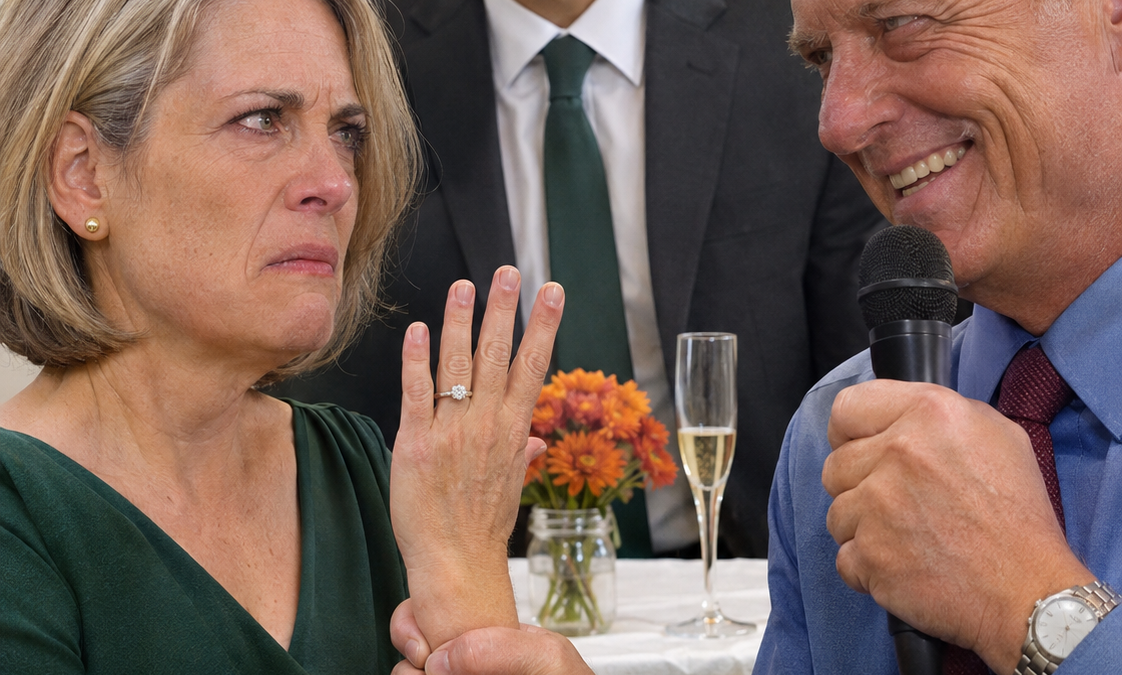
Complete story · 8 parts · about 35 minutes · ending included
Part 1 · Part 2 · Part 3 · Part 4 · Part 5 · Part 6 · Part 7 · Part 8
Part 1 of 8
Glenn lifted his bourbon and said, “Tell Tony how you lost thirty-eight grand rescuing a drunk.”
Six people at our steakhouse table turned toward me.
I kept my fork over the baked potato.
Across from me, Tony Aguirre lowered his eyes to his plate. Nine days later, at our engagement party, that same man would stand up and ask me what color my scarf was. That night he started with two words.
He was the new owner of Schauer Motors, forty-four, quiet enough that the salesmen around him kept filling the space. Glenn had spent most of dinner doing that.
“What happened?” Tony asked.
That was the question Glenn had been waiting for.
He leaned back in his chair.
“My fiancée here drove a school bus for twenty-six years. Snowstorm comes along, she decides she’s Wonder Woman.”
“Glenn.”
“What?” He smiled at me. “You tell it better?”
“I don’t tell it at dinner.”
The man beside Tony chuckled.
Glenn touched my wrist as if we were sharing a private joke.
“She’s modest. Bus full of kids, guy in a ditch, apparently drunk as a skunk. Noreen pulls over, leaves the bus, goes tromping through a blizzard after him.”
“Eleven children,” I said.
“See? She remembers the head count.”
Two people laughed.
Tony did not.
It was Thursday, October 8, 2026, and the back room of Harbor House Steak & Chop smelled like grilled onions and coffee. Schauer Motors had taken twelve managers and spouses out to celebrate its best September in six years. Glenn had talked Tony into two extra chairs, one for his sister and one for his Saturday golf partner.
Glenn had been sales manager there for nineteen years.
He wanted the general manager job badly enough to buy a new sport coat for dinner.
Navy.
Too tight when he buttoned it.
He had introduced me to Tony before we sat down.
“This is Noreen Pagel,” Glenn had said. “The patient woman foolish enough to marry me in January.”
Tony shook my hand.
“Nice to meet you.”
“You too.”
That had been all.
Now Glenn was giving him the version of me that played well in rooms.
“She gets the guy out,” Glenn continued. “Company says she broke policy. Boom. Fired.”
Marcy, seated on my other side, made a sympathetic little sound.
Glenn’s sister could make pity feel like something left on your windshield.
“Thirty-eight thousand dollars,” she said. “Gone.”
“And health coverage,” I said.
Glenn pointed at me.
“Details.”
Tony’s eyes came up.
“You were fired for helping him?”
“For leaving the bus.”
“Same thing,” Glenn said. “Rules are rules.”
The waiter reached between us for an empty bread basket.
Glenn waited until he had stepped away.
“And the best part? After all that, the guy she saved wanted nothing to do with her.”
Vern Wieland laughed from three seats down.
I had not noticed him when we walked in.
I noticed him now.
Sixty-one, ruddy cheeks, gray golf shirt under a blazer. He was Glenn’s Saturday golf partner, something I had learned that spring and asked Glenn to quit, and the same man who had signed my discharge five years earlier.
He raised his glass.
“That was one expensive rescue.”
My fork stopped against the potato skin.
Tony glanced toward Vern.
“You worked at the bus company?”
“Operations manager,” Vern said. “Back then.”
Glenn grinned.
“Small world.”
Smaller than I liked.
Vern leaned toward Tony.
“Company had no choice. You can’t have drivers abandoning kids on the side of the road every time somebody lands in a snowbank.”
“I didn’t abandon them.”
The words came out quiet.
Vern’s smile stayed put.
“Figure of speech, Noreen.”
“Peg Rusch stayed aboard. Doors shut. Heat on. Flashers on.”
Glenn patted my forearm.
“Here comes the defense brief.”
Marcy laughed into her wine.
I moved my arm away.
Tony looked at his plate again.
He kept his eyes off Glenn and Vern.
His knife rested untouched beside the steak.
Glenn told the table the rest anyway.
That I worked the front counter at a marine supply store now.
That I could tell a propeller nut from a cotter pin.
How he had rescued me from “a life of sensible shoes and boat grease.”
That got the biggest laugh.
“Sixteen-fifty an hour,” Marcy said, smiling at me. “But she likes the people.”
“We’re all just so glad Glenn took you on,” Marcy added.
My water glass clicked once against my plate when I set it down.
Glenn gave Marcy the look he used when she had gone half an inch too far.
Then he kissed my temple.
“Don’t mind her.”
I ate the rest of my potato.
At 8:47, coats began coming off chair backs.
Tony shook Glenn’s hand near the host stand.
“Good quarter,” he said.
“Next one will be better,” Glenn answered. “Especially if we get that GM structure settled.”
Tony gave a small nod.
“We’ll talk.”
Glenn glowed all the way to the parking lot.
“What did you think?”
“Of dinner?”
“Of Tony.”
“He listens.”
“That’s what I like about him.”
I opened the passenger door.
“You told that story again.”
Glenn’s hand paused on the roof of the car.
“Oh, come on, Nor.”
“Vern was sitting there.”
“So?”
“You know so.”
He sighed.
“Nobody thinks less of you.”
“I do when you tell it that way.”
His face changed for half a second.
Then the smile came back.
“You’re too close to it.”
I got in.
We drove from Manitowoc to Two Rivers with the radio low and the windshield clear.
My house on 17th Street was dark except for the porch light Glenn had left on that morning.
My mother had bought it in 1978.
She left it to me paid off.
Glenn had moved in after we got engaged, though most of the furniture was still mine and most of his things still looked temporary.
I unlocked the front door.
Behind it, on a brass hook, hung a green wool scarf.
I touched one end while Glenn went upstairs.
My mother had knitted two of them years ago.
Same moss-green yarn.
Same ribbed pattern.
Near one end of each, my mother had finished a short line in red yarn because she had run out of green.
She had laughed when I noticed.
“Turn it toward your coat. Nobody’ll know.”
The twin had disappeared into a whiteout on February 16, 2021.
This one had stayed behind.
From upstairs, Glenn called, “You coming?”
“In a minute.”
I held the scarf between my fingers.
Then I heard him on the phone.
His voice dropped when I stepped toward the stairs.
“Yes,” he said. “Tony liked the numbers.”
A pause.
Then Glenn laughed softly.
“Don’t worry. I can get Noreen there.”
Part 2 of 8
At 3:25 p.m. on Tuesday, February 16, 2021, the world outside my windshield was white.
Not pretty snow.
Whiteout.
The county road vanished fifty feet ahead of the bus, returned in gray strips, then vanished again.
Eleven children sat behind me.
Peg Rusch, my aide, stood braced against the first seat with one hand on the rail.
“Slow,” she said.
“I am.”
We were outside Two Rivers on the afternoon route, crawling at twenty miles an hour.
Wind shoved powder across the road hard enough to erase the shoulder.
Then something dark appeared down the slope to my right.
I hit the brakes.
The bus stopped straight.
Peg leaned toward the windshield.
“What is that?”
A pickup.
On its side.
Forty feet off the road.
I set the brake and turned on the flashers.
The children started talking at once.
“Everybody stays seated,” Peg called.
I picked up the radio.
“Base, this is Route Twelve. Vehicle in the ditch on County Road Q. Pickup on its side.”
Static cracked.
Then Joanie Tenpas answered.
“Route Twelve, copy. Any movement?”
“I can’t tell.”
“Stay with the bus. I’ll call it in.”
I stared through the blowing snow.
A hand appeared against the pickup’s side window.
Then disappeared.
“Joanie.”
“I’m here.”
“I saw a hand.”
“Emergency services have been notified.”
“How long?”
“I don’t have an ETA.”
The hand came up again.
Slid down the glass.
I looked at Peg.
She already knew what I was thinking.
“Noreen.”
I raised the radio.
“Joanie, I’m going down there.”
Her answer came immediately.
“Company rule says driver does not leave a bus with students aboard.”
“I heard you.”
“Noreen, that is the instruction.”
Behind me, one of the younger boys asked, “Is somebody hurt?”
Peg turned.
“Eyes inside, honey.”
I put on my coat.
Peg moved closer.
“I’ve got them.”
“Doors stay shut.”
“I know.”
“Heat running.”
“I know.”
“Call me if anybody gets out of a seat.”
Peg gave me a look.
“Noreen. Go.”
I opened the door.
The wind hit hard enough to shove my coat against my legs.
Snow went down my collar before I reached the front bumper.
By the time I made the ditch, my eyelashes were wet.
The driver’s side of the pickup faced upward.
I climbed onto the running board and pulled at the door.
It opened six inches.
Stopped.
The man inside made a sound I could barely hear.
“Sir?”
His words came out slurred.
I caught only one.
“Cold.”
He was an older man.
Gray hair.
No hat.
His left hand shook when he reached toward me.
“Can you move your legs?”
He tried.
His boot scraped metal.
“Stay with me.”
I got the door farther open and wedged myself against it.
He was heavy.
Dead weight one second, trying to help the next.
We got him up far enough that I could pull one arm over my shoulder.
Then we slid together into the snow.
He could not stand.
His knees folded.
I got him clear of the truck and turned my back to the wind.
“You hurt?”
He shook his head.
Or trembled.
His speech was still thick.
I could smell snow, wet wool, engine oil.
No liquor.
I pulled off my green scarf and wrapped it around his neck.
Near one end was the same short red line my mother had finished when she ran out of green.
He grabbed that end in his fist.
“Keep it,” I told him.
His eyes opened wider.
“Bus?”
“Kids are safe.”
I could see the yellow shape through the storm.
Flashers blinking.
Peg behind the glass.
Doors closed.
I held the man upright against me.
Minutes stretched.
My thighs went numb.
A town plow finally appeared through the white.
Its driver climbed down, looked toward us and yelled, “He drunk?”
“I don’t know.”
The ambulance came behind him.
The man’s hand stayed locked around my scarf until a paramedic loosened his fingers.
Forty minutes after I had stopped, I climbed back onto the bus.
Peg counted every child aloud before I moved.
Eleven.
Every one of them got home safe.
On Friday, March 12, Vern Wieland called me into the Lakeshore Student Lines office at 9:10 in the morning.
Joanie was already there as union steward.
A paper sat in front of Vern.
He folded his hands over it.
“You understand why we’re here.”
“No.”
Vern pushed the page toward me.
The report said I had left students aboard to aid “an intoxicated motorist.”
I tapped the word.
“Who said he was intoxicated?”
“The scene report.”
“The plow driver guessed.”
Vern’s mouth tightened.
“You left the vehicle.”
“With Peg aboard.”
“You were the licensed driver.”
“The children were safe.”
“That is not the point.”
Joanie leaned forward.
“What investigation did the company conduct regarding the motorist?”
Vern looked at her.
“We contacted him.”
My head came up.
“You did?”
“Yes.”
“What did he say?”
Vern turned back to me.
“He wants nothing to do with this.”
I stared at him.
“Nothing?”
“He declined involvement.”
Joanie asked, “Do you have that in writing?”
“We have what we need.”
He slid another paper across the table.
Termination for cause.
Twenty-six years.
My company long-service payout had been scheduled to reach thirty-eight thousand dollars.
For-cause discharge wiped it out.
So did the retiree health coverage that would have carried me to Medicare.
“Sign here,” Vern said.
“I’m not signing that.”
“You can acknowledge receipt without agreeing.”
“No.”
Joanie took the paper instead.
“We’ll grieve it.”
We did.
The answer stayed the same.
Other school-bus contractors heard “for cause” and stopped returning my calls.
By May I was behind the front counter at a marine supply store for $16.50 an hour.
For months, I still watched unfamiliar pickups in parking lots, wondering whether one belonged to the man from the ditch.
Then I remembered Vern’s words.
He wants nothing to do with this.
I stopped looking.
Five years later, at a steakhouse table, Vern had laughed while Glenn called that man a drunk.
And now, standing in my hallway with one green scarf in my hand, I had heard Glenn tell somebody on the phone that he could get me there.
The next morning, I found an envelope from Schauer Motors in his jacket.
Across the front, in Glenn’s handwriting, were three words.
GENERAL MANAGER PROPOSAL.
Part 3 of 8
I did not open Glenn’s envelope.
I put it back in the inside pocket of his jacket and hung the coat exactly where I had found it.
At fifty-eight, I had learned that people revealed more when they believed you were not watching.
Glenn came downstairs at 6:35 wearing a white shirt and carrying his shoes.
“Coffee?”
“Made.”
He kissed my cheek.
“You’re a saint.”
“No. The machine has a timer.”
He laughed.
That was the Glenn I had said yes to.
The private one.
The man who brought soup when I had the flu and never told anyone.
The man who sat beside me at my kitchen table when another bus contractor rejected my application and said, “Their loss,” without trying to turn it into a speech.
We had met through a customer at the marine store after I had been there long enough to stop apologizing for my paycheck.
He came in for dock line.
Came back the next week for a battery switch he did not need.
By the time he proposed two years earlier, he knew what the firing had cost.
He had seen my old Lakeshore folder.
He had watched me calculate health-insurance premiums before ordering dinner.
When we were alone, he never called the man drunk.
That was one reason I trusted him.
Then Glenn discovered the story got laughs.
At 6:50 he reached for his jacket.
“I want you to stop telling it.”
His hand stayed on the hanger.
“What?”
“The bus story.”
He gave me a puzzled smile.
“Still on that?”
“Yes.”
“Noreen.”
“I’m serious.”
He slid one arm into the jacket.
“It’s a funny story about a terrible situation.”
“It isn’t funny to me.”
“I know that.”
“Then stop.”
His second arm went in.
He looked at me for several seconds.
“Okay.”
“Okay what?”
“I’ll stop.”
“Completely.”
“Yes.”
“No dinners. No dealership. No Marcy.”
He raised his right hand.
“I swear.”
“Thank you.”
He kissed my forehead.
“See? Easy.”
Then he left for Manitowoc.
Two days later, Sunday dinner was at Marcy’s.
She lived three streets over in a brick ranch with a ceramic goose by the front step that wore seasonal ribbons around its neck.
That Sunday the ribbon was orange.
Marcy served roast chicken, mashed potatoes and green beans at one o’clock.
Glenn sat beside me.
Her son and daughter-in-law were there, along with a neighbor named Carol whom I had met once.
We were halfway through pie when Carol asked how Glenn and I had met.
Marcy put down her coffee cup.
“Oh, Glenn found her after the whole school-bus disaster.”
I turned my head toward Glenn.
He kept eating.
Carol looked interested.
“What disaster?”
Marcy’s eyebrows lifted.
“Noreen never told you?”
“No.”
“Well, she lost her retirement over a drunk in a ditch.”
Glenn’s mouth moved.
Not quite a laugh.
A grin.
Beside me.
I set down my fork.
Marcy continued.
“Full bus of children. Blizzard. She gets off to save this man who’d apparently been drinking.”
“Marcy,” I said.
She blinked.
“What?”
“That’s enough.”
“Oh, honey, I’m not criticizing you.”
“You’re telling it wrong.”
“I’m telling what Glenn told us.”
Carol glanced at him.
Glenn wiped his mouth with his napkin.
“It got exaggerated.”
Marcy stared at her brother.
“You’re the one who said she threw away thirty-eight thousand dollars playing roadside nurse.”
The table went still.
I looked at Glenn.
He reached for his water.
“I was kidding.”
“You swore you’d stop.”
“That was two days ago.”
Marcy tilted her head.
“Oh.”
Glenn’s jaw tightened.
“Noreen, don’t do this here.”
“Do what?”
“Make everybody uncomfortable.”
Carol became very interested in her pie.
I pushed my chair back.
Marcy lifted both hands.
“Please. We’re family.”
I stood.
“You used the word drunk.”
“So did the company.”
“The company was wrong.”
Marcy’s expression softened into the look I disliked most.
“We’re all just so glad Glenn took you on.”
Glenn closed his eyes.
“Marcy.”
“What? I mean it kindly.”
I picked up my purse.
“Those words don’t improve with repetition.”
Glenn followed me to the front door.
Outside, he caught my elbow before I reached the car.
“I told her that story months ago.”
“You grinned.”
“I was nervous.”
“You always get funny when you have an audience.”
“That’s not fair.”
“It’s accurate.”
He let go.
“I said I’d stop, and I have.”
“Forty-eight hours.”
“Come on, Nor.”
I got into the passenger seat.
He drove us home without turning on the radio.
Monday morning, I worked eight to four-thirty at the marine store.
A man wanted six stainless bolts and argued for five minutes over eleven cents.
A woman came in carrying a cracked bilge-pump housing in a grocery bag.
Ordinary things.
Useful things.
At 4:42, I parked in my driveway.
Glenn’s car was gone.
I carried a paper sack of tomatoes from the produce stand toward the back door.
Then I saw a man at the side of my house.
Khaki pants.
Blue windbreaker.
Clipboard.
He had a measuring wheel on the grass.
I stopped.
He rolled it from the corner of my lot toward the maple tree.
“Excuse me.”
He turned.
“Oh. Hi.”
“What are you doing?”
He glanced at his clipboard.
“Measuring the property.”
“Why?”
His smile faded.
“This is 418 North Seventeenth?”
“Yes.”
He looked down again.
“Noreen Pagel?”
“Yes.”
He shifted the clipboard under his arm.
“I was told someone would be home.”
“Who told you?”
“Mr. Kostka arranged it.”
My fingers tightened around the paper bag.
“For what?”
The man hesitated.
Then he answered.
“To price the property for a listing.”
Part 4 of 8
“To price the property for a listing.”
The man with the clipboard said it carefully, as if changing the speed might improve the sentence.
I set the sack of tomatoes on the back step.
“What listing?”
He looked toward the house.
“I was given the address and asked for exterior measurements.”
“By Glenn Kostka.”
“Yes, ma’am.”
“Did he tell you he owns this house?”
The man’s fingers shifted on the clipboard.
“I don’t handle ownership paperwork.”
“That wasn’t my question.”
“No. He didn’t say that.”
I looked at the measuring wheel beside his shoe.
“How much have you done?”
“Frontage and one side.”
“Then you’re finished.”
He nodded immediately.
“Understood.”
“What company are you with?”
He gave me the name of a local property service I had heard on the radio.
I repeated it once.
He reached into his jacket and handed me a card.
“I’m sorry. I assumed everybody knew.”
“Everybody except the owner.”
His mouth tightened.
“Yes, ma’am.”
He carried the wheel back to a gray hatchback parked at the curb.
I watched him drive away before I picked up the tomatoes.
Inside, the green scarf hung behind the front door.
Glenn’s shoes were gone from the mat.
I put the tomatoes on the counter and called him at 4:49.
He answered on the fourth ring.
“Hey, Nor.”
“A man measured my yard.”
Silence for one beat.
Then traffic noise behind him.
“Oh. Right.”
“Right?”
“I meant to tell you.”
“What was he doing?”
“Insurance.”
I looked through the kitchen window at the strip of flattened grass along the side yard.
“He said he was pricing the property for a listing.”
Glenn laughed once.
“Those guys use the same forms for everything.”
“He used the word listing.”
“Because they do property valuations.”
“For insurance?”
“Yes.”
“What insurance?”
“Our homeowners.”
“My homeowners policy renewed in June.”
Another pause.
“Tony’s people asked about assets.”
I leaned against the counter.
“What people?”
“Business stuff, Noreen. Nothing dramatic.”
“You sent a man to measure my house.”
“Our house.”
I looked at the cupboard where my mother’s old blue sugar bowl still sat.
“My name is on the deed.”
“I know that.”
“Then why didn’t you ask me?”
His voice softened.
“Because I knew you’d hear ‘valuation’ and think somebody was selling the place.”
“A man just said listing.”
“He misspoke.”
“Did you?”
“What does that mean?”
“Did you tell him listing?”
“No.”
The answer came fast.
I heard a car door slam near him.
“Noreen, I have to get back inside. This is part of insurance paperwork connected to my possible promotion. That’s all.”
“Then bring the paperwork home.”
“What paperwork?”
“The paperwork that required measuring my yard.”
He exhaled through his nose.
“I’ll see what I can get.”
“Tonight.”
“Sure.”
He did not bring anything home.
At 7:20, he walked in carrying Chinese takeout and kissed my cheek.
“Peace offering.”
“For what?”
“For forgetting to tell you about the valuation.”
“Insurance valuation.”
“Yes.”
He put cartons on the table.
“Chicken and broccoli. Extra rice.”
I stayed where I was.
“Did you bring the paperwork?”
His hand stopped over the bag.
“Tony’s office has it.”
“You said you’d see what you could get.”
“And I did.”
“What did you get?”
“That it’s routine.”
I pulled out a chair.
Glenn sat across from me.
“You’re making this bigger than it is.”
“That depends how big it is.”
He opened the rice.
“Can we eat?”
We did.
He talked about a customer who had traded in a truck with thirty-two thousand miles and bald tires.
I listened.
At 8:05, his phone buzzed faceup near his plate.
MARCY.
He turned it over.
“Call her back.”
“Later.”
“Now is fine.”
“Noreen.”
“I’m not angry with Marcy.”
“That would be a first this week.”
I looked at him.
He gave me a tired smile.
“Bad joke.”
“Another one.”
He took his phone into the living room.
His voice stayed low enough that I could not make out words.
The next afternoon, Marcy called me herself.
“I need your recipe for that cranberry thing.”
“You hate cranberries.”
“I’m trying to be festive.”
“For what?”
“The engagement party, obviously.”
The parish hall party was Saturday, October 17.
Glenn had insisted on seventy guests.
I had suggested twelve.
Marcy won.
“You’re serving my cranberry salad at an engagement party?”
“Maybe not. I’m brainstorming.”
I rang up a customer buying two dock cleats while Marcy talked about tablecloths.
Then she said, “Have you started packing anything?”
My hand stopped above the register drawer.
“Packing?”
“For after.”
“After what?”
She hesitated.
“The wedding.”
“I’ll still need clothes after the wedding.”
“You know what I mean.”
“No.”
Marcy gave a small laugh.
“Noreen, don’t make me explain every sentence.”
“I’m asking you to explain one.”
The customer took his receipt and left.
I waited.
Marcy lowered her voice.
“You won’t need that little place forever.”
My thumb rested on the edge of the register.
“What little place?”
“The house.”
“What happens to my house?”
“Oh, for heaven’s sake.”
“Marcy.”
“I assumed Glenn talked to you.”
“About what?”
Nothing came from her end except a faint television.
Then she recovered.
“About eventually moving closer to Manitowoc. If he gets the GM job.”
“Moving where?”
“I don’t know. Something newer.”
“And my house?”
“Well, you wouldn’t keep two houses.”
“I own one.”
“You know what I meant.”
“I’m beginning to.”
“Noreen, please don’t turn this into one of your interrogations.”
“I asked what happens to my house.”
Marcy sighed.
“That is between you and Glenn.”
“You brought it up.”
“I shouldn’t have.”
“No.”
“You shouldn’t.”
She ended the call thirty seconds later.
At 4:36, I locked the marine-store register and drove home.
Glenn was not there.
The green scarf hung behind the door.
On the dining table sat his unopened mail, a dealership flyer and the envelope I had found in his jacket days earlier.
GENERAL MANAGER PROPOSAL.
This time it was not in his pocket.
This time he had left it where I could reach it.
I stood over the table.
I picked up my phone instead. Before I read what Glenn had promised anyone, I wanted to know what was legally mine.
I called the lawyer who had handled my mother’s estate.
“I need you to check something for me,” I said.
Part 5 of 8
My lawyer’s office was above a pharmacy on Washington Street.
I sat across from Karen Barta at 10:15 Wednesday morning while she turned her monitor toward me.
Karen had handled my mother’s estate eighteen years earlier.
She wore the same narrow reading glasses she had worn then.
“This is straightforward,” she said.
She pointed at the county record.
“Noreen Pagel. Sole owner.”
“No Glenn Kostka.”
“No Glenn Kostka.”
“No lien I don’t know about?”
“None showing here.”
“Can anybody list it without me?”
“They can say all kinds of things. They cannot convey your property without your signature.”
“Could Glenn sign for me?”
“Not legally.”
“Could he promise it?”
Karen leaned back.
“He can promise the Packers your kitchen table. That doesn’t give him title.”
I almost smiled.
Almost.
“Someone measured the property Monday.”
“For what?”
“He said a listing.”
“Who hired him?”
“Glenn.”
Karen’s expression changed.
“Did Glenn tell you he intends to sell?”
“He says it was for insurance.”
“Do you believe him?”
“I believe he sent the man.”
“That wasn’t my question.”
“I know.”
She removed her glasses.
“What else happened?”
I told her about Marcy.
You won’t need that little place.
Karen listened without interrupting.
Then she asked, “Have you seen a listing agreement?”
“No.”
“Purchase contract?”
“No.”
“Power of attorney?”
“No.”
“Anything with your signature?”
“No.”
“Then nothing is moving legally without you.”
I looked again at my name on the screen.
My mother had made the last mortgage payment before her seventieth birthday.
After she died, I had changed the furnace, the roof and the kitchen faucet.
Glenn had replaced a porch light.
Still, part of me wanted Karen to tell me I had misunderstood all of it.
A measuring wheel.
A careless remark.
A promotion that had made Glenn jumpy.
People did foolish things without being dishonest.
Sometimes.
“Can you print that?”
“The deed record?”
“Yes.”
Karen printed two pages.
I folded them into my purse.
Before I left, she said, “Noreen.”
I turned.
“If anyone puts a document in front of you involving that property, do not sign it because somebody says it is routine.”
“I won’t.”
“Call me first.”
“I will.”
At noon I ate soup in my car.
My phone showed three texts from Glenn.
Dinner tonight?
Need anything?
Love you.
I stared at the last one.
Then I typed:
Chicken is thawed.
He sent back a heart.
At home that evening, he came through the door at 6:18 carrying a bottle of sparkling cider.
“What’s this?” I asked.
“Saturday rehearsal.”
“For drinking cider?”
“For celebrating.”
He put it in the refrigerator.
His mood was bright.
He had spent the day at the dealership, and something there had gone well.
“Tony called me upstairs.”
“What for?”
“GM discussions.”
I took carrots from the cutting board.
“And?”
“Nothing official yet.”
“But good?”
“Very.”
He leaned against the counter.
“If this lands, things change.”
“What things?”
“Money. Hours. Everything.”
He grinned.
“Thirty-five thousand more a year.”
That number was new.
I kept peeling.
“Congratulations.”
“Don’t congratulate me yet.”
“You look congratulated.”
He laughed and reached for a carrot slice.
I slapped his fingers lightly with the peeler.
“Wash your hands.”
“Yes, ma’am.”
He went to the sink.
I watched him scrub his fingers and dry them on the dish towel.
For two years, he had known where I kept my mother’s good roasting pan.
He knew the upstairs window stuck in August.
He knew I slept badly when sleet hit the glass because the sound pulled me back toward a bus on County Road Q.
He also knew the house belonged to me.
Saturday’s engagement party sat between us for the rest of the week.
Marcy called about napkins.
Glenn brought home a new tie.
Thursday night, I found him standing in the dining room looking at the wall where my mother’s framed wedding photograph hung.
“What?” I asked.
“Nothing.”
“You’ve been saying that a lot.”
He turned.
“Big week.”
Friday at the marine store, I sold a bilge pump, three life jackets and forty-two feet of rope.
At 4:30, I drove home through light rain.
Glenn had already changed out of his work clothes.
He stood at the bedroom mirror fastening the cuff of a blue shirt he planned to wear Saturday.
I sat on the edge of the bed.
He saw me in the mirror.
“You okay?”
“Yes.”
“You look serious.”
“I am.”
He turned around.
I kept my voice level.
“Is there anything about my house you want to tell me before Saturday?”
His hands stopped.
I watched his face.
No laugh.
No surprise big enough to be useful.
“What do you mean?”
“You know what I mean.”
“Noreen, we’ve been through this.”
“Then this should be easy.”
He came closer.
“The valuation was insurance-related.”
“And Marcy?”
“Marcy talks.”
“And the house?”
“What about it?”
“Anything you want to tell me.”
“No.”
One word.
Clean.
He bent and kissed my forehead.
“No,” he said again. “There is nothing about your house I need to tell you.”
I looked at the man I had planned to marry in January.
Then I nodded.
“Okay.”
He smiled with relief and went back to his cuff.
I stood.
Saturday, I decided, I would go to his party.
Part 6 of 8
Joanie Tenpas kept her old union contract in a gray plastic file box beside the canned tomatoes.
I learned that at 11:40 Saturday morning in her kitchen.
“You still have that?”
Joanie looked offended.
“I still have my dispatch schedules from 2019.”
“That sounds healthy.”
“It is organized.”
“Different word.”
She poured coffee into two yellow mugs.
At sixty-seven, Joanie had retired without losing the habit of speaking as if somebody might need to quote her later.
I had called at nine and asked if I could stop by.
I told nobody else.
Now I sat at her kitchen table with Karen Barta’s deed printout folded inside my purse.
Joanie listened while I told her about the measuring man.
Then Marcy.
Then Glenn’s answers.
When I finished, Joanie took one sip of coffee.
“He is lying about something.”
“You sound certain.”
“I said something. I did not say what.”
“That’s why I came here.”
“You want me to tell you.”
“No.”
She nodded.
“Good.”
“I want somebody else to know what happened before I walk into that hall tonight.”
“That I can do.”
Her refrigerator hummed behind her.
A grocery list was held to it with a magnet shaped like Wisconsin.
Joanie folded her hands.
“Do you remember your discharge meeting?”
“Every word Vern said.”
“So do I.”
“He said they contacted the motorist and that the man wanted nothing to do with it.”
“Yes. That was Vern’s statement.”
I looked at her.
“You remember that exactly?”
“I wrote it down after the meeting.”
She stood and opened the pantry door.
The gray file box sat on the floor beside six jars of tomatoes.
Joanie lifted the lid.
“You kept my grievance?”
“I kept every grievance I handled.”
She pulled out a thick folder, then an old union contract with a bent blue cover.
“Article 14,” she said.
“You still know it?”
“By heart.”
She did not even open the booklet.
“‘A discharge may be reopened at any time upon proof that the company withheld material evidence.’”
I shook my head.
“You always liked that one.”
“I liked exact language.”
“It didn’t help me.”
“No.”
She returned the contract to the box.
“We had nothing to reopen.”
There was no bitterness in her voice.
Just the fact.
I traced a scratch in her kitchen table with one fingernail.
“Do you think I was wrong to stop looking for him?”
“The motorist?”
“Yes.”
“You were told he had been contacted and wanted no involvement.”
“By Vern.”
“By the operations manager speaking for the company during your discharge.”
“That isn’t the same thing.”
“It was then.”
I looked toward the window.
Joanie sat again.
“What are you planning tonight?”
“Nothing dramatic.”
“That answer usually means something dramatic.”
“I’m going to listen.”
“To Glenn?”
“To everybody.”
“Why?”
“Because when he’s alone, he tells me no.”
Joanie waited.
I finished my coffee.
“When he has an audience, he tells the truth by accident.”
Her mouth tightened at one corner.
“That I believe.”
At 3:10, I left Joanie’s house.
She walked me to the door.
“Noreen.”
I turned.
“You do not owe anybody a scene.”
“I know.”
“You also do not owe anybody silence.”
“I know that too.”
At home, Glenn was already at the parish hall.
Marcy had called twice about a missing cake knife.
I showered.
Put on a dark green dress.
Low heels.
Small gold earrings that had belonged to my mother.
The engagement ring sat in its dish beside the bathroom sink.
I left it there while I dried my hair.
Then I went downstairs.
The house felt unusually still.
Behind the front door hung the twin green scarf.
I touched the short red line near one end, where my mother had run out of green.
My mother’s quick little fix had lasted longer than half the things people paid professionals to repair.
At 4:18, I went back upstairs.
The ring still waited beside the sink.
Glenn had chosen it himself.
Round stone.
Plain band.
He had proposed in my kitchen after bringing takeout from a supper club because I had worked late.
No crowd.
No speech.
That was the man I had agreed to marry.
I slid the ring onto my finger.
Then I picked up my purse.
At 4:42, I pulled into the lot behind St. Casimir’s.
Cars already filled the first three rows.
The parish hall doors stood open.
Inside, seventy chairs surrounded round tables with white paper covers and small jars of autumn flowers.
Someone had strung warm lights along the wall.
I heard Glenn before I saw him.
His laugh carried across the room.
Marcy spotted me near the entrance.
“You’re finally here.”
“It’s 4:46.”
“People came early.”
“They usually do when there’s food.”
She looked me over.
“That dress is nice.”
“Thank you.”
Her eyes dropped to my left hand.
Then she smiled.
“Good.”
I followed her farther into the room.
Glenn stood near the small stage talking to three men from the dealership.
Tony Aguirre was beside them.
Glenn saw me.
“There she is.”
Tony turned.
For half a second, his eyes settled on my face as if he were placing me.
Then he gave one quiet nod.
“Ms. Pagel. Good to see you again.”
“You too.”
That was all.
Glenn kissed my cheek.
“You okay?”
“Fine.”
“Marcy has you at table one.”
“Of course she does.”
He laughed.
Someone called his name from the other side of the hall.
Glenn squeezed my hand and went.
I stayed where I was.
That was why I had come.
To find out what Glenn said when he had an audience.
People moved around me carrying coats, casserole dishes and wrapped gifts.
I scanned the room.
Table two held Glenn’s dealership people.
Table three had relatives.
Then I saw the card marked 4.
Vern Wieland sat there beside two of Glenn’s golf friends, already laughing.
Part 7 of 8
At 5:06, Marcy tapped a spoon against a glass.
The room settled by degrees.
Seventy people turned toward the little stage.
Glenn stood beside me with one hand at the small of my back.
Tony Aguirre rose at table 1 with a champagne flute.
“I’ll keep this short,” he said.
That got a laugh from the dealership tables.
Tony looked at Glenn.
“Schauer Motors has had a strong year. Glenn has been part of that for a long time.”
Glenn smiled.
Tony continued.
“I’m also glad to celebrate the two of you tonight.”
A few people clapped.
Marcy started first.
Then Tony said, “And Glenn, thank you for making the house money available for the partnership. That kind of commitment matters.”
The room applauded.
I did not.
My hand went still around my water glass.
House money.
Glenn looked at me.
For one second, his face emptied.
Then he smiled at Tony.
“Absolutely.”
I turned toward him.
“What house money?”
His smile stayed in place.
“Noreen.”
“What house money?”
Marcy looked down at her plate.
Tony lowered his glass and sat back down.
Glenn leaned toward me.
“We’ll talk later.”
“No.”
A few people near us stopped clapping.
Glenn’s jaw tightened.
Then he reached for the microphone.
A room was where he felt safest.
“Before this gets too serious,” he said, “I should explain something about my bride-to-be.”
Laughter started before he had said anything funny.
He liked that.
“She has a history of making expensive decisions without asking anybody.”
I stared at him.
He grinned.
“She keeps the date like a birthday. February 16, 2021, out on County Road Q, driving a school bus in a whiteout.”
Tony’s hand stopped halfway to his plate.
Glenn kept going.
“Eleven kids aboard. Pickup in the ditch. Driver looked drunk. Company says stay with the bus, but Noreen here decides rules are optional.”
Vern Wieland laughed from table 4.
“That’s her,” he called.
Glenn pointed at him.
“Vern remembers.”
Vern raised his glass.
“Costly afternoon.”
Glenn laughed.
“Thirty-eight thousand dollars costly.”
Tony set down his champagne flute.
The base touched the table with a small hard click.
Glenn did not notice.
“She goes down the ditch, drags the guy out, wraps him up, comes back forty minutes later, and then loses her job.”
Someone near the back said, “Oh my God.”
Glenn smiled wider.
“And somehow I’m the lucky one because now I get to marry the woman who threw away thirty-eight grand to rescue a drunk.”
Vern laughed again.
Tony stood.
“What color was your scarf?”
The microphone lowered in Glenn’s hand.
I looked at Tony.
“What?”
“Your scarf.”
His voice stayed quiet.
“What color was it?”
“Green.”
Nobody moved.
Tony’s eyes stayed on mine.
“Which end has the red?”
My fingers went cold.
“The end my mother ran out of green on. A short red line, three inches above the hem.”
Tony pulled out his phone.
Vern’s chair creaked.
Tony walked toward me.
On the screen was an old photograph.
A green wool scarf lay across the lap of an older man in a recliner.
Near one end, a short line of red yarn crossed the ribbing.
My mother’s short red line.
I touched the edge of Tony’s phone without taking it.
“Where did you get this?”
“My father.”
Glenn lowered the microphone completely.
Tony said, “Ramiro Aguirre.”
The name meant nothing to me.
Then Tony turned the phone so the room could see.
“My father was the man in that ditch.”
Nobody laughed.
I heard Marcy whisper, “What?”
Tony looked at Glenn.
“You told this story at dinner last week. A bus, a blizzard, a drunk, and a man named Wieland at the table. I told myself Wisconsin has plenty of all four. You never gave a date. You never gave a road.”
His eyes shifted to Vern.
“Tonight I heard both.”
At the steakhouse, Tony had looked at his plate.
He had been wondering.
Now he knew.
Tony swiped to another image.
“My father never drank. Not then. Not ever.”
Vern said, “Tony, I don’t know what you were told—”
“He was diabetic.”
Tony’s voice sharpened for the first time.
“He had a severe low-blood-sugar episode. That is why his speech was slurred. That is why he couldn’t stand.”
I looked at the scarf on the screen.
Tony continued.
“He kept this until he died in June 2023.”
My throat closed.
“He kept it?”
“For more than two years.”
Tony swiped again.
A scanned letter appeared.
“My family spent five years looking for the driver who stopped.”
Vern stood halfway.
“This isn’t the place.”
Tony ignored him.
“The original letter is dated March 1, 2021.”
Joanie, at table 6, sat straighter.
Tony read from the screen.
“‘We are trying to locate the school-bus driver who helped Ramiro Aguirre during a medical emergency on February 16. He was not intoxicated. He was experiencing hypoglycemia.’”
Vern’s face changed.
Tony swiped once more.
“And this is the reply.”
He looked directly at Vern.
“Signed Vern Wieland.”
Vern said nothing.
Tony read.
“‘No Lakeshore driver stopped to assist Mr. Aguirre. You must be mistaken.’”
The room went dead still.
March 1.
Eleven days before I was fired.
At my discharge meeting, Vern had looked me in the face and said they contacted the motorist.
He wants nothing to do with this.
Joanie stood.
Her chair scraped the floor.
“Article 14.”
Vern looked at her.
Joanie’s voice carried without a microphone.
“Withheld evidence. That reopens a discharge.”
Vern sat back down.
Glenn reached for my hand.
“Noreen, listen to me.”
I looked at the ring.
Then at his glass.
I slid it off my finger and set it beside the stem.
“You already told me no.”
Tony turned to Glenn.
“And now I need to talk to you about your job.”
Part 8 of 8
Tony did not take Glenn into another room.
He stood beside table 1 while seventy people watched.
“The general manager offer is withdrawn,” he said.
Glenn stared at him.
“Tony, come on.”
“So is the five-percent stake.”
“You can’t make that decision based on a family argument.”
“I’m not.”
Tony’s voice stayed level.
“You told me sixty thousand dollars from your house sale was committed to the partnership.”
My stomach tightened.
Sixty thousand.
Glenn looked at me.
I said, “My house?”
“Noreen, let me explain.”
Tony answered first.
“He represented it as ‘our house sale.’”
I opened my purse, unfolded the two pages Karen Barta had printed for me, and laid them on table 1.
“Noreen Pagel,” I said. “Sole owner.”
Marcy shut her eyes.
Now I understood the measuring wheel.
The envelope.
Her little place.
Glenn’s no in our bedroom.
Tony continued.
“I was considering a business partnership with you. Tonight I learned the money you promised requires property you do not own and did not have permission to sell.”
“I never said I owned it.”
“You said the money was committed.”
“It would have been.”
I looked at him.
“How?”
Glenn rubbed his mouth.
“We were getting married.”
“That wasn’t my question.”
He glanced around the room.
Even now, the audience mattered.
“Noreen, we could have talked about it.”
“I tried.”
Tony picked up his glass.
“You can remain sales manager under the current structure, or you can leave. The GM job and partnership are off the table.”
Glenn’s face reddened.
“You’re humiliating me at my own engagement party.”
I looked at the ring beside his glass.
“You managed that yourself.”
He left twenty minutes later.
Joanie came home with me.
At my kitchen table, she opened her old file while I called Karen Barta.
By 9:40, we knew what needed to happen Monday.
“Article 14,” Joanie said.
This time the words had somewhere to go.
Monday morning, Joanie walked the grievance into the union hall, and the local filed it.
Tony sent Joanie copies of the March 1 letter and Vern’s signed reply with his family’s permission.
The letter and my firing sat eleven days apart.
March 1.
March 12.
Lakeshore Student Lines had possessed the explanation before Vern signed my discharge for helping “an intoxicated motorist.”
Vern called me Tuesday.
I let it ring.
He called again.
I blocked the number.
The company’s lawyer called Karen.
Glenn had slept at Marcy’s since the party, and I gave him until Friday to clear his things out.
We spoke mostly about boxes.
On Wednesday he packed golf clubs, suits and two lamps.
Friday morning, he stood in the kitchen with his car keys.
“Twenty years from now, you’re going to think this was a stupid reason to throw us away.”
I closed the dishwasher.
“You promised money from my house.”
“I planned to talk to you.”
“When?”
He looked toward the hallway.
“I don’t know.”
“After we sold?”
His mouth tightened.
“You would have benefited too.”
He had finally said it.
He took the last box that afternoon, less than a week after the party. Marcy’s goose wore a black ribbon that week, and she stopped calling about napkins, cranberries or anything else.
By Monday, Schauer Motors no longer listed him as sales manager.
Tony told me Glenn had chosen to leave rather than stay in the old position.
Seven weeks after the grievance was formally filed, Karen called me at the marine store.
“Sit down.”
“I’m at work.”
“Then use the stool.”
I sat.
“The company is settling.”
“What does that mean?”
“Your discharge changes to separation without cause.”
I said nothing.
“The thirty-eight-thousand-dollar long-service payout will be paid in full.”
My hand tightened around the phone.
Karen continued.
“Your retiree health coverage is restored under the old plan terms.”
“Until Medicare?”
“Yes.”
She paused.
“They do not want to explain that letter in arbitration.”
“What about Vern?”
“He was consulting for them.”
“Was?”
“They dropped him.”
Five years and nine months after I had walked out of Lakeshore with a cardboard box, the words for cause were coming off my record.
The check arrived six days later.
I deposited thirty-eight thousand dollars.
In January, Tony called.
His family foundation funded transportation for older adults who could no longer drive.
“We’re expanding the senior-ride van program,” he said.
“What does that have to do with me?”
“We need someone to run it.”
“I sell boat parts.”
“You drove children safely for twenty-six years.”
“And got fired.”
“That part was corrected.”
“What does it pay?”
“Sixty-eight thousand.”
I leaned against my kitchen counter.
“Are you offering me a job because I helped your father?”
“I’m asking because you know routes, drivers, passengers and what happens when a rule meets a human being.”
I looked at the green scarf behind the door.
“I want to meet your mother first.”
“She’d like that.”
The following Saturday, I drove to Green Bay.
Ramiro’s widow, Elena, opened the door before I reached the bell.
She was small, silver-haired and holding a photograph.
Ramiro stood in it wearing my scarf.
For a few seconds, neither of us spoke.
Then she touched my arm.
“You found him.”
“I stopped.”
“You stayed.”
I looked down.
“That part cost me a little.”
Inside, she showed me the scarf Ramiro had kept until he died.
The green had faded slightly.
The short red line was still there.
I opened my bag.
My mother’s twin scarf lay folded inside.
Elena looked at it, then at me.
I said, “I brought this for you.”
“Oh, Noreen.”
“They belong together.”
She held both scarves across her lap.
On Monday morning, I left the hook behind my front door empty.
At 7:55, I pulled into the foundation lot in Green Bay.
A white passenger van waited beside the office.
Tony stood near the door with a ring of keys.
He held them out.
“Program director?”
I took them.
“Program director.”
At eight o’clock, I unlocked the van office and started work.
THE END
More stories
My Ex-Wife’s Rich Father Took My Son From School and Called Me the Gate Guy, Then I Stood at the Gate I Built With a Judge’s Order During His Fundraiser.I sat in my apron while my daughter-in-law promised my upstairs to her parents for $2,500—until her father came to my table and my son returned their money.My daughter’s future father-in-law ordered four bottles of champagne, then sent me the $3,600 bill—But the manager walked in and contradicted him where his relatives could hear.My Son Dropped His Daughter at My Bus Depot With One Duffel Bag and Moved to Tampa, Then Sued Me for Custody Three Years Later, Until the Judge Asked Who Braids Her Hair.At 58, I was the “grease monkey” my daughter’s fiancé mocked at his company picnic — Until his boss approached me beside coach 14 and his grin disappeared.My Son Photographed the Rent on My Tax Return and Demanded My Duplex, Until the Head of School Read One Name at My Granddaughter’s Fall Gala.








